
9/14/2021
Created by
OmeedMustafa
ThirdandFourthgenerationprogramming
language
1stStage
M.Sc.(Computer Science)
A computer is a computational device which is used to process the data under the control of a
computer program. Program is a sequence of instruction along with data. While executing the
program, raw data is processed into a desired output format. These computer programs are
written in a programming language which are high level languages. High level languages are
nearly human languages which are more easy then
INTRODUCTION
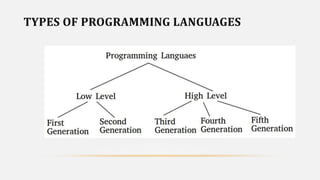
TYPES OF PROGRAMMING LANGUAGES
A third-generation programming language (3GL) is a programming language that is machine-
independent. Programs written in a 3GL can be compiled to run on many different devices.
Compare this to a first-generation programming language (machine code), or a second-
generation programming language (assembly language). In those languages, the program is
written specifically for a certain type of CPU and instruction set.
WHAT IS THIRD-GENERATION PROGRAMMING LANGUAGE ?
3GLs first appeared in the 1950s with the development of FORTRAN, ALGOL, and COBOL.
These languages are considered "high-level," even though they are a much lower-level than
modern high-level programming languages such as C++, Ruby, and JavaScript.
FIRST APPEARANCE OF 3GL
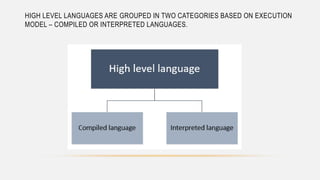
HIGH LEVEL LANGUAGES ARE GROUPED IN TWO CATEGORIES BASED ON EXECUTION
MODEL – COMPILED OR INTERPRETED LANGUAGES.
1. Step-by-step statements
2. Refraining programmers from high-level
3. Abstraction of problems
4. Burdening the productivity of programmers
5. Cannot communicate directly with the
hardware.
1. It is easy to develop, learn and understand
the program.
2. As the program written in these languages is
less prone to errors they are easy to
maintain.
3. The program written in these languages can
be developed in very less time as compared
to the first and second generation language.
THE ADVANTAGES AND DISADVANTAGES
advantages Drawbacks
EXAMPLES OF HIGH-LEVEL LANGUAGE
• ADA
• C
• C++
• JAVA
• BASIC
• COBOL
• PASCAL
• PYTHON
THE FOURTH-GENERATION LANGUAGES
4GL, are languages that consist of statements similar to statements in a human language. Fourth
generation languages are commonly used in database programming and scripts examples include Perl,
PHP, Python, Ruby, and SQL.
A non-procedural programming language that requires less coding than lower-level languages. Command-
line languages that come with operating systems and database management systems (DBMSs) are fourth-
generation languages (4GLs), as are query languages and report writers. Any language with English-like
commands that does not require traditional input-process-output logic falls into this category.
FEATURES OF FOURTH GENERATION COMPUTERS
• Features of fourth generation computer areas follows:
• This generation of computer used Large Scale Integration(L.S.I.) and Very Large Scale
Integration(V.L.S.I.).
• The storage capacity was very much increased.
• This generation computers were very user friendly.
• Input-Output devices were versatile.
• Processing speed was 1 billion instruction per second.
• Comparatively smaller in size and greater reliability.
WHY 4GL?
They can be easily learnt since there are relatively few commands
Function and structures .
• The cost of software development
• Alter and maintain
• Ease of use
• Simplicity of design and implement
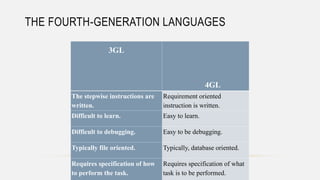
THE FOURTH-GENERATION LANGUAGES
3GL
4GL
The stepwise instructions are
written.
Requirement oriented
instruction is written.
Difficult to learn. Easy to learn.
Difficult to debugging. Easy to be debugging.
Typically file oriented. Typically, database oriented.
Requires specification of how
to perform the task.
Requires specification of what
task is to be performed.
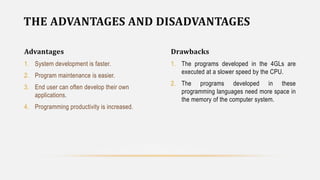
1. The programs developed in the 4GLs are
executed at a slower speed by the CPU.
2. The programs developed in these
programming languages need more space in
the memory of the computer system.
1. System development is faster.
2. Program maintenance is easier.
3. End user can often develop their own
applications.
4. Programming productivity is increased.
THE ADVANTAGES AND DISADVANTAGES
Advantages Drawbacks
Third and fourth generation programming language

Third and fourth generation programming language

  • 1.
  • 2.
    A computer isa computational device which is used to process the data under the control of a computer program. Program is a sequence of instruction along with data. While executing the program, raw data is processed into a desired output format. These computer programs are written in a programming language which are high level languages. High level languages are nearly human languages which are more easy then INTRODUCTION
  • 3.
  • 4.
    A third-generation programminglanguage (3GL) is a programming language that is machine- independent. Programs written in a 3GL can be compiled to run on many different devices. Compare this to a first-generation programming language (machine code), or a second- generation programming language (assembly language). In those languages, the program is written specifically for a certain type of CPU and instruction set. WHAT IS THIRD-GENERATION PROGRAMMING LANGUAGE ?
  • 5.
    3GLs first appearedin the 1950s with the development of FORTRAN, ALGOL, and COBOL. These languages are considered "high-level," even though they are a much lower-level than modern high-level programming languages such as C++, Ruby, and JavaScript. FIRST APPEARANCE OF 3GL
  • 6.
    HIGH LEVEL LANGUAGESARE GROUPED IN TWO CATEGORIES BASED ON EXECUTION MODEL – COMPILED OR INTERPRETED LANGUAGES.
  • 7.
    1. Step-by-step statements 2.Refraining programmers from high-level 3. Abstraction of problems 4. Burdening the productivity of programmers 5. Cannot communicate directly with the hardware. 1. It is easy to develop, learn and understand the program. 2. As the program written in these languages is less prone to errors they are easy to maintain. 3. The program written in these languages can be developed in very less time as compared to the first and second generation language. THE ADVANTAGES AND DISADVANTAGES advantages Drawbacks
  • 8.
    EXAMPLES OF HIGH-LEVELLANGUAGE • ADA • C • C++ • JAVA • BASIC • COBOL • PASCAL • PYTHON
  • 9.
    THE FOURTH-GENERATION LANGUAGES 4GL,are languages that consist of statements similar to statements in a human language. Fourth generation languages are commonly used in database programming and scripts examples include Perl, PHP, Python, Ruby, and SQL. A non-procedural programming language that requires less coding than lower-level languages. Command- line languages that come with operating systems and database management systems (DBMSs) are fourth- generation languages (4GLs), as are query languages and report writers. Any language with English-like commands that does not require traditional input-process-output logic falls into this category.
  • 10.
    FEATURES OF FOURTHGENERATION COMPUTERS • Features of fourth generation computer areas follows: • This generation of computer used Large Scale Integration(L.S.I.) and Very Large Scale Integration(V.L.S.I.). • The storage capacity was very much increased. • This generation computers were very user friendly. • Input-Output devices were versatile. • Processing speed was 1 billion instruction per second. • Comparatively smaller in size and greater reliability.
  • 11.
    WHY 4GL? They canbe easily learnt since there are relatively few commands Function and structures . • The cost of software development • Alter and maintain • Ease of use • Simplicity of design and implement
  • 12.
    THE FOURTH-GENERATION LANGUAGES 3GL 4GL Thestepwise instructions are written. Requirement oriented instruction is written. Difficult to learn. Easy to learn. Difficult to debugging. Easy to be debugging. Typically file oriented. Typically, database oriented. Requires specification of how to perform the task. Requires specification of what task is to be performed.
  • 13.
    1. The programsdeveloped in the 4GLs are executed at a slower speed by the CPU. 2. The programs developed in these programming languages need more space in the memory of the computer system. 1. System development is faster. 2. Program maintenance is easier. 3. End user can often develop their own applications. 4. Programming productivity is increased. THE ADVANTAGES AND DISADVANTAGES Advantages Drawbacks