COMPUTER
NETWORKING
Types of Networks: LAN, MAN, WAN
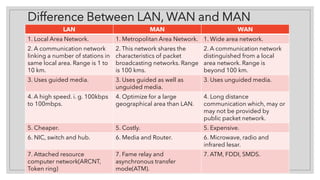
Difference Between LAN, WAN and MAN
LAN MAN WAN
1. Local Area Network. 1. Metropolitan Area Network. 1. Wide area network.
2. A communication network
linking a number of stations in
same local area. Range is 1 to
10 km.
2. This network shares the
characteristics of packet
broadcasting networks. Range
is 100 kms.
2. A communication network
distinguished from a local
area network. Range is
beyond 100 km.
3. Uses guided media. 3. Uses guided as well as
unguided media.
3. Uses unguided media.
4. A high speed. i. g. 100kbps
to 100mbps.
4. Optimize for a large
geographical area than LAN.
4. Long distance
communication which, may or
may not be provided by
public packet network.
5. Cheaper. 5. Costly. 5. Expensive.
6. NIC, switch and hub. 6. Media and Router. 6. Microwave, radio and
infrared lesar.
7. Attached resource
computer network(ARCNT,
Token ring)
7. Fame relay and
asynchronous transfer
mode(ATM).
7. ATM, FDDI, SMDS.

Computer networking - lan. man and wan

  • 1.
  • 2.
    Difference Between LAN,WAN and MAN LAN MAN WAN 1. Local Area Network. 1. Metropolitan Area Network. 1. Wide area network. 2. A communication network linking a number of stations in same local area. Range is 1 to 10 km. 2. This network shares the characteristics of packet broadcasting networks. Range is 100 kms. 2. A communication network distinguished from a local area network. Range is beyond 100 km. 3. Uses guided media. 3. Uses guided as well as unguided media. 3. Uses unguided media. 4. A high speed. i. g. 100kbps to 100mbps. 4. Optimize for a large geographical area than LAN. 4. Long distance communication which, may or may not be provided by public packet network. 5. Cheaper. 5. Costly. 5. Expensive. 6. NIC, switch and hub. 6. Media and Router. 6. Microwave, radio and infrared lesar. 7. Attached resource computer network(ARCNT, Token ring) 7. Fame relay and asynchronous transfer mode(ATM). 7. ATM, FDDI, SMDS.