


This document provides information about various computer hardware components in 3-4 sentences each. It discusses monitors, keyboards, mice, the central processing unit (CPU), speakers, and concludes by thanking the reader for learning.
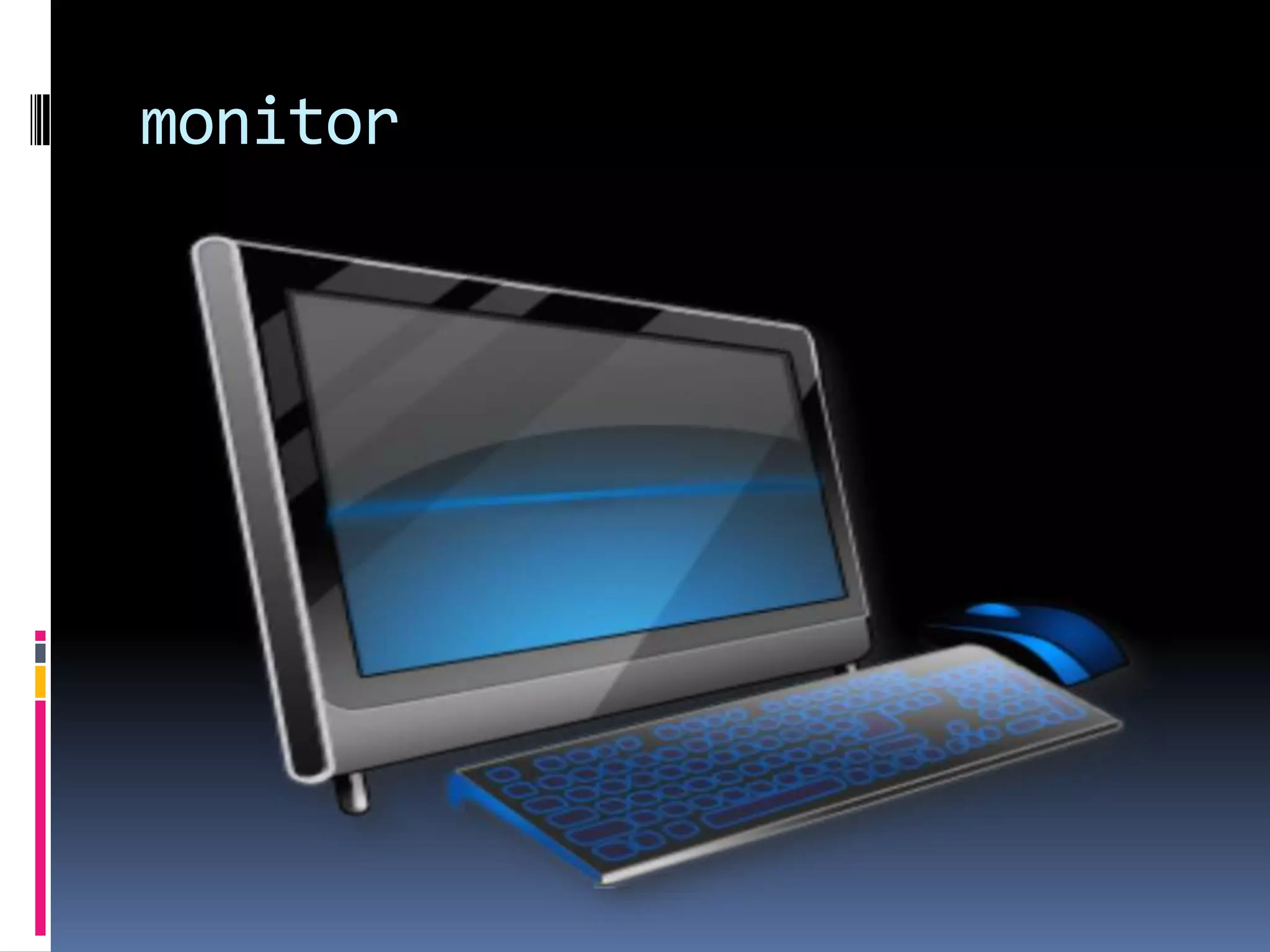
monitorA monitor ordisplay (sometimes called a visual display unit) is a piece of electrical equipment which displays images generated by devices such as computers, without producing a permanent record. The monitor comprises the actual display device, circuitry, and an enclosure. The display device in modern monitors is typically a thin film transistor liquid crystal display (TFT-LCD), while older monitors use a cathode ray tube (CRT)
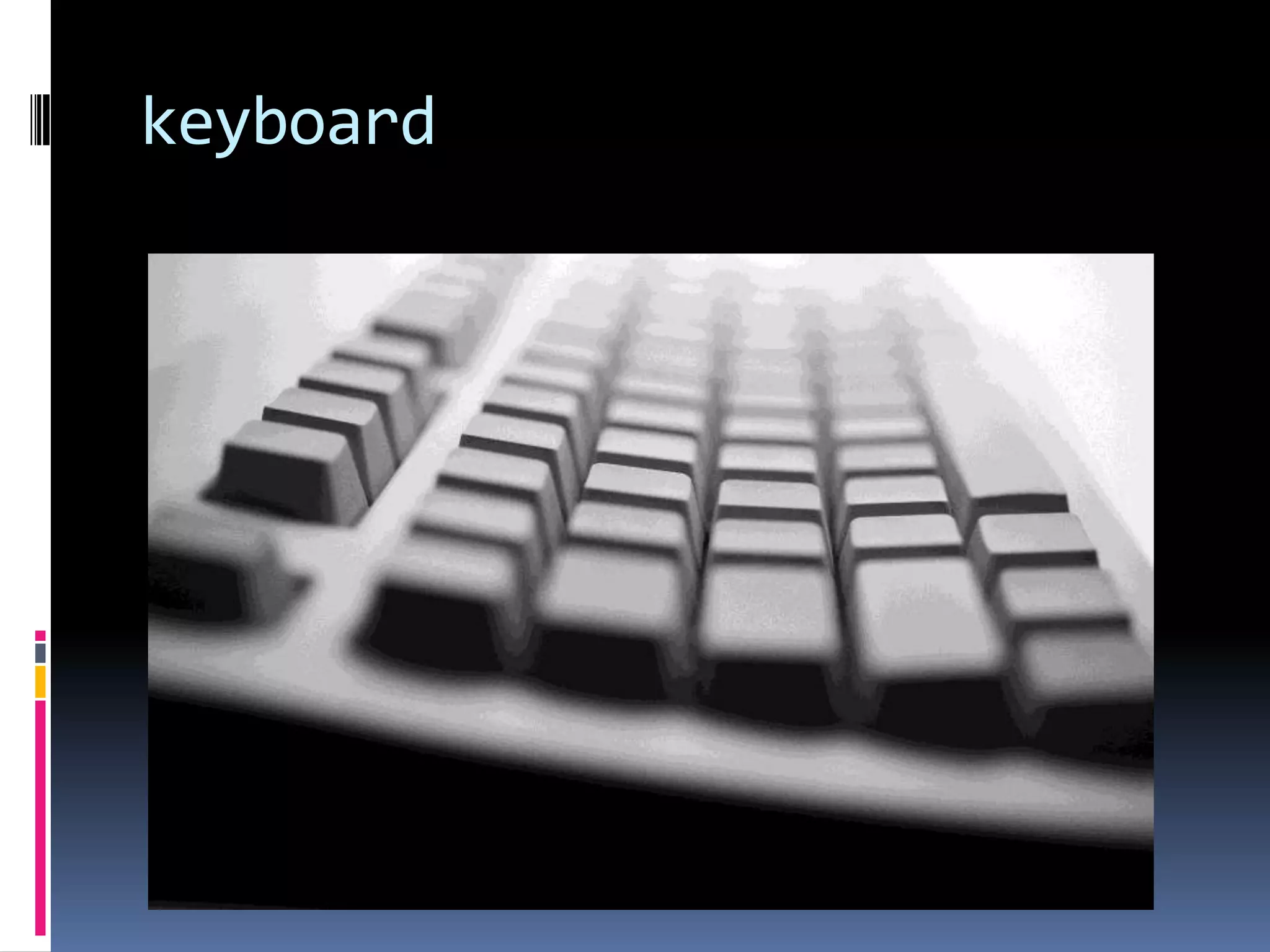
keyboardIn computing, akeyboard is an input device, partially modeled after the typewriter keyboard, which uses an arrangement of buttons or keys, which act as mechanical levers or electronic switches. A keyboard typically has characters engraved or printed on the keys and each press of a key typically corresponds to a single written symbol. However, to produce some symbols requires pressing and holding several keys simultaneously or in sequence. While most keyboard keys produce letters, numbers or signs (characters), other keys or simultaneous key presses can produce actions or computer commands.In normal usage, the keyboard is used to type text and numbers into a word processor, text editor or other program. In a modern computer, the interpretation of keypresses is generally left to the software. A computer keyboard distinguishes each physical key from every other and reports all keypresses to the controlling software. Keyboards are also used for computer gaming, either with regular keyboards or by using keyboards with special gaming features, which can expedite frequently used keystroke combinations. A keyboard is also used to give commands to the operating system of a computer, such as Windows' Control-Alt-Delete combination, which brings up a task window or shuts down the machine.
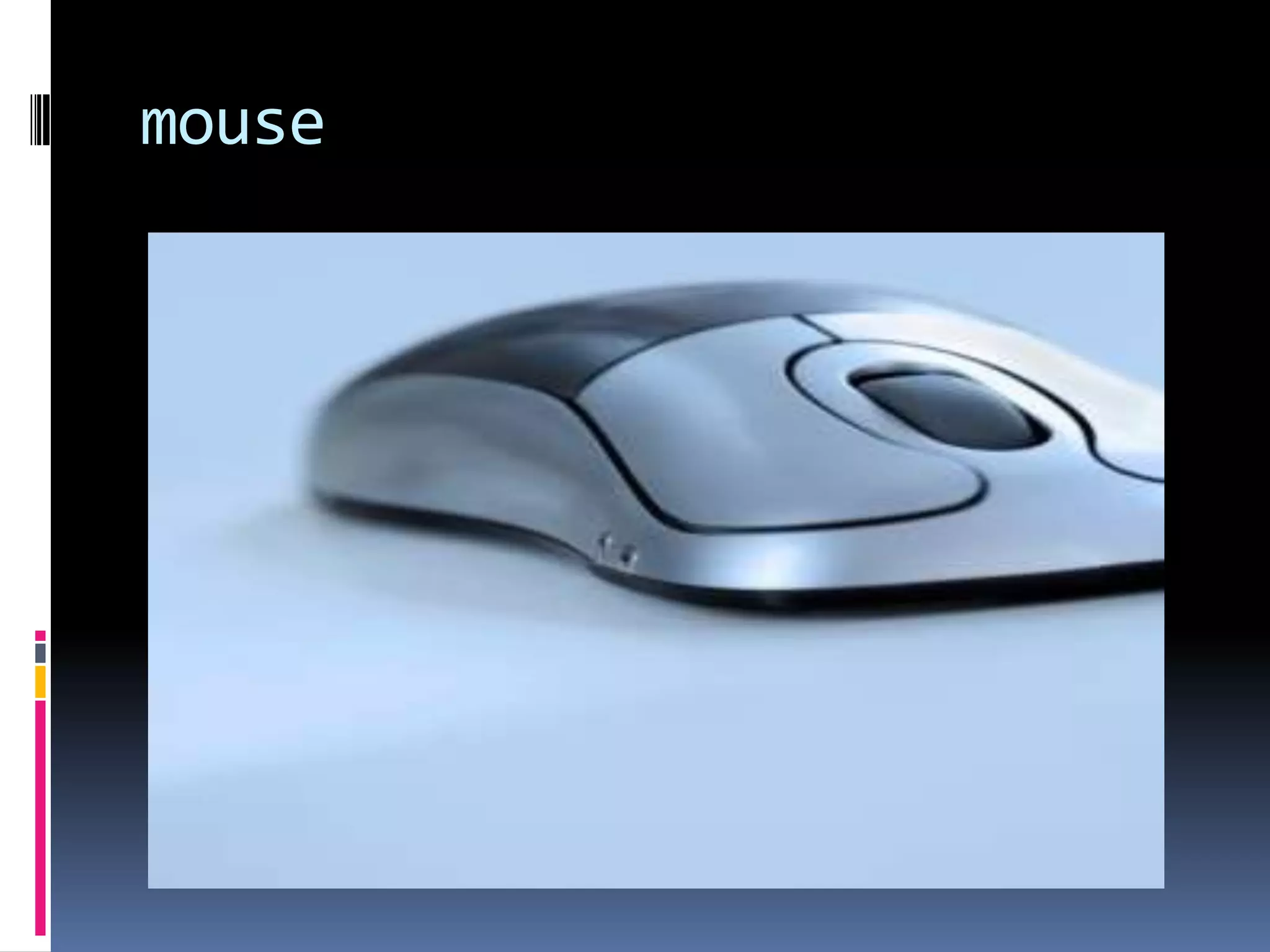
mouseIn computing, amouse (plural mouses, mice, or mouse devices) is a pointing device that functions by detecting two-dimensional motion relative to its supporting surface. Physically, a mouse consists of an object held under one of the user's hands, with one or more buttons. It sometimes features other elements, such as "wheels", which allow the user to perform various system-dependent operations, or extra buttons or features can add more control or dimensional input. The mouse's motion typically translates into the motion of a pointer on a display, which allows for fine control of a Graphical User Interface.The name mouse, originated at the Stanford Research Institute, derives from the resemblance of early models (which had a cord attached to the rear part of the device, suggesting the idea of a tail) to the common mouse.[1]The first marketed integrated mouse – shipped as a part of a computer and intended for personal computer navigation – came with the Xerox 8010 Star Information System in 1981. However, the mouse remained relatively obscure until the appearance of the Apple Macintosh; in 1984 a prominent PC columnist commented the release of this new computer with a mouse: “There is no evidence that people want to use these things.”[2]A mouse now comes with most computers and many other varieties can be bought separately
11.
CPU orcentral processing unitCPU or central processing unit
CPU or centralprocessing unitA central processing unit (CPU) or processor is an electronic circuit that can execute computer programs. This topic has been in use in the computer industry at least since the early 1960s (Weik 1961). The form, design and implementation of CPUs have changed dramatically since the earliest examples, but their fundamental operation has remained much the same.Early CPUs were custom-designed as a part of a larger, sometimes one-of-a-kind, computer. However, this costly method of designing custom CPUs for a particular application has largely given way to the development of mass-produced processors that are made for one or many purposes. This standardization trend generally began in the era of discrete transistormainframes and minicomputers and has rapidly accelerated with the popularization of the integrated circuit (IC). The IC has allowed increasingly complex CPUs to be designed and manufactured to tolerances on the order of nanometers. Both the miniaturization and standardization of CPUs have increased the presence of these digital devices in modern life far beyond the limited application of dedicated computing machines. Modern microprocessors appear in everything from automobiles to cell phones to children's toys.
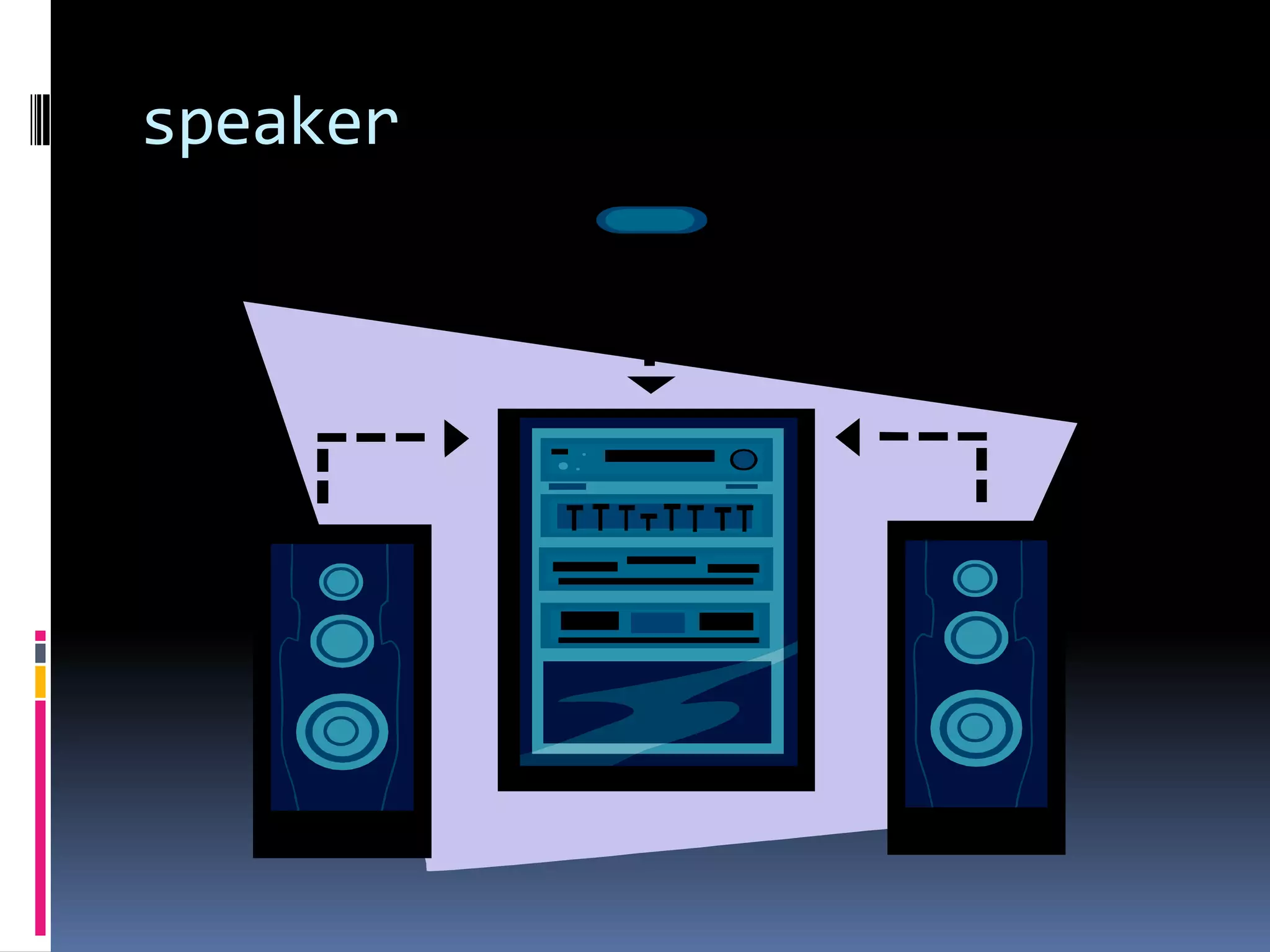
speakerComputer speakers, ormultimedia speakers, are external speakers, commonly equipped with a low-power internal amplifier. The standard audio connection is a 3.5mm (1/8 inch) stereo jack plug often colour-coded lime green (following the PC 99 standard) for computer sound cards. A plug and socket for a two-wire (signal and ground) coaxial cable that is widely used to connect analog audio and video components. Also called a "phono connector," rows of RCA sockets are found on the backs of stereo amplifiers and numerous A/V products. The prong is 1/8" thick by 5/16" long. A few use an RCA connector for input. There are also USB speakers which are powered from the 5 volts at 200 milliamps provided by the USB port, allowing about half a watt of output power.Computer speakers range widely in quality and in price. The computer speakers typically packaged with computer systems are small plastic boxes with mediocre sound quality. Some of the slightly better computer speakers have equalization features such as bass and treble controls, improving their sound quality somewhat.The internal amplifiers require an external power source, known as a 'wall-wart'. More sophisticated computer speakers may have a 'subwoofer' unit, to enhance bass output, and these units usually include the power amplifiers both for the bass speaker, and the small 'satellite' speakers.Some computer displays have rather basic speakers built-in. Laptops come with integrated speakers. Unfortunately the tight restriction on space inevitable in laptops means these speakers unavoidably produce low-quality sound.For some users, a lead connecting computer sound output to an existing stereo system is practical. This normally yields much better results than small low-cost computer speakers. Computer speakers can also serve as an economy amplifier for MP3 player use for those who wish to not use headphones although some models of computer speakers have headphone jacks of their own.
17.
THAT’S THE ENDOF THE SHOWThank you for watching May you enjoy May you learn some thingcreated by: Ryan ali y. banjal