COMPUTER
GRAPHICS
INTRODUCTION TO
CONTENTS
GENERAL INFORMATION
Computer graphics are pictures and films created
using computers. Usually, the term refers to
computer-generated image data created with help
from specialized graphical hardware and software. It
is a vast and recent area in computer science. It is
often abbreviated as CG, though sometimes
erroneously referred to as computer-generated
imagery (CGI).
GRAPHICS PROGRAMMING
Is a sub-field of computer science which studies methods
for digitally synthesizing and manipulating visual content.
Although the term often refers to the study of three-
dimensional computer graphics, it also encompasses two-
dimensional graphics and image processing.
HELLO!I am Tural Hamidov
I am here because I love computer graphics.
You can find me at @Cherkesgiller
WHAT IS CG?
Computer graphics generally means creation, storage and manipulation
of models and images
Such models come from diverse and expanding set of fields including
physical, biological, mathematical, artistic, and conceptual/abstract
structures
WHAT IS
INTEACTIVE CG?
User controls content, structure, and appearance of objects and their
displayed images via rapid visual feedback
Basic components of an interactive graphics system
 input (e.g., mouse, stylus, multi-touch, in-air fingers…)
 processing (and storage of the underlying representation/model)
 display/output (e.g., screen, paper-based printer,video recorder…)
First truly interactive graphics
system,Sketchpad, pioneered by Ivan
Sutherland 1963 Ph.D. thesis
Sketchpad, A Man-Machine Graphical
Communication System
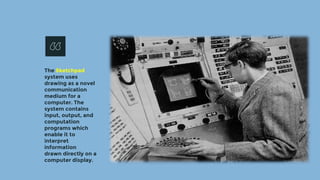
The Sketchpad
system uses
drawing as a novel
communication
medium for a
computer. The
system contains
input, output, and
computation
programs which
enable it to
interpret
information
drawn directly on a
computer display.
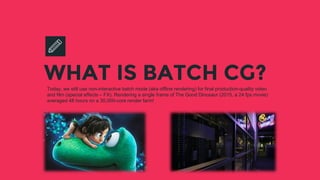
WHAT IS BATCH CG?Today, we still use non-interactive batch mode (aka offline rendering) for final production-quality video
and film (special effects – FX). Rendering a single frame of The Good Dinosaur (2015, a 24 fps movie)
averaged 48 hours on a 30,000-core render farm!
CG
∎ Newest CPUs are 64-bit with 4, 8, 16, even
up to 22 cores
∎ Intel Kaby Lake – consumer processor with 4
cores, 8 threads,and a fully featured graphics
chip built in to the processor
∎ Significant advances in commodity graphics
chips every 6 months vs. several years for
general purpose CPUs
NVIDIA GeForce GTX Titan Xp… 3840 cores,
12GB memory,and 12 teraflops of processing
power in a single chip
MODERN
Enabling Modern
Computer Graphics - 1
NVIDIA GeForce™, AMD Radeon™, and Intel HD and Iris Pro Graphics
GPUs originally designed to handle special-purpose graphics computations
Increasingly, GPUs used to parallelize other types of computation (known as GPGPU, or
General-Purpose Computing on the Graphics Processing Unit)
Enabling Modern
Computer Graphics - 2
• NVIDIA GeForce GTX
1080 Ti (2017)
• 3584 cores, 1.58 GHz clock,
11GB memory, 139 billion
pixels/second fill rate
• NVIDIA GeForce GTX
970 (2014)
• 1664 cores, 1.05 GHz clock,
4GB memory, 75 billion
pixels/second fill rate
• NVIDIA GeForce GTX
460 (2010)
• 336 cores, 1.35 GHz clock,
1GB memory, 37.8 billion
pixels/second fill rate
Enabling Modern
Computer Graphics - 3
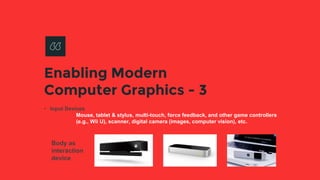
• Input Devices
Mouse, tablet & stylus, multi-touch, force feedback, and other game controllers
(e.g., Wii U), scanner, digital camera (images, computer vision), etc.
Body as
interaction
device
Enabling Modern
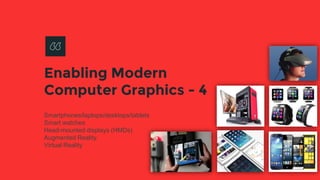
Computer Graphics - 4
Smartphones/laptops/desktops/tablets
Smart watches
Head-mounted displays (HMDs)
Augmented Reality
Virtual Reality
Enabling Modern
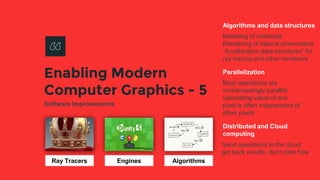
Computer Graphics - 5
Software Improvements
Algorithms and data structures
Modeling of materials
Rendering of natural phenomena
“Acceleration data structures” for
ray tracing and other renderers
Parallelization
Most operations are
embarrassingly parallel:
calculating value of one
pixel is often independent of
other pixels
Distributed and Cloud
computing
Send operations to the cloud,
get back results, don’t care how
Ray Tracers Engines Algorithms
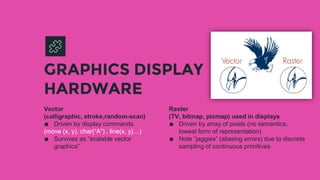
Vector
(calligraphic, stroke,random-scan)
∎ Driven by display commands
(move (x, y), char(“A”) , line(x, y)…)
∎ Survives as “scalable vector
graphics”
GRAPHICS DISPLAY
HARDWARE
Raster
(TV, bitmap, pixmap) used in displays
∎ Driven by array of pixels (no semantics,
lowest form of representation)
∎ Note “jaggies” (aliasing errors) due to discrete
sampling of continuous primitives
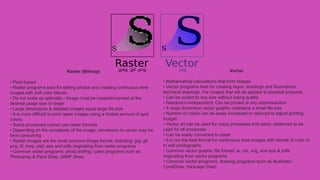
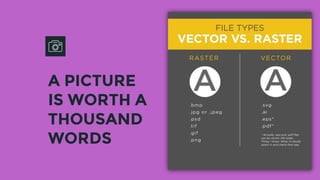
Vector
• Mathematical calculations that form shapes
• Vector programs best for creating logos, drawings and illustrations,
technical drawings. For images that will be applied to physical products.
• Can be scaled to any size without losing quality
• Resolution-independent: Can be printed at any size/resolution
• A large dimension vector graphic maintains a small file size
• Number of colors can be easily increased or reduced to adjust printing
budget
• Vector art can be used for many processes and easily rasterized to be
used for all processes
• Can be easily converted to raster
• It is not the best format for continuous tone images with blends of color or
to edit photographs
• Common vector graphic file format: ai, cdr, svg, and eps & pdfs
originating from vector programs
• Common vector programs: drawing programs such as Illustrator,
CorelDraw, Inkscape (free)
Raster (Bitmap)
• Pixel-based
• Raster programs best for editing photos and creating continuous tone
images with soft color blends
• Do not scale up optimally - Image must be created/scanned at the
desired usage size or larger
• Large dimensions & detailed images equal large file size
• It is more difficult to print raster images using a limited amount of spot
colors
• Some processes cannot use raster formats
• Depending on the complexity of the image, conversion to vector may be
time consuming
• Raster images are the most common image format, including: jpg, gif,
png, tif, bmp, psd, eps and pdfs originating from raster programs
• Common raster programs: photo editing / paint programs such as
Photoshop & Paint Shop, GIMP (free)
A PICTURE
IS WORTH A
THOUSAND
WORDS
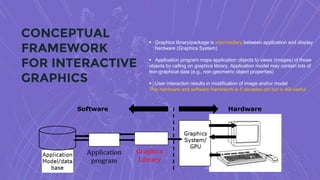
CONCEPTUAL
FRAMEWORK
FOR INTERACTIVE
GRAPHICS
 Graphics library/package is intermediary between application and display
hardware (Graphics System)
 Application program maps application objects to views (images) of those
objects by calling on graphics library. Application model may contain lots of
non-graphical data (e.g., non-geometric object properties)
 User interaction results in modification of image and/or model
This hardware and software framework is 5 decades old but is still useful
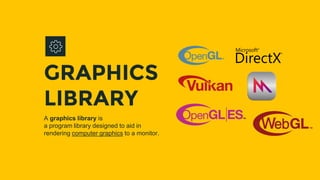
A graphics library is
a program library designed to aid in
rendering computer graphics to a monitor.
GRAPHICS
LIBRARY
THANKS!
Any questions?
You can find me at @Cherkesgiller & cherkesgiller@gmail.com

Kompüter Qrafikasına giriş

  • 1.
  • 2.
    CONTENTS GENERAL INFORMATION Computer graphicsare pictures and films created using computers. Usually, the term refers to computer-generated image data created with help from specialized graphical hardware and software. It is a vast and recent area in computer science. It is often abbreviated as CG, though sometimes erroneously referred to as computer-generated imagery (CGI). GRAPHICS PROGRAMMING Is a sub-field of computer science which studies methods for digitally synthesizing and manipulating visual content. Although the term often refers to the study of three- dimensional computer graphics, it also encompasses two- dimensional graphics and image processing.
  • 3.
    HELLO!I am TuralHamidov I am here because I love computer graphics. You can find me at @Cherkesgiller
  • 4.
    WHAT IS CG? Computergraphics generally means creation, storage and manipulation of models and images Such models come from diverse and expanding set of fields including physical, biological, mathematical, artistic, and conceptual/abstract structures
  • 5.
    WHAT IS INTEACTIVE CG? Usercontrols content, structure, and appearance of objects and their displayed images via rapid visual feedback Basic components of an interactive graphics system  input (e.g., mouse, stylus, multi-touch, in-air fingers…)  processing (and storage of the underlying representation/model)  display/output (e.g., screen, paper-based printer,video recorder…)
  • 6.
    First truly interactivegraphics system,Sketchpad, pioneered by Ivan Sutherland 1963 Ph.D. thesis Sketchpad, A Man-Machine Graphical Communication System
  • 7.
    The Sketchpad system uses drawingas a novel communication medium for a computer. The system contains input, output, and computation programs which enable it to interpret information drawn directly on a computer display.
  • 8.
    WHAT IS BATCHCG?Today, we still use non-interactive batch mode (aka offline rendering) for final production-quality video and film (special effects – FX). Rendering a single frame of The Good Dinosaur (2015, a 24 fps movie) averaged 48 hours on a 30,000-core render farm!
  • 9.
    CG ∎ Newest CPUsare 64-bit with 4, 8, 16, even up to 22 cores ∎ Intel Kaby Lake – consumer processor with 4 cores, 8 threads,and a fully featured graphics chip built in to the processor ∎ Significant advances in commodity graphics chips every 6 months vs. several years for general purpose CPUs NVIDIA GeForce GTX Titan Xp… 3840 cores, 12GB memory,and 12 teraflops of processing power in a single chip MODERN
  • 10.
    Enabling Modern Computer Graphics- 1 NVIDIA GeForce™, AMD Radeon™, and Intel HD and Iris Pro Graphics GPUs originally designed to handle special-purpose graphics computations Increasingly, GPUs used to parallelize other types of computation (known as GPGPU, or General-Purpose Computing on the Graphics Processing Unit)
  • 11.
    Enabling Modern Computer Graphics- 2 • NVIDIA GeForce GTX 1080 Ti (2017) • 3584 cores, 1.58 GHz clock, 11GB memory, 139 billion pixels/second fill rate • NVIDIA GeForce GTX 970 (2014) • 1664 cores, 1.05 GHz clock, 4GB memory, 75 billion pixels/second fill rate • NVIDIA GeForce GTX 460 (2010) • 336 cores, 1.35 GHz clock, 1GB memory, 37.8 billion pixels/second fill rate
  • 12.
    Enabling Modern Computer Graphics- 3 • Input Devices Mouse, tablet & stylus, multi-touch, force feedback, and other game controllers (e.g., Wii U), scanner, digital camera (images, computer vision), etc. Body as interaction device
  • 13.
    Enabling Modern Computer Graphics- 4 Smartphones/laptops/desktops/tablets Smart watches Head-mounted displays (HMDs) Augmented Reality Virtual Reality
  • 14.
    Enabling Modern Computer Graphics- 5 Software Improvements Algorithms and data structures Modeling of materials Rendering of natural phenomena “Acceleration data structures” for ray tracing and other renderers Parallelization Most operations are embarrassingly parallel: calculating value of one pixel is often independent of other pixels Distributed and Cloud computing Send operations to the cloud, get back results, don’t care how Ray Tracers Engines Algorithms
  • 15.
    Vector (calligraphic, stroke,random-scan) ∎ Drivenby display commands (move (x, y), char(“A”) , line(x, y)…) ∎ Survives as “scalable vector graphics” GRAPHICS DISPLAY HARDWARE Raster (TV, bitmap, pixmap) used in displays ∎ Driven by array of pixels (no semantics, lowest form of representation) ∎ Note “jaggies” (aliasing errors) due to discrete sampling of continuous primitives
  • 16.
    Vector • Mathematical calculationsthat form shapes • Vector programs best for creating logos, drawings and illustrations, technical drawings. For images that will be applied to physical products. • Can be scaled to any size without losing quality • Resolution-independent: Can be printed at any size/resolution • A large dimension vector graphic maintains a small file size • Number of colors can be easily increased or reduced to adjust printing budget • Vector art can be used for many processes and easily rasterized to be used for all processes • Can be easily converted to raster • It is not the best format for continuous tone images with blends of color or to edit photographs • Common vector graphic file format: ai, cdr, svg, and eps & pdfs originating from vector programs • Common vector programs: drawing programs such as Illustrator, CorelDraw, Inkscape (free) Raster (Bitmap) • Pixel-based • Raster programs best for editing photos and creating continuous tone images with soft color blends • Do not scale up optimally - Image must be created/scanned at the desired usage size or larger • Large dimensions & detailed images equal large file size • It is more difficult to print raster images using a limited amount of spot colors • Some processes cannot use raster formats • Depending on the complexity of the image, conversion to vector may be time consuming • Raster images are the most common image format, including: jpg, gif, png, tif, bmp, psd, eps and pdfs originating from raster programs • Common raster programs: photo editing / paint programs such as Photoshop & Paint Shop, GIMP (free)
  • 17.
    A PICTURE IS WORTHA THOUSAND WORDS
  • 18.
    CONCEPTUAL FRAMEWORK FOR INTERACTIVE GRAPHICS  Graphicslibrary/package is intermediary between application and display hardware (Graphics System)  Application program maps application objects to views (images) of those objects by calling on graphics library. Application model may contain lots of non-graphical data (e.g., non-geometric object properties)  User interaction results in modification of image and/or model This hardware and software framework is 5 decades old but is still useful
  • 19.
    A graphics libraryis a program library designed to aid in rendering computer graphics to a monitor. GRAPHICS LIBRARY
  • 20.
    THANKS! Any questions? You canfind me at @Cherkesgiller & cherkesgiller@gmail.com