Computational Thinking as an
Emergent Learning Trajectory of
Mathematics
Pia Niemelä, Tiina Partanen, Maarit Harsu,
Leo Leppänen, Petri Ihantola
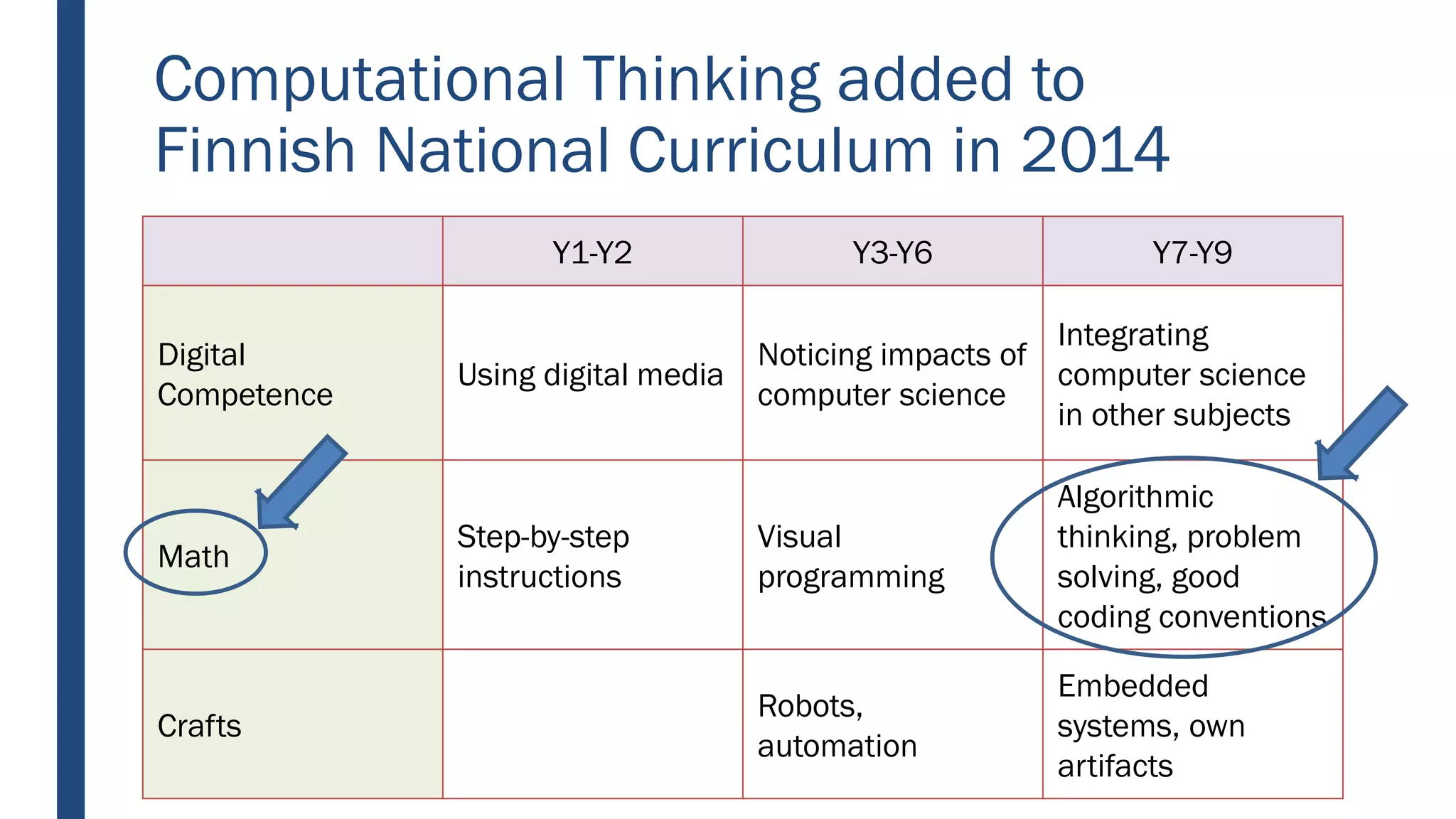
Computational Thinking added to
Finnish National Curriculum in 2014
Y1-Y2 Y3-Y6 Y7-Y9
Digital
Competence
Using digital media
Noticing impacts of
computer science
Integrating
computer science
in other subjects
Math
Step-by-step
instructions
Visual
programming
Algorithmic
thinking, problem
solving, good
coding conventions
Crafts
Robots,
automation
Embedded
systems, own
artifacts
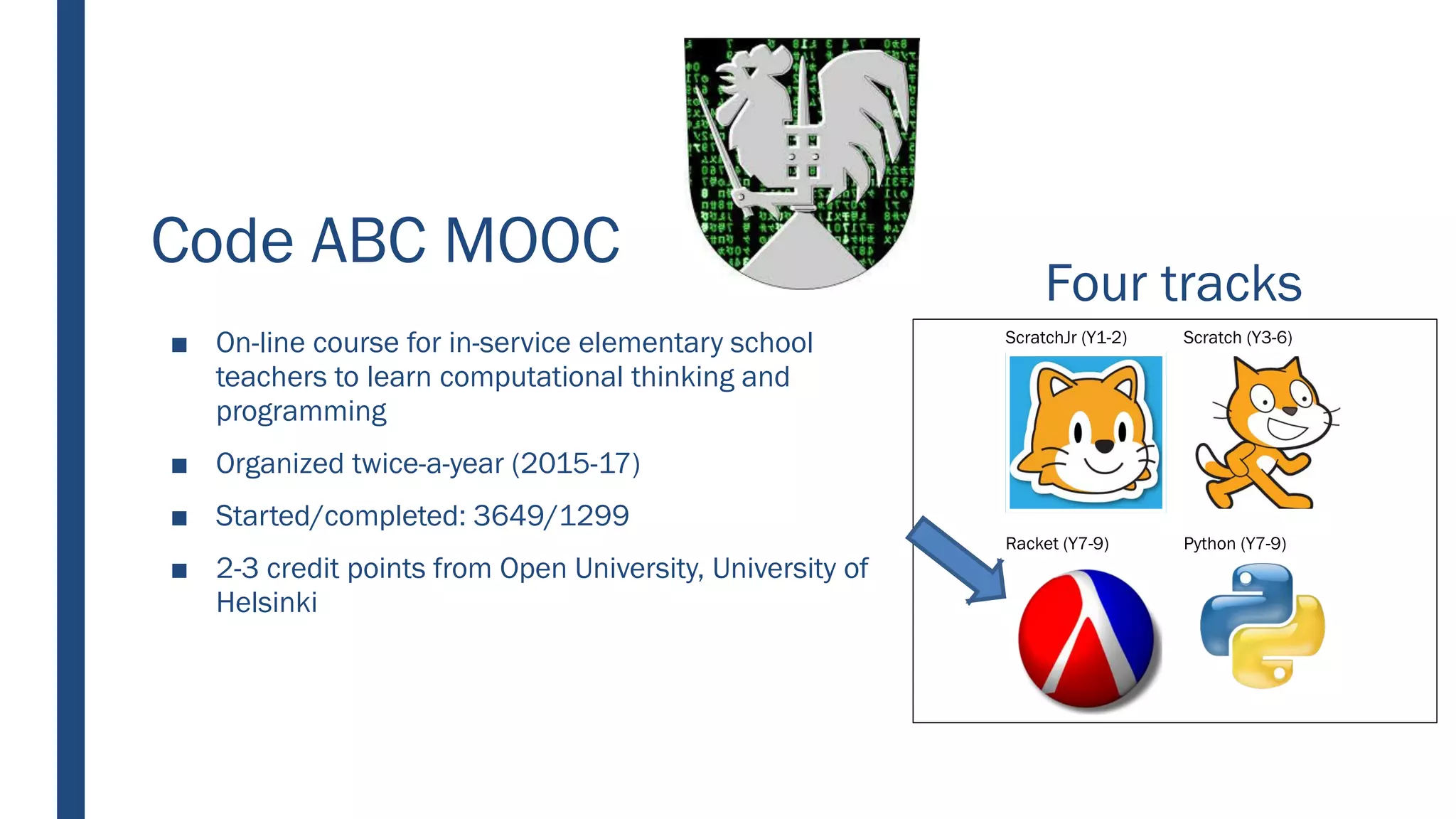
Code ABC MOOC
■ On-line course for in-service elementary school
teachers to learn computational thinking and
programming
■ Organized twice-a-year (2015-17)
■ Started/completed: 3649/1299
■ 2-3 credit points from Open University, University of
Helsinki
ScratchJr (Y1-2) Scratch (Y3-6)
Racket (Y7-9) Python (Y7-9)
Four tracks
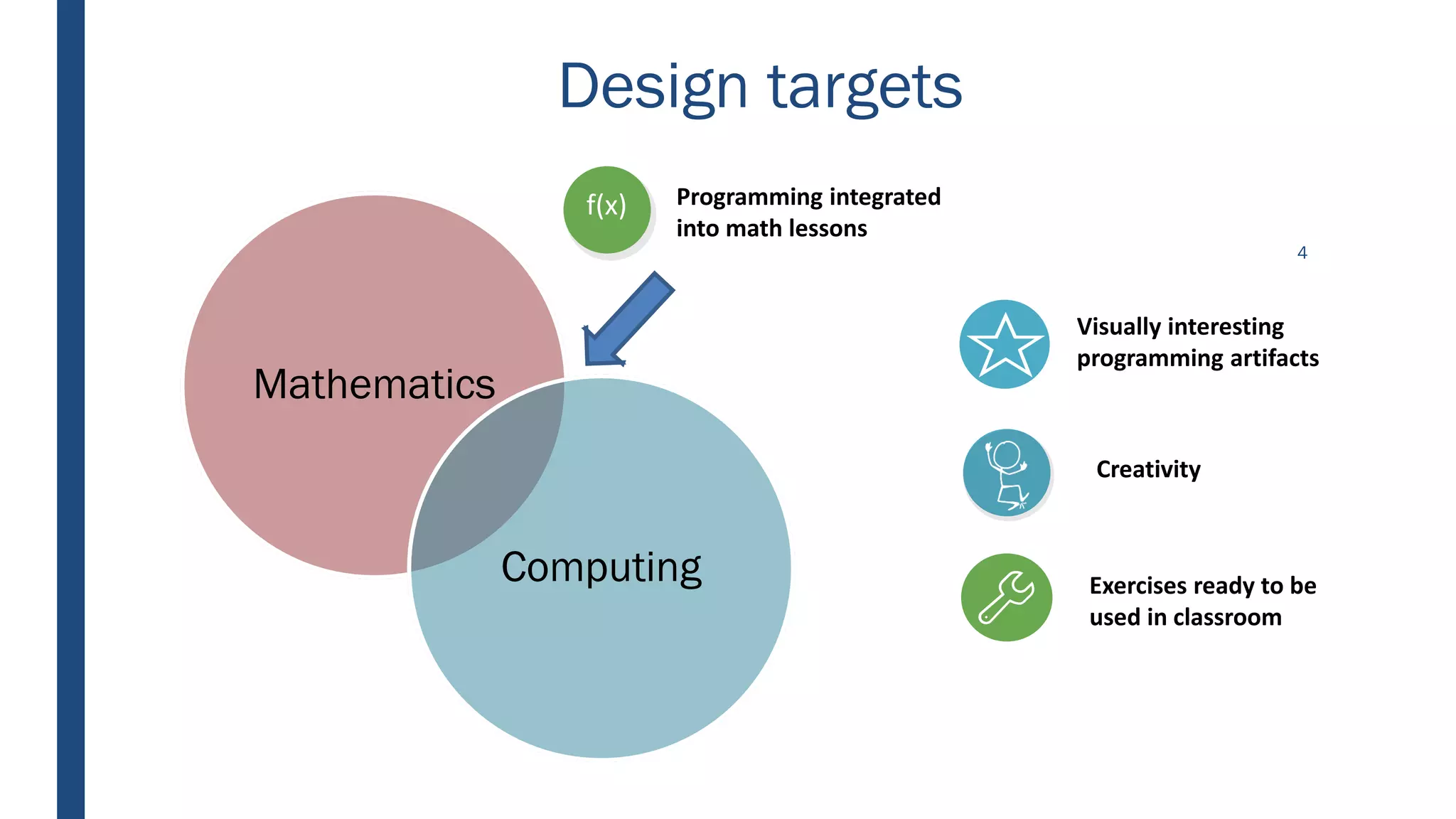
Design targets
4
Visually interesting
programming artifacts
Creativity
Programming integrated
into math lessons
f(x)
Mathematics
Computing Exercises ready to be
used in classroom
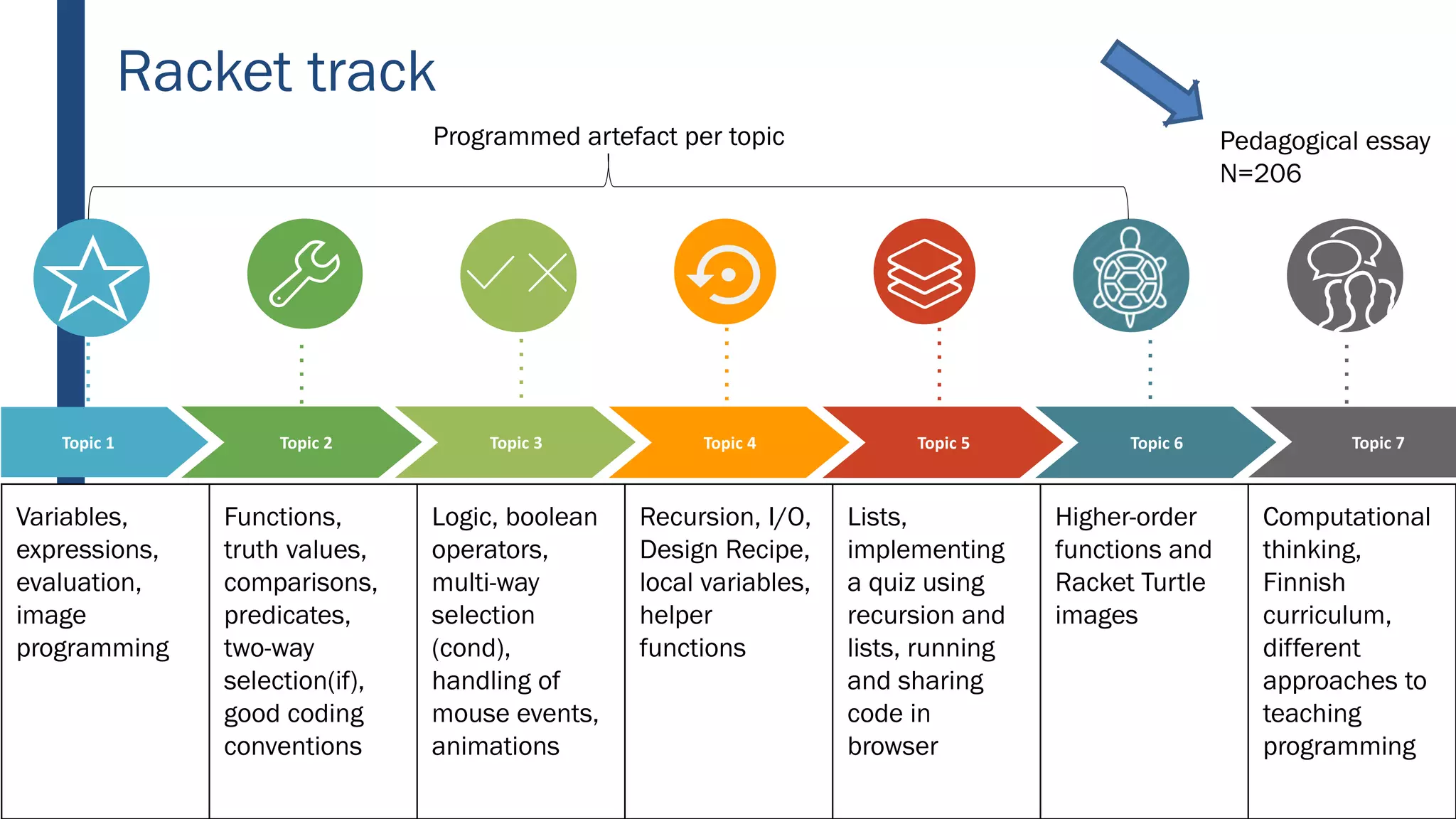
Racket track
Topic 1 Topic 2 Topic 3 Topic 7Topic 4 Topic 5 Topic 6
Variables,
expressions,
evaluation,
image
programming
Functions,
truth values,
comparisons,
predicates,
two-way
selection(if),
good coding
conventions
Logic, boolean
operators,
multi-way
selection
(cond),
handling of
mouse events,
animations
Recursion, I/O,
Design Recipe,
local variables,
helper
functions
Lists,
implementing
a quiz using
recursion and
lists, running
and sharing
code in
browser
Higher-order
functions and
Racket Turtle
images
Computational
thinking,
Finnish
curriculum,
different
approaches to
teaching
programming
Programmed artefact per topic Pedagogical essay
N=206
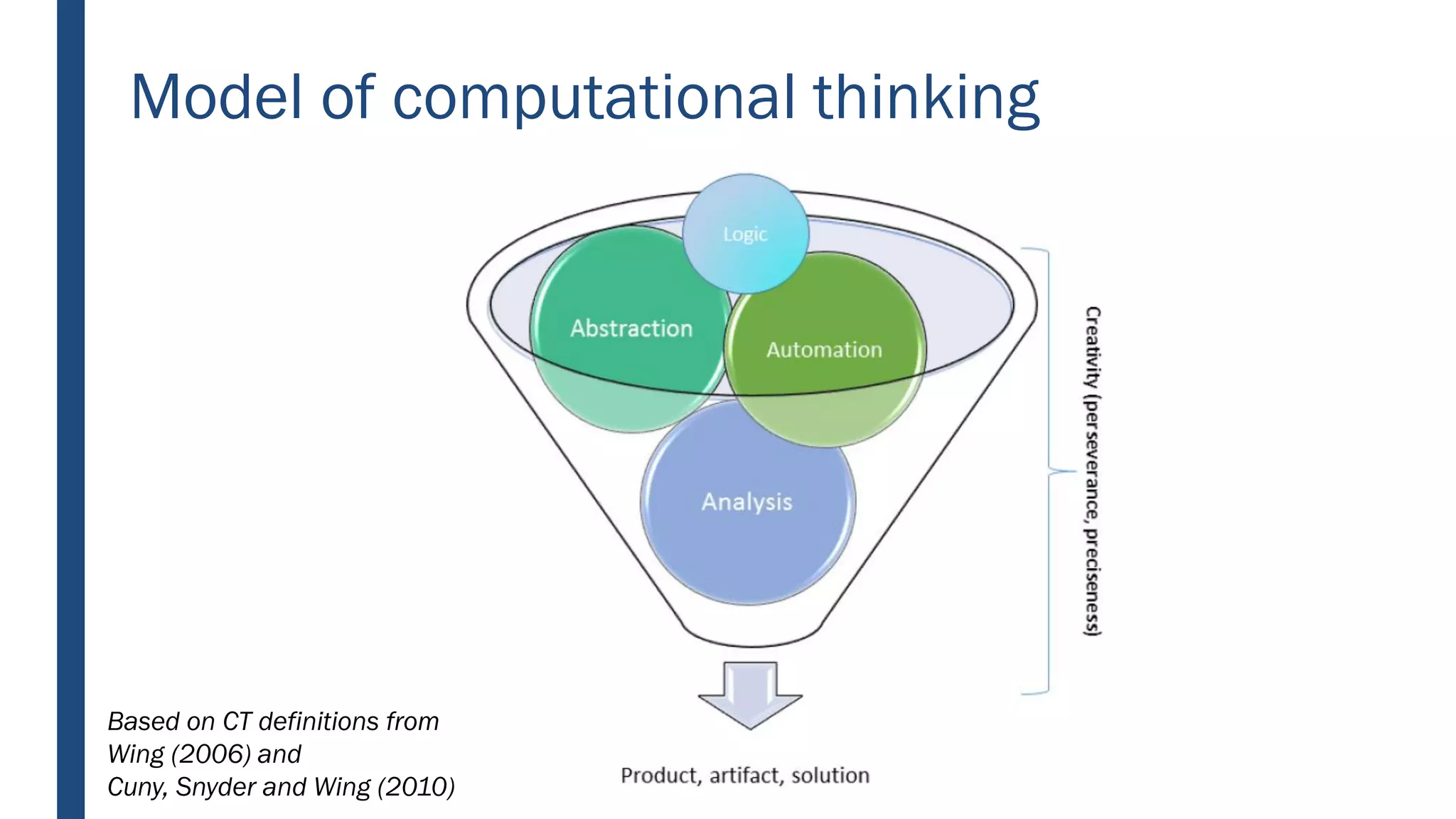
Model of computational thinking
Based on CT definitions from
Wing (2006) and
Cuny, Snyder and Wing (2010)
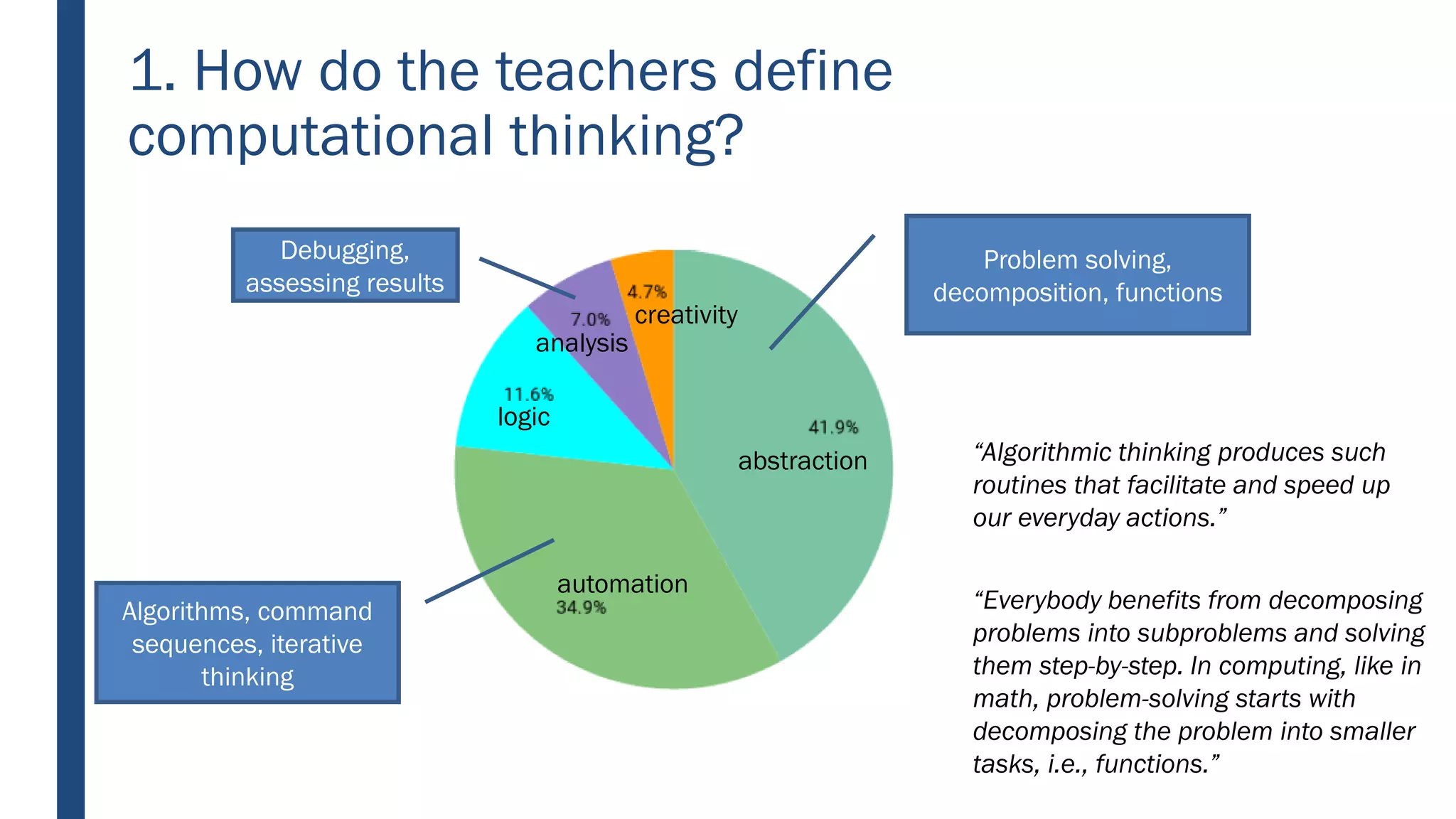
1. How do the teachers define
computational thinking?
abstraction
automation
logic
analysis
creativity
Problem solving,
decomposition, functions
Algorithms, command
sequences, iterative
thinking
Debugging,
assessing results
“Algorithmic thinking produces such
routines that facilitate and speed up
our everyday actions.”
“Everybody benefits from decomposing
problems into subproblems and solving
them step-by-step. In computing, like in
math, problem-solving starts with
decomposing the problem into smaller
tasks, i.e., functions.”
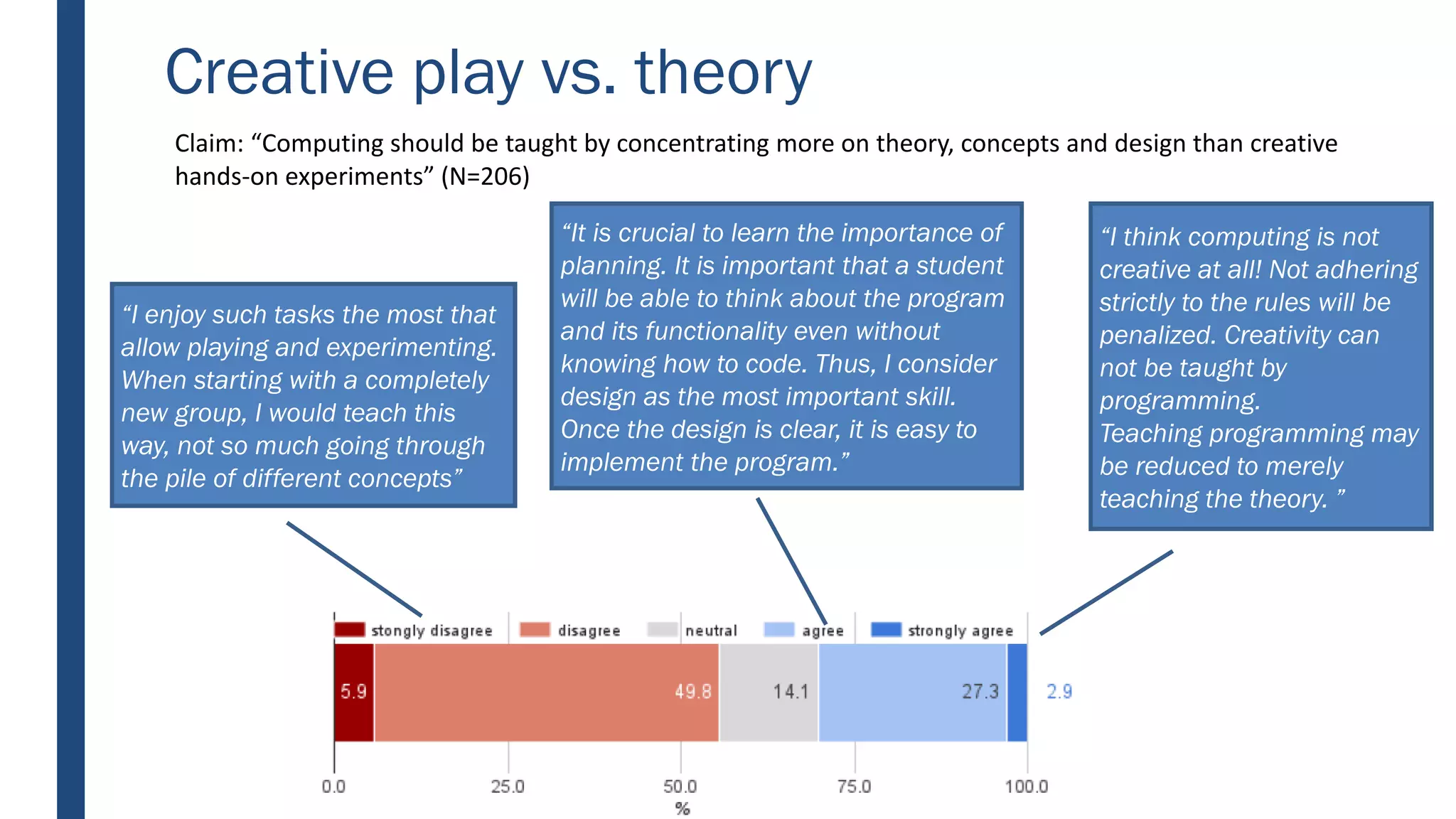
Creative play vs. theory
Claim: “Computing should be taught by concentrating more on theory, concepts and design than creative
hands-on experiments” (N=206)
“I think computing is not
creative at all! Not adhering
strictly to the rules will be
penalized. Creativity can
not be taught by
programming.
Teaching programming may
be reduced to merely
teaching the theory. ”
“It is crucial to learn the importance of
planning. It is important that a student
will be able to think about the program
and its functionality even without
knowing how to code. Thus, I consider
design as the most important skill.
Once the design is clear, it is easy to
implement the program.”
“I enjoy such tasks the most that
allow playing and experimenting.
When starting with a completely
new group, I would teach this
way, not so much going through
the pile of different concepts”
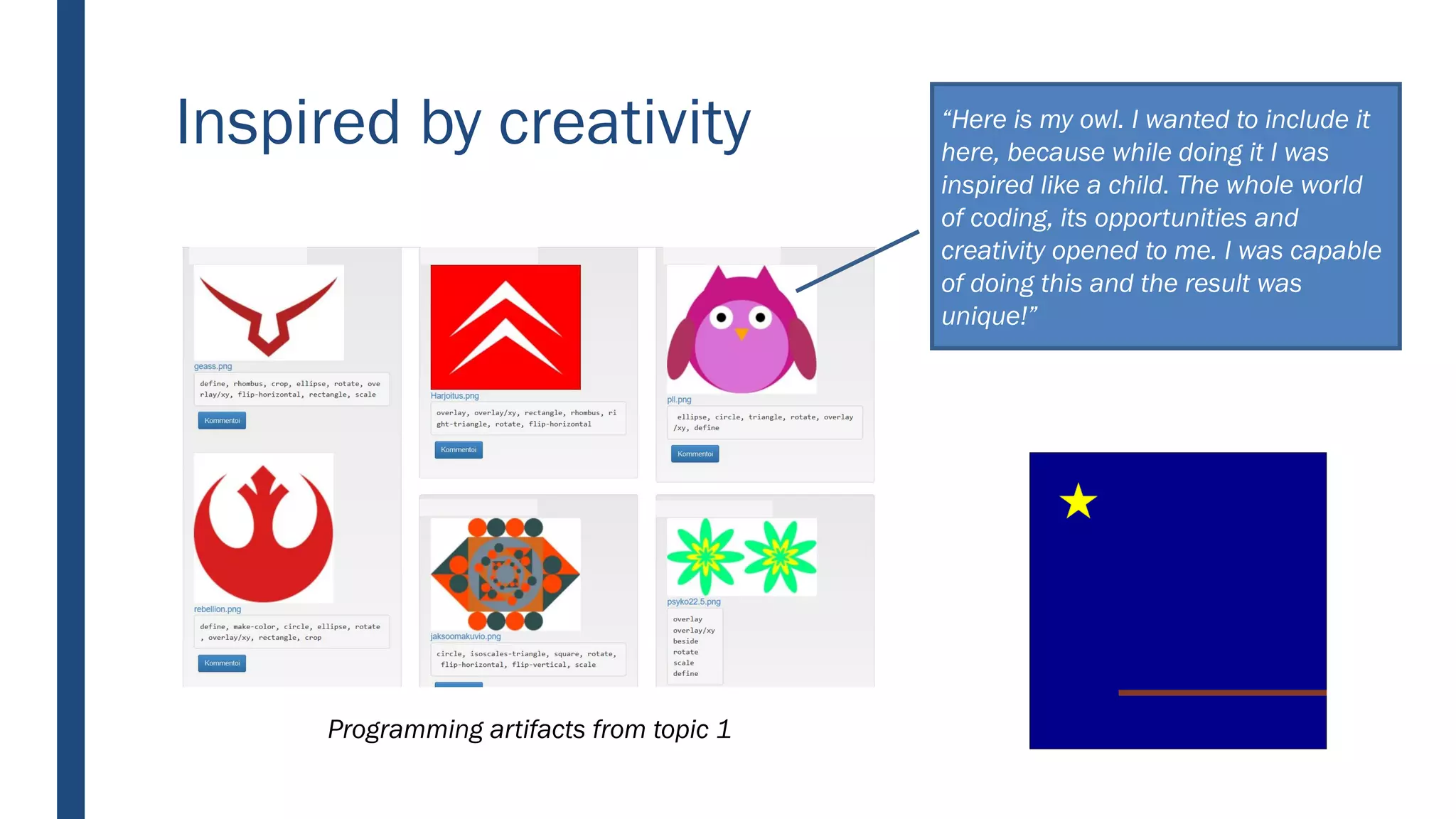
Inspired by creativity
Programming artifacts from topic 1
“Here is my owl. I wanted to include it
here, because while doing it I was
inspired like a child. The whole world
of coding, its opportunities and
creativity opened to me. I was capable
of doing this and the result was
unique!”
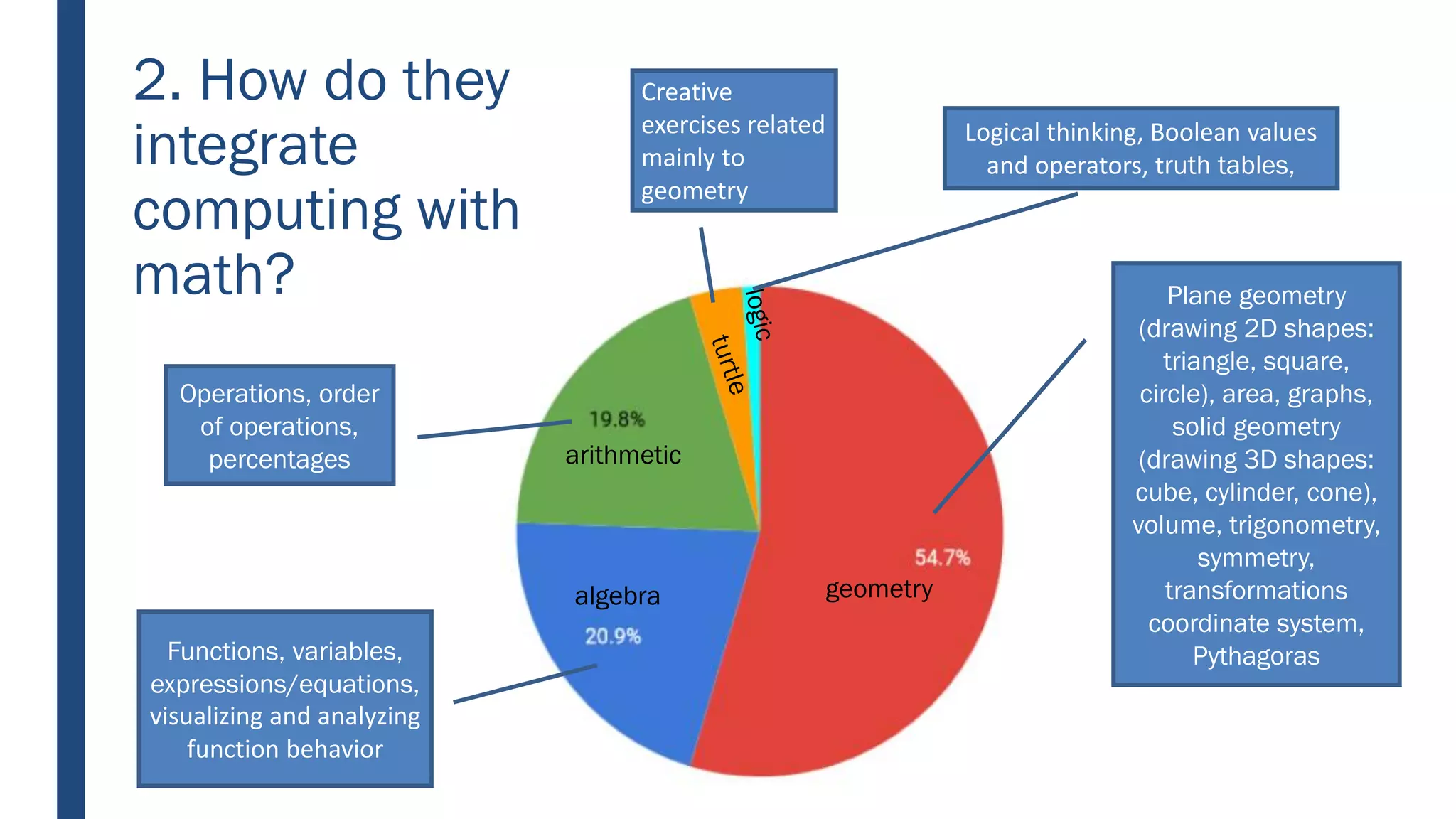
geometryalgebra
arithmetic
2. How do they
integrate
computing with
math? Plane geometry
(drawing 2D shapes:
triangle, square,
circle), area, graphs,
solid geometry
(drawing 3D shapes:
cube, cylinder, cone),
volume, trigonometry,
symmetry,
transformations
coordinate system,
Pythagoras
Operations, order
of operations,
percentages
Functions, variables,
expressions/equations,
visualizing and analyzing
function behavior
Logical thinking, Boolean values
and operators, truth tables,
Creative
exercises related
mainly to
geometry
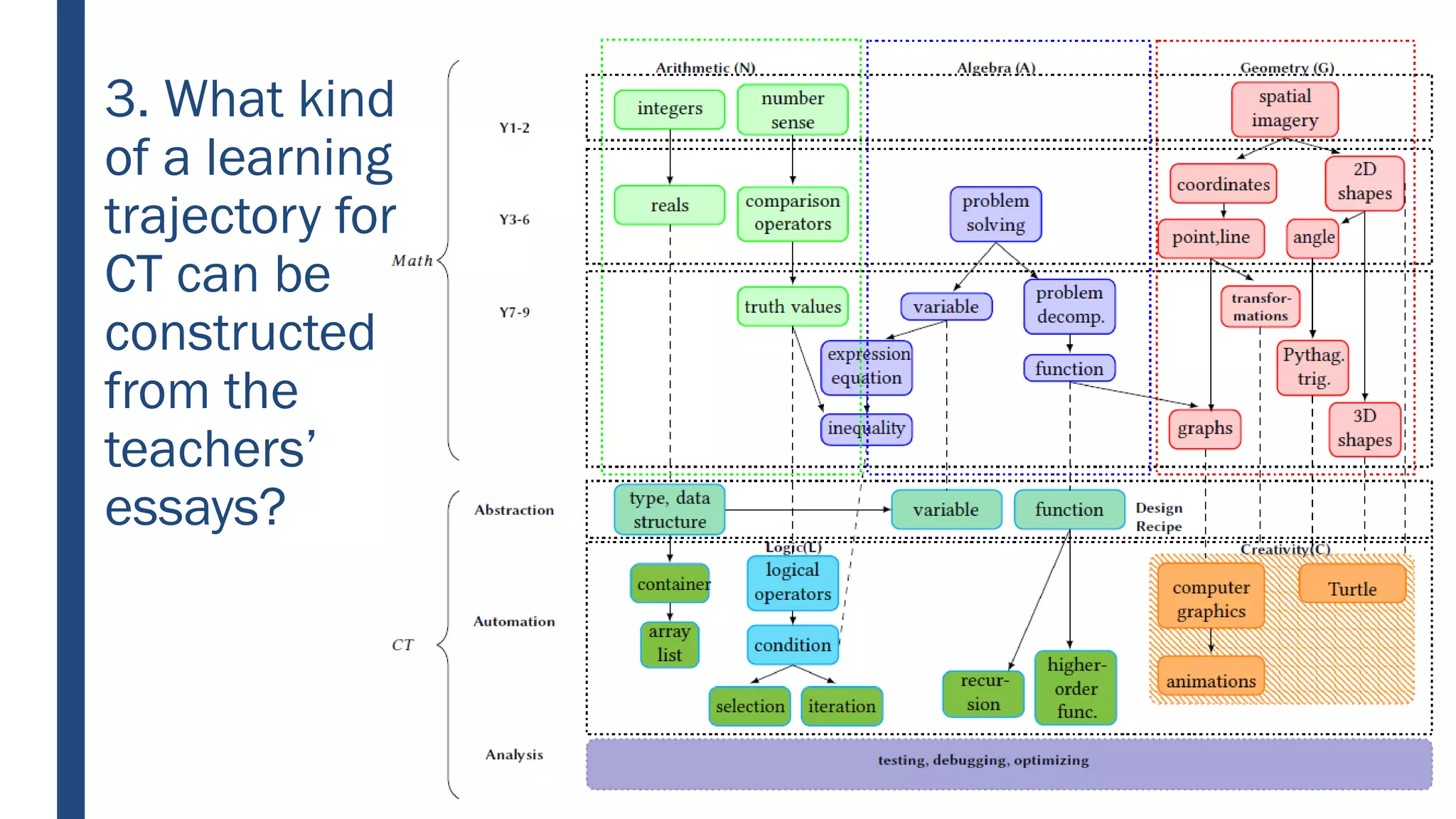
3. What kind
of a learning
trajectory for
CT can be
constructed
from the
teachers’
essays?
Thank you!
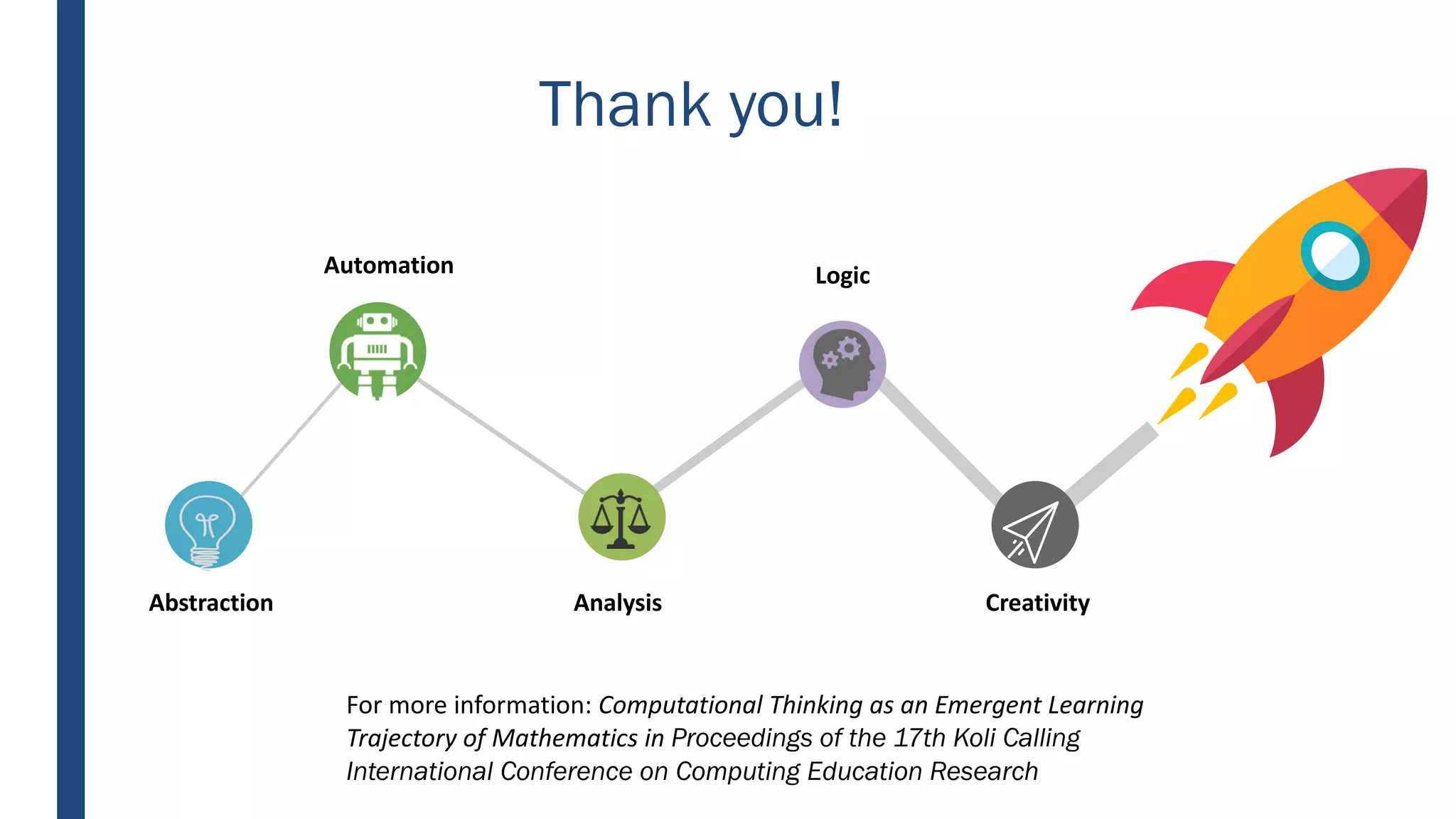
AnalysisAbstraction
Automation Logic
Creativity
For more information: Computational Thinking as an Emergent Learning
Trajectory of Mathematics in Proceedings of the 17th Koli Calling
International Conference on Computing Education Research

Computational Thinking as an Emergent Learning Trajectory of Mathematics

  • 1.
    Computational Thinking asan Emergent Learning Trajectory of Mathematics Pia Niemelä, Tiina Partanen, Maarit Harsu, Leo Leppänen, Petri Ihantola
  • 2.
    Computational Thinking addedto Finnish National Curriculum in 2014 Y1-Y2 Y3-Y6 Y7-Y9 Digital Competence Using digital media Noticing impacts of computer science Integrating computer science in other subjects Math Step-by-step instructions Visual programming Algorithmic thinking, problem solving, good coding conventions Crafts Robots, automation Embedded systems, own artifacts
  • 3.
    Code ABC MOOC ■On-line course for in-service elementary school teachers to learn computational thinking and programming ■ Organized twice-a-year (2015-17) ■ Started/completed: 3649/1299 ■ 2-3 credit points from Open University, University of Helsinki ScratchJr (Y1-2) Scratch (Y3-6) Racket (Y7-9) Python (Y7-9) Four tracks
  • 4.
    Design targets 4 Visually interesting programmingartifacts Creativity Programming integrated into math lessons f(x) Mathematics Computing Exercises ready to be used in classroom
  • 5.
    Racket track Topic 1Topic 2 Topic 3 Topic 7Topic 4 Topic 5 Topic 6 Variables, expressions, evaluation, image programming Functions, truth values, comparisons, predicates, two-way selection(if), good coding conventions Logic, boolean operators, multi-way selection (cond), handling of mouse events, animations Recursion, I/O, Design Recipe, local variables, helper functions Lists, implementing a quiz using recursion and lists, running and sharing code in browser Higher-order functions and Racket Turtle images Computational thinking, Finnish curriculum, different approaches to teaching programming Programmed artefact per topic Pedagogical essay N=206
  • 6.
    Model of computationalthinking Based on CT definitions from Wing (2006) and Cuny, Snyder and Wing (2010)
  • 7.
    1. How dothe teachers define computational thinking? abstraction automation logic analysis creativity Problem solving, decomposition, functions Algorithms, command sequences, iterative thinking Debugging, assessing results “Algorithmic thinking produces such routines that facilitate and speed up our everyday actions.” “Everybody benefits from decomposing problems into subproblems and solving them step-by-step. In computing, like in math, problem-solving starts with decomposing the problem into smaller tasks, i.e., functions.”
  • 8.
    Creative play vs.theory Claim: “Computing should be taught by concentrating more on theory, concepts and design than creative hands-on experiments” (N=206) “I think computing is not creative at all! Not adhering strictly to the rules will be penalized. Creativity can not be taught by programming. Teaching programming may be reduced to merely teaching the theory. ” “It is crucial to learn the importance of planning. It is important that a student will be able to think about the program and its functionality even without knowing how to code. Thus, I consider design as the most important skill. Once the design is clear, it is easy to implement the program.” “I enjoy such tasks the most that allow playing and experimenting. When starting with a completely new group, I would teach this way, not so much going through the pile of different concepts”
  • 9.
    Inspired by creativity Programmingartifacts from topic 1 “Here is my owl. I wanted to include it here, because while doing it I was inspired like a child. The whole world of coding, its opportunities and creativity opened to me. I was capable of doing this and the result was unique!”
  • 10.
    geometryalgebra arithmetic 2. How dothey integrate computing with math? Plane geometry (drawing 2D shapes: triangle, square, circle), area, graphs, solid geometry (drawing 3D shapes: cube, cylinder, cone), volume, trigonometry, symmetry, transformations coordinate system, Pythagoras Operations, order of operations, percentages Functions, variables, expressions/equations, visualizing and analyzing function behavior Logical thinking, Boolean values and operators, truth tables, Creative exercises related mainly to geometry
  • 11.
    3. What kind ofa learning trajectory for CT can be constructed from the teachers’ essays?
  • 12.
    Thank you! AnalysisAbstraction Automation Logic Creativity Formore information: Computational Thinking as an Emergent Learning Trajectory of Mathematics in Proceedings of the 17th Koli Calling International Conference on Computing Education Research