Department of Computer Science / Spatial Economics
The Knowledge Graph for End-to-End
Learning on Heterogeneous Knowledge
Xander Wilcke
w.x.wilcke@vu.nl
19 MAR 2018
Peter Bloem
p.bloem@vu.nl
Victor de Boer
v.de.boer@vu.nl
Xander Wilcke (w.x.wilcke@vu.nl) 2
Our Position
 Expressing heterogeneous knowledge using
knowledge graphs allows us to build true end-
to-end models across domains and tasks
 We should adopt the knowledge graph as the
default data model for machine learning on
heterogeneous knowledge
Xander Wilcke (w.x.wilcke@vu.nl) 3
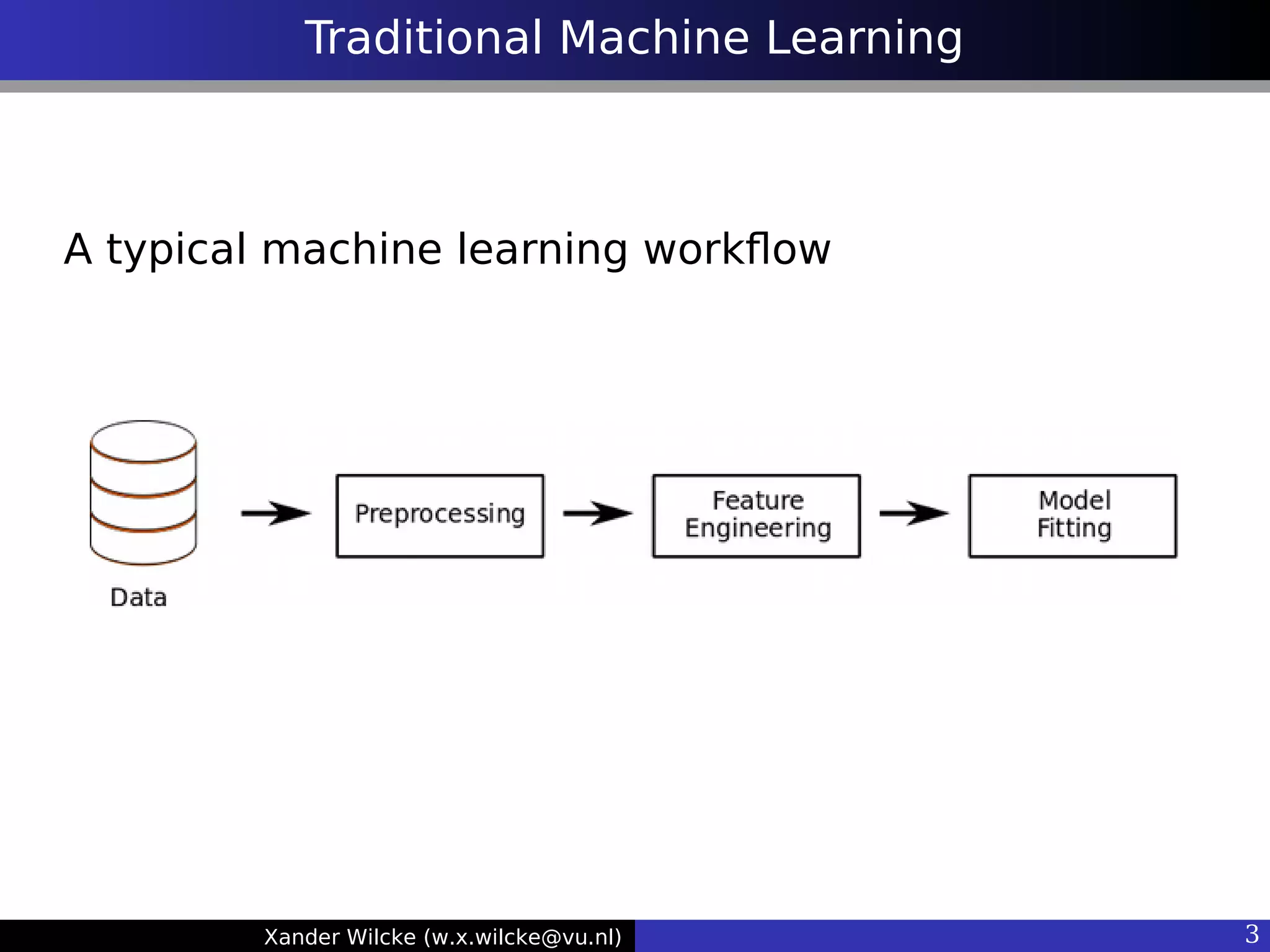
Traditional Machine Learning
A typical machine learning workfow
Xander Wilcke (w.x.wilcke@vu.nl) 4
Traditional Machine Learning
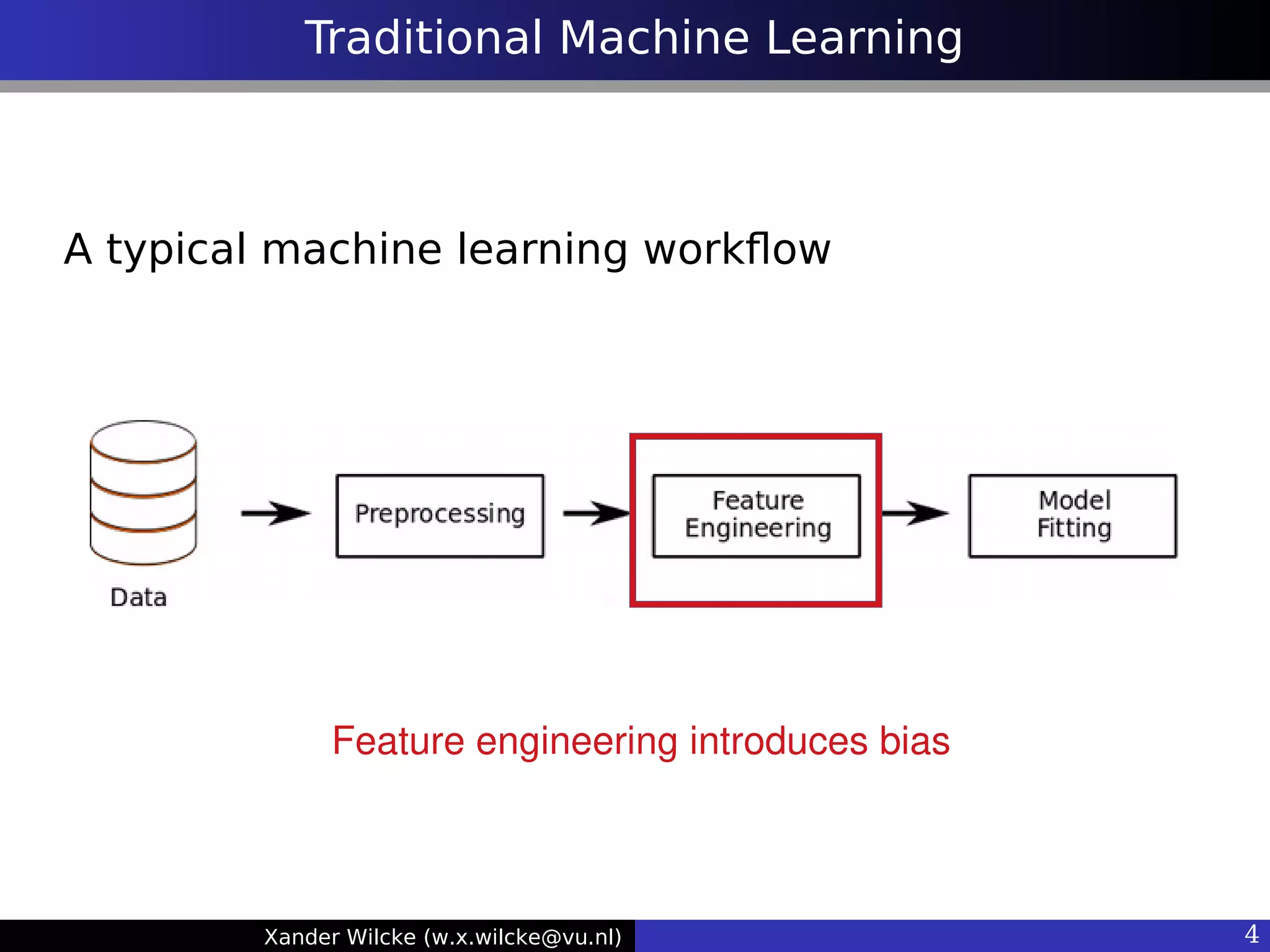
A typical machine learning workfow
Feature engineering introduces bias
Xander Wilcke (w.x.wilcke@vu.nl) 5
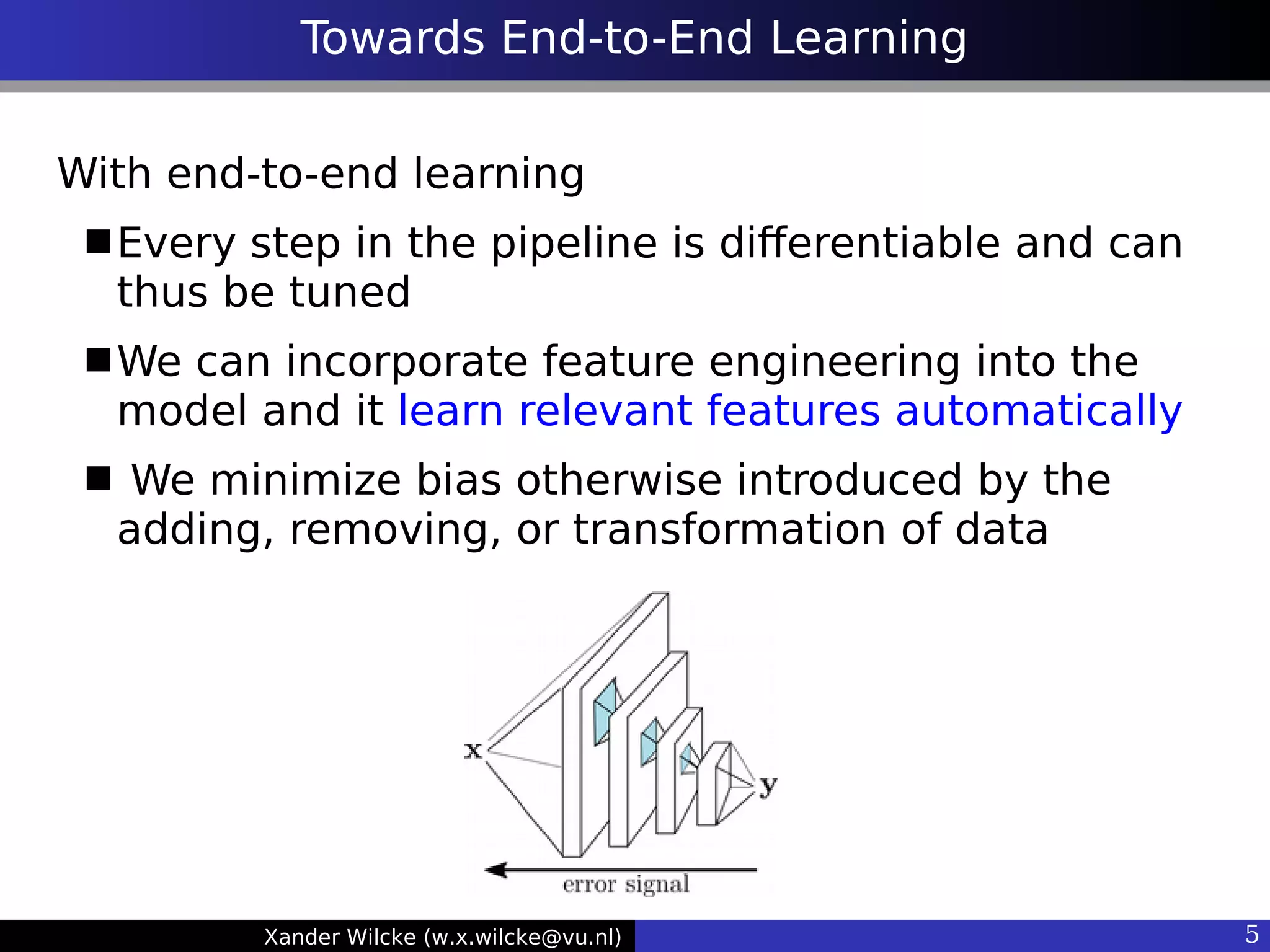
Towards End-to-End Learning
With end-to-end learning
Every step in the pipeline is diferentiable and can
thus be tuned
We can incorporate feature engineering into the
model and it learn relevant features automatically
 We minimize bias otherwise introduced by the
adding, removing, or transformation of data
Xander Wilcke (w.x.wilcke@vu.nl) 6
Towards End-to-End Learning Cont’d
However
Current models only work well for a few specifc
domains; for many other domains we frst need to
create new models
Current models are unsuited for heterogeneous
knowledge
Xander Wilcke (w.x.wilcke@vu.nl) 7
Towards End-to-End Learning Cont’d
However
Current models only work well for a few specifc
domains; for many other domains we frst need to
create new models
Current models are unsuited for heterogeneous
knowledge
Solution
a) adopt the knowledge graph as default data model
for this kind of knowledge, and
b) develop end-to-end models which can directly
consume knowledge graphs
Xander Wilcke (w.x.wilcke@vu.nl) 8
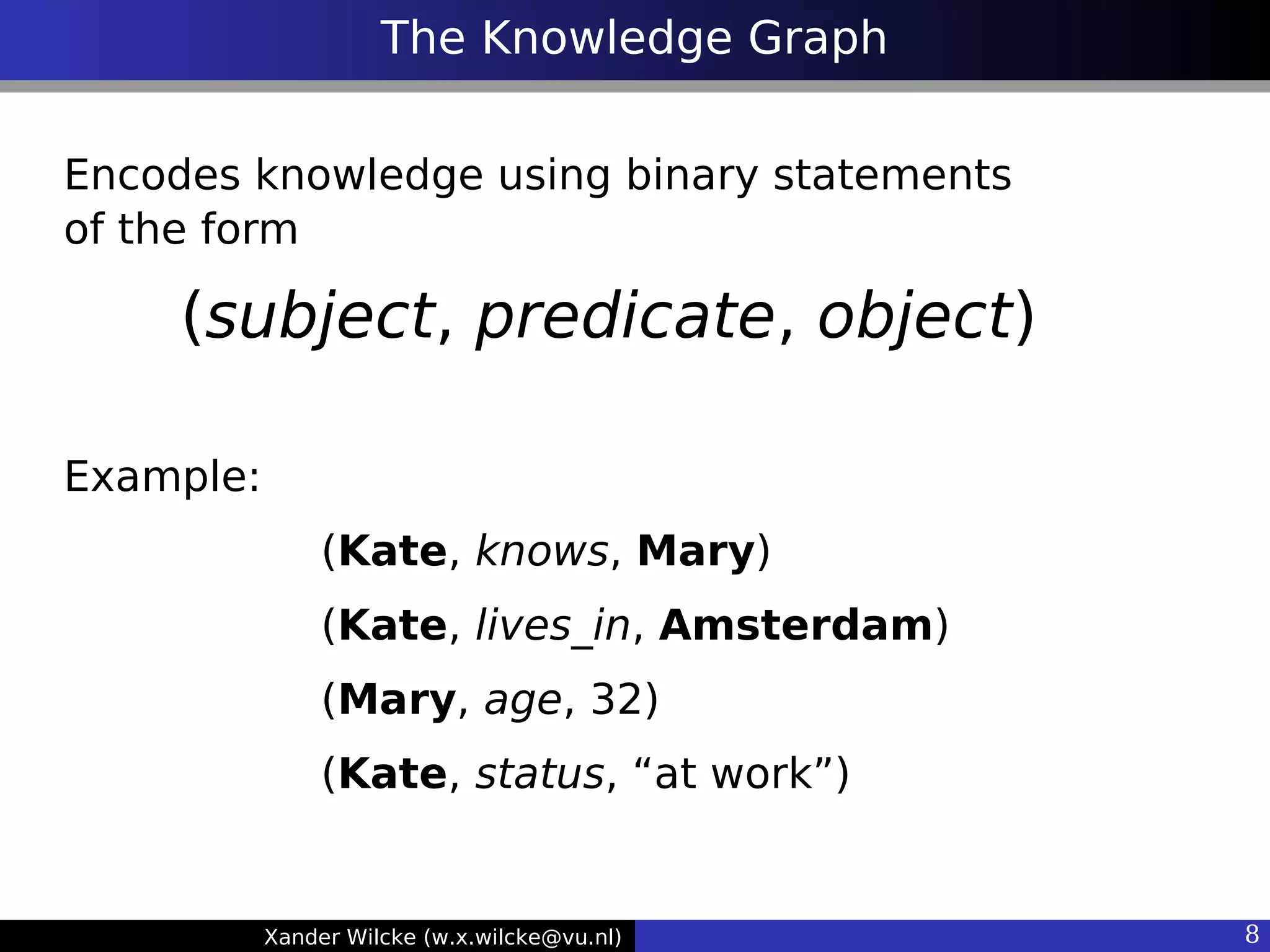
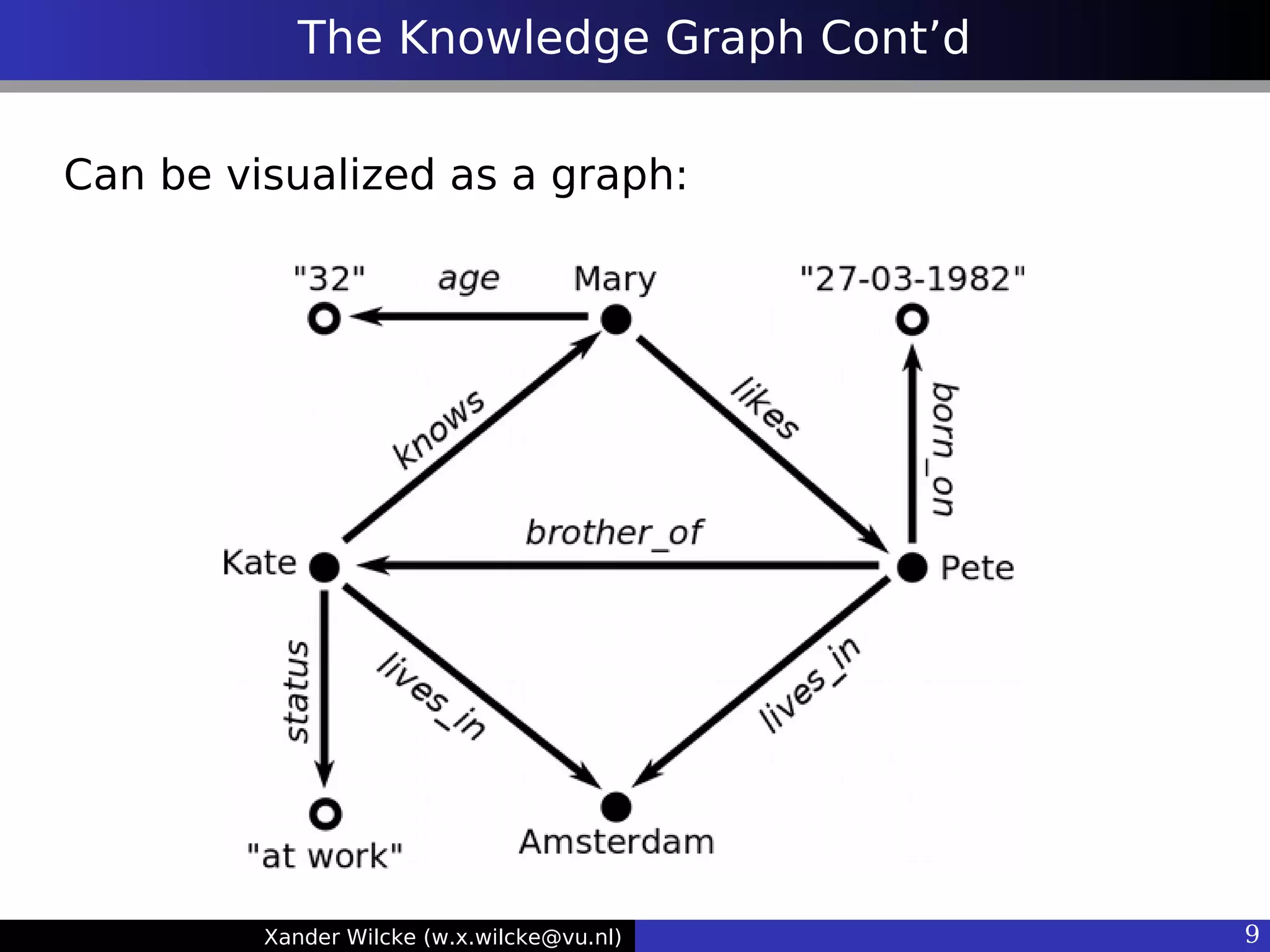
The Knowledge Graph
Encodes knowledge using binary statements
of the form
(subject, predicate, object)
Example:
(Kate, knows, Mary)
(Kate, lives_in, Amsterdam)
(Mary, age, 32)
(Kate, status, “at work”)
Xander Wilcke (w.x.wilcke@vu.nl) 9
The Knowledge Graph Cont’d
Can be visualized as a graph:
Xander Wilcke (w.x.wilcke@vu.nl) 10
The Knowledge Graph as Data Model for Machine Learning
Motivation for the knowledge graph as data model
 Naturally encodes heterogeneous knowledge
 A single uniform data model across nearly all
domains and tasks
 Any method that is tailored to knowledge graphs
can consume all knowledge graphs without
preprocessing them frst
 Data sets expressed as knowledge graphs are task
independent
Xander Wilcke (w.x.wilcke@vu.nl) 11
The Knowledge Graph as Data Model for Machine Learning
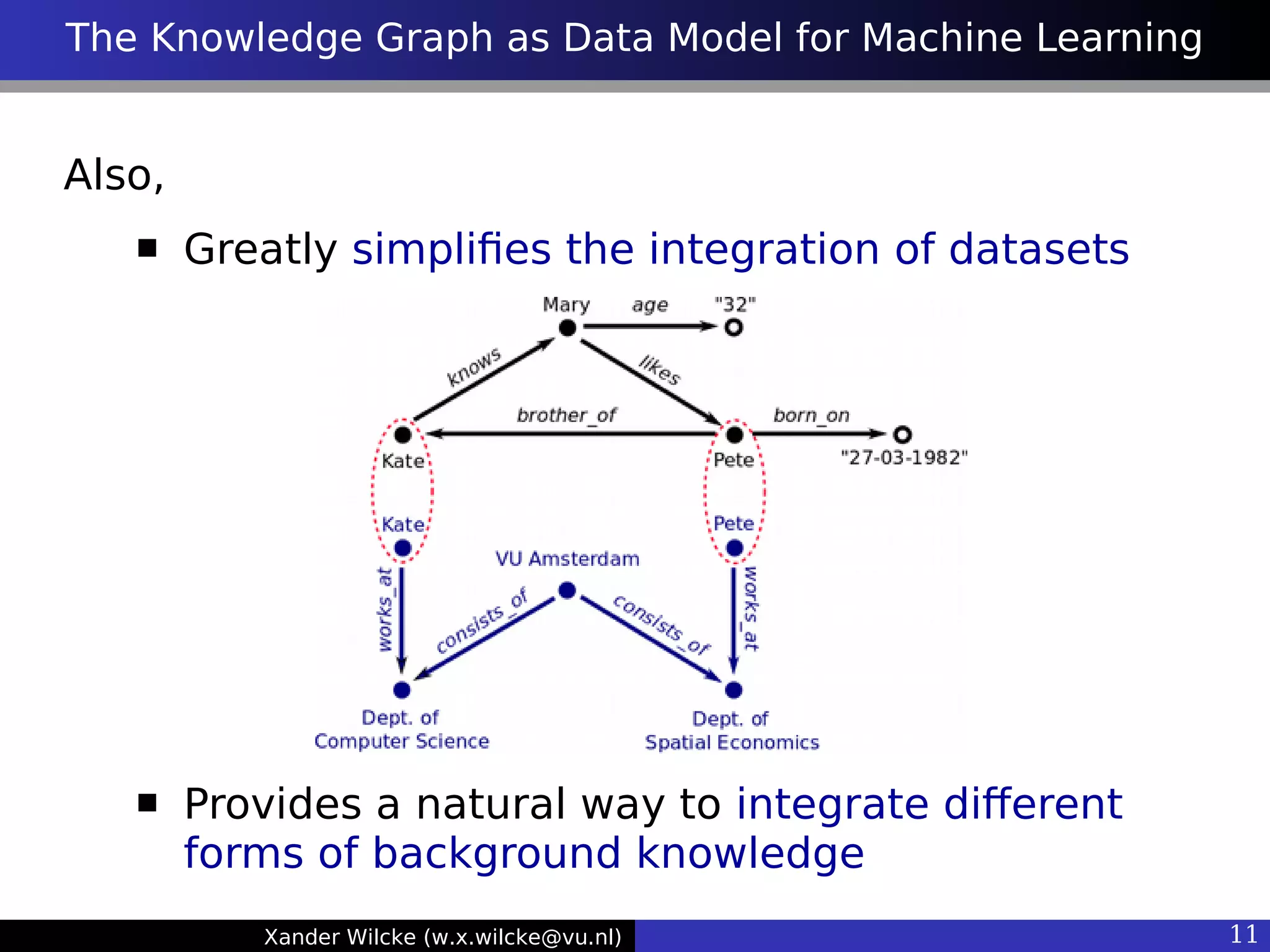
Also,
 Greatly simplifes the integration of datasets
 Provides a natural way to integrate diferent
forms of background knowledge
Xander Wilcke (w.x.wilcke@vu.nl) 12
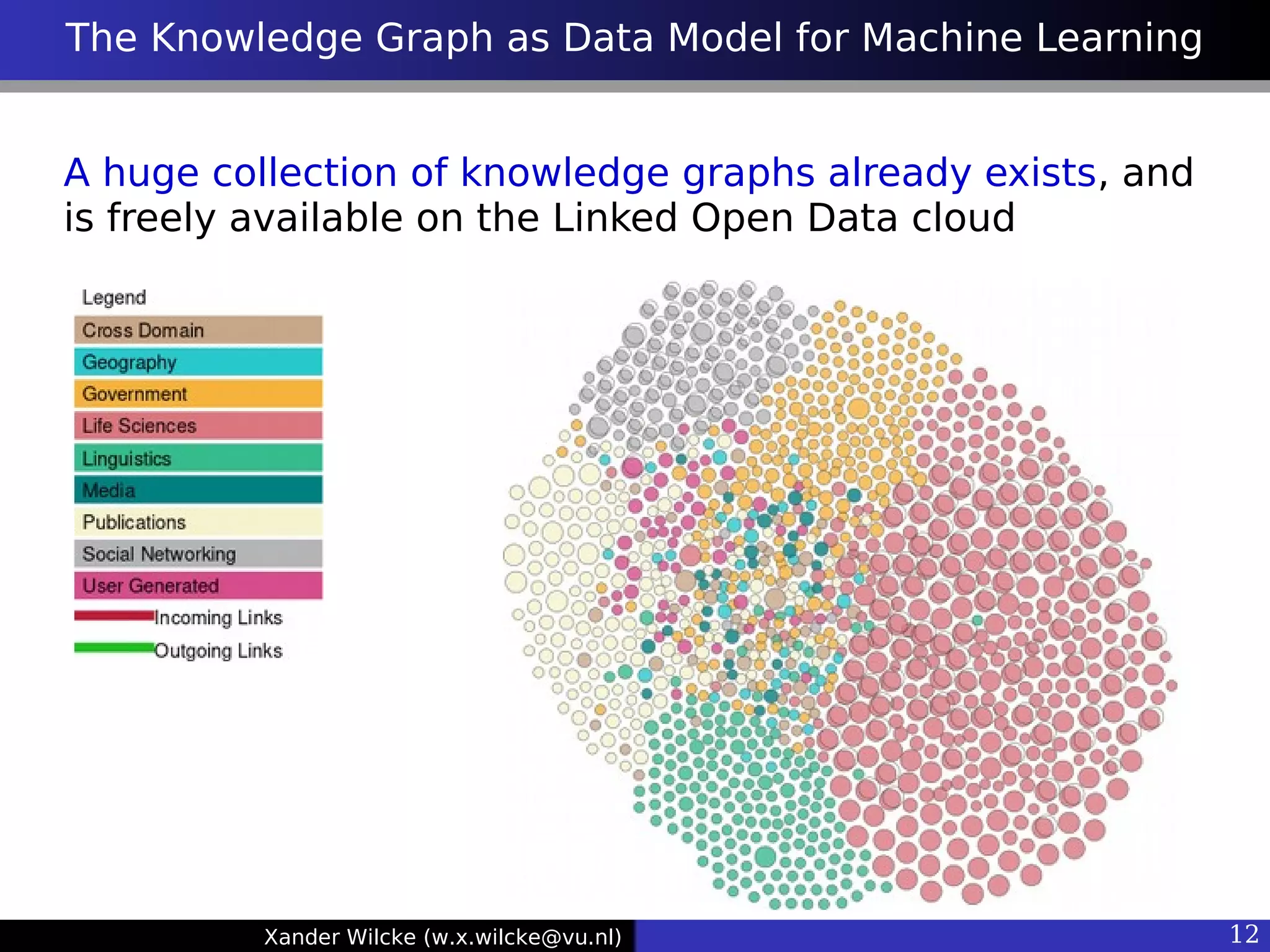
The Knowledge Graph as Data Model for Machine Learning
A huge collection of knowledge graphs already exists, and
is freely available on the Linked Open Data cloud
Xander Wilcke (w.x.wilcke@vu.nl) 13
Challenges
End-to-End Learning on knowledge graphs is still
very experimental and still has many unsolved
challenges
We identify four major challenges:
1)Dealing with implicit knowledge
2)Dealing with incomplete knowledge
3)Dealing with diferently-structured knowledge
4)Dealing with multi-modal knowledge
Xander Wilcke (w.x.wilcke@vu.nl) 14
End-to-End Learning on Multi-modal Knowledge
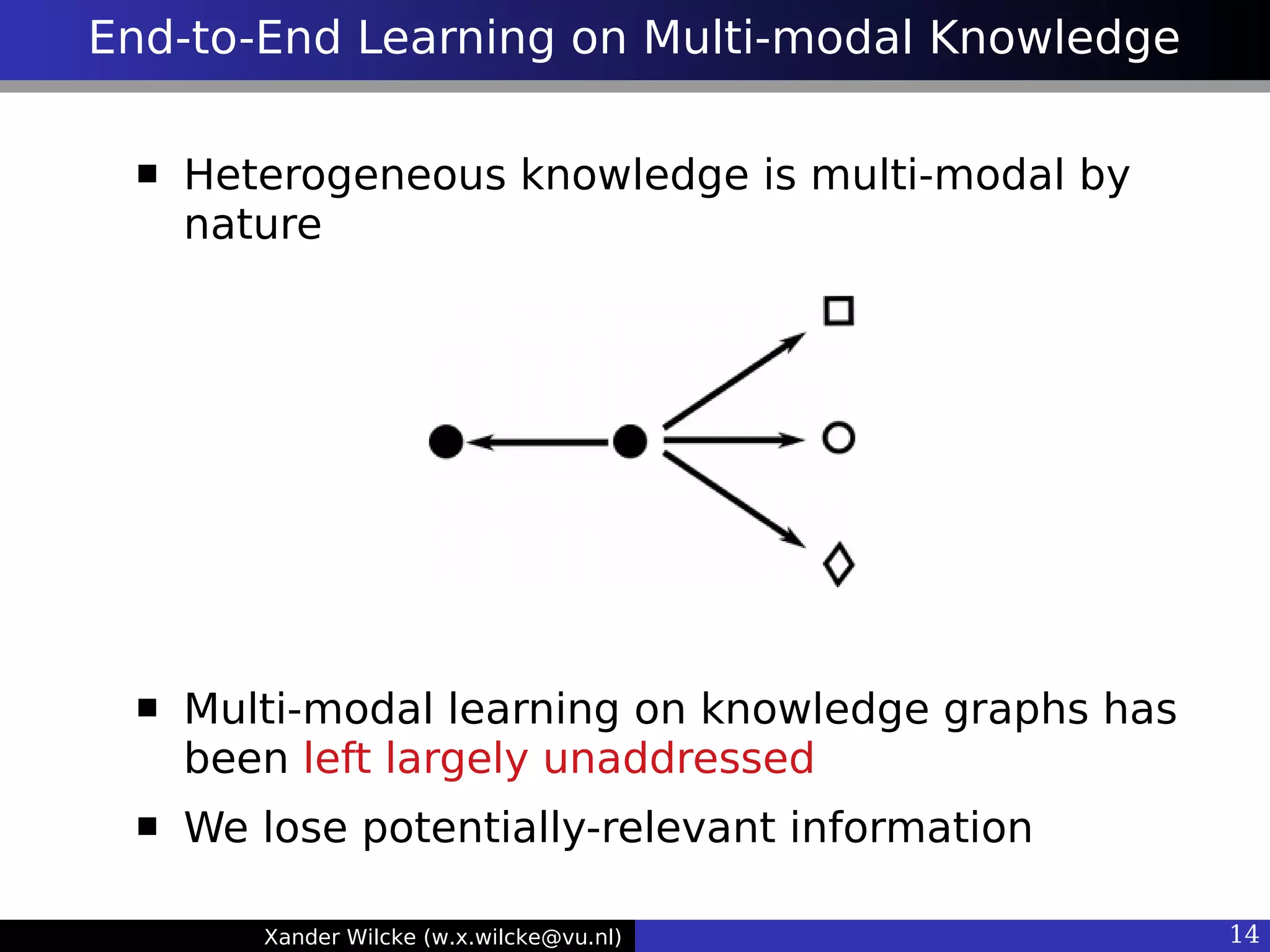
 Heterogeneous knowledge is multi-modal by
nature
 Multi-modal learning on knowledge graphs has
been left largely unaddressed
 We lose potentially-relevant information
Xander Wilcke (w.x.wilcke@vu.nl) 15
End-to-End Learning on Multi-modal Knowledge
Our approach:
 Extend RGCN [1] with modules dedicated to diferent
modalities, each one dealt with accordingly and
projected into the same multi-modal embedding space.
[1] Michael Schlichtkrull, Thomas N Kipf, Peter Bloem, Rianne van den Berg, Ivan Titov, and Max Welling.
Modeling relational data with graph convolutional networks. arXiv preprint arXiv:1703.06103, 2017.
Xander Wilcke (w.x.wilcke@vu.nl) 16

The Knowledge Graph for End-to-End Learning on Heterogeneous Knowledge

  • 1.
    Department of ComputerScience / Spatial Economics The Knowledge Graph for End-to-End Learning on Heterogeneous Knowledge Xander Wilcke w.x.wilcke@vu.nl 19 MAR 2018 Peter Bloem p.bloem@vu.nl Victor de Boer v.de.boer@vu.nl
  • 2.
    Xander Wilcke (w.x.wilcke@vu.nl)2 Our Position  Expressing heterogeneous knowledge using knowledge graphs allows us to build true end- to-end models across domains and tasks  We should adopt the knowledge graph as the default data model for machine learning on heterogeneous knowledge
  • 3.
    Xander Wilcke (w.x.wilcke@vu.nl)3 Traditional Machine Learning A typical machine learning workfow
  • 4.
    Xander Wilcke (w.x.wilcke@vu.nl)4 Traditional Machine Learning A typical machine learning workfow Feature engineering introduces bias
  • 5.
    Xander Wilcke (w.x.wilcke@vu.nl)5 Towards End-to-End Learning With end-to-end learning Every step in the pipeline is diferentiable and can thus be tuned We can incorporate feature engineering into the model and it learn relevant features automatically  We minimize bias otherwise introduced by the adding, removing, or transformation of data
  • 6.
    Xander Wilcke (w.x.wilcke@vu.nl)6 Towards End-to-End Learning Cont’d However Current models only work well for a few specifc domains; for many other domains we frst need to create new models Current models are unsuited for heterogeneous knowledge
  • 7.
    Xander Wilcke (w.x.wilcke@vu.nl)7 Towards End-to-End Learning Cont’d However Current models only work well for a few specifc domains; for many other domains we frst need to create new models Current models are unsuited for heterogeneous knowledge Solution a) adopt the knowledge graph as default data model for this kind of knowledge, and b) develop end-to-end models which can directly consume knowledge graphs
  • 8.
    Xander Wilcke (w.x.wilcke@vu.nl)8 The Knowledge Graph Encodes knowledge using binary statements of the form (subject, predicate, object) Example: (Kate, knows, Mary) (Kate, lives_in, Amsterdam) (Mary, age, 32) (Kate, status, “at work”)
  • 9.
    Xander Wilcke (w.x.wilcke@vu.nl)9 The Knowledge Graph Cont’d Can be visualized as a graph:
  • 10.
    Xander Wilcke (w.x.wilcke@vu.nl)10 The Knowledge Graph as Data Model for Machine Learning Motivation for the knowledge graph as data model  Naturally encodes heterogeneous knowledge  A single uniform data model across nearly all domains and tasks  Any method that is tailored to knowledge graphs can consume all knowledge graphs without preprocessing them frst  Data sets expressed as knowledge graphs are task independent
  • 11.
    Xander Wilcke (w.x.wilcke@vu.nl)11 The Knowledge Graph as Data Model for Machine Learning Also,  Greatly simplifes the integration of datasets  Provides a natural way to integrate diferent forms of background knowledge
  • 12.
    Xander Wilcke (w.x.wilcke@vu.nl)12 The Knowledge Graph as Data Model for Machine Learning A huge collection of knowledge graphs already exists, and is freely available on the Linked Open Data cloud
  • 13.
    Xander Wilcke (w.x.wilcke@vu.nl)13 Challenges End-to-End Learning on knowledge graphs is still very experimental and still has many unsolved challenges We identify four major challenges: 1)Dealing with implicit knowledge 2)Dealing with incomplete knowledge 3)Dealing with diferently-structured knowledge 4)Dealing with multi-modal knowledge
  • 14.
    Xander Wilcke (w.x.wilcke@vu.nl)14 End-to-End Learning on Multi-modal Knowledge  Heterogeneous knowledge is multi-modal by nature  Multi-modal learning on knowledge graphs has been left largely unaddressed  We lose potentially-relevant information
  • 15.
    Xander Wilcke (w.x.wilcke@vu.nl)15 End-to-End Learning on Multi-modal Knowledge Our approach:  Extend RGCN [1] with modules dedicated to diferent modalities, each one dealt with accordingly and projected into the same multi-modal embedding space. [1] Michael Schlichtkrull, Thomas N Kipf, Peter Bloem, Rianne van den Berg, Ivan Titov, and Max Welling. Modeling relational data with graph convolutional networks. arXiv preprint arXiv:1703.06103, 2017.
  • 16.