Prepared by:
Orlando A. Pistan, MAEd
Psychology Instructor
“Facebook addiction” is a term coined by researchers that
is applied to individuals who engage in excessive, compulsive
Facebook use for the purposes of mood alteration, with negative
personal outcomes.
However, excessive use may not be considered addictive
unless it is compulsive; for example, one may spend long hours on
Facebook for the purposes of work without being addicted.
Because Facebook is currently the most popular social
networking site, and empirical studies of Facebook use outweigh
studies of other social networking sites the present review focuses
on the emerging problem of Facebook addiction.
The American Psychiatric Society does not
consider "social media addiction" also called "internet
addiction disorder" to be a behavioral disorder. In the
current Diagnostic and Statistical Manual of Mental
Disorders (DSM) it's listed as a "condition for further
study."
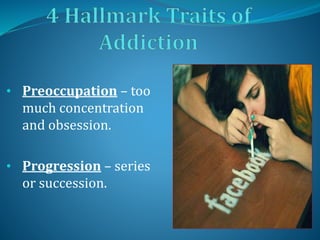
• Preoccupation – too
much concentration
and obsession.
• Progression – series
or succession.
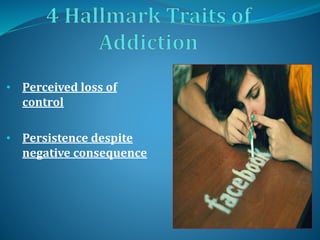
• Perceived loss of
control
• Persistence despite
negative consequence
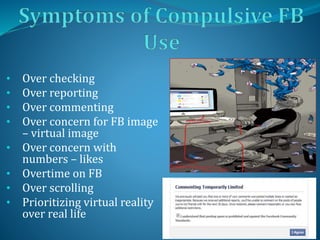
• Over checking
• Over reporting
• Over commenting
• Over concern for FB image
– virtual image
• Over concern with
numbers – likes
• Overtime on FB
• Over scrolling
• Prioritizing virtual reality
over real life
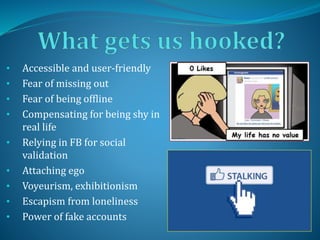
• Accessible and user-friendly
• Fear of missing out
• Fear of being offline
• Compensating for being shy in
real life
• Relying in FB for social
validation
• Attaching ego
• Voyeurism, exhibitionism
• Escapism from loneliness
• Power of fake accounts
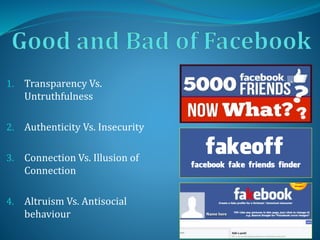
1. Transparency Vs.
Untruthfulness
2. Authenticity Vs. Insecurity
3. Connection Vs. Illusion of
Connection
4. Altruism Vs. Antisocial
behaviour
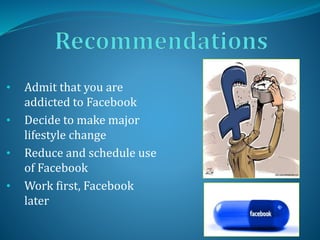
• Admit that you are
addicted to Facebook
• Decide to make major
lifestyle change
• Reduce and schedule use
of Facebook
• Work first, Facebook
later
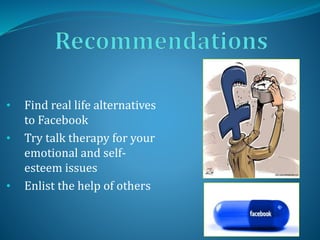
• Find real life alternatives
to Facebook
• Try talk therapy for your
emotional and self-
esteem issues
• Enlist the help of others
Thank you for paying
attention.

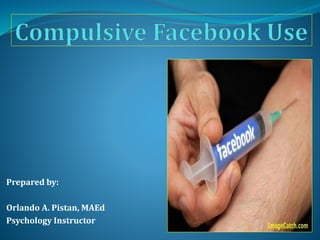
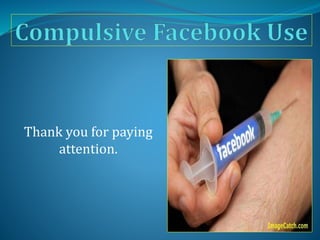
Compulsive Facebook Use

  • 1.
    Prepared by: Orlando A.Pistan, MAEd Psychology Instructor
  • 3.
    “Facebook addiction” isa term coined by researchers that is applied to individuals who engage in excessive, compulsive Facebook use for the purposes of mood alteration, with negative personal outcomes. However, excessive use may not be considered addictive unless it is compulsive; for example, one may spend long hours on Facebook for the purposes of work without being addicted. Because Facebook is currently the most popular social networking site, and empirical studies of Facebook use outweigh studies of other social networking sites the present review focuses on the emerging problem of Facebook addiction.
  • 4.
    The American PsychiatricSociety does not consider "social media addiction" also called "internet addiction disorder" to be a behavioral disorder. In the current Diagnostic and Statistical Manual of Mental Disorders (DSM) it's listed as a "condition for further study."
  • 5.
    • Preoccupation –too much concentration and obsession. • Progression – series or succession.
  • 6.
    • Perceived lossof control • Persistence despite negative consequence
  • 7.
    • Over checking •Over reporting • Over commenting • Over concern for FB image – virtual image • Over concern with numbers – likes • Overtime on FB • Over scrolling • Prioritizing virtual reality over real life
  • 8.
    • Accessible anduser-friendly • Fear of missing out • Fear of being offline • Compensating for being shy in real life • Relying in FB for social validation • Attaching ego • Voyeurism, exhibitionism • Escapism from loneliness • Power of fake accounts
  • 9.
    1. Transparency Vs. Untruthfulness 2.Authenticity Vs. Insecurity 3. Connection Vs. Illusion of Connection 4. Altruism Vs. Antisocial behaviour
  • 10.
    • Admit thatyou are addicted to Facebook • Decide to make major lifestyle change • Reduce and schedule use of Facebook • Work first, Facebook later
  • 11.
    • Find reallife alternatives to Facebook • Try talk therapy for your emotional and self- esteem issues • Enlist the help of others
  • 12.
    Thank you forpaying attention.