www.infosectrain.com
#
l
e
a
r
n
t
o
r
i
s
e
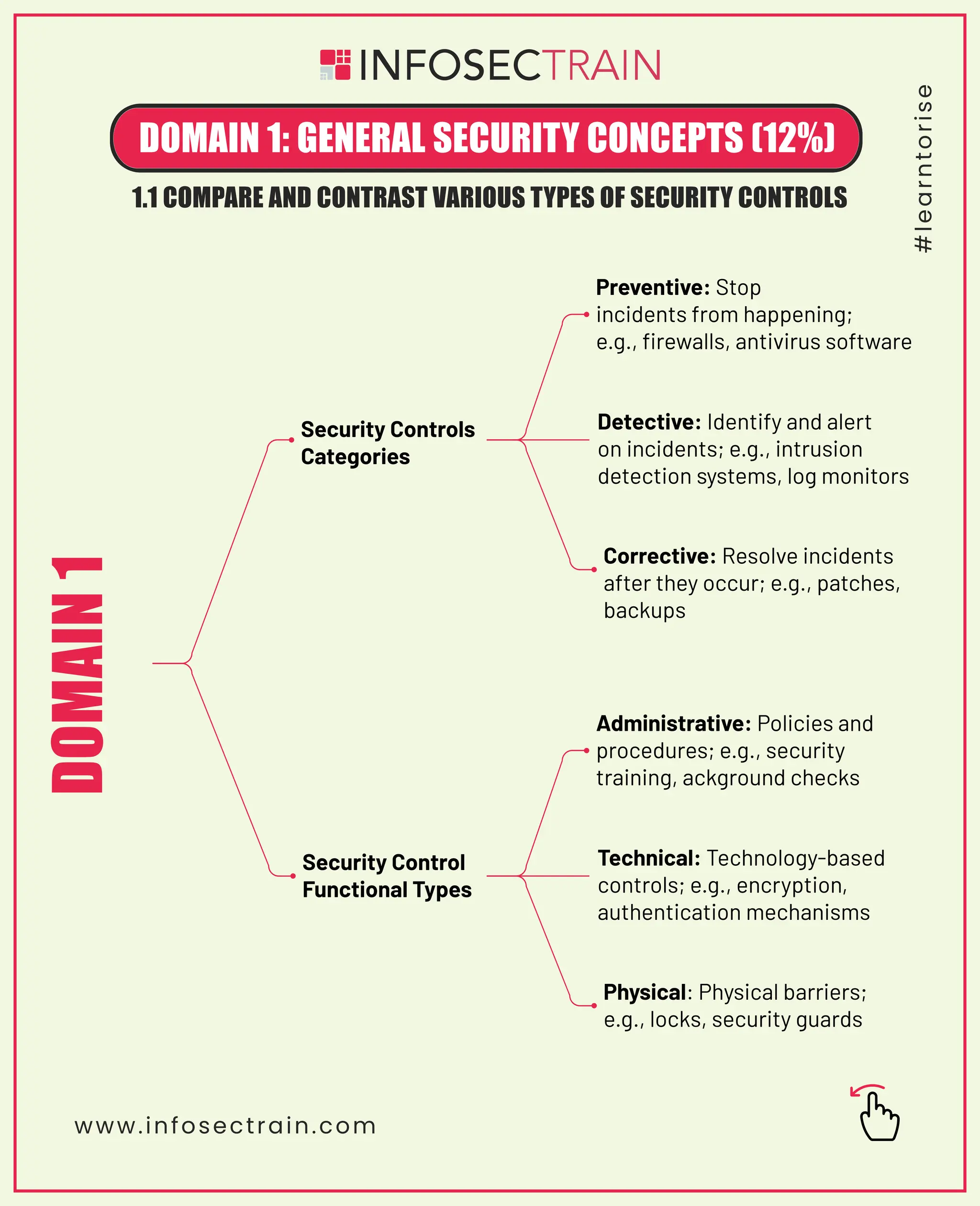
Security Controls
Categories
Security Control
Functional Types
Preventive: Stop
incidents from happening;
e.g., firewalls, antivirus software
Corrective: Resolve incidents
after they occur; e.g., patches,
backups
Detective: Identify and alert
on incidents; e.g., intrusion
detection systems, log monitors
Administrative: Policies and
procedures; e.g., security
training, ackground checks
Physical: Physical barriers;
e.g., locks, security guards
Technical: Technology-based
controls; e.g., encryption,
authentication mechanisms
DOMAIN 1: GENERAL SECURITY CONCEPTS (12%)
DOMAIN
1
1.1 COMPARE AND CONTRAST VARIOUS TYPES OF SECURITY CONTROLS
www.infosectrain.com
#
l
e
a
r
n
t
o
r
i
s
e
www.infosectrain.com
#
l
e
a
r
n
t
o
r
i
s
e
DOMAIN 1: GENERAL SECURITY CONCEPTS (12%)
DOMAIN
1
1.2 SUMMARIZE FUNDAMENTAL SECURITY CONCEPTS
Core Principles
Key Concepts
Confidentiality: Ensuring
information is not disclosed to
unauthorized individuals;
e.g., encryption
Availability (CIA): Ensuring
information is accessible when
needed; e.g., redundancy
Integrity: Ensuring information
is not altered by unauthorized
individuals; e.g., hashing
Authentication, Authorization,
Accounting (AAA): Identifying users,
granting access, and tracking
actions; e.g., login systems
Non-repudiation: Preventing
denial of action; e.g., digital
signatures
Zero Trust Model: Assuming all
network traffic is untrusted;
e.g., microsegmentation, least
privilege access control
Physical Security: Protecting
physical assets; e.g., surveillance
cameras
Gap Analysis: Identifying differences
between current and desired
security postures; e.g., security
assessments, vulnerability scanning
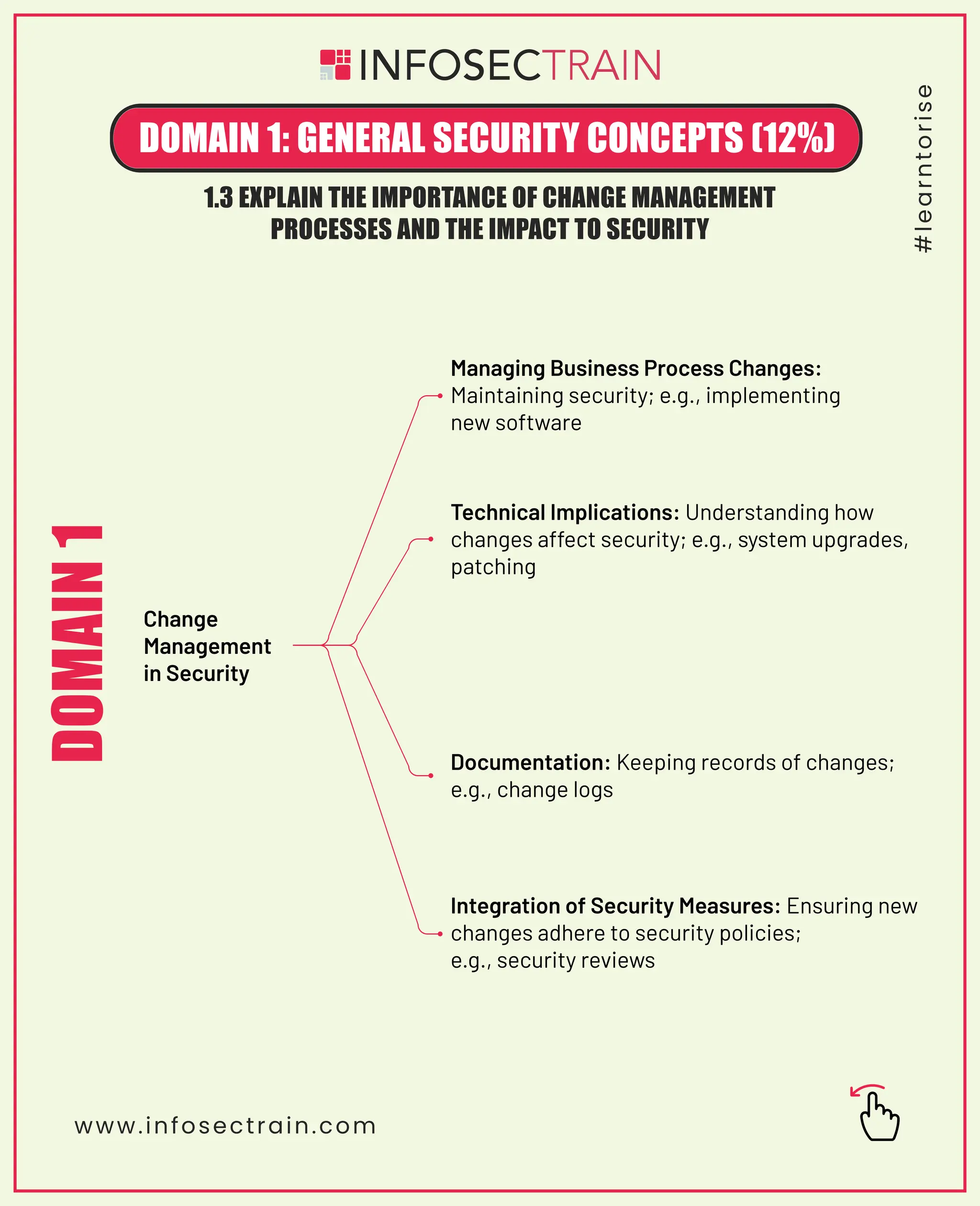
Managing Business Process Changes:
Maintaining security; e.g., implementing
new software
Change
Management
in Security
Technical Implications: Understanding how
changes affect security; e.g., system upgrades,
patching
Integration of Security Measures: Ensuring new
changes adhere to security policies;
e.g., security reviews
Documentation: Keeping records of changes;
e.g., change logs
www.infosectrain.com
#
l
e
a
r
n
t
o
r
i
s
e
DOMAIN 1: GENERAL SECURITY CONCEPTS (12%)
DOMAIN
1
1.3 EXPLAIN THE IMPORTANCE OF CHANGE MANAGEMENT
PROCESSES AND THE IMPACT TO SECURITY
www.infosectrain.com
#
l
e
a
r
n
t
o
r
i
s
e
DOMAIN 1: GENERAL SECURITY CONCEPTS (12%)
1.4 EXPLAIN THE IMPORTANCE OF USING APPROPRIATE
CRYPTOGRAPHIC SOLUTIONS
DOMAIN
1
Encryption and Obfuscation: Protecting data
confidentiality; e.g., AES encryption, VPNs
Public Key Infrastructure (PKI): Framework
for encryption and digital signatures; e.g.,
SSL certificates
Hashing and Salting: Protecting stored
passwords; e.g., password storage
Blockchain and Open Public Ledgers:
Ensuring data integrity in distributed
systems; e.g., Bitcoin
Certificates: Validating identities;
e.g., HTTPS websites
Digital Signatures: Ensuring data integrity
and on-repudiation; e.g., email signing
Key Stretching: Enhancing password
security; e.g., PBKDF2, bcrypt
Cryptographic
Solutions for
Security
To Get More Insights Through Our FREE
FOUND THIS USEFUL?
Courses | Workshops | eBooks | Checklists | Mock Tests
LIKE FOLLOW
SHARE

Comptia security plus domain SYO 701.pdf

  • 1.
  • 2.
    Security Controls Categories Security Control FunctionalTypes Preventive: Stop incidents from happening; e.g., firewalls, antivirus software Corrective: Resolve incidents after they occur; e.g., patches, backups Detective: Identify and alert on incidents; e.g., intrusion detection systems, log monitors Administrative: Policies and procedures; e.g., security training, ackground checks Physical: Physical barriers; e.g., locks, security guards Technical: Technology-based controls; e.g., encryption, authentication mechanisms DOMAIN 1: GENERAL SECURITY CONCEPTS (12%) DOMAIN 1 1.1 COMPARE AND CONTRAST VARIOUS TYPES OF SECURITY CONTROLS www.infosectrain.com # l e a r n t o r i s e
  • 3.
    www.infosectrain.com # l e a r n t o r i s e DOMAIN 1: GENERALSECURITY CONCEPTS (12%) DOMAIN 1 1.2 SUMMARIZE FUNDAMENTAL SECURITY CONCEPTS Core Principles Key Concepts Confidentiality: Ensuring information is not disclosed to unauthorized individuals; e.g., encryption Availability (CIA): Ensuring information is accessible when needed; e.g., redundancy Integrity: Ensuring information is not altered by unauthorized individuals; e.g., hashing Authentication, Authorization, Accounting (AAA): Identifying users, granting access, and tracking actions; e.g., login systems Non-repudiation: Preventing denial of action; e.g., digital signatures Zero Trust Model: Assuming all network traffic is untrusted; e.g., microsegmentation, least privilege access control Physical Security: Protecting physical assets; e.g., surveillance cameras Gap Analysis: Identifying differences between current and desired security postures; e.g., security assessments, vulnerability scanning
  • 4.
    Managing Business ProcessChanges: Maintaining security; e.g., implementing new software Change Management in Security Technical Implications: Understanding how changes affect security; e.g., system upgrades, patching Integration of Security Measures: Ensuring new changes adhere to security policies; e.g., security reviews Documentation: Keeping records of changes; e.g., change logs www.infosectrain.com # l e a r n t o r i s e DOMAIN 1: GENERAL SECURITY CONCEPTS (12%) DOMAIN 1 1.3 EXPLAIN THE IMPORTANCE OF CHANGE MANAGEMENT PROCESSES AND THE IMPACT TO SECURITY
  • 5.
    www.infosectrain.com # l e a r n t o r i s e DOMAIN 1: GENERALSECURITY CONCEPTS (12%) 1.4 EXPLAIN THE IMPORTANCE OF USING APPROPRIATE CRYPTOGRAPHIC SOLUTIONS DOMAIN 1 Encryption and Obfuscation: Protecting data confidentiality; e.g., AES encryption, VPNs Public Key Infrastructure (PKI): Framework for encryption and digital signatures; e.g., SSL certificates Hashing and Salting: Protecting stored passwords; e.g., password storage Blockchain and Open Public Ledgers: Ensuring data integrity in distributed systems; e.g., Bitcoin Certificates: Validating identities; e.g., HTTPS websites Digital Signatures: Ensuring data integrity and on-repudiation; e.g., email signing Key Stretching: Enhancing password security; e.g., PBKDF2, bcrypt Cryptographic Solutions for Security
  • 6.
    To Get MoreInsights Through Our FREE FOUND THIS USEFUL? Courses | Workshops | eBooks | Checklists | Mock Tests LIKE FOLLOW SHARE