FLEXIBLE
WORK
SCHEDULES
WHAT IS A FLEXIBLE
WORK SCHEDULE?
• Alternative to the traditional 9 to 5, 40-hour work week.
• Allows employees to vary their arrival and/or departure
times.
• Employees must work a prescribed number of hours.
• No overtime.
• No work on Holidays.
• No conflict with leave allocation practices.
WHY ALLOW
FLEXIBLE SCHEDULES?
• Allows employees to balance work life and
personal life commitments.
• Facilitates child care.
• Allows coordination of schedules with a
spouse.
• Permits coordination of work schedules with
limited mass transit schedules.
TYPES OF FLEXIBLE
WORK SCHEDULES
• Compressed Workweeks
• Customized Working Hours / Flextime
• Alternative Schedule
• Flex-place
• Remote Working
• Part-time Positions
• Job Sharing
• Extra Paid Time Off (PTO)
Compressed Workweeks
• Unequal distribution of work hours throughout the week to
reduce the number of working days.
Customized Working Hours / Flextime
• Customize operational hours within a workday with flextime.
Alternative Schedule
• For those who can’t work within the regular Monday to Friday,
five day workweek.
Flex-place
• Working from home or any other remote location
We Can Adopt Workplace Flexibility In Three Ways
Flex-place
Telecommuting Hoteling
Snowbird
programe
Telecommuting Hoteling Snowbird Programs
Using computers and
other communication
devices by employees
to overcome the
limitations of place and
time.
Similar to
telecommuting
Employees to transfer
to warmer regions
during the winter
months.
Team members can
work remotely or from
the office
Employees reserve a
separate co-working
space for their job
Attract a larger labor
force irrespective of
age constraints
Useful for those
working in
telemarketing and
communication roles
Remote Working
• Work is performed completely away from the office for a
temporary or permanent period.
Part-time Positions
• Delegated to team members who work for fewer days or hours
than their full-time colleagues.
Job Sharing
• Dividing a full-time job between two or more part-time
employees.
Extra Paid Time Off (PTO)
• Monotonous work routine by increasing time off highly
performing employees.
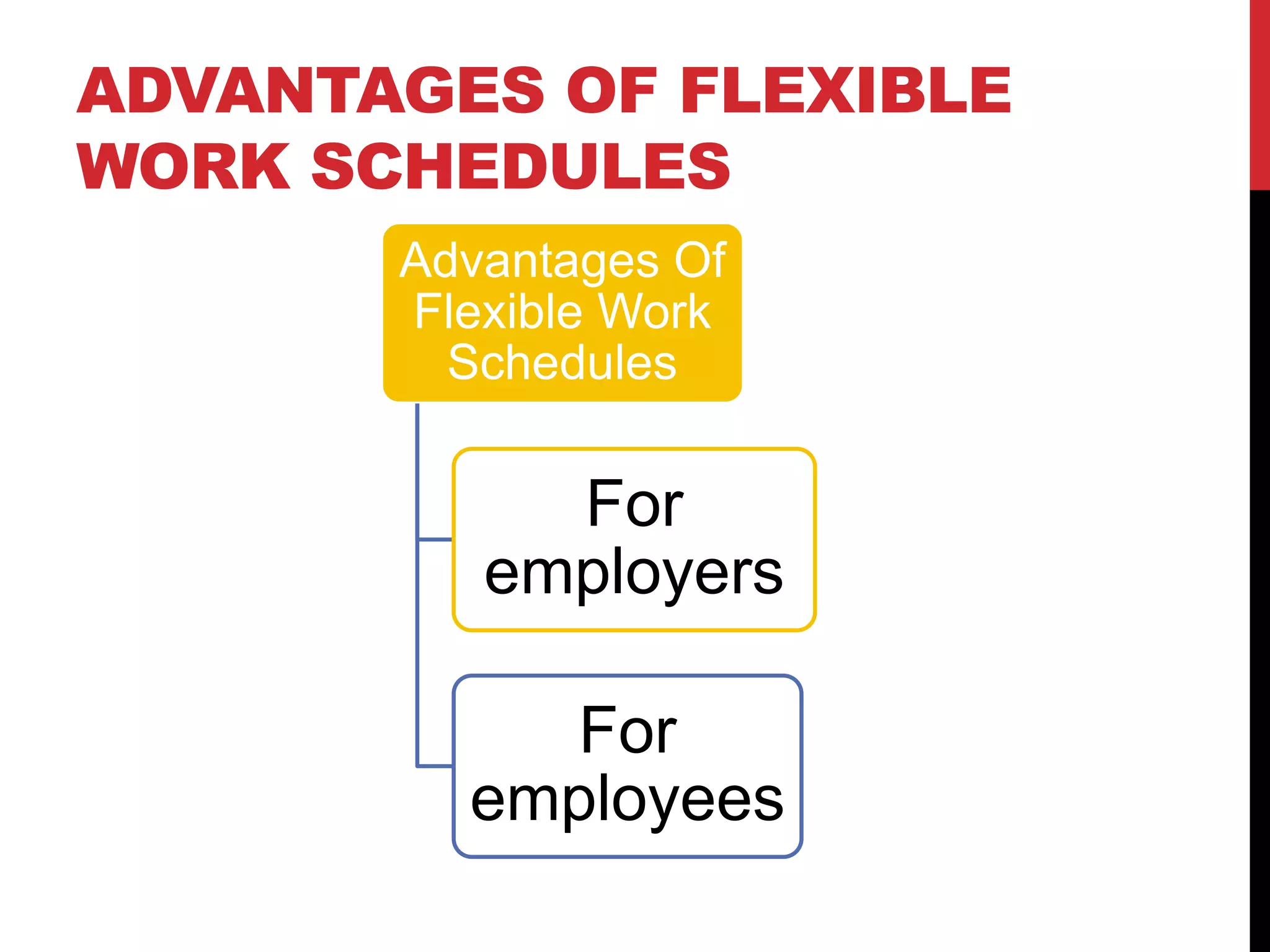
ADVANTAGES OF FLEXIBLE
WORK SCHEDULES
Advantages Of
Flexible Work
Schedules
For
employers
For
employees
`
Larger
Talent
Pool
• Access to a wider and more talented
applicant pool.
• Promotes diversity in the workplace.
• Offer equal opportunities to people
from all spheres of life
• `
Transparency
• Better track of employee
attendance, work hours,
productivity.
• Lead to higher
productivity and lower
absenteeism.
Employee
Retention
• Help to retain talented
employees.
• Employee discontent
within the company
decreases drastically.
Increased
Productivity
And
Continuity
Cost-
Effectiveness
• Highly productive and
motivated workforce.
• Organization can scale
to greater heights
• Save in insurance costs.
• Save up on rent, office
supplies, utilities, etc.
For Employers
For Employees
• Employee convenience
can boost team morale.
• Helps in increase
employee job satisfaction
• Restore the optimal
balance between working
and non-working hours.
• More time available for
childcare, part-time study,
and other creative
pursuits.
• freedom to travel
• work whenever they want
Heightened
Morale
Better Work
Life Balance
Location
Flexibility
DISADVANTAGES OF FLEXIBLE
WORK SCHEDULES
• It’s more difficult for you to arrange meetings with your
team.
• Lines between work and life blur more drastically.
• You won’t find much structure at home.
• It can be difficult to create a bonded team.
CONCLUSION
 Offers both employees and employers different levels of
leverage to attain their respective goals.
 Makes the workplace productive and upbeat.
 Improves the branding of organizations .
 They are seen to be pro-employees and flexible.

Flexible Work Schedules.pptx

  • 1.
  • 2.
    WHAT IS AFLEXIBLE WORK SCHEDULE? • Alternative to the traditional 9 to 5, 40-hour work week. • Allows employees to vary their arrival and/or departure times. • Employees must work a prescribed number of hours. • No overtime. • No work on Holidays. • No conflict with leave allocation practices.
  • 3.
    WHY ALLOW FLEXIBLE SCHEDULES? •Allows employees to balance work life and personal life commitments. • Facilitates child care. • Allows coordination of schedules with a spouse. • Permits coordination of work schedules with limited mass transit schedules.
  • 4.
    TYPES OF FLEXIBLE WORKSCHEDULES • Compressed Workweeks • Customized Working Hours / Flextime • Alternative Schedule • Flex-place • Remote Working • Part-time Positions • Job Sharing • Extra Paid Time Off (PTO)
  • 5.
    Compressed Workweeks • Unequaldistribution of work hours throughout the week to reduce the number of working days. Customized Working Hours / Flextime • Customize operational hours within a workday with flextime. Alternative Schedule • For those who can’t work within the regular Monday to Friday, five day workweek. Flex-place • Working from home or any other remote location
  • 6.
    We Can AdoptWorkplace Flexibility In Three Ways Flex-place Telecommuting Hoteling Snowbird programe
  • 7.
    Telecommuting Hoteling SnowbirdPrograms Using computers and other communication devices by employees to overcome the limitations of place and time. Similar to telecommuting Employees to transfer to warmer regions during the winter months. Team members can work remotely or from the office Employees reserve a separate co-working space for their job Attract a larger labor force irrespective of age constraints Useful for those working in telemarketing and communication roles
  • 8.
    Remote Working • Workis performed completely away from the office for a temporary or permanent period. Part-time Positions • Delegated to team members who work for fewer days or hours than their full-time colleagues. Job Sharing • Dividing a full-time job between two or more part-time employees. Extra Paid Time Off (PTO) • Monotonous work routine by increasing time off highly performing employees.
  • 9.
    ADVANTAGES OF FLEXIBLE WORKSCHEDULES Advantages Of Flexible Work Schedules For employers For employees
  • 10.
    ` Larger Talent Pool • Access toa wider and more talented applicant pool. • Promotes diversity in the workplace. • Offer equal opportunities to people from all spheres of life • ` Transparency • Better track of employee attendance, work hours, productivity. • Lead to higher productivity and lower absenteeism. Employee Retention • Help to retain talented employees. • Employee discontent within the company decreases drastically. Increased Productivity And Continuity Cost- Effectiveness • Highly productive and motivated workforce. • Organization can scale to greater heights • Save in insurance costs. • Save up on rent, office supplies, utilities, etc. For Employers
  • 11.
    For Employees • Employeeconvenience can boost team morale. • Helps in increase employee job satisfaction • Restore the optimal balance between working and non-working hours. • More time available for childcare, part-time study, and other creative pursuits. • freedom to travel • work whenever they want Heightened Morale Better Work Life Balance Location Flexibility
  • 12.
    DISADVANTAGES OF FLEXIBLE WORKSCHEDULES • It’s more difficult for you to arrange meetings with your team. • Lines between work and life blur more drastically. • You won’t find much structure at home. • It can be difficult to create a bonded team.
  • 13.
    CONCLUSION  Offers bothemployees and employers different levels of leverage to attain their respective goals.  Makes the workplace productive and upbeat.  Improves the branding of organizations .  They are seen to be pro-employees and flexible.