SUBMITTED BY :
MANJU THOMAS
WHAT IS COMPOSTING?
 Composting is the natural process of ‘rotting’ or
decomposition of organic matter by
micro-organisms under controlled conditions.
 Compost is a rich source of organic matter.
ADVANTAGES OF COMPOSTING
1. Eco-friendly method of solid waste disposal
with minimum financial expenditure.
2. Provides compost which is a valuable
natural manure.
3. Is a most hygienic method without
environmental pollution and health risk.
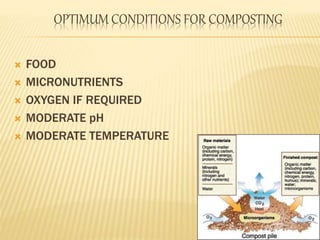
OPTIMUM CONDITIONS FOR COMPOSTING
 FOOD
 MICRONUTRIENTS
 OXYGEN IF REQUIRED
 MODERATE pH
 MODERATE TEMPERATURE
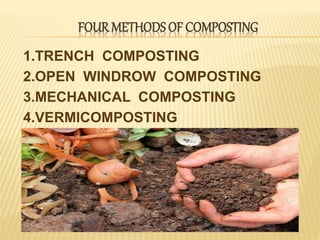
FOUR METHODS OF COMPOSTING
1.TRENCH COMPOSTING
2.OPEN WINDROW COMPOSTING
3.MECHANICAL COMPOSTING
4.VERMICOMPOSTING
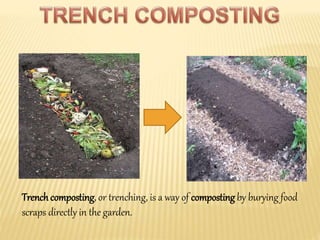
Trenchcomposting, or trenching, is a way of composting by burying food
scraps directly in the garden.
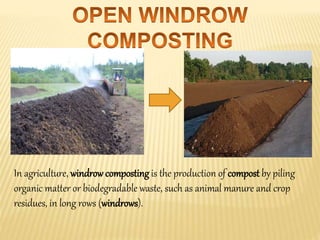
In agriculture, windrow composting is the production of compost by piling
organic matter or biodegradable waste, such as animal manure and crop
residues, in long rows (windrows).
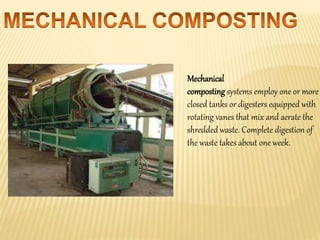
Mechanical
composting systems employ one or more
closed tanks or digesters equipped with
rotating vanes that mix and aerate the
shredded waste. Complete digestion of
the waste takes about one week.
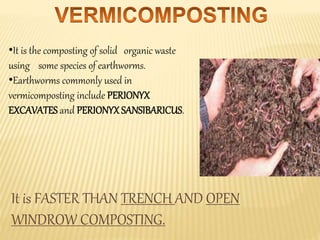
•It is the composting of solid organic waste
using some species of earthworms.
•Earthworms commonly used in
vermicomposting include PERIONYX
EXCAVATES and PERIONYXSANSIBARICUS.
It is FASTER THAN TRENCH AND OPEN
WINDROW COMPOSTING.
REFERENCE
 Environmental Biology –Dr H.R Singh
 A Textbook of Microbiology –Dr R.C Dubey
Dr D.K
Maheshwari
 Ecology and Environment –P.D Sharma

COMPOSTING: A Pile Of Fun

  • 1.
  • 2.
    WHAT IS COMPOSTING? Composting is the natural process of ‘rotting’ or decomposition of organic matter by micro-organisms under controlled conditions.  Compost is a rich source of organic matter.
  • 3.
    ADVANTAGES OF COMPOSTING 1.Eco-friendly method of solid waste disposal with minimum financial expenditure. 2. Provides compost which is a valuable natural manure. 3. Is a most hygienic method without environmental pollution and health risk.
  • 4.
    OPTIMUM CONDITIONS FORCOMPOSTING  FOOD  MICRONUTRIENTS  OXYGEN IF REQUIRED  MODERATE pH  MODERATE TEMPERATURE
  • 5.
    FOUR METHODS OFCOMPOSTING 1.TRENCH COMPOSTING 2.OPEN WINDROW COMPOSTING 3.MECHANICAL COMPOSTING 4.VERMICOMPOSTING
  • 6.
    Trenchcomposting, or trenching,is a way of composting by burying food scraps directly in the garden.
  • 7.
    In agriculture, windrowcomposting is the production of compost by piling organic matter or biodegradable waste, such as animal manure and crop residues, in long rows (windrows).
  • 8.
    Mechanical composting systems employone or more closed tanks or digesters equipped with rotating vanes that mix and aerate the shredded waste. Complete digestion of the waste takes about one week.
  • 9.
    •It is thecomposting of solid organic waste using some species of earthworms. •Earthworms commonly used in vermicomposting include PERIONYX EXCAVATES and PERIONYXSANSIBARICUS. It is FASTER THAN TRENCH AND OPEN WINDROW COMPOSTING.
  • 10.
    REFERENCE  Environmental Biology–Dr H.R Singh  A Textbook of Microbiology –Dr R.C Dubey Dr D.K Maheshwari  Ecology and Environment –P.D Sharma