Composition of Functions & Difference Quotient Module 2, Part 2
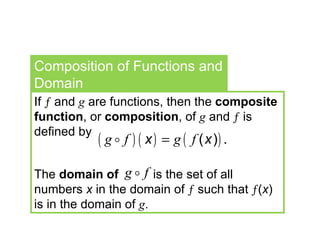
If    and  g  are functions, then the  composite function , or  composition , of  g  and    is defined by The  domain of  is the set of all numbers  x  in the domain of    such that   ( x )   is in the domain of  g . Composition of Functions and Domain
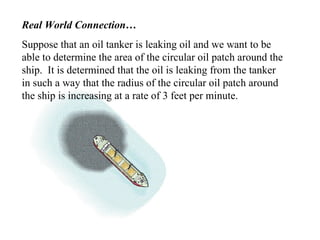
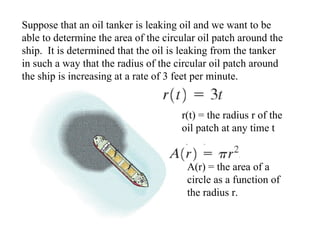
Real World Connection… Suppose that an oil tanker is leaking oil and we want to be able to determine the area of the circular oil patch around the ship.  It is determined that the oil is leaking from the tanker in such a way that the radius of the circular oil patch around the ship is increasing at a rate of 3 feet per minute.
Suppose that an oil tanker is leaking oil and we want to be able to determine the area of the circular oil patch around the ship.  It is determined that the oil is leaking from the tanker in such a way that the radius of the circular oil patch around the ship is increasing at a rate of 3 feet per minute. r(t) = the radius r of the  oil patch at any time t   A(r) = the area of a    circle as a function of    the radius r.
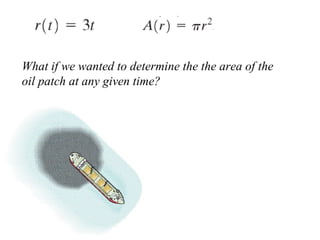
What if we wanted to determine the the area of the oil patch at any given time?
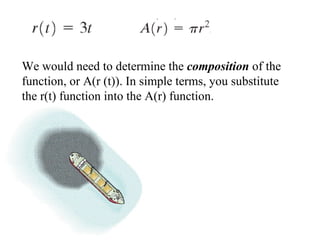
We would need to determine the  composition  of the function, or A(r (t)). In simple terms, you substitute the r(t) function into the A(r) function.
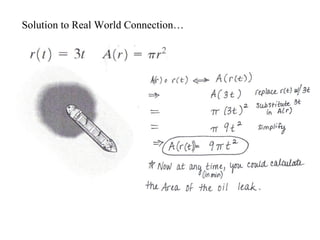
Solution to Real World Connection…
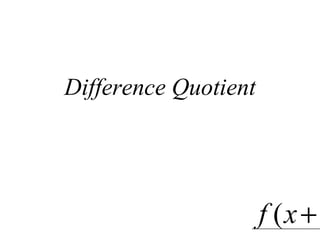
Difference Quotient
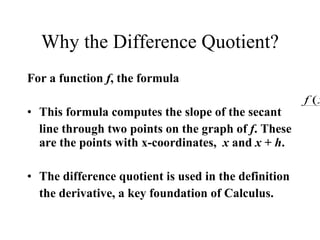
Why the Difference Quotient? For a function  f , the formula  This formula computes the slope of the secant line through two points on the graph of  f . These are the points with x-coordinates,   x  and  x  +  h .  The difference quotient is used in the definition the derivative, a key foundation of Calculus.
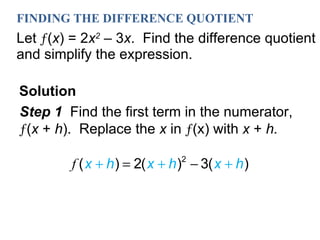
FINDING THE DIFFERENCE QUOTIENT  Let   ( x ) = 2 x 2  – 3 x .  Find the difference quotient and simplify the expression.  Solution Step 1  Find the first term in the numerator,   ( x  +  h ).  Replace the  x  in   (x) with  x  +  h.
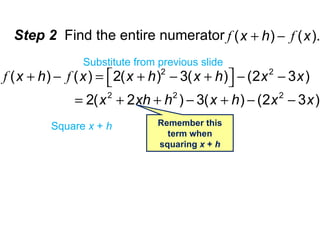
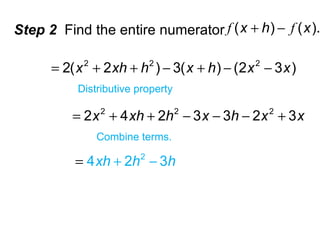
Step 2  Find the entire numerator Substitute from previous slide Remember this term when squaring  x  +  h Square  x  +  h
Step 2  Find the entire numerator Distributive property Combine terms.
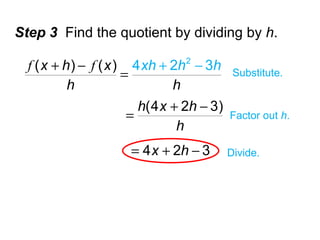
Step 3  Find the quotient by dividing by  h . Substitute. Factor out  h . Divide.
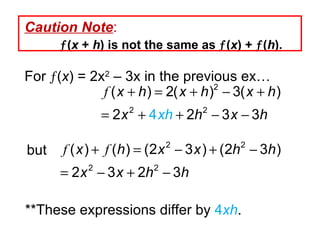
Caution   Note :     ( x  +  h ) is not the same as   ( x ) +   ( h ).  For   ( x ) = 2x 2  – 3x in the previous ex… but **These expressions differ by  4 xh .
Go to Module #2 Assignment Complete #5 - 7

Composition Of Functions & Difference Quotient

  • 1.
    Composition of Functions& Difference Quotient Module 2, Part 2
  • 2.
    If  and g are functions, then the composite function , or composition , of g and  is defined by The domain of is the set of all numbers x in the domain of  such that  ( x ) is in the domain of g . Composition of Functions and Domain
  • 3.
    Real World Connection…Suppose that an oil tanker is leaking oil and we want to be able to determine the area of the circular oil patch around the ship. It is determined that the oil is leaking from the tanker in such a way that the radius of the circular oil patch around the ship is increasing at a rate of 3 feet per minute.
  • 4.
    Suppose that anoil tanker is leaking oil and we want to be able to determine the area of the circular oil patch around the ship. It is determined that the oil is leaking from the tanker in such a way that the radius of the circular oil patch around the ship is increasing at a rate of 3 feet per minute. r(t) = the radius r of the oil patch at any time t A(r) = the area of a circle as a function of the radius r.
  • 5.
    What if wewanted to determine the the area of the oil patch at any given time?
  • 6.
    We would needto determine the composition of the function, or A(r (t)). In simple terms, you substitute the r(t) function into the A(r) function.
  • 7.
    Solution to RealWorld Connection…
  • 8.
  • 9.
    Why the DifferenceQuotient? For a function  f , the formula  This formula computes the slope of the secant line through two points on the graph of  f . These are the points with x-coordinates,  x  and  x  +  h . The difference quotient is used in the definition the derivative, a key foundation of Calculus.
  • 10.
    FINDING THE DIFFERENCEQUOTIENT Let  ( x ) = 2 x 2 – 3 x . Find the difference quotient and simplify the expression. Solution Step 1 Find the first term in the numerator,  ( x + h ). Replace the x in  (x) with x + h.
  • 11.
    Step 2 Find the entire numerator Substitute from previous slide Remember this term when squaring x + h Square x + h
  • 12.
    Step 2 Find the entire numerator Distributive property Combine terms.
  • 13.
    Step 3 Find the quotient by dividing by h . Substitute. Factor out h . Divide.
  • 14.
    Caution Note :  ( x + h ) is not the same as  ( x ) +  ( h ). For  ( x ) = 2x 2 – 3x in the previous ex… but **These expressions differ by 4 xh .
  • 15.
    Go to Module#2 Assignment Complete #5 - 7