COMPOSITES AND SUPER
ALLOYS
BY : ABIN ABRAHAM
COMPOSITES
ABIN ABRAHAM
2
INTRODUCTION
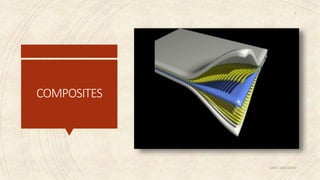
 A composite material (also called a composition material or
shortened to composite, which is the common name) is a material
made from two or more constituent materials with significantly
different physical or chemical properties that, when combined,
produce a material with characteristics different from the
individual components.
 Composite materials are generally used for buildings, bridges,
and structures such as boat hulls, swimming pool
panels, racingcar bodies, shower stalls, bathtubs, storagetanks, im
itation granite and cultured marble sinks and countertops. The
most advanced examples perform routinely
on spacecraft and aircraft in demanding environments
ABIN ABRAHAM
3
CLASSIFICATION
ABIN ABRAHAM
4
MATRIX&
REINFORCEMENT
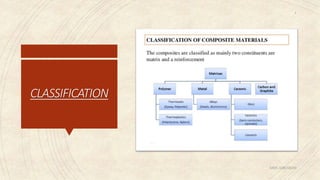
 A composite material consists of two major phases i.e
matrix and reinforcement.
 The matrix is basically a homogeneous and monolithic
material in which a fiber system of a composite is
embedded. It is completely continuous. The matrix
provides a medium for binding and holding
reinforcements together into a solid.
 The function of reinforcement material is to strengthen
the composite.
ABIN ABRAHAM
5
ADVANTAGES
OF
COMPOSITES
 Light in weight.
 Strength to weight and stiffness to
weight ratio are greater than steel or
aluminium.
 Fatigue properties are better than other
metals.
 These do not corrode like steel.
ABIN ABRAHAM
6
MATRIX
FUNCTIONS OF MATRIX
 Holds the fibres together.
 Protects the fibres from the environment.
 Distributes the loads evenly between the fibres.
 Improves impact and fracture resistance.
 Carry inter laminar shear
DESIRED PROPERTIES OF MATRIX
 Reduced moisture absorption.
 Low shrinkage.
 Low coefficient of expansion.
 Strength at elevated temperature.
 Excellent chemical resistance.
ABIN ABRAHAM
7
REINFORCEMENT
FUNCTIONS OF REINFORCEMENT
 Provides strength and stiffness to the composite material.
 Carries the load along the length of fiber.
 Increases the coefficient of thermal expansion and
conductivity.
DESIRED PROPERTIES OF
REINFORCEMENT
 High strength and stiffness.
 Low density.
 Thermal stability.
 High compression and tensile strength.
 Good process ability
ABIN ABRAHAM
8
POLYMERMATRIX
COMPOSITE(PMC)
 The reinforcement in a polymer matrix composite provides
strength and stiffness that are lacking in the matrix. The
composite is designed so that the mechanical loads to
which the structure is subjected in service are supported
by the reinforcement.
 PMCs are often divided into two categories: reinforced
plastics, and so-called advanced composites, The
distinction is based on the level of mechanical properties
(usually strength and stiffness).
 Advanced composites, which have been in use for only
about 15 years consist of fiber and matrix combinations
that yield superior strength and stiffness.
 Less than 2 percent of the material used in the reinforced
plastics/PMCs industry goes into advanced composites for
use in high-technology applications such as aircraft and
aerospace.
ABIN ABRAHAM
9
THERMOSETS
AND
THERMOPLASTICS
 The matrix phase of commercial PMCs can be
classified as either thermoset or thermoplastic.
 Thermosetting resins include polyesters, vinylesters,
epoxies, bismaleimides, and polyamides.
 Thermoplastic resins, sometimes called engineering
plastics, include some polyesters, poly - etherimide,
polyamide imide, polyphenylene sulfide, polyether-
etherketone (PEEK), and liquid crystal polymers.
 The continuous reinforcing fibers of advanced
composites are responsible for their high strength and
stiffness. The most important fibers in current use are
glass, graphite, and aramid. Other organic fibers, such
as oriented polyethylene, are also becoming important.
PMCs contain about 60 percent reinforcing fiber by
volume.
ABIN ABRAHAM
10
DIFFERENCES
THERMOPLASTICS
 Little cross linking.
 Ductile in nature.
 Softens on heating
 Ex : polycarbonate , polypropylene , polystyrene
THERMOSETS
 Large cross linking.
 Brittle in nature.
 Does not soften on heating.
 Ex : epoxy , vulcanised rubber , polyester
ABIN ABRAHAM
11
MERITS&
DEMERITS
MERITS OF PMC
 Light weight.
 Dimensional stability.
 Corrosion resistance.
 Design flexibility.
 durable
DEMERITS OF PMC
 Sensitive to radiation and moisture.
 High cost.
 Damages may occur internally & externally.
 Difficult to join with metals since PMC and metals expand
or contract at different temperatures.
ABIN ABRAHAM
12
PROPERTIES
 Low specific weight
 High material stability against corrosion
 Good electrical and thermal insulation
 Ease of shaping and economic mass
production
 Attractive optical properties
ABIN ABRAHAM
13
APPLICATIONS
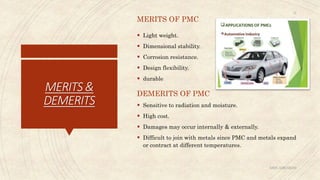
 Automotive industry - Body panels, leaf springs,
driveshaft, bumpers, doors, racing car bodies, and so on.
 Aircraft and aerospace industry - Used in the construction
of structural parts for military aircraft, space shuttles,
and satellite systems. The main purposes of using PMCs
are to reduce aircraft weight, which can improve its
performance, and to reduce its costs.
 Marine - Fibre glass boat bodies, as well as canoes and
kayaks.
 Sports goods - Used in performance footwear, sports
equipment and other sporting goods because of their
lightweight and high-strength properties.
 Biomedical applications - Medical implants, orthopaedic
devices, MRI scanners, X-ray tables, and prosthetics.
 Electrical - Panels, housing, switchgear, insulators, and
connectors. It also covers electronic devices like capacitors,
Li-ion and flexible batteries .
ABIN ABRAHAM
14
METAL MATRIX
COMPOSITE(MMC)
 MMC is a composite material with atleast one phase
being metal and the other may be any material such as
a ceramic or organic compound.
 The first MMC discovered was steel wire reinforced
copper.
 MMC’s are classified into : 1) dispersion hardened &
particle composite 2) layer composites 3) fiber
composites 4) infiltration composites.
 When at least three materials are present, it is called
a hybrid composite.
 the matrix is usually a lighter metal such
as aluminum, magnesium, or titanium, and provides a
compliant support for the reinforcement. In high-
temperature applications, cobalt and cobalt–nickel
alloy matrices are common.
ABIN ABRAHAM
15
PROPERTIES
 Low density.
 Mechanical compatibility.
 Thermal stability.
 High young’s modulus.
 High compression and tensile strength.
 Damping capacity.
 High stiffness and toughness.
ABIN ABRAHAM
16
MERITS&
DEMERITS
MERITS
 High temperature capability.
 No moisture absorption.
 Better radiation resistance.
 High electrical and thermal conductivity.
DEMERITS
 High cost.
 Complex fabrication methods.
ABIN ABRAHAM
17
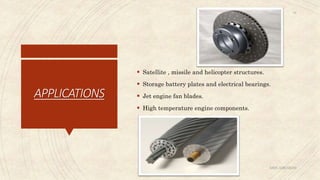
APPLICATIONS
 Satellite , missile and helicopter structures.
 Storage battery plates and electrical bearings.
 Jet engine fan blades.
 High temperature engine components.
ABIN ABRAHAM
18
CERAMIC
MATRIX
COMPOSITE
PROPERTIES OF CMC’s :
1.Tensile and compressive behaviour :
No sudden failure in CMC as like in Ceramics. Certain
amount of Elongation in CMC improves the tensile and
compressive property.
2.Fracture toughness :
It limits to ceramics, but for CMC’s fracture toughness
increases due to reinforcement.
3.Fatigue resistance :
Fatigue occurs due to cyclic loading, in case of CMC’s cracks
arrested by reinforcement. So higher Fatigue Resistance.
4.Thermal resistance.
5.Chemical inertness.
6.Corrosion resistance.
ABIN ABRAHAM
19
ADVANTAGES
 Excellent wear and corrosion resistance
in a wide range of environments and
temperature
 Higher strength to weight ratio
 Higher strength retention at elevated
temperature
 Higher chemical stability
 Non-catastrophic failure
 High hardness
 Lightweight
ABIN ABRAHAM
20
DISADVANTAGES
 Processing routes for CMCs involve high
temperatures & can only be employed with high
temperature reinforcements.
 CMCs are designed to improve toughness of
monolithic ceramics, the main disadvantage of
which is brittleness.
 High processing temperature results in
complexity in manufacturing and hence
expensive processing.
 Difference in the coefficients of thermal
expansion between the matrix and the
reinforcement lead to thermal stresses on cooling
from the processing temperatures.
ABIN ABRAHAM
21
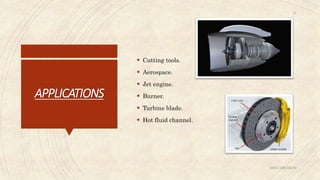
APPLICATIONS
 Cutting tools.
 Aerospace.
 Jet engine.
 Burner.
 Turbine blade.
 Hot fluid channel.
ABIN ABRAHAM
22
SUPER ALLOYS
ABIN ABRAHAM
23
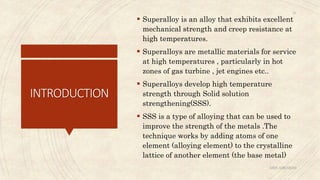
INTRODUCTION
 Superalloy is an alloy that exhibits excellent
mechanical strength and creep resistance at
high temperatures.
 Superalloys are metallic materials for service
at high temperatures , particularly in hot
zones of gas turbine , jet engines etc..
 Superalloys develop high temperature
strength through Solid solution
strengthening(SSS).
 SSS is a type of alloying that can be used to
improve the strength of the metals .The
technique works by adding atoms of one
element (alloying element) to the crystalline
lattice of another element (the base metal)
ABIN ABRAHAM
24
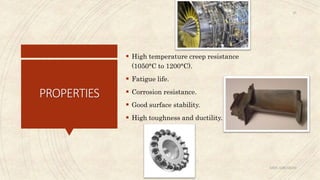
PROPERTIES
 High temperature creep resistance
(1050°C to 1200°C).
 Fatigue life.
 Corrosion resistance.
 Good surface stability.
 High toughness and ductility.
ABIN ABRAHAM
25
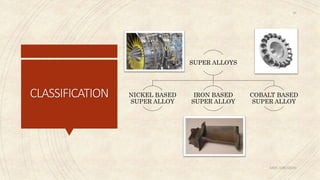
CLASSIFICATION
SUPER ALLOYS
NICKEL BASED
SUPER ALLOY
IRON BASED
SUPER ALLOY
COBALT BASED
SUPER ALLOY
ABIN ABRAHAM
26
NICKELBASED
SUPERALLOY
Nickel based Super alloys can be
either Solid solution strengthening
or Precipitation hardening.
Solid solution strengthened alloys
such as Hastelloy are used only in
applications which require very
modest strength.
Most Ni based alloy contain 10-
20% Cr, up to 8% Al and Ti, 5-10%
Co, and small amounts of B , Zr
and C.
ABIN ABRAHAM
27
HEAT
TREATMENTOF
NBSA
 Gamma (γ): This phase composes the matrix of Ni-based
superalloy. It is a solid solution fcc austenitic phase of the
alloying elements.
 Gamma Prime (γ'): This phase constitutes the precipitate
used to strengthen the alloy. It is an intermetallic phase
based on Ni3(Ti,Al) which have an ordered FCC structure.
 Gamma Double Prime (γ"): This phase typically possesses
the composition of Ni3Nb or Ni3V and is used to
strengthen Ni-based superalloys at lower temperatures
(<650 °C) relative to γ’.
 Carbide Phases: Carbide formation is usually considered
deleterious although in Ni-based superalloys they are
used to stabilize the structure of the material against
deformation at high temperatures.
 Topologically Close-Packed (TCP) Phases: The term "TCP
Phase" refers to any member of a family of phases
(including the σ phase, the χ phase, the μ phase, and
the Laves phase) which are not atomically close-packed
but possess some close-packed planes with HCP stacking.
TCP phases are characterized by their tendency to be
highly brittle.
ABIN ABRAHAM
28
COBALTBASED
SUPERALLOYS
Cobalt based Super alloys have
their origin in the stellite alloys.
Cobalt alloys have higher melting
points than nickel alloys . This
gives them the ability to absorb
stress to a higher temperature.
Cobalt alloys show superior
thermal fatigue resistance and
weldability over the nickel alloys.
ABIN ABRAHAM
29
IRONBASED
SUPERALLOYS
Iron based Super alloys are
characterized by high temperature
as well as room temperature
strength.
Apart from this, it will have good
resistance to creep , oxidation,
corrosion and wear.
Oxidation resistance increases with
chromium content.
ABIN ABRAHAM
30
APPLICATIONS
 Aircraft gas turbines: disks, combustion
chambers, bolts, casings, shafts, exhaust
systems, cases, blades, vanes, burner cans,
afterburners, thrust reversers .
 Steam turbine power plants: bolts, blades,
stack gas re-heaters .
 Reciprocating engines: turbochargers,
exhaust valves, hot plugs, valve seat inserts .
 Metal processing: hot-work tools and dies,
casting dies .
 Space vehicles: aerodynamically heated
skins, rocket engine parts .
ABIN ABRAHAM
31
ADVANTAGES
High strength.
Good elasticity.
Fatigue resistance.
Wear resistance.
Easy fabrication.
Light weight.
ABIN ABRAHAM
32
THANK YOU
BY : ABIN ABRAHAM
ABIN ABRAHAM
33

Composites and super alloys | ABIN ABRAHAM

  • 1.
  • 2.
  • 3.
    INTRODUCTION  A compositematerial (also called a composition material or shortened to composite, which is the common name) is a material made from two or more constituent materials with significantly different physical or chemical properties that, when combined, produce a material with characteristics different from the individual components.  Composite materials are generally used for buildings, bridges, and structures such as boat hulls, swimming pool panels, racingcar bodies, shower stalls, bathtubs, storagetanks, im itation granite and cultured marble sinks and countertops. The most advanced examples perform routinely on spacecraft and aircraft in demanding environments ABIN ABRAHAM 3
  • 4.
  • 5.
    MATRIX& REINFORCEMENT  A compositematerial consists of two major phases i.e matrix and reinforcement.  The matrix is basically a homogeneous and monolithic material in which a fiber system of a composite is embedded. It is completely continuous. The matrix provides a medium for binding and holding reinforcements together into a solid.  The function of reinforcement material is to strengthen the composite. ABIN ABRAHAM 5
  • 6.
    ADVANTAGES OF COMPOSITES  Light inweight.  Strength to weight and stiffness to weight ratio are greater than steel or aluminium.  Fatigue properties are better than other metals.  These do not corrode like steel. ABIN ABRAHAM 6
  • 7.
    MATRIX FUNCTIONS OF MATRIX Holds the fibres together.  Protects the fibres from the environment.  Distributes the loads evenly between the fibres.  Improves impact and fracture resistance.  Carry inter laminar shear DESIRED PROPERTIES OF MATRIX  Reduced moisture absorption.  Low shrinkage.  Low coefficient of expansion.  Strength at elevated temperature.  Excellent chemical resistance. ABIN ABRAHAM 7
  • 8.
    REINFORCEMENT FUNCTIONS OF REINFORCEMENT Provides strength and stiffness to the composite material.  Carries the load along the length of fiber.  Increases the coefficient of thermal expansion and conductivity. DESIRED PROPERTIES OF REINFORCEMENT  High strength and stiffness.  Low density.  Thermal stability.  High compression and tensile strength.  Good process ability ABIN ABRAHAM 8
  • 9.
    POLYMERMATRIX COMPOSITE(PMC)  The reinforcementin a polymer matrix composite provides strength and stiffness that are lacking in the matrix. The composite is designed so that the mechanical loads to which the structure is subjected in service are supported by the reinforcement.  PMCs are often divided into two categories: reinforced plastics, and so-called advanced composites, The distinction is based on the level of mechanical properties (usually strength and stiffness).  Advanced composites, which have been in use for only about 15 years consist of fiber and matrix combinations that yield superior strength and stiffness.  Less than 2 percent of the material used in the reinforced plastics/PMCs industry goes into advanced composites for use in high-technology applications such as aircraft and aerospace. ABIN ABRAHAM 9
  • 10.
    THERMOSETS AND THERMOPLASTICS  The matrixphase of commercial PMCs can be classified as either thermoset or thermoplastic.  Thermosetting resins include polyesters, vinylesters, epoxies, bismaleimides, and polyamides.  Thermoplastic resins, sometimes called engineering plastics, include some polyesters, poly - etherimide, polyamide imide, polyphenylene sulfide, polyether- etherketone (PEEK), and liquid crystal polymers.  The continuous reinforcing fibers of advanced composites are responsible for their high strength and stiffness. The most important fibers in current use are glass, graphite, and aramid. Other organic fibers, such as oriented polyethylene, are also becoming important. PMCs contain about 60 percent reinforcing fiber by volume. ABIN ABRAHAM 10
  • 11.
    DIFFERENCES THERMOPLASTICS  Little crosslinking.  Ductile in nature.  Softens on heating  Ex : polycarbonate , polypropylene , polystyrene THERMOSETS  Large cross linking.  Brittle in nature.  Does not soften on heating.  Ex : epoxy , vulcanised rubber , polyester ABIN ABRAHAM 11
  • 12.
    MERITS& DEMERITS MERITS OF PMC Light weight.  Dimensional stability.  Corrosion resistance.  Design flexibility.  durable DEMERITS OF PMC  Sensitive to radiation and moisture.  High cost.  Damages may occur internally & externally.  Difficult to join with metals since PMC and metals expand or contract at different temperatures. ABIN ABRAHAM 12
  • 13.
    PROPERTIES  Low specificweight  High material stability against corrosion  Good electrical and thermal insulation  Ease of shaping and economic mass production  Attractive optical properties ABIN ABRAHAM 13
  • 14.
    APPLICATIONS  Automotive industry- Body panels, leaf springs, driveshaft, bumpers, doors, racing car bodies, and so on.  Aircraft and aerospace industry - Used in the construction of structural parts for military aircraft, space shuttles, and satellite systems. The main purposes of using PMCs are to reduce aircraft weight, which can improve its performance, and to reduce its costs.  Marine - Fibre glass boat bodies, as well as canoes and kayaks.  Sports goods - Used in performance footwear, sports equipment and other sporting goods because of their lightweight and high-strength properties.  Biomedical applications - Medical implants, orthopaedic devices, MRI scanners, X-ray tables, and prosthetics.  Electrical - Panels, housing, switchgear, insulators, and connectors. It also covers electronic devices like capacitors, Li-ion and flexible batteries . ABIN ABRAHAM 14
  • 15.
    METAL MATRIX COMPOSITE(MMC)  MMCis a composite material with atleast one phase being metal and the other may be any material such as a ceramic or organic compound.  The first MMC discovered was steel wire reinforced copper.  MMC’s are classified into : 1) dispersion hardened & particle composite 2) layer composites 3) fiber composites 4) infiltration composites.  When at least three materials are present, it is called a hybrid composite.  the matrix is usually a lighter metal such as aluminum, magnesium, or titanium, and provides a compliant support for the reinforcement. In high- temperature applications, cobalt and cobalt–nickel alloy matrices are common. ABIN ABRAHAM 15
  • 16.
    PROPERTIES  Low density. Mechanical compatibility.  Thermal stability.  High young’s modulus.  High compression and tensile strength.  Damping capacity.  High stiffness and toughness. ABIN ABRAHAM 16
  • 17.
    MERITS& DEMERITS MERITS  High temperaturecapability.  No moisture absorption.  Better radiation resistance.  High electrical and thermal conductivity. DEMERITS  High cost.  Complex fabrication methods. ABIN ABRAHAM 17
  • 18.
    APPLICATIONS  Satellite ,missile and helicopter structures.  Storage battery plates and electrical bearings.  Jet engine fan blades.  High temperature engine components. ABIN ABRAHAM 18
  • 19.
    CERAMIC MATRIX COMPOSITE PROPERTIES OF CMC’s: 1.Tensile and compressive behaviour : No sudden failure in CMC as like in Ceramics. Certain amount of Elongation in CMC improves the tensile and compressive property. 2.Fracture toughness : It limits to ceramics, but for CMC’s fracture toughness increases due to reinforcement. 3.Fatigue resistance : Fatigue occurs due to cyclic loading, in case of CMC’s cracks arrested by reinforcement. So higher Fatigue Resistance. 4.Thermal resistance. 5.Chemical inertness. 6.Corrosion resistance. ABIN ABRAHAM 19
  • 20.
    ADVANTAGES  Excellent wearand corrosion resistance in a wide range of environments and temperature  Higher strength to weight ratio  Higher strength retention at elevated temperature  Higher chemical stability  Non-catastrophic failure  High hardness  Lightweight ABIN ABRAHAM 20
  • 21.
    DISADVANTAGES  Processing routesfor CMCs involve high temperatures & can only be employed with high temperature reinforcements.  CMCs are designed to improve toughness of monolithic ceramics, the main disadvantage of which is brittleness.  High processing temperature results in complexity in manufacturing and hence expensive processing.  Difference in the coefficients of thermal expansion between the matrix and the reinforcement lead to thermal stresses on cooling from the processing temperatures. ABIN ABRAHAM 21
  • 22.
    APPLICATIONS  Cutting tools. Aerospace.  Jet engine.  Burner.  Turbine blade.  Hot fluid channel. ABIN ABRAHAM 22
  • 23.
  • 24.
    INTRODUCTION  Superalloy isan alloy that exhibits excellent mechanical strength and creep resistance at high temperatures.  Superalloys are metallic materials for service at high temperatures , particularly in hot zones of gas turbine , jet engines etc..  Superalloys develop high temperature strength through Solid solution strengthening(SSS).  SSS is a type of alloying that can be used to improve the strength of the metals .The technique works by adding atoms of one element (alloying element) to the crystalline lattice of another element (the base metal) ABIN ABRAHAM 24
  • 25.
    PROPERTIES  High temperaturecreep resistance (1050°C to 1200°C).  Fatigue life.  Corrosion resistance.  Good surface stability.  High toughness and ductility. ABIN ABRAHAM 25
  • 26.
    CLASSIFICATION SUPER ALLOYS NICKEL BASED SUPERALLOY IRON BASED SUPER ALLOY COBALT BASED SUPER ALLOY ABIN ABRAHAM 26
  • 27.
    NICKELBASED SUPERALLOY Nickel based Superalloys can be either Solid solution strengthening or Precipitation hardening. Solid solution strengthened alloys such as Hastelloy are used only in applications which require very modest strength. Most Ni based alloy contain 10- 20% Cr, up to 8% Al and Ti, 5-10% Co, and small amounts of B , Zr and C. ABIN ABRAHAM 27
  • 28.
    HEAT TREATMENTOF NBSA  Gamma (γ):This phase composes the matrix of Ni-based superalloy. It is a solid solution fcc austenitic phase of the alloying elements.  Gamma Prime (γ'): This phase constitutes the precipitate used to strengthen the alloy. It is an intermetallic phase based on Ni3(Ti,Al) which have an ordered FCC structure.  Gamma Double Prime (γ"): This phase typically possesses the composition of Ni3Nb or Ni3V and is used to strengthen Ni-based superalloys at lower temperatures (<650 °C) relative to γ’.  Carbide Phases: Carbide formation is usually considered deleterious although in Ni-based superalloys they are used to stabilize the structure of the material against deformation at high temperatures.  Topologically Close-Packed (TCP) Phases: The term "TCP Phase" refers to any member of a family of phases (including the σ phase, the χ phase, the μ phase, and the Laves phase) which are not atomically close-packed but possess some close-packed planes with HCP stacking. TCP phases are characterized by their tendency to be highly brittle. ABIN ABRAHAM 28
  • 29.
    COBALTBASED SUPERALLOYS Cobalt based Superalloys have their origin in the stellite alloys. Cobalt alloys have higher melting points than nickel alloys . This gives them the ability to absorb stress to a higher temperature. Cobalt alloys show superior thermal fatigue resistance and weldability over the nickel alloys. ABIN ABRAHAM 29
  • 30.
    IRONBASED SUPERALLOYS Iron based Superalloys are characterized by high temperature as well as room temperature strength. Apart from this, it will have good resistance to creep , oxidation, corrosion and wear. Oxidation resistance increases with chromium content. ABIN ABRAHAM 30
  • 31.
    APPLICATIONS  Aircraft gasturbines: disks, combustion chambers, bolts, casings, shafts, exhaust systems, cases, blades, vanes, burner cans, afterburners, thrust reversers .  Steam turbine power plants: bolts, blades, stack gas re-heaters .  Reciprocating engines: turbochargers, exhaust valves, hot plugs, valve seat inserts .  Metal processing: hot-work tools and dies, casting dies .  Space vehicles: aerodynamically heated skins, rocket engine parts . ABIN ABRAHAM 31
  • 32.
    ADVANTAGES High strength. Good elasticity. Fatigueresistance. Wear resistance. Easy fabrication. Light weight. ABIN ABRAHAM 32
  • 33.
    THANK YOU BY :ABIN ABRAHAM ABIN ABRAHAM 33