Introduction
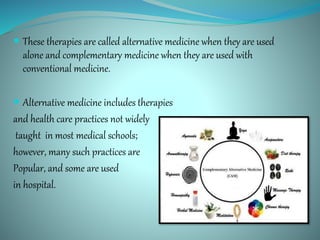
 Complementary and alternative medicine (CAM) includes
various healing approaches and therapies that originate
from around the world and that are not based on
conventional western medicine.
 These therapies are called alternative medicine when they are used
alone and complementary medicine when they are used with
conventional medicine.
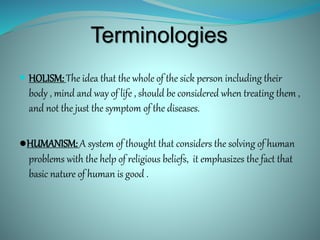
 Alternative medicine includes therapies
and health care practices not widely
taught in most medical schools;
however, many such practices are
Popular, and some are used
in hospital.
Terminologies
 HOLISM: The idea that the whole of the sick person including their
body , mind and way of life , should be considered when treating them ,
and not the just the symptom of the diseases.
●HUMANISM: A system of thought that considers the solving of human
problems with the help of religious beliefs, it emphasizes the fact that
basic nature of human is good .
 BALANCE : A Situation in which different things exist in equal , correct
or good amount.
 ENERGY : The ability to put effort and enthusiasm into an activity ,
work etc.
 HEALING: The process of returning to normal function after a period
of disease or injury.
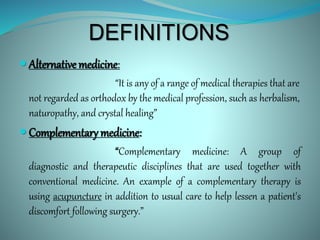
DEFINITIONS
 Alternative medicine:
“It is any of a range of medical therapies that are
not regarded as orthodox by the medical profession, such as herbalism,
naturopathy, and crystal healing”
 Complementary medicine:
“Complementary medicine: A group of
diagnostic and therapeutic disciplines that are used together with
conventional medicine. An example of a complementary therapy is
using acupuncture in addition to usual care to help lessen a patient's
discomfort following surgery.”
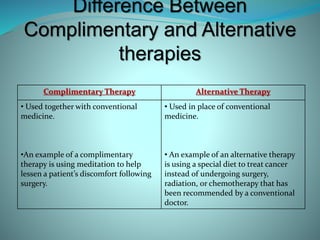
Difference Between
Complimentary and Alternative
therapies
Complimentary Therapy Alternative Therapy
• Used together with conventional
medicine.
•An example of a complimentary
therapy is using meditation to help
lessen a patient’s discomfort following
surgery.
• Used in place of conventional
medicine.
• An example of an alternative therapy
is using a special diet to treat cancer
instead of undergoing surgery,
radiation, or chemotherapy that has
been recommended by a conventional
doctor.
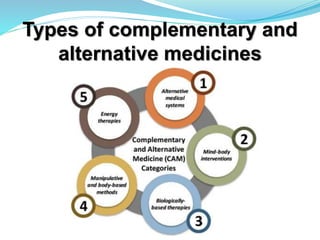
Types of complementary and
alternative medicines
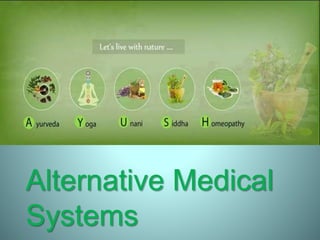
Alternative Medical
Systems
AYURVEDA
 AYURVEDA is a system of healing
based on homeopathy and naturopathy,
with an extensive use of
herbs.
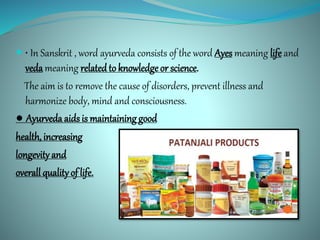
 • In Sanskrit , word ayurveda consists of the word Ayes meaning life and
veda meaning related to knowledgeor science.
The aim is to remove the cause of disorders, prevent illness and
harmonize body, mind and consciousness.
● Ayurveda aids is maintaining good
health, increasing
longevity and
overall qualityof life.
Examples:
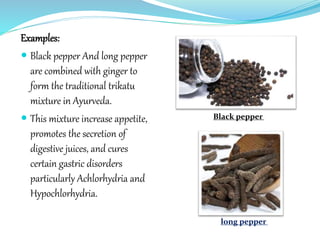
 Black pepper And long pepper
are combined with ginger to
form the traditional trikatu
mixture in Ayurveda.
 This mixture increase appetite,
promotes the secretion of
digestive juices, and cures
certain gastric disorders
particularly Achlorhydria and
Hypochlorhydria.
Black pepper
long pepper
Siddha
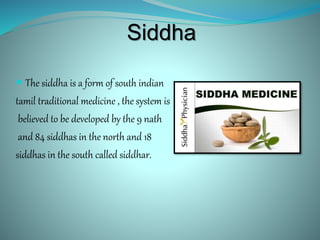
 The siddha is a form of south indian
tamil traditional medicine , the system is
believed to be developed by the 9 nath
and 84 siddhas in the north and 18
siddhas in the south called siddhar.
 Siddharas were the concept that a healthy body, the treatment in
siddha medicines in aimed at keeping the three humours in
equilibrium and maintenance of seven elements it is assumed that
when the normal equilibrium of three humours vatha, pitha & kapha is
distributed diseasecaused.
Unani and tibbi
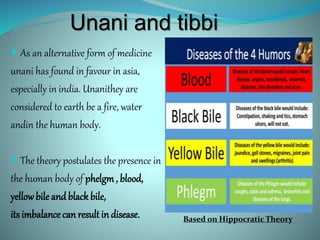
 As an alternative form of medicine
unani has found in favour in asia,
especially in india. Unanithey are
considered to earth be a fire, water
andin the human body.
 The theory postulates the presence in
the human body of phelgm, blood,
yellowbile and black bile,
its imbalance can result in disease. Based on Hippocratic Theory
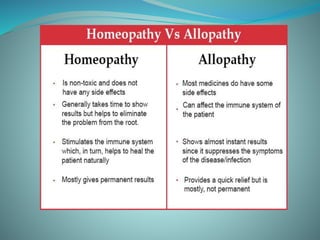
Homeopathy
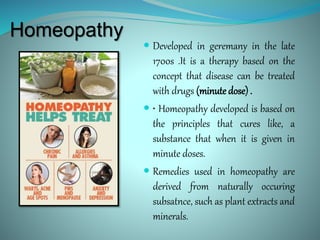
 Developed in geremany in the late
1700s .It is a therapy based on the
concept that disease can be treated
with drugs (minute dose) .
 • Homeopathy developed is based on
the principles that cures like, a
substance that when it is given in
minute doses.
 Remedies used in homeopathy are
derived from naturally occuring
subsatnce, such as plant extracts and
minerals.
Example: Homeopathic remedy Rhus toxicodendron, derived from
poison ivy substance prepared with particular procedure and intended
for treating patient.
Nosodes : Made from pathological product such as fecal, uirnary, and
respiratory discharges, blood and tissue.
Sarcodes : Homeopathic remedies prepared from healthy specimens.
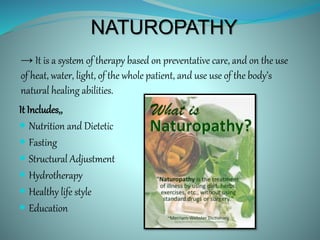
NATUROPATHY
It Includes,,
 Nutrition and Dietetic
 Fasting
 Structural Adjustment
 Hydrotherapy
 Healthy life style
 Education
→ It is a system of therapy based on preventative care, and on the use
of heat, water, light, of the whole patient, and use use of the body’s
natural healing abilities.
Biologically based
treatments
 Herbal medicine: has always attracted some interest many well known
drugs are plant dervied.
• Eg;
digoxin from foxglows and morphine from poppies
• St John’s Wort is a safe and effective treatment for mild to moderate
depression. It may also help fatigue possibly because fatigue is a
common aspect of depression.
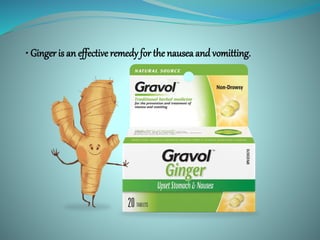
• Ginger is an effective remedy for the nausea and vomitting.
 Nutritional therapy:
 Nutritional therapy is a system of healing based on the belief that food,
as nature intended, provides the medicine we need to obtain and
maintain a state of health.
 Many condition can be relived effectively with nutritional therapy.
These include disorders ranging from chronic fatigue, energy loss,
insomnia and depression, backache, skin complaints, asthma, and
headaches.
 Nutritional therapy will also benefit you if you have no specific illness,
but want to maintain a state of optimum health.
Mind Body Technique
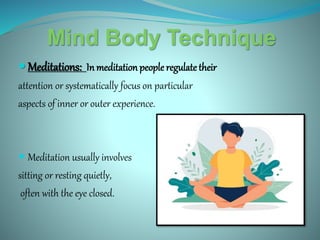
 Meditations: In meditation people regulatetheir
attention or systematically focus on particular
aspects of inner or outer experience.
 Meditation usually involves
sitting or resting quietly,
often with the eye closed.
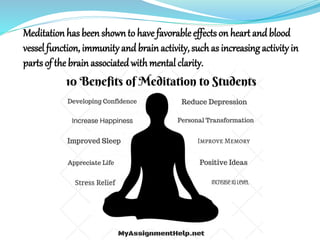
Meditation has been shownto have favorable effects on heart and blood
vessel function, immunity and brainactivity, suchas increasing activity in
parts of the brain associated with mental clarity.
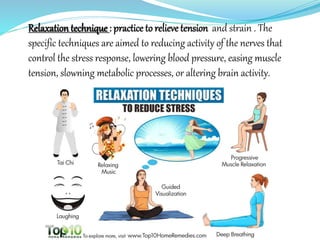
Relaxation technique : practice to relieve tension and strain . The
specific techniques are aimed to reducing activity of the nerves that
control the stress response, lowering blood pressure, easing muscle
tension, slowning metabolic processes, or altering brain activity.
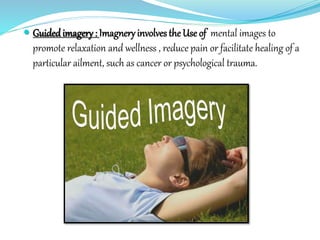
 Guidedimagery : Imagneryinvolves the Use of mental images to
promote relaxation and wellness , reduce pain or facilitate healing of a
particular ailment, such as cancer or psychological trauma.
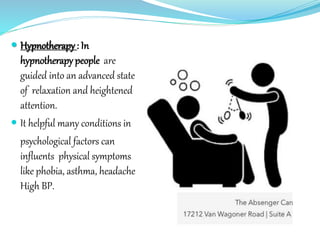
 Hypnotherapy: In
hypnotherapy people are
guided into an advanced state
of relaxation and heightened
attention.
 It helpful many conditions in
psychological factors can
influents physical symptoms
like phobia, asthma, headache
High BP.
Manipulative and body based
methods
Yoga
Chiropractice
Tai Chi & Qigong
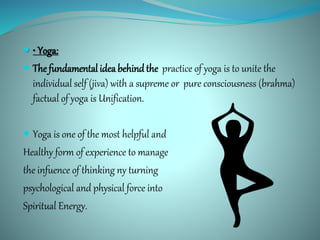
 • Yoga:
 The fundamental idea behindthe practice of yoga is to unite the
individual self (jiva) with a supreme or pure consciousness (brahma)
factual of yoga is Unification.
 Yoga is one of the most helpful and
Healthy form of experience to manage
the infuence of thinking ny turning
psychological and physical force into
Spiritual Energy.
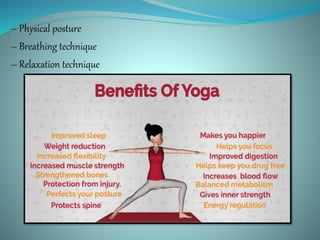
– Physical posture
– Breathing technique
– Relaxation technique
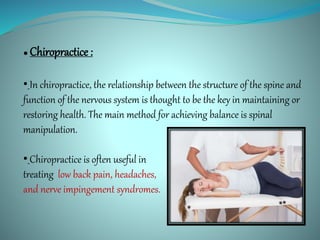
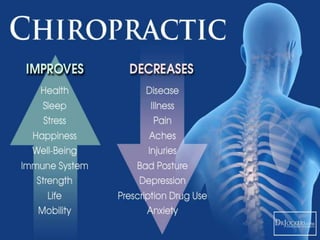
● Chiropractice :
• In chiropractice, the relationship between the structure of the spine and
function of the nervous system is thought to be the key in maintaining or
restoring health. The main method for achieving balance is spinal
manipulation.
• Chiropractice is often useful in
treating low back pain, headaches,
and nerve impingement syndromes.
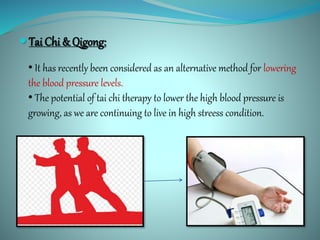
 Tai Chi & Qigong:
• It has recently been considered as an alternative method for lowering
the blood pressure levels.
• The potential of tai chi therapy to lower the high blood pressure is
growing, as we are continuing to live in high streess condition.
Energy therapies
1. Massage therapy
2. Acupuncture
3. Reflexology
4. Hand Mediated Bio Field Therapies
 Massage therapy:
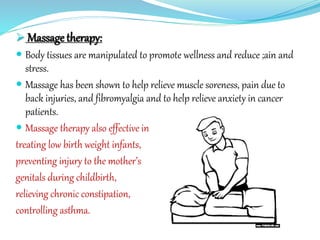
 Body tissues are manipulated to promote wellness and reduce ;ain and
stress.
 Massage has been shown to help relieve muscle soreness, pain due to
back injuries, and fibromyalgia and to help relieve anxiety in cancer
patients.
 Massage therapy also effective in
treating low birth weight infants,
preventing injury to the mother’s
genitals during childbirth,
relieving chronic constipation,
controlling asthma.
 Acupuncture:
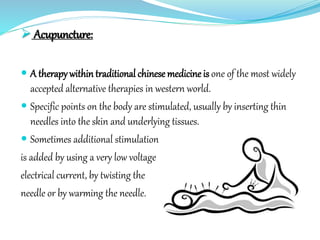
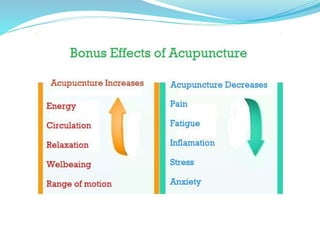
 A therapywithin traditional chinese medicine is one of the most widely
accepted alternative therapies in western world.
 Specific points on the body are stimulated, usually by inserting thin
needles into the skin and underlying tissues.
 Sometimes additional stimulation
is added by using a very low voltage
electrical current, by twisting the
needle or by warming the needle.
 Reflexology:
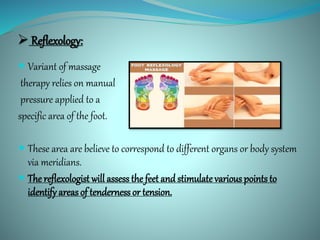
 Variant of massage
therapy relies on manual
pressure applied to a
specific area of the foot.
 These area are believe to correspond to different organs or body system
via meridians.
 The reflexologist will assess the feet and stimulatevarious points to
identify areas of tenderness or tension.
 Hand mediated bio field therapy:
 Therapeutic touch (TT) is a mostly secular variant of faith healing,
started by dolarse Krieger in the early 1970’s.
 The therapeutic touch practitioner moves his hands over the patients
body, specifically the affected area without actually touching the
patient,
“No Evidence Of Effectiveness Has BeenFound”
Other Therapies
(1) Traditional Chinese Medicine (6) Humor and Laughter
(2) Curanderismo (7) Bioelectromegnatic therapy
(3) Aroma therapy (8) Photo energy therapy
(4) Spiritual therapy (9) Detoxification therapy
(5) Music therapy (10) Animal assisited therapy
(11) Horticultural therapy
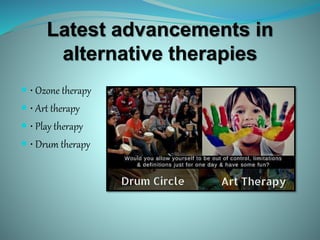
Latest advancements in
alternative therapies
 • Ozone therapy
 • Art therapy
 • Play therapy
 • Drum therapy
Alternative and complimentry medicine

Alternative and complimentry medicine

  • 2.
    Introduction  Complementary andalternative medicine (CAM) includes various healing approaches and therapies that originate from around the world and that are not based on conventional western medicine.
  • 3.
     These therapiesare called alternative medicine when they are used alone and complementary medicine when they are used with conventional medicine.  Alternative medicine includes therapies and health care practices not widely taught in most medical schools; however, many such practices are Popular, and some are used in hospital.
  • 4.
    Terminologies  HOLISM: Theidea that the whole of the sick person including their body , mind and way of life , should be considered when treating them , and not the just the symptom of the diseases. ●HUMANISM: A system of thought that considers the solving of human problems with the help of religious beliefs, it emphasizes the fact that basic nature of human is good .
  • 5.
     BALANCE :A Situation in which different things exist in equal , correct or good amount.  ENERGY : The ability to put effort and enthusiasm into an activity , work etc.  HEALING: The process of returning to normal function after a period of disease or injury.
  • 6.
    DEFINITIONS  Alternative medicine: “Itis any of a range of medical therapies that are not regarded as orthodox by the medical profession, such as herbalism, naturopathy, and crystal healing”  Complementary medicine: “Complementary medicine: A group of diagnostic and therapeutic disciplines that are used together with conventional medicine. An example of a complementary therapy is using acupuncture in addition to usual care to help lessen a patient's discomfort following surgery.”
  • 7.
    Difference Between Complimentary andAlternative therapies Complimentary Therapy Alternative Therapy • Used together with conventional medicine. •An example of a complimentary therapy is using meditation to help lessen a patient’s discomfort following surgery. • Used in place of conventional medicine. • An example of an alternative therapy is using a special diet to treat cancer instead of undergoing surgery, radiation, or chemotherapy that has been recommended by a conventional doctor.
  • 8.
    Types of complementaryand alternative medicines
  • 9.
  • 10.
    AYURVEDA  AYURVEDA isa system of healing based on homeopathy and naturopathy, with an extensive use of herbs.
  • 11.
     • InSanskrit , word ayurveda consists of the word Ayes meaning life and veda meaning related to knowledgeor science. The aim is to remove the cause of disorders, prevent illness and harmonize body, mind and consciousness. ● Ayurveda aids is maintaining good health, increasing longevity and overall qualityof life.
  • 12.
    Examples:  Black pepperAnd long pepper are combined with ginger to form the traditional trikatu mixture in Ayurveda.  This mixture increase appetite, promotes the secretion of digestive juices, and cures certain gastric disorders particularly Achlorhydria and Hypochlorhydria. Black pepper long pepper
  • 13.
    Siddha  The siddhais a form of south indian tamil traditional medicine , the system is believed to be developed by the 9 nath and 84 siddhas in the north and 18 siddhas in the south called siddhar.
  • 14.
     Siddharas werethe concept that a healthy body, the treatment in siddha medicines in aimed at keeping the three humours in equilibrium and maintenance of seven elements it is assumed that when the normal equilibrium of three humours vatha, pitha & kapha is distributed diseasecaused.
  • 15.
    Unani and tibbi As an alternative form of medicine unani has found in favour in asia, especially in india. Unanithey are considered to earth be a fire, water andin the human body.  The theory postulates the presence in the human body of phelgm, blood, yellowbile and black bile, its imbalance can result in disease. Based on Hippocratic Theory
  • 16.
    Homeopathy  Developed ingeremany in the late 1700s .It is a therapy based on the concept that disease can be treated with drugs (minute dose) .  • Homeopathy developed is based on the principles that cures like, a substance that when it is given in minute doses.  Remedies used in homeopathy are derived from naturally occuring subsatnce, such as plant extracts and minerals.
  • 17.
    Example: Homeopathic remedyRhus toxicodendron, derived from poison ivy substance prepared with particular procedure and intended for treating patient. Nosodes : Made from pathological product such as fecal, uirnary, and respiratory discharges, blood and tissue. Sarcodes : Homeopathic remedies prepared from healthy specimens.
  • 19.
    NATUROPATHY It Includes,,  Nutritionand Dietetic  Fasting  Structural Adjustment  Hydrotherapy  Healthy life style  Education → It is a system of therapy based on preventative care, and on the use of heat, water, light, of the whole patient, and use use of the body’s natural healing abilities.
  • 20.
    Biologically based treatments  Herbalmedicine: has always attracted some interest many well known drugs are plant dervied. • Eg; digoxin from foxglows and morphine from poppies • St John’s Wort is a safe and effective treatment for mild to moderate depression. It may also help fatigue possibly because fatigue is a common aspect of depression.
  • 21.
    • Ginger isan effective remedy for the nausea and vomitting.
  • 22.
     Nutritional therapy: Nutritional therapy is a system of healing based on the belief that food, as nature intended, provides the medicine we need to obtain and maintain a state of health.  Many condition can be relived effectively with nutritional therapy. These include disorders ranging from chronic fatigue, energy loss, insomnia and depression, backache, skin complaints, asthma, and headaches.  Nutritional therapy will also benefit you if you have no specific illness, but want to maintain a state of optimum health.
  • 23.
    Mind Body Technique Meditations: In meditation people regulatetheir attention or systematically focus on particular aspects of inner or outer experience.  Meditation usually involves sitting or resting quietly, often with the eye closed.
  • 24.
    Meditation has beenshownto have favorable effects on heart and blood vessel function, immunity and brainactivity, suchas increasing activity in parts of the brain associated with mental clarity.
  • 25.
    Relaxation technique :practice to relieve tension and strain . The specific techniques are aimed to reducing activity of the nerves that control the stress response, lowering blood pressure, easing muscle tension, slowning metabolic processes, or altering brain activity.
  • 26.
     Guidedimagery :Imagneryinvolves the Use of mental images to promote relaxation and wellness , reduce pain or facilitate healing of a particular ailment, such as cancer or psychological trauma.
  • 27.
     Hypnotherapy: In hypnotherapypeople are guided into an advanced state of relaxation and heightened attention.  It helpful many conditions in psychological factors can influents physical symptoms like phobia, asthma, headache High BP.
  • 28.
    Manipulative and bodybased methods Yoga Chiropractice Tai Chi & Qigong
  • 29.
     • Yoga: The fundamental idea behindthe practice of yoga is to unite the individual self (jiva) with a supreme or pure consciousness (brahma) factual of yoga is Unification.  Yoga is one of the most helpful and Healthy form of experience to manage the infuence of thinking ny turning psychological and physical force into Spiritual Energy.
  • 30.
    – Physical posture –Breathing technique – Relaxation technique
  • 31.
    ● Chiropractice : •In chiropractice, the relationship between the structure of the spine and function of the nervous system is thought to be the key in maintaining or restoring health. The main method for achieving balance is spinal manipulation. • Chiropractice is often useful in treating low back pain, headaches, and nerve impingement syndromes.
  • 33.
     Tai Chi& Qigong: • It has recently been considered as an alternative method for lowering the blood pressure levels. • The potential of tai chi therapy to lower the high blood pressure is growing, as we are continuing to live in high streess condition.
  • 34.
    Energy therapies 1. Massagetherapy 2. Acupuncture 3. Reflexology 4. Hand Mediated Bio Field Therapies
  • 35.
     Massage therapy: Body tissues are manipulated to promote wellness and reduce ;ain and stress.  Massage has been shown to help relieve muscle soreness, pain due to back injuries, and fibromyalgia and to help relieve anxiety in cancer patients.  Massage therapy also effective in treating low birth weight infants, preventing injury to the mother’s genitals during childbirth, relieving chronic constipation, controlling asthma.
  • 36.
     Acupuncture:  Atherapywithin traditional chinese medicine is one of the most widely accepted alternative therapies in western world.  Specific points on the body are stimulated, usually by inserting thin needles into the skin and underlying tissues.  Sometimes additional stimulation is added by using a very low voltage electrical current, by twisting the needle or by warming the needle.
  • 38.
     Reflexology:  Variantof massage therapy relies on manual pressure applied to a specific area of the foot.  These area are believe to correspond to different organs or body system via meridians.  The reflexologist will assess the feet and stimulatevarious points to identify areas of tenderness or tension.
  • 39.
     Hand mediatedbio field therapy:  Therapeutic touch (TT) is a mostly secular variant of faith healing, started by dolarse Krieger in the early 1970’s.  The therapeutic touch practitioner moves his hands over the patients body, specifically the affected area without actually touching the patient, “No Evidence Of Effectiveness Has BeenFound”
  • 40.
    Other Therapies (1) TraditionalChinese Medicine (6) Humor and Laughter (2) Curanderismo (7) Bioelectromegnatic therapy (3) Aroma therapy (8) Photo energy therapy (4) Spiritual therapy (9) Detoxification therapy (5) Music therapy (10) Animal assisited therapy (11) Horticultural therapy
  • 41.
    Latest advancements in alternativetherapies  • Ozone therapy  • Art therapy  • Play therapy  • Drum therapy