COMPETING
AGAINST FREE
PGP31269 | Kavya Bhargava
IEP17005 | Tom T'Seyen
PGP31282 | Sharath Kumar
PGP31294 | Somya Singh
BRAND MANAGEMENT
SECTION B
GROUP 2
WHAT ARE THE
KEY TAKEAWAYS ?
Case Lessons
Brand Management concepts
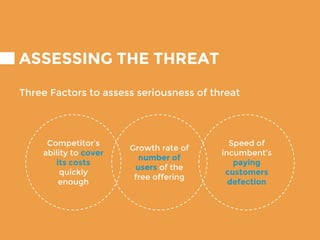
ASSESSING THE THREAT
Three Factors to assess seriousness of threat
Growth rate of
number of
users of the
free offering
Competitor’s
ability to cover
its costs
quickly
enough
Speed of
incumbent’s
paying
customers
defection
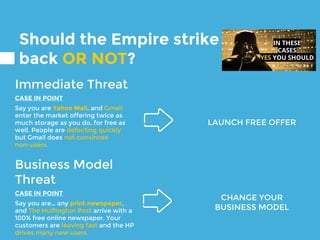
Should the Empire strike
back OR NOT?
Immediate Threat
CASE IN POINT
Say you are Yahoo Mail, and Gmail
enter the market offering twice as
much storage as you do, for free as
well. People are defecting quickly
but Gmail does not convinces
non-users.
Business Model
Threat
CASE IN POINT
Say you are… any print newspaper,
and The Huffington Post arrive with a
100% free online newspaper. Your
customers are leaving fast and the HP
drives many new users.
CHANGE YOUR
BUSINESS MODEL
LAUNCH FREE OFFER
IN THESE
CASES
YES YOU SHOULD
Moderate
threat
Your customers are defecting
slowly and competitor lures
users slowly
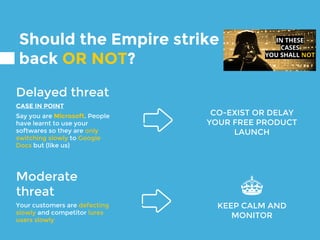
Delayed threat
CASE IN POINT
Say you are Microsoft. People
have learnt to use your
softwares so they are only
switching slowly to Google
Docs but (like us)
Should the Empire strike
back OR NOT?
KEEP CALM AND
MONITOR
CO-EXIST OR DELAY
YOUR FREE PRODUCT
LAUNCH
IN THESE
CASES
YOU SHALL NOT
HOW DO
INCUMBENTS
REACT & WHAT
WORKS ?
Examples
Brand Management concepts
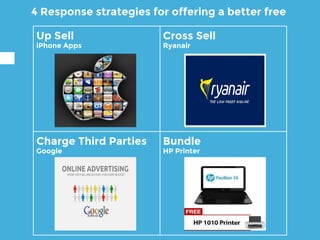
Up Sell
iPhone Apps
Cross Sell
Ryanair
Charge Third Parties
Google
Bundle
HP Printer
4 Response strategies for offering a better free
Incumbents Fail to counter attack
○ Various instances when incumbent
does not react
○ CASE IN POINT
● Most of the newspapers were reluctant to
embrace the free classified model when
Craigslist attacked their business model
● HBO when Netflix entered
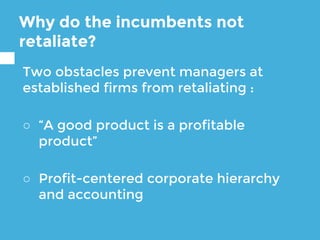
Why do the incumbents not
retaliate?
Two obstacles prevent managers at
established firms from retaliating :
○ “A good product is a profitable
product”
○ Profit-centered corporate hierarchy
and accounting
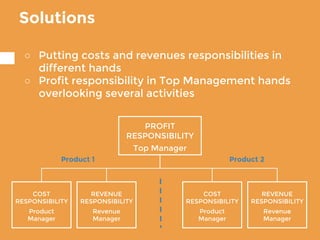
Solutions
○ Putting costs and revenues responsibilities in
different hands
○ Profit responsibility in Top Management hands
overlooking several activities
COST
RESPONSIBILITY
Product
Manager
REVENUE
RESPONSIBILITY
Revenue
Manager
PROFIT
RESPONSIBILITY
Top Manager
COST
RESPONSIBILITY
Product
Manager
REVENUE
RESPONSIBILITY
Revenue
Manager
Product 1 Product 2
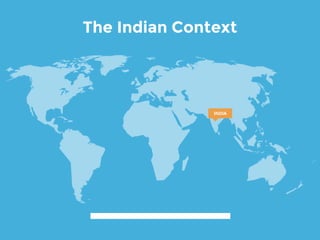
The Indian Context
INDIA
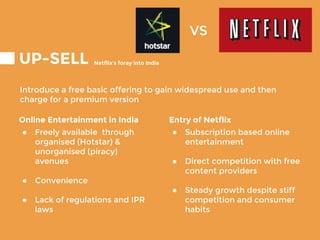
UP-SELL
Introduce a free basic offering to gain widespread use and then
charge for a premium version
Online Entertainment in India
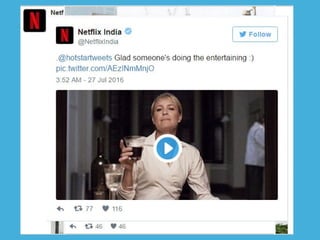
● Freely available through
organised (Hotstar) &
unorganised (piracy)
avenues
● Convenience
● Lack of regulations and IPR
laws
Entry of Netflix
● Subscription based online
entertainment
● Direct competition with free
content providers
● Steady growth despite stiff
competition and consumer
habits
Netflix’s foray into India
VS
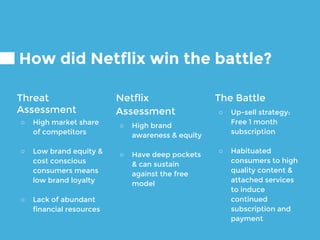
How did Netflix win the battle?
Threat
Assessment
○ High market share
of competitors
○ Low brand equity &
cost conscious
consumers means
low brand loyalty
○ Lack of abundant
financial resources
Netflix
Assessment
○ High brand
awareness & equity
○ Have deep pockets
& can sustain
against the free
model
The Battle
○ Up-sell strategy:
Free 1 month
subscription
○ Habituated
consumers to high
quality content &
attached services
to induce
continued
subscription and
payment
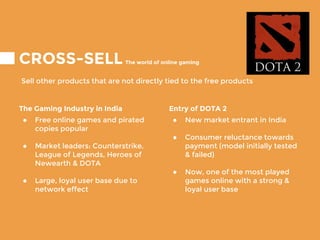
CROSS-SELL
Sell other products that are not directly tied to the free products
The Gaming Industry in India
● Free online games and pirated
copies popular
● Market leaders: Counterstrike,
League of Legends, Heroes of
Newearth & DOTA
● Large, loyal user base due to
network effect
Entry of DOTA 2
● New market entrant in India
● Consumer reluctance towards
payment (model initially tested
& failed)
● Now, one of the most played
games online with a strong &
loyal user base
The world of online gaming
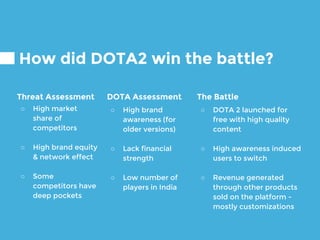
How did DOTA2 win the battle?
Threat Assessment
○ High market
share of
competitors
○ High brand equity
& network effect
○ Some
competitors have
deep pockets
DOTA Assessment
○ High brand
awareness (for
older versions)
○ Lack financial
strength
○ Low number of
players in India
The Battle
○ DOTA 2 launched for
free with high quality
content
○ High awareness induced
users to switch
○ Revenue generated
through other products
sold on the platform -
mostly customizations
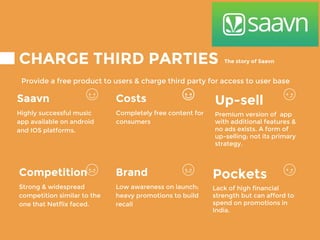
CHARGE THIRD PARTIES
Provide a free product to users & charge third party for access to user base
The story of Saavn
Saavn
Highly successful music
app available on android
and IOS platforms.
Costs
Completely free content for
consumers
Up-sell
Premium version of app
with additional features &
no ads exists. A form of
up-selling; not its primary
strategy.
Competition
Strong & widespread
competition similar to the
one that Netflix faced.
Brand
Low awareness on launch;
heavy promotions to build
recall
Pockets
Lack of high financial
strength but can afford to
spend on promotions in
India.
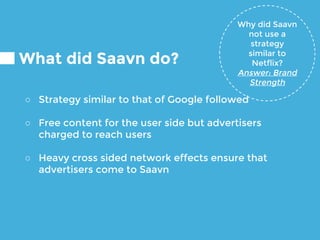
What did Saavn do?
○ Strategy similar to that of Google followed
○ Free content for the user side but advertisers
charged to reach users
○ Heavy cross sided network effects ensure that
advertisers come to Saavn
Why did Saavn
not use a
strategy
similar to
Netflix?
Answer: Brand
Strength
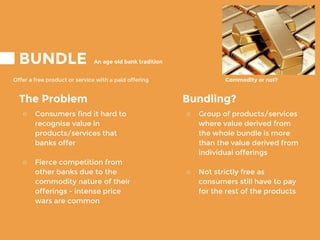
BUNDLE
Offer a free product or service with a paid offering
An age old bank tradition
Commodity or not?
Bundling?
○ Group of products/services
where value derived from
the whole bundle is more
than the value derived from
individual offerings
○ Not strictly free as
consumers still have to pay
for the rest of the products
The Problem
○ Consumers find it hard to
recognise value in
products/services that
banks offer
○ Fierce competition from
other banks due to the
commodity nature of their
offerings - intense price
wars are common
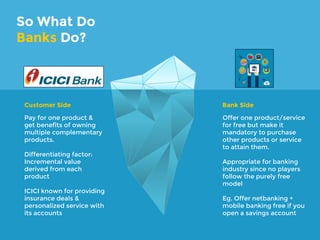
So What Do
Banks Do?
Customer Side
Pay for one product &
get benefits of owning
multiple complementary
products.
Differentiating factor:
Incremental value
derived from each
product
ICICI known for providing
insurance deals &
personalized service with
its accounts
Bank Side
Offer one product/service
for free but make it
mandatory to purchase
other products or service
to attain them.
Appropriate for banking
industry since no players
follow the purely free
model
Eg. Offer netbanking +
mobile banking free if you
open a savings account
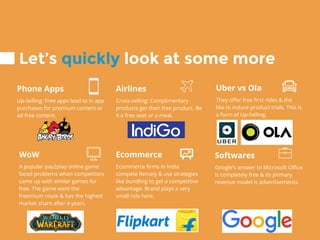
Let’s quickly look at some more
Phone Apps
Up-Selling: Free apps lead to in app
purchases for premium content or
ad free content.
Airlines
Cross-selling: Complimentary
products get their free product. Be
it a free seat or a meal.
Softwares
Google’s answer to Microsoft Office
is completely free & its primary
revenue model is advertisements.
WoW
A popular pay2play online game
faced problems when competitors
came up with similar games for
free. The game went the
freemium route & has the highest
market share after 4 years.
Ecommerce
Ecommerce firms in India
compete fiercely & use strategies
like bundling to get a competitive
advantage. Brand plays a very
small role here.
Uber vs Ola
They offer free first rides & the
like to induce product trials. This is
a form of Up-Selling.
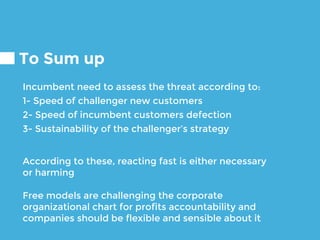
To Sum up
Incumbent need to assess the threat according to:
1- Speed of challenger new customers
2- Speed of incumbent customers defection
3- Sustainability of the challenger’s strategy
According to these, reacting fast is either necessary
or harming
Free models are challenging the corporate
organizational chart for profits accountability and
companies should be flexible and sensible about it
ANY QUESTIONS ?
(We won’t charge you for that,
so feel free to ask)

Competing against free grp 2 sec b

  • 1.
    COMPETING AGAINST FREE PGP31269 |Kavya Bhargava IEP17005 | Tom T'Seyen PGP31282 | Sharath Kumar PGP31294 | Somya Singh BRAND MANAGEMENT SECTION B GROUP 2
  • 2.
    WHAT ARE THE KEYTAKEAWAYS ? Case Lessons Brand Management concepts
  • 3.
    ASSESSING THE THREAT ThreeFactors to assess seriousness of threat Growth rate of number of users of the free offering Competitor’s ability to cover its costs quickly enough Speed of incumbent’s paying customers defection
  • 4.
    Should the Empirestrike back OR NOT? Immediate Threat CASE IN POINT Say you are Yahoo Mail, and Gmail enter the market offering twice as much storage as you do, for free as well. People are defecting quickly but Gmail does not convinces non-users. Business Model Threat CASE IN POINT Say you are… any print newspaper, and The Huffington Post arrive with a 100% free online newspaper. Your customers are leaving fast and the HP drives many new users. CHANGE YOUR BUSINESS MODEL LAUNCH FREE OFFER IN THESE CASES YES YOU SHOULD
  • 5.
    Moderate threat Your customers aredefecting slowly and competitor lures users slowly Delayed threat CASE IN POINT Say you are Microsoft. People have learnt to use your softwares so they are only switching slowly to Google Docs but (like us) Should the Empire strike back OR NOT? KEEP CALM AND MONITOR CO-EXIST OR DELAY YOUR FREE PRODUCT LAUNCH IN THESE CASES YOU SHALL NOT
  • 6.
    HOW DO INCUMBENTS REACT &WHAT WORKS ? Examples Brand Management concepts
  • 7.
    Up Sell iPhone Apps CrossSell Ryanair Charge Third Parties Google Bundle HP Printer 4 Response strategies for offering a better free
  • 8.
    Incumbents Fail tocounter attack ○ Various instances when incumbent does not react ○ CASE IN POINT ● Most of the newspapers were reluctant to embrace the free classified model when Craigslist attacked their business model ● HBO when Netflix entered
  • 9.
    Why do theincumbents not retaliate? Two obstacles prevent managers at established firms from retaliating : ○ “A good product is a profitable product” ○ Profit-centered corporate hierarchy and accounting
  • 10.
    Solutions ○ Putting costsand revenues responsibilities in different hands ○ Profit responsibility in Top Management hands overlooking several activities COST RESPONSIBILITY Product Manager REVENUE RESPONSIBILITY Revenue Manager PROFIT RESPONSIBILITY Top Manager COST RESPONSIBILITY Product Manager REVENUE RESPONSIBILITY Revenue Manager Product 1 Product 2
  • 11.
  • 12.
    UP-SELL Introduce a freebasic offering to gain widespread use and then charge for a premium version Online Entertainment in India ● Freely available through organised (Hotstar) & unorganised (piracy) avenues ● Convenience ● Lack of regulations and IPR laws Entry of Netflix ● Subscription based online entertainment ● Direct competition with free content providers ● Steady growth despite stiff competition and consumer habits Netflix’s foray into India VS
  • 14.
    How did Netflixwin the battle? Threat Assessment ○ High market share of competitors ○ Low brand equity & cost conscious consumers means low brand loyalty ○ Lack of abundant financial resources Netflix Assessment ○ High brand awareness & equity ○ Have deep pockets & can sustain against the free model The Battle ○ Up-sell strategy: Free 1 month subscription ○ Habituated consumers to high quality content & attached services to induce continued subscription and payment
  • 15.
    CROSS-SELL Sell other productsthat are not directly tied to the free products The Gaming Industry in India ● Free online games and pirated copies popular ● Market leaders: Counterstrike, League of Legends, Heroes of Newearth & DOTA ● Large, loyal user base due to network effect Entry of DOTA 2 ● New market entrant in India ● Consumer reluctance towards payment (model initially tested & failed) ● Now, one of the most played games online with a strong & loyal user base The world of online gaming
  • 16.
    How did DOTA2win the battle? Threat Assessment ○ High market share of competitors ○ High brand equity & network effect ○ Some competitors have deep pockets DOTA Assessment ○ High brand awareness (for older versions) ○ Lack financial strength ○ Low number of players in India The Battle ○ DOTA 2 launched for free with high quality content ○ High awareness induced users to switch ○ Revenue generated through other products sold on the platform - mostly customizations
  • 17.
    CHARGE THIRD PARTIES Providea free product to users & charge third party for access to user base The story of Saavn Saavn Highly successful music app available on android and IOS platforms. Costs Completely free content for consumers Up-sell Premium version of app with additional features & no ads exists. A form of up-selling; not its primary strategy. Competition Strong & widespread competition similar to the one that Netflix faced. Brand Low awareness on launch; heavy promotions to build recall Pockets Lack of high financial strength but can afford to spend on promotions in India.
  • 18.
    What did Saavndo? ○ Strategy similar to that of Google followed ○ Free content for the user side but advertisers charged to reach users ○ Heavy cross sided network effects ensure that advertisers come to Saavn Why did Saavn not use a strategy similar to Netflix? Answer: Brand Strength
  • 19.
    BUNDLE Offer a freeproduct or service with a paid offering An age old bank tradition Commodity or not? Bundling? ○ Group of products/services where value derived from the whole bundle is more than the value derived from individual offerings ○ Not strictly free as consumers still have to pay for the rest of the products The Problem ○ Consumers find it hard to recognise value in products/services that banks offer ○ Fierce competition from other banks due to the commodity nature of their offerings - intense price wars are common
  • 20.
    So What Do BanksDo? Customer Side Pay for one product & get benefits of owning multiple complementary products. Differentiating factor: Incremental value derived from each product ICICI known for providing insurance deals & personalized service with its accounts Bank Side Offer one product/service for free but make it mandatory to purchase other products or service to attain them. Appropriate for banking industry since no players follow the purely free model Eg. Offer netbanking + mobile banking free if you open a savings account
  • 21.
    Let’s quickly lookat some more Phone Apps Up-Selling: Free apps lead to in app purchases for premium content or ad free content. Airlines Cross-selling: Complimentary products get their free product. Be it a free seat or a meal. Softwares Google’s answer to Microsoft Office is completely free & its primary revenue model is advertisements. WoW A popular pay2play online game faced problems when competitors came up with similar games for free. The game went the freemium route & has the highest market share after 4 years. Ecommerce Ecommerce firms in India compete fiercely & use strategies like bundling to get a competitive advantage. Brand plays a very small role here. Uber vs Ola They offer free first rides & the like to induce product trials. This is a form of Up-Selling.
  • 22.
    To Sum up Incumbentneed to assess the threat according to: 1- Speed of challenger new customers 2- Speed of incumbent customers defection 3- Sustainability of the challenger’s strategy According to these, reacting fast is either necessary or harming Free models are challenging the corporate organizational chart for profits accountability and companies should be flexible and sensible about it
  • 23.
    ANY QUESTIONS ? (Wewon’t charge you for that, so feel free to ask)

Editor's Notes

  • #22 Dont remove content from this slide, we can leave this on & take questions so those not asking questions have something to read