







Open Up and Globalization
      China World of Opportunities:
ChinaLearning in Globalization
                and ExpandedLanguagesTime
   Students asaLinguists and Diplomats:
Eight Principles for Creative World Learning Teaching
      Global
Open Up a World of Opportunities:
Global Learning in Expanded Learning Time
Open Up a World of Opportunities:
Global Learning in Expanded Learning Time
Open Up a World of
 Opportunity:
 Global Learning in Expanded Learning Time


                                                                Webinar
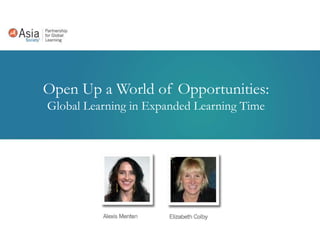
                                              Alexis Menten, Asia Society
                           Elizabeth Colby, Newfound Area School District


March 14, 2013
Goals for the Webinar
 • Define expanded learning and explore emerging models

 • Identify policies and practices that support credit-bearing
   expanded learning opportunities (ELOs), including the
   connection to global competence

 • Provide examples of what global learning ELOs look like
   in practice through a pilot program in New Hampshire

 • Share tools and templates that will help you to get started
   at your school or afterschool site
Defining Expanded Learning
Emerging Models of Expanded Learning
  1. Extended school day/year that increases time
     for learning

  2. Expanded school day/year that includes
     community partners and hands-on learning
     experiences

  3. Expanded/extended learning opportunities
     that are based on competencies and award
     credit based on proficiency
Expanded Learning Opportunities
          (ELOs) and
      Global Competence
What Is Competency-Based Education?

 • Students advance upon achieving mastery.
 • Competencies include explicit, measurable, transferable
   learning objectives that empower students.
 • Assessment is meaningful and a positive learning
   experience for students.
 • Students receive timely, differentiated support based on
   their individual learning needs.
 • Learning outcomes emphasize competencies that include
   application and creation of knowledge, along with the
   development of important skills and dispositions.
 CCSSO, iNACOL, and MetisNet: https://sites.google.com/site/competencybasedpathways/home
Competencies vs. Standards

•   Standards are outcomes (the what – knowledge and skills)

•   Competencies are behaviors (the how – habits and
    dispositions)
Global Competence: Common Core…
  and More
•   Common Core State Standards are not the only outcomes
    that students need to master to be successful in college,
    career, and life in the global 21st century

•   21st century skills or deeper learning skills like
    communication, collaboration, critical thinking, and
    creativity are equally important

•   Through global competence, students acquire and apply
    the knowledge, skills, and dispositions in the CCSS through
    hands-on and real-world projects
What Is Global Competence?
                        Possession of the knowledge, skills,
                        and dispositions to act creatively on
                        issues of global significance.

                        Globally competent young people:
                        • Investigate the World
                        • Recognize Perspectives
                        • Communicate Ideas
                        • Take Action


 http://asiasociety.org/files/book-globalcompetence.pdf
What Is Competency-Based Education?

 • Students advance upon achieving mastery.
 • Competencies include explicit, measurable, transferable
   learning objectives that empower students.
 • Assessment is meaningful and a positive learning
   experience for students.
 • Students receive timely, differentiated support based on
   their individual learning needs.
 • Learning outcomes emphasize competencies that include
   application and creation of knowledge, along with the
   development of important skills and dispositions.
 CCSSO, iNACOL, and MetisNet: https://sites.google.com/site/competencybasedpathways/home
N.H.
               A New Theory of Action

If we believe that all
students must be
college- and career-
ready...                 Then our system must
                         advance students as they
                         demonstrate mastery of
                         content, skills and
                         dispositions…
                                                    Which requires a
                                                    comprehensive system of
                                                    educator and school
                                                    supports.


       http://www.education.nh.gov/
                                                                          15
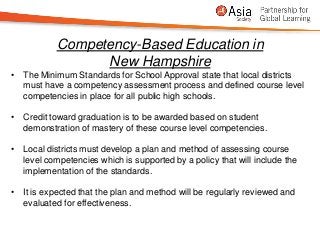
Competency-Based Education in
                 New Hampshire
• The Minimum Standards for School Approval state that local districts
  must have a competency assessment process and defined course level
  competencies in place for all public high schools.

• Credit toward graduation is to be awarded based on student
  demonstration of mastery of these course level competencies.

• Local districts must develop a plan and method of assessing course
  level competencies which is supported by a policy that will include the
  implementation of the standards.

• It is expected that the plan and method will be regularly reviewed and
  evaluated for effectiveness.
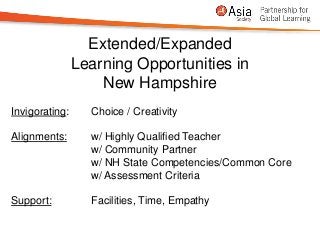
Extended/Expanded
                Learning Opportunities in
                    New Hampshire
Invigorating:     Choice / Creativity

Alignments:       w/ Highly Qualified Teacher
                  w/ Community Partner
                  w/ NH State Competencies/Common Core
                  w/ Assessment Criteria

Support:          Facilities, Time, Empathy
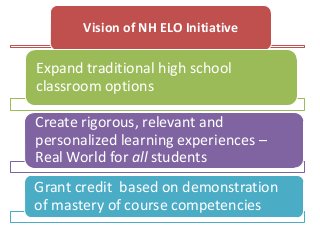
Vision of NH ELO Initiative

Expand traditional high school
classroom options

Create rigorous, relevant and
personalized learning experiences –
Real World for all students
Grant credit based on demonstration
of mastery of course competencies
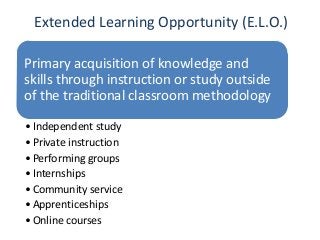
Extended Learning Opportunity (E.L.O.)

Primary acquisition of knowledge and
skills through instruction or study outside
of the traditional classroom methodology

• Independent study
• Private instruction
• Performing groups
• Internships
• Community service
• Apprenticeships
• Online courses
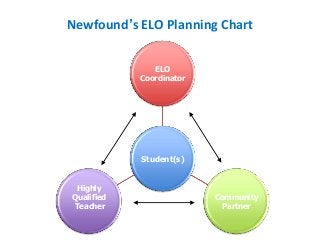
Newfound’s ELO Planning Chart


               ELO
            Coordinator


            Student(s)


 Highly
Qualified                 Community
 Teacher                    Partner
Expanded Learning Opportunities
           (ELOs) and
  Global Competence in Action
NRHS Partnership with the Asia Society

Goal: Expand ELOs and embed competency-based
approaches towards global competence in the afterschool
21st Century Community Learning Center program

• Alignment of course competencies and global
  competencies

• Training on student voice and choice, and facilitative
  teaching/leading methods
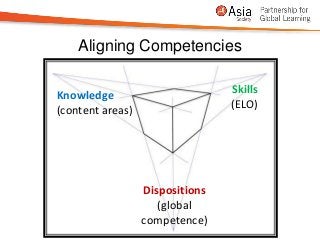
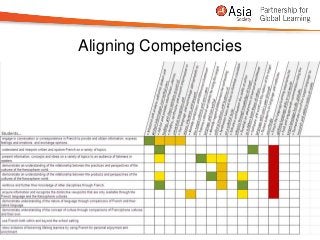
Aligning Competencies


Knowledge                        Skills
(content areas)                  (ELO)


                  Dispositions
                     (global
                  competence)
Aligning Competencies
21CCLC International Club
Target Competencies:

    • NRHS competency: The student artist will choose and evaluate a range of
      subject matter and ideas to communicate intended meaning in artworks.

    • Global competency: Students will recognize that people from diverse
      backgrounds perceive information differently, even when receiving the same
      information.

Arts Project Idea: Global Art Exchange
    “We can set up galleries where students from other countries send art pieces,
    and we send our art back to them. By exchanging art, we will be able to
    express ourselves and understand each other better. Art is an immediate way
    to understand aspects of culture.”
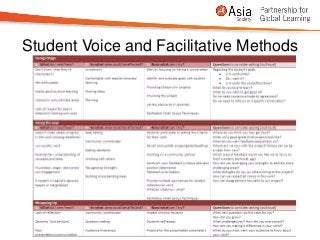
Student Voice and Facilitative Methods
Q&A
Browse
Attend


         Save the dates!
         March 28
         April 11, 25
         May 9, 23
Participate
Connect
ChinaLearningininExpanded Learning Time
EightGlobal and Globalization
   Open Up aaWorld of Opportunities:
    Students as World of and Diplomats:
    Open Up Linguists Opportunities:
       China andExpanded Languages Teaching
                         Globalization
   Global Learning Creative World Learning Time
      Principles for

Global Learning in Expanded Learning Time

  • 1.
    Open Up andGlobalization China World of Opportunities: ChinaLearning in Globalization and ExpandedLanguagesTime Students asaLinguists and Diplomats: Eight Principles for Creative World Learning Teaching Global
  • 3.
    Open Up aWorld of Opportunities: Global Learning in Expanded Learning Time
  • 4.
    Open Up aWorld of Opportunities: Global Learning in Expanded Learning Time
  • 5.
    Open Up aWorld of Opportunity: Global Learning in Expanded Learning Time Webinar Alexis Menten, Asia Society Elizabeth Colby, Newfound Area School District March 14, 2013
  • 6.
    Goals for theWebinar • Define expanded learning and explore emerging models • Identify policies and practices that support credit-bearing expanded learning opportunities (ELOs), including the connection to global competence • Provide examples of what global learning ELOs look like in practice through a pilot program in New Hampshire • Share tools and templates that will help you to get started at your school or afterschool site
  • 7.
  • 8.
    Emerging Models ofExpanded Learning 1. Extended school day/year that increases time for learning 2. Expanded school day/year that includes community partners and hands-on learning experiences 3. Expanded/extended learning opportunities that are based on competencies and award credit based on proficiency
  • 9.
    Expanded Learning Opportunities (ELOs) and Global Competence
  • 10.
    What Is Competency-BasedEducation? • Students advance upon achieving mastery. • Competencies include explicit, measurable, transferable learning objectives that empower students. • Assessment is meaningful and a positive learning experience for students. • Students receive timely, differentiated support based on their individual learning needs. • Learning outcomes emphasize competencies that include application and creation of knowledge, along with the development of important skills and dispositions. CCSSO, iNACOL, and MetisNet: https://sites.google.com/site/competencybasedpathways/home
  • 11.
    Competencies vs. Standards • Standards are outcomes (the what – knowledge and skills) • Competencies are behaviors (the how – habits and dispositions)
  • 12.
    Global Competence: CommonCore… and More • Common Core State Standards are not the only outcomes that students need to master to be successful in college, career, and life in the global 21st century • 21st century skills or deeper learning skills like communication, collaboration, critical thinking, and creativity are equally important • Through global competence, students acquire and apply the knowledge, skills, and dispositions in the CCSS through hands-on and real-world projects
  • 13.
    What Is GlobalCompetence? Possession of the knowledge, skills, and dispositions to act creatively on issues of global significance. Globally competent young people: • Investigate the World • Recognize Perspectives • Communicate Ideas • Take Action http://asiasociety.org/files/book-globalcompetence.pdf
  • 14.
    What Is Competency-BasedEducation? • Students advance upon achieving mastery. • Competencies include explicit, measurable, transferable learning objectives that empower students. • Assessment is meaningful and a positive learning experience for students. • Students receive timely, differentiated support based on their individual learning needs. • Learning outcomes emphasize competencies that include application and creation of knowledge, along with the development of important skills and dispositions. CCSSO, iNACOL, and MetisNet: https://sites.google.com/site/competencybasedpathways/home
  • 15.
    N.H. A New Theory of Action If we believe that all students must be college- and career- ready... Then our system must advance students as they demonstrate mastery of content, skills and dispositions… Which requires a comprehensive system of educator and school supports. http://www.education.nh.gov/ 15
  • 16.
    Competency-Based Education in New Hampshire • The Minimum Standards for School Approval state that local districts must have a competency assessment process and defined course level competencies in place for all public high schools. • Credit toward graduation is to be awarded based on student demonstration of mastery of these course level competencies. • Local districts must develop a plan and method of assessing course level competencies which is supported by a policy that will include the implementation of the standards. • It is expected that the plan and method will be regularly reviewed and evaluated for effectiveness.
  • 17.
    Extended/Expanded Learning Opportunities in New Hampshire Invigorating: Choice / Creativity Alignments: w/ Highly Qualified Teacher w/ Community Partner w/ NH State Competencies/Common Core w/ Assessment Criteria Support: Facilities, Time, Empathy
  • 18.
    Vision of NHELO Initiative Expand traditional high school classroom options Create rigorous, relevant and personalized learning experiences – Real World for all students Grant credit based on demonstration of mastery of course competencies
  • 19.
    Extended Learning Opportunity(E.L.O.) Primary acquisition of knowledge and skills through instruction or study outside of the traditional classroom methodology • Independent study • Private instruction • Performing groups • Internships • Community service • Apprenticeships • Online courses
  • 20.
    Newfound’s ELO PlanningChart ELO Coordinator Student(s) Highly Qualified Community Teacher Partner
  • 21.
    Expanded Learning Opportunities (ELOs) and Global Competence in Action
  • 22.
    NRHS Partnership withthe Asia Society Goal: Expand ELOs and embed competency-based approaches towards global competence in the afterschool 21st Century Community Learning Center program • Alignment of course competencies and global competencies • Training on student voice and choice, and facilitative teaching/leading methods
  • 23.
    Aligning Competencies Knowledge Skills (content areas) (ELO) Dispositions (global competence)
  • 24.
  • 25.
    21CCLC International Club TargetCompetencies: • NRHS competency: The student artist will choose and evaluate a range of subject matter and ideas to communicate intended meaning in artworks. • Global competency: Students will recognize that people from diverse backgrounds perceive information differently, even when receiving the same information. Arts Project Idea: Global Art Exchange “We can set up galleries where students from other countries send art pieces, and we send our art back to them. By exchanging art, we will be able to express ourselves and understand each other better. Art is an immediate way to understand aspects of culture.”
  • 26.
    Student Voice andFacilitative Methods
  • 27.
  • 28.
  • 29.
    Attend Save the dates! March 28 April 11, 25 May 9, 23
  • 30.
  • 31.
  • 32.
    ChinaLearningininExpanded Learning Time EightGlobaland Globalization Open Up aaWorld of Opportunities: Students as World of and Diplomats: Open Up Linguists Opportunities: China andExpanded Languages Teaching Globalization Global Learning Creative World Learning Time Principles for

Editor's Notes

  • #8 Growing concern in education: How do we ensure that all students, especially disadvantaged students, have sufficient time and opportunity to attain all the skills needed for college, career, and the global innovation economy beyond? “Expanded learning” has become a catchphrase for a variety of models that aim to expand learning time and experiences for students. Before we go further, we want to explore the variety of expanded learning models that emerging across the countryLAUNCH POLL #2:What does “expanded learning” mean to you?Extending the school day/year for an additional number of hours/daysIncorporating school-based afterschool or summer programs provided by community partners into an expanded school schedule for all studentsProviding credit for learning that takes place outside the school day and beyond the school buildingOther
  • #10 We are going to focus on expanded or extended learning opportunities for credit in this webinar, but we believe that the approaches and tools we have developed, and lessons learned, will be helpful to anyone working to design and/or implement an expanded learning program.
  • #14 Asia Society chaired a taskforce, convened by CCSSO as part of their EdSteps project, that pulled together representatives from leading universities, non-profit organizations, and state education agencies across the country to form a definition of global competence. To be globally competent, young people must be able to:Investigate the world, including their immediate environment and beyondRecognize perspectives, both their own and others’Communicate ideas and collaborate with diverse audiences Take action to improve conditions both locally and globally Within each of these four domains of global competence, Asia Society has developed a set of competencies, aligned to Common Core and benchmarked at multiple grade levels, that drive curriculum, instruction, and assessment in our partner schools. These competencies help ensure that we are graduating students who are both globally competent and college and career ready.
  • #17 New Hampshire is “Off The Clock”. The Carnegie Unit has been abandoned as the drive-train for assignment of credits that document student achievement. This enables true flexibility in organizing anywhere/anytime learning anchored in competency assessment.NRHS is dedicated to the Mission of providing a competency-based, personalized education for each student. Our program alignment assures that Content Area and individual Course Competencies dovetail with Mission Academic Expectations.Competency statements are supported by Curricula mapped to Common Core Standards.
  • #18 Extended Learning Opportunities allow for the primary acquisition of knowledge and skills through instruction or study outside of the traditional classroom. ELO's validate the learning that takes place out side of school that is youth centered and focuses both on the acquisition of skills and knowledge and on youth development.
  • #20 Here is our working definition of Extended Learning Opportunity, or ELO… It is a much broader definition than we tend to see in use elsewhere today… It is not just afterschool or summer school, it is about learning for credit outside the traditional four walls and time periods of the typical high school classroom, and it stretches the creativity and resources of our system… But we think it is absolutely right to accomplish what we want to accomplish in this New Day for Learning that we are talking about today!
  • #22 Now that we’ve defined expanded learning and competency-based education, and heard a little about how the two work together at the state level, we want to dive even deeper into the work that we have been doing in partnership with Newfound Regional High School.
  • #23 Notes: I will talk about the matrix, formative and summative assessments that empowers students to own and develop their own ELO and educational plan and the reality that there are teachers that struggle with what student voice and facilitative teaching really are.
  • #24 At the beginning of the project, we pulled together teachers and afterschool staff to create a matrix that aligned outcomes in three areas
  • #25 It looked like this in processDon’t expect you to read this – example Newfound course competencies down the left, global competencies across the topGreen for high intersection, yellow and orange for some, and red for none. Teachers and afterschool staff together decided where to focus. No wrong answer – high alignment provides opportunity to do both at once, some alignment provides opportunity to explicitly reinforce, and no alignment provides opportunity to fill gaps
  • #27 Grace has the link for this toolWRAP UP by 8:45