Open Access:
the Book Challenge
Nigel Vincent
Topics to be covered
•
•
•
•
•
•
•
•

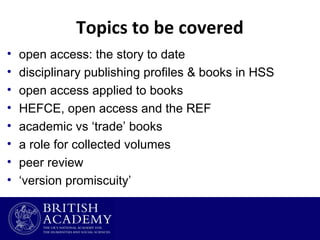
open access: the story to date
disciplinary publishing profiles & books in HSS
open access applied to books
HEFCE, open access and the REF
academic vs ‘trade’ books
a role for collected volumes
peer review
‘version promiscuity’
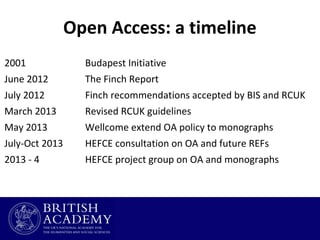
Open Access: a timeline
2001

Budapest Initiative

June 2012

The Finch Report

July 2012

Finch recommendations accepted by BIS and RCUK

March 2013

Revised RCUK guidelines

May 2013

Wellcome extend OA policy to monographs

July-Oct 2013

HEFCE consultation on OA and future REFs

2013 - 4

HEFCE project group on OA and monographs
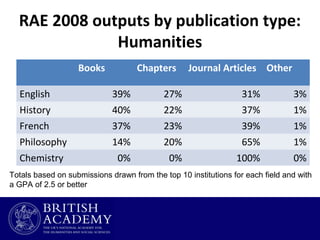
RAE 2008 outputs by publication type:
Humanities
Books

Chapters

Journal Articles Other

English
History
French
Philosophy

39%
40%
37%
14%

27%
22%
23%
20%

31%
37%
39%
65%

3%
1%
1%
1%

Chemistry

0%

0%

100%

0%

Totals based on submissions drawn from the top 10 institutions for each field and with
a GPA of 2.5 or better
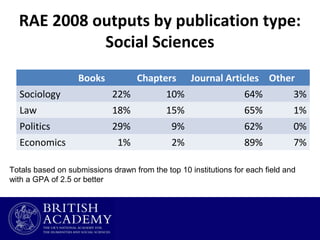
RAE 2008 outputs by publication type:
Social Sciences
Books

Chapters

Journal Articles Other

Sociology

22%

10%

64%

3%

Law

18%

15%

65%

1%

Politics

29%

9%

62%

0%

1%

2%

89%

7%

Economics

Totals based on submissions drawn from the top 10 institutions for each field and
with a GPA of 2.5 or better
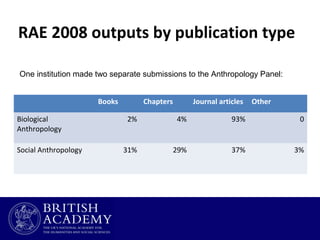
RAE 2008 outputs by publication type
One institution made two separate submissions to the Anthropology Panel:
Books
Biological
Anthropology
Social Anthropology

Chapters

Journal articles

Other

2%

4%

93%

0

31%

29%

37%

3%
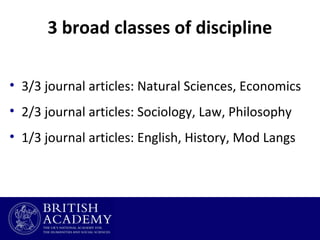
3 broad classes of discipline
• 3/3 journal articles: Natural Sciences, Economics
• 2/3 journal articles: Sociology, Law, Philosophy
• 1/3 journal articles: English, History, Mod Langs
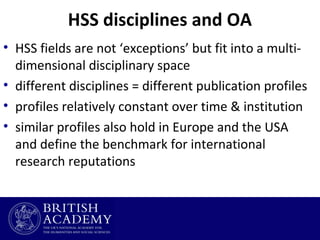
HSS disciplines and OA
• HSS fields are not ‘exceptions’ but fit into a multidimensional disciplinary space
• different disciplines = different publication profiles
• profiles relatively constant over time & institution
• similar profiles also hold in Europe and the USA
and define the benchmark for international
research reputations
OA in relation to books
• monographs (‘long-form’)
• book chapters
• academic vs ‘trade’ books
Monographs
•
•
•
•

tend to be single-authored
not captured by usual bibliometric methods
international gold standard in some fields
under threat because of publishing costs and
low sales figures
Status of monographs
‘There is no other medium that allows for the
depth of research, analysis and sustained
argumentation.’
[British Academy Postdoctoral Fellow, 2012]
Status of monographs
‘But if you are a scholar in the humanities, your
gold standard is likely to be the long-considered
and deeply researched monograph, not the brisk
journal article. Making a book available for free is
very different from uploading a ten-page article to
the Web.’
[Jonathan Bate, TLS, 10 Jan 2014]
Options for OA monographs
• gold with APC: subventions from the institution
or the funding agency BUT costly – cf Austria
FWF pays €14,000 and new Wellcome policy
• green:with an embargo period BUT how long?
• ‘mixed’: self-organizing co-operatives BUT how
sustainable?; e-version OA and print version
for a payment; etc
HEFCE group on monographs
•
•
–
–

chaired by Geoff Crossick
aims to explore and understand:
scale/nature of problems for monographs
place/purpose of monographs in the academic
context
– emerging models that accommodate OA
HEFCE group on monographs
•
•
•
•
•
•

sustainability
ethical issues
speed of publication
access to supporting data, texts, images, etc
shorter and longer books
special problems for fields like art history, music
“The Wellcome Trust today announces that it is to
extend its open access policy to include all
scholarly monographs and book chapters written
by its grantholders as part of their Trust-funded
research … The Wellcome Trust will make funds
available for the payment of publishers' open
access monograph processing charges.”
[30 May 2013]
“The new policy does not apply to textbooks,
'trade' books, general reference works or works
of fiction, or to collections edited but not
authored by Trust grantholders. It would not
affect, for example, a non-fiction work written by
a medical historian aimed at a general audience
and published by a commercial publisher.”
The ‘crossover’ book
‘In such a world, without the mediating presence
of publishers and reviewers alert to the needs of
non-specialist readers, jargon, myopia and petty
cavils are sure to prevail. There will be no place
for the work of grand synthesis and bold
interdisciplinary reach. The mantra of openness
will actually close the doors of the ivory tower. ’
[Jonathan Bate, TLS, 10 Jan 2014]
Book chapters: contra

‘If you write a chapter for an edited book, you
might as well write the paper and then bury it in
a hole in the ground.’
Dorothy Bishop
http://deevybee.blogspot.co.uk/2012/08/how-to-bu
Book chapters: pro
• a range of views come together in one volume
• benefits of mutual peer review by authors
• whole greater than the sum of the parts

http://peterwebster.wordpress.com/2013/01/14/on
Book chapters and online publishing
• chapters can be rescued from ‘invisibility’
• option to access the whole collection or
individual chapters
• same issues as monographs for access and
sustainability
Licence type and text mining
• CC-BY preferred by Finch
• allows unlimited text and data-mining
• BUT text-mining less successful on free prose
• AND not guaranteed to detect quotation and text
in languages other than English
• Bioinformatics publishes under CC-BY-NC
OA and peer review (PR)
•
•
•
•
•

traditional journal and book publishing built on PR
PR as the guarantee of quality and reputation
PR as the foundation of RAE and REF
OA does not necessarily undermine PR
BUT some OA ventures also question the value of PR (cf
PLOS-ONE and the concept of post-publication review)
‘Evaluation, not publication, should be academe’s new
priority … For the monograph-driven fields, publication has
(except for some copy-editing) therefore been beaten back
to its last function: a proxy evaluation of the work. In a
situation where a million texts clamor for attention, vetting,
not dissemination, is the crux … The quality of the press
becomes a proxy for the value of the work.’
[Peter Baldwin, The Chronicle of Higher Education, 17/2/14]
Version promiscuity
• an issue in the world of software development
• exists for journal articles (pre-print vs post-print)
• books
– continuous editing and correcting
– the end of the book as a discrete entity?
– Kathleen Fitzpatrick Planned obsolescence. Publishing,
Technology and the Future of the Academy (NYU Press
2011)

Open Access: The Book Challenge

  • 1.
    Open Access: the BookChallenge Nigel Vincent
  • 2.
    Topics to becovered • • • • • • • • open access: the story to date disciplinary publishing profiles & books in HSS open access applied to books HEFCE, open access and the REF academic vs ‘trade’ books a role for collected volumes peer review ‘version promiscuity’
  • 3.
    Open Access: atimeline 2001 Budapest Initiative June 2012 The Finch Report July 2012 Finch recommendations accepted by BIS and RCUK March 2013 Revised RCUK guidelines May 2013 Wellcome extend OA policy to monographs July-Oct 2013 HEFCE consultation on OA and future REFs 2013 - 4 HEFCE project group on OA and monographs
  • 4.
    RAE 2008 outputsby publication type: Humanities Books Chapters Journal Articles Other English History French Philosophy 39% 40% 37% 14% 27% 22% 23% 20% 31% 37% 39% 65% 3% 1% 1% 1% Chemistry 0% 0% 100% 0% Totals based on submissions drawn from the top 10 institutions for each field and with a GPA of 2.5 or better
  • 5.
    RAE 2008 outputsby publication type: Social Sciences Books Chapters Journal Articles Other Sociology 22% 10% 64% 3% Law 18% 15% 65% 1% Politics 29% 9% 62% 0% 1% 2% 89% 7% Economics Totals based on submissions drawn from the top 10 institutions for each field and with a GPA of 2.5 or better
  • 6.
    RAE 2008 outputsby publication type One institution made two separate submissions to the Anthropology Panel: Books Biological Anthropology Social Anthropology Chapters Journal articles Other 2% 4% 93% 0 31% 29% 37% 3%
  • 7.
    3 broad classesof discipline • 3/3 journal articles: Natural Sciences, Economics • 2/3 journal articles: Sociology, Law, Philosophy • 1/3 journal articles: English, History, Mod Langs
  • 8.
    HSS disciplines andOA • HSS fields are not ‘exceptions’ but fit into a multidimensional disciplinary space • different disciplines = different publication profiles • profiles relatively constant over time & institution • similar profiles also hold in Europe and the USA and define the benchmark for international research reputations
  • 9.
    OA in relationto books • monographs (‘long-form’) • book chapters • academic vs ‘trade’ books
  • 10.
    Monographs • • • • tend to besingle-authored not captured by usual bibliometric methods international gold standard in some fields under threat because of publishing costs and low sales figures
  • 11.
    Status of monographs ‘Thereis no other medium that allows for the depth of research, analysis and sustained argumentation.’ [British Academy Postdoctoral Fellow, 2012]
  • 12.
    Status of monographs ‘Butif you are a scholar in the humanities, your gold standard is likely to be the long-considered and deeply researched monograph, not the brisk journal article. Making a book available for free is very different from uploading a ten-page article to the Web.’ [Jonathan Bate, TLS, 10 Jan 2014]
  • 13.
    Options for OAmonographs • gold with APC: subventions from the institution or the funding agency BUT costly – cf Austria FWF pays €14,000 and new Wellcome policy • green:with an embargo period BUT how long? • ‘mixed’: self-organizing co-operatives BUT how sustainable?; e-version OA and print version for a payment; etc
  • 14.
    HEFCE group onmonographs • • – – chaired by Geoff Crossick aims to explore and understand: scale/nature of problems for monographs place/purpose of monographs in the academic context – emerging models that accommodate OA
  • 15.
    HEFCE group onmonographs • • • • • • sustainability ethical issues speed of publication access to supporting data, texts, images, etc shorter and longer books special problems for fields like art history, music
  • 16.
    “The Wellcome Trusttoday announces that it is to extend its open access policy to include all scholarly monographs and book chapters written by its grantholders as part of their Trust-funded research … The Wellcome Trust will make funds available for the payment of publishers' open access monograph processing charges.” [30 May 2013]
  • 17.
    “The new policydoes not apply to textbooks, 'trade' books, general reference works or works of fiction, or to collections edited but not authored by Trust grantholders. It would not affect, for example, a non-fiction work written by a medical historian aimed at a general audience and published by a commercial publisher.”
  • 18.
    The ‘crossover’ book ‘Insuch a world, without the mediating presence of publishers and reviewers alert to the needs of non-specialist readers, jargon, myopia and petty cavils are sure to prevail. There will be no place for the work of grand synthesis and bold interdisciplinary reach. The mantra of openness will actually close the doors of the ivory tower. ’ [Jonathan Bate, TLS, 10 Jan 2014]
  • 19.
    Book chapters: contra ‘Ifyou write a chapter for an edited book, you might as well write the paper and then bury it in a hole in the ground.’ Dorothy Bishop http://deevybee.blogspot.co.uk/2012/08/how-to-bu
  • 20.
    Book chapters: pro •a range of views come together in one volume • benefits of mutual peer review by authors • whole greater than the sum of the parts http://peterwebster.wordpress.com/2013/01/14/on
  • 21.
    Book chapters andonline publishing • chapters can be rescued from ‘invisibility’ • option to access the whole collection or individual chapters • same issues as monographs for access and sustainability
  • 22.
    Licence type andtext mining • CC-BY preferred by Finch • allows unlimited text and data-mining • BUT text-mining less successful on free prose • AND not guaranteed to detect quotation and text in languages other than English • Bioinformatics publishes under CC-BY-NC
  • 23.
    OA and peerreview (PR) • • • • • traditional journal and book publishing built on PR PR as the guarantee of quality and reputation PR as the foundation of RAE and REF OA does not necessarily undermine PR BUT some OA ventures also question the value of PR (cf PLOS-ONE and the concept of post-publication review)
  • 24.
    ‘Evaluation, not publication,should be academe’s new priority … For the monograph-driven fields, publication has (except for some copy-editing) therefore been beaten back to its last function: a proxy evaluation of the work. In a situation where a million texts clamor for attention, vetting, not dissemination, is the crux … The quality of the press becomes a proxy for the value of the work.’ [Peter Baldwin, The Chronicle of Higher Education, 17/2/14]
  • 25.
    Version promiscuity • anissue in the world of software development • exists for journal articles (pre-print vs post-print) • books – continuous editing and correcting – the end of the book as a discrete entity? – Kathleen Fitzpatrick Planned obsolescence. Publishing, Technology and the Future of the Academy (NYU Press 2011)