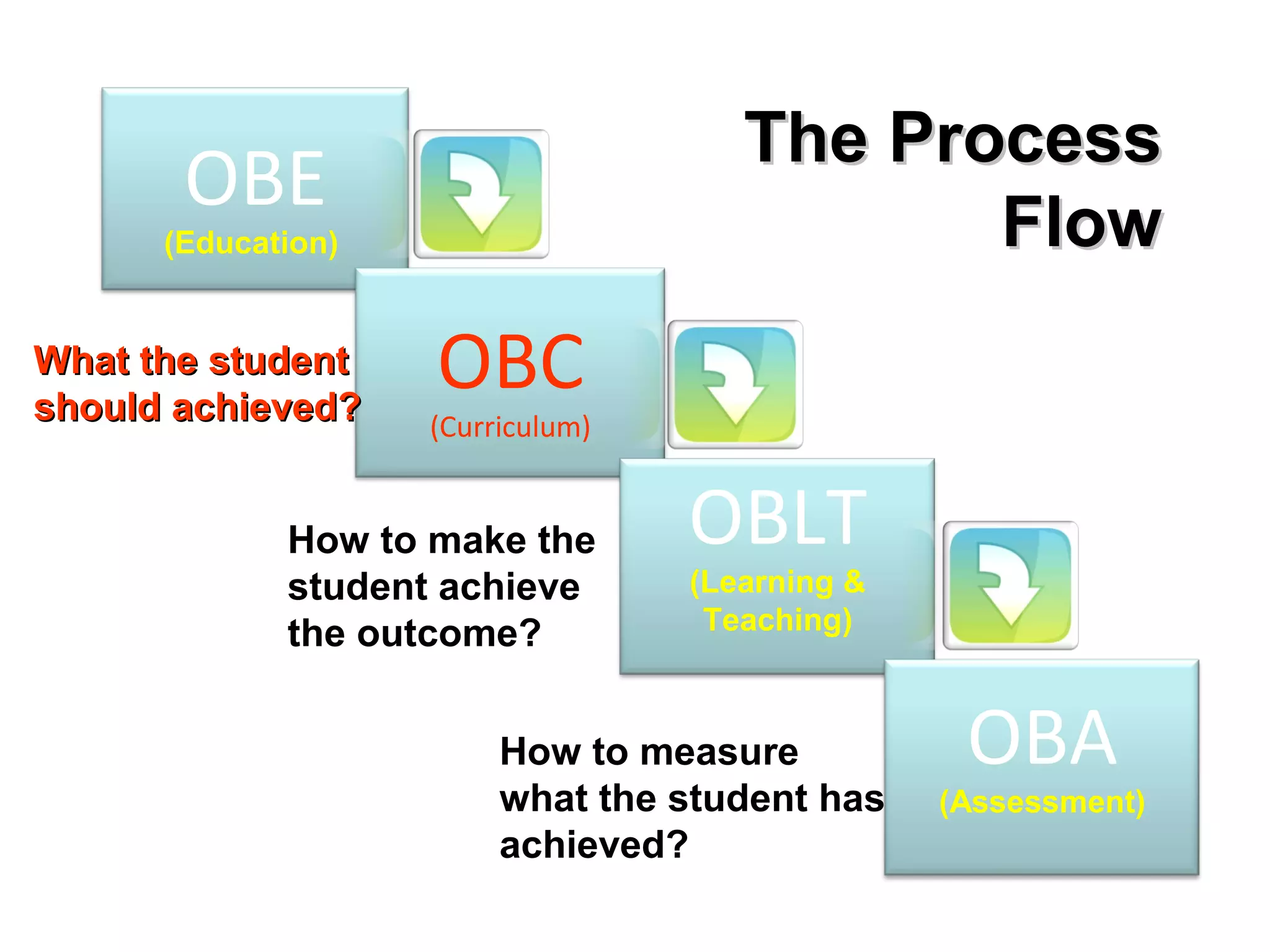
The Process
       OBE                                   Flow
      (Education)


What the student
should achieved?
                    OBC
                    (Curriculum)


             How to make the       OBLT
             student achieve       (Learning &
             the outcome?           Teaching)


                         How to measure           OBA
                         what the student has    (Assessment)
                         achieved?
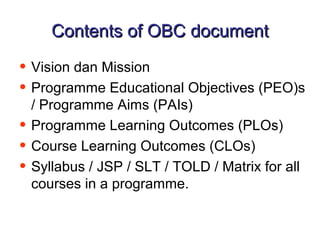
Contents of OBC document

• Vision dan Mission
• Programme Educational Objectives (PEO)s
    / Programme Aims (PAIs)
•   Programme Learning Outcomes (PLOs)
•   Course Learning Outcomes (CLOs)
•   Syllabus / JSP / SLT / TOLD / Matrix for all
    courses in a programme.
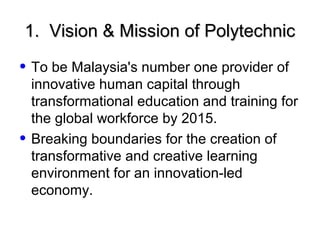
1. Vision & Mission of Polytechnic

• To be Malaysia's number one provider of
    innovative human capital through
    transformational education and training for
    the global workforce by 2015.
•   Breaking boundaries for the creation of
    transformative and creative learning
    environment for an innovation-led
    economy.
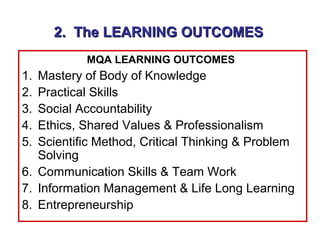
2. The LEARNING OUTCOMES
           MQA LEARNING OUTCOMES
1. Mastery of Body of Knowledge
2. Practical Skills
3. Social Accountability
4. Ethics, Shared Values & Professionalism
5. Scientific Method, Critical Thinking & Problem
   Solving
6. Communication Skills & Team Work
7. Information Management & Life Long Learning
8. Entrepreneurship
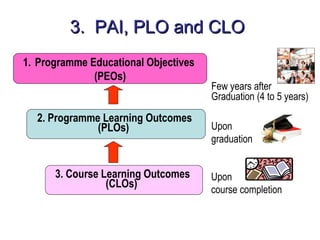
3. PAI, PLO and CLO
1. Programme Educational Objectives
              (PEOs)
                                      Few years after
                                      Graduation (4 to 5 years)

  2. Programme Learning Outcomes
              (PLOs)                  Upon
                                      graduation


      3. Course Learning Outcomes     Upon
                 (CLOs)               course completion
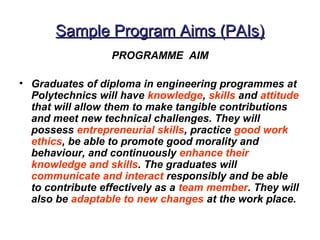
Sample Program Aims (PAIs)
                  PROGRAMME AIM

• Graduates of diploma in engineering programmes at
  Polytechnics will have knowledge, skills and attitude
  that will allow them to make tangible contributions
  and meet new technical challenges. They will
  possess entrepreneurial skills, practice good work
  ethics, be able to promote good morality and
  behaviour, and continuously enhance their
  knowledge and skills. The graduates will
  communicate and interact responsibly and be able
  to contribute effectively as a team member. They will
  also be adaptable to new changes at the work place.
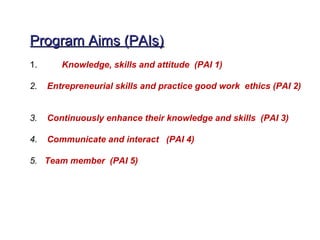
Program Aims (PAIs)
1.      Knowledge, skills and attitude (PAI 1)

2.   Entrepreneurial skills and practice good work ethics (PAI 2)


3.   Continuously enhance their knowledge and skills (PAI 3)

4.   Communicate and interact (PAI 4)

5. Team member (PAI 5)
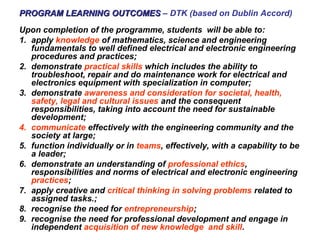
PROGRAM LEARNING OUTCOMES – DTK (based on Dublin Accord)
Upon completion of the programme, students will be able to:
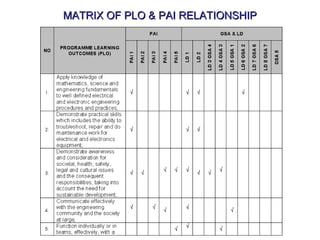
1. apply knowledge of mathematics, science and engineering
   fundamentals to well defined electrical and electronic engineering
   procedures and practices;
2. demonstrate practical skills which includes the ability to
   troubleshoot, repair and do maintenance work for electrical and
   electronics equipment with specialization in computer;
3. demonstrate awareness and consideration for societal, health,
   safety, legal and cultural issues and the consequent
   responsibilities, taking into account the need for sustainable
   development;
4. communicate effectively with the engineering community and the
   society at large;
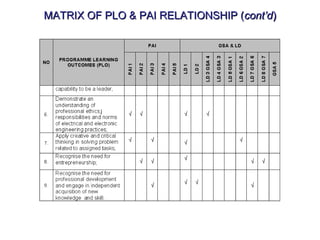
5. function individually or in teams, effectively, with a capability to be
   a leader;
6. demonstrate an understanding of professional ethics,
   responsibilities and norms of electrical and electronic engineering
   practices;
7. apply creative and critical thinking in solving problems related to
   assigned tasks.;
8. recognise the need for entrepreneurship;
9. recognise the need for professional development and engage in
   independent acquisition of new knowledge and skill.
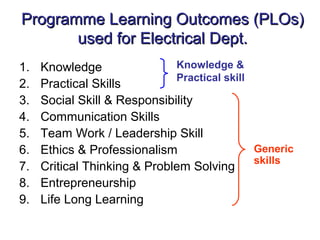
Programme Learning Outcomes (PLOs)
       used for Electrical Dept.
1.   Knowledge                Knowledge &
                              Practical skill
2.   Practical Skills
3.   Social Skill & Responsibility
4.   Communication Skills
5.   Team Work / Leadership Skill
6.   Ethics & Professionalism                 Generic
                                              skills
7.   Critical Thinking & Problem Solving
8.   Entrepreneurship
9.   Life Long Learning
Pembuktian
• Pembuktian akur kepada kehendak MQA
  akan ditunjukkan melalui mapping dalam
  matriks-matriks.
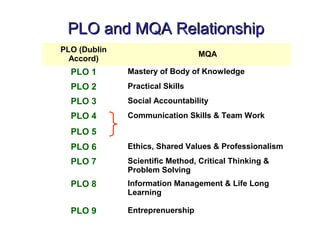
PLO and MQA Relationship
PLO (Dublin
                                 MQA
  Accord)
  PLO 1       Mastery of Body of Knowledge
  PLO 2       Practical Skills
  PLO 3       Social Accountability
  PLO 4       Communication Skills & Team Work

  PLO 5
  PLO 6       Ethics, Shared Values & Professionalism
  PLO 7       Scientific Method, Critical Thinking &
              Problem Solving
  PLO 8       Information Management & Life Long
              Learning

  PLO 9       Entreprenuership
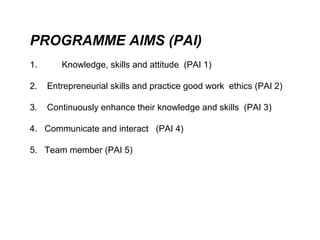
PROGRAMME AIMS (PAI)
1.      Knowledge, skills and attitude (PAI 1)

2.   Entrepreneurial skills and practice good work ethics (PAI 2)

3.   Continuously enhance their knowledge and skills (PAI 3)

4. Communicate and interact (PAI 4)

5. Team member (PAI 5)
MATRIX OF PLO & PAI RELATIONSHIP
MATRIX OF PLO & PAI RELATIONSHIP (cont’d)
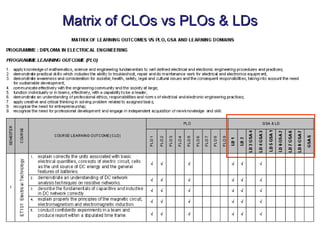
Matrix of CLOs vs PLOs & LDs
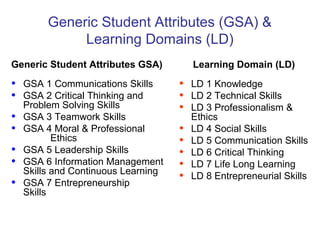
Generic Student Attributes (GSA) &
              Learning Domains (LD)
Generic Student Attributes GSA)          Learning Domain (LD)

•   GSA 1 Communications Skills      •   LD 1 Knowledge
•   GSA 2 Critical Thinking and      •   LD 2 Technical Skills
    Problem Solving Skills           •   LD 3 Professionalism &
•   GSA 3 Teamwork Skills                Ethics
•   GSA 4 Moral & Professional       •   LD 4 Social Skills
           Ethics                    •   LD 5 Communication Skills
•   GSA 5 Leadership Skills          •   LD 6 Critical Thinking
•   GSA 6 Information Management     •   LD 7 Life Long Learning
    Skills and Continuous Learning
                                     •   LD 8 Entrepreneurial Skills
•   GSA 7 Entrepreneurship
    Skills
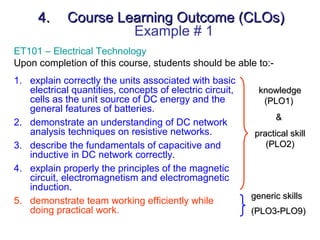
4.      Course Learning Outcome (CLOs)
                      Example # 1
ET101 – Electrical Technology
Upon completion of this course, students should be able to:-
1. explain correctly the units associated with basic
   electrical quantities, concepts of electric circuit,     knowledge
   cells as the unit source of DC energy and the             (PLO1)
   general features of batteries.
                                                                &
2. demonstrate an understanding of DC network
   analysis techniques on resistive networks.             practical skill
3. describe the fundamentals of capacitive and               (PLO2)
   inductive in DC network correctly.
4. explain properly the principles of the magnetic
   circuit, electromagnetism and electromagnetic
   induction.
                                                          generic skills
5. demonstrate team working efficiently while
   doing practical work.                                  (PLO3-PLO9)
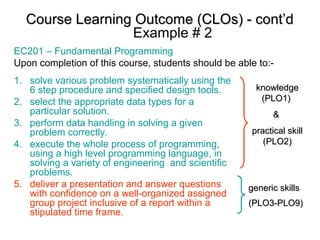
Course Learning Outcome (CLOs) - cont’d
                 Example # 2
EC201 – Fundamental Programming
Upon completion of this course, students should be able to:-
1. solve various problem systematically using the
   6 step procedure and specified design tools.         knowledge
2. select the appropriate data types for a               (PLO1)
   particular solution.                                     &
3. perform data handling in solving a given
   problem correctly.                                 practical skill
4. execute the whole process of programming,             (PLO2)
   using a high level programming language, in
   solving a variety of engineering and scientific
   problems.
5. deliver a presentation and answer questions        generic skills
   with confidence on a well-organized assigned
   group project inclusive of a report within a       (PLO3-PLO9)
   stipulated time frame.
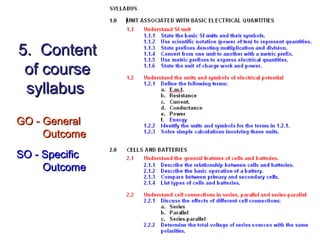
5. Content
 of course
 syllabus
GO - General
     Outcome
SO - Specific
     Outcome
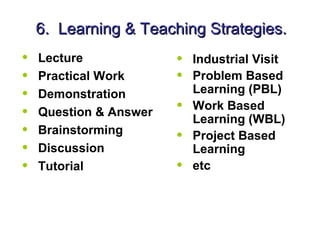
6. Learning & Teaching Strategies.
•   Lecture             •   Industrial Visit
•   Practical Work      •   Problem Based
•   Demonstration           Learning (PBL)
•   Question & Answer   •   Work Based
                            Learning (WBL)
•   Brainstorming
                        •   Project Based
•   Discussion              Learning
•   Tutorial            •   etc
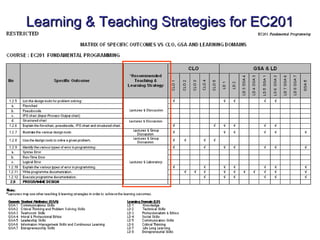
Learning & Teaching Strategies for EC201
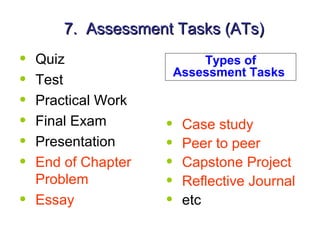
7. Assessment Tasks (ATs)
•   Quiz                     Types of
                         Assessment Tasks
•   Test
•   Practical Work
•   Final Exam       •    Case study
•   Presentation     •    Peer to peer
•   End of Chapter   •    Capstone Project
    Problem          •    Reflective Journal
•   Essay            •    etc
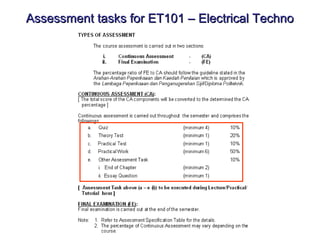
Assessment tasks for ET101 – Electrical Techno
Assessment tasks for
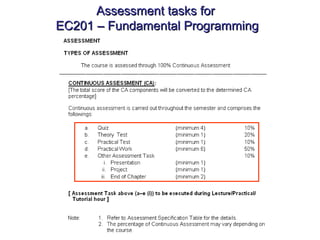
EC201 – Fundamental Programming
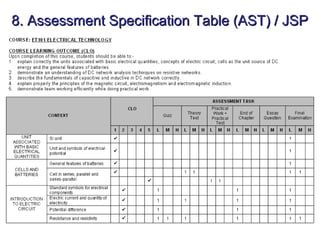
8. Assessment Specification Table (AST) / JSP
Memahami Kandungan
    Jadual Spesifikasi
    Pentaksiran - JSP
(Assessment Specification
       Table - AST)
JSP / AST
• Jadual Spesifikasi Pentaksiran (JSP) /
    Assessment Specification Table (AST) merupakan
    jadual yang mengandungi perincian untuk setiap
    assessment task (ATs) bagi suatu kursus. (Perlu
    rujuk kepada silibus - ASSESSMENT)
•   Assessment tasks :
    Kuiz, Ujian, Amali, Final Exam
• Other Assessment task :
    End-of-chapter Problem, Essay, Mini-Project,
    Presentation, Case Study dll.
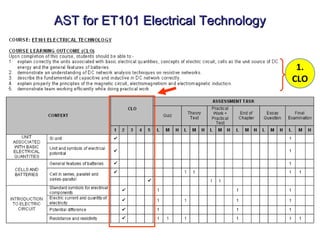
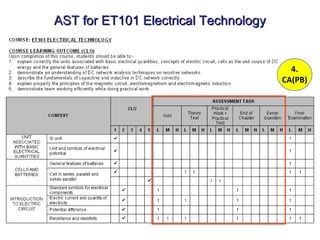
AST for ET101 Electrical Technology


                                       1.
                                      CLO
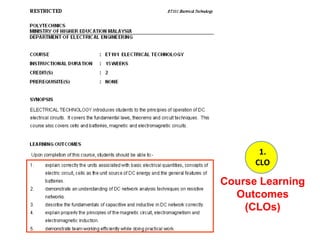
1.
      CLO

Course Learning
  Outcomes
    (CLOs)
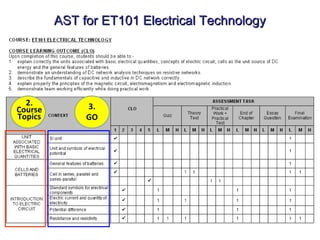
AST for ET101 Electrical Technology


  2.          3.
Course
Topics        GO
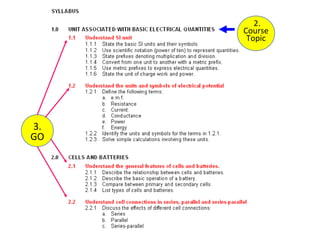
2.
     Course
      Topic


3.
GO
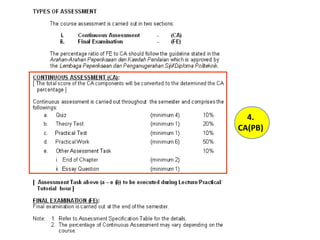
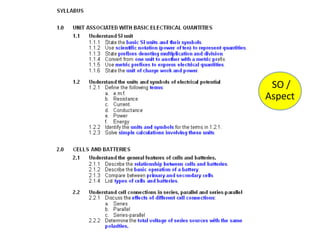
AST for ET101 Electrical Technology


                                        4.
                                      CA(PB)
4.
CA(PB)
SO /
Aspect
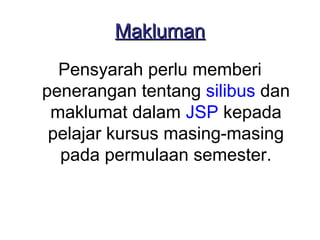
Makluman
  Pensyarah perlu memberi
penerangan tentang silibus dan
 maklumat dalam JSP kepada
 pelajar kursus masing-masing
  pada permulaan semester.

Obc 2011

  • 1.
    The Process OBE Flow (Education) What the student should achieved? OBC (Curriculum) How to make the OBLT student achieve (Learning & the outcome? Teaching) How to measure OBA what the student has (Assessment) achieved?
  • 2.
    Contents of OBCdocument • Vision dan Mission • Programme Educational Objectives (PEO)s / Programme Aims (PAIs) • Programme Learning Outcomes (PLOs) • Course Learning Outcomes (CLOs) • Syllabus / JSP / SLT / TOLD / Matrix for all courses in a programme.
  • 3.
    1. Vision &Mission of Polytechnic • To be Malaysia's number one provider of innovative human capital through transformational education and training for the global workforce by 2015. • Breaking boundaries for the creation of transformative and creative learning environment for an innovation-led economy.
  • 4.
    2. The LEARNINGOUTCOMES MQA LEARNING OUTCOMES 1. Mastery of Body of Knowledge 2. Practical Skills 3. Social Accountability 4. Ethics, Shared Values & Professionalism 5. Scientific Method, Critical Thinking & Problem Solving 6. Communication Skills & Team Work 7. Information Management & Life Long Learning 8. Entrepreneurship
  • 5.
    3. PAI, PLOand CLO 1. Programme Educational Objectives (PEOs) Few years after Graduation (4 to 5 years) 2. Programme Learning Outcomes (PLOs) Upon graduation 3. Course Learning Outcomes Upon (CLOs) course completion
  • 6.
    Sample Program Aims(PAIs) PROGRAMME AIM • Graduates of diploma in engineering programmes at Polytechnics will have knowledge, skills and attitude that will allow them to make tangible contributions and meet new technical challenges. They will possess entrepreneurial skills, practice good work ethics, be able to promote good morality and behaviour, and continuously enhance their knowledge and skills. The graduates will communicate and interact responsibly and be able to contribute effectively as a team member. They will also be adaptable to new changes at the work place.
  • 7.
    Program Aims (PAIs) 1. Knowledge, skills and attitude (PAI 1) 2. Entrepreneurial skills and practice good work ethics (PAI 2) 3. Continuously enhance their knowledge and skills (PAI 3) 4. Communicate and interact (PAI 4) 5. Team member (PAI 5)
  • 8.
    PROGRAM LEARNING OUTCOMES– DTK (based on Dublin Accord) Upon completion of the programme, students will be able to: 1. apply knowledge of mathematics, science and engineering fundamentals to well defined electrical and electronic engineering procedures and practices; 2. demonstrate practical skills which includes the ability to troubleshoot, repair and do maintenance work for electrical and electronics equipment with specialization in computer; 3. demonstrate awareness and consideration for societal, health, safety, legal and cultural issues and the consequent responsibilities, taking into account the need for sustainable development; 4. communicate effectively with the engineering community and the society at large; 5. function individually or in teams, effectively, with a capability to be a leader; 6. demonstrate an understanding of professional ethics, responsibilities and norms of electrical and electronic engineering practices; 7. apply creative and critical thinking in solving problems related to assigned tasks.; 8. recognise the need for entrepreneurship; 9. recognise the need for professional development and engage in independent acquisition of new knowledge and skill.
  • 9.
    Programme Learning Outcomes(PLOs) used for Electrical Dept. 1. Knowledge Knowledge & Practical skill 2. Practical Skills 3. Social Skill & Responsibility 4. Communication Skills 5. Team Work / Leadership Skill 6. Ethics & Professionalism Generic skills 7. Critical Thinking & Problem Solving 8. Entrepreneurship 9. Life Long Learning
  • 10.
    Pembuktian • Pembuktian akurkepada kehendak MQA akan ditunjukkan melalui mapping dalam matriks-matriks.
  • 11.
    PLO and MQARelationship PLO (Dublin MQA Accord) PLO 1 Mastery of Body of Knowledge PLO 2 Practical Skills PLO 3 Social Accountability PLO 4 Communication Skills & Team Work PLO 5 PLO 6 Ethics, Shared Values & Professionalism PLO 7 Scientific Method, Critical Thinking & Problem Solving PLO 8 Information Management & Life Long Learning PLO 9 Entreprenuership
  • 12.
    PROGRAMME AIMS (PAI) 1. Knowledge, skills and attitude (PAI 1) 2. Entrepreneurial skills and practice good work ethics (PAI 2) 3. Continuously enhance their knowledge and skills (PAI 3) 4. Communicate and interact (PAI 4) 5. Team member (PAI 5)
  • 13.
    MATRIX OF PLO& PAI RELATIONSHIP
  • 14.
    MATRIX OF PLO& PAI RELATIONSHIP (cont’d)
  • 15.
    Matrix of CLOsvs PLOs & LDs
  • 16.
    Generic Student Attributes(GSA) & Learning Domains (LD) Generic Student Attributes GSA) Learning Domain (LD) • GSA 1 Communications Skills • LD 1 Knowledge • GSA 2 Critical Thinking and • LD 2 Technical Skills Problem Solving Skills • LD 3 Professionalism & • GSA 3 Teamwork Skills Ethics • GSA 4 Moral & Professional • LD 4 Social Skills Ethics • LD 5 Communication Skills • GSA 5 Leadership Skills • LD 6 Critical Thinking • GSA 6 Information Management • LD 7 Life Long Learning Skills and Continuous Learning • LD 8 Entrepreneurial Skills • GSA 7 Entrepreneurship Skills
  • 17.
    4. Course Learning Outcome (CLOs) Example # 1 ET101 – Electrical Technology Upon completion of this course, students should be able to:- 1. explain correctly the units associated with basic electrical quantities, concepts of electric circuit, knowledge cells as the unit source of DC energy and the (PLO1) general features of batteries. & 2. demonstrate an understanding of DC network analysis techniques on resistive networks. practical skill 3. describe the fundamentals of capacitive and (PLO2) inductive in DC network correctly. 4. explain properly the principles of the magnetic circuit, electromagnetism and electromagnetic induction. generic skills 5. demonstrate team working efficiently while doing practical work. (PLO3-PLO9)
  • 18.
    Course Learning Outcome(CLOs) - cont’d Example # 2 EC201 – Fundamental Programming Upon completion of this course, students should be able to:- 1. solve various problem systematically using the 6 step procedure and specified design tools. knowledge 2. select the appropriate data types for a (PLO1) particular solution. & 3. perform data handling in solving a given problem correctly. practical skill 4. execute the whole process of programming, (PLO2) using a high level programming language, in solving a variety of engineering and scientific problems. 5. deliver a presentation and answer questions generic skills with confidence on a well-organized assigned group project inclusive of a report within a (PLO3-PLO9) stipulated time frame.
  • 19.
    5. Content ofcourse syllabus GO - General Outcome SO - Specific Outcome
  • 20.
    6. Learning &Teaching Strategies. • Lecture • Industrial Visit • Practical Work • Problem Based • Demonstration Learning (PBL) • Question & Answer • Work Based Learning (WBL) • Brainstorming • Project Based • Discussion Learning • Tutorial • etc
  • 21.
    Learning & TeachingStrategies for EC201
  • 22.
    7. Assessment Tasks(ATs) • Quiz Types of Assessment Tasks • Test • Practical Work • Final Exam • Case study • Presentation • Peer to peer • End of Chapter • Capstone Project Problem • Reflective Journal • Essay • etc
  • 23.
    Assessment tasks forET101 – Electrical Techno
  • 24.
    Assessment tasks for EC201– Fundamental Programming
  • 25.
    8. Assessment SpecificationTable (AST) / JSP
  • 26.
    Memahami Kandungan Jadual Spesifikasi Pentaksiran - JSP (Assessment Specification Table - AST)
  • 27.
    JSP / AST •Jadual Spesifikasi Pentaksiran (JSP) / Assessment Specification Table (AST) merupakan jadual yang mengandungi perincian untuk setiap assessment task (ATs) bagi suatu kursus. (Perlu rujuk kepada silibus - ASSESSMENT) • Assessment tasks : Kuiz, Ujian, Amali, Final Exam • Other Assessment task : End-of-chapter Problem, Essay, Mini-Project, Presentation, Case Study dll.
  • 28.
    AST for ET101Electrical Technology 1. CLO
  • 29.
    1. CLO Course Learning Outcomes (CLOs)
  • 30.
    AST for ET101Electrical Technology 2. 3. Course Topics GO
  • 31.
    2. Course Topic 3. GO
  • 32.
    AST for ET101Electrical Technology 4. CA(PB)
  • 33.
  • 34.
  • 35.
    Makluman Pensyarahperlu memberi penerangan tentang silibus dan maklumat dalam JSP kepada pelajar kursus masing-masing pada permulaan semester.