Compassion-Focused-Therapy
Model and Research
By Justin La Rose
Talk Today
Outline basic philosophy and model of
Compassion focused Therapy
Note the powerful effects of our self-
evaluation systems (self-criticism vs self
compassion)
Explore the main therapeutic work as
overcoming the fear of compassion and self
compassions
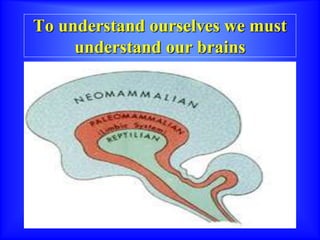
To understand ourselves we must
understand our brains
why we have complex brains and minds that are
difficult to understand regulate
1. Old Brain
Emotions: Anger, anxiety, sadness, joy, lust
Behaviours: Fight, flight, withdraw, engage
Relationships: Sex, status, attachment, tribalism
2. New Brain
Imagination, fantasise, look back and forward, plan, ruminate
Integration of mental abilities
Self-awareness, self-identity, and self-feeling
3. Social Brain
Need for affection and care
Socially responsive, self-experience and motives
What happens when new brain is recruited to pursue old brain passions?
Sources of behaviour
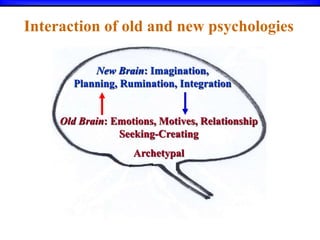
Old Brain: Emotions, Motives, Relationship
Seeking-Creating
Archetypal
New Brain: Imagination,
Planning, Rumination, Integration
Interaction of old and new psychologies
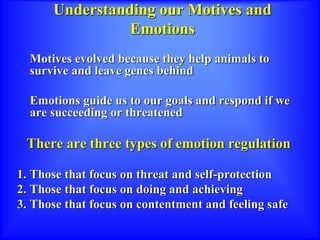
Understanding our Motives and
Emotions
Motives evolved because they help animals to
survive and leave genes behind
Emotions guide us to our goals and respond if we
are succeeding or threatened
There are three types of emotion regulation
1. Those that focus on threat and self-protection
2. Those that focus on doing and achieving
3. Those that focus on contentment and feeling safe
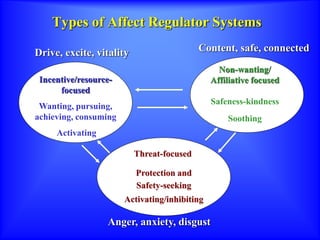
Types of Affect Regulator Systems
Incentive/resource-
focused
Wanting, pursuing,
achieving, consuming
Activating
Non-wanting/
Affiliative focused
Safeness-kindness
Soothing
Threat-focused
Protection and
Safety-seeking
Activating/inhibiting
Anger, anxiety, disgust
Drive, excite, vitality Content, safe, connected
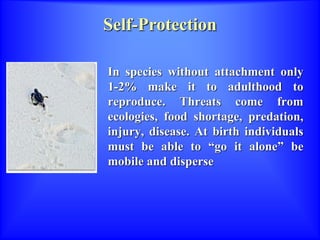
Self-Protection
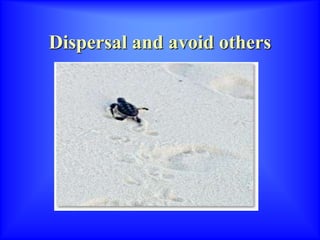
In species without attachment only
1-2% make it to adulthood to
reproduce. Threats come from
ecologies, food shortage, predation,
injury, disease. At birth individuals
must be able to “go it alone” be
mobile and disperse
Dispersal and avoid others
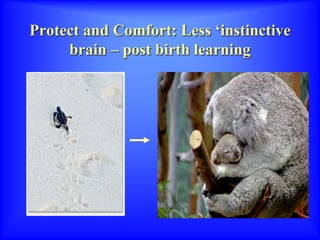
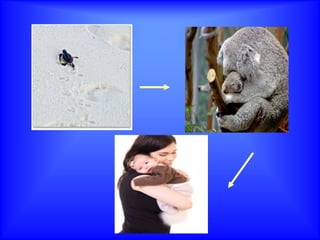
Protect and Comfort: Less ‘instinctive
brain – post birth learning
The Mammalian Importance of
Caring Minds
Caring as “looking after”. Seeking closeness
rather than dispersion. Individuals obtain
protection, food, and care when ill. Key also is
soothing-calming and physiological regulation.
Few offspring but high survival rate in
comparison to species without attachment.
Affection and kindness
Co-operative and mutual support can develop as
we see that our prosperity impacts on that of
others, sharing and not-exploiting
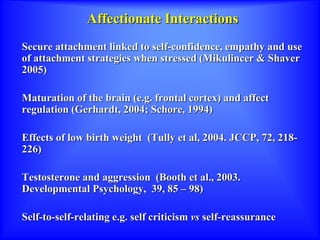
Affectionate Interactions
Secure attachment linked to self-confidence, empathy and use
of attachment strategies when stressed (Mikulincer & Shaver
2005)
Maturation of the brain (e.g. frontal cortex) and affect
regulation (Gerhardt, 2004; Schore, 1994)
Effects of low birth weight (Tully et al, 2004. JCCP, 72, 218-
226)
Testosterone and aggression (Booth et al., 2003.
Developmental Psychology, 39, 85 – 98)
Self-to-self-relating e.g. self criticism vs self-reassurance
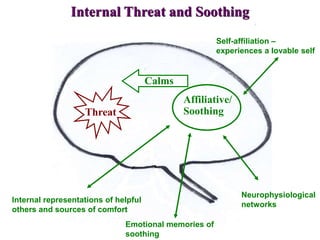
Internal Threat and Soothing
Threat
Affiliative/
Soothing
Calms
Internal representations of helpful
others and sources of comfort
Emotional memories of
soothing
Neurophysiological
networks
Self-affiliation –
experiences a lovable self
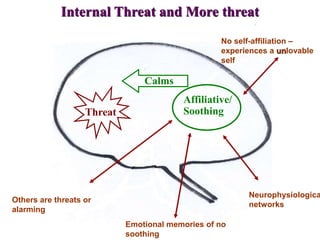
Internal Threat and More threat
Threat
Affiliative/
Soothing
Calms
Others are threats or
alarming
Emotional memories of no
soothing
Neurophysiologica
networks
No self-affiliation –
experiences a unlovable
self
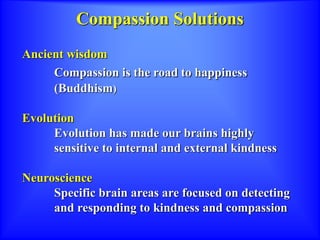
Compassion Solutions
Ancient wisdom
Compassion is the road to happiness
(Buddhism)
Evolution
Evolution has made our brains highly
sensitive to internal and external kindness
Neuroscience
Specific brain areas are focused on detecting
and responding to kindness and compassion
Compassion
Compassion can be defined in many ways: “As a
sensitivity to the suffering of self and others with a
deep commitment to try to relieve it” Dalai Lama
Eight fold path - represents a multi-modal
approach for training one’s mind
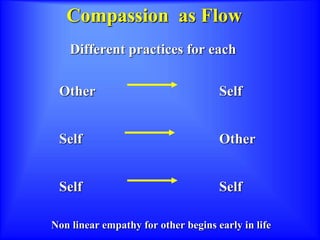
Compassion as Flow
Different practices for each
Other Self
Self Other
Self Self
Non linear empathy for other begins early in life
Data
• Practice of imagining compassion for others produces changes in
frontal cortex and immune system (Lutz et al, 2009)
• Loving kindness meditation (compassion directed to self, then
others, then strangers) increases positive emotions, mindfulness,
feelings of purpose in life and social support and decreases illness
symptoms (Frederickson et al, 2008, JPSP)
• Compassion meditation (6 weeks) improves immune function, and
neuroendocrine and behavioural responses to stress (Pace, 2008,
PNE)
• Viewing sad faces, neutrally or with a compassionate attitude
influences neurophysiological responses to faces (Ji-Woong Kim,
2009, NP)
• Compassion training reduces shame and self-criticism in chronic
depressed patients (Gilbert & Proctor, 2006, CPP)
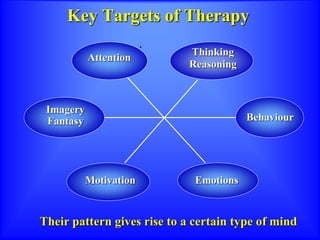
Key Targets of Therapy
Attention
Thinking
Reasoning
Behaviour
Motivation Emotions
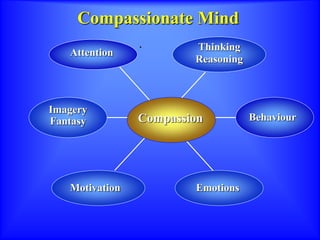
Their pattern gives rise to a certain type of mind
Imagery
Fantasy
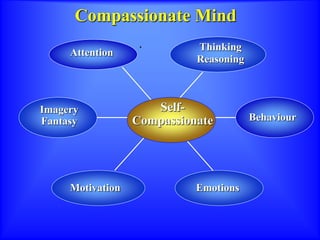
Compassionate Mind
Attention
Thinking
Reasoning
Behaviour
Motivation Emotions
Imagery
Fantasy Compassion
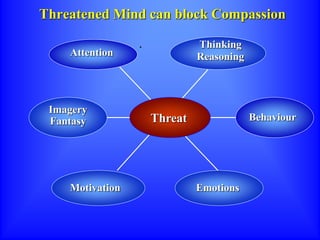
Threatened Mind can block Compassion
Attention
Thinking
Reasoning
Behaviour
Motivation Emotions
Imagery
Fantasy Threat
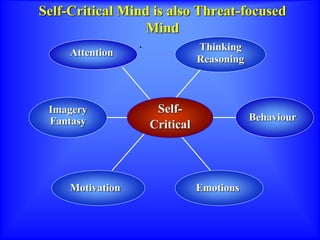
Self-Critical Mind is also Threat-focused
Mind
Attention
Thinking
Reasoning
Behaviour
Motivation Emotions
Imagery
Fantasy
Self-
Critical
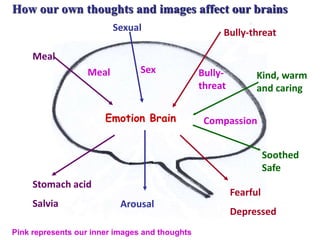
Meal
Sexual Bully-threat
Emotion Brain
Stomach acid
Salvia Arousal
Fearful
Depressed
How our own thoughts and images affect our brains
Kind, warm
and caring
Soothed
Safe
Meal Sex Bully-
threat
Compassion
Pink represents our inner images and thoughts
Questions
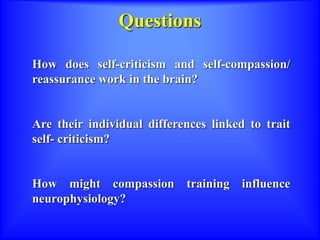
How does self-criticism and self-compassion/
reassurance work in the brain?
Are their individual differences linked to trait
self- criticism?
How might compassion training influence
neurophysiology?
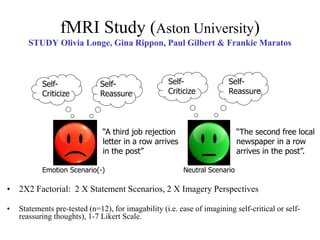
fMRI Study (Aston University)
STUDY Olivia Longe, Gina Rippon, Paul Gilbert & Frankie Maratos
• 2X2 Factorial: 2 X Statement Scenarios, 2 X Imagery Perspectives
• Statements pre-tested (n=12), for imagability (i.e. ease of imagining self-critical or self-
reassuring thoughts), 1-7 Likert Scale.
Emotion Scenario(-) Neutral Scenario
“A third job rejection
letter in a row arrives
in the post”
“The second free local
newspaper in a row
arrives in the post”.
Self-
Reassure
Self-
Criticize
Self-
Reassure
Self-
Criticize
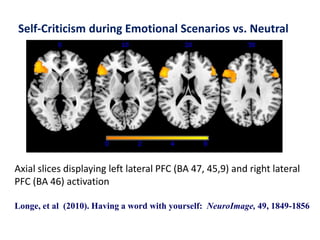
Axial slices displaying left lateral PFC (BA 47, 45,9) and right lateral
PFC (BA 46) activation
Longe, et al (2010). Having a word with yourself: NeuroImage, 49, 1849-1856
Self-Criticism during Emotional Scenarios vs. Neutral
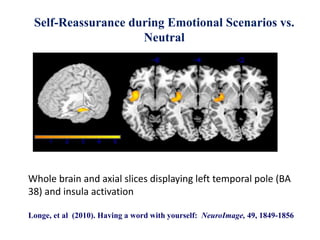
Self-Reassurance during Emotional Scenarios vs.
Neutral
Whole brain and axial slices displaying left temporal pole (BA
38) and insula activation
Longe, et al (2010). Having a word with yourself: NeuroImage, 49, 1849-1856
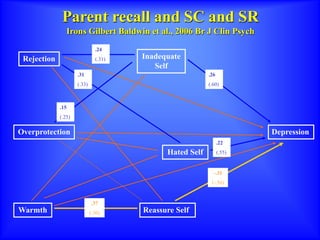
Parent recall and SC and SR
Irons Gilbert Baldwin et al., 2006 Br J Clin Psych
Rejection
Overprotection
Warmth
Inadequate
Self
Hated Self
Reassure Self
Depression
.37
(.30)
-.31
(-.56)
.24
(.31)
.26
(.60)
.15
(.25)
.31
(.33)
.22
(.55)
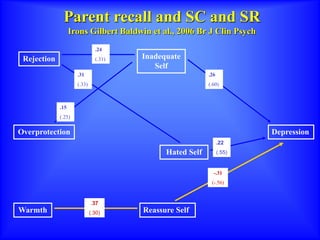
Parent recall and SC and SR
Irons Gilbert Baldwin et al., 2006 Br J Clin Psych
Rejection
Overprotection
Warmth
Inadequate
Self
Hated Self
Reassure Self
Depression
.37
(.30)
-.31
(-.56)
.24
(.31)
.26
(.60)
.15
(.25)
.31
(.33)
.22
(.55)
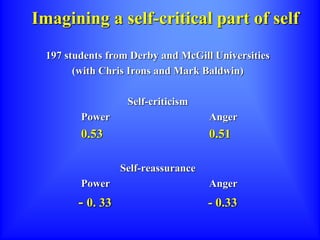
Imagining a self-critical part of self
197 students from Derby and McGill Universities
(with Chris Irons and Mark Baldwin)
Self-criticism
Power Anger
0.53 0.51
Self-reassurance
Power Anger
- 0. 33 - 0.33
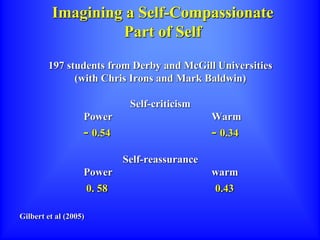
Imagining a Self-Compassionate
Part of Self
197 students from Derby and McGill Universities
(with Chris Irons and Mark Baldwin)
Self-criticism
Power Warm
- 0.54 - 0.34
Self-reassurance
Power warm
0. 58 0.43
Gilbert et al (2005)
Compassionate Mind
Attention
Thinking
Reasoning
Behaviour
Motivation Emotions
Imagery
Fantasy
Self-
Compassionate
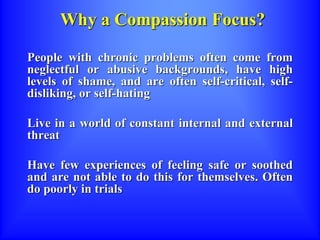
Why a Compassion Focus?
People with chronic problems often come from
neglectful or abusive backgrounds, have high
levels of shame, and are often self-critical, self-
disliking, or self-hating
Live in a world of constant internal and external
threat
Have few experiences of feeling safe or soothed
and are not able to do this for themselves. Often
do poorly in trials
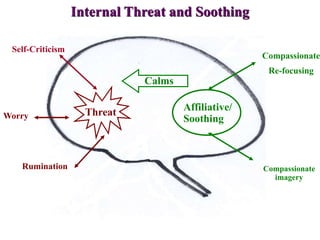
Self-Criticism
Internal Threat and Soothing
Rumination
Worry Threat
Compassionate
Re-focusing
Affiliative/
Soothing
Compassionate
imagery
Calms
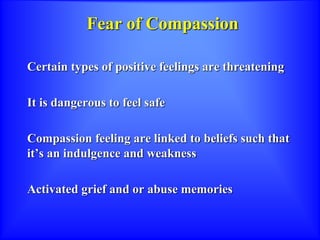
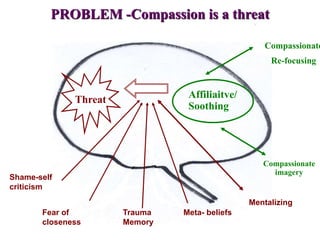
Fear of Compassion
Certain types of positive feelings are threatening
It is dangerous to feel safe
Compassion feeling are linked to beliefs such that
it’s an indulgence and weakness
Activated grief and or abuse memories
PROBLEM -Compassion is a threat
Threat
Compassionate
Re-focusing
Affiliaitve/
Soothing
Compassionate
imagery
Shame-self
criticism
Trauma
Memory
Meta- beliefsFear of
closeness
Mentalizing
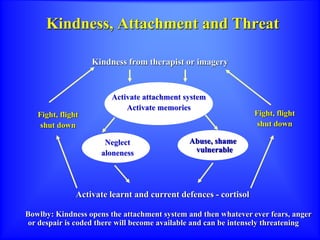
Kindness, Attachment and Threat
Kindness from therapist or imagery
Activate attachment system
Activate memories
Neglect
aloneness
Abuse, shame
vulnerable
Activate learnt and current defences - cortisol
Fight, flight
shut down
Fight, flight
shut down
Bowlby: Kindness opens the attachment system and then whatever ever fears, anger
or despair is coded there will become available and can be intensely threatening
Study of reactions to
compassionate imagery
• Control of the mechanisms for balance between
sympathetic and parasympathetic nervous system have
been modified and are linked to evolution of mammalian,
attachment and social engagement systems
• This relative balance can be measured in heart rate
variability
• Heart rate variability linked to adaptive balance and
flexibility, soothing and safeness - low variability to
relative control/dominance of one over the other - threat
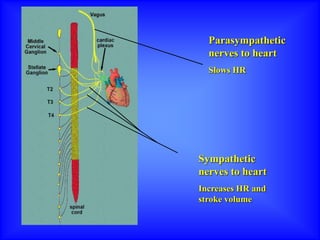
Sympathetic
nerves to heart
Increases HR and
stroke volume
Parasympathetic
nerves to heart
Slows HR
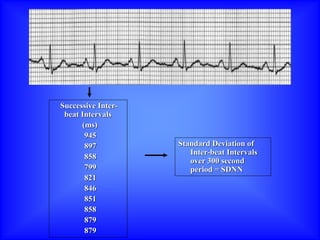
Successive Inter-
beat Intervals
(ms)
945
897
858
799
821
846
851
858
879
879
Standard Deviation of
Inter-beat Intervals
over 300 second
period = SDNN
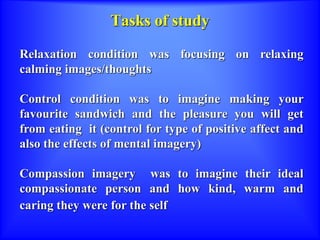
Tasks of study
Relaxation condition was focusing on relaxing
calming images/thoughts
Control condition was to imagine making your
favourite sandwich and the pleasure you will get
from eating it (control for type of positive affect and
also the effects of mental imagery)
Compassion imagery was to imagine their ideal
compassionate person and how kind, warm and
caring they were for the self
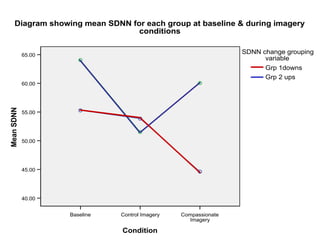
Compassionate
Imagery
Control ImageryBaseline
Condition
65.00
60.00
55.00
50.00
45.00
40.00
MeanSDNN
Grp 2 ups
Grp 1downs
SDNN change grouping
variable
Diagram showing mean SDNN for each group at baseline & during imagery
conditions
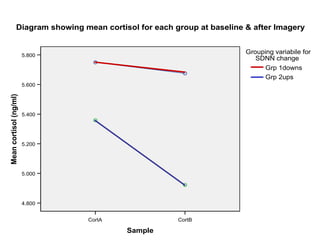
CortBCortA
Sample
5.800
5.600
5.400
5.200
5.000
4.800
Meancortisol(ng/ml)
Grp 2ups
Grp 1downs
Grouping variabile for
SDNN change
Diagram showing mean cortisol for each group at baseline & after Imagery
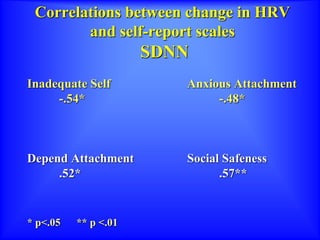
Correlations between change in HRV
and self-report scales
SDNN
Inadequate Self Anxious Attachment
-.54* -.48*
Depend Attachment Social Safeness
.52* .57**
* p<.05 ** p <.01
Fears of Compassion
Basic Beliefs and Meta-cognitions
Fear of Compassion For Others
Scale
People will take advantage of you if you are
too compassionate
If I’m too compassionate, others will become
too dependent on me
I can’t tolerate others distress
Fear of Compassion From Others
Scale
I fear that if I need other people to be kind, they
wont be
I worry that people are only kind and
compassionate if they want something from me
If I think someone is being kind & caring towards
me, I put up a barrier
Fear of Compassion Towards
Self Scale
I fear that if I develop compassion for
myself, I will become someone I don’t want
to be
I fear that if I am more self-compassionate
I will become a weak person
I fear that if I start to feel compassion for myself,
I will be overcome with loss/grief
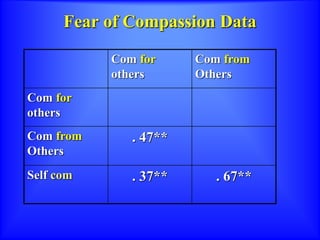
Fear of Compassion Data
Com for
others
Com from
Others
Com for
others
Com from
Others
. 47**
Self com . 37** . 67**
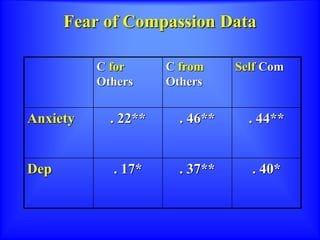
Fear of Compassion Data
C for
Others
C from
Others
Self Com
Anxiety . 22** . 46** . 44**
Dep . 17* . 37** . 40*
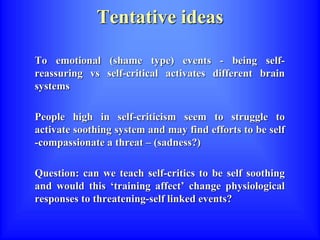
Tentative ideas
To emotional (shame type) events - being self-
reassuring vs self-critical activates different brain
systems
People high in self-criticism seem to struggle to
activate soothing system and may find efforts to be self
-compassionate a threat – (sadness?)
Question: can we teach self-critics to be self soothing
and would this ‘training affect’ change physiological
responses to threatening-self linked events?
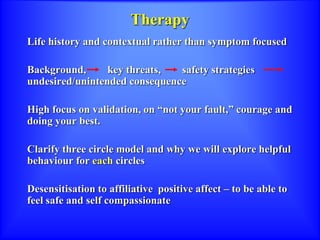
Therapy
Life history and contextual rather than symptom focused
Background, key threats, safety strategies
undesired/unintended consequence
High focus on validation, on “not your fault,” courage and
doing your best.
Clarify three circle model and why we will explore helpful
behaviour for each circles
Desensitisation to affiliative positive affect – to be able to
feel safe and self compassionate
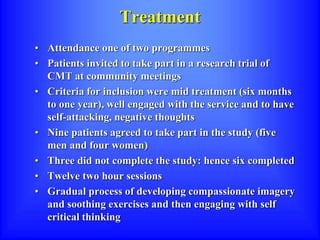
Treatment
• Attendance one of two programmes
• Patients invited to take part in a research trial of
CMT at community meetings
• Criteria for inclusion were mid treatment (six months
to one year), well engaged with the service and to have
self-attacking, negative thoughts
• Nine patients agreed to take part in the study (five
men and four women)
• Three did not complete the study: hence six completed
• Twelve two hour sessions
• Gradual process of developing compassionate imagery
and soothing exercises and then engaging with self
critical thinking
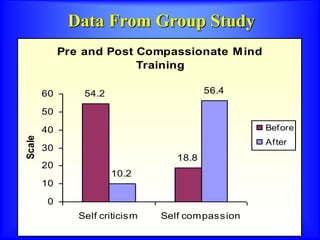
Data From Group Study
Pre and Post Compassionate Mind
Training
10.2
18.8
54.2 56.4
0
10
20
30
40
50
60
Self criticism Self compassion
Scale
Before
After
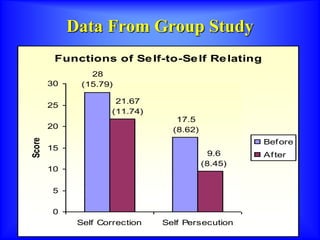
Data From Group Study
Functions of Self-to-Self Relating
28
(15.79)
17.5
(8.62)
21.67
(11.74)
9.6
(8.45)
0
5
10
15
20
25
30
Self Correction Self Persecution
Score
Before
After
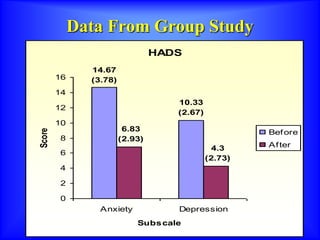
Data From Group Study
HADS
10.33
(2.67)
14.67
(3.78)
4.3
(2.73)
6.83
(2.93)
0
2
4
6
8
10
12
14
16
Anxiety Depression
Subscale
Score
Before
After
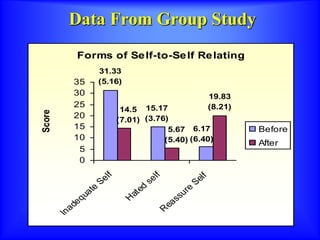
Data From Group Study
Forms of Self-to-Self Relating
31.33
(5.16)
15.17
(3.76)
6.17
(6.40)
14.5
(7.01)
5.67
(5.40)
19.83
(8.21)
0
5
10
15
20
25
30
35
Inadequate
S
elf
H
ated
self
R
eassure
S
elf
Score
Before
After
Data From Group Study
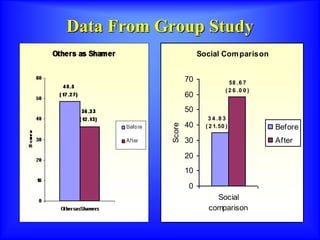
Social Comparison
3 4 .8 3
( 2 1.50 )
58 .6 7
( 2 6 .0 0 )
0
10
20
30
40
50
60
70
Social
comparison
Score
Before
After
Reflections
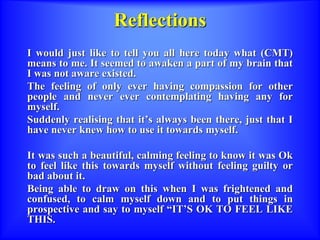
I would just like to tell you all here today what (CMT)
means to me. It seemed to awaken a part of my brain that
I was not aware existed.
The feeling of only ever having compassion for other
people and never ever contemplating having any for
myself.
Suddenly realising that it’s always been there, just that I
have never knew how to use it towards myself.
It was such a beautiful, calming feeling to know it was Ok
to feel like this towards myself without feeling guilty or
bad about it.
Being able to draw on this when I was frightened and
confused, to calm myself down and to put things in
prospective and say to myself “IT’S OK TO FEEL LIKE
THIS.
Reflections
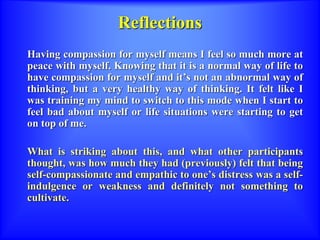
Having compassion for myself means I feel so much more at
peace with myself. Knowing that it is a normal way of life to
have compassion for myself and it’s not an abnormal way of
thinking, but a very healthy way of thinking. It felt like I
was training my mind to switch to this mode when I start to
feel bad about myself or life situations were starting to get
on top of me.
What is striking about this, and what other participants
thought, was how much they had (previously) felt that being
self-compassionate and empathic to one’s distress was a self-
indulgence or weakness and definitely not something to
cultivate.
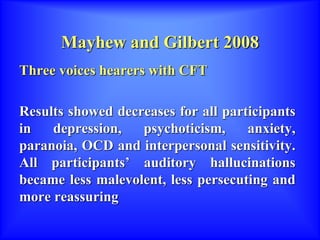
Mayhew and Gilbert 2008
Three voices hearers with CFT
Results showed decreases for all participants
in depression, psychoticism, anxiety,
paranoia, OCD and interpersonal sensitivity.
All participants’ auditory hallucinations
became less malevolent, less persecuting and
more reassuring
Some other studies
Laithwaite et al., (2010) (University of Glasgow) in a
study of group based CFT study for 19 clients in a high
security psychiatric at Carstairs found
“… a large magnitude of change for levels of
depression and self-esteem ….. A moderate magnitude
of change was found for the social comparison scale
and general psychopathology, with a small magnitude
of change for shame. These changes were maintained
at 6-week follow-up”.
Conclusions
• CFT linked to evolved and neurophysiological systems : Must
distinguish different types of positive emotion systems
• Self-to-self relationships are important mediators between early
rearing styles and distressed states
• CFT focuses on this inner relationship – shifting it to a self
compassionate one
• First movements to compassion in self-critics are often aversive so
this system needs to be ‘detoxified’
• Takes time and should focus on practice rather than focusing on
feelings first up
• Clients like the neurophysiological and Mind Training aspects --
like ‘going to the gym’ analogies

Compassion focused therapy - Justin La Rose

  • 1.
  • 2.
    Talk Today Outline basicphilosophy and model of Compassion focused Therapy Note the powerful effects of our self- evaluation systems (self-criticism vs self compassion) Explore the main therapeutic work as overcoming the fear of compassion and self compassions
  • 3.
    To understand ourselveswe must understand our brains
  • 4.
    why we havecomplex brains and minds that are difficult to understand regulate 1. Old Brain Emotions: Anger, anxiety, sadness, joy, lust Behaviours: Fight, flight, withdraw, engage Relationships: Sex, status, attachment, tribalism 2. New Brain Imagination, fantasise, look back and forward, plan, ruminate Integration of mental abilities Self-awareness, self-identity, and self-feeling 3. Social Brain Need for affection and care Socially responsive, self-experience and motives What happens when new brain is recruited to pursue old brain passions?
  • 5.
    Sources of behaviour OldBrain: Emotions, Motives, Relationship Seeking-Creating Archetypal New Brain: Imagination, Planning, Rumination, Integration Interaction of old and new psychologies
  • 6.
    Understanding our Motivesand Emotions Motives evolved because they help animals to survive and leave genes behind Emotions guide us to our goals and respond if we are succeeding or threatened There are three types of emotion regulation 1. Those that focus on threat and self-protection 2. Those that focus on doing and achieving 3. Those that focus on contentment and feeling safe
  • 7.
    Types of AffectRegulator Systems Incentive/resource- focused Wanting, pursuing, achieving, consuming Activating Non-wanting/ Affiliative focused Safeness-kindness Soothing Threat-focused Protection and Safety-seeking Activating/inhibiting Anger, anxiety, disgust Drive, excite, vitality Content, safe, connected
  • 8.
    Self-Protection In species withoutattachment only 1-2% make it to adulthood to reproduce. Threats come from ecologies, food shortage, predation, injury, disease. At birth individuals must be able to “go it alone” be mobile and disperse
  • 9.
  • 10.
    Protect and Comfort:Less ‘instinctive brain – post birth learning
  • 12.
    The Mammalian Importanceof Caring Minds Caring as “looking after”. Seeking closeness rather than dispersion. Individuals obtain protection, food, and care when ill. Key also is soothing-calming and physiological regulation. Few offspring but high survival rate in comparison to species without attachment. Affection and kindness Co-operative and mutual support can develop as we see that our prosperity impacts on that of others, sharing and not-exploiting
  • 13.
    Affectionate Interactions Secure attachmentlinked to self-confidence, empathy and use of attachment strategies when stressed (Mikulincer & Shaver 2005) Maturation of the brain (e.g. frontal cortex) and affect regulation (Gerhardt, 2004; Schore, 1994) Effects of low birth weight (Tully et al, 2004. JCCP, 72, 218- 226) Testosterone and aggression (Booth et al., 2003. Developmental Psychology, 39, 85 – 98) Self-to-self-relating e.g. self criticism vs self-reassurance
  • 14.
    Internal Threat andSoothing Threat Affiliative/ Soothing Calms Internal representations of helpful others and sources of comfort Emotional memories of soothing Neurophysiological networks Self-affiliation – experiences a lovable self
  • 15.
    Internal Threat andMore threat Threat Affiliative/ Soothing Calms Others are threats or alarming Emotional memories of no soothing Neurophysiologica networks No self-affiliation – experiences a unlovable self
  • 16.
    Compassion Solutions Ancient wisdom Compassionis the road to happiness (Buddhism) Evolution Evolution has made our brains highly sensitive to internal and external kindness Neuroscience Specific brain areas are focused on detecting and responding to kindness and compassion
  • 17.
    Compassion Compassion can bedefined in many ways: “As a sensitivity to the suffering of self and others with a deep commitment to try to relieve it” Dalai Lama Eight fold path - represents a multi-modal approach for training one’s mind
  • 18.
    Compassion as Flow Differentpractices for each Other Self Self Other Self Self Non linear empathy for other begins early in life
  • 19.
    Data • Practice ofimagining compassion for others produces changes in frontal cortex and immune system (Lutz et al, 2009) • Loving kindness meditation (compassion directed to self, then others, then strangers) increases positive emotions, mindfulness, feelings of purpose in life and social support and decreases illness symptoms (Frederickson et al, 2008, JPSP) • Compassion meditation (6 weeks) improves immune function, and neuroendocrine and behavioural responses to stress (Pace, 2008, PNE) • Viewing sad faces, neutrally or with a compassionate attitude influences neurophysiological responses to faces (Ji-Woong Kim, 2009, NP) • Compassion training reduces shame and self-criticism in chronic depressed patients (Gilbert & Proctor, 2006, CPP)
  • 20.
    Key Targets ofTherapy Attention Thinking Reasoning Behaviour Motivation Emotions Their pattern gives rise to a certain type of mind Imagery Fantasy
  • 21.
  • 22.
    Threatened Mind canblock Compassion Attention Thinking Reasoning Behaviour Motivation Emotions Imagery Fantasy Threat
  • 23.
    Self-Critical Mind isalso Threat-focused Mind Attention Thinking Reasoning Behaviour Motivation Emotions Imagery Fantasy Self- Critical
  • 24.
    Meal Sexual Bully-threat Emotion Brain Stomachacid Salvia Arousal Fearful Depressed How our own thoughts and images affect our brains Kind, warm and caring Soothed Safe Meal Sex Bully- threat Compassion Pink represents our inner images and thoughts
  • 25.
    Questions How does self-criticismand self-compassion/ reassurance work in the brain? Are their individual differences linked to trait self- criticism? How might compassion training influence neurophysiology?
  • 26.
    fMRI Study (AstonUniversity) STUDY Olivia Longe, Gina Rippon, Paul Gilbert & Frankie Maratos • 2X2 Factorial: 2 X Statement Scenarios, 2 X Imagery Perspectives • Statements pre-tested (n=12), for imagability (i.e. ease of imagining self-critical or self- reassuring thoughts), 1-7 Likert Scale. Emotion Scenario(-) Neutral Scenario “A third job rejection letter in a row arrives in the post” “The second free local newspaper in a row arrives in the post”. Self- Reassure Self- Criticize Self- Reassure Self- Criticize
  • 27.
    Axial slices displayingleft lateral PFC (BA 47, 45,9) and right lateral PFC (BA 46) activation Longe, et al (2010). Having a word with yourself: NeuroImage, 49, 1849-1856 Self-Criticism during Emotional Scenarios vs. Neutral
  • 28.
    Self-Reassurance during EmotionalScenarios vs. Neutral Whole brain and axial slices displaying left temporal pole (BA 38) and insula activation Longe, et al (2010). Having a word with yourself: NeuroImage, 49, 1849-1856
  • 29.
    Parent recall andSC and SR Irons Gilbert Baldwin et al., 2006 Br J Clin Psych Rejection Overprotection Warmth Inadequate Self Hated Self Reassure Self Depression .37 (.30) -.31 (-.56) .24 (.31) .26 (.60) .15 (.25) .31 (.33) .22 (.55)
  • 30.
    Parent recall andSC and SR Irons Gilbert Baldwin et al., 2006 Br J Clin Psych Rejection Overprotection Warmth Inadequate Self Hated Self Reassure Self Depression .37 (.30) -.31 (-.56) .24 (.31) .26 (.60) .15 (.25) .31 (.33) .22 (.55)
  • 31.
    Imagining a self-criticalpart of self 197 students from Derby and McGill Universities (with Chris Irons and Mark Baldwin) Self-criticism Power Anger 0.53 0.51 Self-reassurance Power Anger - 0. 33 - 0.33
  • 32.
    Imagining a Self-Compassionate Partof Self 197 students from Derby and McGill Universities (with Chris Irons and Mark Baldwin) Self-criticism Power Warm - 0.54 - 0.34 Self-reassurance Power warm 0. 58 0.43 Gilbert et al (2005)
  • 33.
  • 34.
    Why a CompassionFocus? People with chronic problems often come from neglectful or abusive backgrounds, have high levels of shame, and are often self-critical, self- disliking, or self-hating Live in a world of constant internal and external threat Have few experiences of feeling safe or soothed and are not able to do this for themselves. Often do poorly in trials
  • 35.
    Self-Criticism Internal Threat andSoothing Rumination Worry Threat Compassionate Re-focusing Affiliative/ Soothing Compassionate imagery Calms
  • 36.
    Fear of Compassion Certaintypes of positive feelings are threatening It is dangerous to feel safe Compassion feeling are linked to beliefs such that it’s an indulgence and weakness Activated grief and or abuse memories
  • 37.
    PROBLEM -Compassion isa threat Threat Compassionate Re-focusing Affiliaitve/ Soothing Compassionate imagery Shame-self criticism Trauma Memory Meta- beliefsFear of closeness Mentalizing
  • 38.
    Kindness, Attachment andThreat Kindness from therapist or imagery Activate attachment system Activate memories Neglect aloneness Abuse, shame vulnerable Activate learnt and current defences - cortisol Fight, flight shut down Fight, flight shut down Bowlby: Kindness opens the attachment system and then whatever ever fears, anger or despair is coded there will become available and can be intensely threatening
  • 39.
    Study of reactionsto compassionate imagery • Control of the mechanisms for balance between sympathetic and parasympathetic nervous system have been modified and are linked to evolution of mammalian, attachment and social engagement systems • This relative balance can be measured in heart rate variability • Heart rate variability linked to adaptive balance and flexibility, soothing and safeness - low variability to relative control/dominance of one over the other - threat
  • 40.
    Sympathetic nerves to heart IncreasesHR and stroke volume Parasympathetic nerves to heart Slows HR
  • 41.
    Successive Inter- beat Intervals (ms) 945 897 858 799 821 846 851 858 879 879 StandardDeviation of Inter-beat Intervals over 300 second period = SDNN
  • 42.
    Tasks of study Relaxationcondition was focusing on relaxing calming images/thoughts Control condition was to imagine making your favourite sandwich and the pleasure you will get from eating it (control for type of positive affect and also the effects of mental imagery) Compassion imagery was to imagine their ideal compassionate person and how kind, warm and caring they were for the self
  • 43.
    Compassionate Imagery Control ImageryBaseline Condition 65.00 60.00 55.00 50.00 45.00 40.00 MeanSDNN Grp 2ups Grp 1downs SDNN change grouping variable Diagram showing mean SDNN for each group at baseline & during imagery conditions
  • 44.
    CortBCortA Sample 5.800 5.600 5.400 5.200 5.000 4.800 Meancortisol(ng/ml) Grp 2ups Grp 1downs Groupingvariabile for SDNN change Diagram showing mean cortisol for each group at baseline & after Imagery
  • 45.
    Correlations between changein HRV and self-report scales SDNN Inadequate Self Anxious Attachment -.54* -.48* Depend Attachment Social Safeness .52* .57** * p<.05 ** p <.01
  • 46.
    Fears of Compassion BasicBeliefs and Meta-cognitions
  • 47.
    Fear of CompassionFor Others Scale People will take advantage of you if you are too compassionate If I’m too compassionate, others will become too dependent on me I can’t tolerate others distress
  • 48.
    Fear of CompassionFrom Others Scale I fear that if I need other people to be kind, they wont be I worry that people are only kind and compassionate if they want something from me If I think someone is being kind & caring towards me, I put up a barrier
  • 49.
    Fear of CompassionTowards Self Scale I fear that if I develop compassion for myself, I will become someone I don’t want to be I fear that if I am more self-compassionate I will become a weak person I fear that if I start to feel compassion for myself, I will be overcome with loss/grief
  • 50.
    Fear of CompassionData Com for others Com from Others Com for others Com from Others . 47** Self com . 37** . 67**
  • 51.
    Fear of CompassionData C for Others C from Others Self Com Anxiety . 22** . 46** . 44** Dep . 17* . 37** . 40*
  • 52.
    Tentative ideas To emotional(shame type) events - being self- reassuring vs self-critical activates different brain systems People high in self-criticism seem to struggle to activate soothing system and may find efforts to be self -compassionate a threat – (sadness?) Question: can we teach self-critics to be self soothing and would this ‘training affect’ change physiological responses to threatening-self linked events?
  • 53.
    Therapy Life history andcontextual rather than symptom focused Background, key threats, safety strategies undesired/unintended consequence High focus on validation, on “not your fault,” courage and doing your best. Clarify three circle model and why we will explore helpful behaviour for each circles Desensitisation to affiliative positive affect – to be able to feel safe and self compassionate
  • 54.
    Treatment • Attendance oneof two programmes • Patients invited to take part in a research trial of CMT at community meetings • Criteria for inclusion were mid treatment (six months to one year), well engaged with the service and to have self-attacking, negative thoughts • Nine patients agreed to take part in the study (five men and four women) • Three did not complete the study: hence six completed • Twelve two hour sessions • Gradual process of developing compassionate imagery and soothing exercises and then engaging with self critical thinking
  • 55.
    Data From GroupStudy Pre and Post Compassionate Mind Training 10.2 18.8 54.2 56.4 0 10 20 30 40 50 60 Self criticism Self compassion Scale Before After
  • 56.
    Data From GroupStudy Functions of Self-to-Self Relating 28 (15.79) 17.5 (8.62) 21.67 (11.74) 9.6 (8.45) 0 5 10 15 20 25 30 Self Correction Self Persecution Score Before After
  • 57.
    Data From GroupStudy HADS 10.33 (2.67) 14.67 (3.78) 4.3 (2.73) 6.83 (2.93) 0 2 4 6 8 10 12 14 16 Anxiety Depression Subscale Score Before After
  • 58.
    Data From GroupStudy Forms of Self-to-Self Relating 31.33 (5.16) 15.17 (3.76) 6.17 (6.40) 14.5 (7.01) 5.67 (5.40) 19.83 (8.21) 0 5 10 15 20 25 30 35 Inadequate S elf H ated self R eassure S elf Score Before After
  • 59.
    Data From GroupStudy Social Comparison 3 4 .8 3 ( 2 1.50 ) 58 .6 7 ( 2 6 .0 0 ) 0 10 20 30 40 50 60 70 Social comparison Score Before After
  • 60.
    Reflections I would justlike to tell you all here today what (CMT) means to me. It seemed to awaken a part of my brain that I was not aware existed. The feeling of only ever having compassion for other people and never ever contemplating having any for myself. Suddenly realising that it’s always been there, just that I have never knew how to use it towards myself. It was such a beautiful, calming feeling to know it was Ok to feel like this towards myself without feeling guilty or bad about it. Being able to draw on this when I was frightened and confused, to calm myself down and to put things in prospective and say to myself “IT’S OK TO FEEL LIKE THIS.
  • 61.
    Reflections Having compassion formyself means I feel so much more at peace with myself. Knowing that it is a normal way of life to have compassion for myself and it’s not an abnormal way of thinking, but a very healthy way of thinking. It felt like I was training my mind to switch to this mode when I start to feel bad about myself or life situations were starting to get on top of me. What is striking about this, and what other participants thought, was how much they had (previously) felt that being self-compassionate and empathic to one’s distress was a self- indulgence or weakness and definitely not something to cultivate.
  • 62.
    Mayhew and Gilbert2008 Three voices hearers with CFT Results showed decreases for all participants in depression, psychoticism, anxiety, paranoia, OCD and interpersonal sensitivity. All participants’ auditory hallucinations became less malevolent, less persecuting and more reassuring
  • 63.
    Some other studies Laithwaiteet al., (2010) (University of Glasgow) in a study of group based CFT study for 19 clients in a high security psychiatric at Carstairs found “… a large magnitude of change for levels of depression and self-esteem ….. A moderate magnitude of change was found for the social comparison scale and general psychopathology, with a small magnitude of change for shame. These changes were maintained at 6-week follow-up”.
  • 64.
    Conclusions • CFT linkedto evolved and neurophysiological systems : Must distinguish different types of positive emotion systems • Self-to-self relationships are important mediators between early rearing styles and distressed states • CFT focuses on this inner relationship – shifting it to a self compassionate one • First movements to compassion in self-critics are often aversive so this system needs to be ‘detoxified’ • Takes time and should focus on practice rather than focusing on feelings first up • Clients like the neurophysiological and Mind Training aspects -- like ‘going to the gym’ analogies