Intelligent
Compassion
Dr. Harry Stefanakis
304-1055West Broadway
Vancouver BCV6H1E2
www.drharry.ca
www.drharry.ca
Bold Statement
 The fundamental neuroses of our time involve
FRAGMENTATION
◦ In our relationships with ourselves, others
and the environment
◦ Works against change by creating certainty
and fear
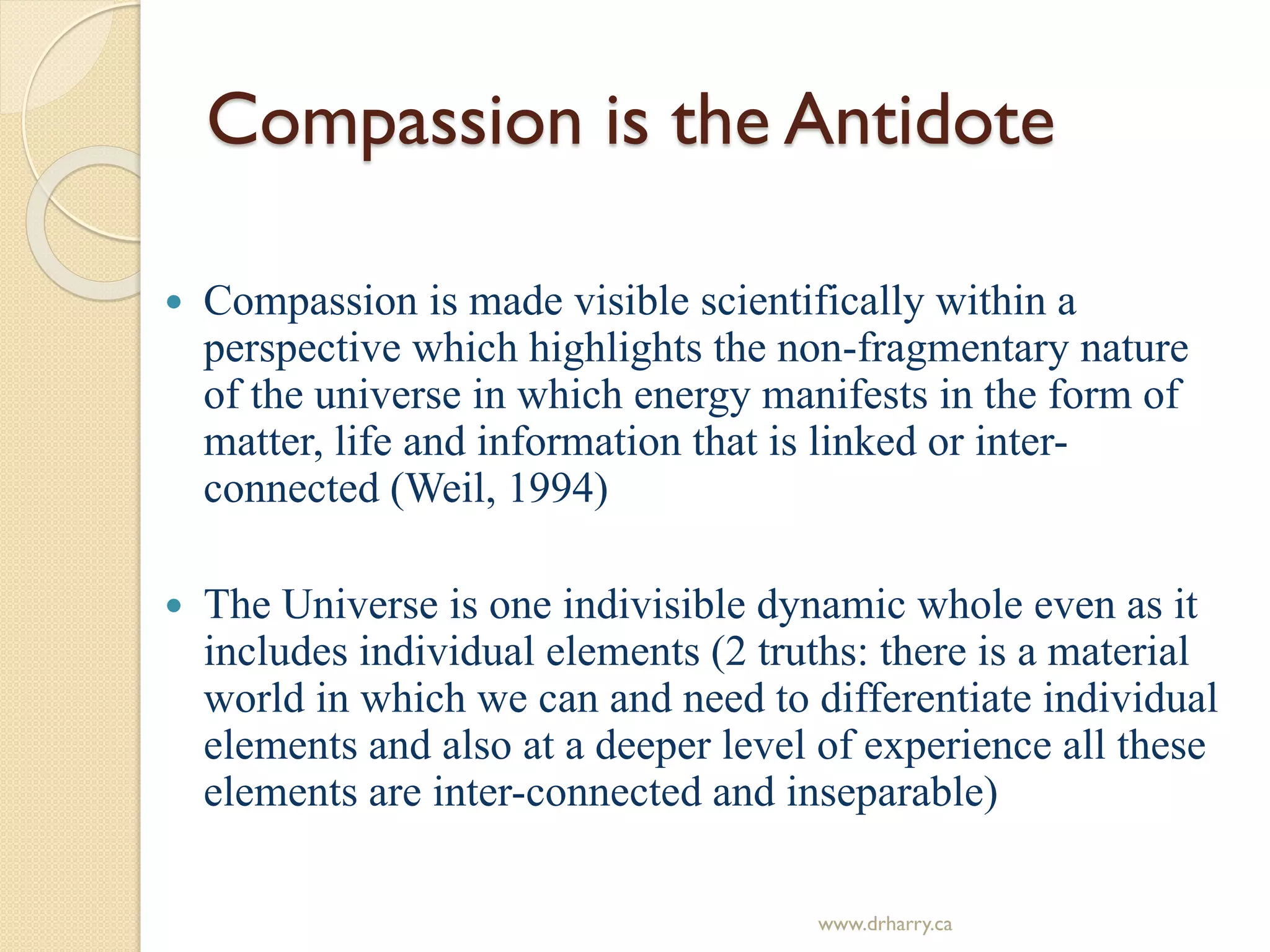
 Compassion is the antidote
www.drharry.ca
TwoWolves
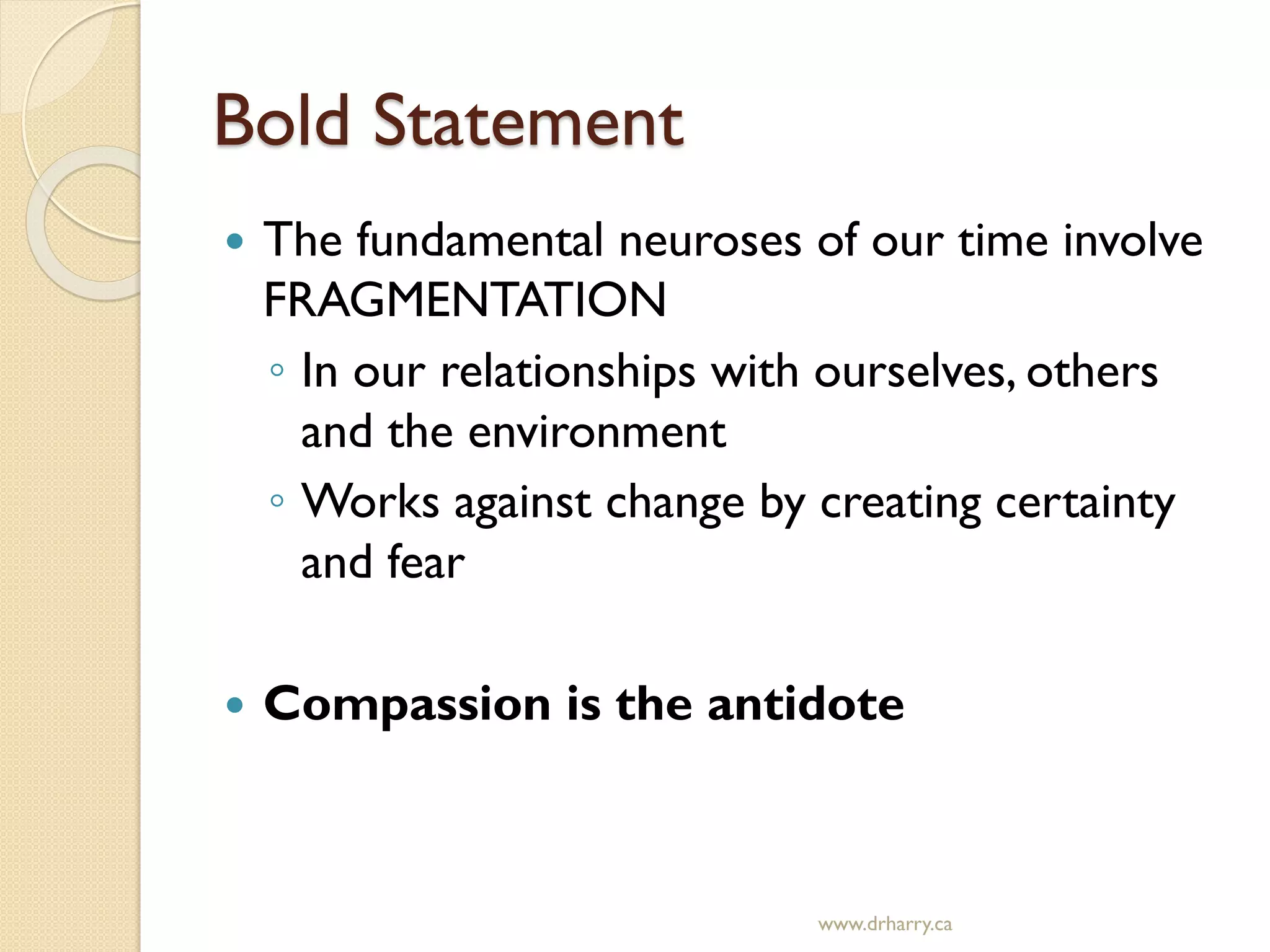
A First Nations grandfather
was talking to his grandson
about how he felt. He said 'I
feel as if I have two wolves
fighting in my heart. One wolf
is the frightened and reactive
one.The other wolf is the
loving, compassionate one.' The
grandson asked him, 'Which
wolf will win the fight in your
heart?' The grandfather
answered: 'The one I feed.'
www.drharry.ca
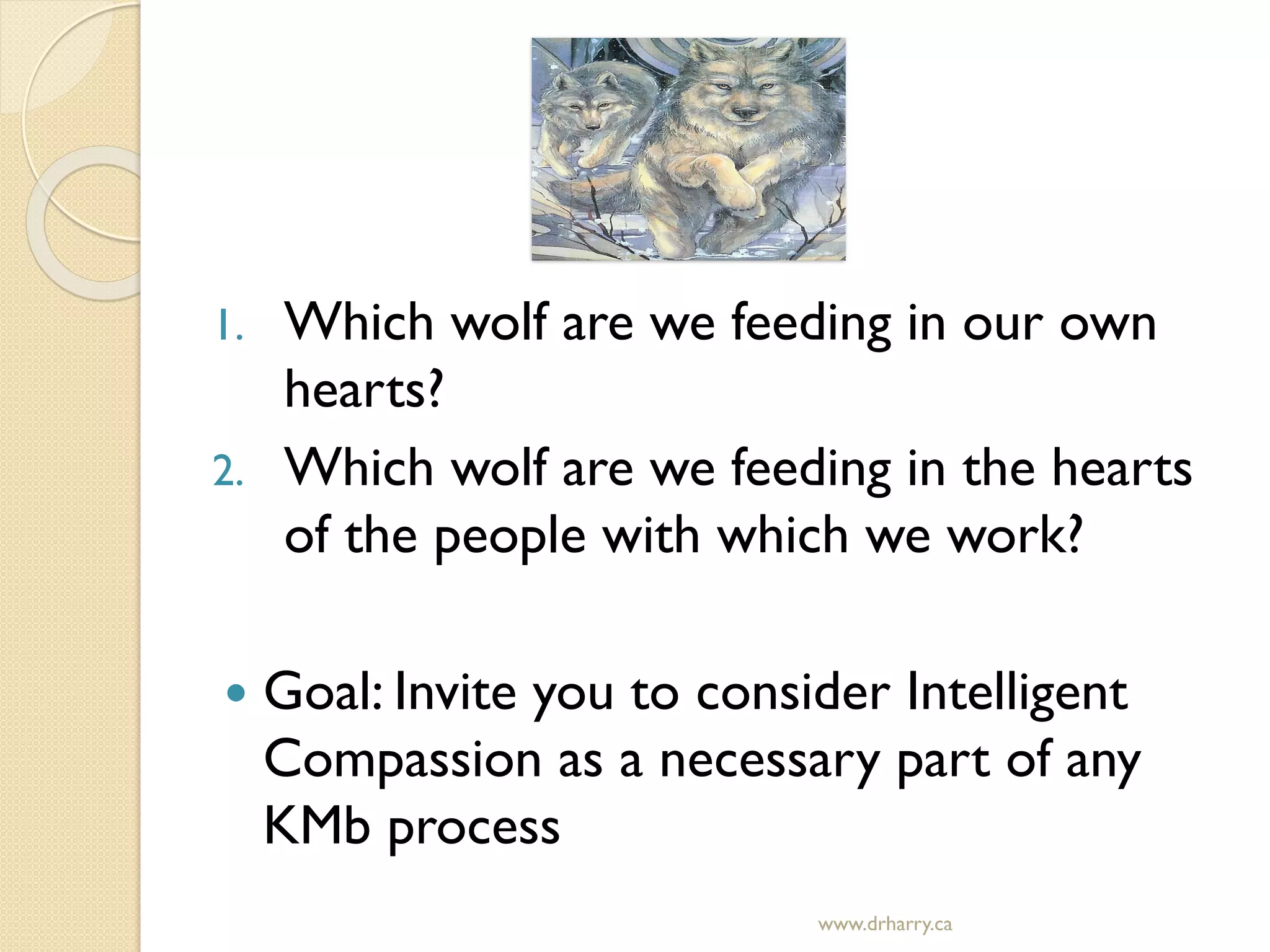
1. Which wolf are we feeding in our own
hearts?
2. Which wolf are we feeding in the hearts
of the people with which we work?
 Goal: Invite you to consider Intelligent
Compassion as a necessary part of any
KMb process
www.drharry.ca
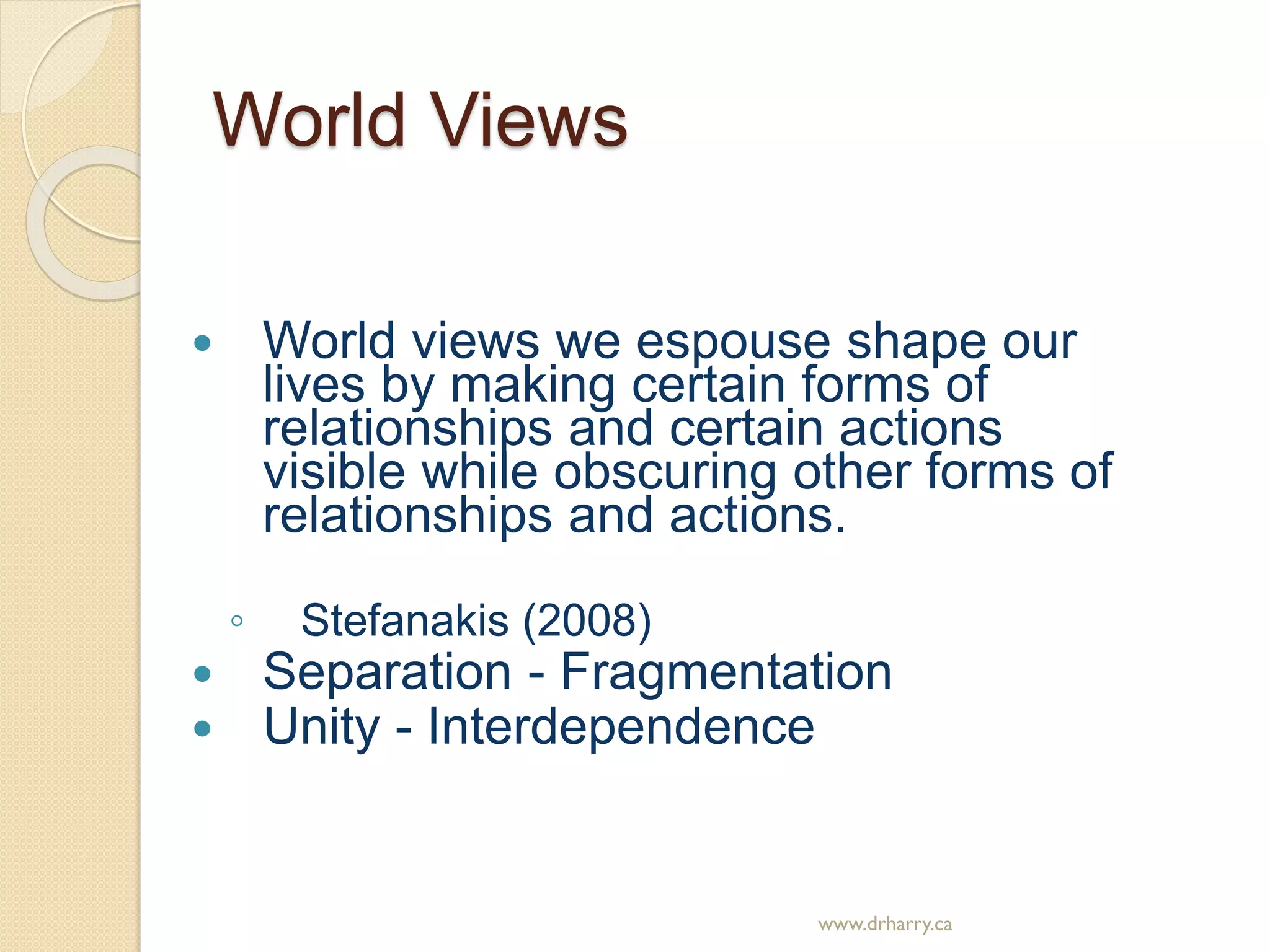
World Views
 World views we espouse shape our
lives by making certain forms of
relationships and certain actions
visible while obscuring other forms of
relationships and actions.
◦ Stefanakis (2008)
 Separation - Fragmentation
 Unity - Interdependence
www.drharry.ca
www.drharry.ca
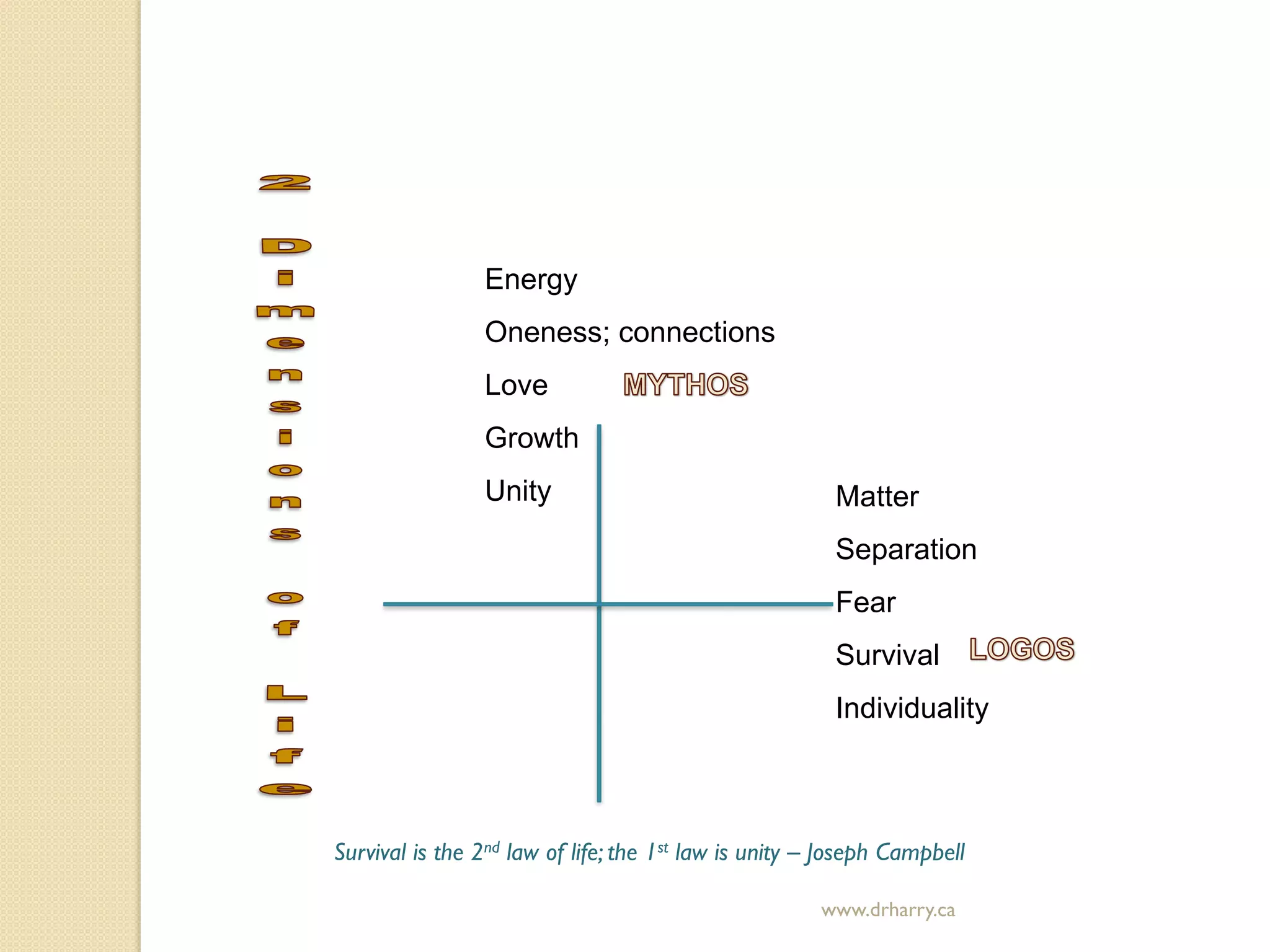
Energy
Oneness; connections
Love
Growth
Unity Matter
Separation
Fear
Survival
Individuality
Survival is the 2nd law of life; the 1st law is unity – Joseph Campbell
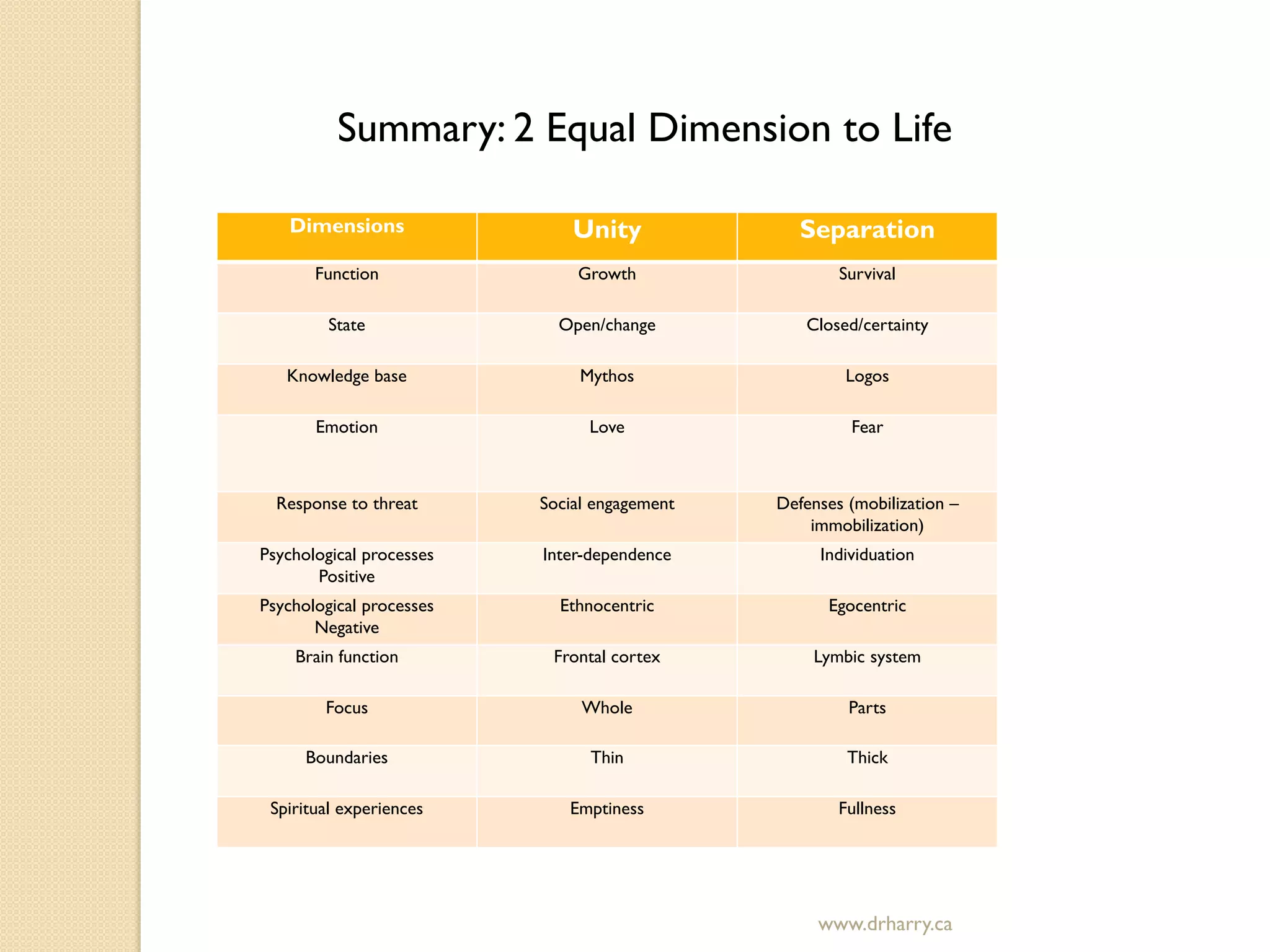
Dimensions Unity Separation
Function Growth Survival
State Open/change Closed/certainty
Knowledge base Mythos Logos
Emotion Love Fear
Response to threat Social engagement Defenses (mobilization –
immobilization)
Psychological processes
Positive
Inter-dependence Individuation
Psychological processes
Negative
Ethnocentric Egocentric
Brain function Frontal cortex Lymbic system
Focus Whole Parts
Boundaries Thin Thick
Spiritual experiences Emptiness Fullness
Summary: 2 Equal Dimension to Life
www.drharry.ca
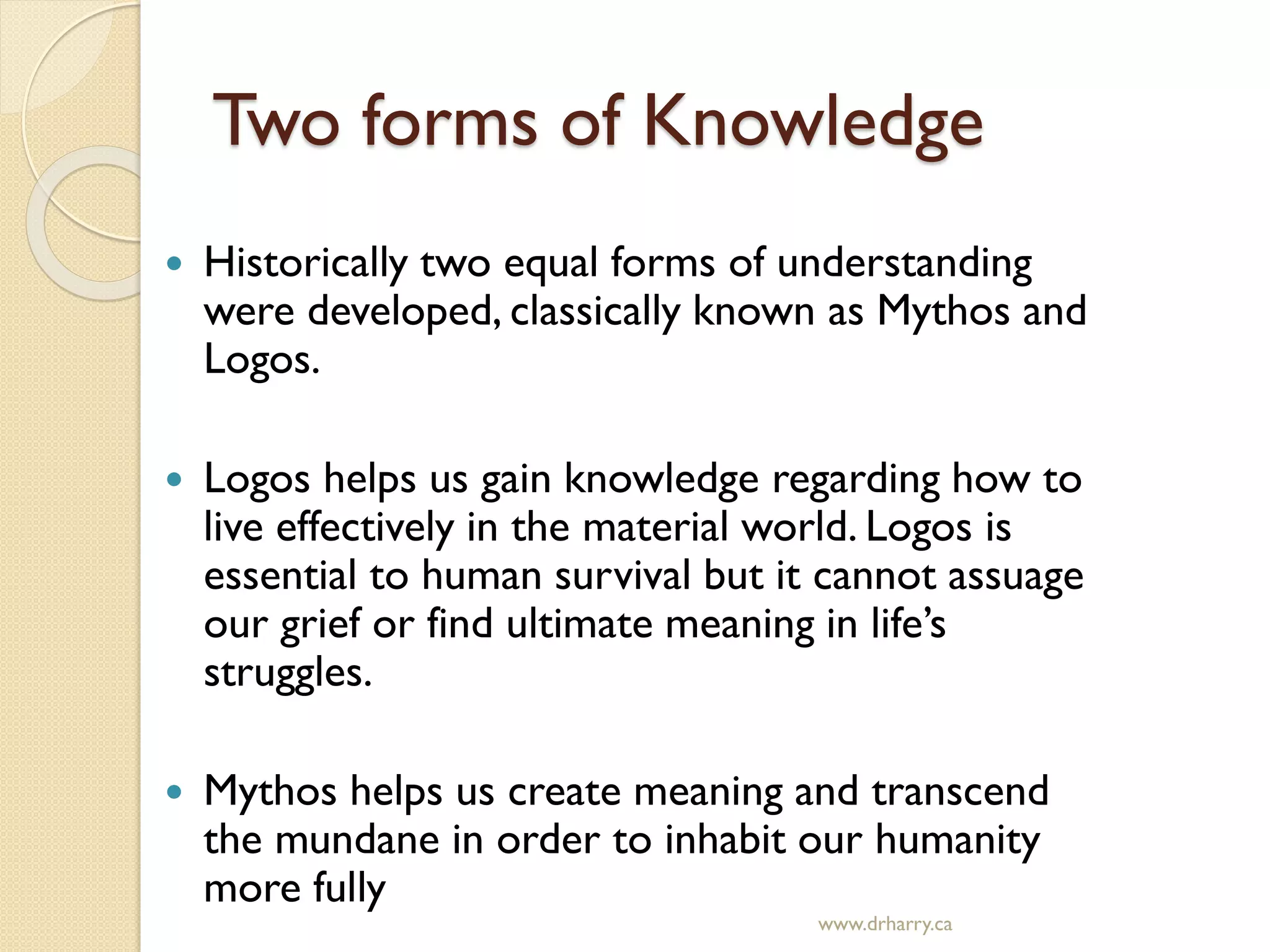
Two forms of Knowledge
 Historically two equal forms of understanding
were developed, classically known as Mythos and
Logos.
 Logos helps us gain knowledge regarding how to
live effectively in the material world. Logos is
essential to human survival but it cannot assuage
our grief or find ultimate meaning in life’s
struggles.
 Mythos helps us create meaning and transcend
the mundane in order to inhabit our humanity
more fully
www.drharry.ca
Separation
 Ideas of separation are sustained within the
orthodox view of science: The world is a
collection of distinct and separate elements that
are related to each other by systems that are
ruled by mechanical laws (Weil, 1994).
 Premises: Objectification, Prediction (cause-
effect), Control
 Premises of this model support the use of
violence and inhibit change to nonviolence
(Stefanakis, 2008)
www.drharry.ca
The Limits of Logos
 Some things are non-rational (Logos ignores the
contradictory complexity of life where our humanity is
situated)
 Focuses more on stability (prediction; control) and
therefore not as well on transformation (especially
nonlinear change)
 Can become simply symptom/behaviour/problem
management
 Can replicate the problem
 Often it doesn’t matter how true something is if we
don’t believe it – meaning trumps logic
www.drharry.ca
www.drharry.ca
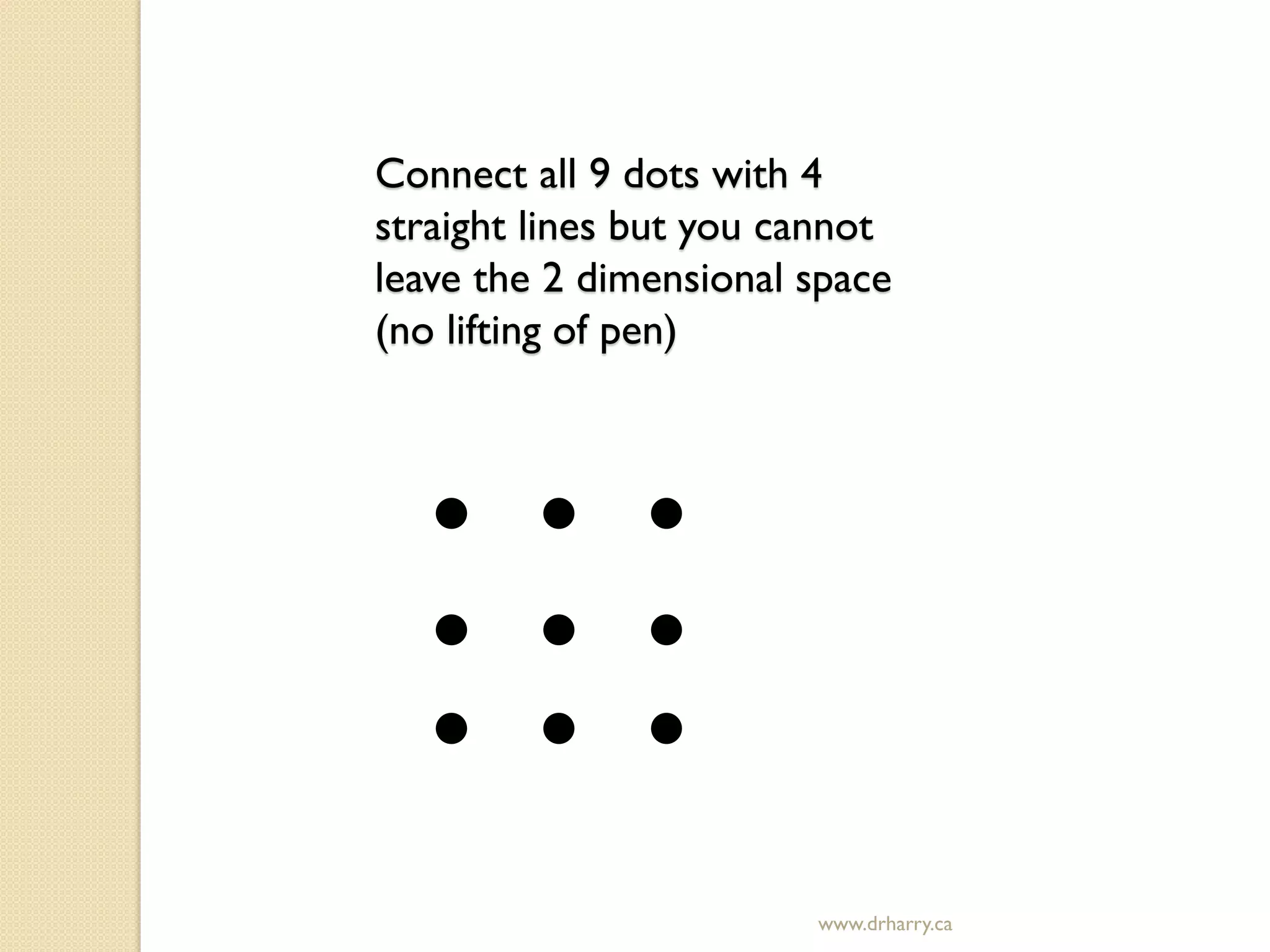
Connect all 9 dots with 4
straight lines but you cannot
leave the 2 dimensional space
(no lifting of pen)
www.drharry.ca
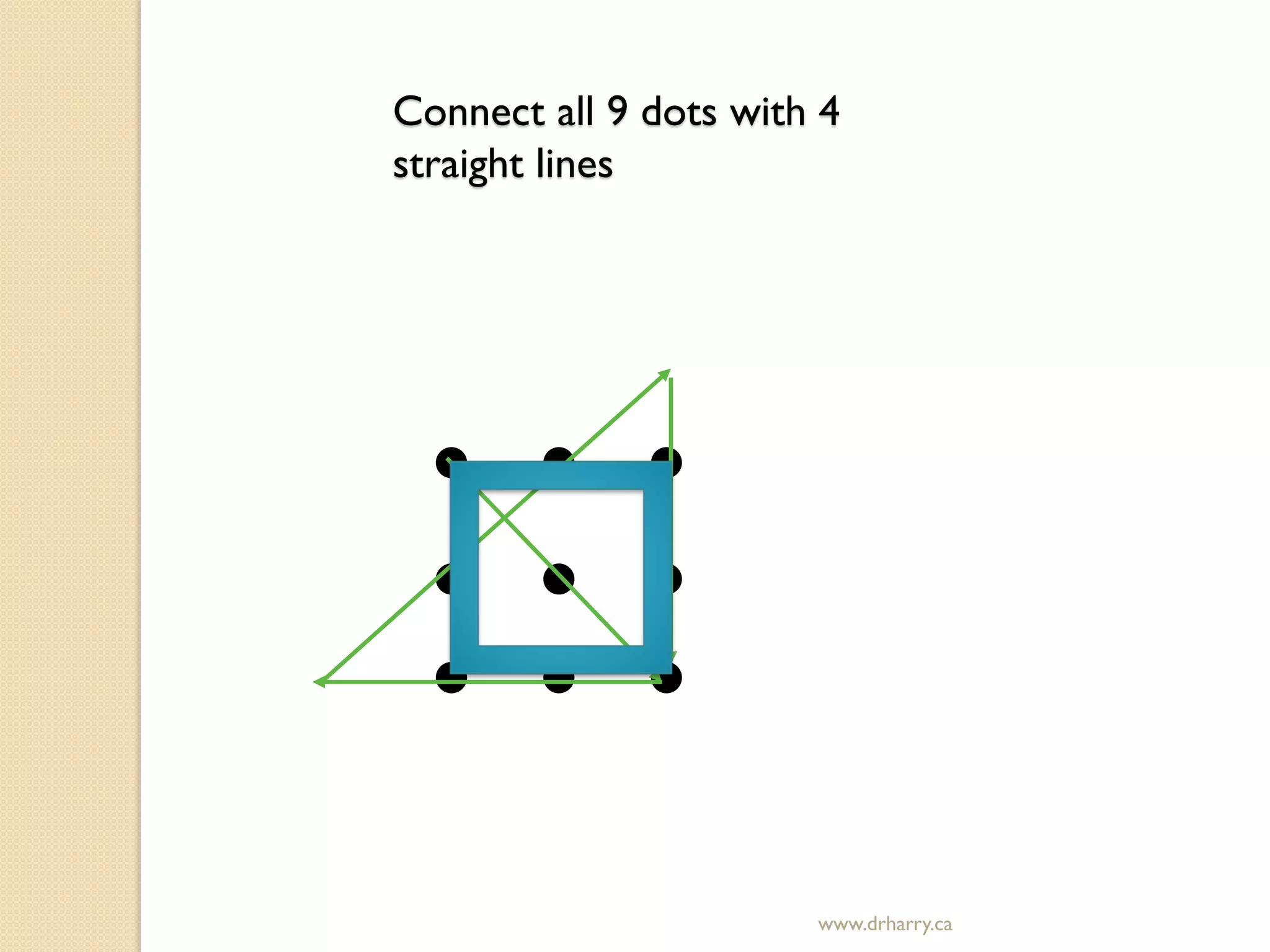
Connect all 9 dots with 4
straight lines
Compassion is the Antidote
 Compassion is made visible scientifically within a
perspective which highlights the non-fragmentary nature
of the universe in which energy manifests in the form of
matter, life and information that is linked or inter-
connected (Weil, 1994)
 The Universe is one indivisible dynamic whole even as it
includes individual elements (2 truths: there is a material
world in which we can and need to differentiate individual
elements and also at a deeper level of experience all these
elements are inter-connected and inseparable)
www.drharry.ca
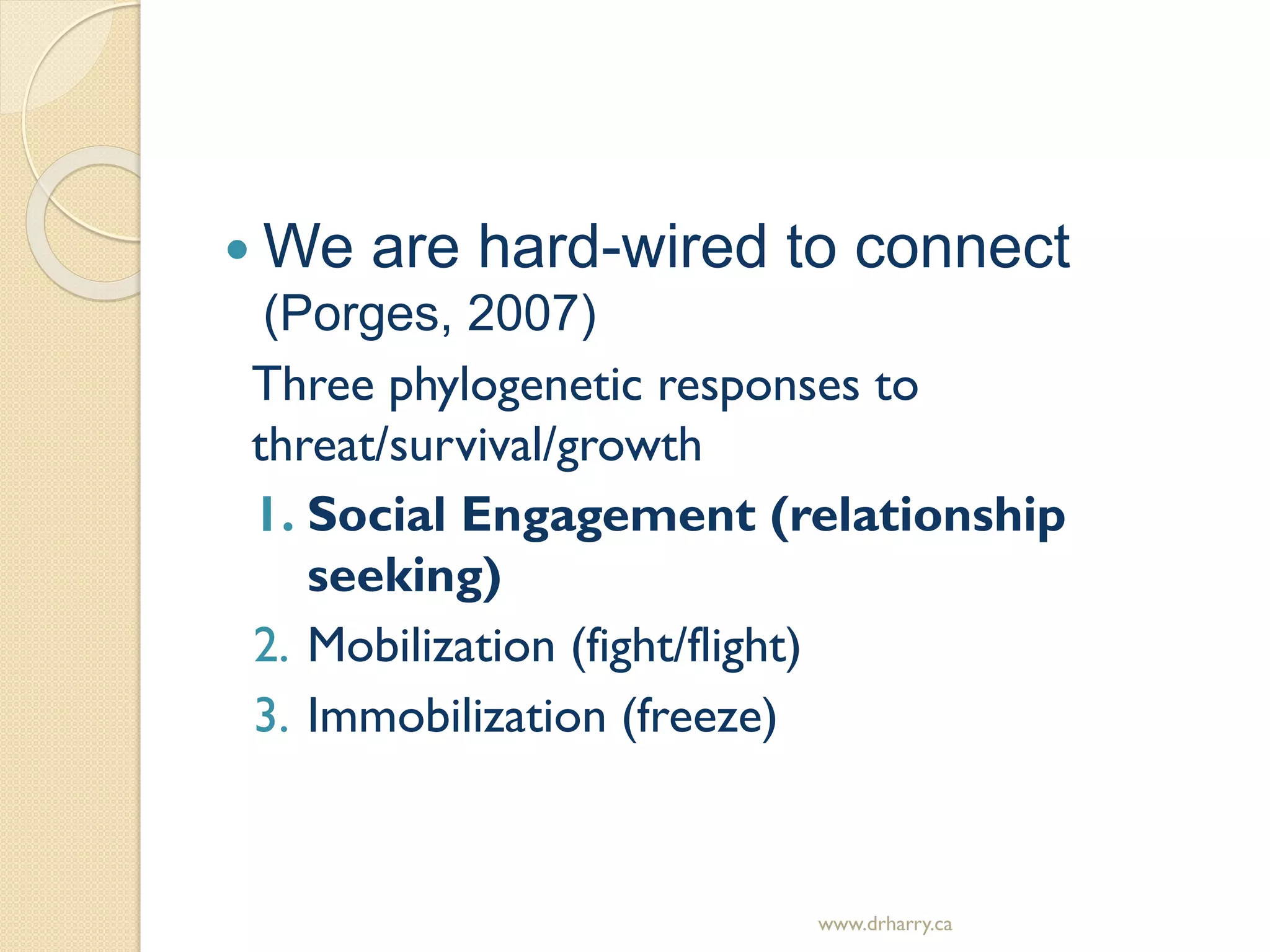
 We are hard-wired to connect
(Porges, 2007)
Three phylogenetic responses to
threat/survival/growth
1. Social Engagement (relationship
seeking)
2. Mobilization (fight/flight)
3. Immobilization (freeze)
www.drharry.ca
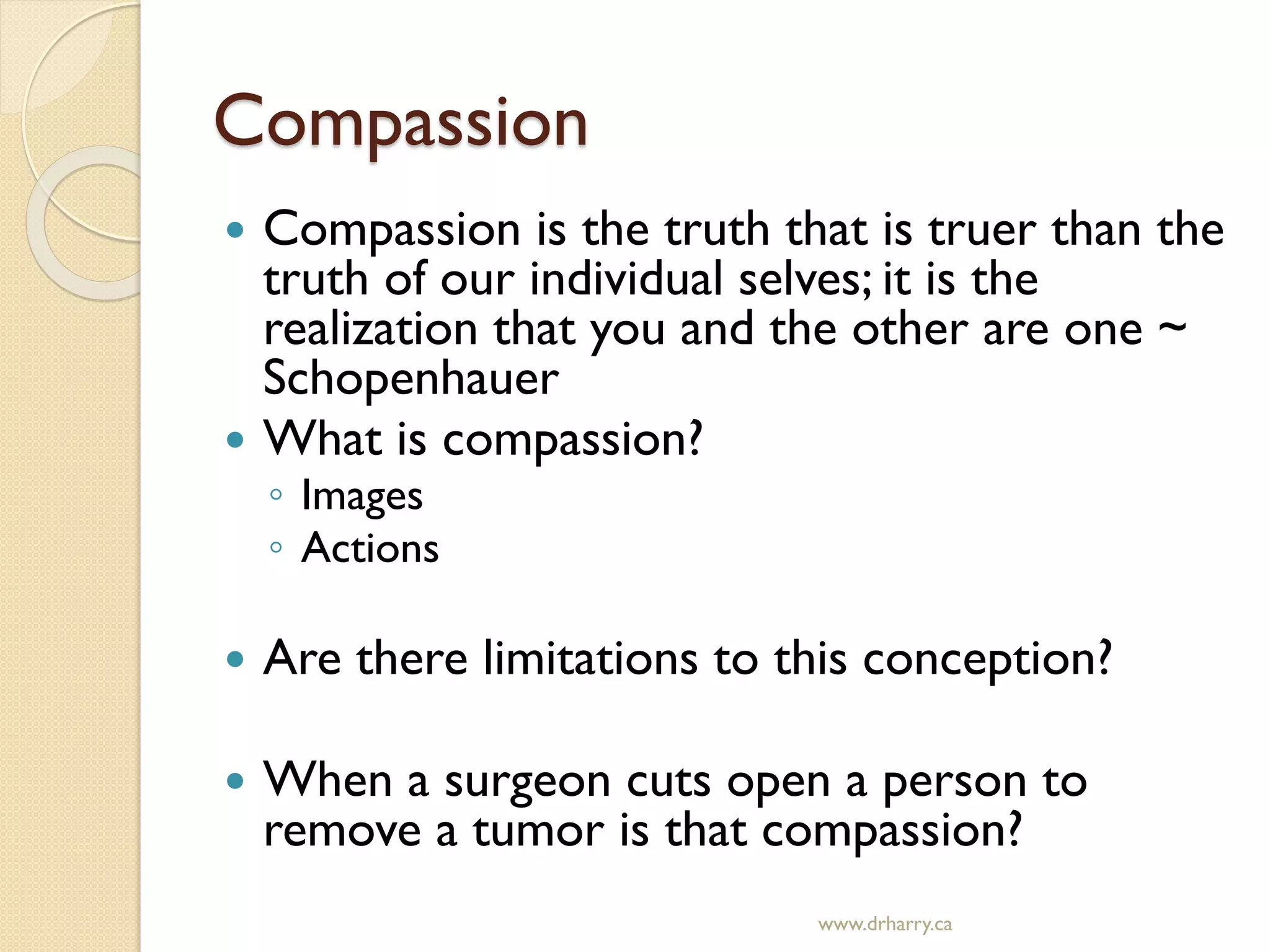
Compassion
 Compassion is the truth that is truer than the
truth of our individual selves; it is the
realization that you and the other are one ~
Schopenhauer
 What is compassion?
◦ Images
◦ Actions
 Are there limitations to this conception?
 When a surgeon cuts open a person to
remove a tumor is that compassion?
www.drharry.ca
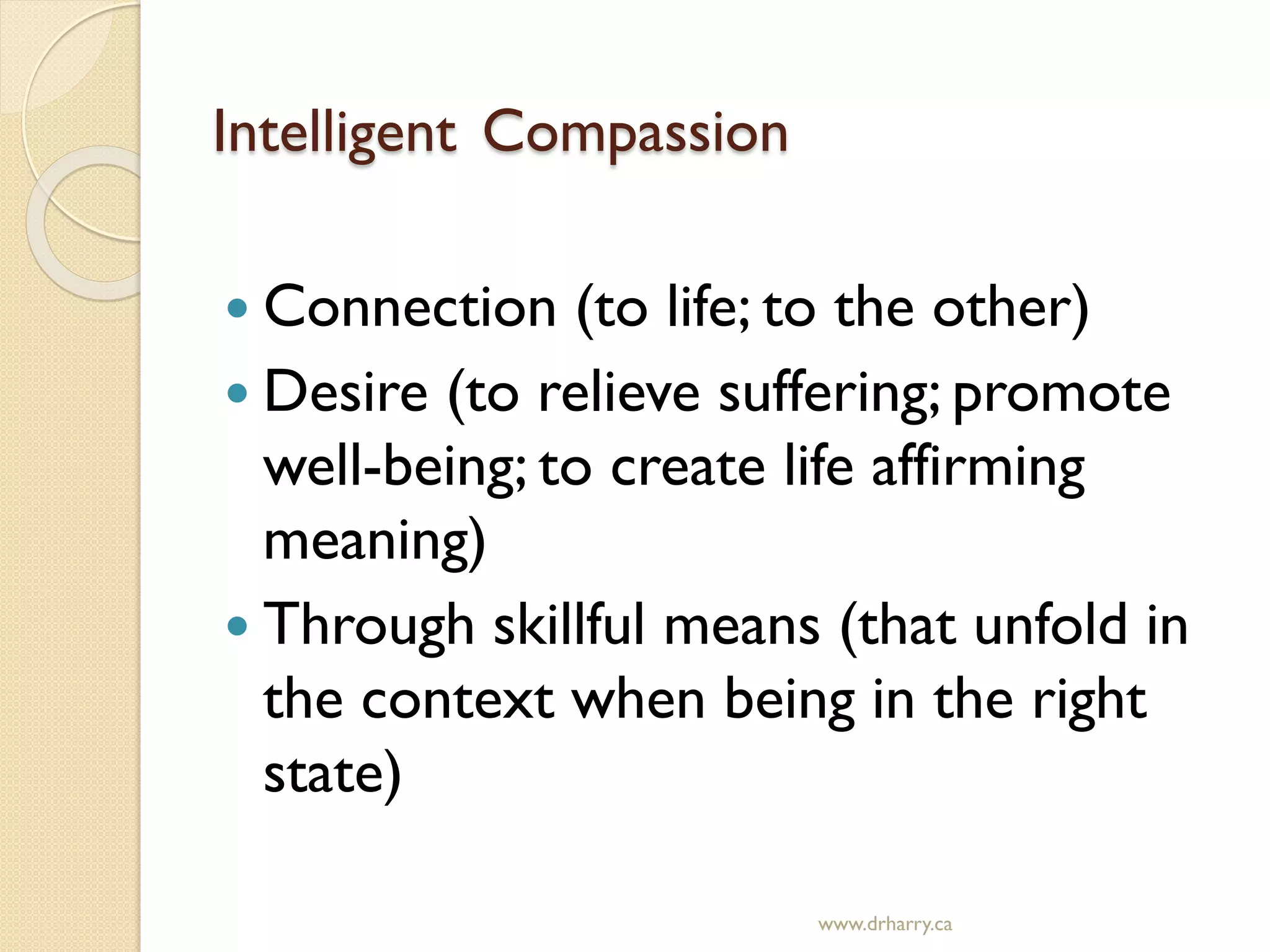
Intelligent Compassion
 Connection (to life; to the other)
 Desire (to relieve suffering; promote
well-being; to create life affirming
meaning)
 Through skillful means (that unfold in
the context when being in the right
state)
www.drharry.ca
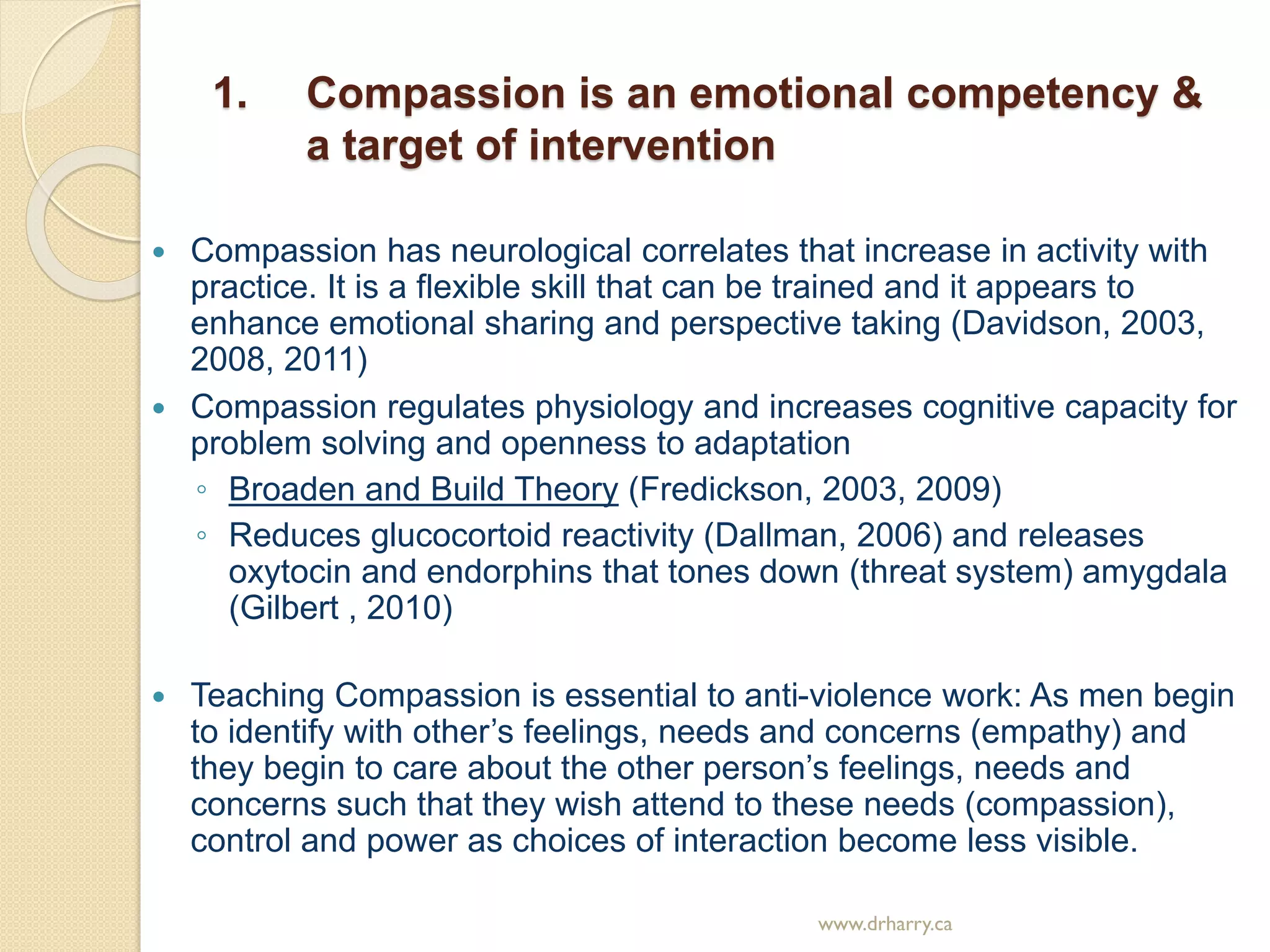
1. Compassion is an emotional competency &
a target of intervention
 Compassion has neurological correlates that increase in activity with
practice. It is a flexible skill that can be trained and it appears to
enhance emotional sharing and perspective taking (Davidson, 2003,
2008, 2011)
 Compassion regulates physiology and increases cognitive capacity for
problem solving and openness to adaptation
◦ Broaden and Build Theory (Fredickson, 2003, 2009)
◦ Reduces glucocortoid reactivity (Dallman, 2006) and releases
oxytocin and endorphins that tones down (threat system) amygdala
(Gilbert , 2010)
 Teaching Compassion is essential to anti-violence work: As men begin
to identify with other’s feelings, needs and concerns (empathy) and
they begin to care about the other person’s feelings, needs and
concerns such that they wish attend to these needs (compassion),
control and power as choices of interaction become less visible.
www.drharry.ca
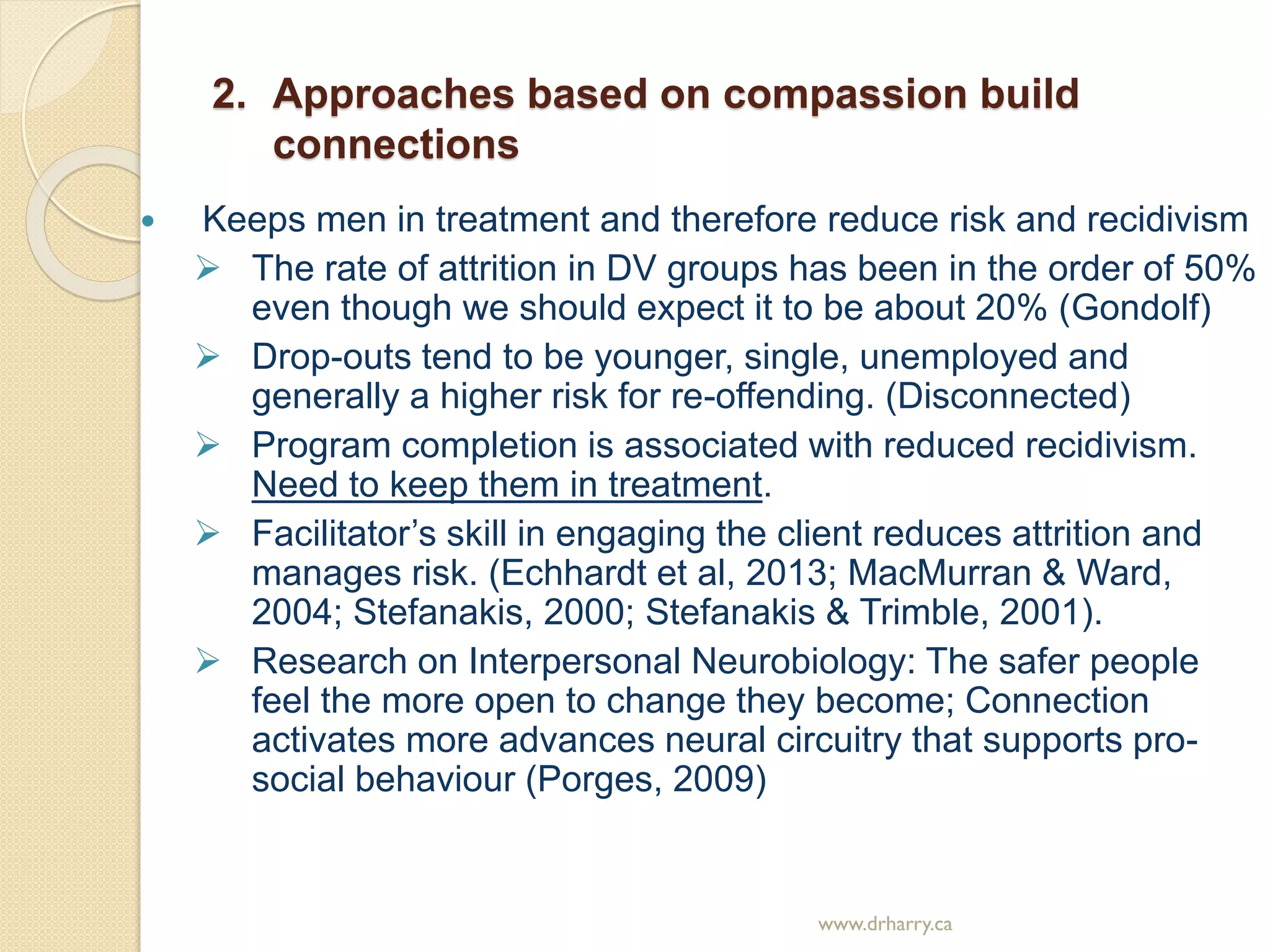
2. Approaches based on compassion build
connections
 Keeps men in treatment and therefore reduce risk and recidivism
 The rate of attrition in DV groups has been in the order of 50%
even though we should expect it to be about 20% (Gondolf)
 Drop-outs tend to be younger, single, unemployed and
generally a higher risk for re-offending. (Disconnected)
 Program completion is associated with reduced recidivism.
Need to keep them in treatment.
 Facilitator’s skill in engaging the client reduces attrition and
manages risk. (Echhardt et al, 2013; MacMurran & Ward,
2004; Stefanakis, 2000; Stefanakis & Trimble, 2001).
 Research on Interpersonal Neurobiology: The safer people
feel the more open to change they become; Connection
activates more advances neural circuitry that supports pro-
social behaviour (Porges, 2009)
www.drharry.ca
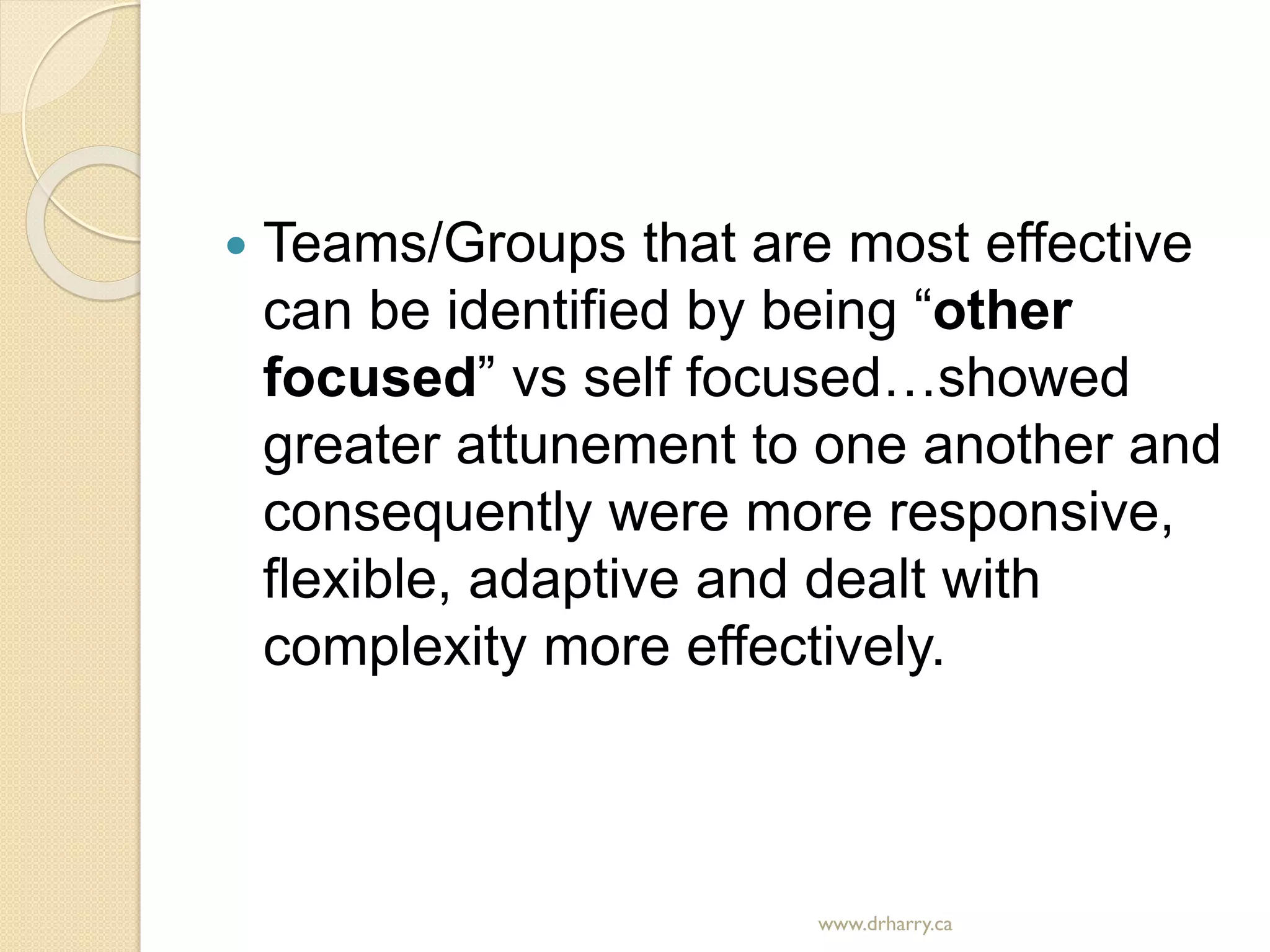
 Teams/Groups that are most effective
can be identified by being “other
focused” vs self focused…showed
greater attunement to one another and
consequently were more responsive,
flexible, adaptive and dealt with
complexity more effectively.
www.drharry.ca
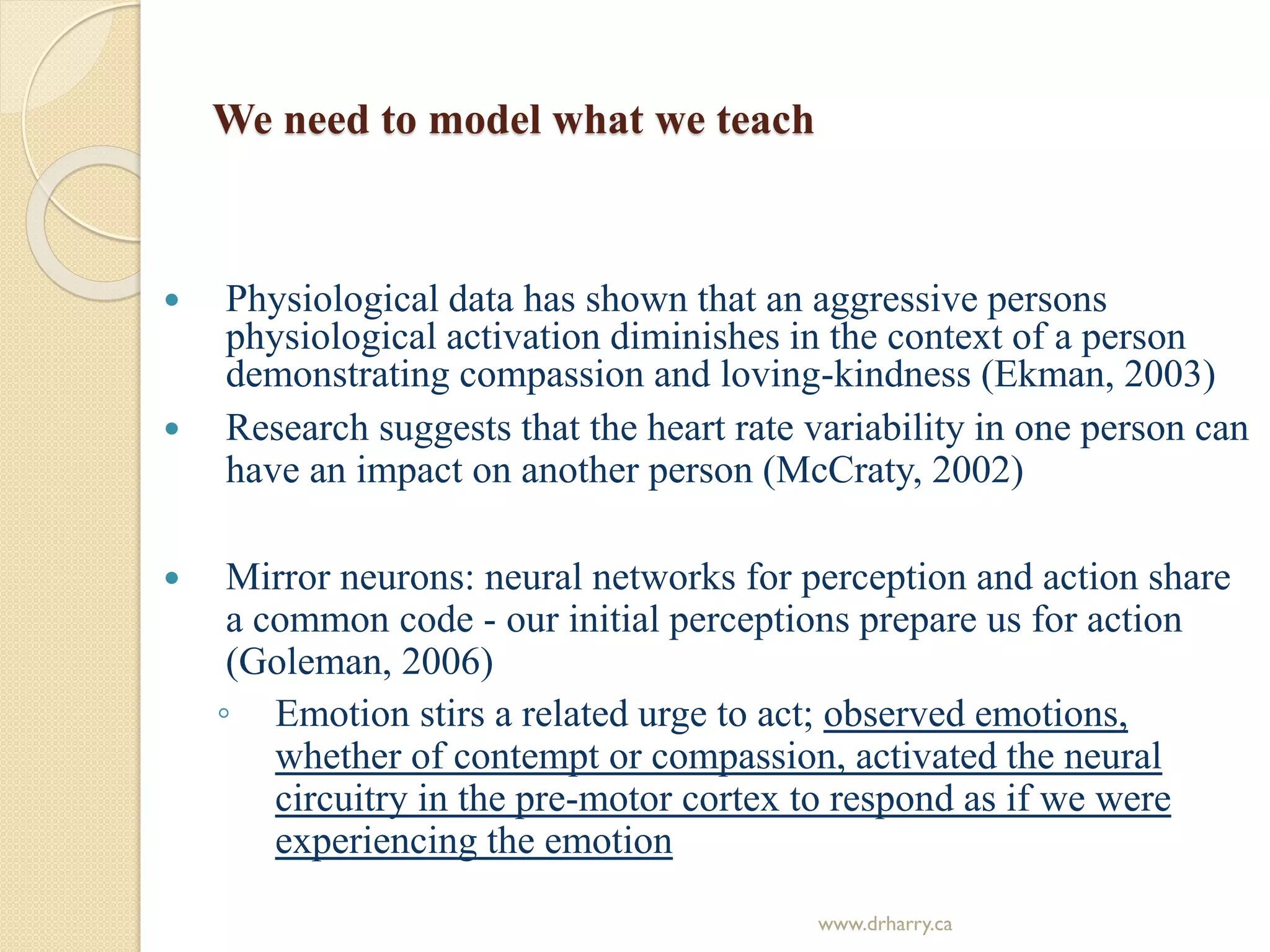
We need to model what we teach
 Physiological data has shown that an aggressive persons
physiological activation diminishes in the context of a person
demonstrating compassion and loving-kindness (Ekman, 2003)
 Research suggests that the heart rate variability in one person can
have an impact on another person (McCraty, 2002)
 Mirror neurons: neural networks for perception and action share
a common code - our initial perceptions prepare us for action
(Goleman, 2006)
◦ Emotion stirs a related urge to act; observed emotions,
whether of contempt or compassion, activated the neural
circuitry in the pre-motor cortex to respond as if we were
experiencing the emotion
www.drharry.ca
3. Intelligent Compassion also indicates that we
need to be clear about accountability
 Compassionate approaches attend to responsibility not
blame (Gilbert, 2010)
 Compassion allows one to take responsibility for ones
actions without being overwhelmed by negative emotions
(Leary et al 2007)
 Skillful action is based on intelligent compassion; a
compassion that has both warmth and clarity (sees things as
they are) and desire to effect life affirming change
 When a man is engaged in tactics of control he is suffering
even as he creates suffering; compassion moves us to hold
him accountable as it is the only way to end suffering
www.drharry.ca
4. Compassion makes change (and obstacles to
change) visible and invites people into change
process
 Instead of getting caught up in blame/rhetoric of
resistance or pathologizing labels we focus on asking
questions regarding obstacles to change and how we
can intervene to facilitate further change
 Shifts brain from narrow focus on details to
see objects (people) as wholes
 New research highlights the positive impact of short-
term compassion training on prosocial behavior
(Lieberg,Klimecki, Singer, 2011)
www.drharry.ca
The Logos of Compassion
1. Compassion is an emotional competency
2. Compassion facilitates engagement
3. Compassion makes accountability and
responsibility clear
4. Compassion focuses on facilitating change
and overcoming barriers
www.drharry.ca
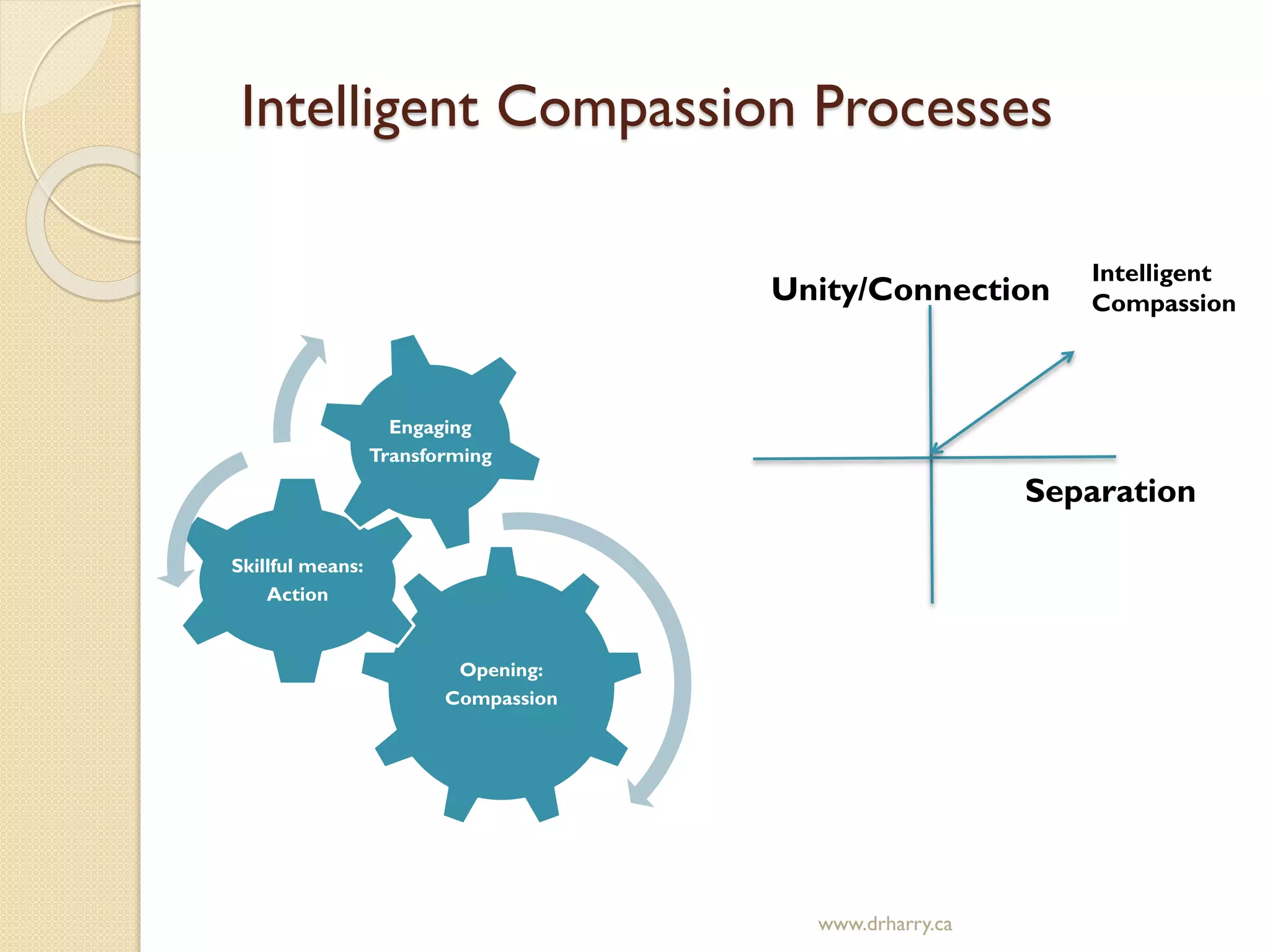
Intelligent Compassion Processes
Unity/Connection
Separation
Opening:
Compassion
Skillful means:
Action
Engaging
Transforming
Intelligent
Compassion
www.drharry.ca
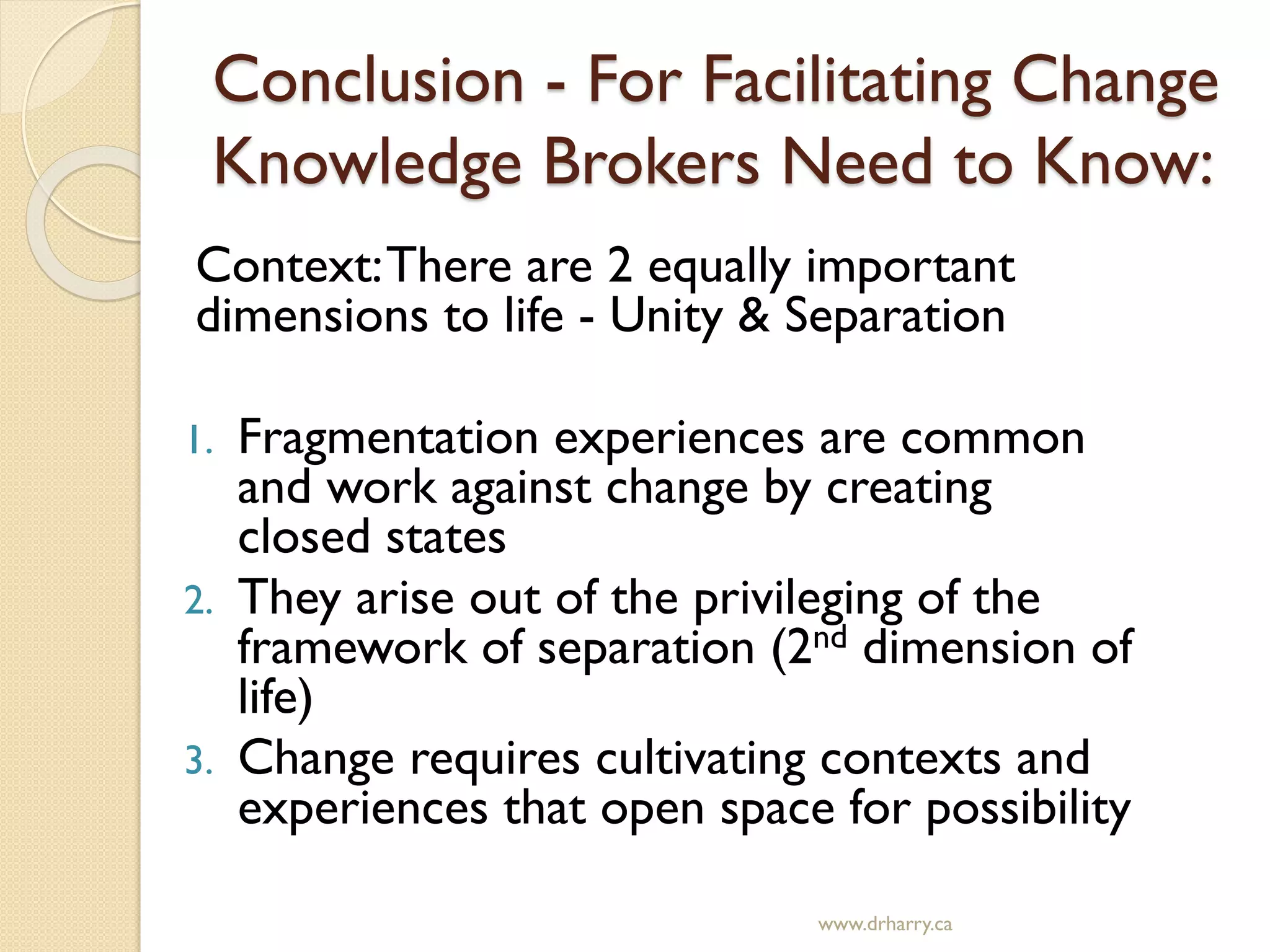
Conclusion - For Facilitating Change
Knowledge Brokers Need to Know:
Context:There are 2 equally important
dimensions to life - Unity & Separation
1. Fragmentation experiences are common
and work against change by creating
closed states
2. They arise out of the privileging of the
framework of separation (2nd dimension of
life)
3. Change requires cultivating contexts and
experiences that open space for possibility
www.drharry.ca
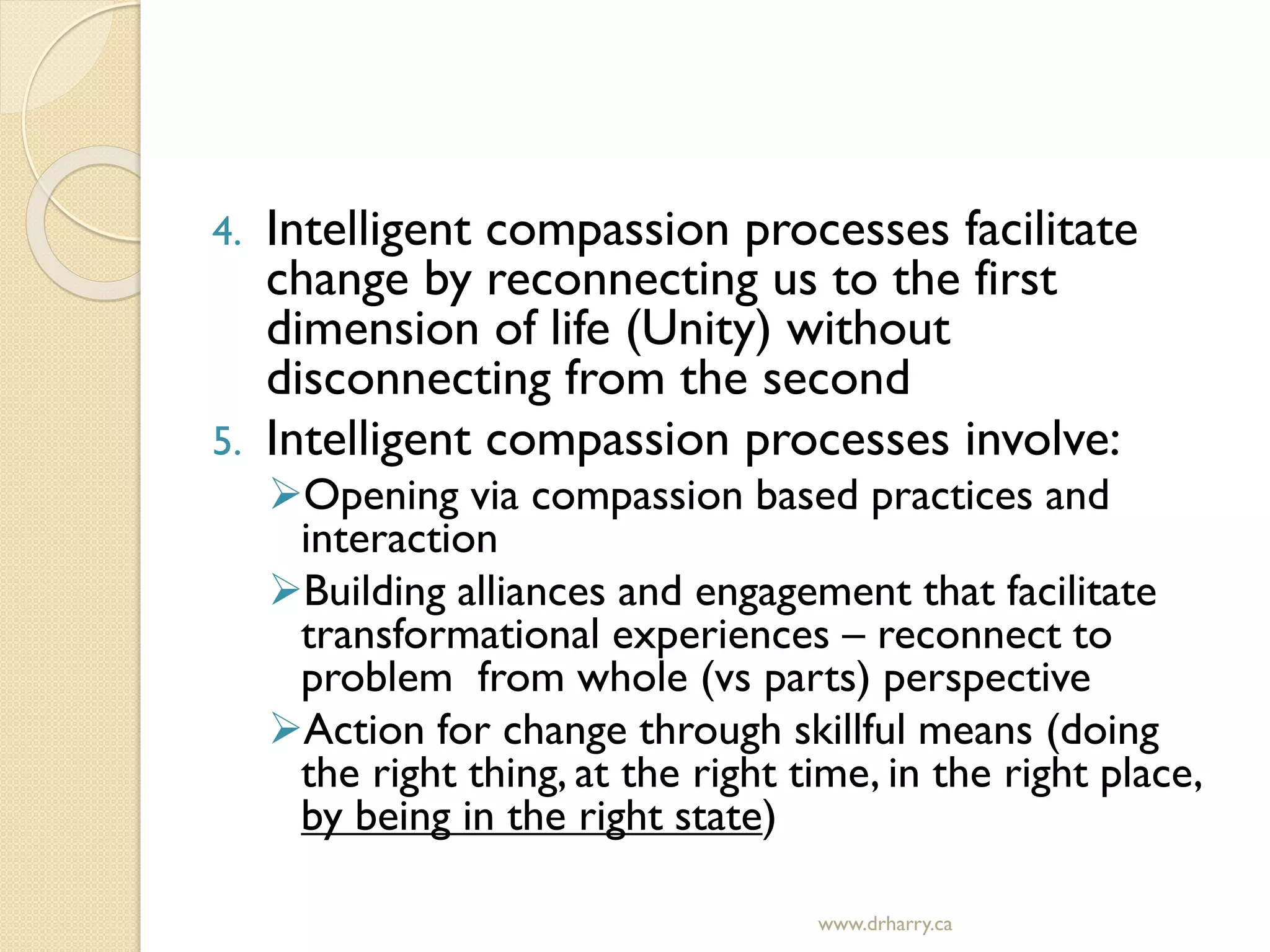
4. Intelligent compassion processes facilitate
change by reconnecting us to the first
dimension of life (Unity) without
disconnecting from the second
5. Intelligent compassion processes involve:
Opening via compassion based practices and
interaction
Building alliances and engagement that facilitate
transformational experiences – reconnect to
problem from whole (vs parts) perspective
Action for change through skillful means (doing
the right thing, at the right time, in the right place,
by being in the right state)
www.drharry.ca

Mobilizing intelligent compassion by Harry Stefanakis

  • 1.
    Intelligent Compassion Dr. Harry Stefanakis 304-1055WestBroadway Vancouver BCV6H1E2 www.drharry.ca www.drharry.ca
  • 2.
    Bold Statement  Thefundamental neuroses of our time involve FRAGMENTATION ◦ In our relationships with ourselves, others and the environment ◦ Works against change by creating certainty and fear  Compassion is the antidote www.drharry.ca
  • 3.
    TwoWolves A First Nationsgrandfather was talking to his grandson about how he felt. He said 'I feel as if I have two wolves fighting in my heart. One wolf is the frightened and reactive one.The other wolf is the loving, compassionate one.' The grandson asked him, 'Which wolf will win the fight in your heart?' The grandfather answered: 'The one I feed.' www.drharry.ca
  • 4.
    1. Which wolfare we feeding in our own hearts? 2. Which wolf are we feeding in the hearts of the people with which we work?  Goal: Invite you to consider Intelligent Compassion as a necessary part of any KMb process www.drharry.ca
  • 5.
    World Views  Worldviews we espouse shape our lives by making certain forms of relationships and certain actions visible while obscuring other forms of relationships and actions. ◦ Stefanakis (2008)  Separation - Fragmentation  Unity - Interdependence www.drharry.ca
  • 6.
  • 7.
    Dimensions Unity Separation FunctionGrowth Survival State Open/change Closed/certainty Knowledge base Mythos Logos Emotion Love Fear Response to threat Social engagement Defenses (mobilization – immobilization) Psychological processes Positive Inter-dependence Individuation Psychological processes Negative Ethnocentric Egocentric Brain function Frontal cortex Lymbic system Focus Whole Parts Boundaries Thin Thick Spiritual experiences Emptiness Fullness Summary: 2 Equal Dimension to Life www.drharry.ca
  • 8.
    Two forms ofKnowledge  Historically two equal forms of understanding were developed, classically known as Mythos and Logos.  Logos helps us gain knowledge regarding how to live effectively in the material world. Logos is essential to human survival but it cannot assuage our grief or find ultimate meaning in life’s struggles.  Mythos helps us create meaning and transcend the mundane in order to inhabit our humanity more fully www.drharry.ca
  • 9.
    Separation  Ideas ofseparation are sustained within the orthodox view of science: The world is a collection of distinct and separate elements that are related to each other by systems that are ruled by mechanical laws (Weil, 1994).  Premises: Objectification, Prediction (cause- effect), Control  Premises of this model support the use of violence and inhibit change to nonviolence (Stefanakis, 2008) www.drharry.ca
  • 10.
    The Limits ofLogos  Some things are non-rational (Logos ignores the contradictory complexity of life where our humanity is situated)  Focuses more on stability (prediction; control) and therefore not as well on transformation (especially nonlinear change)  Can become simply symptom/behaviour/problem management  Can replicate the problem  Often it doesn’t matter how true something is if we don’t believe it – meaning trumps logic www.drharry.ca
  • 11.
    www.drharry.ca Connect all 9dots with 4 straight lines but you cannot leave the 2 dimensional space (no lifting of pen)
  • 12.
    www.drharry.ca Connect all 9dots with 4 straight lines
  • 13.
    Compassion is theAntidote  Compassion is made visible scientifically within a perspective which highlights the non-fragmentary nature of the universe in which energy manifests in the form of matter, life and information that is linked or inter- connected (Weil, 1994)  The Universe is one indivisible dynamic whole even as it includes individual elements (2 truths: there is a material world in which we can and need to differentiate individual elements and also at a deeper level of experience all these elements are inter-connected and inseparable) www.drharry.ca
  • 14.
     We arehard-wired to connect (Porges, 2007) Three phylogenetic responses to threat/survival/growth 1. Social Engagement (relationship seeking) 2. Mobilization (fight/flight) 3. Immobilization (freeze) www.drharry.ca
  • 15.
    Compassion  Compassion isthe truth that is truer than the truth of our individual selves; it is the realization that you and the other are one ~ Schopenhauer  What is compassion? ◦ Images ◦ Actions  Are there limitations to this conception?  When a surgeon cuts open a person to remove a tumor is that compassion? www.drharry.ca
  • 16.
    Intelligent Compassion  Connection(to life; to the other)  Desire (to relieve suffering; promote well-being; to create life affirming meaning)  Through skillful means (that unfold in the context when being in the right state) www.drharry.ca
  • 17.
    1. Compassion isan emotional competency & a target of intervention  Compassion has neurological correlates that increase in activity with practice. It is a flexible skill that can be trained and it appears to enhance emotional sharing and perspective taking (Davidson, 2003, 2008, 2011)  Compassion regulates physiology and increases cognitive capacity for problem solving and openness to adaptation ◦ Broaden and Build Theory (Fredickson, 2003, 2009) ◦ Reduces glucocortoid reactivity (Dallman, 2006) and releases oxytocin and endorphins that tones down (threat system) amygdala (Gilbert , 2010)  Teaching Compassion is essential to anti-violence work: As men begin to identify with other’s feelings, needs and concerns (empathy) and they begin to care about the other person’s feelings, needs and concerns such that they wish attend to these needs (compassion), control and power as choices of interaction become less visible. www.drharry.ca
  • 18.
    2. Approaches basedon compassion build connections  Keeps men in treatment and therefore reduce risk and recidivism  The rate of attrition in DV groups has been in the order of 50% even though we should expect it to be about 20% (Gondolf)  Drop-outs tend to be younger, single, unemployed and generally a higher risk for re-offending. (Disconnected)  Program completion is associated with reduced recidivism. Need to keep them in treatment.  Facilitator’s skill in engaging the client reduces attrition and manages risk. (Echhardt et al, 2013; MacMurran & Ward, 2004; Stefanakis, 2000; Stefanakis & Trimble, 2001).  Research on Interpersonal Neurobiology: The safer people feel the more open to change they become; Connection activates more advances neural circuitry that supports pro- social behaviour (Porges, 2009) www.drharry.ca
  • 19.
     Teams/Groups thatare most effective can be identified by being “other focused” vs self focused…showed greater attunement to one another and consequently were more responsive, flexible, adaptive and dealt with complexity more effectively. www.drharry.ca
  • 20.
    We need tomodel what we teach  Physiological data has shown that an aggressive persons physiological activation diminishes in the context of a person demonstrating compassion and loving-kindness (Ekman, 2003)  Research suggests that the heart rate variability in one person can have an impact on another person (McCraty, 2002)  Mirror neurons: neural networks for perception and action share a common code - our initial perceptions prepare us for action (Goleman, 2006) ◦ Emotion stirs a related urge to act; observed emotions, whether of contempt or compassion, activated the neural circuitry in the pre-motor cortex to respond as if we were experiencing the emotion www.drharry.ca
  • 21.
    3. Intelligent Compassionalso indicates that we need to be clear about accountability  Compassionate approaches attend to responsibility not blame (Gilbert, 2010)  Compassion allows one to take responsibility for ones actions without being overwhelmed by negative emotions (Leary et al 2007)  Skillful action is based on intelligent compassion; a compassion that has both warmth and clarity (sees things as they are) and desire to effect life affirming change  When a man is engaged in tactics of control he is suffering even as he creates suffering; compassion moves us to hold him accountable as it is the only way to end suffering www.drharry.ca
  • 22.
    4. Compassion makeschange (and obstacles to change) visible and invites people into change process  Instead of getting caught up in blame/rhetoric of resistance or pathologizing labels we focus on asking questions regarding obstacles to change and how we can intervene to facilitate further change  Shifts brain from narrow focus on details to see objects (people) as wholes  New research highlights the positive impact of short- term compassion training on prosocial behavior (Lieberg,Klimecki, Singer, 2011) www.drharry.ca
  • 23.
    The Logos ofCompassion 1. Compassion is an emotional competency 2. Compassion facilitates engagement 3. Compassion makes accountability and responsibility clear 4. Compassion focuses on facilitating change and overcoming barriers www.drharry.ca
  • 24.
    Intelligent Compassion Processes Unity/Connection Separation Opening: Compassion Skillfulmeans: Action Engaging Transforming Intelligent Compassion www.drharry.ca
  • 25.
    Conclusion - ForFacilitating Change Knowledge Brokers Need to Know: Context:There are 2 equally important dimensions to life - Unity & Separation 1. Fragmentation experiences are common and work against change by creating closed states 2. They arise out of the privileging of the framework of separation (2nd dimension of life) 3. Change requires cultivating contexts and experiences that open space for possibility www.drharry.ca
  • 26.
    4. Intelligent compassionprocesses facilitate change by reconnecting us to the first dimension of life (Unity) without disconnecting from the second 5. Intelligent compassion processes involve: Opening via compassion based practices and interaction Building alliances and engagement that facilitate transformational experiences – reconnect to problem from whole (vs parts) perspective Action for change through skillful means (doing the right thing, at the right time, in the right place, by being in the right state) www.drharry.ca