
Defence Mechanisms 
(Supporting material for 
Brand Psychology book 
by Jonathan Gabay) 
Brand Psychology book by Jonathan Gabay
DEFINITION 
Ego Defense Mechanisms protect the 
mind/self/ego from anxiety or provide a 
retreat from a difficult situation. 
Brand Psychology book by Jonathan Gabay
Key figures in Defence Mechanism development 
• Sigmund Freud 
• Founder of psychoanalysis. 
• Theory of Psychosexual 
Development. The Id, Ego, 
and Superego 
• Dream interpretation. Free 
Brand Psychology book by Jonathan Gabay 
association. 
Anna Freud 
• Child psychoanalysis 
• Clear explanations of 
defense mechanism 
• Concept of signal anxiety. 
Otto F. Kernberg 
-theory of borderline 
personality organization 
,based on ego psychological 
object relations theory. 
Robert Plutchik 
- defenses as derivatives of 
basic emotions. 
George Eman 
Valliant -a continuum related 
to psychoanalytical 
developmental levels.
Pathological/Narcissistic Defenses 
Brand Psychology book by Jonathan Gabay 
Denial 
Distortion 
Projection 
Regression
IMMATURE DEFENCES 
• Acting out 
• Hypochondriasis 
• Introjections 
• Passive aggressive behavior 
• Regression 
• Schizoid fantasy 
• Somatization 
Commonly present in adolescents. 
Such defenses can be viewed as immature, difficult to deal with. 
Brand Psychology book by Jonathan Gabay
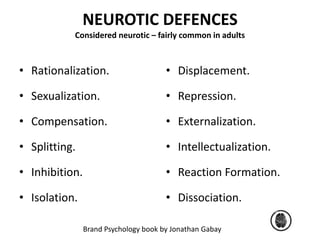
NEUROTIC DEFENCES 
Considered neurotic – fairly common in adults 
• Rationalization. 
• Sexualization. 
• Compensation. 
Brand Psychology book by Jonathan Gabay 
• Splitting. 
• Inhibition. 
• Isolation. 
• Displacement. 
• Repression. 
• Externalization. 
• Intellectualization. 
• Reaction Formation. 
• Dissociation.
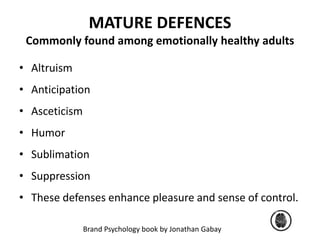
MATURE DEFENCES 
Commonly found among emotionally healthy adults 
• Altruism 
• Anticipation 
• Asceticism 
• Humor 
• Sublimation 
• Suppression 
• These defenses enhance pleasure and sense of control. 
Brand Psychology book by Jonathan Gabay
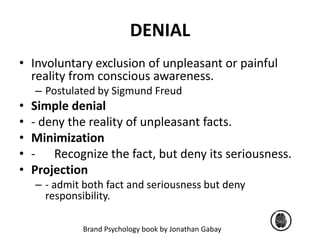
DENIAL 
• Involuntary exclusion of unpleasant or painful 
reality from conscious awareness. 
– Postulated by Sigmund Freud 
• Simple denial 
• - deny the reality of unpleasant facts. 
• Minimization 
• - Recognize the fact, but deny its seriousness. 
• Projection 
– - admit both fact and seriousness but deny 
responsibility. 
Brand Psychology book by Jonathan Gabay
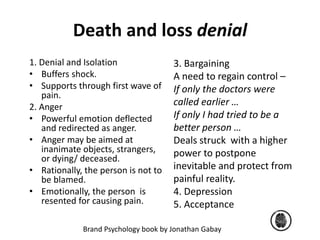
Death and loss denial 
1. Denial and Isolation 
• Buffers shock. 
• Supports through first wave of 
Brand Psychology book by Jonathan Gabay 
pain. 
2. Anger 
• Powerful emotion deflected 
and redirected as anger. 
• Anger may be aimed at 
inanimate objects, strangers, 
or dying/ deceased. 
• Rationally, the person is not to 
be blamed. 
• Emotionally, the person is 
resented for causing pain. 
3. Bargaining 
A need to regain control – 
If only the doctors were 
called earlier … 
If only I had tried to be a 
better person … 
Deals struck with a higher 
power to postpone 
inevitable and protect from 
painful reality. 
4. Depression 
5. Acceptance
TYPES OF DENIAL 
• Denial of fact 
– Avoids a fact by lying. 
– lying can be an outright falsehood (commission), 
– leaving out certain details to tailor a story 
(omission), 
– falsely agreeing to something 
– (also referred to as "yessing" behaviour). 
Brand Psychology book by Jonathan Gabay
Denial of responsibility 
– Avoiding personal responsibility. 
– Blaming 
– A direct statement shifting blame; may overlap with 
denial of fact 
– Minimizing 
– Attempt to make the consequences of an action 
appear less harmful. 
– Justifying – 
– Having made a choice, tries to make it appear look 
acceptable (due to a perception of what is "right”). 
Brand Psychology book by Jonathan Gabay
• Denial of impact 
• Avoids thinking about or understanding the 
harms a behaviour (i.e. denial of consequences). 
• Avoids a sense of guilt. 
• Prevent remorse or empathy of others. 
• Denial of awareness 
• Avoids pain and harm by stating they were in a 
different state of awareness (such as alcohol or 
drug intoxication). 
Brand Psychology book by Jonathan Gabay
• Denial of cycle 
• “It just happened." 
• Denial of denial 
• Involves thoughts, actions and behaviours 
• Example: 
• Overt consumerism - bolsters belief that 
personal behaviour need not change. 
Brand Psychology book by Jonathan Gabay
DISTORTION 
• Totally redesigning external reality to suit 
inner needs. 
• Delusions - especially grandiose. 
Brand Psychology book by Jonathan Gabay
PROJECTION 
• Perceiving and reacting to unacceptable inner impulses 
and derivatives as though they emanated from outside 
the self. 
• Freudian Projection 
– Projective identification 
– connection of the self with that projected impulse 
continues. 
Brand Psychology book by Jonathan Gabay 
Examples: 
– Blaming 
– Clinical-Delusions 
– Paranoid personality.
Acting out 
• Expression of an unconscious impulses; gratifying impulses rather 
than prohibiting them. 
• Designed (often unconsciously or semi-consciously) to gain 
Brand Psychology book by Jonathan Gabay 
attention. 
• Can be destructive to self or others, and may inhibit the 
development of more constructive responses to the feelings. 
• Examples: 
– Temper tantrums 
– Rebellious behaviours
INTROJECTION 
• Unconscious internalization of the qualities of 
an object or person. 
Example: 
Identification with the aggressor. 
• Stockholm syndrome. 
• Depression. 
Brand Psychology book by Jonathan Gabay
Hypochondriasis 
Exaggerating for the purpose of evasion and 
regression. 
Passive aggression 
• Indirect aggression towards others through 
passivity, masochism and turning against the 
self. 
Brand Psychology book by Jonathan Gabay
REGRESSION 
• Effort to return to an earlier libidinal phase, so 
avoid tension and conflict of the current 
phase. 
– A person may revert to immature behavior to 
ventilate feelings of frustration. 
– Becomes a problem when used frequently to 
avoid adult situations. 
Brand Psychology book by Jonathan Gabay
SCHIZOID FANTASY 
• Withdrawal in self to resolve conflict and 
gratify frustrated wishes. 
• Something which is not or cannot be real. 
• Examples: 
– Adolescence wish to fulfilling sexual daydreams. 
– Middle-aged wish to be youthful, virile and 
alluring. 
– Narcissistic personality disorder. 
Brand Psychology book by Jonathan Gabay
Somatization 
• Converting psychic derivatives into bodily 
symptoms. 
• Reacting with somatic rather than psychic 
appearances. 
• Unconscious rechanneling of repressed 
emotions into somatic symptoms. 
Brand Psychology book by Jonathan Gabay
REACTION FORMATION 
• Converting an unacceptable impulse into 
its opposite. 
– The original, rejected impulse doesn’t disappear. 
– Persists, unconscious, in its original infantile form. 
Brand Psychology book by Jonathan Gabay
REPRESSION 
• Expelling or withholding an idea or feeling from consciousness 
• Primary repression 
• Refers to the curbing of ideas and feelings before they have attained 
consciousness. 
• Secondary repression 
• Excludes from awareness what was once experienced at a conscious level. 
Examples: 
• Forgetfulness. 
• Slip of tongue. 
Brand Psychology book by Jonathan Gabay
RATIONALIZATION 
• Ernest jones-contributed the term 
"rationalization" to psychoanalysis. 
• Offering rational explanations to justify 
attitudes, beliefs, or unacceptable behaviour. 
– Providing logical explanations for irrational 
behaviour motivated by unacceptable wishes. 
Brand Psychology book by Jonathan Gabay
DISPLACEMENT 
• Involves taking out frustrations, feelings, and 
impulses on people or objects that are less 
threatening. 
• Punching cushions in anger. 
• Bosses ‘snapping’ for no reason at employees. 
Brand Psychology book by Jonathan Gabay
DISSOCIATION 
• Involuntary splitting or suppression of mental 
function from rest of the personality. 
• Allows expression of forbidden unconscious 
impulses without any accompanying sense of 
responsibility for actions. 
Brand Psychology book by Jonathan Gabay
INTELLECTUALIZATION 
• One of Freud's original defence mechanisms 
– Employing intellectual processes to avoid 
affective expressions or experiences. 
• Intellectualization may accompany, but differs from 
rationalization, which is validation of irrational 
behaviour through clichés, stories, and simplified 
explanation. 
Brand Psychology book by Jonathan Gabay
UNDOING 
• Unconsciously motivated actions which 
symbolically counteract unacceptable 
thoughts ,impulses or actions. 
– Example : 
• “Sorry for bumping into you.” 
• Compulsive OCD. 
Brand Psychology book by Jonathan Gabay
SEXUALIZATION 
• Endowing an object or function with sexual 
significance that it didn’t previously possess. 
• Can also refer to warding off anxieties 
associated with prohibited impulses or 
derivatives. 
Brand Psychology book by Jonathan Gabay
EXTERNALIZATION 
• Perceiving one’s personality, including 
impulses, conflicts, moods and attitudes in the 
external world. 
• More general than ‘projection’. 
• Example: 
• A belligerent person perceives others as 
argumentative whilst believing him/her self to 
be blameless. 
Brand Psychology book by Jonathan Gabay
INHIBITION 
• conscious or unconscious constraint or curtailment of a 
process or behaviour, especially of impulses or desires. 
• Conscious inhibition is commonly present whenever 
whenever two desires are in conflict. 
Brand Psychology book by Jonathan Gabay 
• Examples: 
• Writing blocks 
• Eating delicious cakes, whilst dieting.
COMPENSATION 
• Unconscious tendency to deal with a fear or 
conflict by excessive effort in the opposite 
direction. 
• Example: 
• Excessive preoccupation with body building to 
counter inferiority. 
Brand Psychology book by Jonathan Gabay
SPLITTING 
• Viewing of self or others as either good or bad 
without considering the entire range of 
qualities in between. 
• Example: 
• Seeing all brands as greedy. 
Brand Psychology book by Jonathan Gabay
SUPPRESSION 
Deliberately trying to stop thinking about certain 
thoughts. 
Brand Psychology book by Jonathan Gabay
ASCETICISM 
• Eliminating the enjoyment of experiences by 
assigning moral values to specific pleasures. 
• Gratification is derived from renunciation. 
Brand Psychology book by Jonathan Gabay
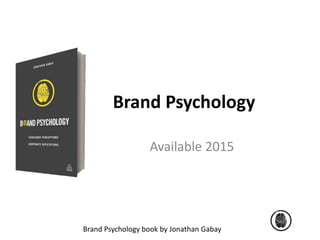
Brand Psychology 
Available 2015 
Brand Psychology book by Jonathan Gabay

Defense mechanisms

  • 1.
    Defence Mechanisms (Supportingmaterial for Brand Psychology book by Jonathan Gabay) Brand Psychology book by Jonathan Gabay
  • 2.
    DEFINITION Ego DefenseMechanisms protect the mind/self/ego from anxiety or provide a retreat from a difficult situation. Brand Psychology book by Jonathan Gabay
  • 3.
    Key figures inDefence Mechanism development • Sigmund Freud • Founder of psychoanalysis. • Theory of Psychosexual Development. The Id, Ego, and Superego • Dream interpretation. Free Brand Psychology book by Jonathan Gabay association. Anna Freud • Child psychoanalysis • Clear explanations of defense mechanism • Concept of signal anxiety. Otto F. Kernberg -theory of borderline personality organization ,based on ego psychological object relations theory. Robert Plutchik - defenses as derivatives of basic emotions. George Eman Valliant -a continuum related to psychoanalytical developmental levels.
  • 4.
    Pathological/Narcissistic Defenses BrandPsychology book by Jonathan Gabay Denial Distortion Projection Regression
  • 5.
    IMMATURE DEFENCES •Acting out • Hypochondriasis • Introjections • Passive aggressive behavior • Regression • Schizoid fantasy • Somatization Commonly present in adolescents. Such defenses can be viewed as immature, difficult to deal with. Brand Psychology book by Jonathan Gabay
  • 6.
    NEUROTIC DEFENCES Consideredneurotic – fairly common in adults • Rationalization. • Sexualization. • Compensation. Brand Psychology book by Jonathan Gabay • Splitting. • Inhibition. • Isolation. • Displacement. • Repression. • Externalization. • Intellectualization. • Reaction Formation. • Dissociation.
  • 7.
    MATURE DEFENCES Commonlyfound among emotionally healthy adults • Altruism • Anticipation • Asceticism • Humor • Sublimation • Suppression • These defenses enhance pleasure and sense of control. Brand Psychology book by Jonathan Gabay
  • 8.
    DENIAL • Involuntaryexclusion of unpleasant or painful reality from conscious awareness. – Postulated by Sigmund Freud • Simple denial • - deny the reality of unpleasant facts. • Minimization • - Recognize the fact, but deny its seriousness. • Projection – - admit both fact and seriousness but deny responsibility. Brand Psychology book by Jonathan Gabay
  • 9.
    Death and lossdenial 1. Denial and Isolation • Buffers shock. • Supports through first wave of Brand Psychology book by Jonathan Gabay pain. 2. Anger • Powerful emotion deflected and redirected as anger. • Anger may be aimed at inanimate objects, strangers, or dying/ deceased. • Rationally, the person is not to be blamed. • Emotionally, the person is resented for causing pain. 3. Bargaining A need to regain control – If only the doctors were called earlier … If only I had tried to be a better person … Deals struck with a higher power to postpone inevitable and protect from painful reality. 4. Depression 5. Acceptance
  • 10.
    TYPES OF DENIAL • Denial of fact – Avoids a fact by lying. – lying can be an outright falsehood (commission), – leaving out certain details to tailor a story (omission), – falsely agreeing to something – (also referred to as "yessing" behaviour). Brand Psychology book by Jonathan Gabay
  • 11.
    Denial of responsibility – Avoiding personal responsibility. – Blaming – A direct statement shifting blame; may overlap with denial of fact – Minimizing – Attempt to make the consequences of an action appear less harmful. – Justifying – – Having made a choice, tries to make it appear look acceptable (due to a perception of what is "right”). Brand Psychology book by Jonathan Gabay
  • 12.
    • Denial ofimpact • Avoids thinking about or understanding the harms a behaviour (i.e. denial of consequences). • Avoids a sense of guilt. • Prevent remorse or empathy of others. • Denial of awareness • Avoids pain and harm by stating they were in a different state of awareness (such as alcohol or drug intoxication). Brand Psychology book by Jonathan Gabay
  • 13.
    • Denial ofcycle • “It just happened." • Denial of denial • Involves thoughts, actions and behaviours • Example: • Overt consumerism - bolsters belief that personal behaviour need not change. Brand Psychology book by Jonathan Gabay
  • 14.
    DISTORTION • Totallyredesigning external reality to suit inner needs. • Delusions - especially grandiose. Brand Psychology book by Jonathan Gabay
  • 15.
    PROJECTION • Perceivingand reacting to unacceptable inner impulses and derivatives as though they emanated from outside the self. • Freudian Projection – Projective identification – connection of the self with that projected impulse continues. Brand Psychology book by Jonathan Gabay Examples: – Blaming – Clinical-Delusions – Paranoid personality.
  • 16.
    Acting out •Expression of an unconscious impulses; gratifying impulses rather than prohibiting them. • Designed (often unconsciously or semi-consciously) to gain Brand Psychology book by Jonathan Gabay attention. • Can be destructive to self or others, and may inhibit the development of more constructive responses to the feelings. • Examples: – Temper tantrums – Rebellious behaviours
  • 17.
    INTROJECTION • Unconsciousinternalization of the qualities of an object or person. Example: Identification with the aggressor. • Stockholm syndrome. • Depression. Brand Psychology book by Jonathan Gabay
  • 18.
    Hypochondriasis Exaggerating forthe purpose of evasion and regression. Passive aggression • Indirect aggression towards others through passivity, masochism and turning against the self. Brand Psychology book by Jonathan Gabay
  • 19.
    REGRESSION • Effortto return to an earlier libidinal phase, so avoid tension and conflict of the current phase. – A person may revert to immature behavior to ventilate feelings of frustration. – Becomes a problem when used frequently to avoid adult situations. Brand Psychology book by Jonathan Gabay
  • 20.
    SCHIZOID FANTASY •Withdrawal in self to resolve conflict and gratify frustrated wishes. • Something which is not or cannot be real. • Examples: – Adolescence wish to fulfilling sexual daydreams. – Middle-aged wish to be youthful, virile and alluring. – Narcissistic personality disorder. Brand Psychology book by Jonathan Gabay
  • 21.
    Somatization • Convertingpsychic derivatives into bodily symptoms. • Reacting with somatic rather than psychic appearances. • Unconscious rechanneling of repressed emotions into somatic symptoms. Brand Psychology book by Jonathan Gabay
  • 22.
    REACTION FORMATION •Converting an unacceptable impulse into its opposite. – The original, rejected impulse doesn’t disappear. – Persists, unconscious, in its original infantile form. Brand Psychology book by Jonathan Gabay
  • 23.
    REPRESSION • Expellingor withholding an idea or feeling from consciousness • Primary repression • Refers to the curbing of ideas and feelings before they have attained consciousness. • Secondary repression • Excludes from awareness what was once experienced at a conscious level. Examples: • Forgetfulness. • Slip of tongue. Brand Psychology book by Jonathan Gabay
  • 24.
    RATIONALIZATION • Ernestjones-contributed the term "rationalization" to psychoanalysis. • Offering rational explanations to justify attitudes, beliefs, or unacceptable behaviour. – Providing logical explanations for irrational behaviour motivated by unacceptable wishes. Brand Psychology book by Jonathan Gabay
  • 25.
    DISPLACEMENT • Involvestaking out frustrations, feelings, and impulses on people or objects that are less threatening. • Punching cushions in anger. • Bosses ‘snapping’ for no reason at employees. Brand Psychology book by Jonathan Gabay
  • 26.
    DISSOCIATION • Involuntarysplitting or suppression of mental function from rest of the personality. • Allows expression of forbidden unconscious impulses without any accompanying sense of responsibility for actions. Brand Psychology book by Jonathan Gabay
  • 27.
    INTELLECTUALIZATION • Oneof Freud's original defence mechanisms – Employing intellectual processes to avoid affective expressions or experiences. • Intellectualization may accompany, but differs from rationalization, which is validation of irrational behaviour through clichés, stories, and simplified explanation. Brand Psychology book by Jonathan Gabay
  • 28.
    UNDOING • Unconsciouslymotivated actions which symbolically counteract unacceptable thoughts ,impulses or actions. – Example : • “Sorry for bumping into you.” • Compulsive OCD. Brand Psychology book by Jonathan Gabay
  • 29.
    SEXUALIZATION • Endowingan object or function with sexual significance that it didn’t previously possess. • Can also refer to warding off anxieties associated with prohibited impulses or derivatives. Brand Psychology book by Jonathan Gabay
  • 30.
    EXTERNALIZATION • Perceivingone’s personality, including impulses, conflicts, moods and attitudes in the external world. • More general than ‘projection’. • Example: • A belligerent person perceives others as argumentative whilst believing him/her self to be blameless. Brand Psychology book by Jonathan Gabay
  • 31.
    INHIBITION • consciousor unconscious constraint or curtailment of a process or behaviour, especially of impulses or desires. • Conscious inhibition is commonly present whenever whenever two desires are in conflict. Brand Psychology book by Jonathan Gabay • Examples: • Writing blocks • Eating delicious cakes, whilst dieting.
  • 32.
    COMPENSATION • Unconscioustendency to deal with a fear or conflict by excessive effort in the opposite direction. • Example: • Excessive preoccupation with body building to counter inferiority. Brand Psychology book by Jonathan Gabay
  • 33.
    SPLITTING • Viewingof self or others as either good or bad without considering the entire range of qualities in between. • Example: • Seeing all brands as greedy. Brand Psychology book by Jonathan Gabay
  • 34.
    SUPPRESSION Deliberately tryingto stop thinking about certain thoughts. Brand Psychology book by Jonathan Gabay
  • 35.
    ASCETICISM • Eliminatingthe enjoyment of experiences by assigning moral values to specific pleasures. • Gratification is derived from renunciation. Brand Psychology book by Jonathan Gabay
  • 36.
    Brand Psychology Available2015 Brand Psychology book by Jonathan Gabay