Yyuryyubicuryy4me
MEREPEAT
AGENDA
Recitations 4
Teams #3
Lecture: The Late Romances; The
Tempest
Discussion: The Tempest
Recitations: 4
 Anna Deh: Othello “How
am I then a villain?”
 Rachel Bonner: Romeo and
Juliet
 Celeste Dilullo: Sonnet 145
 Jenn Bendana: Sonnet 9
The Late Romances
Although some scholars have speculated that
Shakespeare wrote portions of The Tempest at an
earlier stage in his career, most literary historians
assign the entire play a composition date of 1610
or 1611. And while Shakespeare may have had a
hand in The Two Noble Kinsmen (written a after
The Tempest and assigned to dual authorship),
The Tempest is customarily identified as the
Bard's last stage piece.
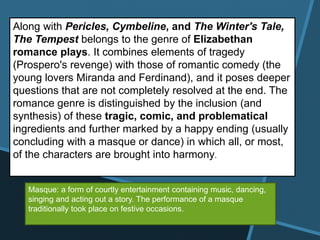
Along with Pericles, Cymbeline, and The Winter's Tale,
The Tempest belongs to the genre of Elizabethan
romance plays. It combines elements of tragedy
(Prospero's revenge) with those of romantic comedy (the
young lovers Miranda and Ferdinand), and it poses deeper
questions that are not completely resolved at the end. The
romance genre is distinguished by the inclusion (and
synthesis) of these tragic, comic, and problematical
ingredients and further marked by a happy ending (usually
concluding with a masque or dance) in which all, or most,
of the characters are brought into harmony.
Masque: a form of courtly entertainment containing music, dancing,
singing and acting out a story. The performance of a masque
traditionally took place on festive occasions.
In writing The Tempest, Shakespeare was undoubtedly influenced by a
popular, true story told in London. In May 1609, nine ships with five
hundred colonists set out from England bound for Virginia. The settlers
were on their way to begin new lives in the newly founded colony. Their
minds were fixed on the riches reputed to be abundant in the New
World. But on July 24, the flagship, Sea-Adventure, became lost in a
storm and wound up at Bermuda (the “still-vexed Bermoothes” Ariel
speaks of in Act I, Scene 2). England mourned for almost a year.
Eventually, the crew and passengers arrived in Virginia on May 23,
1610. Many stories of the wreck, which at first was thought to be fatal,
were published, and the event was seen as a sign of divine providence.
Source of The Tempest
Although no direct source has been identified for the
play as a whole, there is a clear relationship to the
discovery of the New World. This relationship is
underscored in the figure of Caliban, a grotesque and
morally monstrous inhabitant of the island, once its
master, now Prospero’s slave. For many critics, Caliban
represents a certain view of the native populations of
newly colonized lands in the Americas. Shakespeare’s
evident use of passages taken from Michel de
Montaigne’s essay Des Canibales evokes idealistic
images of the New world, as a new Eden. The tension at
work between this ideal and any form of political reality
shows, at the very least, an open question about the
nature and validity of sovereignty and enslavement.
It’s probable that Shakespeare patterned
the character of Prospero after John Dee
(1527 –1609) who was a mathematician,
astronomer, astrologer, occultist, navigator,
and adviser to Queen Elizabeth I.
Dee immersed himself in the worlds of
magic, including alchemy, divination,
astrology and Hermetic philosophy.
He devoted much time and effort in the last
thirty years or so of his life to attempting to
commune with angels in order to learn the
universal language of creation and bring
about the pre-apocalyptic unity of
mankind.
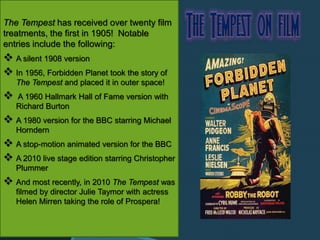
The Tempest has received over twenty film
treatments, the first in 1905! Notable
entries include the following:
 A silent 1908 version
 In 1956, Forbidden Planet took the story of
The Tempest and placed it in outer space!
 A 1960 Hallmark Hall of Fame version with
Richard Burton
 A 1980 version for the BBC starring Michael
Horndern
 A stop-motion animated version for the BBC
 A 2010 live stage edition starring Christopher
Plummer
 And most recently, in 2010 The Tempest was
filmed by director Julie Taymor with actress
Helen Mirren taking the role of Prospera!
Your First
Group!
 Change Teams.
Get into groups
of four or five.
(1-2 minutes)
 If you can’t find
a group, please
raise your
hand.
 Introduce
yourselves, and
write your
names down
on a sheet of
paper. This will
be your point
sheet.
In
Groups
Discuss your
answers to
the
homework
questions and
your QHQs.
The Setting
6:11
https://www.youtube.com/watch?v=-XOACd-40d4
Tossed upon the ocean, a ship
carrying the King of Naples is caught
in a sudden, violent storm…
On a nearby island, a lone figure
chants incantations, summoning and
controlling the storm with his powerful
magic…
Meanwhile, a beautiful young girl
watches the ship sinking in the storm
and trembles with fear...
And a monstrous figure, twisted and
tortured, secretly watches the girl,
and waits…
The Setting
Prospero
Miranda
Ariel
Caliban
Alonso
Sebastian
Antonio
Ferdinand
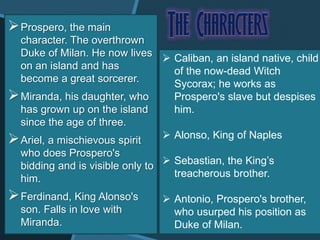
Prospero, the main
character. The overthrown
Duke of Milan. He now lives
on an island and has
become a great sorcerer.
Miranda, his daughter, who
has grown up on the island
since the age of three.
Ariel, a mischievous spirit
who does Prospero's
bidding and is visible only to
him.
Ferdinand, King Alonso's
son. Falls in love with
Miranda.
 Caliban, an island native, child
of the now-dead Witch
Sycorax; he works as
Prospero's slave but despises
him.
 Alonso, King of Naples
 Sebastian, the King’s
treacherous brother.
 Antonio, Prospero's brother,
who usurped his position as
Duke of Milan.
Let me
ask you!
1. Who is Miranda? What is her reaction to the storm
scene she has just witnessed?
2. Who is Prospero? How does he know that everyone
has survived the storm?
3. How did Prospero and Miranda come to be on the
island?
4. Who is Ariel? Why should he be grateful to Prospero
and just do what he's told?
5. Who is Caliban? What is his attitude towards
Prospero's control of the island?
6. What event led Prospero to start treating Caliban as
his slave?
7. Who taught Caliban to speak? How does he tend to
use language? Why?
8. Why does Miranda think that Ferdinand might be a
"spirit”?
9. How does Prospero treat Ferdinand? Why? How is this
treatment like and unlike the treatment of Caliban?
10. From what event were the Italians returning when they
were ship-wrecked? What is their attitude towards the
event?
Act 1, Scene 1 shows the
“tempest" of the play's
title. How do the
different characters react
to crisis?
Prospero presents himself as the civilized discoverer of a desert
island, with Caliban and Ariel as its not-quite-human inhabitants.
How does Caliban's history of the island differ from Prospero's?
Whom do you think Shakespeare agrees with, Prospero or
Caliban? Whom do you agree with, Prospero or Caliban? Give
textual evidence in working out your answers.
CALIBAN I must eat my dinner.
This island’s mine by Sycorax, my mother,
Which thou tak’st from me. When thou cam’st first,
Thou strok’st me and made much of me, wouldst
give me
Water with berries in ’t, and teach me how
To name the bigger light and how the less,
That burn by day and night. And then I loved thee,
And showed thee all the qualities o’ th’ isle,
The fresh springs, brine pits, barren place and
fertile.
Cursed be I that did so! All the charms
Of Sycorax, toads, beetles, bats, light on you,
For I am all the subjects that you have,
Which first was mine own king; and here you sty me
In this hard rock, whiles you do keep from me
The rest o’ th’ island. (1.2.395-411)
https://www.youtube.com/watch?v=Wd6NGXbN2-4 2:39 1.2.385-451
Who was Sycorax? How does
Prospero feel about her? Are
there any parallels between
Sycorax's story and
Prospero's?
1.2.310-348
PROSPERO
This blue-eyed hag was hither brought with child
And here was left by th’ sailors. Thou, my slave,
As thou report’st thyself, was then her servant,
And for thou wast a spirit too delicate
To act her earthy and abhorred commands,
Refusing her grand hests, she did confine thee,
By help of her more potent ministers
And in her most unmitigable rage,
Into a cloven pine, within which rift
Imprisoned thou didst painfully remain
A dozen years; within which space she died
And left thee there, where thou didst vent thy groans
As fast as mill wheels strike. Then was this island
(Save for the son that she did litter here,
A freckled whelp, hag-born) not honored with
A human shape. (1.2.321-338)
What kind of society
would Gonzalo like to
have found on the
desert island (2.1.146-
70)? What is the
reaction of his
companions?
GONZALO
And were the king on ’t, what would I do?
SEBASTIAN Scape being drunk, for want of wine.
GONZALO
I’ th’ commonwealth I would by contraries
Execute all things, for no kind of traffic
Would I admit; no name of magistrate;
Letters should not be known; riches, poverty,
And use of service, none; contract, succession,
Bourn, bound of land, tilth, vineyard, none;
No use of metal, corn, or wine, or oil;
No occupation; all men idle, all,
And women too, but innocent and pure;
No sovereignty— (2.1.160-71)
Questions
What do Antonio
and Sebastian want
to do to Alonso and
Gonzalo? Why?
What does Antonio
mean when he says,
"What's past is
prologue" (2.1.289)?
ANTONIO
Here lies your brother,
No better than the earth he lies upon.
If he were that which now he’s like—that’s dead—
Whom I with this obedient steel, three inches of it,
Can lay to bed forever; whiles you, doing thus,
To the perpetual wink for aye might put
This ancient morsel, this Sir Prudence, who
Should not upbraid our course. For all the rest,
They’ll take suggestion as a cat laps milk.
They’ll tell the clock to any business that
We say befits the hour.
SEBASTIAN Thy case, dear friend,
Shall be my precedent: as thou got’st Milan,
I’ll come by Naples. Draw thy sword. One stroke
Shall free thee from the tribute which thou payest,
And I the King shall love thee.
ANTONIO Draw together,
And when I rear my hand, do you the like
To fall it on Gonzalo.They draw their swords
SEBASTIAN O, but one word. (2.1.321-340)
Read: The Tempest Acts 3, 4, and 5
Post #16
1. Read with special care the scenes with Caliban, Trinculo, and Stephano (2.2 and
3.2). What does Caliban think Trinculo is? What does Trinculo think Caliban is?
What does Stephano think Trinculo and Caliban together are? What is their plan,
and what happens to it? To what extent would you call this plan revolutionary?
2. What role does Ariel play in 3.2?
3. How does Trinculo and Stephano's discovery of Caliban resemble aspects of Prospero and
Miranda's first encounters with him? What do these scenes of discovery reveal about the
political, religious, or social attitudes of each character?
4. What are the goals of the conspiracy staged by Trinculo, Stephano, and Caliban (2.2 and
3.2)? What does each party want to get out of it? Do you ever feel that they are likely to
succeed? How (if at all) does the playwright let us know whose side he's on?
5. What is the overall impact of the Masque-like? How is it supposed to affect the two young
lovers? What is its message about the sanctity of the marriage bond?
6. Why does Prospero decide to show mercy to his enemies? Why is Ariel the first to speak of
mercy? Do you think Prospero had planned to forgive them from the beginning?
7. Why does Prospero decide to give up magic? What does his choice show about what he
thinks happened in the past? How does he plan to live in the future? What has Prospero
learned? Has he changed in any fundamental way or had the change already occurred
before the beginning of the action

Elit 17 class 16

  • 1.
  • 2.
    AGENDA Recitations 4 Teams #3 Lecture:The Late Romances; The Tempest Discussion: The Tempest
  • 3.
    Recitations: 4  AnnaDeh: Othello “How am I then a villain?”  Rachel Bonner: Romeo and Juliet  Celeste Dilullo: Sonnet 145  Jenn Bendana: Sonnet 9
  • 4.
    The Late Romances Althoughsome scholars have speculated that Shakespeare wrote portions of The Tempest at an earlier stage in his career, most literary historians assign the entire play a composition date of 1610 or 1611. And while Shakespeare may have had a hand in The Two Noble Kinsmen (written a after The Tempest and assigned to dual authorship), The Tempest is customarily identified as the Bard's last stage piece.
  • 5.
    Along with Pericles,Cymbeline, and The Winter's Tale, The Tempest belongs to the genre of Elizabethan romance plays. It combines elements of tragedy (Prospero's revenge) with those of romantic comedy (the young lovers Miranda and Ferdinand), and it poses deeper questions that are not completely resolved at the end. The romance genre is distinguished by the inclusion (and synthesis) of these tragic, comic, and problematical ingredients and further marked by a happy ending (usually concluding with a masque or dance) in which all, or most, of the characters are brought into harmony. Masque: a form of courtly entertainment containing music, dancing, singing and acting out a story. The performance of a masque traditionally took place on festive occasions.
  • 7.
    In writing TheTempest, Shakespeare was undoubtedly influenced by a popular, true story told in London. In May 1609, nine ships with five hundred colonists set out from England bound for Virginia. The settlers were on their way to begin new lives in the newly founded colony. Their minds were fixed on the riches reputed to be abundant in the New World. But on July 24, the flagship, Sea-Adventure, became lost in a storm and wound up at Bermuda (the “still-vexed Bermoothes” Ariel speaks of in Act I, Scene 2). England mourned for almost a year. Eventually, the crew and passengers arrived in Virginia on May 23, 1610. Many stories of the wreck, which at first was thought to be fatal, were published, and the event was seen as a sign of divine providence. Source of The Tempest
  • 8.
    Although no directsource has been identified for the play as a whole, there is a clear relationship to the discovery of the New World. This relationship is underscored in the figure of Caliban, a grotesque and morally monstrous inhabitant of the island, once its master, now Prospero’s slave. For many critics, Caliban represents a certain view of the native populations of newly colonized lands in the Americas. Shakespeare’s evident use of passages taken from Michel de Montaigne’s essay Des Canibales evokes idealistic images of the New world, as a new Eden. The tension at work between this ideal and any form of political reality shows, at the very least, an open question about the nature and validity of sovereignty and enslavement.
  • 9.
    It’s probable thatShakespeare patterned the character of Prospero after John Dee (1527 –1609) who was a mathematician, astronomer, astrologer, occultist, navigator, and adviser to Queen Elizabeth I. Dee immersed himself in the worlds of magic, including alchemy, divination, astrology and Hermetic philosophy. He devoted much time and effort in the last thirty years or so of his life to attempting to commune with angels in order to learn the universal language of creation and bring about the pre-apocalyptic unity of mankind.
  • 10.
    The Tempest hasreceived over twenty film treatments, the first in 1905! Notable entries include the following:  A silent 1908 version  In 1956, Forbidden Planet took the story of The Tempest and placed it in outer space!  A 1960 Hallmark Hall of Fame version with Richard Burton  A 1980 version for the BBC starring Michael Horndern  A stop-motion animated version for the BBC  A 2010 live stage edition starring Christopher Plummer  And most recently, in 2010 The Tempest was filmed by director Julie Taymor with actress Helen Mirren taking the role of Prospera!
  • 11.
    Your First Group!  ChangeTeams. Get into groups of four or five. (1-2 minutes)  If you can’t find a group, please raise your hand.  Introduce yourselves, and write your names down on a sheet of paper. This will be your point sheet.
  • 12.
  • 13.
  • 14.
    Tossed upon theocean, a ship carrying the King of Naples is caught in a sudden, violent storm… On a nearby island, a lone figure chants incantations, summoning and controlling the storm with his powerful magic… Meanwhile, a beautiful young girl watches the ship sinking in the storm and trembles with fear... And a monstrous figure, twisted and tortured, secretly watches the girl, and waits… The Setting
  • 15.
  • 16.
    Prospero, the main character.The overthrown Duke of Milan. He now lives on an island and has become a great sorcerer. Miranda, his daughter, who has grown up on the island since the age of three. Ariel, a mischievous spirit who does Prospero's bidding and is visible only to him. Ferdinand, King Alonso's son. Falls in love with Miranda.  Caliban, an island native, child of the now-dead Witch Sycorax; he works as Prospero's slave but despises him.  Alonso, King of Naples  Sebastian, the King’s treacherous brother.  Antonio, Prospero's brother, who usurped his position as Duke of Milan.
  • 17.
    Let me ask you! 1.Who is Miranda? What is her reaction to the storm scene she has just witnessed? 2. Who is Prospero? How does he know that everyone has survived the storm? 3. How did Prospero and Miranda come to be on the island? 4. Who is Ariel? Why should he be grateful to Prospero and just do what he's told? 5. Who is Caliban? What is his attitude towards Prospero's control of the island? 6. What event led Prospero to start treating Caliban as his slave? 7. Who taught Caliban to speak? How does he tend to use language? Why? 8. Why does Miranda think that Ferdinand might be a "spirit”? 9. How does Prospero treat Ferdinand? Why? How is this treatment like and unlike the treatment of Caliban? 10. From what event were the Italians returning when they were ship-wrecked? What is their attitude towards the event?
  • 18.
    Act 1, Scene1 shows the “tempest" of the play's title. How do the different characters react to crisis?
  • 19.
    Prospero presents himselfas the civilized discoverer of a desert island, with Caliban and Ariel as its not-quite-human inhabitants. How does Caliban's history of the island differ from Prospero's? Whom do you think Shakespeare agrees with, Prospero or Caliban? Whom do you agree with, Prospero or Caliban? Give textual evidence in working out your answers.
  • 20.
    CALIBAN I musteat my dinner. This island’s mine by Sycorax, my mother, Which thou tak’st from me. When thou cam’st first, Thou strok’st me and made much of me, wouldst give me Water with berries in ’t, and teach me how To name the bigger light and how the less, That burn by day and night. And then I loved thee, And showed thee all the qualities o’ th’ isle, The fresh springs, brine pits, barren place and fertile. Cursed be I that did so! All the charms Of Sycorax, toads, beetles, bats, light on you, For I am all the subjects that you have, Which first was mine own king; and here you sty me In this hard rock, whiles you do keep from me The rest o’ th’ island. (1.2.395-411) https://www.youtube.com/watch?v=Wd6NGXbN2-4 2:39 1.2.385-451
  • 21.
    Who was Sycorax?How does Prospero feel about her? Are there any parallels between Sycorax's story and Prospero's? 1.2.310-348
  • 22.
    PROSPERO This blue-eyed hagwas hither brought with child And here was left by th’ sailors. Thou, my slave, As thou report’st thyself, was then her servant, And for thou wast a spirit too delicate To act her earthy and abhorred commands, Refusing her grand hests, she did confine thee, By help of her more potent ministers And in her most unmitigable rage, Into a cloven pine, within which rift Imprisoned thou didst painfully remain A dozen years; within which space she died And left thee there, where thou didst vent thy groans As fast as mill wheels strike. Then was this island (Save for the son that she did litter here, A freckled whelp, hag-born) not honored with A human shape. (1.2.321-338)
  • 23.
    What kind ofsociety would Gonzalo like to have found on the desert island (2.1.146- 70)? What is the reaction of his companions?
  • 24.
    GONZALO And were theking on ’t, what would I do? SEBASTIAN Scape being drunk, for want of wine. GONZALO I’ th’ commonwealth I would by contraries Execute all things, for no kind of traffic Would I admit; no name of magistrate; Letters should not be known; riches, poverty, And use of service, none; contract, succession, Bourn, bound of land, tilth, vineyard, none; No use of metal, corn, or wine, or oil; No occupation; all men idle, all, And women too, but innocent and pure; No sovereignty— (2.1.160-71)
  • 25.
    Questions What do Antonio andSebastian want to do to Alonso and Gonzalo? Why? What does Antonio mean when he says, "What's past is prologue" (2.1.289)?
  • 26.
    ANTONIO Here lies yourbrother, No better than the earth he lies upon. If he were that which now he’s like—that’s dead— Whom I with this obedient steel, three inches of it, Can lay to bed forever; whiles you, doing thus, To the perpetual wink for aye might put This ancient morsel, this Sir Prudence, who Should not upbraid our course. For all the rest, They’ll take suggestion as a cat laps milk. They’ll tell the clock to any business that We say befits the hour. SEBASTIAN Thy case, dear friend, Shall be my precedent: as thou got’st Milan, I’ll come by Naples. Draw thy sword. One stroke Shall free thee from the tribute which thou payest, And I the King shall love thee. ANTONIO Draw together, And when I rear my hand, do you the like To fall it on Gonzalo.They draw their swords SEBASTIAN O, but one word. (2.1.321-340)
  • 29.
    Read: The TempestActs 3, 4, and 5 Post #16 1. Read with special care the scenes with Caliban, Trinculo, and Stephano (2.2 and 3.2). What does Caliban think Trinculo is? What does Trinculo think Caliban is? What does Stephano think Trinculo and Caliban together are? What is their plan, and what happens to it? To what extent would you call this plan revolutionary? 2. What role does Ariel play in 3.2? 3. How does Trinculo and Stephano's discovery of Caliban resemble aspects of Prospero and Miranda's first encounters with him? What do these scenes of discovery reveal about the political, religious, or social attitudes of each character? 4. What are the goals of the conspiracy staged by Trinculo, Stephano, and Caliban (2.2 and 3.2)? What does each party want to get out of it? Do you ever feel that they are likely to succeed? How (if at all) does the playwright let us know whose side he's on? 5. What is the overall impact of the Masque-like? How is it supposed to affect the two young lovers? What is its message about the sanctity of the marriage bond? 6. Why does Prospero decide to show mercy to his enemies? Why is Ariel the first to speak of mercy? Do you think Prospero had planned to forgive them from the beginning? 7. Why does Prospero decide to give up magic? What does his choice show about what he thinks happened in the past? How does he plan to live in the future? What has Prospero learned? Has he changed in any fundamental way or had the change already occurred before the beginning of the action