HISTORY OF POST
OFFICE
 In the 1820s Thomas Waghorn began investigations into
improving mail routes between England and India.
 Mails may taken nearly three months to reach England,
but Waghorn’s letters accomplished he same journey in
just 35 days
INTRODUCTION
TO IPPB
 The Indian post payment was setuped in 30 Jan 2016
 Headquarter is situated in new Delhi
 There was a plan to setup around 650 post payments
bank branches.
Roles in financial inclusion
 India Post has about 1,54,000 post offices, of them 90% are
in rural areas.
 There is one post office for every 7176 people in India.
India Post also has 2,96,000 agents in the rural area. After
State Bank of India, India Post has the largest deposits
valued at ₹6 lakh crore.
Role in financial inclusion
 About 2.2 crore people, already receive their National
Rural Employment Guarantee Act launch in
2006(NREGA ) payments by post offices.
National rural employment
guarantee act
 It aims to enhance livelihood security in rural areas by
providing at least 140 days of wage employment in a
financial year to every household whose adult
members volunteer to do unskilled manual work.
Latest development and News
 Recruitment for IPPB started, about 3500 personnel will be
recruited across the country in the next few months
 Post Payments Bank has been incorporated as a Public
Limited Company by the Department of Posts, Government
of India, on 17th August, 2016.
Latest development and News
 IPPB started its operations on 30th January, 2016 by
opening two main branches, one at Raipur and the
other at Ranchi.
 IPPB proposes to open 650 branches to cover almost all
the districts of the country
Key factor of IPPB
KEY FACTORS
The four key features of IPPB are:
 FINANCIAL LITERACY: Wealth creates wealth. Even a little saving can
go a long way if channelized correctly. With trustworthy advice and
services designed to include everybody, income can be invested
correctly, more can be saved, and people can start moving forward,
faster. IPPB aims to make India prosperous by ensuring that everyone
has equal access to financial information and services, no matter who
they are, what they earn and where they live.
 STREAMLINING PAYMENTS: Beneficiaries can access income from
government’s DBT programs like wages, Social Security Pensions and
scholarships, directly from their IPPB bank account. They can also pay
their utility bills, fees for educational institutions and much more from
the same IPPB account. It ensures that wherever they are, they can
make the most of the financial opportunities available to them.
 FINANCIAL INCLUSION: Millions of Indians don’t have access
to banking facilities. They cannot avail of government benefits,
loans and insurance, and even interest on savings. IPPB will
reach the unbanked and the underbanked across all cross
sections of society . Services offered by IPPB will help them take
the first step towards prosperity.
 EASE OF ACCESSIBILITY: IPPB is powered by the very postmen
who deliver our letters. With over 1.54 lac post offices across the
country, India Post enjoys the trust of Indians everywhere. The
postal delivery system will make IPPB, India’s most accessible
banking network. IPPB will also offer services through the
internet and mobile banking, and prepaid instruments like
mobile wallets, debit cards, ATMs, etc.
Services
 Domestic Remittance Services
 Direct benefit Transfer
 Doorstep Banking
Domestic Remittance Services:
 IPPB will provide an inexpensive and secure medium
to transfer funds from its domestic remittance offering.
 All customers of IPPB would be eligible to avail a host
of different modes of domestic remittance subject to
the stipulated constraints .
Example: NEFT, IMPS, AEPS and UPI
Direct Benefit Transfer (DBT):
 DBT program aims to transfer subsidies directly to the
people through their bank accounts, which will in turn
reduce leakages, delays and other similar challenges.
 Funds from the disbursing agency are automatically
credited into the beneficiary accounts through
NACH/APBS instead of cash disbursal. IPPB will
provide cash out of the subsidies at the customer's
doorstep by combining this service with Doorstep
Banking.
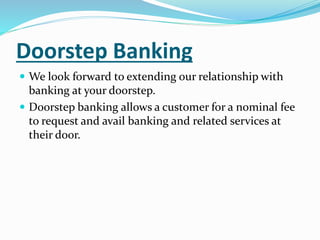
Doorstep Banking
 We look forward to extending our relationship with
banking at your doorstep.
 Doorstep banking allows a customer for a nominal fee
to request and avail banking and related services at
their door.
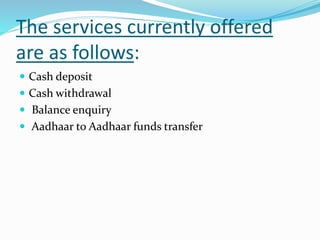
The services currently offered
are as follows:
 Cash deposit
 Cash withdrawal
 Balance enquiry
 Aadhaar to Aadhaar funds transfer
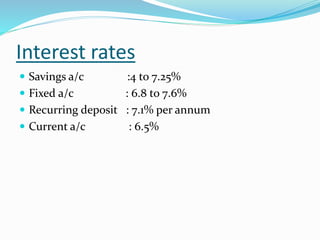
Interest rates
 Savings a/c :4 to 7.25%
 Fixed a/c : 6.8 to 7.6%
 Recurring deposit : 7.1% per annum
 Current a/c : 6.5%
Thank you

Indian post payment bank

  • 2.
  • 3.
     In the1820s Thomas Waghorn began investigations into improving mail routes between England and India.  Mails may taken nearly three months to reach England, but Waghorn’s letters accomplished he same journey in just 35 days
  • 4.
  • 5.
     The Indianpost payment was setuped in 30 Jan 2016  Headquarter is situated in new Delhi  There was a plan to setup around 650 post payments bank branches.
  • 6.
  • 7.
     India Posthas about 1,54,000 post offices, of them 90% are in rural areas.  There is one post office for every 7176 people in India. India Post also has 2,96,000 agents in the rural area. After State Bank of India, India Post has the largest deposits valued at ₹6 lakh crore.
  • 8.
    Role in financialinclusion  About 2.2 crore people, already receive their National Rural Employment Guarantee Act launch in 2006(NREGA ) payments by post offices.
  • 9.
    National rural employment guaranteeact  It aims to enhance livelihood security in rural areas by providing at least 140 days of wage employment in a financial year to every household whose adult members volunteer to do unskilled manual work.
  • 10.
    Latest development andNews  Recruitment for IPPB started, about 3500 personnel will be recruited across the country in the next few months  Post Payments Bank has been incorporated as a Public Limited Company by the Department of Posts, Government of India, on 17th August, 2016.
  • 11.
    Latest development andNews  IPPB started its operations on 30th January, 2016 by opening two main branches, one at Raipur and the other at Ranchi.  IPPB proposes to open 650 branches to cover almost all the districts of the country
  • 12.
  • 13.
    KEY FACTORS The fourkey features of IPPB are:  FINANCIAL LITERACY: Wealth creates wealth. Even a little saving can go a long way if channelized correctly. With trustworthy advice and services designed to include everybody, income can be invested correctly, more can be saved, and people can start moving forward, faster. IPPB aims to make India prosperous by ensuring that everyone has equal access to financial information and services, no matter who they are, what they earn and where they live.  STREAMLINING PAYMENTS: Beneficiaries can access income from government’s DBT programs like wages, Social Security Pensions and scholarships, directly from their IPPB bank account. They can also pay their utility bills, fees for educational institutions and much more from the same IPPB account. It ensures that wherever they are, they can make the most of the financial opportunities available to them.
  • 14.
     FINANCIAL INCLUSION:Millions of Indians don’t have access to banking facilities. They cannot avail of government benefits, loans and insurance, and even interest on savings. IPPB will reach the unbanked and the underbanked across all cross sections of society . Services offered by IPPB will help them take the first step towards prosperity.  EASE OF ACCESSIBILITY: IPPB is powered by the very postmen who deliver our letters. With over 1.54 lac post offices across the country, India Post enjoys the trust of Indians everywhere. The postal delivery system will make IPPB, India’s most accessible banking network. IPPB will also offer services through the internet and mobile banking, and prepaid instruments like mobile wallets, debit cards, ATMs, etc.
  • 15.
    Services  Domestic RemittanceServices  Direct benefit Transfer  Doorstep Banking
  • 16.
    Domestic Remittance Services: IPPB will provide an inexpensive and secure medium to transfer funds from its domestic remittance offering.  All customers of IPPB would be eligible to avail a host of different modes of domestic remittance subject to the stipulated constraints . Example: NEFT, IMPS, AEPS and UPI
  • 17.
    Direct Benefit Transfer(DBT):  DBT program aims to transfer subsidies directly to the people through their bank accounts, which will in turn reduce leakages, delays and other similar challenges.  Funds from the disbursing agency are automatically credited into the beneficiary accounts through NACH/APBS instead of cash disbursal. IPPB will provide cash out of the subsidies at the customer's doorstep by combining this service with Doorstep Banking.
  • 18.
    Doorstep Banking  Welook forward to extending our relationship with banking at your doorstep.  Doorstep banking allows a customer for a nominal fee to request and avail banking and related services at their door.
  • 19.
    The services currentlyoffered are as follows:  Cash deposit  Cash withdrawal  Balance enquiry  Aadhaar to Aadhaar funds transfer
  • 20.
    Interest rates  Savingsa/c :4 to 7.25%  Fixed a/c : 6.8 to 7.6%  Recurring deposit : 7.1% per annum  Current a/c : 6.5%
  • 21.