Compare and
Contrast
Instructional Focus Area For
Weeks 19-21
Compare and Contrast
The Benchmark:
The student recognizes the use of
comparison and contrast in a text.
LA.A.2.2.7
Important Vocabulary and
Definitions
• Compare: Finding how two or more things
are alike. Clue words that tell how things
are alike; same, like, both, alike, still,
likewise, in the same ways, in
comparisons, at the same time, in the
same manner, and similar.


Contrast: Finding how things are different. Clue words
that tell how things are different; but, unlike, different,
however, on the other hand, but, yet, nevertheless,
conversely, rather, on the contrary, nonetheless, and
whereas.
People, places, objects, and events can all be compared
and contrasted.
Comparing and contrasting text is one of the most
challenging critical reading skills to acquire because it
requires evaluating and synthesizing.
Graphic Organizers:
•
•
•
•

Venn Diagram
Three column notes
Character mapping
Semantic Feature Analysis
Application of Strategy:
• Compare and contrast two events, characters,
•
•
•


settings, or ideas in a selection
Identify compare and contrast statements and
clue words in a given text
Write similes, metaphors, and analogies that
compare and contrast two or more things
Demonstrate the results of compare and
contrast in a graphic organizer
Critical Thinking Questions:

• How did the author help readers learn new
ideas by comparing and contrasting?
• What text-to-text, text-to-world, or text-toself connections can you make?
• What similes, metaphors, or analogies did
the author use to make comparisons?
• What ideas did the author compare and
contrast?
A Critical Thinking Skill, the
Rationale:
Comparing and contrasting text is a critical
thinking skill. Mastering the skill leads
students toward proficiency in reading,
writing, analyzing problems and making
decisions.
Teaching Strategies


Using one of the books from the “Literature
Suggestions,” plan and present a Think-Aloud,
modeling how to apply the skills for comparing
and contrasting.
Teach the vocabulary that signals the compare
and contrast by identifying these words in text.
Teach and model the use of graphic organizers
while reading and writing.
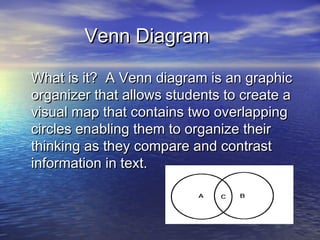
Venn Diagram
What is it? A Venn diagram is an graphic
organizer that allows students to create a
visual map that contains two overlapping
circles enabling them to organize their
thinking as they compare and contrast
information in text.
 
Thinking Maps
• Thinking maps integrate thinking skills and
mapping techniques. Learning to use
these strategies helps students develop
good writing skills. These techniques also
help students become better learners as
they develop life-long skills that help them
to study.
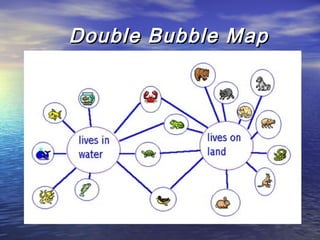
Double Bubble Thinking Maps
When comparing and contrasting we use double bubble
maps. This is similar in concept to a Venn diagram.
Two items being compared are written in the two center
circles. Outside bubbles display items that share
qualities with only one object-these are contrasting
qualities. Center bubbles that connect to both circles
show similarities between the two items being compared.
 
http://www.thinkingmaps.com/httmexam.php3
Double Bubble Map
Special Points of Interest


FACT:
3rd grade: 40% of the FCAT questions use expository text
4th & 5th grade: 50% of the FCAT questions use expository text
Key Questions:
How are ___ and ___ alike?
How are you like ___ (person)?
How is your family like ___’s (person’s) family?
What did ___ and ___ (person or animal) do that is alike? ( can
compare 3)
Think about ___ and ___ (people) in the story. How are they alike?
How are they different? 
Literature Suggestions:
•
•
•
•
•
•
•
 

Borreguita and the Coyote
Solomon and the Rusty Nail
The Girl who Loved Horses
Lon Po Po
Song and Dance Man
Deep in the Forest
Fish Is Fish
Extension Activities FCRR Just Read
Florida Activity Binder:
Character Characteristics:
Students describe a character by using a graphic organizer. Grade 2-3 (C.001)
Compare-A-Character:
Students will identify similarities and differences
between characters.
Grade 2-3(C.002)
Word Analysis:
Students will identify similarities and differences between the meaning of words
Grade K-1(V.029)
Semantic Feature Analysis:
Students will identify similarities and differences between the meaning of
words.
Grade K-1 (V.032)
 

Compare and contrast

  • 1.
  • 2.
    Compare and Contrast TheBenchmark: The student recognizes the use of comparison and contrast in a text. LA.A.2.2.7
  • 3.
    Important Vocabulary and Definitions •Compare: Finding how two or more things are alike. Clue words that tell how things are alike; same, like, both, alike, still, likewise, in the same ways, in comparisons, at the same time, in the same manner, and similar.
  • 4.
          Contrast: Finding howthings are different. Clue words that tell how things are different; but, unlike, different, however, on the other hand, but, yet, nevertheless, conversely, rather, on the contrary, nonetheless, and whereas. People, places, objects, and events can all be compared and contrasted. Comparing and contrasting text is one of the most challenging critical reading skills to acquire because it requires evaluating and synthesizing.
  • 5.
    Graphic Organizers: • • • • Venn Diagram Threecolumn notes Character mapping Semantic Feature Analysis
  • 6.
    Application of Strategy: •Compare and contrast two events, characters, • • •     settings, or ideas in a selection Identify compare and contrast statements and clue words in a given text Write similes, metaphors, and analogies that compare and contrast two or more things Demonstrate the results of compare and contrast in a graphic organizer
  • 7.
    Critical Thinking Questions: •How did the author help readers learn new ideas by comparing and contrasting? • What text-to-text, text-to-world, or text-toself connections can you make? • What similes, metaphors, or analogies did the author use to make comparisons? • What ideas did the author compare and contrast?
  • 8.
    A Critical ThinkingSkill, the Rationale: Comparing and contrasting text is a critical thinking skill. Mastering the skill leads students toward proficiency in reading, writing, analyzing problems and making decisions.
  • 9.
    Teaching Strategies         Using oneof the books from the “Literature Suggestions,” plan and present a Think-Aloud, modeling how to apply the skills for comparing and contrasting. Teach the vocabulary that signals the compare and contrast by identifying these words in text. Teach and model the use of graphic organizers while reading and writing.
  • 10.
    Venn Diagram What isit? A Venn diagram is an graphic organizer that allows students to create a visual map that contains two overlapping circles enabling them to organize their thinking as they compare and contrast information in text.  
  • 11.
    Thinking Maps • Thinkingmaps integrate thinking skills and mapping techniques. Learning to use these strategies helps students develop good writing skills. These techniques also help students become better learners as they develop life-long skills that help them to study.
  • 12.
    Double Bubble ThinkingMaps When comparing and contrasting we use double bubble maps. This is similar in concept to a Venn diagram. Two items being compared are written in the two center circles. Outside bubbles display items that share qualities with only one object-these are contrasting qualities. Center bubbles that connect to both circles show similarities between the two items being compared.   http://www.thinkingmaps.com/httmexam.php3
  • 13.
  • 14.
    Special Points ofInterest   FACT: 3rd grade: 40% of the FCAT questions use expository text 4th & 5th grade: 50% of the FCAT questions use expository text Key Questions: How are ___ and ___ alike? How are you like ___ (person)? How is your family like ___’s (person’s) family? What did ___ and ___ (person or animal) do that is alike? ( can compare 3) Think about ___ and ___ (people) in the story. How are they alike? How are they different? 
  • 15.
    Literature Suggestions: • • • • • • •   Borreguita andthe Coyote Solomon and the Rusty Nail The Girl who Loved Horses Lon Po Po Song and Dance Man Deep in the Forest Fish Is Fish
  • 16.
    Extension Activities FCRRJust Read Florida Activity Binder: Character Characteristics: Students describe a character by using a graphic organizer. Grade 2-3 (C.001) Compare-A-Character: Students will identify similarities and differences between characters. Grade 2-3(C.002) Word Analysis: Students will identify similarities and differences between the meaning of words Grade K-1(V.029) Semantic Feature Analysis: Students will identify similarities and differences between the meaning of words. Grade K-1 (V.032)