A qualitative meta-analysis of social interaction  in e-learning Melanie Johnston
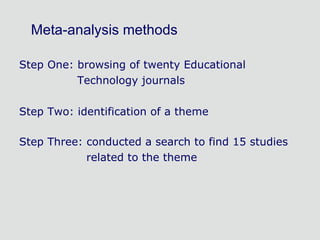
Meta-analysis methods Step One: browsing of twenty Educational    Technology journals Step Two: identification of a theme Step Three: conducted a search to find 15 studies  related to the theme
 
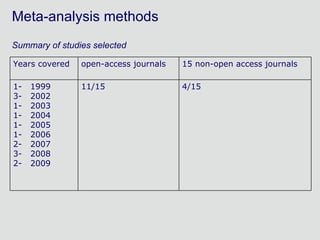
Meta-analysis methods Summary of studies selected 4/15  11/15  1-  1999 3-  2002 1-  2003 1-  2004 1-  2005 1-  2006 2-  2007 3-  2008 2-  2009 15 non-open access journals  open-access journals Years covered
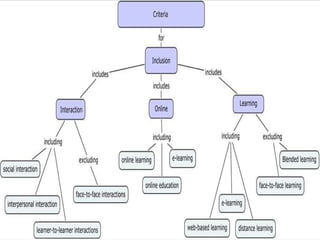
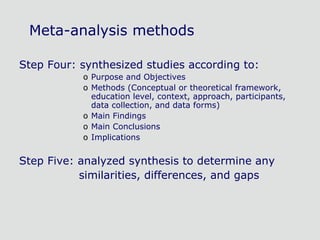
Meta-analysis methods Step Four: synthesized studies according to: Purpose and Objectives Methods (Conceptual or theoretical framework, education level, context, approach, participants, data collection, and data forms) Main Findings Main Conclusions Implications  Step Five: analyzed synthesis to determine any  similarities, differences, and gaps
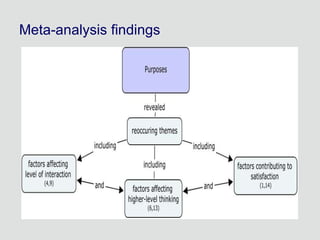
Meta-analysis findings
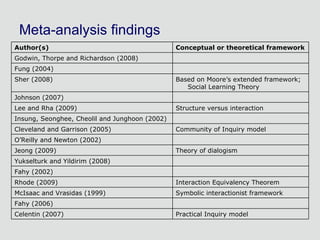
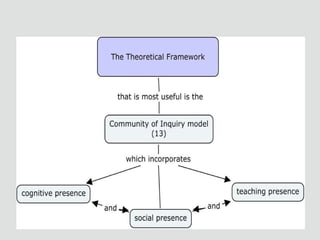
Meta-analysis findings Practical Inquiry model Celentin (2007) Fahy (2006) Symbolic interactionist framework McIsaac and Vrasidas (1999) Interaction Equivalency Theorem Rhode (2009) Fahy (2002) Yukselturk and Yildirim (2008) Theory of dialogism Jeong (2009) O’Reilly and Newton (2002) Community of Inquiry model Cleveland and Garrison (2005) Insung, Seonghee, Cheolil and Junghoon (2002) Structure versus interaction Lee and Rha (2009) Johnson (2007) Based on Moore’s extended framework;  Social Learning Theory Sher (2008) Fung (2004) Godwin, Thorpe and Richardson (2008)  Conceptual or theoretical framework Author(s)
 
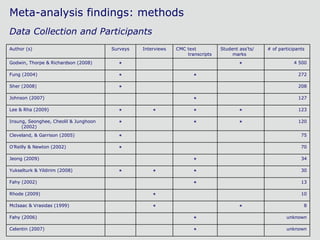
Meta-analysis findings: methods Data Collection and Participants   unknown * Celentin (2007) unknown * Fahy (2006) 8 * * McIsaac & Vrasidas (1999) 10 * Rhode (2009) 13 * Fahy (2002) 30 * * * Yukselturk & Yildirim (2008) 34 * Jeong (2009) 70 * O’Reilly & Newton (2002) 75 * Cleveland, & Garrison (2005) 120 * * * Insung, Seonghee, Cheolil & Junghoon (2002) 123 * * * * Lee & Rha (2009) 127 * Johnson (2007) 208 * Sher (2008) 272 * * Fung (2004) 4 500 * * Godwin, Thorpe & Richardson (2008) # of participants Student ass’ts/ marks CMC text transcripts Interviews Surveys Author (s)
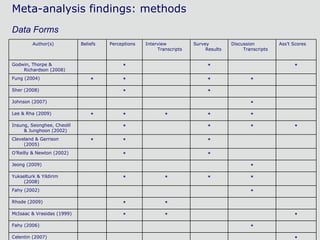
Meta-analysis findings: methods     Data Forms * Celentin (2007) * Fahy (2006) * * * McIsaac & Vrasidas (1999) * * Rhode (2009) * Fahy (2002) * * * * Yukselturk & Yildirim (2008) * Jeong (2009) * * O’Reilly & Newton (2002) * * * Cleveland & Garrison (2005) * * * * Insung, Seonghee, Cheolil & Junghoon (2002) * * * * * Lee & Rha (2009) * Johnson (2007) * * Sher (2008) * * * * Fung (2004) * * * Godwin, Thorpe & Richardson (2008) Ass’t Scores Discussion Transcripts Survey Results Interview Transcripts Perceptions Beliefs Author(s)
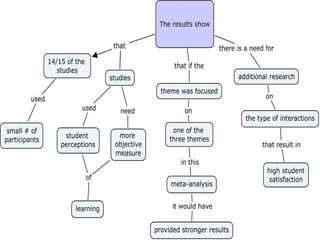
Findings


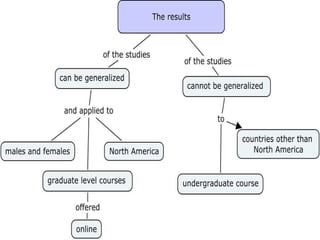
Conclusion


Implications
 
 
Discussion
 
Conclusion
 
Implications
 
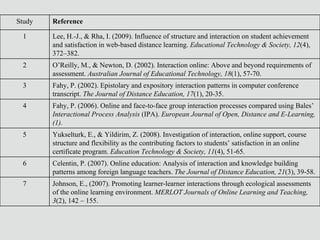
Johnson, E., (2007). Promoting learner-learner interactions through ecological assessments of the online learning environment.  MERLOT Journals of Online Learning and Teaching, 3 (2), 142 – 155.  7 Celentin, P. (2007). Online education: Analysis of interaction and knowledge building patterns among foreign language teachers.  The Journal of Distance Education, 21 (3), 39-58.  6 Yukselturk, E., & Yildirim, Z. (2008). Investigation of interaction, online support, course structure and flexibility as the contributing factors to students’ satisfaction in an online certificate program.  Education Technology & Society, 11 (4), 51-65. 5 Fahy, P. (2006). Online and face-to-face group interaction processes compared using Bales’  Interactional Process Analysis  (IPA).  European Journal of Open, Distance and E-Learning,(1).  4 Fahy, P. (2002). Epistolary and expository interaction patterns in computer conference transcript.  The Journal of Distance Education, 17 (1), 20-35. 3 O’Reilly, M., & Newton, D. (2002). Interaction online: Above and beyond requirements of assessment.  Australian Journal of Educational Technology, 18 (1), 57-70.  2 Lee, H.-J., & Rha, I. (2009). Influence of structure and interaction on student achievement and satisfaction in web-based distance learning.  Educational Technology & Society, 12 (4), 372–382. 1 Reference Study
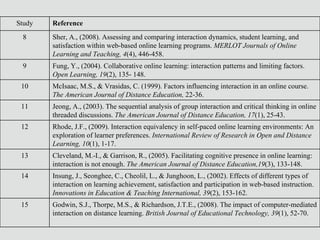
Reference Study Godwin, S.J., Thorpe, M.S., & Richardson, J.T.E., (2008).  The impact of computer-mediated interaction on distance learning.  British Journal of Educational Technology, 39 (1), 52-70. 15 Insung, J., Seonghee, C., Cheolil, L., & Junghoon, L., (2002).  Effects of different types of interaction on learning achievement, satisfaction and participation in web-based instruction.   Innovations in Education & Teaching International,   39 (2), 153-162.  14 Cleveland, M.-I., & Garrison, R., (2005). Facilitating cognitive presence in online learning: interaction is not enough.  The American Journal of Distance Education,19 (3), 133-148. 13 Rhode, J.F., (2009). Interaction equivalency in self-paced online learning environments: An exploration of learner preferences.  International Review of Research in Open and Distance Learning, 10 (1), 1-17. 12 Jeong, A., (2003). The sequential analysis of group interaction and critical thinking in online threaded discussions.  The American Journal of Distance Education, 17 (1), 25-43. 11 McIsaac, M.S., & Vrasidas, C. (1999). Factors influencing interaction in an online course.  The American Journal of Distance Education,  22-36.  10 Fung, Y., (2004). Collaborative online learning: interaction patterns and limiting factors.  Open Learning, 19 (2), 135- 148.  9 Sher, A., (2008). Assessing and comparing interaction dynamics, student learning, and satisfaction within web-based online learning programs.  MERLOT Journals of Online Learning and Teaching, 4 (4), 446-458.  8

6610johnstonmodule3a

  • 1.
    A qualitative meta-analysisof social interaction in e-learning Melanie Johnston
  • 2.
    Meta-analysis methods StepOne: browsing of twenty Educational Technology journals Step Two: identification of a theme Step Three: conducted a search to find 15 studies related to the theme
  • 3.
  • 4.
    Meta-analysis methods Summaryof studies selected 4/15 11/15 1- 1999 3- 2002 1- 2003 1- 2004 1- 2005 1- 2006 2- 2007 3- 2008 2- 2009 15 non-open access journals open-access journals Years covered
  • 5.
    Meta-analysis methods StepFour: synthesized studies according to: Purpose and Objectives Methods (Conceptual or theoretical framework, education level, context, approach, participants, data collection, and data forms) Main Findings Main Conclusions Implications Step Five: analyzed synthesis to determine any similarities, differences, and gaps
  • 6.
  • 7.
    Meta-analysis findings PracticalInquiry model Celentin (2007) Fahy (2006) Symbolic interactionist framework McIsaac and Vrasidas (1999) Interaction Equivalency Theorem Rhode (2009) Fahy (2002) Yukselturk and Yildirim (2008) Theory of dialogism Jeong (2009) O’Reilly and Newton (2002) Community of Inquiry model Cleveland and Garrison (2005) Insung, Seonghee, Cheolil and Junghoon (2002) Structure versus interaction Lee and Rha (2009) Johnson (2007) Based on Moore’s extended framework; Social Learning Theory Sher (2008) Fung (2004) Godwin, Thorpe and Richardson (2008) Conceptual or theoretical framework Author(s)
  • 8.
  • 9.
    Meta-analysis findings: methodsData Collection and Participants unknown * Celentin (2007) unknown * Fahy (2006) 8 * * McIsaac & Vrasidas (1999) 10 * Rhode (2009) 13 * Fahy (2002) 30 * * * Yukselturk & Yildirim (2008) 34 * Jeong (2009) 70 * O’Reilly & Newton (2002) 75 * Cleveland, & Garrison (2005) 120 * * * Insung, Seonghee, Cheolil & Junghoon (2002) 123 * * * * Lee & Rha (2009) 127 * Johnson (2007) 208 * Sher (2008) 272 * * Fung (2004) 4 500 * * Godwin, Thorpe & Richardson (2008) # of participants Student ass’ts/ marks CMC text transcripts Interviews Surveys Author (s)
  • 10.
    Meta-analysis findings: methods Data Forms * Celentin (2007) * Fahy (2006) * * * McIsaac & Vrasidas (1999) * * Rhode (2009) * Fahy (2002) * * * * Yukselturk & Yildirim (2008) * Jeong (2009) * * O’Reilly & Newton (2002) * * * Cleveland & Garrison (2005) * * * * Insung, Seonghee, Cheolil & Junghoon (2002) * * * * * Lee & Rha (2009) * Johnson (2007) * * Sher (2008) * * * * Fung (2004) * * * Godwin, Thorpe & Richardson (2008) Ass’t Scores Discussion Transcripts Survey Results Interview Transcripts Perceptions Beliefs Author(s)
  • 11.
  • 12.
  • 13.
  • 14.
  • 15.
  • 16.
  • 17.
  • 18.
  • 19.
  • 20.
  • 21.
  • 22.
  • 23.
  • 24.
  • 25.
  • 26.
  • 27.
  • 28.
    Johnson, E., (2007).Promoting learner-learner interactions through ecological assessments of the online learning environment. MERLOT Journals of Online Learning and Teaching, 3 (2), 142 – 155. 7 Celentin, P. (2007). Online education: Analysis of interaction and knowledge building patterns among foreign language teachers. The Journal of Distance Education, 21 (3), 39-58. 6 Yukselturk, E., & Yildirim, Z. (2008). Investigation of interaction, online support, course structure and flexibility as the contributing factors to students’ satisfaction in an online certificate program. Education Technology & Society, 11 (4), 51-65. 5 Fahy, P. (2006). Online and face-to-face group interaction processes compared using Bales’ Interactional Process Analysis (IPA). European Journal of Open, Distance and E-Learning,(1). 4 Fahy, P. (2002). Epistolary and expository interaction patterns in computer conference transcript. The Journal of Distance Education, 17 (1), 20-35. 3 O’Reilly, M., & Newton, D. (2002). Interaction online: Above and beyond requirements of assessment. Australian Journal of Educational Technology, 18 (1), 57-70. 2 Lee, H.-J., & Rha, I. (2009). Influence of structure and interaction on student achievement and satisfaction in web-based distance learning. Educational Technology & Society, 12 (4), 372–382. 1 Reference Study
  • 29.
    Reference Study Godwin,S.J., Thorpe, M.S., & Richardson, J.T.E., (2008). The impact of computer-mediated interaction on distance learning. British Journal of Educational Technology, 39 (1), 52-70. 15 Insung, J., Seonghee, C., Cheolil, L., & Junghoon, L., (2002). Effects of different types of interaction on learning achievement, satisfaction and participation in web-based instruction. Innovations in Education & Teaching International, 39 (2), 153-162. 14 Cleveland, M.-I., & Garrison, R., (2005). Facilitating cognitive presence in online learning: interaction is not enough. The American Journal of Distance Education,19 (3), 133-148. 13 Rhode, J.F., (2009). Interaction equivalency in self-paced online learning environments: An exploration of learner preferences. International Review of Research in Open and Distance Learning, 10 (1), 1-17. 12 Jeong, A., (2003). The sequential analysis of group interaction and critical thinking in online threaded discussions. The American Journal of Distance Education, 17 (1), 25-43. 11 McIsaac, M.S., & Vrasidas, C. (1999). Factors influencing interaction in an online course. The American Journal of Distance Education, 22-36. 10 Fung, Y., (2004). Collaborative online learning: interaction patterns and limiting factors. Open Learning, 19 (2), 135- 148. 9 Sher, A., (2008). Assessing and comparing interaction dynamics, student learning, and satisfaction within web-based online learning programs. MERLOT Journals of Online Learning and Teaching, 4 (4), 446-458. 8