1
COMP 4710 Senior Design Project
Surviving a Group Project
Dr. Xiao Qin
Auburn University
http://www.eng.auburn.edu/~xqin
xqin@auburn.edu
2
Learning Goals
Goal: Compete for positions in the job market or in graduate
schools.
Team Work Skills Leadership
Abilities
Problem Solving
Skills
Management
Skills
Project Planning
3
Collaborative Learning
4
5
Common Obstacles
6
Choose the best means of Communication
7
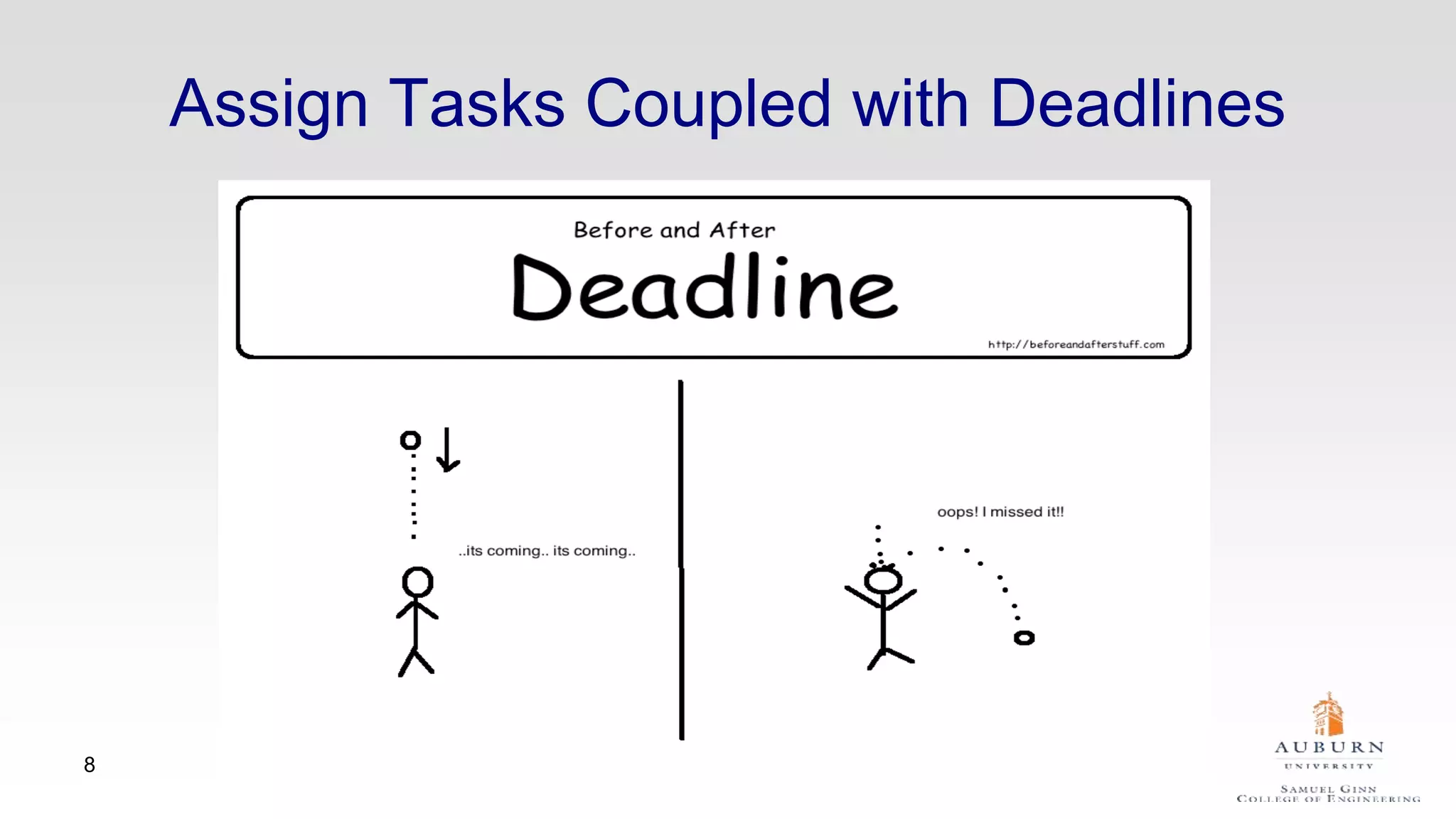
Assign Tasks Coupled with Deadlines
8
Give a Time Cushion
9
Take the Lead
10
You can’t do it alone!
• When you see that your group
members are not doing their part,
immediately talk to them
• If they won’t listen then you have to
tell it to Dr. Chapman or Dr. Qin.
11
Stay Positive
12
Tools and Applications for
Group Projects
13
14
15
16
17
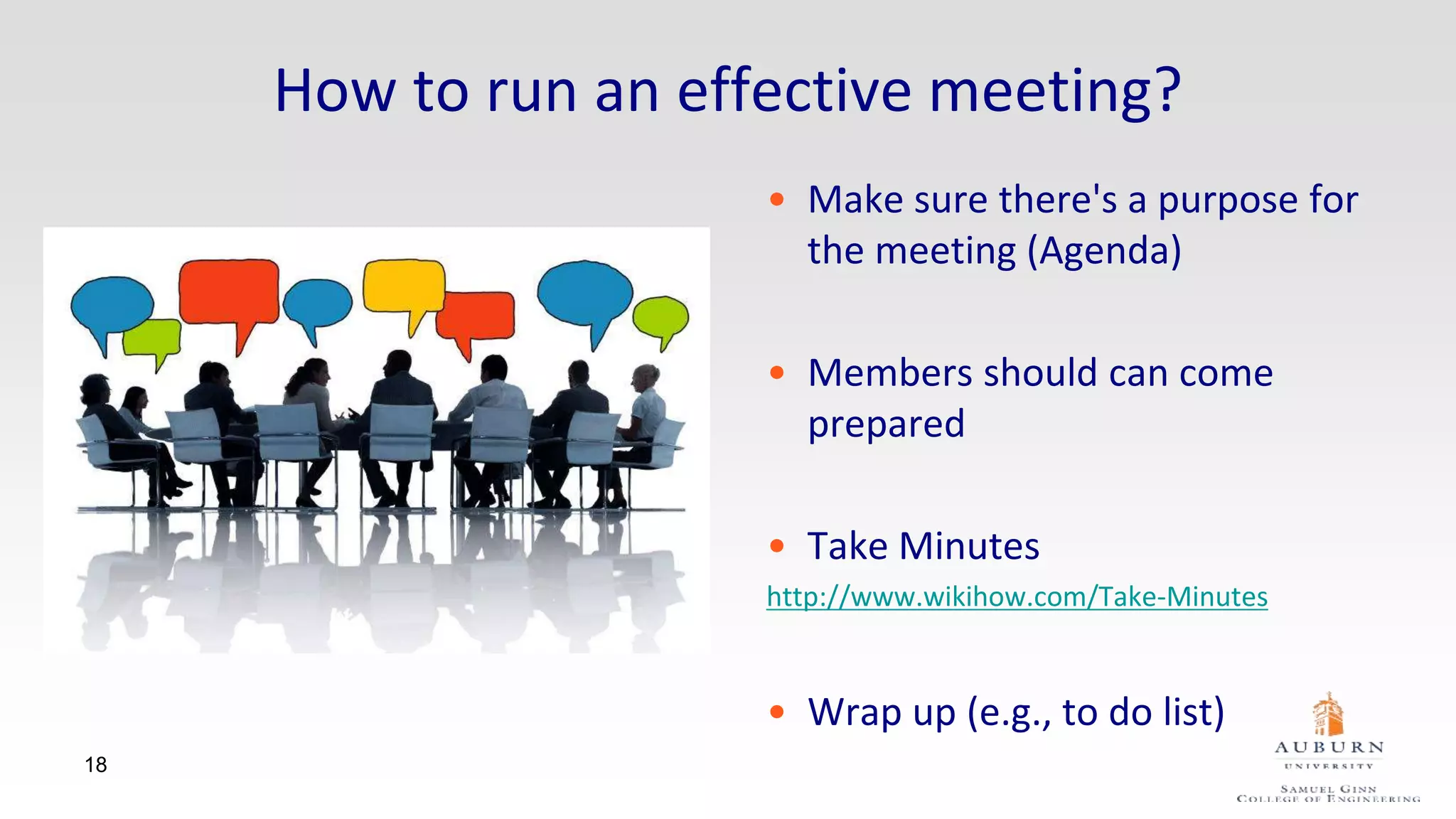
How to run an effective meeting?
• Make sure there's a purpose for
the meeting (Agenda)
• Members should can come
prepared
• Take Minutes
http://www.wikihow.com/Take-Minutes
• Wrap up (e.g., to do list)
18
Our Agenda
• Determine a weekly meeting time
• Choose a way of communication
• Toolkits to support collaborations
• Decide roles in future meetings:
– Who is a coordinator
– Who takes minutes
• Development environments, software,
hardware
• Make an initial plan for the architectural
spike phase19

Surviving a group project

Editor's Notes

  • #2 15 min Reference: http://college.usatoday.com/2012/05/20/seven-tips-for-surviving-a-group-project/
  • #6 Not all groups are perfect. You can meet some who do not care about their grades, or simply do not know what to do.
  • #8 When you have to meet them on weekends or you want them to revise some parts of the project, you have to communicate. It can be through Emails, Facebook groups, or phone calls. Make sure all your members are active and participating by checking what they have accomplished once in awhile.
  • #9 Assign each member a task. Give them deadlines. With the deadlines, they know their priorities and it is their responsibility to complete what is given to them.
  • #10 Give a time cushion at the end of the project People get sick, documents get deleted, group members are irresponsible. For the unexpected and unaccounted for issues, set an earlier date than the actual due date for the project to be completed. By giving the team a few extra days as a time cushion, catastrophes and dilemmas can be solved by the time of the teacher’s due date.
  • #11 Don’t fear stepping up and being the team coordinator or leader. If you get stuck with a group full of slackers, this is the perfect opportunity to expand your leadership skills and take control. This doesn’t mean being the person who does all the work, but ensuring everything gets done on time. Leaders also facilitate communication between members and help keep members on track. If you find yourself in the leadership role, keep an open mind and listen to everyone’s opinions. The best leaders can find a compromise that all group members can agree with.
  • #12 Don’t be afraid to ask your professor for help Asking for help does not show weakness – it proves to professors that you care about the outcome of the project and are willing to try alternative solutions to achieve success. If your research hypothesis is failing or someone is not pulling their weight, have the courage to ask your teacher for help with the next steps. As educators, pfofessors are full of guidance that you can use to move forward. After all, the teacher assigned the project, so why not pick their brain for more knowledge?
  • #13 Stay positive Although time consuming and at times, stressful, group projects are beneficial for providing realistic examples of what your future internship or career may entail. Coming up with an entire media strategy for a local pizza spot may later help with your prospective job in the advertising field or the public service announcement project can assist with your future in broadcast journalism. By focusing on the positives instead of the negatives, you give yourself the chance to learn the most out of each project and apply it to the real world.
  • #19 Reference: http://www.inc.com/guides/2010/08/how-to-run-effective-meeting.html How to Run an Effective Meeting: 3 Tips for Meeting Success While Parker outlines 33 tools for honing your meeting leading abilities in his book, he boiled the essentials down to three key ways to keep your meetings from being time wasters: The first tidbit sounds obvious, but enough people disregard it to make it necessary. "Make sure there's a purpose for the meeting," Parker says. "Don't just have a meeting because it's Tuesday or don't just have a meeting because you haven't had one in a month and you feel like you should." Phone calls, e-mails, and calling folks into your office can be valuable replacements for larger group meetings. Secondly, having a purpose for the meeting isn't enough unless people know what that purpose is so they can come prepared. There should also be a list of agenda items that get distributed to everyone involved, and ideally a specific amount of time alotted to cover each one to partially preempt digressions. Finally, for a meeting to be successful rather than wasteful, you need to make sure the right people are there, no more no less. Do you need multiple representatives from the sales department or can one of them report back to their team. If someone consistently stays silent during meetings you either have a shy employee or someone with nothing to contribute in the context of that particular meeting.
  • #20 Interrupt transfers control to the interrupt service routine through the interrupt vector (contains the addresses of all the service routines) Interrupt architecture must save the address of the interrupted instruction A trap or exception is a software-generated interrupt caused either by an error or a user request An operating system is interrupt driven