What is
What is
Community Organization (CO)?
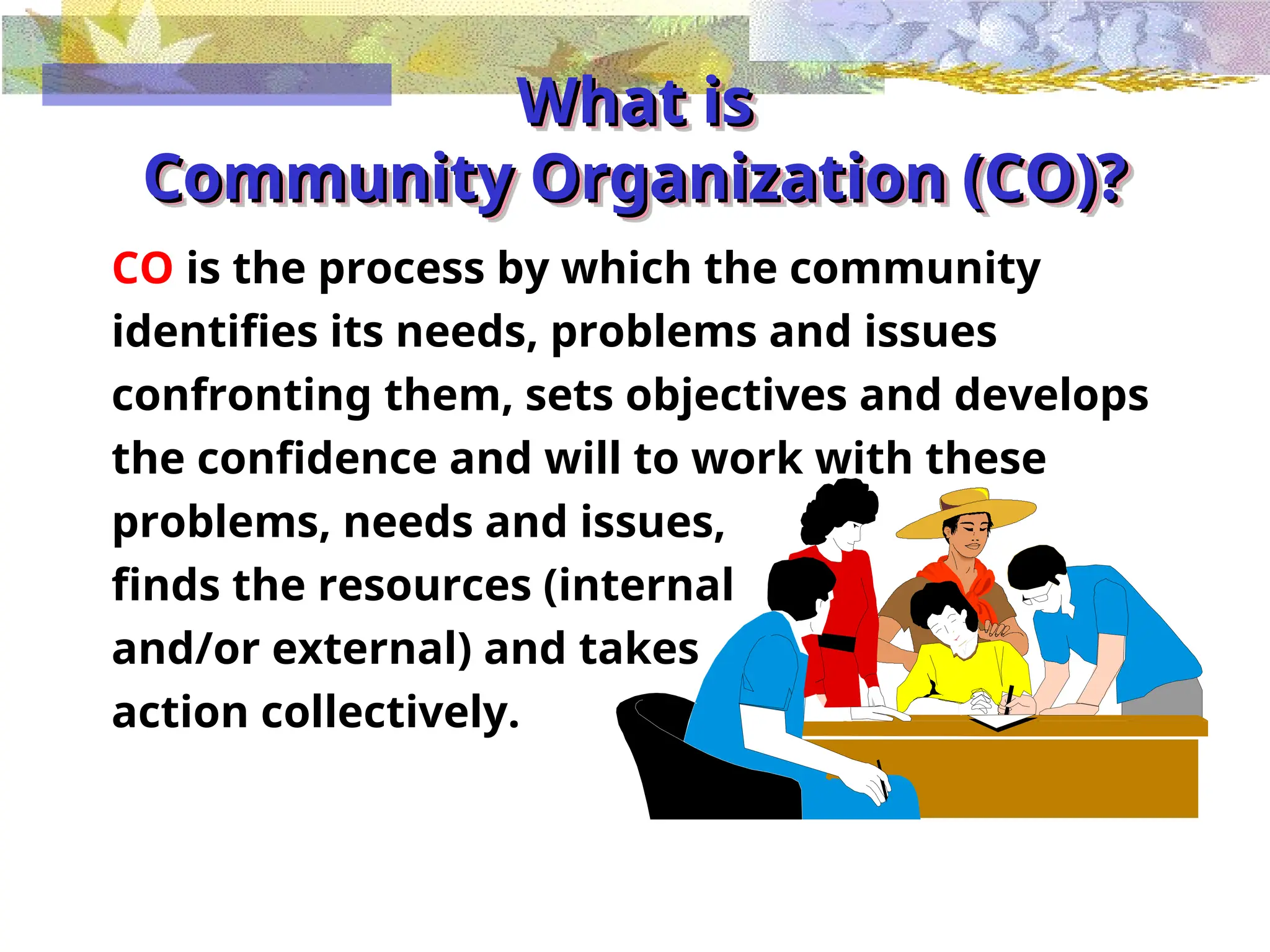
CO is the process by which the community
identifies its needs, problems and issues
confronting them, sets objectives and develops
the confidence and will to work with these
problems, needs and issues,
finds the resources (internal
and/or external) and takes
action collectively.
CO definition...
 It deals with problem-solving in response to
problems and needs.
 It seeks social change for the greater good.
 Involves the process of social interaction.
 It involves people’s participation in
planning and implementation
of plans.
Typology of
Participation in
Development Programs
1. Passive participation
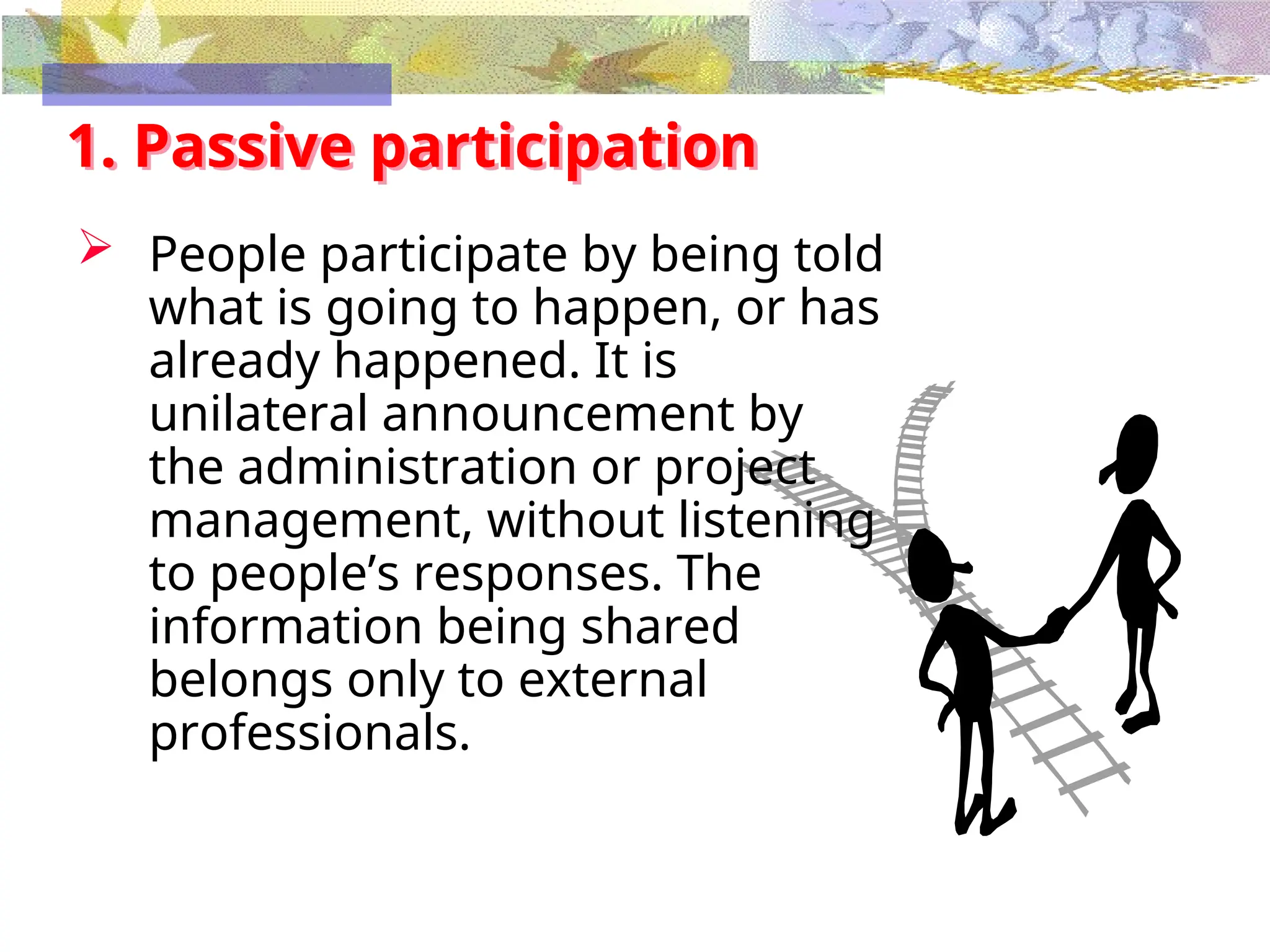
 People participate by being told
what is going to happen, or has
already happened. It is
unilateral announcement by
the administration or project
management, without listening
to people’s responses. The
information being shared
belongs only to external
professionals.
2. Participation in information
giving
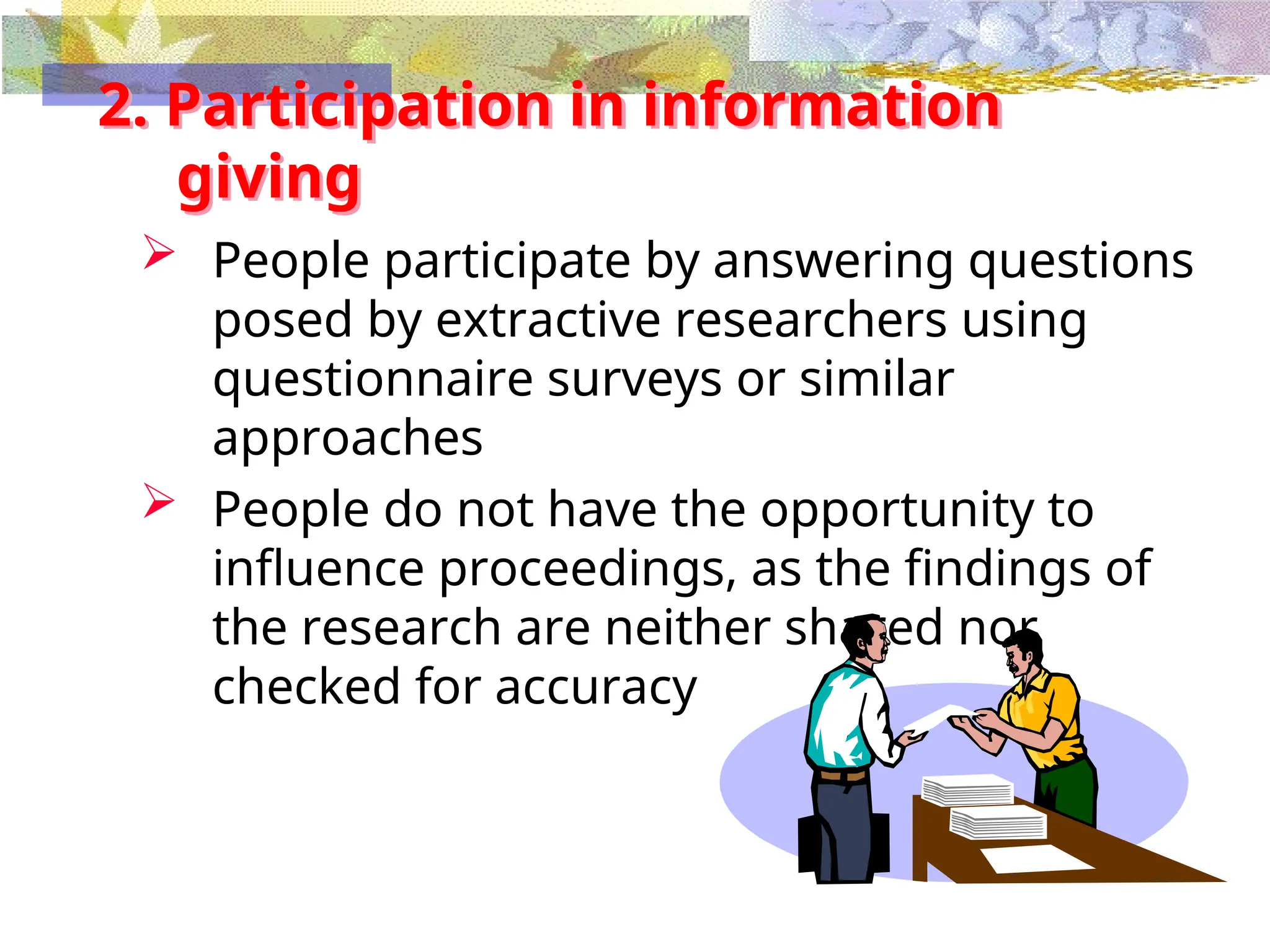
 People participate by answering questions
posed by extractive researchers using
questionnaire surveys or similar
approaches
 People do not have the opportunity to
influence proceedings, as the findings of
the research are neither shared nor
checked for accuracy
3. Participation by consultation
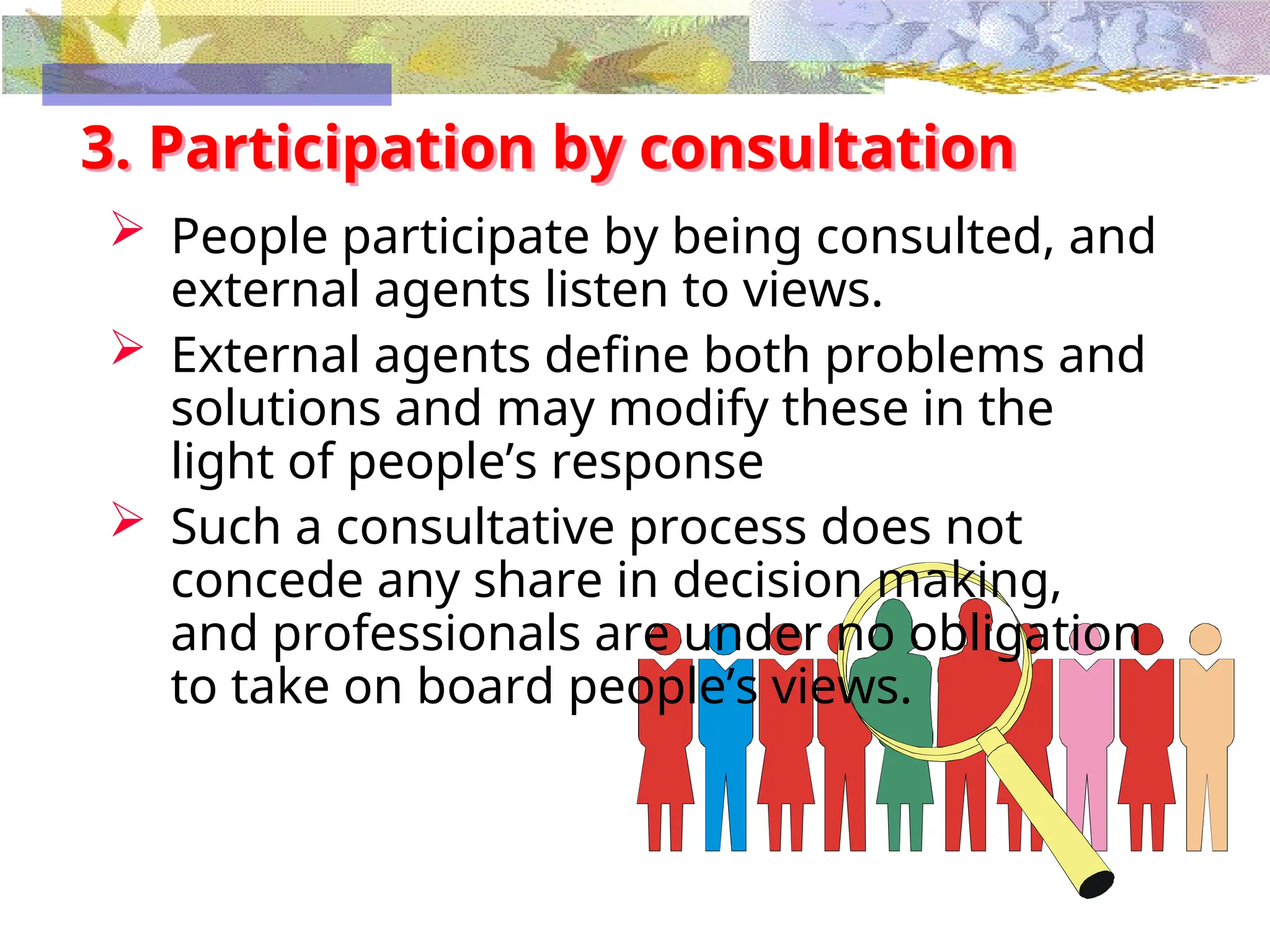
 People participate by being consulted, and
external agents listen to views.
 External agents define both problems and
solutions and may modify these in the
light of people’s response
 Such a consultative process does not
concede any share in decision making,
and professionals are under no obligation
to take on board people’s views.
4. Participation for material
incentives
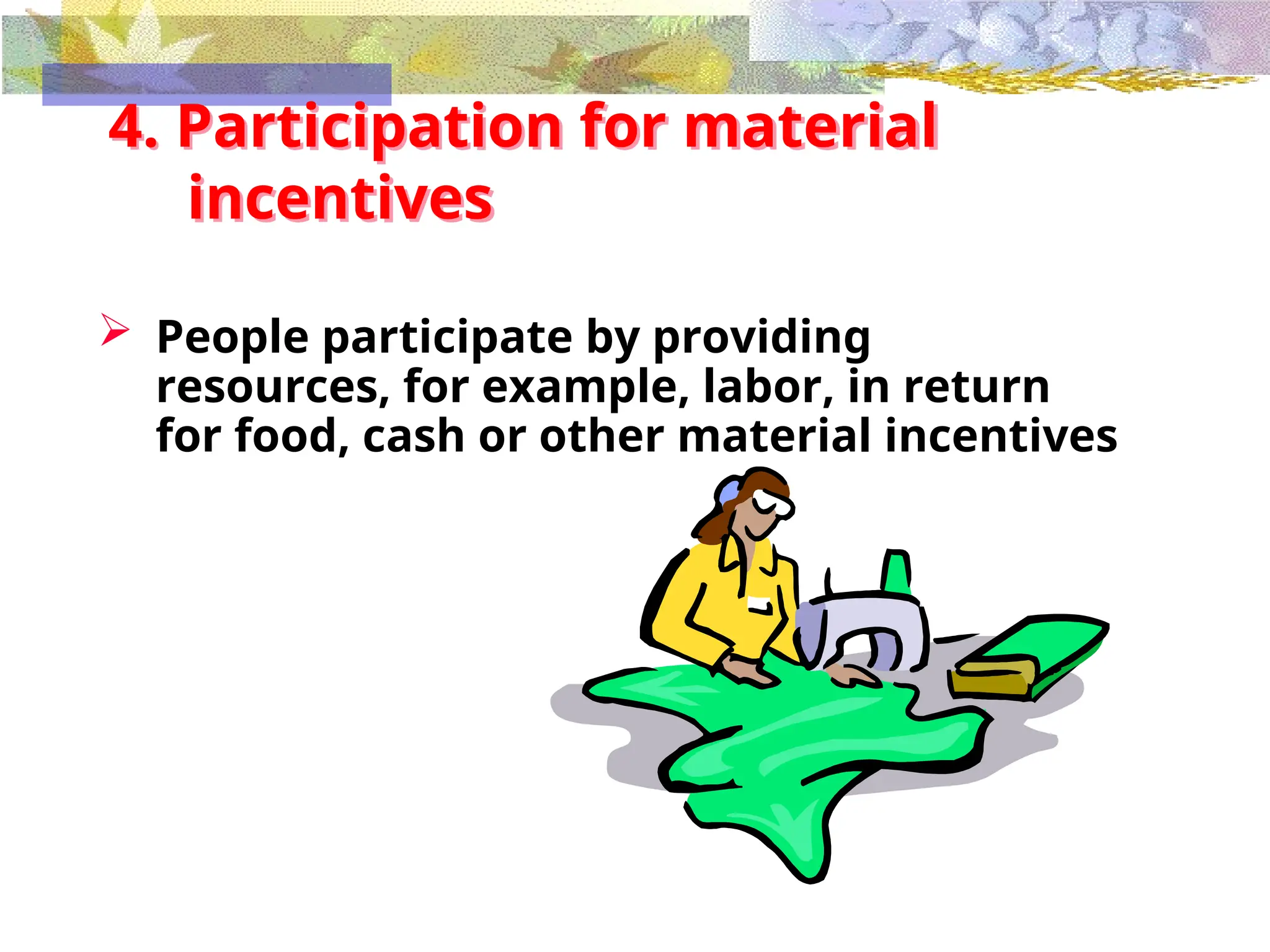
 People participate by providing
resources, for example, labor, in return
for food, cash or other material incentives
5. Functional Participation
 forming groups to meet pre-determined
objectives related to project
 involvement occurs not at early stages
of project cycles or planning but after
major decisions have been made
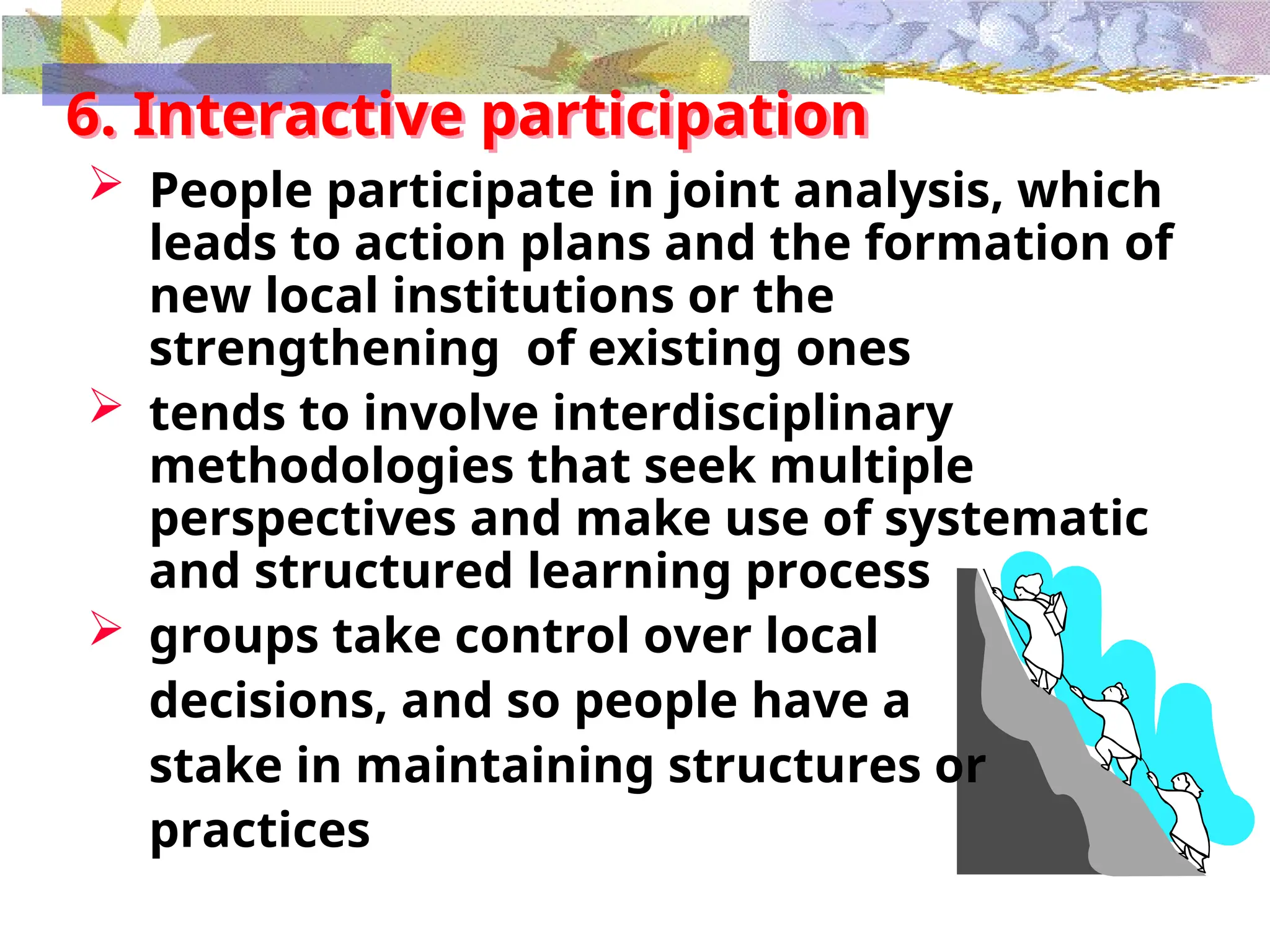
6. Interactive participation
 People participate in joint analysis, which
leads to action plans and the formation of
new local institutions or the
strengthening of existing ones
 tends to involve interdisciplinary
methodologies that seek multiple
perspectives and make use of systematic
and structured learning process
 groups take control over local
decisions, and so people have a
stake in maintaining structures or
practices
7. Self-mobilization
 People participate by taking initiatives
independent of external institutions to
change systems
 They develop contracts with external
institutions for resources and technical
advice they need, but retain control over
how resources are used
 Such self-initiative mobilization and
collective action may or may not challenge
existing inequitable distributions of wealth
and power
Aims/Goals of
Aims/Goals of CO
CO
CO is concerned with 3 types of goals :
a. Task Goals - refer to concrete tasks to be undertaken to meet
specific needs and people’s aspirations or to solve a particular
problem.
b. Process goals – are concerned with the process of helping
people in a community or group strengthen their quality o
participation , self direction, and cooperation. It prepares
them for their specific roles in community builidng and
development.
c. Relationship goals - are focused on changing
certain types of social relationships and decision-making
patterns in the community by diffusing power to a wider base.
Stakeholders
Stakeholders
 Stakeholders are individuals,
groups of men and women who
are in one way or another
interested, involved or affected
(positively or negatively) by a
particular conservation or
development project. They are
motivated to take action.
People Empowerment
People Empowerment
 Process of releasing the potentials of people
through appropriate programs and strategies
and services; removing blocks that deter their
growth and development and providing
opportunities for people to develop their
capabilities to positively deal with their
problems and stand up for their rights
and take control over
their lives as individuals
and community.
Focus of
Focus of
Community Organizing
1. Removal of blocks to growth.
2. The release of potentialities of individuals, groups and
communities.
3. Development of the capacities of indigenous leaders
to lead in the dealing with their community
problems.
4. Developing capacities of different sectors in the
community to function as an integrated whole.
5. Strengthening people’s capacity for problem-solving,
decision-making and cooperation.
6. The full use of inner/indigenous resources before
tapping external resources.
Values of
Values of
Community Organizing
1. A commitment to democratic processes and
goals.
2. Right of community for self - determination.
3. Belief on the capacity of people to change.
4. Belief on the innate dignity of individuals and
groups in the community.
5. The commitment to seek social
justice and equity.
Value Assumptions of CO
• Changes in which individuals, groups and communities determine
their own destiny in a democratic process have better change of
enduring than changes that are imposed.
• Readiness to change is a variable which affect the potential and
rate of community change obtainable at a given time
• Skills in participating in a democratic process can be taught and
learned by individuals and groups
• Society can provide ways to achieve maximum compatibility of
individual and community interest. Majority’s interest and benefit
should override any individual self interest .
• Planning, coordination and integration of social welfare provisions
and services should be pursued, since social ills are interrelated,
and social welfare provisions are inter-dependent.
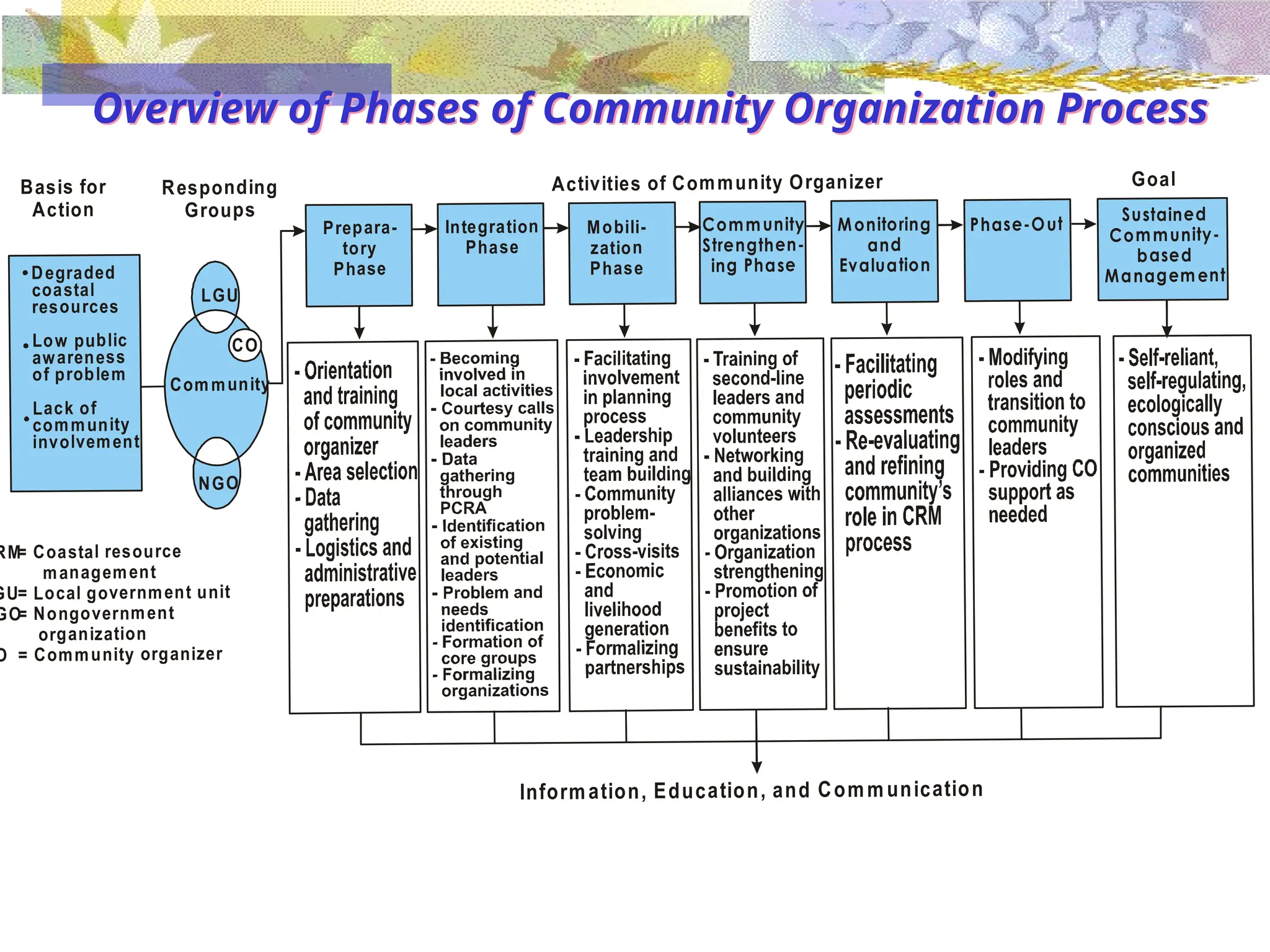
Overview of Phases of Community Organization Process
Responding
Groups
Activities of Community Organizer
Prepara-
tory
Phase
Integration
Phase
Mobili-
zation
Phase
Community
Strengthen-
ing Phase
Community
CO
LGU
NGO
Monitoring
and
Evaluation
Phase-Out
Sustained
Community-
based
Management
Degraded
coastal
resources
Low public
awareness
of problem
Lack of
community
involvement
Goal
Information, Education, and Communication
Basis for
Action
RM
GU
GO
O
= Coastal resource
management
= Local government unit
= Nongovernment
organization
= Community organizer
The Community Organizer
A community organizer is responsible for facilitating the CO
process, who comes from within or outside the community
and is often sponsored by a donor agency, NGO, civil
society organization, national agency or local government
unit, private sector etc. that is providing technical advise
and funding at least during the initial stages of the CO
process. The ultimate goal is to empower the community so
they are able to deal with their community needs even
without the presence of community workers.
The Co worker serves as the “bridge” between the
community and the external resources that could provide
assistance in finding solutions to their community needs.
A CO worker should have :
•A clear understanding of the different theories of
development
•Familiarity with the concepts and processes of
community organization
•Social and community relationship skills e.g skill in
establishing rapport, conflict management and group
maintenance
•Ability to work with multidisciplinary teams
•A clear perspective of when to phase out and “let go”
•Interviewing and documentation skill
•Facilitation and communication skill
•Networking and linkaging
The Models of CO
1. Community Development
– Community is approached as a whole, self help projects
– Activities undertaken corresponds to basic needs (water,
irrigation, livelihood, feeding program, etc)
– Project –oriented, inter-agency collaboration
– Proponents (James Yen, Magsaysay, USAID...)
2. Social Planning
– Translating social goals into programs and services
– Participatory data gathering, and problem analysis
– Policy formulation, program development and coordination,
e.g. Barangay development planning, Municipal CRM plan,
disaster risk management planning
The Models of CO
3. Social Action Model - (Alinsky Model)
– Conflict Theory, radical organizing
– Issue-based organizing, issue as a point of entry of
organizing
– Focus - a specific sector of the community who are
the “oppressed”
– Strategy and tactics ( protest actions, rallies, lobbying,
petitions, mass protest)
– Use of agitation, intimidation, use of media to get
public sympathy towards and issue
The Models of CO
4. Alinsky-Freire Fusion (BCCO-CO)
– Fused Alinsky’s strategy and tactics, and Paolo
Freire’s conscientization process (Praxis: action-
reflection-action)
– Issue-based organizing, issue as a point of entry of
organizing
– Focus - a specific sector of the community who are
the “oppressed”, sectoral organizing
– Strategy and tactics ( protest actions, rallies, lobbying,
petitions, mass protest)
– Use of agitation, intimidation, use of media to get
public sympathy towards and issue
The Models of CO
5. Ecological Model
– CBCRM/FRM (Community-based Coastal/Forest
Resource Management)
– Environmental issue - focus of organizing
6.Community-based Health Program (CBHP)
– Health as the point of entry of organizing
– Ex. Establishment of “Botica sa Barangay” , capacity
building of local healers, (Hilots, herbolarios, etc)
Success Indicators of an Effective
People’s Organization
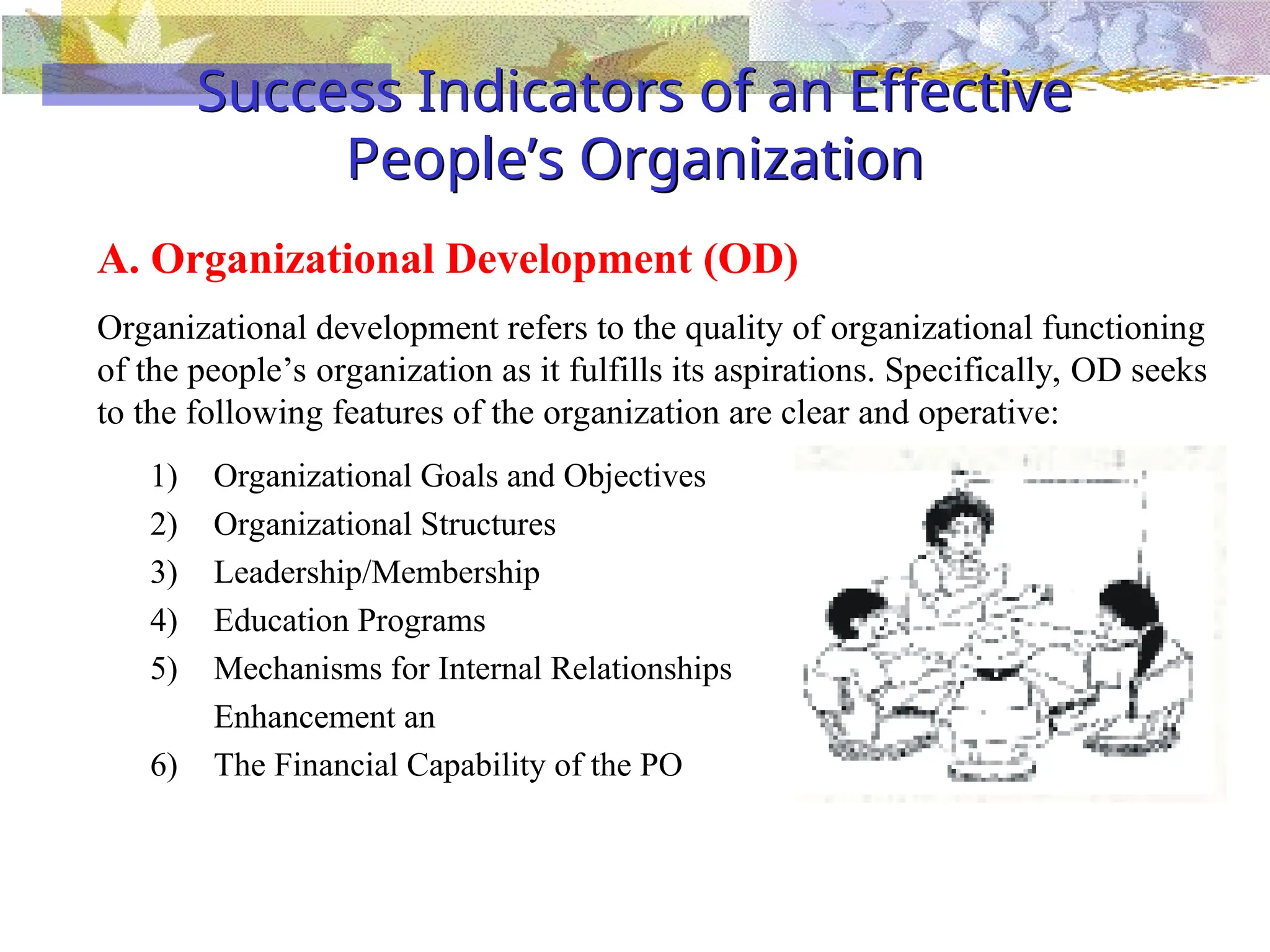
1) Organizational Goals and Objectives
2) Organizational Structures
3) Leadership/Membership
4) Education Programs
5) Mechanisms for Internal Relationships
Enhancement an
6) The Financial Capability of the PO
A. Organizational Development (OD)
Organizational development refers to the quality of organizational functioning
of the people’s organization as it fulfills its aspirations. Specifically, OD seeks
to the following features of the organization are clear and operative:
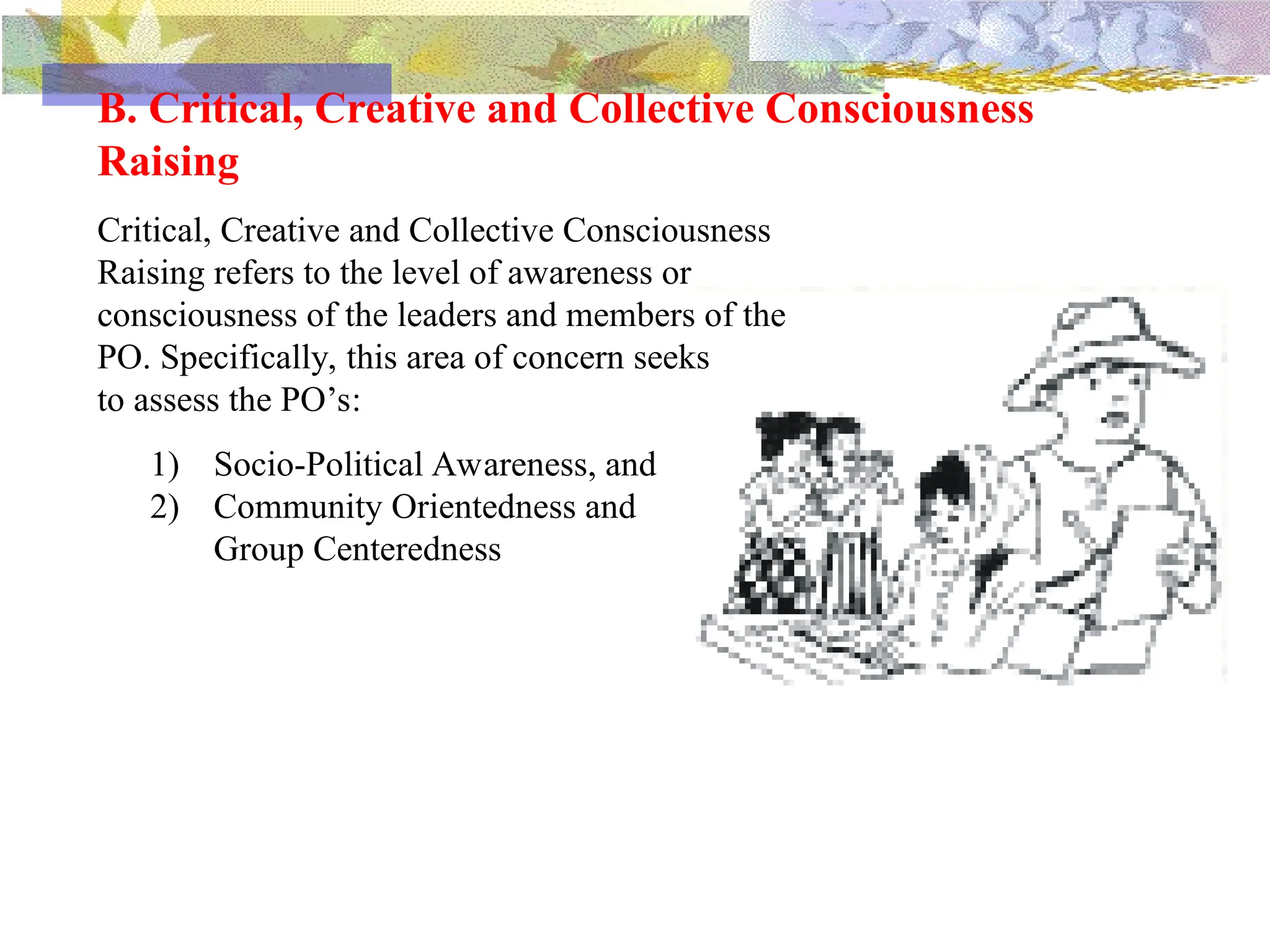
B. Critical, Creative and Collective Consciousness
Raising
Critical, Creative and Collective Consciousness
Raising refers to the level of awareness or
consciousness of the leaders and members of the
PO. Specifically, this area of concern seeks
to assess the PO’s:
1) Socio-Political Awareness, and
2) Community Orientedness and
Group Centeredness
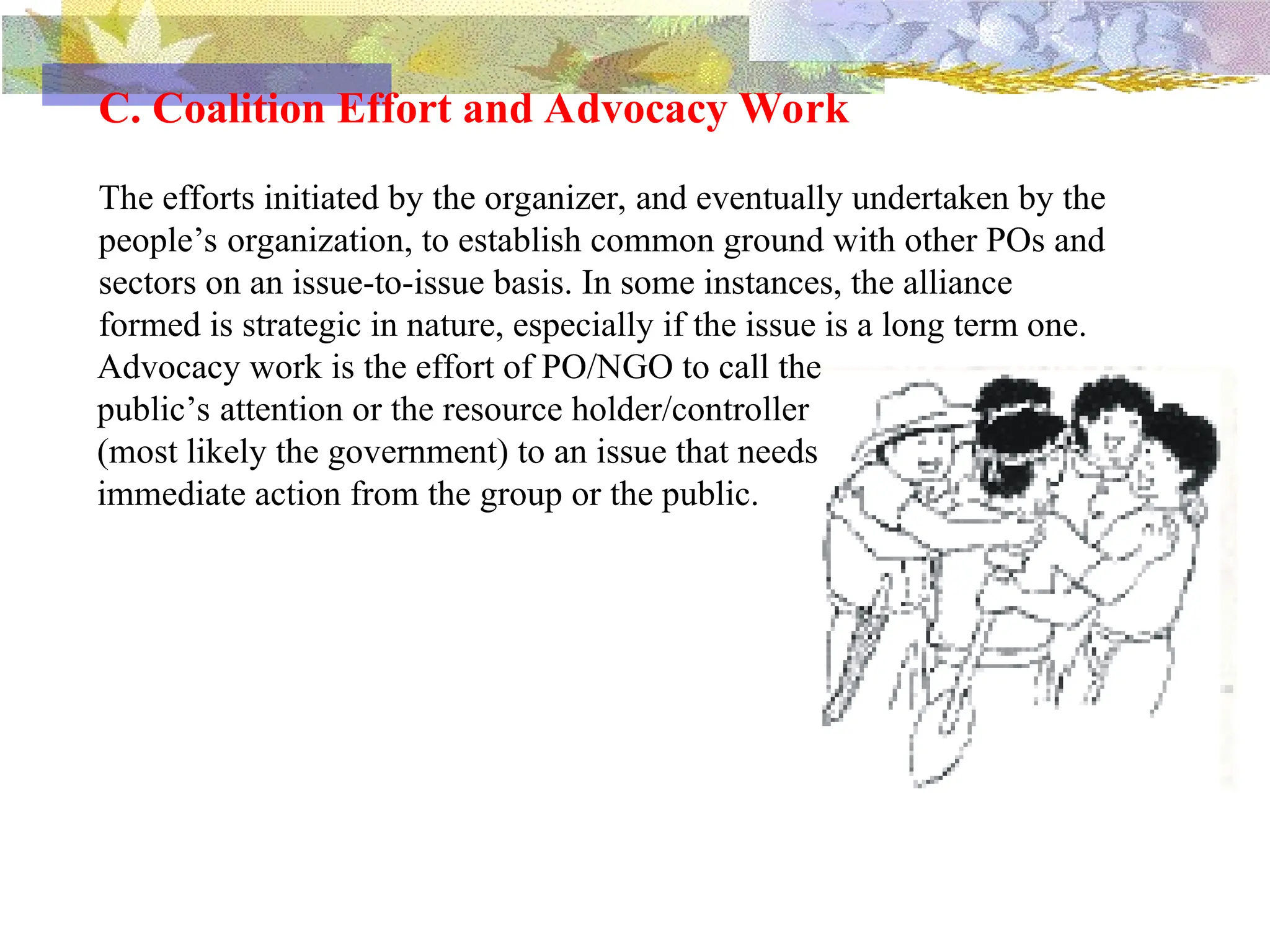
C. Coalition Effort and Advocacy Work
The efforts initiated by the organizer, and eventually undertaken by the
people’s organization, to establish common ground with other POs and
sectors on an issue-to-issue basis. In some instances, the alliance
formed is strategic in nature, especially if the issue is a long term one.
Advocacy work is the effort of PO/NGO to call the
public’s attention or the resource holder/controller
(most likely the government) to an issue that needs
immediate action from the group or the public.
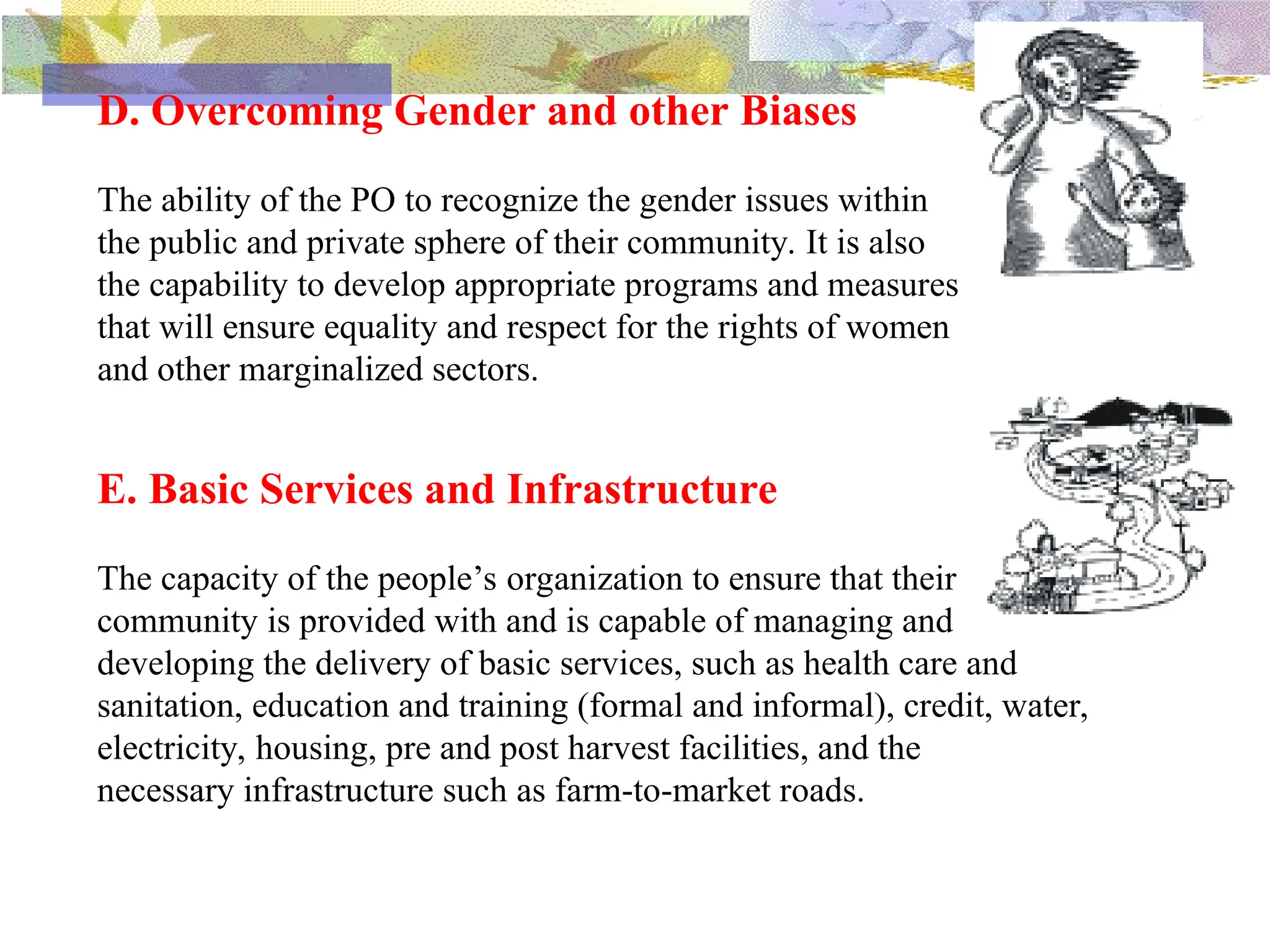
D. Overcoming Gender and other Biases
The ability of the PO to recognize the gender issues within
the public and private sphere of their community. It is also
the capability to develop appropriate programs and measures
that will ensure equality and respect for the rights of women
and other marginalized sectors.
E. Basic Services and Infrastructure
The capacity of the people’s organization to ensure that their
community is provided with and is capable of managing and
developing the delivery of basic services, such as health care and
sanitation, education and training (formal and informal), credit, water,
electricity, housing, pre and post harvest facilities, and the
necessary infrastructure such as farm-to-market roads.
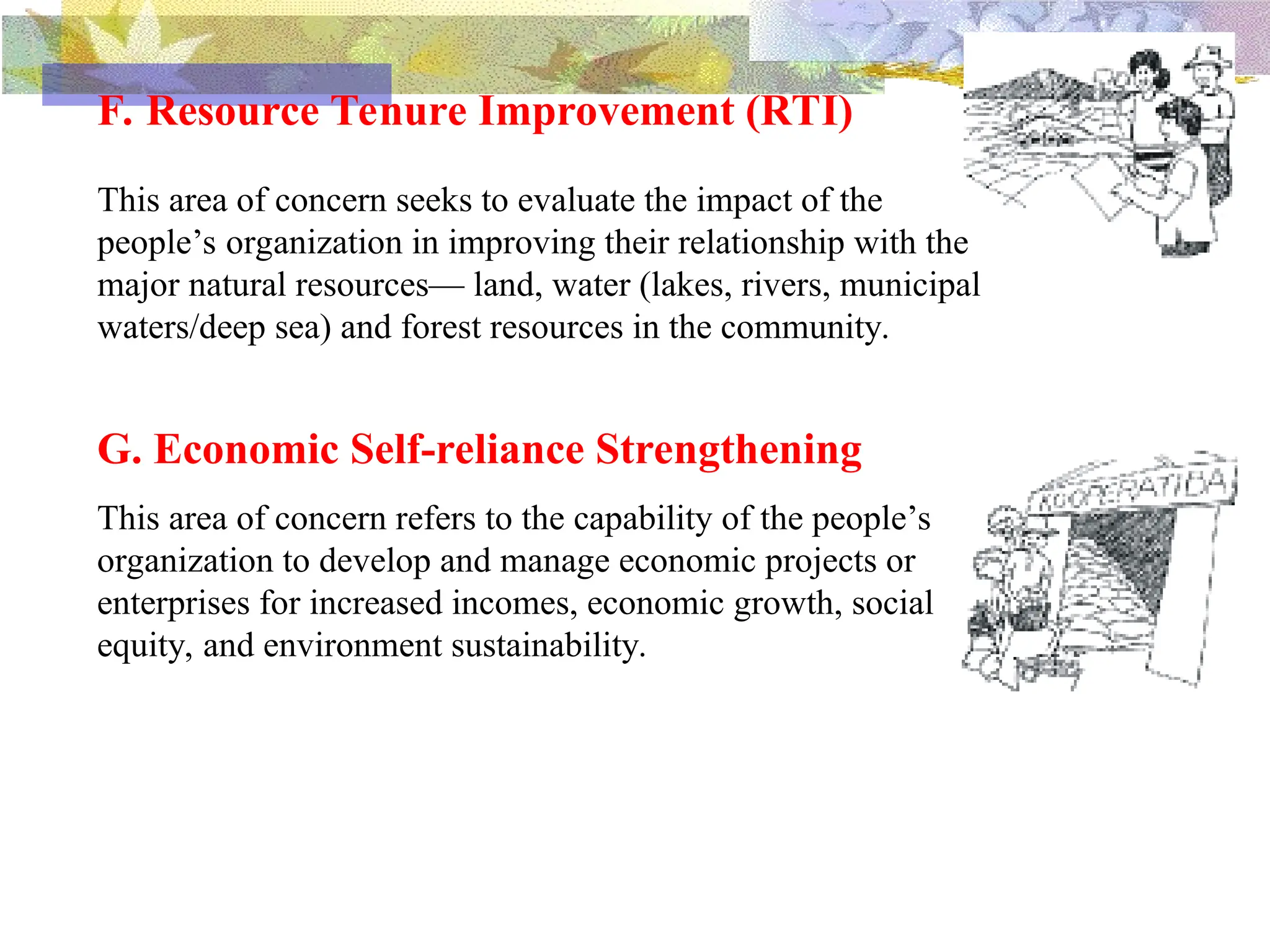
F. Resource Tenure Improvement (RTI)
This area of concern seeks to evaluate the impact of the
people’s organization in improving their relationship with the
major natural resources— land, water (lakes, rivers, municipal
waters/deep sea) and forest resources in the community.
G. Economic Self-reliance Strengthening
This area of concern refers to the capability of the people’s
organization to develop and manage economic projects or
enterprises for increased incomes, economic growth, social
equity, and environment sustainability.
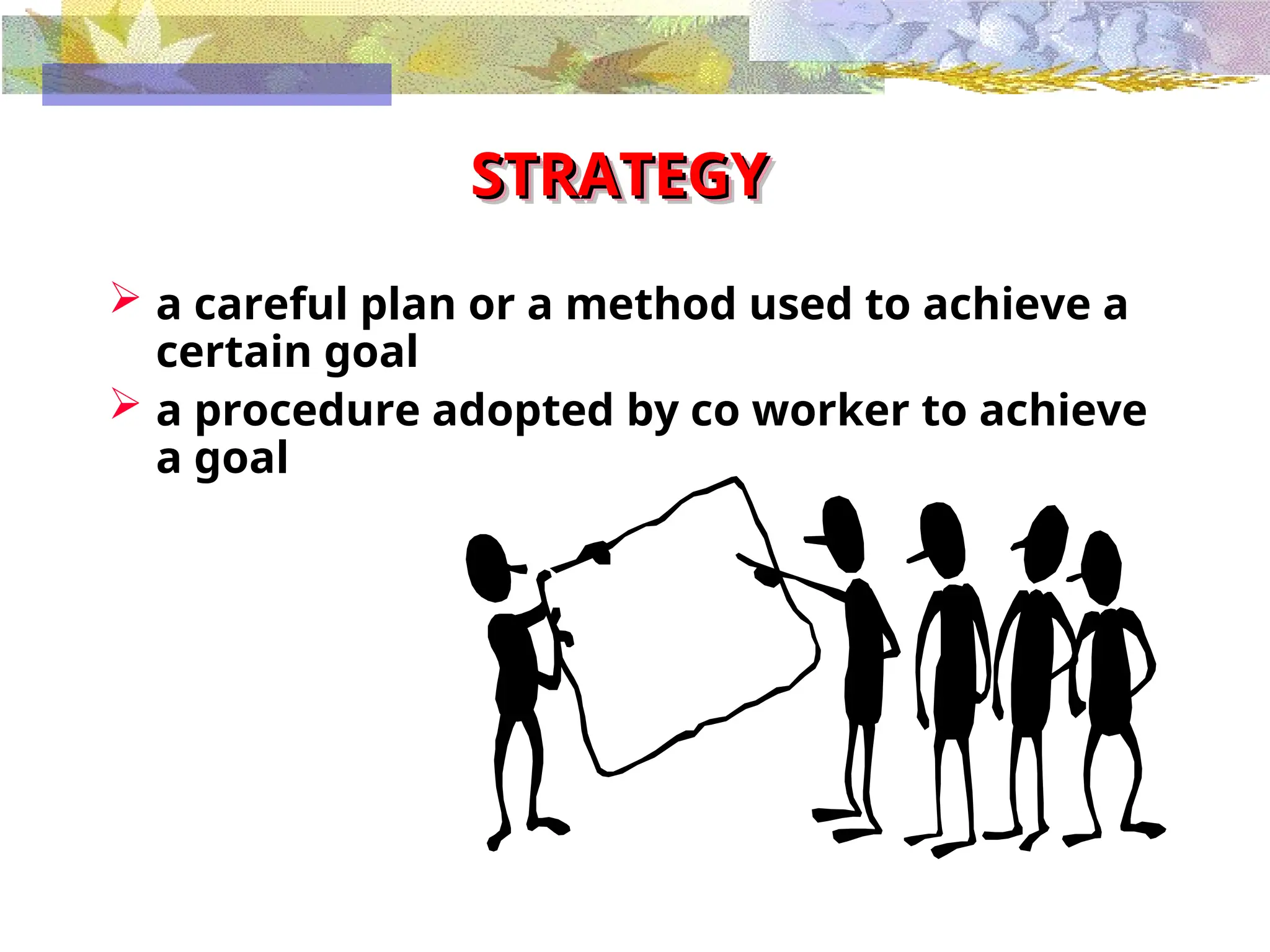
STRATEGY
STRATEGY
 a careful plan or a method used to achieve a
certain goal
 a procedure adopted by co worker to achieve
a goal
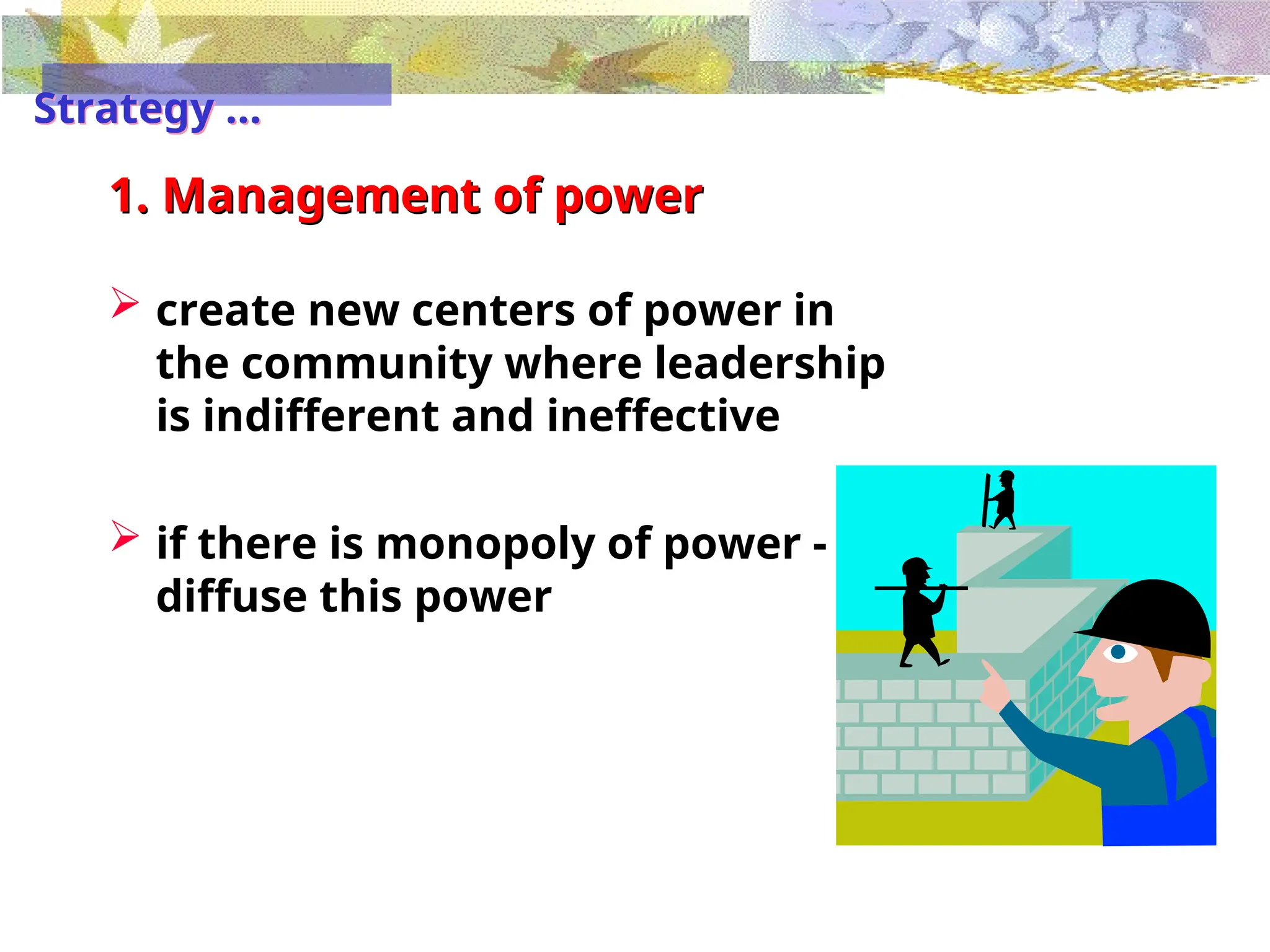
1. Management of power
 create new centers of power in
the community where leadership
is indifferent and ineffective
 if there is monopoly of power -
diffuse this power
Strategy …
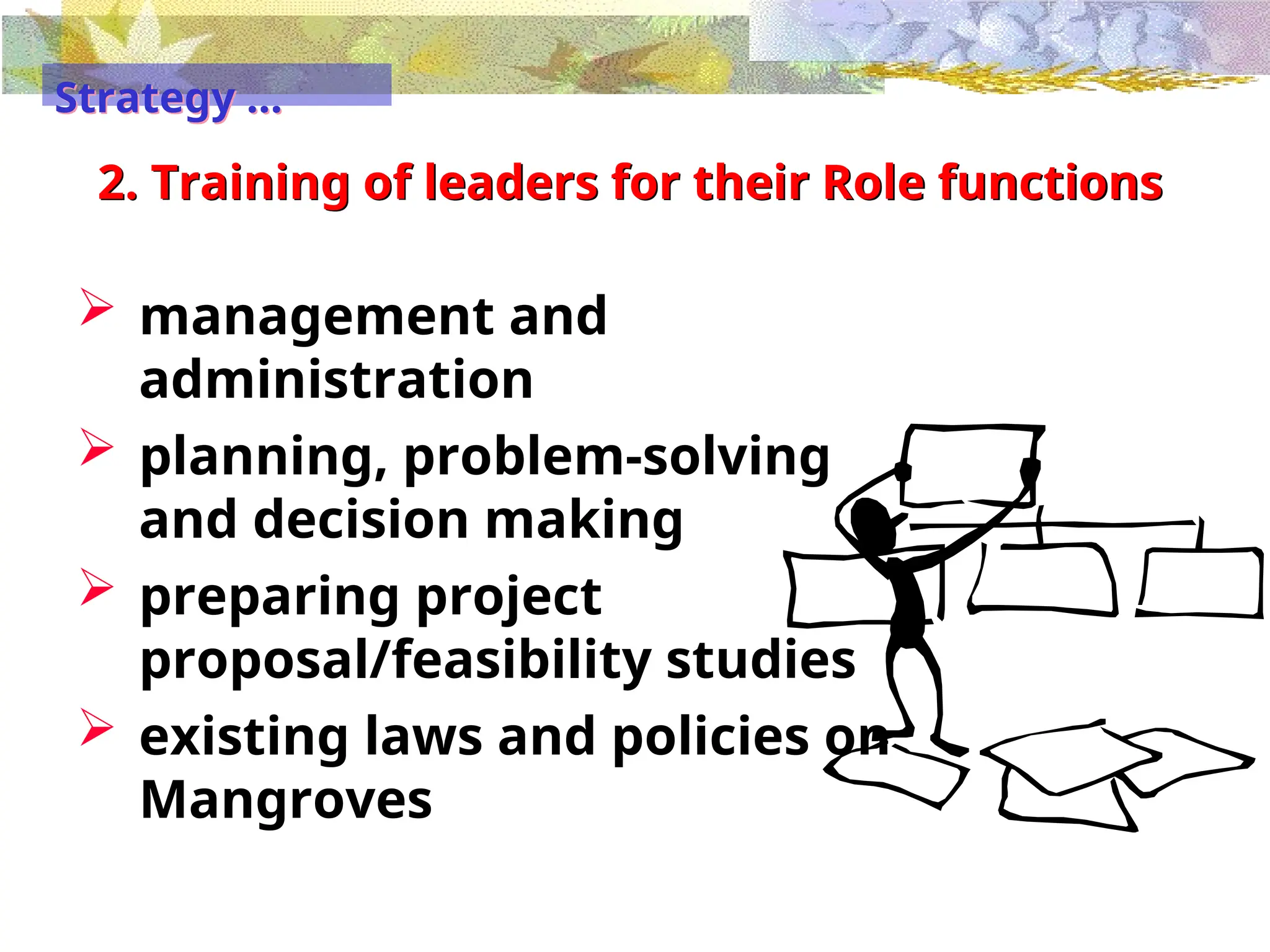
2. Training of leaders for their Role functions
 management and
administration
 planning, problem-solving
and decision making
 preparing project
proposal/feasibility studies
 existing laws and policies on
Mangroves
Strategy …
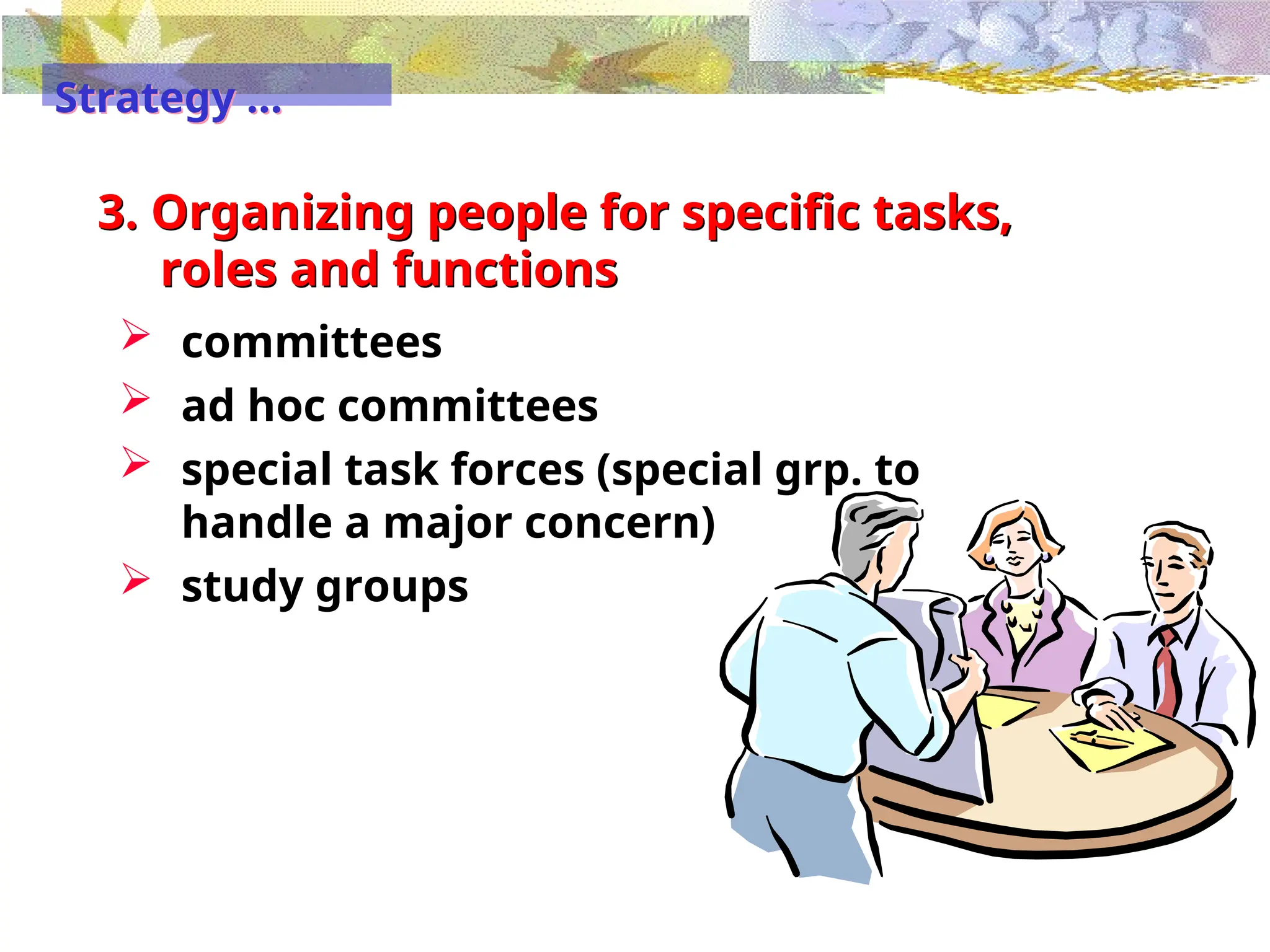
3. Organizing people for specific tasks,
roles and functions
 committees
 ad hoc committees
 special task forces (special grp. to
handle a major concern)
 study groups
Strategy …
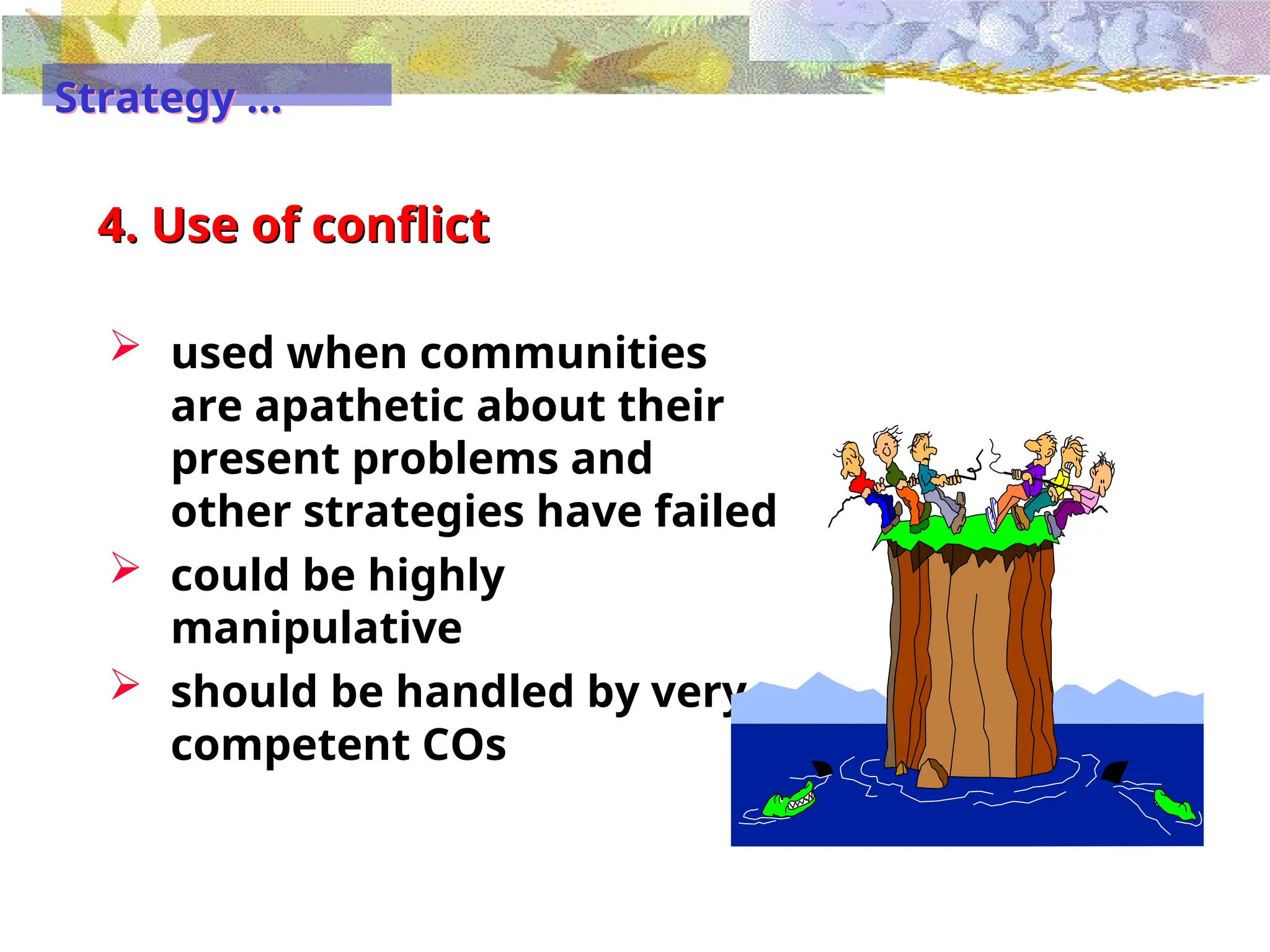
4. Use of conflict
 used when communities
are apathetic about their
present problems and
other strategies have failed
 could be highly
manipulative
 should be handled by very
competent COs
Strategy …
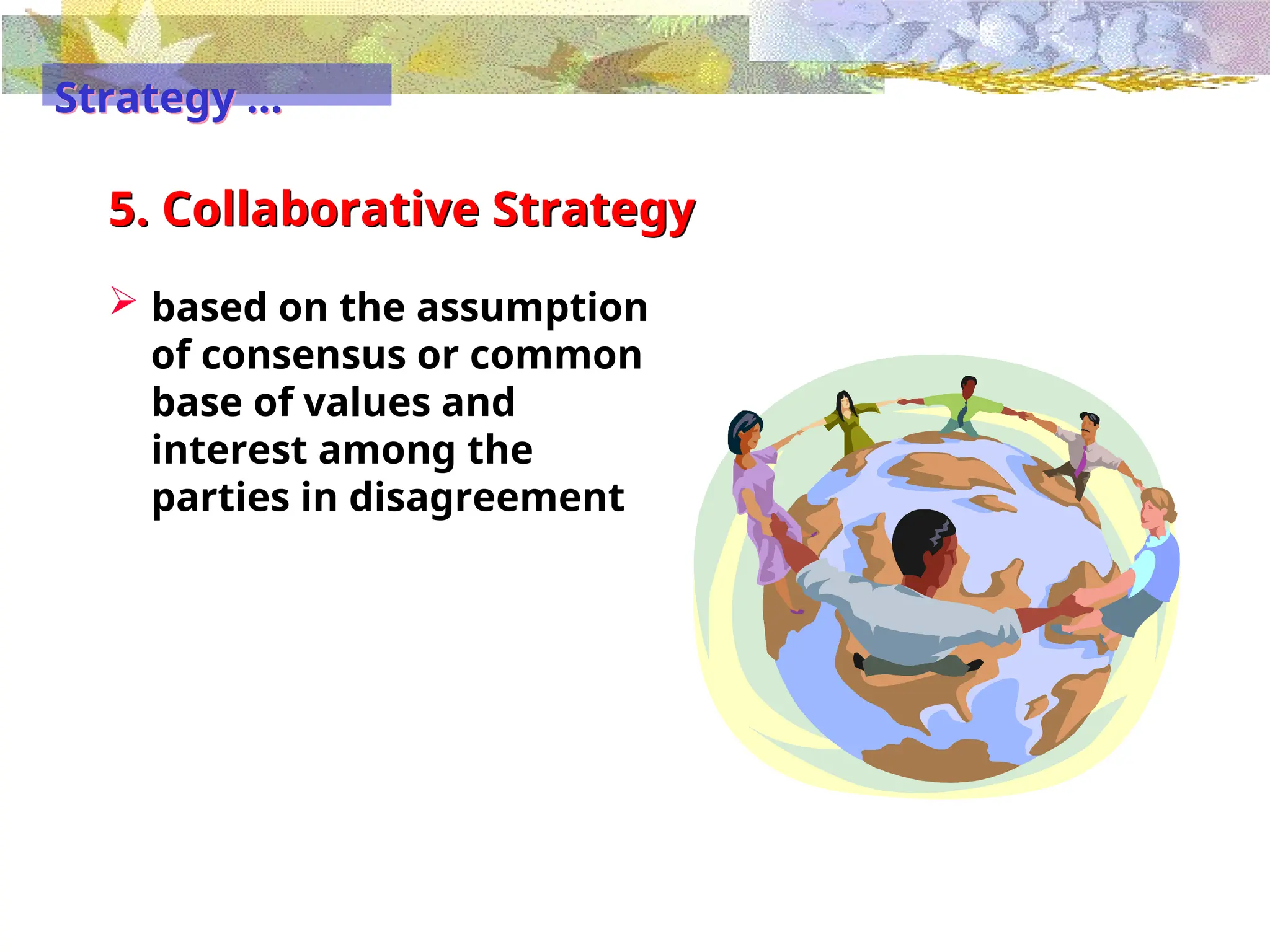
5. Collaborative Strategy
 based on the assumption
of consensus or common
base of values and
interest among the
parties in disagreement
Strategy …
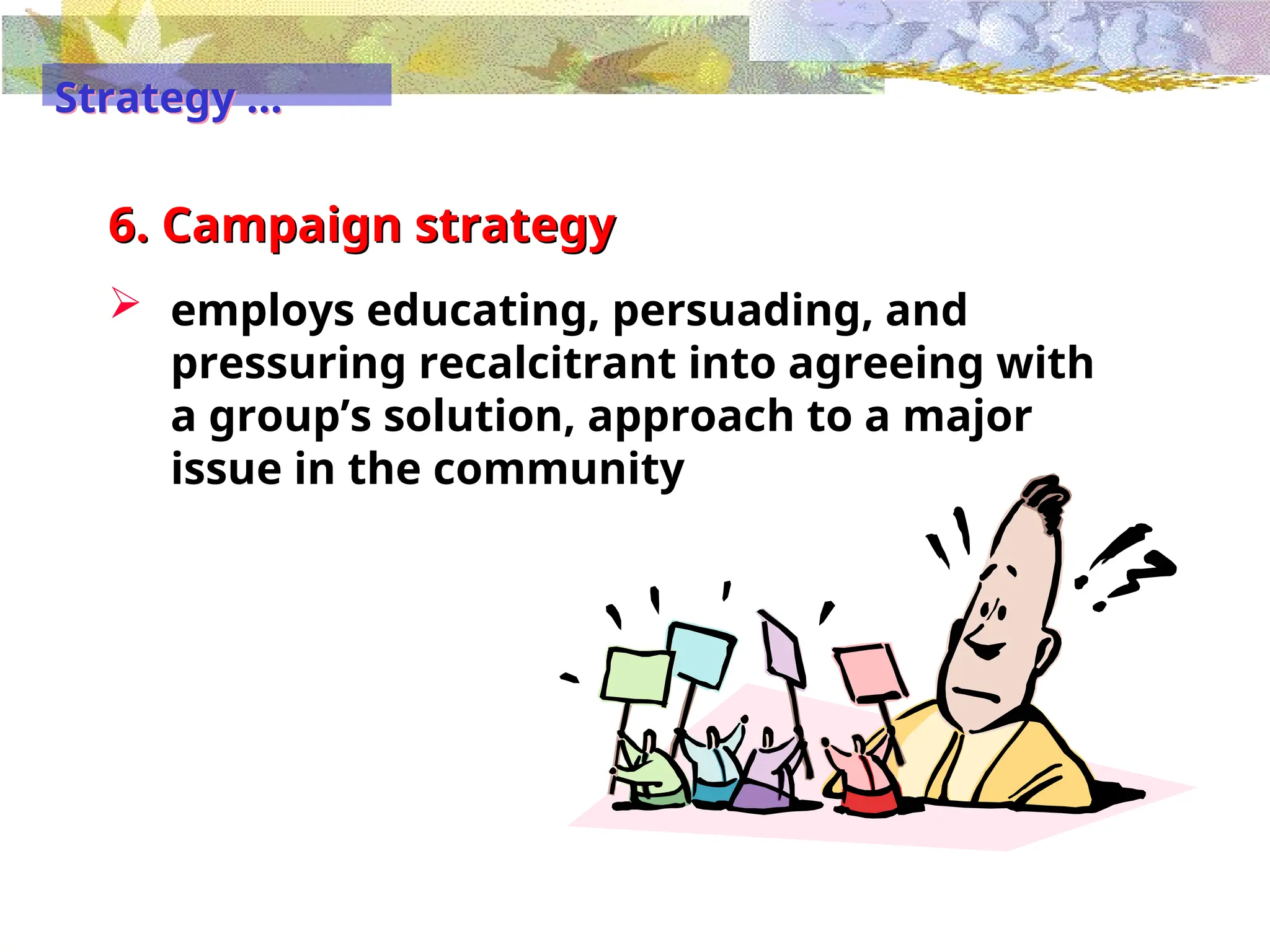
6. Campaign strategy
 employs educating, persuading, and
pressuring recalcitrant into agreeing with
a group’s solution, approach to a major
issue in the community
Strategy …
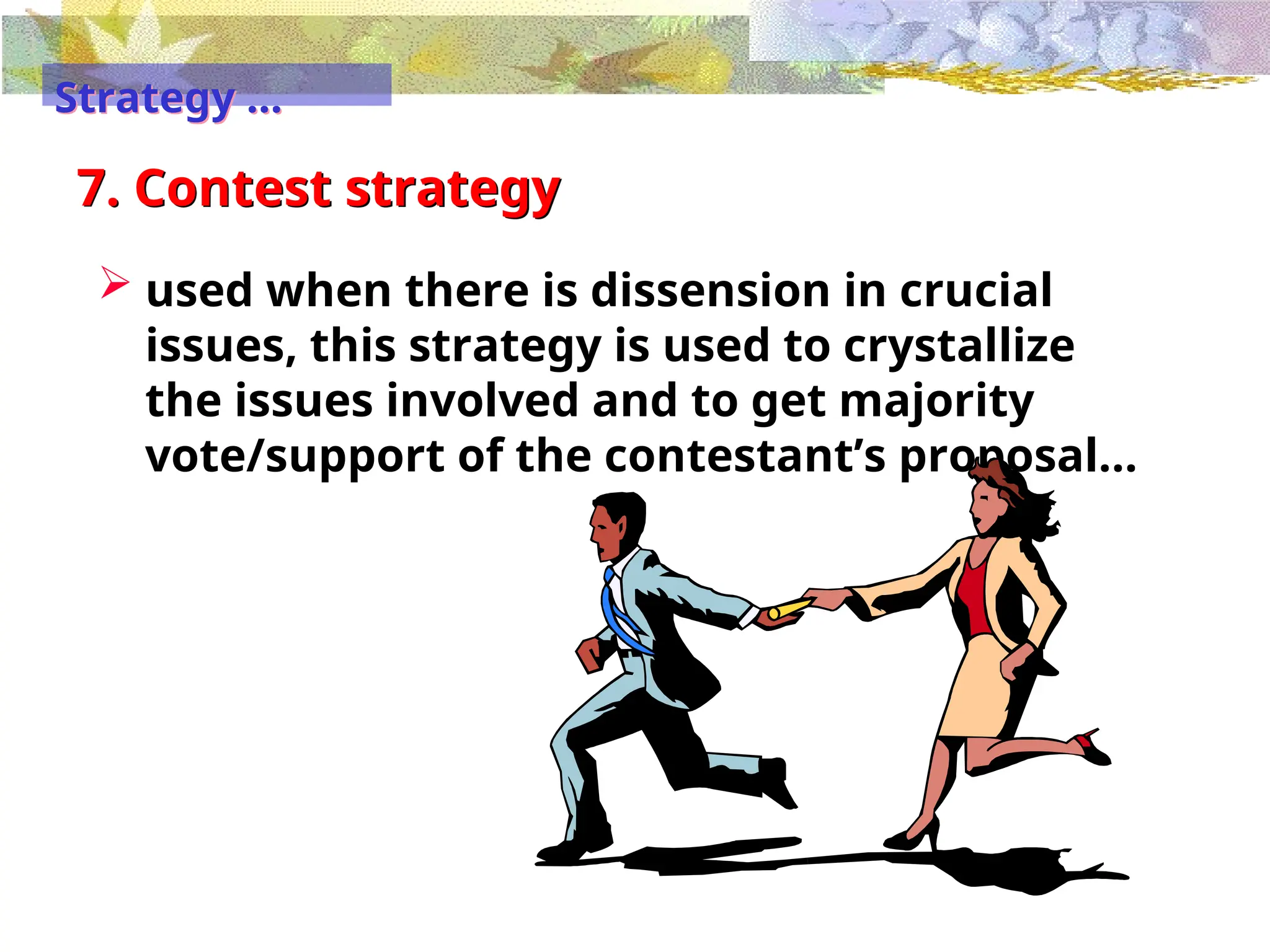
7. Contest strategy
 used when there is dissension in crucial
issues, this strategy is used to crystallize
the issues involved and to get majority
vote/support of the contestant’s proposal...
Strategy …
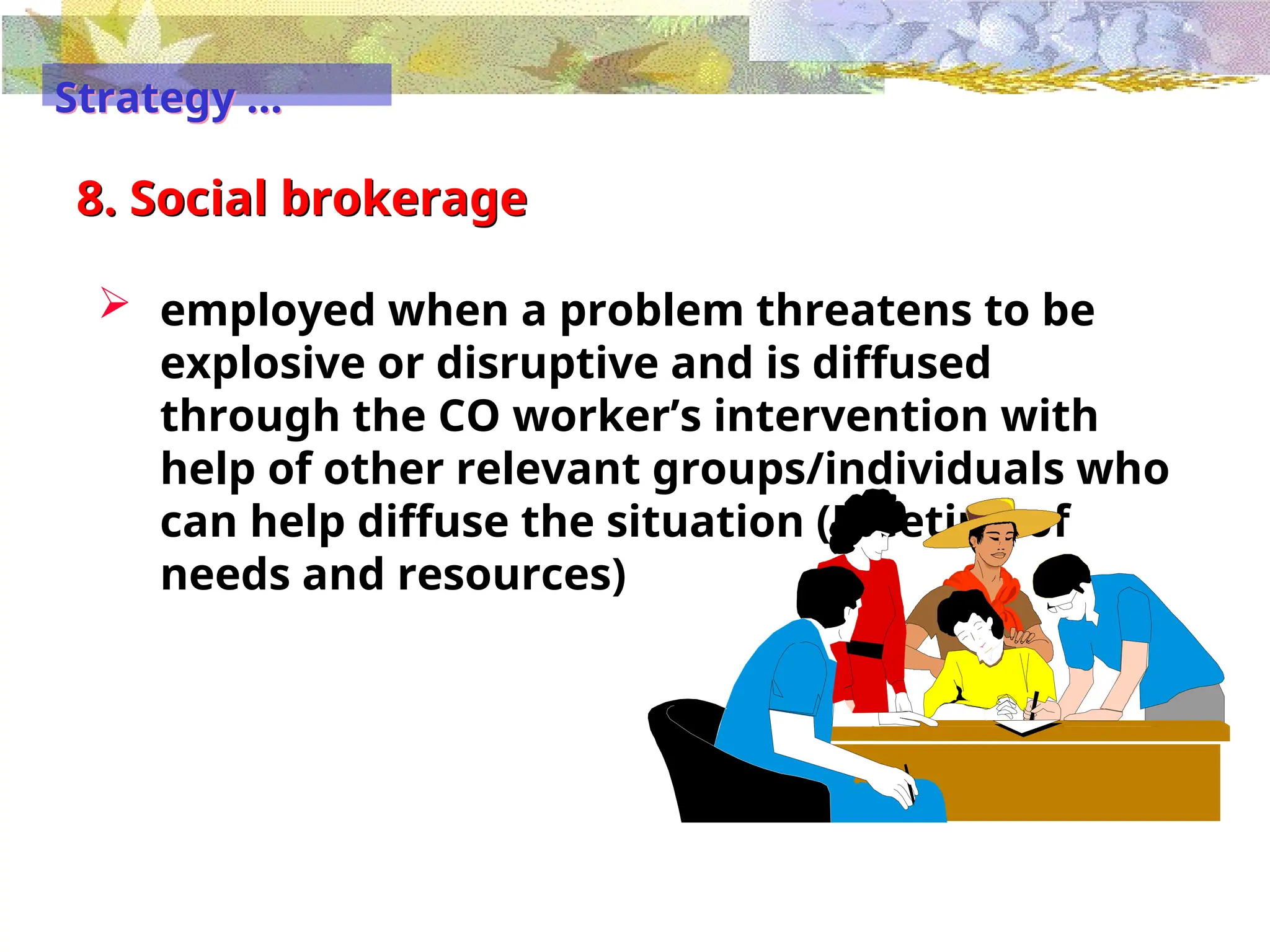
8. Social brokerage
 employed when a problem threatens to be
explosive or disruptive and is diffused
through the CO worker’s intervention with
help of other relevant groups/individuals who
can help diffuse the situation (Meeting of
needs and resources)
Strategy …
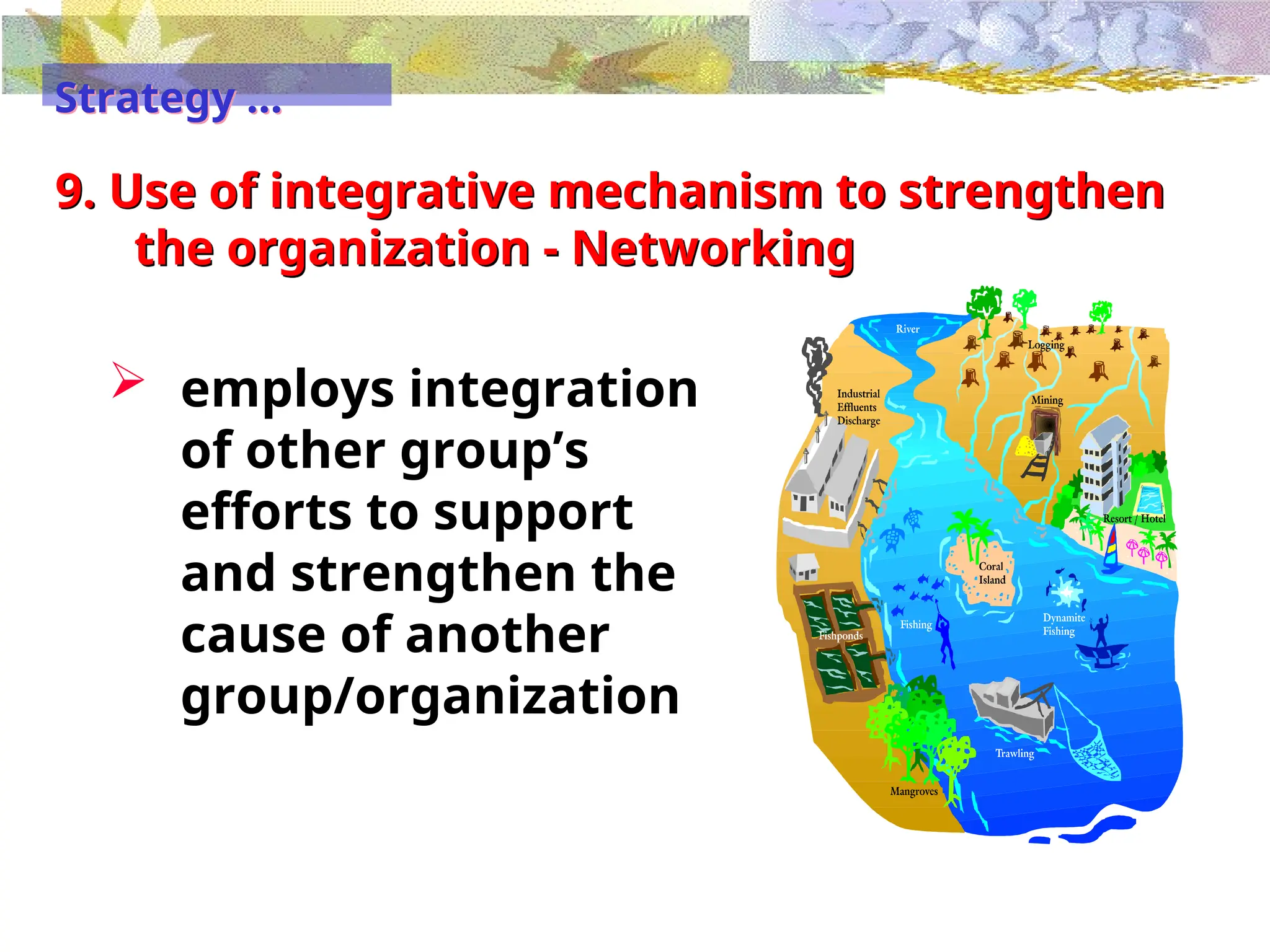
9. Use of integrative mechanism to strengthen
the organization - Networking
 employs integration
of other group’s
efforts to support
and strengthen the
cause of another
group/organization
Strategy …
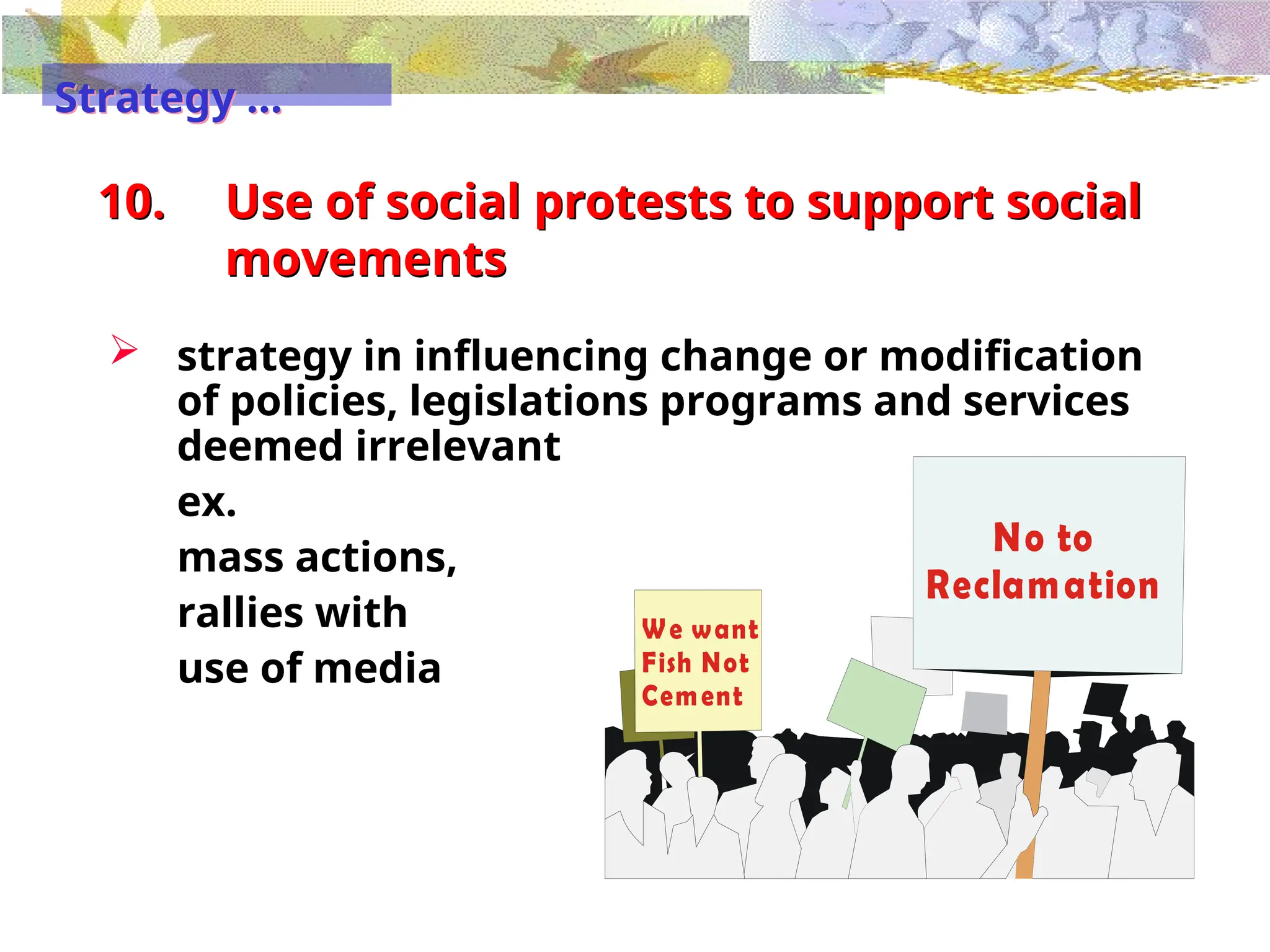
No to
Reclamation
We want
Fish Not
Cement
10. Use of social protests to support social
movements
 strategy in influencing change or modification
of policies, legislations programs and services
deemed irrelevant
ex.
mass actions,
rallies with
use of media
Strategy …
11. Lobbying
 interest groups attend
committee meetings of
the legislative bodies to
show support or to
protest against the
passage of certain
bills/ordinances
Strategy …
12. Use of field trips/
study tour/ “lakbay
aral”
 employed by COs to fast-
track learning designed
for indigenous leaders’
training for com. dev’t
and leadership roles.
Strategy …
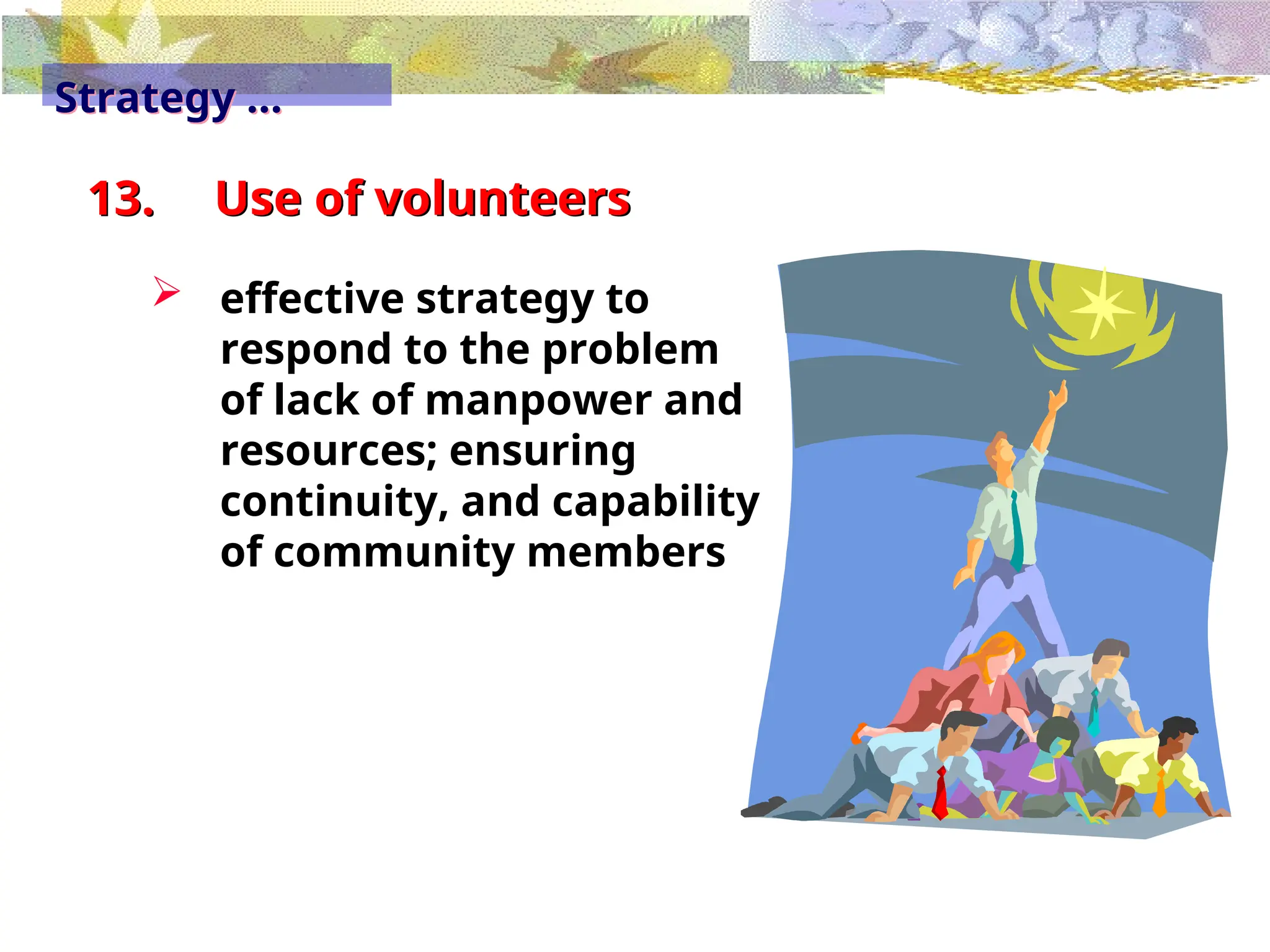
13. Use of volunteers
 effective strategy to
respond to the problem
of lack of manpower and
resources; ensuring
continuity, and capability
of community members
Strategy …
TECHNIQUES
TECHNIQUES
 manner by which certain activities are executed
based on the technical or mechanical aspects.
1. Structuring
 employ use of suitable
structure to engage in
problem solving such as
councils, committees, task
force, ad hoc committee, etc.
2. Situation Analysis
 involves breaking up of a problem situation,
or collection of data examination and setting
of the various aspects to gain insight into the
situation
3. Problem Analysis
 process of looking into the causes of
the problem and their effects on
those affected by it.
Techniques...
4. Role playing and Socio-drama
 Role playing - acting out a
situation which would depict a
problem and their effects
designed to change attitude
and thinking of target audience.
 Socio drama - a dramatic
performance with psychological
overtones that is also designed
to change the values, attitudes
habits of target audience
Techniques...
5. Education and Promotion
 employs a range of educational and
promotional ways/approaches to enhance
people’s understanding and support of
programs, projects and plans for
community improvement and
development
6. Demonstration
 uses the organization of demonstration
projects to illustrate ways of dealing with
certain social problems and economic concerns
which can be adopted for similar uses
Techniques...
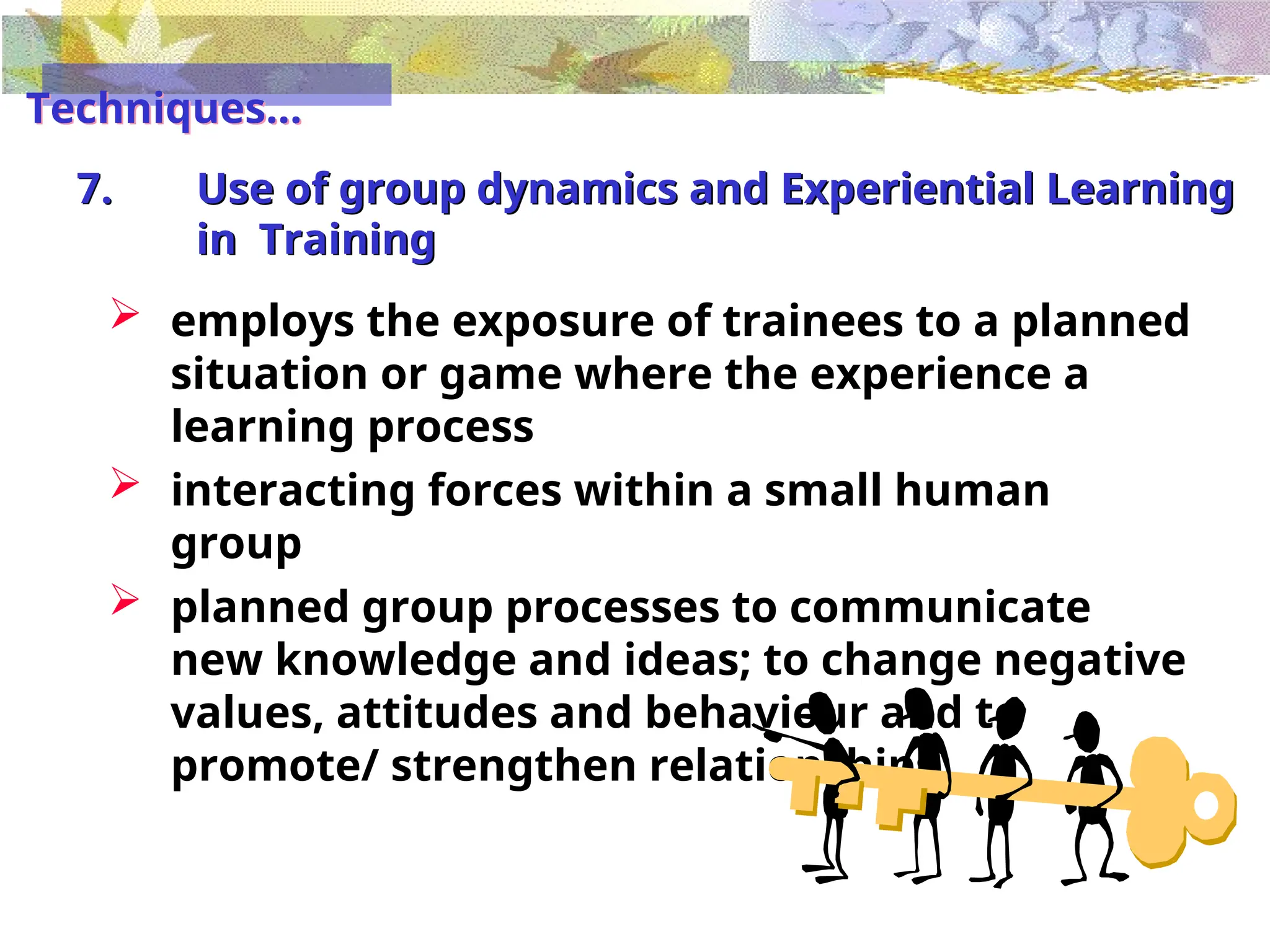
7. Use of group dynamics and Experiential Learning
in Training
 employs the exposure of trainees to a planned
situation or game where the experience a
learning process
 interacting forces within a small human
group
 planned group processes to communicate
new knowledge and ideas; to change negative
values, attitudes and behaviour and to
promote/ strengthen relationships
Techniques...
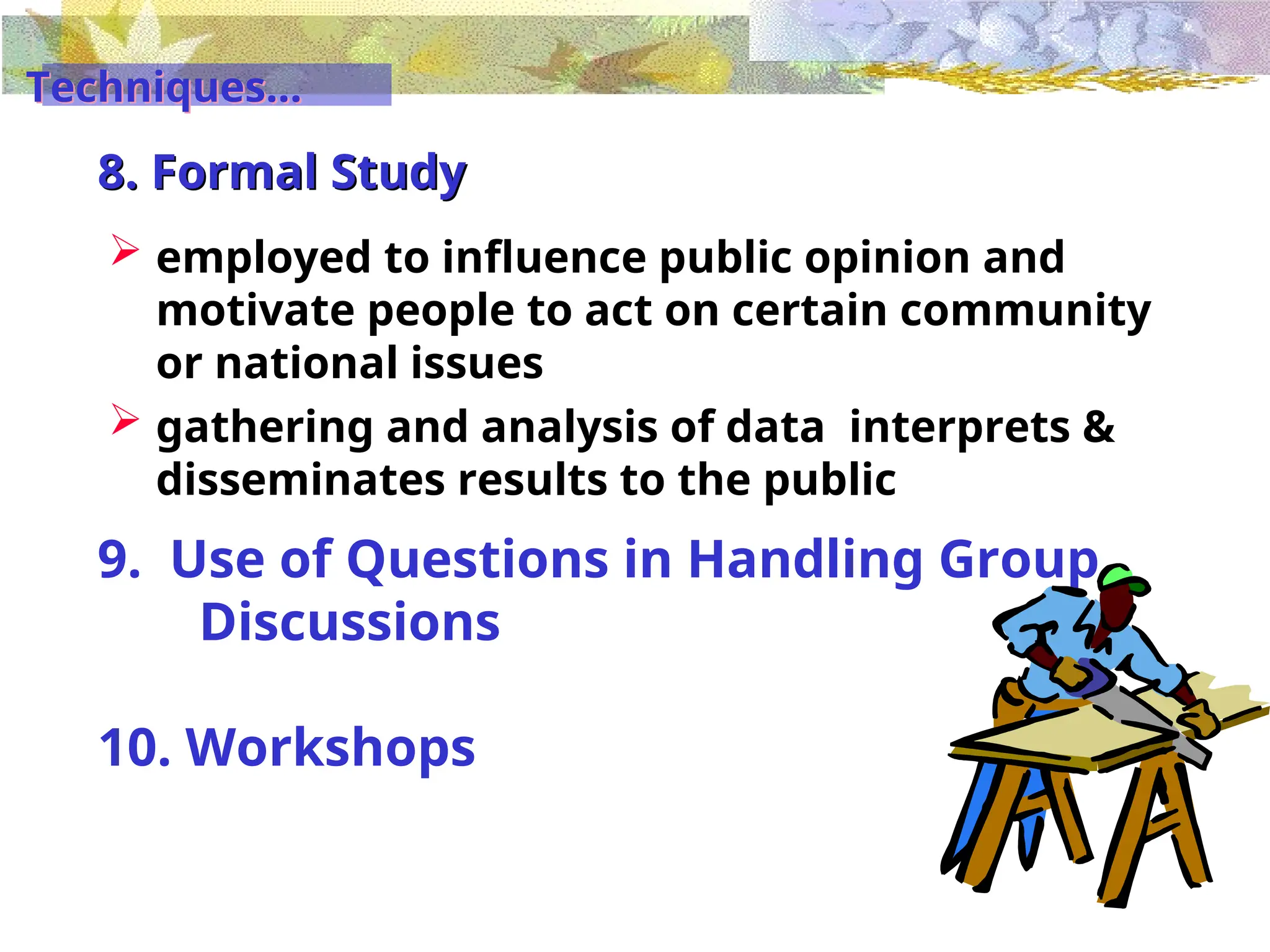
8. Formal Study
 employed to influence public opinion and
motivate people to act on certain community
or national issues
 gathering and analysis of data interprets &
disseminates results to the public
9. Use of Questions in Handling Group
Discussions
10. Workshops
Techniques...
COMMUNITY ORGANIZING FOR BSSW-Review_2 (1).ppt

COMMUNITY ORGANIZING FOR BSSW-Review_2 (1).ppt

  • 1.
    What is What is CommunityOrganization (CO)? Community Organization (CO)? CO is the process by which the community identifies its needs, problems and issues confronting them, sets objectives and develops the confidence and will to work with these problems, needs and issues, finds the resources (internal and/or external) and takes action collectively.
  • 2.
    CO definition...  Itdeals with problem-solving in response to problems and needs.  It seeks social change for the greater good.  Involves the process of social interaction.  It involves people’s participation in planning and implementation of plans.
  • 3.
  • 4.
    1. Passive participation People participate by being told what is going to happen, or has already happened. It is unilateral announcement by the administration or project management, without listening to people’s responses. The information being shared belongs only to external professionals.
  • 5.
    2. Participation ininformation giving  People participate by answering questions posed by extractive researchers using questionnaire surveys or similar approaches  People do not have the opportunity to influence proceedings, as the findings of the research are neither shared nor checked for accuracy
  • 6.
    3. Participation byconsultation  People participate by being consulted, and external agents listen to views.  External agents define both problems and solutions and may modify these in the light of people’s response  Such a consultative process does not concede any share in decision making, and professionals are under no obligation to take on board people’s views.
  • 7.
    4. Participation formaterial incentives  People participate by providing resources, for example, labor, in return for food, cash or other material incentives
  • 8.
    5. Functional Participation forming groups to meet pre-determined objectives related to project  involvement occurs not at early stages of project cycles or planning but after major decisions have been made
  • 9.
    6. Interactive participation People participate in joint analysis, which leads to action plans and the formation of new local institutions or the strengthening of existing ones  tends to involve interdisciplinary methodologies that seek multiple perspectives and make use of systematic and structured learning process  groups take control over local decisions, and so people have a stake in maintaining structures or practices
  • 10.
    7. Self-mobilization  Peopleparticipate by taking initiatives independent of external institutions to change systems  They develop contracts with external institutions for resources and technical advice they need, but retain control over how resources are used  Such self-initiative mobilization and collective action may or may not challenge existing inequitable distributions of wealth and power
  • 11.
    Aims/Goals of Aims/Goals ofCO CO CO is concerned with 3 types of goals : a. Task Goals - refer to concrete tasks to be undertaken to meet specific needs and people’s aspirations or to solve a particular problem. b. Process goals – are concerned with the process of helping people in a community or group strengthen their quality o participation , self direction, and cooperation. It prepares them for their specific roles in community builidng and development. c. Relationship goals - are focused on changing certain types of social relationships and decision-making patterns in the community by diffusing power to a wider base.
  • 12.
    Stakeholders Stakeholders  Stakeholders areindividuals, groups of men and women who are in one way or another interested, involved or affected (positively or negatively) by a particular conservation or development project. They are motivated to take action.
  • 13.
    People Empowerment People Empowerment Process of releasing the potentials of people through appropriate programs and strategies and services; removing blocks that deter their growth and development and providing opportunities for people to develop their capabilities to positively deal with their problems and stand up for their rights and take control over their lives as individuals and community.
  • 14.
    Focus of Focus of CommunityOrganizing Community Organizing 1. Removal of blocks to growth. 2. The release of potentialities of individuals, groups and communities. 3. Development of the capacities of indigenous leaders to lead in the dealing with their community problems. 4. Developing capacities of different sectors in the community to function as an integrated whole. 5. Strengthening people’s capacity for problem-solving, decision-making and cooperation. 6. The full use of inner/indigenous resources before tapping external resources.
  • 15.
    Values of Values of CommunityOrganizing Community Organizing 1. A commitment to democratic processes and goals. 2. Right of community for self - determination. 3. Belief on the capacity of people to change. 4. Belief on the innate dignity of individuals and groups in the community. 5. The commitment to seek social justice and equity.
  • 16.
    Value Assumptions ofCO • Changes in which individuals, groups and communities determine their own destiny in a democratic process have better change of enduring than changes that are imposed. • Readiness to change is a variable which affect the potential and rate of community change obtainable at a given time • Skills in participating in a democratic process can be taught and learned by individuals and groups • Society can provide ways to achieve maximum compatibility of individual and community interest. Majority’s interest and benefit should override any individual self interest . • Planning, coordination and integration of social welfare provisions and services should be pursued, since social ills are interrelated, and social welfare provisions are inter-dependent.
  • 17.
    Overview of Phasesof Community Organization Process Responding Groups Activities of Community Organizer Prepara- tory Phase Integration Phase Mobili- zation Phase Community Strengthen- ing Phase Community CO LGU NGO Monitoring and Evaluation Phase-Out Sustained Community- based Management Degraded coastal resources Low public awareness of problem Lack of community involvement Goal Information, Education, and Communication Basis for Action RM GU GO O = Coastal resource management = Local government unit = Nongovernment organization = Community organizer
  • 18.
    The Community Organizer Acommunity organizer is responsible for facilitating the CO process, who comes from within or outside the community and is often sponsored by a donor agency, NGO, civil society organization, national agency or local government unit, private sector etc. that is providing technical advise and funding at least during the initial stages of the CO process. The ultimate goal is to empower the community so they are able to deal with their community needs even without the presence of community workers. The Co worker serves as the “bridge” between the community and the external resources that could provide assistance in finding solutions to their community needs.
  • 19.
    A CO workershould have : •A clear understanding of the different theories of development •Familiarity with the concepts and processes of community organization •Social and community relationship skills e.g skill in establishing rapport, conflict management and group maintenance •Ability to work with multidisciplinary teams •A clear perspective of when to phase out and “let go” •Interviewing and documentation skill •Facilitation and communication skill •Networking and linkaging
  • 20.
    The Models ofCO 1. Community Development – Community is approached as a whole, self help projects – Activities undertaken corresponds to basic needs (water, irrigation, livelihood, feeding program, etc) – Project –oriented, inter-agency collaboration – Proponents (James Yen, Magsaysay, USAID...) 2. Social Planning – Translating social goals into programs and services – Participatory data gathering, and problem analysis – Policy formulation, program development and coordination, e.g. Barangay development planning, Municipal CRM plan, disaster risk management planning
  • 21.
    The Models ofCO 3. Social Action Model - (Alinsky Model) – Conflict Theory, radical organizing – Issue-based organizing, issue as a point of entry of organizing – Focus - a specific sector of the community who are the “oppressed” – Strategy and tactics ( protest actions, rallies, lobbying, petitions, mass protest) – Use of agitation, intimidation, use of media to get public sympathy towards and issue
  • 22.
    The Models ofCO 4. Alinsky-Freire Fusion (BCCO-CO) – Fused Alinsky’s strategy and tactics, and Paolo Freire’s conscientization process (Praxis: action- reflection-action) – Issue-based organizing, issue as a point of entry of organizing – Focus - a specific sector of the community who are the “oppressed”, sectoral organizing – Strategy and tactics ( protest actions, rallies, lobbying, petitions, mass protest) – Use of agitation, intimidation, use of media to get public sympathy towards and issue
  • 23.
    The Models ofCO 5. Ecological Model – CBCRM/FRM (Community-based Coastal/Forest Resource Management) – Environmental issue - focus of organizing 6.Community-based Health Program (CBHP) – Health as the point of entry of organizing – Ex. Establishment of “Botica sa Barangay” , capacity building of local healers, (Hilots, herbolarios, etc)
  • 24.
    Success Indicators ofan Effective People’s Organization 1) Organizational Goals and Objectives 2) Organizational Structures 3) Leadership/Membership 4) Education Programs 5) Mechanisms for Internal Relationships Enhancement an 6) The Financial Capability of the PO A. Organizational Development (OD) Organizational development refers to the quality of organizational functioning of the people’s organization as it fulfills its aspirations. Specifically, OD seeks to the following features of the organization are clear and operative:
  • 25.
    B. Critical, Creativeand Collective Consciousness Raising Critical, Creative and Collective Consciousness Raising refers to the level of awareness or consciousness of the leaders and members of the PO. Specifically, this area of concern seeks to assess the PO’s: 1) Socio-Political Awareness, and 2) Community Orientedness and Group Centeredness
  • 26.
    C. Coalition Effortand Advocacy Work The efforts initiated by the organizer, and eventually undertaken by the people’s organization, to establish common ground with other POs and sectors on an issue-to-issue basis. In some instances, the alliance formed is strategic in nature, especially if the issue is a long term one. Advocacy work is the effort of PO/NGO to call the public’s attention or the resource holder/controller (most likely the government) to an issue that needs immediate action from the group or the public.
  • 27.
    D. Overcoming Genderand other Biases The ability of the PO to recognize the gender issues within the public and private sphere of their community. It is also the capability to develop appropriate programs and measures that will ensure equality and respect for the rights of women and other marginalized sectors. E. Basic Services and Infrastructure The capacity of the people’s organization to ensure that their community is provided with and is capable of managing and developing the delivery of basic services, such as health care and sanitation, education and training (formal and informal), credit, water, electricity, housing, pre and post harvest facilities, and the necessary infrastructure such as farm-to-market roads.
  • 28.
    F. Resource TenureImprovement (RTI) This area of concern seeks to evaluate the impact of the people’s organization in improving their relationship with the major natural resources— land, water (lakes, rivers, municipal waters/deep sea) and forest resources in the community. G. Economic Self-reliance Strengthening This area of concern refers to the capability of the people’s organization to develop and manage economic projects or enterprises for increased incomes, economic growth, social equity, and environment sustainability.
  • 29.
    STRATEGY STRATEGY  a carefulplan or a method used to achieve a certain goal  a procedure adopted by co worker to achieve a goal
  • 30.
    1. Management ofpower  create new centers of power in the community where leadership is indifferent and ineffective  if there is monopoly of power - diffuse this power Strategy …
  • 31.
    2. Training ofleaders for their Role functions  management and administration  planning, problem-solving and decision making  preparing project proposal/feasibility studies  existing laws and policies on Mangroves Strategy …
  • 32.
    3. Organizing peoplefor specific tasks, roles and functions  committees  ad hoc committees  special task forces (special grp. to handle a major concern)  study groups Strategy …
  • 33.
    4. Use ofconflict  used when communities are apathetic about their present problems and other strategies have failed  could be highly manipulative  should be handled by very competent COs Strategy …
  • 34.
    5. Collaborative Strategy based on the assumption of consensus or common base of values and interest among the parties in disagreement Strategy …
  • 35.
    6. Campaign strategy employs educating, persuading, and pressuring recalcitrant into agreeing with a group’s solution, approach to a major issue in the community Strategy …
  • 36.
    7. Contest strategy used when there is dissension in crucial issues, this strategy is used to crystallize the issues involved and to get majority vote/support of the contestant’s proposal... Strategy …
  • 37.
    8. Social brokerage employed when a problem threatens to be explosive or disruptive and is diffused through the CO worker’s intervention with help of other relevant groups/individuals who can help diffuse the situation (Meeting of needs and resources) Strategy …
  • 38.
    9. Use ofintegrative mechanism to strengthen the organization - Networking  employs integration of other group’s efforts to support and strengthen the cause of another group/organization Strategy …
  • 39.
    No to Reclamation We want FishNot Cement 10. Use of social protests to support social movements  strategy in influencing change or modification of policies, legislations programs and services deemed irrelevant ex. mass actions, rallies with use of media Strategy …
  • 40.
    11. Lobbying  interestgroups attend committee meetings of the legislative bodies to show support or to protest against the passage of certain bills/ordinances Strategy …
  • 41.
    12. Use offield trips/ study tour/ “lakbay aral”  employed by COs to fast- track learning designed for indigenous leaders’ training for com. dev’t and leadership roles. Strategy …
  • 42.
    13. Use ofvolunteers  effective strategy to respond to the problem of lack of manpower and resources; ensuring continuity, and capability of community members Strategy …
  • 43.
    TECHNIQUES TECHNIQUES  manner bywhich certain activities are executed based on the technical or mechanical aspects. 1. Structuring  employ use of suitable structure to engage in problem solving such as councils, committees, task force, ad hoc committee, etc.
  • 44.
    2. Situation Analysis involves breaking up of a problem situation, or collection of data examination and setting of the various aspects to gain insight into the situation 3. Problem Analysis  process of looking into the causes of the problem and their effects on those affected by it. Techniques...
  • 45.
    4. Role playingand Socio-drama  Role playing - acting out a situation which would depict a problem and their effects designed to change attitude and thinking of target audience.  Socio drama - a dramatic performance with psychological overtones that is also designed to change the values, attitudes habits of target audience Techniques...
  • 46.
    5. Education andPromotion  employs a range of educational and promotional ways/approaches to enhance people’s understanding and support of programs, projects and plans for community improvement and development 6. Demonstration  uses the organization of demonstration projects to illustrate ways of dealing with certain social problems and economic concerns which can be adopted for similar uses Techniques...
  • 47.
    7. Use ofgroup dynamics and Experiential Learning in Training  employs the exposure of trainees to a planned situation or game where the experience a learning process  interacting forces within a small human group  planned group processes to communicate new knowledge and ideas; to change negative values, attitudes and behaviour and to promote/ strengthen relationships Techniques...
  • 48.
    8. Formal Study employed to influence public opinion and motivate people to act on certain community or national issues  gathering and analysis of data interprets & disseminates results to the public 9. Use of Questions in Handling Group Discussions 10. Workshops Techniques...

Editor's Notes

  • #24 This leads to the primary difference between leadership and management. Managers make sure your are making progress in the direction you are headed. Leaders provide the direction. Story about a group of managers working threir way threough the jungle. They are very effieciently and enthusiastically making a trail through the dense jungel with machetes. When asked if they are going in the right direction, the manager in charge responds, “I don’t know, but we’re sure making great progress!