Statewide Data Interoperability
For Improving Population Health
Wu Xu, PhD
State Health IT Coordinator
Director, Center for Health Data
& Informatics
Utah Department of Health
May 23, 2016
Iona Thraen, PhD
UT State Innovation Model Grant
Director, Office of Health Systems
Collaboration
States as Laboratories
For Nationwide Clinical and Public
Health Data Interoperability
2
Discovering Laboratories’ Commonality
Participants from states and large cities/counties share their
interoperability visions, priorities and strategies at the Public
Health Informatics for Leaders Forum
Sponsored by Public Health Informatics Institute, April 26, 2016, Atlanta, GA
3
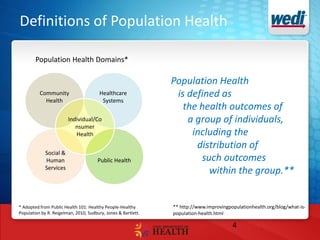
Definitions of Population Health
Population Health Domains*
* Adopted from Public Health 101: Healthy People-Healthy
Population by R. Reigelman, 2010, Sudbury, Jones & Bartlett.
** http://www.improvingpopulationhealth.org/blog/what-is-
population-health.html
Population Health
is defined as
the health outcomes of
a group of individuals,
including the
distribution of
such outcomes
within the group.**
Social &
Human
Services
Public Health
Community
Health
Healthcare
Systems
Individual/Co
nsumer
Health
4
http://www.phi.org/news-events/806/85-of-hospitals-committed-to-population-health-says-ahaphi-national-survey
5
Key Outcome of Population Health
Utah Department of Health’s Definition of Population Health:
UDOH integrates its practice with health systems and payers to
fully address determinants and outcomes of health in the Utah
population and its sub-populations.
6
Public HealthHealth Care
Innovative
Clinical
Prevention
Traditional
Clinical
Prevention
Increase the
use of
evidence-based
services
Provide services
outside the
clinical setting
Total Population or
Community-Wide
Prevention
Implement
interventions that
reach whole
populations
1 2 3
The 3 Buckets of Prevention
• Article by John Auerbach, 2016, available on the Journal of Public Health Management and Practice’s website – www.JPHMP.com
Shared Space: Innovative Clinical Prevention
7
Population Health Business Cases with ROI in 5yrs
Promote adoption of evidence-based interventions in
collaboration with health care purchasers, payers, and providers
8
Informatics Support to the 6|18
Use Case Informatics Support in Utah
Reduce Tobacco Use  HIE facilitates “quit-line” referrals
Control High Blood
Pressure
 APCD estimates of risk populations and cost
 Population data collection from HIE, systems
Control Asthma
 APCD risk and cost analysis
 BRFSS, Inpatient, ED, clinical asthma patient
distribution
 Outcome evaluation
Control and Prevent
Diabetes
 Local data to supporting health and cost
evidence and monitor progress
 APCD patient risk and cost analysis
9
Data Interoperability
for Population Health
=
Information Exchanges & Analysis
across EHR, HIE & Public Health
Utah’s Information Exchange Strategies
• Develop a Shared Vision
• Develop a Shared Statewide Health IT Plan
• Develop Governance for The Shared Identification
Services for Utahns (ThSisU)
• Leverage State-Designated Health Information Exchange
(HIE)
• Leverage Public Health Meaningful Use Reporting
• Pilot Other “Meaningful” Public Health Information
Services
• Clinical Data Needs for Population Health Collaborative:
Clinical measures and Advanced Analytics
11
Utah Statewide Shared Vision, 2015 -
12
Alignment Federal and State Health IT Goals
• Federal ONC Goals:
 Advance Person-Centered
and Self-Managed Health
 Transform Health Care
Delivery and Community
Health
 Foster Research, Scientific
Knowledge, and Innovation
 Enhance Nation’s Health IT
Infrastructure
https://www.healthit.gov/sites/default/files/9
-5-federalhealthitstratplanfinal_0.pdf
• Utah HIT Goals (Draft):
 Advance the Health and Well-
being of Individuals and
Communities through Person-
centered & Self-managed
Health
 Strengthen Health Care
Delivery Transformation
 Enhance Utah's Interoperable
Health It Infrastructure
 Support Research, Innovation,
and Implementation Science
13
Need for Statewide Master Person Index
14
ThSisU: Governance
15
ThSisU: Building Blocks and Initial Use Cases
Patient Identity Service
• Identity proofing
• Link digital identity to patient records
• Match digital identities across organizations
Risk
Indemnification
ThSisU Identity-related Building Blocks to
support appropriate data movement
Selected Care Coordination
Use Cases
Trust framework
Pooled-shared
knowledge
Business case and
financial benefit
Provider Electronic Receiving
Specifics
• Provider digital identity repository
• Provider identity proofing
Care Team
• Message interfaces
• Care team imputation algorithms tested
• Encounter records from member
organizations
Patient Proxy Relationship
Management
• Proxy relationship verification and policy
Case Information Delivery
Newborn data Bundle
• Electronic birth certificate
• Screening orders, tracking
results
• Pediatrician identification and
follow-up
End of Life Care
• Electronic POLST
• Advance Directives
• Emergency Medical Services
Poison Control
• Case coordination with
Emergency Physicians
16
Meaningful Use (MU) and Health
Information Exchange (HIE)
are Transforming
Silo Pubic Health Systems’ Data
Communication and Analytics
Silo Public Health Information Systems
• UDOH has
 about 1,000 employees
 more than 100 stand along information systems.
 A hospital may report data in about 30 different ways to UDOH
 A program may use 10 different methods to exchange data with
external entities
• Root causes
 Historically categorical funding streams and restrictions
 Decentralized business and IT management structures
 Legacy systems and aging workforce
 Lack of federal-state strategic collaboration and adequate
funding
18
Transformation by MU and HIE
• Public Health Meaningful Use Reporting
 Immunization Records (bi-directional)
 Electronic Laboratory Reporting
 Syndromic Surveillance Reporting
 Cancer Registry
• Public Health Uses the Statewide HIE
 Meaningful Use Reproting
 Newborn Hearing Screening Results & Diagnostics Reports
Exchange
 Emergence Medical Services
 Poisoning Control Data exchange through cHIE
19
MU Challenges: EHR-IIS complexities
USIIS 20
MU Challenges (cont.)
• MU instructions from various sources
 CMS, ONC, Medicaid, EHR vendors, UDOH, USIIS, REC, etc.
• Complexity of EHR systems and EHR-USIIS interfaces
• Multiple possible points of failure
• Understand and undertake responsibility for data quality
– In EHR system and in USIIS
– Clinic workflow and staff practices impact data quality
USIIS 21
Shared Service for Interoperability
INTERFACES:
• SFTP
• VPN
• HTTPS
• SOAP Web Service
• PHIN MS
• Secure web portal
GATEWAY and INTEGRATION
ENGINE:
• Mirth Connect
• Rhapsody
• Shared Service Platform
• HIE
“No Door is a Wrong Door” Tradition is Costly.
22
PHCP: Electronic Case Reporting
23
Direct
1g
HIE
Solution
EHR
System B
HIE
Solution
EHR
System A
My Health
1a
2i
1b
2h
Diagnostics
Test Results
Test Results
HIE Solution
DOH Gateway
Identity Resolver
Public Health
2a
2b
2c
EHDI
Test
Results
Early Hearing
Detection &
Intervention (EHDI)
Standard-based
Message Broker
(eHEX, Direct, HL7v2)
Relationship
Resolver
MessageOrchestrator
MessageRouter
Format
Converter
Identity
Resolver
Alert/
Notification
Central
Repository
2d1c
1d
1e
1f
2e
2g
2f
HIE Use Case 1: EHR sends hearing diagnostics reports to public health registry
HIE Use Case 2: EHR receives hearing test results from public health registry
24
Vital Records and EHRs
BIRTH and DEATH records are fundamental public health data
 Registration systems are electronic but silo with manual data entry
• Pilot: Quality of Birth Data Extracted from HER
 Most of the labor, delivery and newborn care information are
available
 PDF information (i.e. prenatal or out of network care) can’t
automated extracted [J. Duncan, et al. CDC 2015-Q-17144)
• EHR Death Certificate Reporting
 EHR and EDEN interoperability for physicians to timely enter the
Cause of Death via their own EHR
• Death Notification for EHR Patient Identity Validation
25
Informatics and Opioids Crisis
• Utah ranked the 4th highest for drug poisoning
deaths in the U.S.
• State Interventions:
Prescription Drug Management Program
Controlled Substance Database (CSD)
• Informatics Support
EHR - CSD connection or single login for prescribers
Education and decision-support to prescribers
Automated prescription misuse/abuse surveillance
Timely information for community intervention
26
Challenges for Analytics and Visualization
For Population Health Planning
opendata.utah.gov
Public Health Assessment App.
Websites for Consumers
27
Expanded Needs for Population Health Analytics
Domain Public Health Informatics Population Health Informatics
Data Source Public health data + clinical & other data
sources
Data Model Disease/event centric + Person, People,
community-centric
Interoperability Silo systems + Linkage and real-time
exchange are required
User Public health profession + Diverse external users
Analytics Standard public health
measures, pre-defined
conditions
+ flexible user-defined
measures and populations
28
Develop Population Health Informatics
• Develop shared vision and frameworks
Population health use case driven technical design
• Build interoperability between clinical and public health
data
Standard terminology and data models
Federated infrastructure among all partners
 Standard shared service platforms
• Flexible and shared analytics functionality for various
users
• Standard quality measures for value-based purchasing,
payment reform, and community health improvement
29
Questions?
Comments?
Suggestions?
THANK YOU!

Statewide Data Interoperability for Improving Population Health

  • 1.
    Statewide Data Interoperability ForImproving Population Health Wu Xu, PhD State Health IT Coordinator Director, Center for Health Data & Informatics Utah Department of Health May 23, 2016 Iona Thraen, PhD UT State Innovation Model Grant Director, Office of Health Systems Collaboration
  • 2.
    States as Laboratories ForNationwide Clinical and Public Health Data Interoperability 2
  • 3.
    Discovering Laboratories’ Commonality Participantsfrom states and large cities/counties share their interoperability visions, priorities and strategies at the Public Health Informatics for Leaders Forum Sponsored by Public Health Informatics Institute, April 26, 2016, Atlanta, GA 3
  • 4.
    Definitions of PopulationHealth Population Health Domains* * Adopted from Public Health 101: Healthy People-Healthy Population by R. Reigelman, 2010, Sudbury, Jones & Bartlett. ** http://www.improvingpopulationhealth.org/blog/what-is- population-health.html Population Health is defined as the health outcomes of a group of individuals, including the distribution of such outcomes within the group.** Social & Human Services Public Health Community Health Healthcare Systems Individual/Co nsumer Health 4
  • 5.
  • 6.
    Key Outcome ofPopulation Health Utah Department of Health’s Definition of Population Health: UDOH integrates its practice with health systems and payers to fully address determinants and outcomes of health in the Utah population and its sub-populations. 6
  • 7.
    Public HealthHealth Care Innovative Clinical Prevention Traditional Clinical Prevention Increasethe use of evidence-based services Provide services outside the clinical setting Total Population or Community-Wide Prevention Implement interventions that reach whole populations 1 2 3 The 3 Buckets of Prevention • Article by John Auerbach, 2016, available on the Journal of Public Health Management and Practice’s website – www.JPHMP.com Shared Space: Innovative Clinical Prevention 7
  • 8.
    Population Health BusinessCases with ROI in 5yrs Promote adoption of evidence-based interventions in collaboration with health care purchasers, payers, and providers 8
  • 9.
    Informatics Support tothe 6|18 Use Case Informatics Support in Utah Reduce Tobacco Use  HIE facilitates “quit-line” referrals Control High Blood Pressure  APCD estimates of risk populations and cost  Population data collection from HIE, systems Control Asthma  APCD risk and cost analysis  BRFSS, Inpatient, ED, clinical asthma patient distribution  Outcome evaluation Control and Prevent Diabetes  Local data to supporting health and cost evidence and monitor progress  APCD patient risk and cost analysis 9
  • 10.
    Data Interoperability for PopulationHealth = Information Exchanges & Analysis across EHR, HIE & Public Health
  • 11.
    Utah’s Information ExchangeStrategies • Develop a Shared Vision • Develop a Shared Statewide Health IT Plan • Develop Governance for The Shared Identification Services for Utahns (ThSisU) • Leverage State-Designated Health Information Exchange (HIE) • Leverage Public Health Meaningful Use Reporting • Pilot Other “Meaningful” Public Health Information Services • Clinical Data Needs for Population Health Collaborative: Clinical measures and Advanced Analytics 11
  • 12.
    Utah Statewide SharedVision, 2015 - 12
  • 13.
    Alignment Federal andState Health IT Goals • Federal ONC Goals:  Advance Person-Centered and Self-Managed Health  Transform Health Care Delivery and Community Health  Foster Research, Scientific Knowledge, and Innovation  Enhance Nation’s Health IT Infrastructure https://www.healthit.gov/sites/default/files/9 -5-federalhealthitstratplanfinal_0.pdf • Utah HIT Goals (Draft):  Advance the Health and Well- being of Individuals and Communities through Person- centered & Self-managed Health  Strengthen Health Care Delivery Transformation  Enhance Utah's Interoperable Health It Infrastructure  Support Research, Innovation, and Implementation Science 13
  • 14.
    Need for StatewideMaster Person Index 14
  • 15.
  • 16.
    ThSisU: Building Blocksand Initial Use Cases Patient Identity Service • Identity proofing • Link digital identity to patient records • Match digital identities across organizations Risk Indemnification ThSisU Identity-related Building Blocks to support appropriate data movement Selected Care Coordination Use Cases Trust framework Pooled-shared knowledge Business case and financial benefit Provider Electronic Receiving Specifics • Provider digital identity repository • Provider identity proofing Care Team • Message interfaces • Care team imputation algorithms tested • Encounter records from member organizations Patient Proxy Relationship Management • Proxy relationship verification and policy Case Information Delivery Newborn data Bundle • Electronic birth certificate • Screening orders, tracking results • Pediatrician identification and follow-up End of Life Care • Electronic POLST • Advance Directives • Emergency Medical Services Poison Control • Case coordination with Emergency Physicians 16
  • 17.
    Meaningful Use (MU)and Health Information Exchange (HIE) are Transforming Silo Pubic Health Systems’ Data Communication and Analytics
  • 18.
    Silo Public HealthInformation Systems • UDOH has  about 1,000 employees  more than 100 stand along information systems.  A hospital may report data in about 30 different ways to UDOH  A program may use 10 different methods to exchange data with external entities • Root causes  Historically categorical funding streams and restrictions  Decentralized business and IT management structures  Legacy systems and aging workforce  Lack of federal-state strategic collaboration and adequate funding 18
  • 19.
    Transformation by MUand HIE • Public Health Meaningful Use Reporting  Immunization Records (bi-directional)  Electronic Laboratory Reporting  Syndromic Surveillance Reporting  Cancer Registry • Public Health Uses the Statewide HIE  Meaningful Use Reproting  Newborn Hearing Screening Results & Diagnostics Reports Exchange  Emergence Medical Services  Poisoning Control Data exchange through cHIE 19
  • 20.
    MU Challenges: EHR-IIScomplexities USIIS 20
  • 21.
    MU Challenges (cont.) •MU instructions from various sources  CMS, ONC, Medicaid, EHR vendors, UDOH, USIIS, REC, etc. • Complexity of EHR systems and EHR-USIIS interfaces • Multiple possible points of failure • Understand and undertake responsibility for data quality – In EHR system and in USIIS – Clinic workflow and staff practices impact data quality USIIS 21
  • 22.
    Shared Service forInteroperability INTERFACES: • SFTP • VPN • HTTPS • SOAP Web Service • PHIN MS • Secure web portal GATEWAY and INTEGRATION ENGINE: • Mirth Connect • Rhapsody • Shared Service Platform • HIE “No Door is a Wrong Door” Tradition is Costly. 22
  • 23.
  • 24.
    Direct 1g HIE Solution EHR System B HIE Solution EHR System A MyHealth 1a 2i 1b 2h Diagnostics Test Results Test Results HIE Solution DOH Gateway Identity Resolver Public Health 2a 2b 2c EHDI Test Results Early Hearing Detection & Intervention (EHDI) Standard-based Message Broker (eHEX, Direct, HL7v2) Relationship Resolver MessageOrchestrator MessageRouter Format Converter Identity Resolver Alert/ Notification Central Repository 2d1c 1d 1e 1f 2e 2g 2f HIE Use Case 1: EHR sends hearing diagnostics reports to public health registry HIE Use Case 2: EHR receives hearing test results from public health registry 24
  • 25.
    Vital Records andEHRs BIRTH and DEATH records are fundamental public health data  Registration systems are electronic but silo with manual data entry • Pilot: Quality of Birth Data Extracted from HER  Most of the labor, delivery and newborn care information are available  PDF information (i.e. prenatal or out of network care) can’t automated extracted [J. Duncan, et al. CDC 2015-Q-17144) • EHR Death Certificate Reporting  EHR and EDEN interoperability for physicians to timely enter the Cause of Death via their own EHR • Death Notification for EHR Patient Identity Validation 25
  • 26.
    Informatics and OpioidsCrisis • Utah ranked the 4th highest for drug poisoning deaths in the U.S. • State Interventions: Prescription Drug Management Program Controlled Substance Database (CSD) • Informatics Support EHR - CSD connection or single login for prescribers Education and decision-support to prescribers Automated prescription misuse/abuse surveillance Timely information for community intervention 26
  • 27.
    Challenges for Analyticsand Visualization For Population Health Planning opendata.utah.gov Public Health Assessment App. Websites for Consumers 27
  • 28.
    Expanded Needs forPopulation Health Analytics Domain Public Health Informatics Population Health Informatics Data Source Public health data + clinical & other data sources Data Model Disease/event centric + Person, People, community-centric Interoperability Silo systems + Linkage and real-time exchange are required User Public health profession + Diverse external users Analytics Standard public health measures, pre-defined conditions + flexible user-defined measures and populations 28
  • 29.
    Develop Population HealthInformatics • Develop shared vision and frameworks Population health use case driven technical design • Build interoperability between clinical and public health data Standard terminology and data models Federated infrastructure among all partners  Standard shared service platforms • Flexible and shared analytics functionality for various users • Standard quality measures for value-based purchasing, payment reform, and community health improvement 29
  • 30.

Editor's Notes

  • #12 Iona’s slide #1
  • #13 Iona’s slide #2
  • #14 Iona’s slide #3
  • #15 Iona’s slide #4
  • #16 Iona’s slide #5
  • #17 Iona’s slide
  • #24 Public Health Community Platform: Electronic Case Reporting Pilot