LEARNING OBJECTIVES
Understandthe concept of program development in the community
Compare & contrast program management process & nursing
process
Analyze the application of program planning process to nursing
Critique a program planning method to use in nursing practice
Analyze the components of program evaluation methods,
techniques, & sources
At the end of the lecture, the students should be able to do
the following:
3.
INTRODUCTION
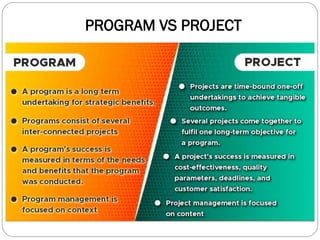
A programis an organized approach to meet the assessed needs of
individuals, families, groups, populations, or communities by reducing
the effect of or eliminating one or more health problems.
Community health programs are interventions designed to inform,
elicit, facilitate, and maintain positive health practices. They are
specifically planned to meet the needs of designated populations or
subpopulations in a community
4.
INTRODUCTION
Projects are smaller,
organizedactivities
with a limited time
frame e.g. BP
screening
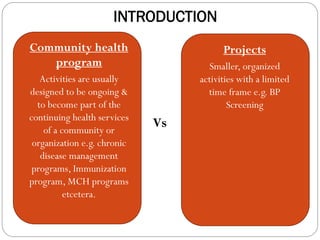
Community health
program
Activities are usually
designed to be ongoing &
to become part of the
continuing health services
of a community or
organization e.g. chronic
disease management
programs, Immunization
program, MCH programs
etcetera.
Vs
Projects
Smaller, organized
activities with a limited
time frame e.g. BP
Screening
PROGRAM MANAGEMENT PROCESS
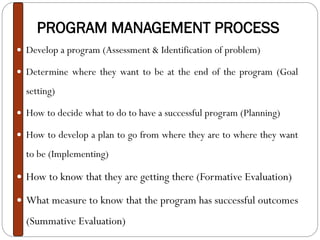
Develop a program (Assessment & Identification of problem)
Determine where they want to be at the end of the program (Goal
setting)
How to decide what to do to have a successful program (Planning)
How to develop a plan to go from where they are to where they want
to be (Implementing)
How to know that they are getting there (Formative Evaluation)
What measure to know that the program has successful outcomes
(Summative Evaluation)
7.
WHY SHOULD NURSESBE INVOLVED
IN HEALTH PROGRAM?
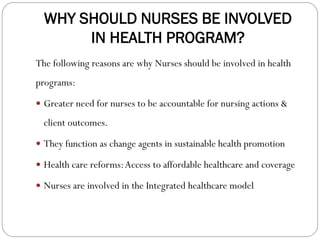
The following reasons are why Nurses should be involved in health
programs:
Greater need for nurses to be accountable for nursing actions &
client outcomes.
They function as change agents in sustainable health promotion
Health care reforms:Access to affordable healthcare and coverage
Nurses are involved in the Integrated healthcare model
8.
EXAMPLES OF HEALTHPROGRAMS
Immunization & infectious disease programs
Family planning programs
Community school health program
Occupational health & Safety
Disaster preparedness
9.
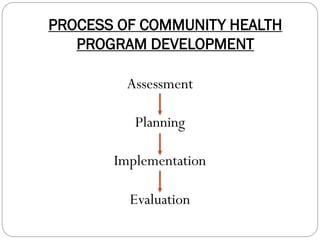
PROCESS OF COMMUNITYHEALTH
PROGRAM DEVELOPMENT
Assessment
Planning
Implementation
Evaluation
11.
1. COMMUNITY ASSESSMENT
Communityassessment data gathering is essential for effective
programming in CHN.This is necessary to:
provide a clear understanding of the overall health status of community
Identification of community health problems through
- Review of available data in the government/community repository,
local clinics, etcetera
- Literature review:To determine gaps in previously implemented
programs
Identify the population at risk (Identification of groups)
Identify available resources and their quality to meet the identified
problems
Identify barriers to the use of existing resources
12.
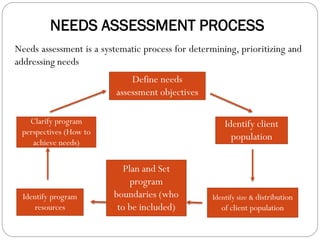
NEEDS ASSESSMENT PROCESS
Identifyclient
population
Define needs
assessment objectives
Identify program
resources
Clarify program
perspectives (How to
achieve needs)
Identify size & distribution
of client population
Plan and Set
program
boundaries (who
to be included)
Needs assessment is a systematic process for determining, prioritizing and
addressing needs
13.
SUMMARY OF NEEDSASSESSMENT TOOLS
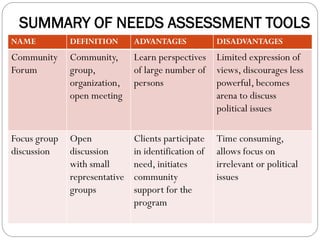
NAME DEFINITION ADVANTAGES DISADVANTAGES
Community
Forum
Community,
group,
organization,
open meeting
Learn perspectives
of large number of
persons
Limited expression of
views, discourages less
powerful, becomes
arena to discuss
political issues
Focus group
discussion
Open
discussion
with small
representative
groups
Clients participate
in identification of
need, initiates
community
support for the
program
Time consuming,
allows focus on
irrelevant or political
issues
14.
SUMMARY OF NEEDSASSESSMENT TOOLS
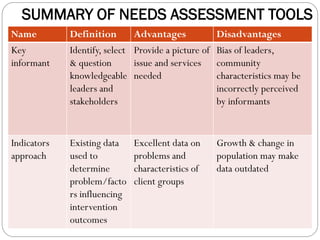
Name Definition Advantages Disadvantages
Key
informant
Identify, select
& question
knowledgeable
leaders and
stakeholders
Provide a picture of
issue and services
needed
Bias of leaders,
community
characteristics may be
incorrectly perceived
by informants
Indicators
approach
Existing data
used to
determine
problem/facto
rs influencing
intervention
outcomes
Excellent data on
problems and
characteristics of
client groups
Growth & change in
population may make
data outdated
15.
SUMMARY OF NEEDSASSESSMENT TOOLS
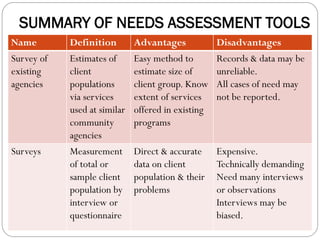
Name Definition Advantages Disadvantages
Survey of
existing
agencies
Estimates of
client
populations
via services
used at similar
community
agencies
Easy method to
estimate size of
client group. Know
extent of services
offered in existing
programs
Records & data may be
unreliable.
All cases of need may
not be reported.
Surveys Measurement
of total or
sample client
population by
interview or
questionnaire
Direct & accurate
data on client
population & their
problems
Expensive.
Technically demanding
Need many interviews
or observations
Interviews may be
biased.
16.
2. PLANNING
Planningis defined as the selecting & carrying out of a series of
activities designed to achieve desired improvements.
Goal of planning is to ensure that health care services are
acceptable, equal, efficient, & effective
Planning provides a blue print for coordination of resources to
achieve desired goals
17.
BENEFITS OF PROGRAMPLANNING
Systematic planning for meeting the health needs of populations in a
community benefits clients, nurses, employing agencies & community.
These are:
It ensures that available resources are used to address the actual needs
of people in the community
It focuses attention on what the organization & health provider are
attempting to do for clients
Assists in identifying the resources & activities that are needed to meet
the objectives of clients services
Reduces uncertainty within the program environment & increases the
abilities of the provider & agency to cope with the external
environment.
18.
BENEFITS OF PROGRAMPLANNING
Reduces role ambiguity (uncertainty) by giving responsibility to
specific providers to meet program objectives.
Everyone involved with the program can anticipate what will be
needed to implement the program, what will occur during the
implementation process & what the outcomes will be.
Planning allows for quality decision-making & better control
over the actual program results.
19.
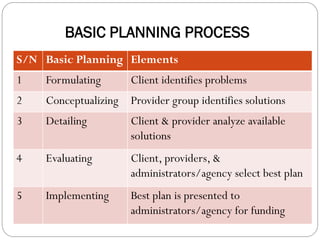
BASIC PLANNING PROCESS
S/NBasic Planning Elements
1 Formulating Client identifies problems
2 Conceptualizing Provider group identifies solutions
3 Detailing Client & provider analyze available
solutions
4 Evaluating Client, providers, &
administrators/agency select best plan
5 Implementing Best plan is presented to
administrators/agency for funding
20.
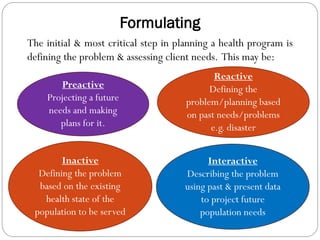
Formulating
The initial &most critical step in planning a health program is
defining the problem & assessing client needs. This may be:
Preactive
Projecting a future
needs and making
plans for it.
Reactive
Defining the
problem/planning based
on past needs/problems
e.g. disaster
Inactive
Defining the problem
based on the existing
health state of the
population to be served
Interactive
Describing the problem
using past & present data
to project future
population needs
21.
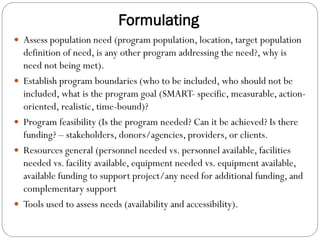
Formulating
Assess populationneed (program population, location, target population
definition of need, is any other program addressing the need?, why is
need not being met).
Establish program boundaries (who to be included, who should not be
included, what is the program goal (SMART- specific, measurable, action-
oriented, realistic, time-bound)?
Program feasibility (Is the program needed? Can it be achieved? Is there
funding? – stakeholders, donors/agencies, providers, or clients.
Resources general (personnel needed vs. personnel available, facilities
needed vs. facility available, equipment needed vs. equipment available,
available funding to support project/any need for additional funding, and
complementary support
Tools used to assess needs (availability and accessibility).
22.
Conceptualizing
This stage createsoptions for solving the problem & considers several
solutions
Involves review of the literature to determine what approaches have
been used in other places with similar problems, & with what success
This review can assist nurses in improving the quality, effectiveness &
appropriateness of health programs by synthesizing the evidence &
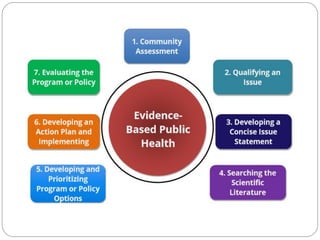
translating it into practice (Evidence-based practice)
Each option for program solution is examined for its uncertainties
(risks) & consequences, leading to outcomes.
23.
Conceptualizing
List thepotential solutions to the problem
What are the risks of each solution
What are the consequences
What are the outcomes to be gained from the solutions?
Draw a decision tree to show the problem-solving process used.
24.
Detailing
Provider withclient input, considers the possibilities of solving a
problem using one of the solutions identified (Formulation of
advisory group)
Provider provides details about costs, resources, and program
activities needed to choose one of the solutions from the
conceptualizing phase.
The total costs of each solution must be considered
The advisory group should review each solution for acceptance.
25.
Detailing
What arethe objectives for each solution to meet the program goal?
What activities will be done to conduct each of the alternative solutions
listed?
What are the differences in the resources needed for each of the
alternative solutions?
Which of the alternative solutions would be chosen based on available
resources?
Who would be responsible or accountable for implementing the plan?
26.
Evaluating
In this phase.Theprovider weighs;
Which of the alternative solutions is most acceptable to the client
population, the funding agencies, providers & the community
Which alternative solutions appear to have the most benefits to
the client population, agency, provider & Community
Which alternative solution would be chosen based on cost by
client population, agency, provider & Community
27.
Implementing the programplan
Based on the data collected, which of the solutions has been
chosen?
Will additional funding be sought?
When can the program begin/ Give date
28.
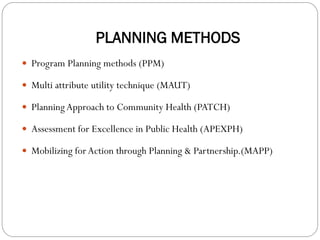
PLANNING METHODS
ProgramPlanning methods (PPM)
Multi attribute utility technique (MAUT)
PlanningApproach to Community Health (PATCH)
Assessment for Excellence in Public Health (APEXPH)
Mobilizing forAction through Planning & Partnership.(MAPP)
29.
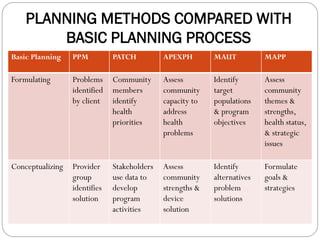
PLANNING METHODS COMPAREDWITH
BASIC PLANNING PROCESS
Basic Planning PPM PATCH APEXPH MAUT MAPP
Formulating Problems
identified
by client
Community
members
identify
health
priorities
Assess
community
capacity to
address
health
problems
Identify
target
populations
& program
objectives
Assess
community
themes &
strengths,
health status,
& strategic
issues
Conceptualizing Provider
group
identifies
solution
Stakeholders
use data to
develop
program
activities
Assess
community
strengths &
device
solution
Identify
alternatives
problem
solutions
Formulate
goals &
strategies
30.
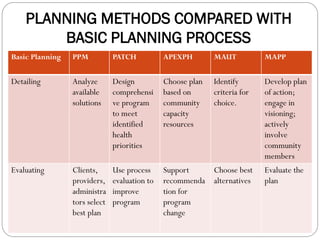
PLANNING METHODS COMPAREDWITH
BASIC PLANNING PROCESS
Basic Planning PPM PATCH APEXPH MAUT MAPP
Detailing Analyze
available
solutions
Design
comprehensi
ve program
to meet
identified
health
priorities
Choose plan
based on
community
capacity
resources
Identify
criteria for
choice.
Develop plan
of action;
engage in
visioning;
actively
involve
community
members
Evaluating Clients,
providers,
administra
tors select
best plan
Use process
evaluation to
improve
program
Support
recommenda
tion for
program
change
Choose best
alternatives
Evaluate the
plan
31.
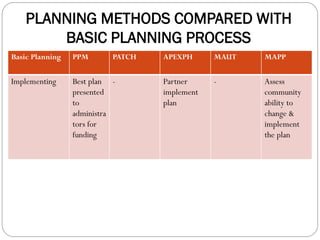
PLANNING METHODS COMPAREDWITH
BASIC PLANNING PROCESS
Basic Planning PPM PATCH APEXPH MAUT MAPP
Implementing Best plan
presented
to
administra
tors for
funding
- Partner
implement
plan
- Assess
community
ability to
change &
implement
the plan
32.
3. PROGRAM IMPLEMENTATION
Thisis the process of putting the plans into action to address the
community needs.
Elements in the program implementation phase
Community Collaboration: Local Leaders, Personnels, Stakeholders
Mobilizing/Utilizing resources
PersonnelTraining
Organizing
Monitoring
Supervising
Recording and Reporting
33.
4. PROGRAM EVALUATION(PE)
It is a method of ensuring that a program has met its goals.
It is a means of documenting accountability by the program managers to
the clients & funding sources
Program evaluation should answer the following questions
Are the needs for which the program was designed being met
Are the problems it was designed to solve being solved?
This is critical information for program managers, funding agencies, top-
level decision makers, program accreditation reviewers, health providers
& the community
34.
PROGRAM EVALUATION
Evaluation dataare used to make judgments about a program & may be
used to justify
sustaining the program
making adjustments to the program
expanding or reducing the program or even discontinuing it.
35.
PROGRAM EVALUATION TYPES
Formativeevaluation
Used in early stages of program initiation (Assessment and Planning
phase).
Makes it possible to do mid-program correction/adjustments. Also
referred to as program monitoring.
It helps to identify areas for improvement before full implementation
Summative Evaluation
Carried out at the end of the program to measure the effectiveness of
the program in achieving desired results
It is used to determine if a program can be expanded for future
continuity
36.
Process evaluation
Usedto assess how a program is being implemented along the way
by measuring participation rates, the quality of delivery, and the
degree to which the program is being implemented as intended.
Outcome evaluation
This is concerned with the desired change the program is meant to
achieve.
It measures changes in behaviour, health status, perception
Comparison of intervention to control group
This evaluation is summative in nature
37.
PROGRAM EVALUATION (PE)
Sources of information for PE
❖Program clients
❖Program Records
❖Community indexes
❖Epidemiological data (Mortality, morbidity data) is there a reduction
in health indices?
Methods of evaluating community responses to program
❖Site visits
❖Structured observations of interventions (using pre-determined
categories).
❖Attitude scale (e.g. Client satisfaction survey)
38.
PROGRAM EVALUATION
❖Surveys
❖Interviews
❖Diagnostic tests
Identifying program benefits & effectiveness
❖This is done through cost studies (This is the process of
analysing the cost of a program and weighing with the benefits
of the program)
39.
PLANNING FOR THEEVALUATION
PROCESS
Planning for the evaluation process is an important part of
program planning
The Centres for Disease Control and Prevention described six
approaches to program evaluation
40.
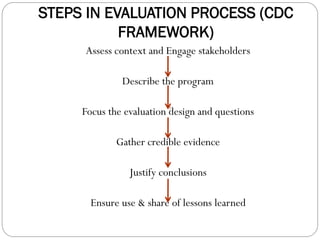
STEPS IN EVALUATIONPROCESS (CDC
FRAMEWORK)
Assess context and Engage stakeholders
Describe the program
Focus the evaluation design and questions
Gather credible evidence
Justify conclusions
Ensure use & share of lessons learned
41.
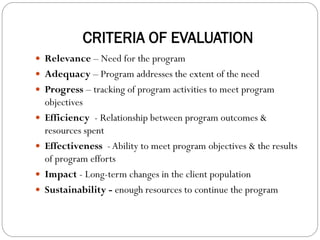
CRITERIA OF EVALUATION
Relevance – Need for the program
Adequacy – Program addresses the extent of the need
Progress – tracking of program activities to meet program
objectives
Efficiency - Relationship between program outcomes &
resources spent
Effectiveness -Ability to meet program objectives & the results
of program efforts
Impact - Long-term changes in the client population
Sustainability - enough resources to continue the program
42.
BARRIERS TO SOLVINGHEALTH PROBLEMS
Barriers related to government: Lack of support and resource
allocation
Barriers related to healthcare professionals:
- Lack of necessary skills among health professionals
- Lack of understanding of goals, benefits, and transparency of roles
and responsibilities
Barriers related to the community: Cultural and language barrier
(Mahmoodi et al., 2019).
43.
PUBLIC HEALTH NURSES’ROLE IN
COMMUNITY PROGRAM PLANNING AND
IMPLEMENTATION
Assess health needs
Program Initiator
Educator
Advocate
Collaborates with Community
Secure Funding
Manage Budgets
44.
References
Allender, J.A., Rector,C., &Warner, K.D. ( 2014). Community Health Nursing:Promoting
and protecting the public’s health. 8th edition. LippincottWilliams &Wilkins
Mahmoodi, H., Bolbanabad,A.M., Shaghaghi,A., Zokaie, M., Gheshlagh , R.G., &
Afkhamzadeh ,A. (2023). Barriers to implementing health programs based on
community participation: the Q method derived perspectives of healthcare
professional. BMC Public Health 23, 2019 (2023).
https://doi.org/10.1186/s12889-023-16961-5
Posavac, E.J., & Carey, R.G. (2013). Program Evaluation: Methods and Case Studies. 6th
Edition.
Singerhouse, E. (2023).What are the different types of evaluation?. Retrieved from
https://www.strategicpreventionsolutions.com/post/what-are-the-different-
types-of-evaluation
Assignment/Further study
Relatethe basic planning process and the Nursing process? Noting
the similarities and Differences
Read about the concept of cost studies applied to program
management:
CostAccounting
Cost Benefits
Cost effectiveness
Cost efficiency
Read about the following evaluation Models
Donabedian Model
Quality Health Outcomes Model
Omaha system model
The Quality Practice Setting Attributes Model