NEED ASSESSMENT IN
PUBLIC HEALTH CARE
Group 4 LPKPKA 2/2022
NICE Definition of Health Needs Assessment
“A Health Needs Assessment is a systematic
method for reviewing the health issues facing a
population, leading to agreed priorities and
resource allocation that will improve health and
reduce health inequalities.”
PURPOSE OF NEED ASSESSMENT
◦ Development of new programs:
- Can be used to validate the current target populations in need of services as well as to
identify new target populations with unmet needs.
- Help to reaffirm current need priorities and acknowledge new ones. These in turn can
be used to refine or redefine appropriate goals, objectives, and activities of programs
and agencies.
◦ Reassessment for existing programs and agencies:
- Serves as a periodic reappraisal of whether their various services and activities
continue to be needed.
- Improve the quality of policy or program decision made.
NEED ASSESSMENT IN PUBLIC HEALTH CARE
◦ Public health is responsible for assessing the health needs of the entire population.
This responsibility includes the publication and dissemination of the results of the
assessment for the use of all interested parties.
◦ The assessment function of public health must not only consider the needs of the
many, it must ensure that the needs of vulnerable groups are also regularly assessed
and given attention.
◦ The results may bring about marked changes. Not only can it alter perceptions
regarding the need for an activity or agency, but can also reshape a program’s
purpose, direction, organization, operations, and personnel complement.
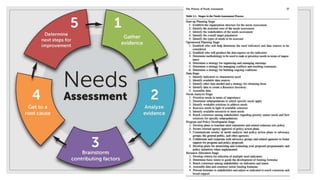
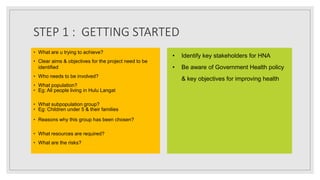
STEP 1 : GETTING STARTED
• What are u trying to achieve?
• Clear aims & objectives for the project need to be
identified
• Who needs to be involved?
• What population?
• Eg: All people living in Hulu Langat
• What subpopulation group?
• Eg: Children under 5 & their families
• Reasons why this group has been chosen?
• What resources are required?
• What are the risks?
• Identify key stakeholders for HNA
• Be aware of Government Health policy
& key objectives for improving health
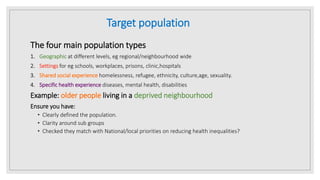
Target population
The four main population types
1. Geographic at different levels, eg regional/neighbourhood wide
2. Settings for eg schools, workplaces, prisons, clinic,hospitals
3. Shared social experience homelessness, refugee, ethnicity, culture,age, sexuality.
4. Specific health experience diseases, mental health, disabilities
Example: older people living in a deprived neighbourhood
Ensure you have:
• Clearly defined the population.
• Clarity around sub groups
• Checked they match with National/local priorities on reducing health inequalities?
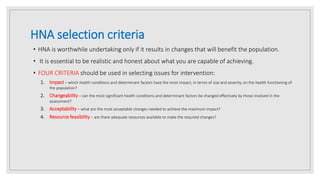
HNA selection criteria
• HNA is worthwhile undertaking only if it results in changes that will benefit the population.
• It is essential to be realistic and honest about what you are capable of achieving.
• FOUR CRITERIA should be used in selecting issues for intervention:
1. Impact – which health conditions and determinant factors have the most impact, in terms of size and severity, on the health functioning of
the population?
2. Changeability – can the most significant health conditions and determinant factors be changed effectively by those involved in the
assessment?
3. Acceptability – what are the most acceptable changes needed to achieve the maximum impact?
4. Resource feasibility – are there adequate resources available to make the required changes?
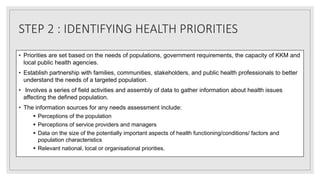
STEP 2 : IDENTIFYING HEALTH PRIORITIES
• Priorities are set based on the needs of populations, government requirements, the capacity of KKM and
local public health agencies.
• Establish partnership with families, communities, stakeholders, and public health professionals to better
understand the needs of a targeted population.
• Involves a series of field activities and assembly of data to gather information about health issues
affecting the defined population.
• The information sources for any needs assessment include:
 Perceptions of the population
 Perceptions of service providers and managers
 Data on the size of the potentially important aspects of health functioning/conditions/ factors and
population characteristics
 Relevant national, local or organisational priorities.
STEP 2 : IDENTIFYING HEALTH PRIORITIES
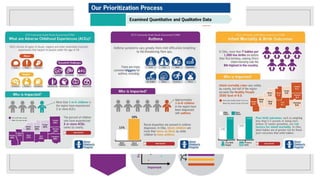
• Identify the aspects of health functioning and conditions and factors that might have a significant impact on
the health of the profiled population
• Developed a profile of these issues
• Use this information to decide a limited number of overall health priorities for the population, using the first
two explicit selection criteria of HNA :
1. Impact – they have a significant impact in terms of severity and size
2. Changeability – they can be changed locally
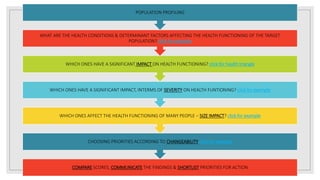
COMPARE SCORES, COMMUNICATE THE FINDINGS & SHORTLIST PRIORITIES FOR ACTION
CHOOSING PRIORITIES ACCORDING TO CHANGEABILITY click for example
WHICH ONES AFFECT THE HEALTH FUNCTIONING OF MANY PEOPLE – SIZE IMPACT? click for example
WHICH ONES HAVE A SIGNIFICANT IMPACT, INTERMS OF SEVERITY ON HEALTH FUNTIONING? click for example
WHICH ONES HAVE A SIGNIFICANT IMPACT ON HEALTH FUNCTIONING? click for health triangle
WHAT ARE THE HEALTH CONDITIONS & DETERMINANT FACTORS AFFECTING THE HEALTH FUNCTIONING OF THE TARGET
POPULATION? click for example
POPULATION PROFILING
STEP 3 : ASSESSING A HEALTH PRIORITY
FOR ACTION
• The task is to assess each specific health priority for change.
• The needs-led approach requires being clear about the ‘what and why’ before
considering the ‘how’.
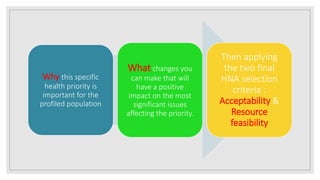
Why this specific
health priority is
important for the
profiled population
What changes you
can make that will
have a positive
impact on the most
significant issues
affecting the priority.
Then applying
the two final
HNA selection
criteria :
Acceptability &
Resource
feasibility
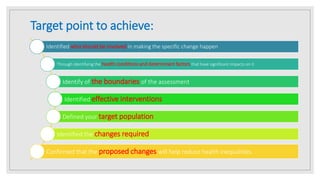
Target point to achieve:
Identified who should be involved in making the specific change happen
Through identifying the health conditions and determinant factors that have significant impacts on it
Identify of the boundaries of the assessment
Identified effective interventions
Defined your target population
Identified the changes required
Confirmed that the proposed changes will help reduce health inequalities.
REVIEW STEP 3
At this stage in the process you should:
• Be confident that the health conditions/determinant factors with the most significant impact
on health functioning for the selected health priority are being tackled
• Be sure the action is focused on reducing health inequalities for that health priority
• Have identified acceptable and cost-efficient actions to improve the selected health priority.
You will now be ready for action planning.
STEP 4 Planning for Change
◦ Clarifying aims of intervention
◦ Action planning
◦ Monitoring and evaluation strategy
◦ Risk management strategy
◦ Some questions to help us
◦ WHAT are we aiming to do?
◦ WHO is going to do it?
◦ WHEN is it going to be done?
◦ HOW are we going to monitor and evaluate the programme?
◦ WHAT is our implementation and dissemination plan?
◦ WHAT is our risk assessment strategy?
STEP 5 : MOVE ON/REVIEW
• This final stage of the HNA process involves the team in some reflective questions and the opportunity to
take stock and learn, both for individual contributors and from a team perspective. This is a vital part of
the process if HNA is to continue to be a relevant and effective tool in improving health and tackling health
inequalities in the population.
• Learn from the project:
 What went well, and why? Check achievements against the original aims and objectives of the project
 What did not go well, and why? Is any further action required?
 Identify further action to be taken. Perceived improvement in health/services following the interventions:
How effective was it?
How could it have been improved?
What were the main challenges?
What were the main barriers?
STEP 5 : MOVE
ON/REVIEW
• Evaluation must involve an
honest description of what
happened
• It is not meant to prove
that everything went
brilliantly
• But to celebrate successes
• Share difficulties
encountered

health need assessment

  • 1.
    NEED ASSESSMENT IN PUBLICHEALTH CARE Group 4 LPKPKA 2/2022
  • 2.
    NICE Definition ofHealth Needs Assessment “A Health Needs Assessment is a systematic method for reviewing the health issues facing a population, leading to agreed priorities and resource allocation that will improve health and reduce health inequalities.”
  • 3.
    PURPOSE OF NEEDASSESSMENT ◦ Development of new programs: - Can be used to validate the current target populations in need of services as well as to identify new target populations with unmet needs. - Help to reaffirm current need priorities and acknowledge new ones. These in turn can be used to refine or redefine appropriate goals, objectives, and activities of programs and agencies. ◦ Reassessment for existing programs and agencies: - Serves as a periodic reappraisal of whether their various services and activities continue to be needed. - Improve the quality of policy or program decision made.
  • 4.
    NEED ASSESSMENT INPUBLIC HEALTH CARE ◦ Public health is responsible for assessing the health needs of the entire population. This responsibility includes the publication and dissemination of the results of the assessment for the use of all interested parties. ◦ The assessment function of public health must not only consider the needs of the many, it must ensure that the needs of vulnerable groups are also regularly assessed and given attention. ◦ The results may bring about marked changes. Not only can it alter perceptions regarding the need for an activity or agency, but can also reshape a program’s purpose, direction, organization, operations, and personnel complement.
  • 6.
    STEP 1 :GETTING STARTED • What are u trying to achieve? • Clear aims & objectives for the project need to be identified • Who needs to be involved? • What population? • Eg: All people living in Hulu Langat • What subpopulation group? • Eg: Children under 5 & their families • Reasons why this group has been chosen? • What resources are required? • What are the risks? • Identify key stakeholders for HNA • Be aware of Government Health policy & key objectives for improving health
  • 7.
    Target population The fourmain population types 1. Geographic at different levels, eg regional/neighbourhood wide 2. Settings for eg schools, workplaces, prisons, clinic,hospitals 3. Shared social experience homelessness, refugee, ethnicity, culture,age, sexuality. 4. Specific health experience diseases, mental health, disabilities Example: older people living in a deprived neighbourhood Ensure you have: • Clearly defined the population. • Clarity around sub groups • Checked they match with National/local priorities on reducing health inequalities?
  • 8.
    HNA selection criteria •HNA is worthwhile undertaking only if it results in changes that will benefit the population. • It is essential to be realistic and honest about what you are capable of achieving. • FOUR CRITERIA should be used in selecting issues for intervention: 1. Impact – which health conditions and determinant factors have the most impact, in terms of size and severity, on the health functioning of the population? 2. Changeability – can the most significant health conditions and determinant factors be changed effectively by those involved in the assessment? 3. Acceptability – what are the most acceptable changes needed to achieve the maximum impact? 4. Resource feasibility – are there adequate resources available to make the required changes?
  • 9.
    STEP 2 :IDENTIFYING HEALTH PRIORITIES • Priorities are set based on the needs of populations, government requirements, the capacity of KKM and local public health agencies. • Establish partnership with families, communities, stakeholders, and public health professionals to better understand the needs of a targeted population. • Involves a series of field activities and assembly of data to gather information about health issues affecting the defined population. • The information sources for any needs assessment include:  Perceptions of the population  Perceptions of service providers and managers  Data on the size of the potentially important aspects of health functioning/conditions/ factors and population characteristics  Relevant national, local or organisational priorities.
  • 10.
    STEP 2 :IDENTIFYING HEALTH PRIORITIES • Identify the aspects of health functioning and conditions and factors that might have a significant impact on the health of the profiled population • Developed a profile of these issues • Use this information to decide a limited number of overall health priorities for the population, using the first two explicit selection criteria of HNA : 1. Impact – they have a significant impact in terms of severity and size 2. Changeability – they can be changed locally
  • 11.
    COMPARE SCORES, COMMUNICATETHE FINDINGS & SHORTLIST PRIORITIES FOR ACTION CHOOSING PRIORITIES ACCORDING TO CHANGEABILITY click for example WHICH ONES AFFECT THE HEALTH FUNCTIONING OF MANY PEOPLE – SIZE IMPACT? click for example WHICH ONES HAVE A SIGNIFICANT IMPACT, INTERMS OF SEVERITY ON HEALTH FUNTIONING? click for example WHICH ONES HAVE A SIGNIFICANT IMPACT ON HEALTH FUNCTIONING? click for health triangle WHAT ARE THE HEALTH CONDITIONS & DETERMINANT FACTORS AFFECTING THE HEALTH FUNCTIONING OF THE TARGET POPULATION? click for example POPULATION PROFILING
  • 13.
    STEP 3 :ASSESSING A HEALTH PRIORITY FOR ACTION • The task is to assess each specific health priority for change. • The needs-led approach requires being clear about the ‘what and why’ before considering the ‘how’.
  • 14.
    Why this specific healthpriority is important for the profiled population What changes you can make that will have a positive impact on the most significant issues affecting the priority. Then applying the two final HNA selection criteria : Acceptability & Resource feasibility
  • 15.
    Target point toachieve: Identified who should be involved in making the specific change happen Through identifying the health conditions and determinant factors that have significant impacts on it Identify of the boundaries of the assessment Identified effective interventions Defined your target population Identified the changes required Confirmed that the proposed changes will help reduce health inequalities.
  • 16.
    REVIEW STEP 3 Atthis stage in the process you should: • Be confident that the health conditions/determinant factors with the most significant impact on health functioning for the selected health priority are being tackled • Be sure the action is focused on reducing health inequalities for that health priority • Have identified acceptable and cost-efficient actions to improve the selected health priority. You will now be ready for action planning.
  • 17.
    STEP 4 Planningfor Change ◦ Clarifying aims of intervention ◦ Action planning ◦ Monitoring and evaluation strategy ◦ Risk management strategy ◦ Some questions to help us ◦ WHAT are we aiming to do? ◦ WHO is going to do it? ◦ WHEN is it going to be done? ◦ HOW are we going to monitor and evaluate the programme? ◦ WHAT is our implementation and dissemination plan? ◦ WHAT is our risk assessment strategy?
  • 18.
    STEP 5 :MOVE ON/REVIEW • This final stage of the HNA process involves the team in some reflective questions and the opportunity to take stock and learn, both for individual contributors and from a team perspective. This is a vital part of the process if HNA is to continue to be a relevant and effective tool in improving health and tackling health inequalities in the population. • Learn from the project:  What went well, and why? Check achievements against the original aims and objectives of the project  What did not go well, and why? Is any further action required?  Identify further action to be taken. Perceived improvement in health/services following the interventions: How effective was it? How could it have been improved? What were the main challenges? What were the main barriers?
  • 19.
    STEP 5 :MOVE ON/REVIEW • Evaluation must involve an honest description of what happened • It is not meant to prove that everything went brilliantly • But to celebrate successes • Share difficulties encountered

Editor's Notes

  • #4 an effective tool to clarify problems and identify appropriate interventions or solutions