02 chap: Community
by- Dr. Nishandani PT
Definition of Community
• The word “community” derives from the Old
French comunete, which comes from the Latin
communitas” community”, “public spirit”
A Community is a small or large social unit(a group
of living things) who have something in
common, such as norms, religions, values or
identity.
• Community often share a sense of place that is
situated in a given geographical area(eg- a
country, village, town or neighborhood) or in
the virtual space through communication
platforms.
• Durable relations that extend beyond
immediate genealogical ties(related to the
history of past and present members of
families) also define a sense of community.
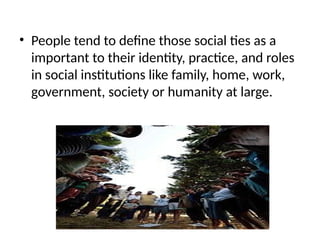
• People tend to define those social ties as a
important to their identity, practice, and roles
in social institutions like family, home, work,
government, society or humanity at large.
• Although communities are usually small
relative to personal ties(micro-level),
community may also refer to large group
affiliations(macro-level) , such as National
communities, international communities and
virtual communities.
• Human communities may share intent, belief,
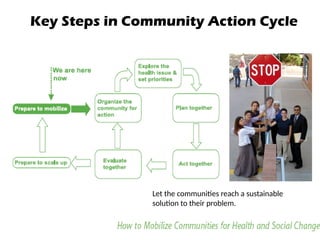
resources, preferences, needs and risks in
common, affecting the identity of the
participants and their degree of cohesiveness.
( the quality of forming a united whole)
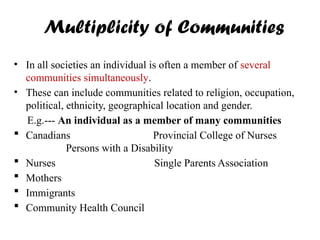
Multiplicity of Communities
• In all societies an individual is often a member of several
communities simultaneously.
• These can include communities related to religion, occupation,
political, ethnicity, geographical location and gender.
E.g.--- An individual as a member of many communities
 Canadians Provincial College of Nurses
Persons with a Disability
 Nurses Single Parents Association
 Mothers
 Immigrants
 Community Health Council
Community based/
participatory approach(CBA)
• The community based approach was developed in response to inefficient
and centralized mechanisms for solving community problems.
• In community based programmes the users of a service have some
control over resources from complete control to merely exerting a
powerful influence.
• A community based approach(CBA)- where those who are affected by
an emergency are included as key partner in developing strategies
related to their assistance and protection- is inextricably linked to both
the rights-based approach and the survivor- centred approach.
• A community based approach insists that people targeted for
humanitarian assistance have “the right to participate in making
decisions that affect their lives” as well as a “right to information and
transparency” from those responsible for providing assistance.
Community based/ participatory Approach(CBPA)
is based on principles that includes:
1. Recognizing the community as a unit of identity.
2. Building on collective strengths and shared
resources.
3. Facilitating partnership and capacity building
throughout the process.
4. Disseminating pertinent information, data and
other findings to all participants.
5. Involving a long term process and commitment.
seeking balance between research and action.
History of CBA
• The historical roots of CBPR generally trace back to the
development of participatory action research by Kurt Lewin and
Orlando Fals Borda.
• In CBPR projects, the community participates fully in all aspects
of the research process.
• CBPR projects starts with the community. Community is often
self- defined, but general categories of community include
geographic community, community of individuals with a common
problem or issues, or a community of individuals with a common
interest or common goal.
• CBPR encourage collaboration of “ formally trained research”
partner from any area of expertise and provided research that is
seen as useful to the investigation by the community and be fully
committed to the partnership of equals and producing outcomes
usable to the community.
• Equitable partnership require sharing power,
resources, credits, results and knowledge as well
as a reciprocal appreciation of each partner’s
knowledge and skills at each stage of the project,
including problem definition/issuse selection,
research design, conducting research, interpreting
the results and determining how the results
should be used for action.
• CBPR differs from traditional research in many
ways. One of the principal ways in which it is
different is that instead of creating knowledge for
the advancement of field or for knowledge’s sake.
Community Entry strategies
• Community entry refers to the
process of initiating, nurturing and
sustaining a desirable relationship
with the purpose of securing and
sustaining the community’s interest in
all aspect of a program
• Definition of community Entry: refers
to the process of initiating, nurturing
and sustaining a desirable relationship
with the purpose of securing and
sustaining the community’s interest in
all aspect of a programme.
• Community entry refers to the process,
principles and techniques of community
mobilization and participation.
• This involves recognizing the community its
leadership and people and adopting the most
appropriate process in meeting, interacting
and working with them.
Guidelines for community entry
• build relationships and trust by being considerate of
community members' time and other obligations, by
being open about what you are doing, by treating
people with respect and by being seen to be impartial
• Community entry can also be built on an existing &
valued community program which is already
organised, supported & maintained by the community.
eg: voluntary organisation of women working with
families in an industrial area in Bombay
Strategic steps involved in community entry
1. Conducting field analysis for the cultural, social,
political and economic factors of targeted community.
2. Developing of needs analysis of the market.
3. Verifying level of competition of targeted community.
4. Production of product(pilot stage)
5. Designing the entry strategy
6. Feedback.
7. Verifying needed level of production and size based on
the feedback.
SKILLS AND ATTITUDES REQUIRED FOR HEALTH WORKERS IN UNDERTAKING COMMUNITY ENTRY
SKILLS
• Maintain good eye contact.
• Listen to both sides of and issue
• Show interest
• Be empathetic
• Encourage others to listen.
ATTITUDE
• Patience
• Tolerance
• Respect for other people
• Good listening attitude
• Humility
Community Participation
• Participation is key to all successful community development
programmes.
• WHO suggested that participation can be categorized in 3
ways:
1. Participation as contribution
2. Participation as organization
3. Participation as empowerment
Strengths of Community Participation
• More can be accomplished
• Services may be provided at a lower cost
• Participation ensures that things are done the right way
• Participation leads to a sense of responsibility for the project
& eventual sustainability
• Participation ensures the use of indigenous knowledge and
expertise
• Participation brings freedom from dependence on
professionals
Barriers to Community Participation
• Participation may become ritualistic
• Participation depends on one charismatic leader
• Participation may raise expectations that cannot be fulfilled
• Participation may lead to coercion by neighbors
• Participation experiments are often not cost effective or
replicable
• Participation may lead to development of agendas which do
not match national or international development goals
How to enhance the community Participation
• State one example you have done so far!
• Write one mean to enhance participation?
Community Meetings
Gathering People at ONE Platform
Puppet Show &Theatre
Village Literacy Fair
Human Chain
Sports & Games
Electronic & Print Media
Pamphlets & Handouts
Benefits of Community Participation
• Increased ownership, support and responsibility
• More likelihood of, and sustainability for, behavior change
• More cost-effective programming
• Better response to community needs and concerns
• More culturally appropriate strategies and messages
• Increased coverage and access to information and services
• Increased demand
• Increased advocacy for service and policy change
• Increased success (results and sustainability)
Community development
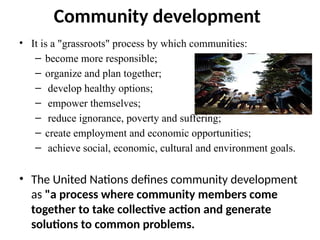
• It is a "grassroots" process by which communities:
– become more responsible;
– organize and plan together;
– develop healthy options;
– empower themselves;
– reduce ignorance, poverty and suffering;
– create employment and economic opportunities;
– achieve social, economic, cultural and environment goals.
• The United Nations defines community development
as "a process where community members come
together to take collective action and generate
solutions to common problems.
• It is a broad term given to the practices of civic leaders,
activists, involved citizens and professionals to improve
various aspects of communities, typically aiming to build
stronger and more resilient local communities
• CD is defined by the International Association for
Community Development the global network of
community development practitioners and scholars,
as "a practice-based profession and an academic
discipline that promotes participative democracy,
sustainable development, rights, economic opportunity,
equality and social justice, through the organization,
education and empowerment of people within their
communities, whether these be of locality, identity or
interest, in urban and rural settings“.
• Community development is also understood as a
professional discipline.
• Community development seeks to empower
individuals and groups of people with the skills they
need to effect change within their communities.
• Community developers must understand both how
to work with individuals and how to affect
communities' positions within the context of larger
social institutions.
• Community development approaches are
recognized internationally. These methods and
approaches have been acknowledged as
significant for local social, economic, cultural,
environmental and political development by
such organizations as the UN, WHO, OECD,
World Bank.
• A set of values and practices which plays a
special role in overcoming poverty and
disadvantage, knitting society together at the
grass roots and deepening democracy.
• Community development involves changing
the relationships between ordinary people
and people in positions of power, so that
everyone can take part in the issues that
affect their lives.
• It starts from the principle that within any
community there is a wealth of knowledge
and experience which, if used in creative
ways, can be channeled into collective
action to achieve the communities' desired
goals.
• Community development practitioners work
alongside people in communities to help
build relationships with key people and
organizations and to identify common
concerns.
• They create opportunities for the community
to learn new skills and, by enabling people to
act together, community development
practitioners help to foster social inclusion and
equality.
Different approaches for CD
• There are numerous overlapping approaches to community
development.
1. Women Self-help Group; focusing on
• the contribution of women in settlement
• groups.
2. Community capacity building; focusing
• on helping communities obtain, strengthen, and maintain the
ability to
set and achieve their own development objectives.
3. Community-based participatory research (CBPR); a partnership
• approach to research that equitably involves, for example,
community members, organizational representatives, and
researchers in all.
COMMUNITY
MOBILIZATION
Community Mobilization
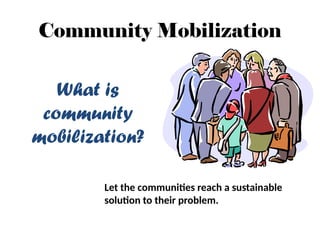
What is
community
mobilization?
Let the communities reach a sustainable
solution to their problem.
Community Mobilization
• Community mobilization is the process of bringing together
all Intersectoral social allies to raise people’s awareness of
and demand for a particular development programme, to
assist in the delivery of resources & to strengthen the
participation of people to achieve project sustainability and
self reliance.
OR
 A capacity-building process through which individuals,
groups, or organizations plan, carry out, and evaluate
activities on a participatory and sustained basis to improve
their health and other needs, either on their own initiative or
stimulated by others.
Key Steps in Community Action Cycle
Let the communities reach a sustainable
solution to their problem.
Prepare to mobilize
Finalizing Program Objectives
Setting Mobilization Objectives
Work plan and Procedures Clarification
Initial Visits and Rapid Assessments
Target Area Selection
Introductory Community Meetings
Study the Community.
Organizing Community
• In group
• Structure
• Define norms and procedures
• Resolving the conflict
• Sharing the common vision/goal
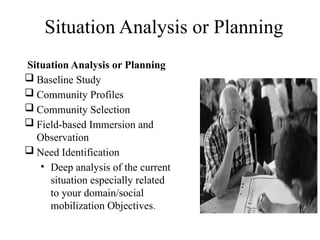
Situation Analysis or Planning
 Baseline Study
 Community Profiles
 Community Selection
 Field-based Immersion and
Observation
 Need Identification
• Deep analysis of the current
situation especially related
to your domain/social
mobilization Objectives.
Evaluation
Evaluation
• Joint Reviews.
• Establish joint evaluation committees including all
stakeholders.(A person, group, or organization that has
direct or indirect stake in an organization because it can
affect or be affected by the organization's actions,
objectives, and policies.
• Knowing when you are successful.
• Measuring the progress & success.
• Use the evaluation results for planning and promotion of the
partnership
Preparing for a Community Based Program
1. Collect geographic and demographic data
2. Collect baseline FP data; review research and survey
information
3. Contact existing organizations and institutions (NGOs,
CBOs, local MOH)
4. Involve national and senior officials
Channels for Reaching the Community
• NGOs
• CBOs
• Local government
• Local leaders – traditional and formal
• Community Resource persons
• Special clubs or interest groups
Role of Community Mobilizers
A mobilizer is a person who mobilizes, i.e. gets things
moving. Social animator.
 A Catalyst
• Bringing People Together
• Building Trust
• Encouraging Participation
• Facilitating Discussion and Decision-making
• Helping Things to Run Smoothly .
• Facilitation in community mobilization process
Some Qualities of Mobilizers
• Good communication skills
• Good facilitation skills
• Good listener
• Committed
• Decision maker
• Active
• Negotiation skills
• Honest
• Known to culture and values of society
• Well dress
• Catalyst
• Management skills

community based Rehabilitation- Community

  • 1.
    02 chap: Community by-Dr. Nishandani PT
  • 2.
    Definition of Community •The word “community” derives from the Old French comunete, which comes from the Latin communitas” community”, “public spirit” A Community is a small or large social unit(a group of living things) who have something in common, such as norms, religions, values or identity. • Community often share a sense of place that is situated in a given geographical area(eg- a country, village, town or neighborhood) or in the virtual space through communication platforms. • Durable relations that extend beyond immediate genealogical ties(related to the history of past and present members of families) also define a sense of community.
  • 3.
    • People tendto define those social ties as a important to their identity, practice, and roles in social institutions like family, home, work, government, society or humanity at large.
  • 4.
    • Although communitiesare usually small relative to personal ties(micro-level), community may also refer to large group affiliations(macro-level) , such as National communities, international communities and virtual communities. • Human communities may share intent, belief, resources, preferences, needs and risks in common, affecting the identity of the participants and their degree of cohesiveness. ( the quality of forming a united whole)
  • 5.
    Multiplicity of Communities •In all societies an individual is often a member of several communities simultaneously. • These can include communities related to religion, occupation, political, ethnicity, geographical location and gender. E.g.--- An individual as a member of many communities  Canadians Provincial College of Nurses Persons with a Disability  Nurses Single Parents Association  Mothers  Immigrants  Community Health Council
  • 6.
    Community based/ participatory approach(CBA) •The community based approach was developed in response to inefficient and centralized mechanisms for solving community problems. • In community based programmes the users of a service have some control over resources from complete control to merely exerting a powerful influence. • A community based approach(CBA)- where those who are affected by an emergency are included as key partner in developing strategies related to their assistance and protection- is inextricably linked to both the rights-based approach and the survivor- centred approach. • A community based approach insists that people targeted for humanitarian assistance have “the right to participate in making decisions that affect their lives” as well as a “right to information and transparency” from those responsible for providing assistance.
  • 7.
    Community based/ participatoryApproach(CBPA) is based on principles that includes: 1. Recognizing the community as a unit of identity. 2. Building on collective strengths and shared resources. 3. Facilitating partnership and capacity building throughout the process. 4. Disseminating pertinent information, data and other findings to all participants. 5. Involving a long term process and commitment. seeking balance between research and action.
  • 8.
    History of CBA •The historical roots of CBPR generally trace back to the development of participatory action research by Kurt Lewin and Orlando Fals Borda. • In CBPR projects, the community participates fully in all aspects of the research process. • CBPR projects starts with the community. Community is often self- defined, but general categories of community include geographic community, community of individuals with a common problem or issues, or a community of individuals with a common interest or common goal. • CBPR encourage collaboration of “ formally trained research” partner from any area of expertise and provided research that is seen as useful to the investigation by the community and be fully committed to the partnership of equals and producing outcomes usable to the community.
  • 9.
    • Equitable partnershiprequire sharing power, resources, credits, results and knowledge as well as a reciprocal appreciation of each partner’s knowledge and skills at each stage of the project, including problem definition/issuse selection, research design, conducting research, interpreting the results and determining how the results should be used for action. • CBPR differs from traditional research in many ways. One of the principal ways in which it is different is that instead of creating knowledge for the advancement of field or for knowledge’s sake.
  • 10.
    Community Entry strategies •Community entry refers to the process of initiating, nurturing and sustaining a desirable relationship with the purpose of securing and sustaining the community’s interest in all aspect of a program • Definition of community Entry: refers to the process of initiating, nurturing and sustaining a desirable relationship with the purpose of securing and sustaining the community’s interest in all aspect of a programme.
  • 11.
    • Community entryrefers to the process, principles and techniques of community mobilization and participation. • This involves recognizing the community its leadership and people and adopting the most appropriate process in meeting, interacting and working with them.
  • 12.
    Guidelines for communityentry • build relationships and trust by being considerate of community members' time and other obligations, by being open about what you are doing, by treating people with respect and by being seen to be impartial • Community entry can also be built on an existing & valued community program which is already organised, supported & maintained by the community. eg: voluntary organisation of women working with families in an industrial area in Bombay
  • 13.
    Strategic steps involvedin community entry 1. Conducting field analysis for the cultural, social, political and economic factors of targeted community. 2. Developing of needs analysis of the market. 3. Verifying level of competition of targeted community. 4. Production of product(pilot stage) 5. Designing the entry strategy 6. Feedback. 7. Verifying needed level of production and size based on the feedback.
  • 14.
    SKILLS AND ATTITUDESREQUIRED FOR HEALTH WORKERS IN UNDERTAKING COMMUNITY ENTRY SKILLS • Maintain good eye contact. • Listen to both sides of and issue • Show interest • Be empathetic • Encourage others to listen. ATTITUDE • Patience • Tolerance • Respect for other people • Good listening attitude • Humility
  • 15.
    Community Participation • Participationis key to all successful community development programmes. • WHO suggested that participation can be categorized in 3 ways: 1. Participation as contribution 2. Participation as organization 3. Participation as empowerment
  • 16.
    Strengths of CommunityParticipation • More can be accomplished • Services may be provided at a lower cost • Participation ensures that things are done the right way • Participation leads to a sense of responsibility for the project & eventual sustainability • Participation ensures the use of indigenous knowledge and expertise • Participation brings freedom from dependence on professionals
  • 17.
    Barriers to CommunityParticipation • Participation may become ritualistic • Participation depends on one charismatic leader • Participation may raise expectations that cannot be fulfilled • Participation may lead to coercion by neighbors • Participation experiments are often not cost effective or replicable • Participation may lead to development of agendas which do not match national or international development goals
  • 18.
    How to enhancethe community Participation • State one example you have done so far! • Write one mean to enhance participation? Community Meetings Gathering People at ONE Platform Puppet Show &Theatre Village Literacy Fair Human Chain Sports & Games Electronic & Print Media Pamphlets & Handouts
  • 19.
    Benefits of CommunityParticipation • Increased ownership, support and responsibility • More likelihood of, and sustainability for, behavior change • More cost-effective programming • Better response to community needs and concerns • More culturally appropriate strategies and messages • Increased coverage and access to information and services • Increased demand • Increased advocacy for service and policy change • Increased success (results and sustainability)
  • 20.
    Community development • Itis a "grassroots" process by which communities: – become more responsible; – organize and plan together; – develop healthy options; – empower themselves; – reduce ignorance, poverty and suffering; – create employment and economic opportunities; – achieve social, economic, cultural and environment goals. • The United Nations defines community development as "a process where community members come together to take collective action and generate solutions to common problems.
  • 21.
    • It isa broad term given to the practices of civic leaders, activists, involved citizens and professionals to improve various aspects of communities, typically aiming to build stronger and more resilient local communities • CD is defined by the International Association for Community Development the global network of community development practitioners and scholars, as "a practice-based profession and an academic discipline that promotes participative democracy, sustainable development, rights, economic opportunity, equality and social justice, through the organization, education and empowerment of people within their communities, whether these be of locality, identity or interest, in urban and rural settings“.
  • 22.
    • Community developmentis also understood as a professional discipline. • Community development seeks to empower individuals and groups of people with the skills they need to effect change within their communities. • Community developers must understand both how to work with individuals and how to affect communities' positions within the context of larger social institutions.
  • 23.
    • Community developmentapproaches are recognized internationally. These methods and approaches have been acknowledged as significant for local social, economic, cultural, environmental and political development by such organizations as the UN, WHO, OECD, World Bank. • A set of values and practices which plays a special role in overcoming poverty and disadvantage, knitting society together at the grass roots and deepening democracy.
  • 24.
    • Community developmentinvolves changing the relationships between ordinary people and people in positions of power, so that everyone can take part in the issues that affect their lives. • It starts from the principle that within any community there is a wealth of knowledge and experience which, if used in creative ways, can be channeled into collective action to achieve the communities' desired goals.
  • 25.
    • Community developmentpractitioners work alongside people in communities to help build relationships with key people and organizations and to identify common concerns. • They create opportunities for the community to learn new skills and, by enabling people to act together, community development practitioners help to foster social inclusion and equality.
  • 26.
    Different approaches forCD • There are numerous overlapping approaches to community development. 1. Women Self-help Group; focusing on • the contribution of women in settlement • groups. 2. Community capacity building; focusing • on helping communities obtain, strengthen, and maintain the ability to set and achieve their own development objectives. 3. Community-based participatory research (CBPR); a partnership • approach to research that equitably involves, for example, community members, organizational representatives, and researchers in all.
  • 27.
  • 28.
    Community Mobilization What is community mobilization? Letthe communities reach a sustainable solution to their problem.
  • 29.
    Community Mobilization • Communitymobilization is the process of bringing together all Intersectoral social allies to raise people’s awareness of and demand for a particular development programme, to assist in the delivery of resources & to strengthen the participation of people to achieve project sustainability and self reliance. OR  A capacity-building process through which individuals, groups, or organizations plan, carry out, and evaluate activities on a participatory and sustained basis to improve their health and other needs, either on their own initiative or stimulated by others.
  • 30.
    Key Steps inCommunity Action Cycle Let the communities reach a sustainable solution to their problem.
  • 31.
    Prepare to mobilize FinalizingProgram Objectives Setting Mobilization Objectives Work plan and Procedures Clarification Initial Visits and Rapid Assessments Target Area Selection Introductory Community Meetings Study the Community.
  • 32.
    Organizing Community Organizing Community •In group • Structure • Define norms and procedures • Resolving the conflict • Sharing the common vision/goal
  • 33.
    Situation Analysis orPlanning Situation Analysis or Planning  Baseline Study  Community Profiles  Community Selection  Field-based Immersion and Observation  Need Identification • Deep analysis of the current situation especially related to your domain/social mobilization Objectives.
  • 34.
    Evaluation Evaluation • Joint Reviews. •Establish joint evaluation committees including all stakeholders.(A person, group, or organization that has direct or indirect stake in an organization because it can affect or be affected by the organization's actions, objectives, and policies. • Knowing when you are successful. • Measuring the progress & success. • Use the evaluation results for planning and promotion of the partnership
  • 35.
    Preparing for aCommunity Based Program 1. Collect geographic and demographic data 2. Collect baseline FP data; review research and survey information 3. Contact existing organizations and institutions (NGOs, CBOs, local MOH) 4. Involve national and senior officials
  • 36.
    Channels for Reachingthe Community • NGOs • CBOs • Local government • Local leaders – traditional and formal • Community Resource persons • Special clubs or interest groups
  • 37.
    Role of CommunityMobilizers A mobilizer is a person who mobilizes, i.e. gets things moving. Social animator.  A Catalyst • Bringing People Together • Building Trust • Encouraging Participation • Facilitating Discussion and Decision-making • Helping Things to Run Smoothly . • Facilitation in community mobilization process
  • 38.
    Some Qualities ofMobilizers • Good communication skills • Good facilitation skills • Good listener • Committed • Decision maker • Active • Negotiation skills • Honest • Known to culture and values of society • Well dress • Catalyst • Management skills

Editor's Notes

  • #5 Multiplicity: A large number, A large variety, Ethnicity: The fact or state of belonging to a social group that has a common national or cultural tradition, Francophone- A person who speaks French
  • #17 Ritualistic- Advocating or practicing ritual, coercion- compelling by force, replicable- turn backward
  • #34 support (a plant) with a stake or stakes. "the gladioli were staked in gaudy ranks" synonyms:prop up, tie up, tether, support, hold up, bolster up, brace, buttress, reinforce, truss, stay
  • #37 a person or thing that precipitates an event.