Strengthen community Action
Presented By:
Ayaz Ahmed
MPH-Fellow
School of Public Health-DUHS
Objective
• Defining Community development
• Community development in health promotion
• Working with a community development
approach
• Community development activities
• Dilemmas for practice
Defining Community
• There are different ways of defining community,
but the most commonly cited factors are
geography, culture and social stratification.
• These factors are viewed as being linked to the
subjective feelings of belonging or identity which
characterizes the concept of community.
• Others factors are;
• Social network or
• systems of contact.
Geography
• A community may be defined on a geographical
basis. A well known example is the east end
London, but this use of community is not
restricted to working class or urban areas.
Culture
• Community may be defined in cultural terms, as
in “the chinese community” or “the jewish
community.
• The most commonly cited elements of common
cultural heritage are:
• Ethnic origin,
• Language,
• Religion and
• Customs.
Social Stratification
• A community may be based on interests held to
be common, which are usually the products of
social stratification.
• Thus we have; “the working class community”
and “the gay community”.
• Members of community shares;
• Networks of support,
• Knowledge and
• Resources.
Community
• The meaning and significance of community
vary enormously.
• How one defines community is important
because it influences how practitioners
understand the dynamics within communities
and the potential challenges that may present
when working with them.
Community development
• Community development has been defined as:
• “ Building active and sustainable communities
based on social justice and mutual respect. It is
about changing power structures to remove the
barriers that prevent people from participating in
the issues that affects their lives . Community
workers support individuals, groups and
organization in this process (standing
conference for community development 2001)”.
Community development
• Community development is both a philosophy
and a method. As a philosophy its key features
are:
• Equality
• Enabling all communities to be heard
• Valuing of peoples own experience
• Collection of problems and together identify and
implement action
• Recognize the skills, knowledge and expertise
• The empowerment of individuals and
communities through education, skills
development, sharing and joint action.
Community development
• As a method it has two different characteristics:
Community-based Community development
Problem, targets and action defined by sponsoring body Problem, targets and action defined by community
Community seen as medium, venue or setting for intervention Community itself the target of intervention in respect to capacity-
building and empowerment
Notion of ‘community’ relatively unproblematic Community recognized as complex, changing, subject to power
imbalances and conflict
Target is largely individuals within either geographic area or specific
subgroup in geographic area defined by sponsoring body
Target may be community structures or services and policies that
impact on the health of the community
Activities largely health-oriented Activities may be quite broad-based, targeting wider factors with an
impact on health, but with indirect health outcomes (empowerment,
social capital)
Community development and health promotion
• Community development is a recurring theme in
health promotion. Shared personal experience
led to a new understanding of health issues as
well as providing positive effects and social
cohesion for participants. Black and ethnic-
minority groups also addressed health issues,
particularly the effect of racism within the health
services (Jones 1991).
• In the latter part of 1980s there was wide spread
lip service to the notion of community
development, stimulated in part by WHO.
Working with a community development approach
• The ways in which community development is
carried out vary enormously. However, there are
a number of core principles underpinning
community development work, which overlap
and link together. These principles are:
• Participation,
• Community empowerment,
• Community-led, and
• Social justice
Working with a community development approach
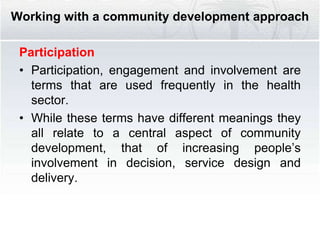
Participation
• Participation, engagement and involvement are
terms that are used frequently in the health
sector.
• While these terms have different meanings they
all relate to a central aspect of community
development, that of increasing people’s
involvement in decision, service design and
delivery.
Participation may be thought of as a ladder
which includes many different activities
Citizens are involved in planning
and decision-making through joint
comities, delegated
representatives or complete
control.
Citizens have a voice but may not
be heeded.
Those with power educate or cure
citizens are receipients.
Community empowerment
• A process by which communities gain more
control over the decisions and resources that
influence their lives, including the determinants
of health. Community empowerment builds from
the individuals to the group to the wider
collective and embodies the intention to bring
about social and political change (Laverack
2007, p.29).
Community Empowerment
Nine
domains to
understand
C.E by
Laverack
Improves
Participation
Develops Local
Leadership
Builds
empowering
Organizational
structure
Increase
problem
assessment
capacities
Enhances the
ability of
community to
“Ask Why”
Improve
Resource
mobilization
Strengthens
links to other
organization
and people
Creates an
equitable
relationship
with outside
agencies
Increase
control over
programme
management
Community-led
• In contrast to professionally determined
priorities, community development starts with
priorities identifies by and common to
communities.
• The term community-led requires us to make a
commitment to learning from communities, being
accountable to communities and working in
partnership.
Social Justice
• Community development recognizes that
inequalities exist within society and that some
communities are:
• More privileged,
• Better resourced and consequently
• More healthy than
Others communities.
Social
justice
mean
Working to
promote the
health of
disadvantaged
groups
Increasing the
accessibility of
sources
Influencing the
commissioning
of services
Acting as an
advocate and
representing
the interests of
disadvantaged
groups
Building a
social profile of
community,
highlighting the
relationship to
health status.
Types of Activities involved in community
development
• A large number of activities may be included as
part of a community development approach:
• Profiling,
• Capacity-building,
• Organizing,
• Networking and
• Negotiating
Profiling
• Community profiling involves the community,
statutory and voluntary organizations in identifying
the community’s:
• Needs,
• Particular issues and
• Resources
• It’s an important and early stage of community
development process.
Capacity-building
• Capacity-building is working with individuals and
groups within communities to recognize and develop
the skills and resources they have (their assets) in
order to identify and meet their own needs.
• The charity commission sees it as being concerned
with two key areas.
• Providing opportunities for people to learn through
experience-opportunities that would not otherwise be
available to them.
• Involving people in collective effort so that they gain
confidence in their own abilities and their ability to
influence decisions that affect them (Charity
commission 2000)
Organizing
• An important area of work that community
development workers are engaged in is the
process of organizing to organize the community
to work together collectively.
• This may include:
• Helping to establish self-help groups or
• Organizing community efforts such as health
forums
Networking
• Networks are the ties that link the people
together within communities. Gilchrist (2004,
2007) identifies two different types of networks:
• Strong ties: are based on bonds of:
• Friendship,
• Family relations and
• Whom we look for support and give
companionship.
• Weak ties: they link different clusters of networks
together-forming bridge between the sections of
community and/or between organizations.
Networking
• Both type of networks are an important asset
within a community and are an indicator of levels
of social capital.
• Strong networks creates opportunities for;
• Skills,
• Information,
• Learning,
• Creating energy and
• Lead more effective community action.
Negotiating
• Communities are not homogenous entities but
include;
• Hierarchies,
• Imbalances in power and
• Differences.
• Such diversity must be negotiated and managed
in order to achieve consensus, particularly in
relation to priorities needs and agreeing actions
to meet needs.
• Community development worker must negotiate
and advocate on behalf of community.
Dilemmas in community development practice
• Common dilemmas facing the community
development worker relates to:
• Funding,
• Accountability,
• Acceptability,
• The role of the professional and
• Evaluation
Funding
• Most community development projects are
funded by Statutory agencies, such as;
• Health authority,
• Education authority, and sometimes
• Joint funding.
• Other projects which might come under label
“community development” belong to voluntary
sector, and are funded by;
• Government grants fund raising
Accountability
• All community development workers have dual
accountability:
• To their employee and
• To their communities.
• Funding agencies naturally require projects to be
accountable, and this can lead to problems where the
priorities of the community and the agency are not the
same.
• Community development workers may feel themselves to be
trapped in the role of mediator, informing statutory services
about community needs and informing the community about
Acceptability
• Community development tends to focus on small
numbers of peoples whereas employers tend to
be responsible for large populations.
• Issues which are raised through a community
development approach (such as discrimination
in service provision) may be unacceptable to
employing authorities.
• Community development workers may also find
that they need to establish and negotiate their
role before they are accepted by a community.
Role of the professional
• Community development also poses problems
for workers whose primary training lies in other
areas.
• Professional workers are taught a particular area
of expertise and tend to assume that they know
what is best for their clients.
• They may be sensitive to individual
circumstances but the secondary socialization
encountered during professional training
reinforces the notion of expertise.
Role of the professional
• The task of professional is to enable a
community to express its needs, and support the
community in meeting those needs themselves.
• The skills involved in community work also tend
to be different from those acquired in
professional training (unless this includes
community development ).
Role of the professional
• Professional key skills concern process rather
than content and include:
Key
skill
s
Organizational skills, e.g.
Developing appropriate
management structures such as
management committees or
steering groups
Communication skills,
e.g. consultation and
communication with a
variety of groups
including community
groups, finding agency
and co-workers.
Evaluation skills, e.g.
monitoring the impact of
intervention and self-
evaluation
Evaluation
• Community development has often been
described as difficult to evaluate because it
works on so many levels, is a long-term strategy
and encompasses so many strands of work.
• ABCD model was developed by the Scottish
Community Development Centre to support both
the planning and evaluation of projects and
provides a framework for measuring
participation and empowerment (Barr &
Hashagen 2000).
Conclusion
• What [inner-city community health projects] are
doing is creating a climate in which some of the
most oppressed and deprived sections of our
urban communities can find a voice with which
to challenge the forces which both determine
their health and control the quantity and quality
of health services to which they have access
(Rosenthal 1983).
Reference
• Foundations for health promotion by Naidoo 4th
edition, chapter 10.
Strengthen community action

Strengthen community action

  • 2.
    Strengthen community Action PresentedBy: Ayaz Ahmed MPH-Fellow School of Public Health-DUHS
  • 3.
    Objective • Defining Communitydevelopment • Community development in health promotion • Working with a community development approach • Community development activities • Dilemmas for practice
  • 4.
    Defining Community • Thereare different ways of defining community, but the most commonly cited factors are geography, culture and social stratification. • These factors are viewed as being linked to the subjective feelings of belonging or identity which characterizes the concept of community. • Others factors are; • Social network or • systems of contact.
  • 5.
    Geography • A communitymay be defined on a geographical basis. A well known example is the east end London, but this use of community is not restricted to working class or urban areas.
  • 6.
    Culture • Community maybe defined in cultural terms, as in “the chinese community” or “the jewish community. • The most commonly cited elements of common cultural heritage are: • Ethnic origin, • Language, • Religion and • Customs.
  • 7.
    Social Stratification • Acommunity may be based on interests held to be common, which are usually the products of social stratification. • Thus we have; “the working class community” and “the gay community”. • Members of community shares; • Networks of support, • Knowledge and • Resources.
  • 8.
    Community • The meaningand significance of community vary enormously. • How one defines community is important because it influences how practitioners understand the dynamics within communities and the potential challenges that may present when working with them.
  • 9.
    Community development • Communitydevelopment has been defined as: • “ Building active and sustainable communities based on social justice and mutual respect. It is about changing power structures to remove the barriers that prevent people from participating in the issues that affects their lives . Community workers support individuals, groups and organization in this process (standing conference for community development 2001)”.
  • 10.
    Community development • Communitydevelopment is both a philosophy and a method. As a philosophy its key features are: • Equality • Enabling all communities to be heard • Valuing of peoples own experience • Collection of problems and together identify and implement action • Recognize the skills, knowledge and expertise • The empowerment of individuals and communities through education, skills development, sharing and joint action.
  • 11.
    Community development • Asa method it has two different characteristics: Community-based Community development Problem, targets and action defined by sponsoring body Problem, targets and action defined by community Community seen as medium, venue or setting for intervention Community itself the target of intervention in respect to capacity- building and empowerment Notion of ‘community’ relatively unproblematic Community recognized as complex, changing, subject to power imbalances and conflict Target is largely individuals within either geographic area or specific subgroup in geographic area defined by sponsoring body Target may be community structures or services and policies that impact on the health of the community Activities largely health-oriented Activities may be quite broad-based, targeting wider factors with an impact on health, but with indirect health outcomes (empowerment, social capital)
  • 12.
    Community development andhealth promotion • Community development is a recurring theme in health promotion. Shared personal experience led to a new understanding of health issues as well as providing positive effects and social cohesion for participants. Black and ethnic- minority groups also addressed health issues, particularly the effect of racism within the health services (Jones 1991). • In the latter part of 1980s there was wide spread lip service to the notion of community development, stimulated in part by WHO.
  • 13.
    Working with acommunity development approach • The ways in which community development is carried out vary enormously. However, there are a number of core principles underpinning community development work, which overlap and link together. These principles are: • Participation, • Community empowerment, • Community-led, and • Social justice
  • 14.
    Working with acommunity development approach Participation • Participation, engagement and involvement are terms that are used frequently in the health sector. • While these terms have different meanings they all relate to a central aspect of community development, that of increasing people’s involvement in decision, service design and delivery.
  • 15.
    Participation may bethought of as a ladder which includes many different activities Citizens are involved in planning and decision-making through joint comities, delegated representatives or complete control. Citizens have a voice but may not be heeded. Those with power educate or cure citizens are receipients.
  • 16.
    Community empowerment • Aprocess by which communities gain more control over the decisions and resources that influence their lives, including the determinants of health. Community empowerment builds from the individuals to the group to the wider collective and embodies the intention to bring about social and political change (Laverack 2007, p.29).
  • 17.
    Community Empowerment Nine domains to understand C.Eby Laverack Improves Participation Develops Local Leadership Builds empowering Organizational structure Increase problem assessment capacities Enhances the ability of community to “Ask Why” Improve Resource mobilization Strengthens links to other organization and people Creates an equitable relationship with outside agencies Increase control over programme management
  • 18.
    Community-led • In contrastto professionally determined priorities, community development starts with priorities identifies by and common to communities. • The term community-led requires us to make a commitment to learning from communities, being accountable to communities and working in partnership.
  • 19.
    Social Justice • Communitydevelopment recognizes that inequalities exist within society and that some communities are: • More privileged, • Better resourced and consequently • More healthy than Others communities.
  • 20.
    Social justice mean Working to promote the healthof disadvantaged groups Increasing the accessibility of sources Influencing the commissioning of services Acting as an advocate and representing the interests of disadvantaged groups Building a social profile of community, highlighting the relationship to health status.
  • 22.
    Types of Activitiesinvolved in community development • A large number of activities may be included as part of a community development approach: • Profiling, • Capacity-building, • Organizing, • Networking and • Negotiating
  • 23.
    Profiling • Community profilinginvolves the community, statutory and voluntary organizations in identifying the community’s: • Needs, • Particular issues and • Resources • It’s an important and early stage of community development process.
  • 24.
    Capacity-building • Capacity-building isworking with individuals and groups within communities to recognize and develop the skills and resources they have (their assets) in order to identify and meet their own needs. • The charity commission sees it as being concerned with two key areas. • Providing opportunities for people to learn through experience-opportunities that would not otherwise be available to them. • Involving people in collective effort so that they gain confidence in their own abilities and their ability to influence decisions that affect them (Charity commission 2000)
  • 25.
    Organizing • An importantarea of work that community development workers are engaged in is the process of organizing to organize the community to work together collectively. • This may include: • Helping to establish self-help groups or • Organizing community efforts such as health forums
  • 26.
    Networking • Networks arethe ties that link the people together within communities. Gilchrist (2004, 2007) identifies two different types of networks: • Strong ties: are based on bonds of: • Friendship, • Family relations and • Whom we look for support and give companionship. • Weak ties: they link different clusters of networks together-forming bridge between the sections of community and/or between organizations.
  • 27.
    Networking • Both typeof networks are an important asset within a community and are an indicator of levels of social capital. • Strong networks creates opportunities for; • Skills, • Information, • Learning, • Creating energy and • Lead more effective community action.
  • 28.
    Negotiating • Communities arenot homogenous entities but include; • Hierarchies, • Imbalances in power and • Differences. • Such diversity must be negotiated and managed in order to achieve consensus, particularly in relation to priorities needs and agreeing actions to meet needs. • Community development worker must negotiate and advocate on behalf of community.
  • 29.
    Dilemmas in communitydevelopment practice • Common dilemmas facing the community development worker relates to: • Funding, • Accountability, • Acceptability, • The role of the professional and • Evaluation
  • 30.
    Funding • Most communitydevelopment projects are funded by Statutory agencies, such as; • Health authority, • Education authority, and sometimes • Joint funding. • Other projects which might come under label “community development” belong to voluntary sector, and are funded by; • Government grants fund raising
  • 31.
    Accountability • All communitydevelopment workers have dual accountability: • To their employee and • To their communities. • Funding agencies naturally require projects to be accountable, and this can lead to problems where the priorities of the community and the agency are not the same. • Community development workers may feel themselves to be trapped in the role of mediator, informing statutory services about community needs and informing the community about
  • 32.
    Acceptability • Community developmenttends to focus on small numbers of peoples whereas employers tend to be responsible for large populations. • Issues which are raised through a community development approach (such as discrimination in service provision) may be unacceptable to employing authorities. • Community development workers may also find that they need to establish and negotiate their role before they are accepted by a community.
  • 33.
    Role of theprofessional • Community development also poses problems for workers whose primary training lies in other areas. • Professional workers are taught a particular area of expertise and tend to assume that they know what is best for their clients. • They may be sensitive to individual circumstances but the secondary socialization encountered during professional training reinforces the notion of expertise.
  • 34.
    Role of theprofessional • The task of professional is to enable a community to express its needs, and support the community in meeting those needs themselves. • The skills involved in community work also tend to be different from those acquired in professional training (unless this includes community development ).
  • 35.
    Role of theprofessional • Professional key skills concern process rather than content and include: Key skill s Organizational skills, e.g. Developing appropriate management structures such as management committees or steering groups Communication skills, e.g. consultation and communication with a variety of groups including community groups, finding agency and co-workers. Evaluation skills, e.g. monitoring the impact of intervention and self- evaluation
  • 36.
    Evaluation • Community developmenthas often been described as difficult to evaluate because it works on so many levels, is a long-term strategy and encompasses so many strands of work. • ABCD model was developed by the Scottish Community Development Centre to support both the planning and evaluation of projects and provides a framework for measuring participation and empowerment (Barr & Hashagen 2000).
  • 37.
    Conclusion • What [inner-citycommunity health projects] are doing is creating a climate in which some of the most oppressed and deprived sections of our urban communities can find a voice with which to challenge the forces which both determine their health and control the quantity and quality of health services to which they have access (Rosenthal 1983).
  • 38.
    Reference • Foundations forhealth promotion by Naidoo 4th edition, chapter 10.