Community
Action
CeeJae Perez
COMMUNITY
ACTION:
Community action refers to collective
efforts of people to address social
problems (e.g., social inequalities,
environmental degradation, and
poverty) in order to achieve human
well-being and community developmen
The following are
emphasized and
discussed
substantively in this
module: (1) community
engagement, (2)
solidarity, (3)
citizenship, and (4)
social change.
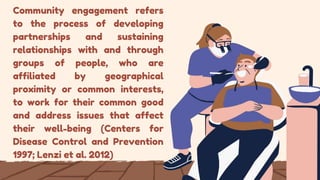
Community engagement refers
to the process of developing
partnerships and sustaining
relationships with and through
groups of people, who are
affiliated by geographical
proximity or common interests,
to work for their common good
and address issues that affect
their well-being (Centers for
Disease Control and Prevention
1997; Lenzi et al. 2012)
Community engagement requires
caring for other groups,
especially the
vulnerable and marginalized,
aside from your
family. It is necessary to help
such groups to
play a meaningful role towards
achieving
their well-being
Community engagement in
educational settings can take
many forms, but the most
common are service learning,
community outreach, and
community-engaged research
Service learning is a teaching
methodology that employs community
service and reflection on
service to teach community
engagement, develop greater
community and social responsibility,
and
strengthen communities (Donahue,
Fenner, and Mitchell 2015; Scott and
Graham 2015).
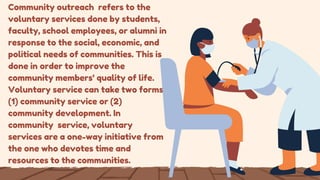
Community outreach refers to the
voluntary services done by students,
faculty, school employees, or alumni in
response to the social, economic, and
political needs of communities. This is
done in order to improve the
community members’ quality of life.
Voluntary service can take two forms:
(1) community service or (2)
community development. In
community service, voluntary
services are a one-way initiative from
the one who devotes time and
resources to the communities.
Community-engaged
research (CEnR) is a
collaborative process
between the faculty and/or
student researchers and the
partner community in
conducting research.
Levels and
Modalities of
Community
Engagement
Information
is a one-way dissemination of
information to community members. It
covers passive
access to information by people via
traditional media (posters, brochures,
telephone calls, or
word of mouth marketing), mass media
(newspaper, radio, television, Web
sites), and social
media (Facebook, Twitter, Instagram,
etc.). It also includes more active
measures to disseminate
information through community education
and community campaign awareness
Consultation
involves obtaining stakeholder
approval for a particular
initiative. It seeks to
interact with communities to
get feedback without direct
community participation in
project design, implementation,
and evaluation. However,
information gathered from
consultation can be used to
help frame an issue, identify
options for service learning,
community outreach, and CEnR
projects, and enrich the
Involvement
is about enlisting community
stakeholders as volunteers
and/or consumers of an
envisaged service learning,
community outreach, or CEnR
project and its associated
services
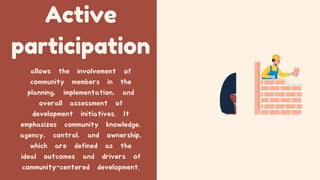
Active
participation
allows the involvement of
community members in the
planning, implementation, and
overall assessment of
development initiatives. It
emphasizes community knowledge,
agency, control, and ownership,
which are defined as the
ideal outcomes and drivers of
community-centered development.
Solidarity
refers to the firm and persevering
determination to commit oneself to the
common good by mutually supporting
and sustaining movements for social
change and social justice. These
movements could be local or global
and may take the form of policy and/or
action advocacies.
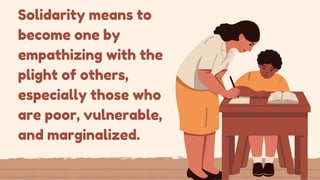
Solidarity means to
become one by
empathizing with the
plight of others,
especially those who
are poor, vulnerable,
and marginalized.
In Philippine society, among the
most common
sectors that are often
considered vulnerable,
oppressed, or marginalized are:
• rural poor (e.g., landless farmers, peasants,
fisherfolk)
• urban poor (e.g., contractual laborers and
workers from the informal economy)
• migrant workers and victims of human
trafficking
• poor children, youth, women, the elderly,
and street families
• indigenous people
• persons with disabilities
• prisoners and inmates
• victims or survivors of disaster
• lesbian, gay, bisexual, transsexual, queer,
In working with the
aforementioned sectors, solidarity
values the principle that there
is strength in numbers. Hence,
solidarity entails working with
the vulnerable, oppressed, and/or
marginalized sectors to face a
social problem and collectively
work for their emancipation.
This means that solidarity
requires action, not just
approval or lip-service support.
The emancipation goals that
solidarity strives
Health for
All.
All. It pertains to the understanding that
health—which is a state of complete physical,
mental, and social well-being, and not merely
the absence of disease or infirmity—is a
fundamental human right. Thus, every
human being is entitled to the
enjoyment of the highest possible
standard of health that is conducive
to living a life in dignity (UN 1966).
Education
for All.
This refers to bringing the benefits of
education to every citizen in society.
Research indicates that education enables
people to perform better economically,
enhances health
and extends life span, promotes civic engagement,
and improves one’s sense of well-being (ICSU
and ISSC 2015; UNESCO 2000). Thus, it
is imperative that access to education
(from kinder up to
senior high school) is viewed not as a
Good
Governance
for All.
This pertains to capacitating local communities
and institutions to
manage and regulate their own welfare in terms
of economic security, sociopolitical well-being,
and cultural preservation and progress. At the
same time, it shall help them establish an active
partnership with their respective local governments
to engage in the design and implementation of
economic, social, and environmental policies; to enhance each
other’s lasting development efforts;
and to bolster citizenship in the process (Abenir
Economic
Justice for
All.
It pertains to enabling all people—especially the
poor; the disadvantaged;
and discriminated men, women, and youth, who are
excluded from growth processes—to contribute
to and benefit from the overall growth
in the economy and be lifted above the
poverty line (Wagner
2006, Ravallion and Chen 2003).
Climate and
Environmental
Justice for All.
This refers to the fair
treatment and meaningful
involvement of all people in
the development, implementation,
and enforcement of
environmental
laws, regulations, and policies
(Pedersen 2011).
Citizenship
• its most basic sense, refers
to full membership in a
community in which one lives,
works, or was born (Atlanta
and Marquis 2010). However,
there are three interrelated
dimensions of citizenship that
shape its common notion of
understanding. According to
Leydet (2014), these three
pertain to the legal,
political, and identity
dimensions of citizenship.
Citizenship is about
being able to feel
safe in your country,
to voice out your
opinion, and to
freely participate in
shaping the destiny
of your nation
Citizenship
Education in
the Philippine
Preamble
We the sovereign Filipino people,
imploring the aid of Almighty God,
in order to build a just humane
society and establish a Government
that shall embody our ideals and
aspirations, promote the common
good, conserve and develop our
patrimony, and secure to ourselves
and our posterity the blessings of
independence and democracy under
the rule of law and a regime of
truth, justice, freedom, love,
equality, and peace, do ordain and
Based on the
Preamble,
the core
Filipino
values are:
• Pagkamaka-Diyos (being God-fearing) –
this encompasses faith in the
Almighty God.
• Pagkamaka-Tao (being humane) – this
includes the promotion of the
common good and valuing of truth,
justice, freedom, love, equality, and
peace.
• Pagkamaka-Bayan (being nationalistic and
patriotic) – this includes securing
the blessings of democracy and
respect for the rule of law, the
Philippine government, and its
instrumentalities.
• Pagkamaka-Kalikasan (being caring for the
environment) – this involves the
These core Filipino values are the
bases of Filipino citizenship within the
dimension of national
identity. They set the anchors of
Filipino identity as defined by the
nation-state—that is, the “Philippines
for the Filipinos.” Aside from this,
citizenship education in the country
also requires every Filipino
citizen to know the highest law of the
land—the 1987 Constitution. The 1987

Constitution enunciates
State principles and policies such as
the following
1. Sovereignty of the people
2. Renunciation of war as an
instrument of national policy
3. Supremacy at all times by the
civilian authority over the military
4. Service to and protection of the
people as the prime duty of the
government
5. Enjoyment of the blessing of
democracy by all people
6. Inviolable separation of Church and
State
7. Protection of the rights of
workers and the promotion of their
welfare
8. Separation of power among the
executive, legislative, and judicial branches
of government
Aside from the aforementioned
State principles and policies,
another central feature of the
Philippine Constitution is the Bill of
Rights. The Bill of Rights
enumerates the Filipino people’s
basic rights and liberties, which no
one, not even the government, is
allowed to violate or infringe upon.
Some of the rights granted by the
Constitution are the following:
1. Due process of law and equal
protection
2. Right against unreasonable
search and seizure
3. Right to privacy
4. Freedom of speech, of
expression, and of the press
5. Freedom of religion
6. Liberty of abode and travel
7. Right to information on matters
of public concern
8. Right to form unions and
associations for purposes not
contrary to law
9. Right to a just compensation
when private property is taken for

Community Action, Solidarity, Citezenship

  • 1.
  • 2.
    COMMUNITY ACTION: Community action refersto collective efforts of people to address social problems (e.g., social inequalities, environmental degradation, and poverty) in order to achieve human well-being and community developmen
  • 3.
    The following are emphasizedand discussed substantively in this module: (1) community engagement, (2) solidarity, (3) citizenship, and (4) social change.
  • 4.
    Community engagement refers tothe process of developing partnerships and sustaining relationships with and through groups of people, who are affiliated by geographical proximity or common interests, to work for their common good and address issues that affect their well-being (Centers for Disease Control and Prevention 1997; Lenzi et al. 2012)
  • 5.
    Community engagement requires caringfor other groups, especially the vulnerable and marginalized, aside from your family. It is necessary to help such groups to play a meaningful role towards achieving their well-being
  • 6.
    Community engagement in educationalsettings can take many forms, but the most common are service learning, community outreach, and community-engaged research
  • 7.
    Service learning isa teaching methodology that employs community service and reflection on service to teach community engagement, develop greater community and social responsibility, and strengthen communities (Donahue, Fenner, and Mitchell 2015; Scott and Graham 2015).
  • 8.
    Community outreach refersto the voluntary services done by students, faculty, school employees, or alumni in response to the social, economic, and political needs of communities. This is done in order to improve the community members’ quality of life. Voluntary service can take two forms: (1) community service or (2) community development. In community service, voluntary services are a one-way initiative from the one who devotes time and resources to the communities.
  • 9.
    Community-engaged research (CEnR) isa collaborative process between the faculty and/or student researchers and the partner community in conducting research.
  • 10.
  • 11.
    Information is a one-waydissemination of information to community members. It covers passive access to information by people via traditional media (posters, brochures, telephone calls, or word of mouth marketing), mass media (newspaper, radio, television, Web sites), and social media (Facebook, Twitter, Instagram, etc.). It also includes more active measures to disseminate information through community education and community campaign awareness
  • 12.
    Consultation involves obtaining stakeholder approvalfor a particular initiative. It seeks to interact with communities to get feedback without direct community participation in project design, implementation, and evaluation. However, information gathered from consultation can be used to help frame an issue, identify options for service learning, community outreach, and CEnR projects, and enrich the
  • 13.
    Involvement is about enlistingcommunity stakeholders as volunteers and/or consumers of an envisaged service learning, community outreach, or CEnR project and its associated services
  • 14.
    Active participation allows the involvementof community members in the planning, implementation, and overall assessment of development initiatives. It emphasizes community knowledge, agency, control, and ownership, which are defined as the ideal outcomes and drivers of community-centered development.
  • 15.
    Solidarity refers to thefirm and persevering determination to commit oneself to the common good by mutually supporting and sustaining movements for social change and social justice. These movements could be local or global and may take the form of policy and/or action advocacies.
  • 16.
    Solidarity means to becomeone by empathizing with the plight of others, especially those who are poor, vulnerable, and marginalized.
  • 17.
    In Philippine society,among the most common sectors that are often considered vulnerable, oppressed, or marginalized are: • rural poor (e.g., landless farmers, peasants, fisherfolk) • urban poor (e.g., contractual laborers and workers from the informal economy) • migrant workers and victims of human trafficking • poor children, youth, women, the elderly, and street families • indigenous people • persons with disabilities • prisoners and inmates • victims or survivors of disaster • lesbian, gay, bisexual, transsexual, queer,
  • 18.
    In working withthe aforementioned sectors, solidarity values the principle that there is strength in numbers. Hence, solidarity entails working with the vulnerable, oppressed, and/or marginalized sectors to face a social problem and collectively work for their emancipation. This means that solidarity requires action, not just approval or lip-service support. The emancipation goals that solidarity strives
  • 19.
    Health for All. All. Itpertains to the understanding that health—which is a state of complete physical, mental, and social well-being, and not merely the absence of disease or infirmity—is a fundamental human right. Thus, every human being is entitled to the enjoyment of the highest possible standard of health that is conducive to living a life in dignity (UN 1966).
  • 20.
    Education for All. This refersto bringing the benefits of education to every citizen in society. Research indicates that education enables people to perform better economically, enhances health and extends life span, promotes civic engagement, and improves one’s sense of well-being (ICSU and ISSC 2015; UNESCO 2000). Thus, it is imperative that access to education (from kinder up to senior high school) is viewed not as a
  • 21.
    Good Governance for All. This pertainsto capacitating local communities and institutions to manage and regulate their own welfare in terms of economic security, sociopolitical well-being, and cultural preservation and progress. At the same time, it shall help them establish an active partnership with their respective local governments to engage in the design and implementation of economic, social, and environmental policies; to enhance each other’s lasting development efforts; and to bolster citizenship in the process (Abenir
  • 22.
    Economic Justice for All. It pertainsto enabling all people—especially the poor; the disadvantaged; and discriminated men, women, and youth, who are excluded from growth processes—to contribute to and benefit from the overall growth in the economy and be lifted above the poverty line (Wagner 2006, Ravallion and Chen 2003).
  • 23.
    Climate and Environmental Justice forAll. This refers to the fair treatment and meaningful involvement of all people in the development, implementation, and enforcement of environmental laws, regulations, and policies (Pedersen 2011).
  • 24.
  • 25.
    • its mostbasic sense, refers to full membership in a community in which one lives, works, or was born (Atlanta and Marquis 2010). However, there are three interrelated dimensions of citizenship that shape its common notion of understanding. According to Leydet (2014), these three pertain to the legal, political, and identity dimensions of citizenship.
  • 26.
    Citizenship is about beingable to feel safe in your country, to voice out your opinion, and to freely participate in shaping the destiny of your nation
  • 27.
  • 28.
    Preamble We the sovereignFilipino people, imploring the aid of Almighty God, in order to build a just humane society and establish a Government that shall embody our ideals and aspirations, promote the common good, conserve and develop our patrimony, and secure to ourselves and our posterity the blessings of independence and democracy under the rule of law and a regime of truth, justice, freedom, love, equality, and peace, do ordain and
  • 29.
    Based on the Preamble, thecore Filipino values are: • Pagkamaka-Diyos (being God-fearing) – this encompasses faith in the Almighty God. • Pagkamaka-Tao (being humane) – this includes the promotion of the common good and valuing of truth, justice, freedom, love, equality, and peace. • Pagkamaka-Bayan (being nationalistic and patriotic) – this includes securing the blessings of democracy and respect for the rule of law, the Philippine government, and its instrumentalities. • Pagkamaka-Kalikasan (being caring for the environment) – this involves the
  • 30.
    These core Filipinovalues are the bases of Filipino citizenship within the dimension of national identity. They set the anchors of Filipino identity as defined by the nation-state—that is, the “Philippines for the Filipinos.” Aside from this, citizenship education in the country also requires every Filipino citizen to know the highest law of the land—the 1987 Constitution. The 1987 Constitution enunciates State principles and policies such as the following 1. Sovereignty of the people 2. Renunciation of war as an instrument of national policy 3. Supremacy at all times by the civilian authority over the military 4. Service to and protection of the people as the prime duty of the government 5. Enjoyment of the blessing of democracy by all people 6. Inviolable separation of Church and State 7. Protection of the rights of workers and the promotion of their welfare 8. Separation of power among the executive, legislative, and judicial branches of government

  • 31.
    Aside from theaforementioned State principles and policies, another central feature of the Philippine Constitution is the Bill of Rights. The Bill of Rights enumerates the Filipino people’s basic rights and liberties, which no one, not even the government, is allowed to violate or infringe upon. Some of the rights granted by the Constitution are the following:
  • 32.
    1. Due processof law and equal protection 2. Right against unreasonable search and seizure 3. Right to privacy 4. Freedom of speech, of expression, and of the press 5. Freedom of religion 6. Liberty of abode and travel 7. Right to information on matters of public concern 8. Right to form unions and associations for purposes not contrary to law 9. Right to a just compensation when private property is taken for