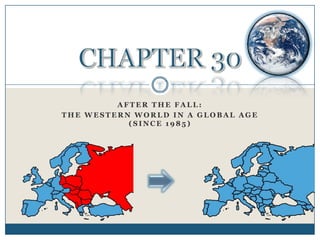
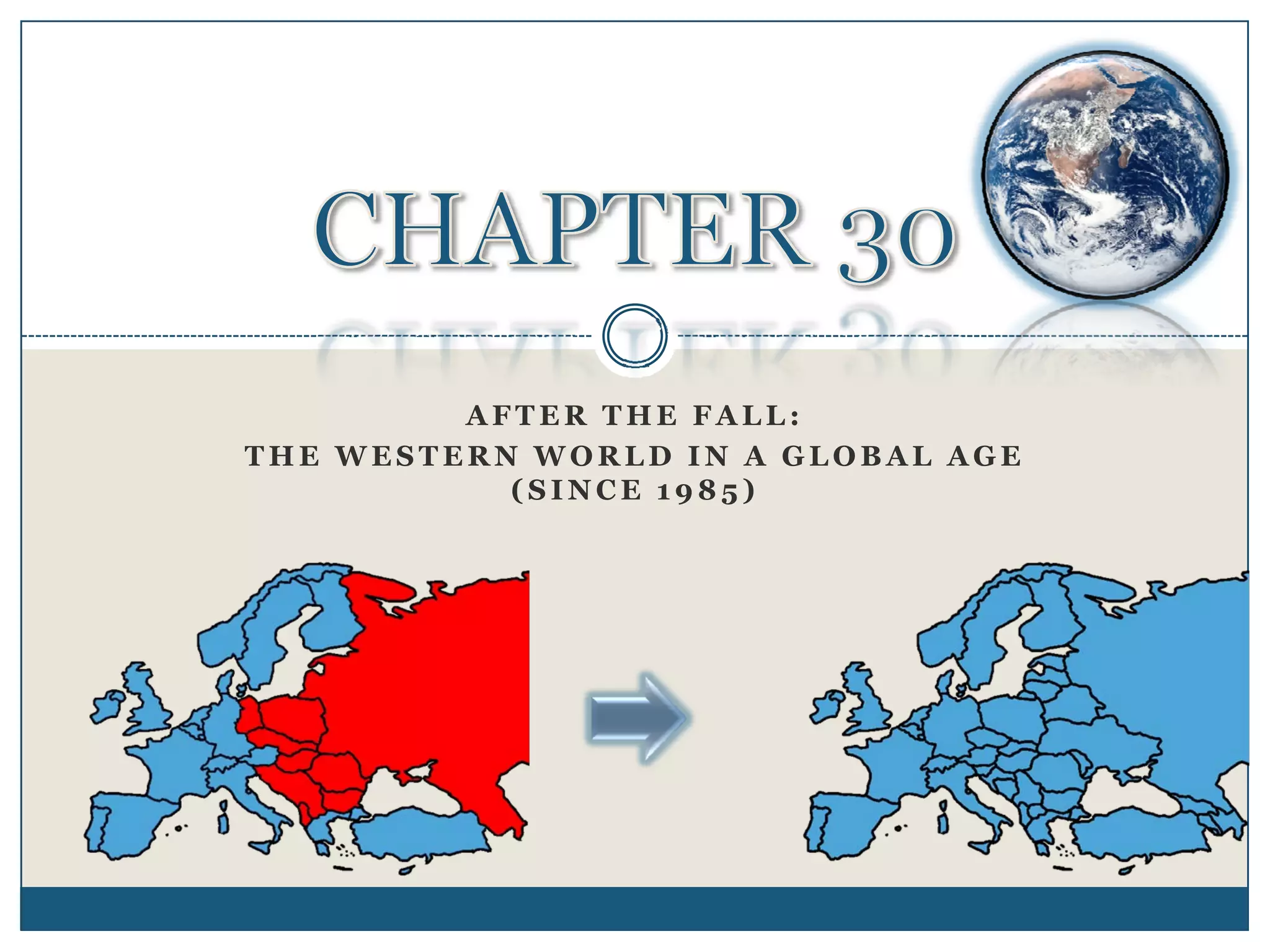
AFTER THE FALL:
THE WESTERN WORLD IN A GLOBAL AGE
           (SINCE 1985)
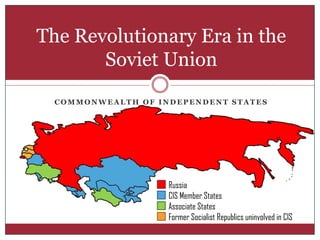
The Revolutionary Era in the
       Soviet Union
  COMMONWEALTH OF INDEPENDENT STATES


                    Russia
                    CIS Member States
                    Associate States
                    Former Socialist Republics uninvolved in CIS
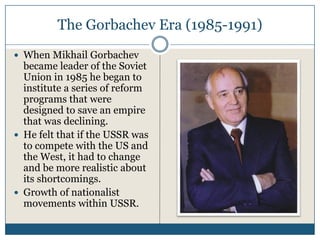
The Gorbachev Era (1985-1991)
When Mikhail Gorbachev
became leader of the Soviet
Union in 1985 he began to
institute a series of reform
programs that were
designed to save an empire
that was declining.
He felt that if the USSR was
to compete with the US and
the West, it had to change
and be more realistic about
its shortcomings.
Growth of nationalist
movements within USSR.
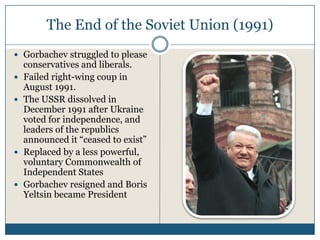
The End of the Soviet Union (1991)
Gorbachev struggled to please
conservatives and liberals.
Failed right-wing coup in
August 1991.
The USSR dissolved in
December 1991 after Ukraine
voted for independence, and
leaders of the republics
announced it “ceased to exist”
Replaced by a less powerful,
voluntary Commonwealth of
Independent States
Gorbachev resigned and Boris
Yeltsin became President
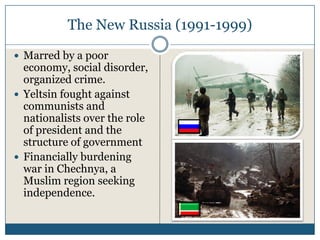
The New Russia (1991-1999)

Marred by a poor
economy, social disorder,
organized crime.
Yeltsin fought against
communists and
nationalists over the role
of president and the
structure of government
Financially burdening
war in Chechnya, a
Muslim region seeking
independence.
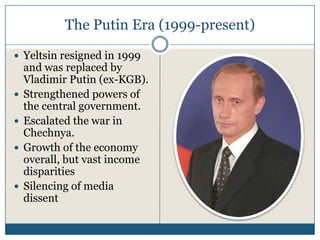
The Putin Era (1999-present)

Yeltsin resigned in 1999
and was replaced by
Vladimir Putin (ex-KGB).
Strengthened powers of
the central government.
Escalated the war in
Chechnya.
Growth of the economy
overall, but vast income
disparities
Silencing of media
dissent
Question 1

The ruling policies of Mikhail Gorbachev in the Soviet
Union
a) included the forcible          d) grew out of Russian
   exportation of Russian            misperceptions of United
   Communism to Central and          States strengths and failed
   South America.                    to appreciate that American
b) evoked a "New Thinking"           military spending and tax
   about world affairs and the       reductions under Ronald
   balance of power leading to       Reagan had greatly
   new arms limitation treaties      increased American budget
   and greater autonomy for          deficits.
   Communist regimes in           e) led to a reform of Soviet
   Eastern Europe.                   Communism and the
c) increased political               permanent strengthening of
   repression in Russia and in       the Soviet regime.
   Eastern Europe.
Question 2

Mikhail Gorbachev's radical reforms included all of the
following except

a) the creation of a new       d) to initiate policies of
   Soviet Parliament.             perestroika and
b) the creation of a market       glasnost.
   economy with limited        e) the termination of the
   free enterprise and            office of president of
   private property.
                                  the Soviet Union.
c) to open discussion of
   Soviet weaknesses in
   public.
Question 3

After the breakup of the Soviet Union, the leader of
Russia became

a)   Boris Yeltsin.
b)   Andrei Sakharov.
c)   Leonid Brezhnev.
d)   Josif Venediktov.
e)   Vladimir Putin.
Question 4

After the fall of the Soviet Union, Russia struggled with all
of the following except:

a) a renewed                    d) economic hardships.
   Communist Party              e) a president who was
   majority which took             often ill.
   over the government.
b) organized crime.
c) an uprising in largely
   Muslim Chechnya.
Question 5

Under Vladimir Putin's presidency, all of the following
have occurred except:

a) power was centralized       d) the economy grew
   in the federal                 significantly and the
   government.                    government had a
b) Russia ended its               budget surplus.
   involvement in              e) the economy
   Chechnya.                      significantly
c) as many as 40 percent          depended upon
   of the population lived
                                  exports of oil and
                                  natural gas.
   in poverty.
Question 6

The first and most successful independence movements among the
Soviet republics during Gorbachev's rule occurred in the Baltic area of


a)   Afghanistan.
b)   Azerbaijan.
c)   Lithuania.
d)   Georgia.
e)   Chechnya.
Question 7

Boris Yeltsin was succeeded as president of Russia by


a)   Lech Walesa.
b)   Mikhail Gorbachev.
c)   Vladimir Putin.
d)   Yuri Andropov.
e)   Andrei Sakharov.
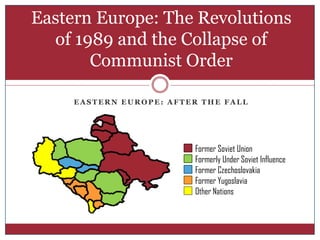
Eastern Europe: The Revolutions
  of 1989 and the Collapse of
       Communist Order

     EASTERN EUROPE: AFTER THE FALL


                         Former Soviet Union
                         Formerly Under Soviet Influence
                         Former Czechoslovakia
                         Former Yugoslavia
                         Other Nations
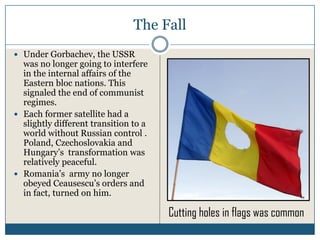
The Fall
Under Gorbachev, the USSR
was no longer going to interfere
in the internal affairs of the
Eastern bloc nations. This
signaled the end of communist
regimes.
Each former satellite had a
slightly different transition to a
world without Russian control .
Poland, Czechoslovakia and
Hungary’s transformation was
relatively peaceful.
Romania’s army no longer
obeyed Ceausescu’s orders and
in fact, turned on him.

                                     Cutting holes in flags was common
After the Fall
Once the initial euphoria of a
post-Soviet world set in many
East European nations faced
daunting problems including a
lack of democratic tradition
and weak economies. Ethnic
squabbling emerged
particularly in Czechoslovakia.
Many nations applied for
inclusion into the European
Union or NATO.
Some worried about West
Europe’s dominance.
The Reunification of Germany

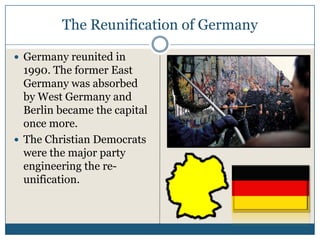
Germany reunited in
1990. The former East
Germany was absorbed
by West Germany and
Berlin became the capital
once more.
The Christian Democrats
were the major party
engineering the re-
unification.
The Disintegration of Yugoslavia
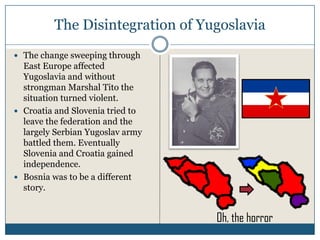
The change sweeping through
East Europe affected
Yugoslavia and without
strongman Marshal Tito the
situation turned violent.
Croatia and Slovenia tried to
leave the federation and the
largely Serbian Yugoslav army
battled them. Eventually
Slovenia and Croatia gained
independence.
Bosnia was to be a different
story.


                                Oh, the horror
War in Bosnia
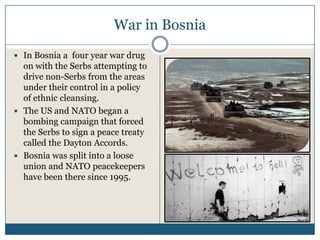
In Bosnia a four year war drug
on with the Serbs attempting to
drive non-Serbs from the areas
under their control in a policy
of ethnic cleansing.
The US and NATO began a
bombing campaign that forced
the Serbs to sign a peace treaty
called the Dayton Accords.
Bosnia was split into a loose
union and NATO peacekeepers
have been there since 1995.
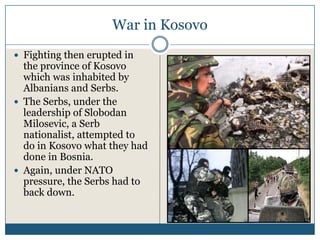
War in Kosovo
Fighting then erupted in
the province of Kosovo
which was inhabited by
Albanians and Serbs.
The Serbs, under the
leadership of Slobodan
Milosevic, a Serb
nationalist, attempted to
do in Kosovo what they had
done in Bosnia.
Again, under NATO
pressure, the Serbs had to
back down.
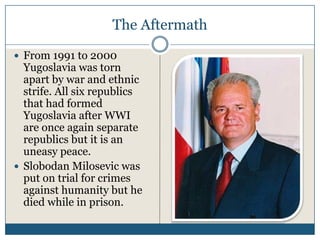
The Aftermath

From 1991 to 2000
Yugoslavia was torn
apart by war and ethnic
strife. All six republics
that had formed
Yugoslavia after WWI
are once again separate
republics but it is an
uneasy peace.
Slobodan Milosevic was
put on trial for crimes
against humanity but he
died while in prison.
Question 8

The Solidarity movement in Poland

a) was temporarily           d) lacked solidarity and
   crushed by General
   Lech Walesa in 1981.         quickly disintegrated
b) failed to gain massive       and disappeared in
   support due to stiff         1980.
   opposition from the
   conservative Polish       e) ended the
   Catholic church.             Communist
c) was formed by                monopoly of power in
   Wladyslaw Gomulka in
   1956.                        1988-1989.
Question 9

In 1988, the first free parliamentary elections to occur in
Eastern Europe for forty years took place in

a)   Hungary.
b)   Austria.
c)   Poland.
d)   Estonia.
e)   Lithuania.
Question 10

The leader of Czechoslovakia in 1990 who replaced the Communist
government was the former dissident writer and philosopher


a)   Kádár.
b)   Husák.
c)   Dubcek.
d)   Havel.
e)   Dubrovnik.
Question 11

The brutal dictatorial Communist government of Nicolae
Ceausecu came to an end 1989 in

a)   Czechoslovakia.
b)   Bulgaria.
c)   East Germany.
d)   Romania.
e)   Yugoslavia.
Question 12

An Eastern European republic that, fueled by ethnic rivalries, came
into existence in 1993 with the breakup of a previously existing state is


a)   Lithuania.
b)   Estonia.
c)   Albania.
d)   Lichtenstein.
e)   Slovakia.
Question 13

Probably the most symbolic events ending the Cold War
was

a) the death of Mao.         d) the fall of the Berlin
b) the Helsinki Accords.        Wall.
c) Russia's defeat in the    e) the election of Boris
   Afghan war.                  Yeltsin as president of
                                the Soviet Union.
Question 14

The politician who kept the fractious state of Yugoslavia
together for decades after World War II was

a) Marshall Tito.
b) General Filopovic.
c) President Milosevic.
d) Prime Minister
   Kostunica.
e) Marshall Petain.
Question 15

Yugoslavia was divided into warring factions because of


a) demands for ethnic
   separatism.
b) differences of
   political goals.
c) support of the Serbs.
d) lack of cultural
   diversity.
e) religious uniformity.
Question 16

The Dayton Accords of November 1995

a) recognized the            d) did not require the
   recreation of a unified
   Yugoslavia.                  use of military force
b) brought an end to the        by NATO for their
   war in Bosnia with a         achievement.
   peace plan acceptable
   to Bosnian Muslims,       e) failed due to
   Croatians, and Serbs.        intervention by the
c) were achieved despite        European
   the opposition of the
   United States.               Community.
Question 17

The tactic of "ethnic cleansing," murdering or forcibly removing ethnic
minorities from their lands in the former Yugoslavia, is a savage
strategy of modern political terror practiced most brutally by

a)   Serbs.
b)   Croatians.
c)   Bosnians.
d)   Herzgovenians.
e)   Slovenes.
Question 18

The Yugoslavian president ousted from power in 2000 and who was
subsequently put on trial for war crimes against humanity was


a)   Vojislav Kostunica.
b)   Nicolae Ceausescu.
c)   Wladyslaw Gomulka.
d)   Todor Zhivkov.
e)   Slobodan Milosevic.
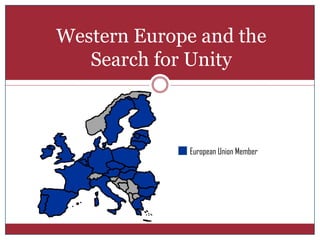
Western Europe and the
   Search for Unity


             European Union Member
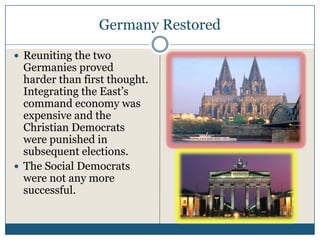
Germany Restored

Reuniting the two
Germanies proved
harder than first thought.
Integrating the East’s
command economy was
expensive and the
Christian Democrats
were punished in
subsequent elections.
The Social Democrats
were not any more
successful.
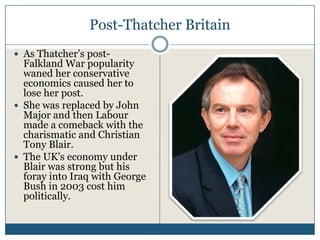
Post-Thatcher Britain
As Thatcher’s post-
Falkland War popularity
waned her conservative
economics caused her to
lose her post.
She was replaced by John
Major and then Labour
made a comeback with the
charismatic and Christian
Tony Blair.
The UK’s economy under
Blair was strong but his
foray into Iraq with George
Bush in 2003 cost him
politically.
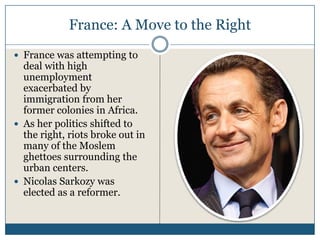
France: A Move to the Right
France was attempting to
deal with high
unemployment
exacerbated by
immigration from her
former colonies in Africa.
As her politics shifted to
the right, riots broke out in
many of the Moslem
ghettoes surrounding the
urban centers.
Nicolas Sarkozy was
elected as a reformer.
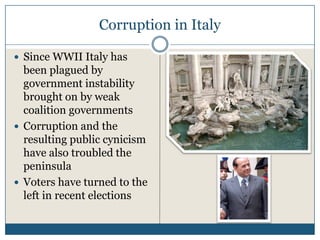
Corruption in Italy

Since WWII Italy has
been plagued by
government instability
brought on by weak
coalition governments
Corruption and the
resulting public cynicism
have also troubled the
peninsula
Voters have turned to the
left in recent elections
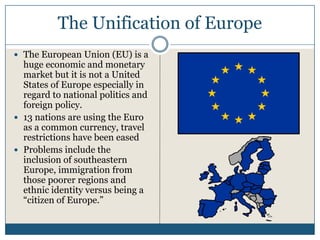
The Unification of Europe
The European Union (EU) is a
huge economic and monetary
market but it is not a United
States of Europe especially in
regard to national politics and
foreign policy.
13 nations are using the Euro
as a common currency, travel
restrictions have been eased
Problems include the
inclusion of southeastern
Europe, immigration from
those poorer regions and
ethnic identity versus being a
“citizen of Europe.”
Question 19

The reunification of Germany was accomplished under
the leadership of

a)   Willy Brandt.
b)   Conrad Adenauer.
c)   Helmut Schmidt.
d)   Gunter Grass.
e)   Helmut Kohl.
Question 20

The issue that fatally weakened Margaret Thatcher's government and
which eventually brought the Labour Party to power was


a) the Falklands War.               d) a drastic increase in
b) race riots in London.               air and water
c) the proposal for a                  pollution.
   flat-rate poll tax.              e) the nationalization of
                                       Britain's railroads.
Question 21

The individual who succeeded Tony Blair as Britain's
prime minister in 2007 was

a)   Gordon Brown.
b)   John Major.
c)   Clement Attlee.
d)   Nicolas Sarkozy.
e)   James Callaghan.
Question 22

The British prime minister who gave support to the United
States in the war on terror and in the Iraq War was

a)   Margaret Thatcher.
b)   James Callaghan.
c)   John Major.
d)   Tony Blair.
e)   Ramsey McDonald.
Question 23

By 1995, a major issue in French society was


a) whether to support          c) to leave the Common
   America's "war on              Market in protest to
   terror."                       high subsidies to
b) to rejoin NATO,                agriculture.
   which France had left       d) resentment against
   in the 1960s.                  immigrants.
                               e) massive inflation.
Question 24

The new French president elected in 2007 was


a)   Jacques Chirac.
b)   Francois Mitterrand.
c)   Jacques Le Pen.
d)   Yves Montand.
e)   Nicolas Sarkozy.
Question 25

The major issue that troubled Italian society in recent
decades has been

a) Islamic terrorism.           d) a significant increase
b) Catholic                        in the birth rate.
   fundamentalism               e) economic collapse,
c) political corruption.           with high
                                   unemployment and
                                   bankruptcies.
Question 26

The common currency that was initially adopted by eleven
member states of the European Union is the

a)   continental.
b)   euro.
c)   maastricht.
d)   francmark.
e)   freipence.
Question 27

Challenges facing the Economic Union in the early
twenty-first century include

a) the lack of a common       d) lack of economic
   currency.                     assistance to Europe's
b) the lack of any military      farming community.
   force.                     e) the failure to create a
c) many Europeans                truly single internal
   remain committed to a         market.
   national identify and
   do not see themselves
   as "Europeans."
Question 28

By 2004, the population of the European Union was


a)   455 million.
b)   355 million.
c)   295 million.
d)   245 million.
e)   550 million.

Chapter 30a

  • 1.
    AFTER THE FALL: THEWESTERN WORLD IN A GLOBAL AGE (SINCE 1985)
  • 2.
    The Revolutionary Erain the Soviet Union COMMONWEALTH OF INDEPENDENT STATES Russia CIS Member States Associate States Former Socialist Republics uninvolved in CIS
  • 3.
    The Gorbachev Era(1985-1991) When Mikhail Gorbachev became leader of the Soviet Union in 1985 he began to institute a series of reform programs that were designed to save an empire that was declining. He felt that if the USSR was to compete with the US and the West, it had to change and be more realistic about its shortcomings. Growth of nationalist movements within USSR.
  • 4.
    The End ofthe Soviet Union (1991) Gorbachev struggled to please conservatives and liberals. Failed right-wing coup in August 1991. The USSR dissolved in December 1991 after Ukraine voted for independence, and leaders of the republics announced it “ceased to exist” Replaced by a less powerful, voluntary Commonwealth of Independent States Gorbachev resigned and Boris Yeltsin became President
  • 5.
    The New Russia(1991-1999) Marred by a poor economy, social disorder, organized crime. Yeltsin fought against communists and nationalists over the role of president and the structure of government Financially burdening war in Chechnya, a Muslim region seeking independence.
  • 6.
    The Putin Era(1999-present) Yeltsin resigned in 1999 and was replaced by Vladimir Putin (ex-KGB). Strengthened powers of the central government. Escalated the war in Chechnya. Growth of the economy overall, but vast income disparities Silencing of media dissent
  • 7.
    Question 1 The rulingpolicies of Mikhail Gorbachev in the Soviet Union a) included the forcible d) grew out of Russian exportation of Russian misperceptions of United Communism to Central and States strengths and failed South America. to appreciate that American b) evoked a "New Thinking" military spending and tax about world affairs and the reductions under Ronald balance of power leading to Reagan had greatly new arms limitation treaties increased American budget and greater autonomy for deficits. Communist regimes in e) led to a reform of Soviet Eastern Europe. Communism and the c) increased political permanent strengthening of repression in Russia and in the Soviet regime. Eastern Europe.
  • 8.
    Question 2 Mikhail Gorbachev'sradical reforms included all of the following except a) the creation of a new d) to initiate policies of Soviet Parliament. perestroika and b) the creation of a market glasnost. economy with limited e) the termination of the free enterprise and office of president of private property. the Soviet Union. c) to open discussion of Soviet weaknesses in public.
  • 9.
    Question 3 After thebreakup of the Soviet Union, the leader of Russia became a) Boris Yeltsin. b) Andrei Sakharov. c) Leonid Brezhnev. d) Josif Venediktov. e) Vladimir Putin.
  • 10.
    Question 4 After thefall of the Soviet Union, Russia struggled with all of the following except: a) a renewed d) economic hardships. Communist Party e) a president who was majority which took often ill. over the government. b) organized crime. c) an uprising in largely Muslim Chechnya.
  • 11.
    Question 5 Under VladimirPutin's presidency, all of the following have occurred except: a) power was centralized d) the economy grew in the federal significantly and the government. government had a b) Russia ended its budget surplus. involvement in e) the economy Chechnya. significantly c) as many as 40 percent depended upon of the population lived exports of oil and natural gas. in poverty.
  • 12.
    Question 6 The firstand most successful independence movements among the Soviet republics during Gorbachev's rule occurred in the Baltic area of a) Afghanistan. b) Azerbaijan. c) Lithuania. d) Georgia. e) Chechnya.
  • 13.
    Question 7 Boris Yeltsinwas succeeded as president of Russia by a) Lech Walesa. b) Mikhail Gorbachev. c) Vladimir Putin. d) Yuri Andropov. e) Andrei Sakharov.
  • 14.
    Eastern Europe: TheRevolutions of 1989 and the Collapse of Communist Order EASTERN EUROPE: AFTER THE FALL Former Soviet Union Formerly Under Soviet Influence Former Czechoslovakia Former Yugoslavia Other Nations
  • 15.
    The Fall Under Gorbachev,the USSR was no longer going to interfere in the internal affairs of the Eastern bloc nations. This signaled the end of communist regimes. Each former satellite had a slightly different transition to a world without Russian control . Poland, Czechoslovakia and Hungary’s transformation was relatively peaceful. Romania’s army no longer obeyed Ceausescu’s orders and in fact, turned on him. Cutting holes in flags was common
  • 16.
    After the Fall Oncethe initial euphoria of a post-Soviet world set in many East European nations faced daunting problems including a lack of democratic tradition and weak economies. Ethnic squabbling emerged particularly in Czechoslovakia. Many nations applied for inclusion into the European Union or NATO. Some worried about West Europe’s dominance.
  • 17.
    The Reunification ofGermany Germany reunited in 1990. The former East Germany was absorbed by West Germany and Berlin became the capital once more. The Christian Democrats were the major party engineering the re- unification.
  • 18.
    The Disintegration ofYugoslavia The change sweeping through East Europe affected Yugoslavia and without strongman Marshal Tito the situation turned violent. Croatia and Slovenia tried to leave the federation and the largely Serbian Yugoslav army battled them. Eventually Slovenia and Croatia gained independence. Bosnia was to be a different story. Oh, the horror
  • 19.
    War in Bosnia InBosnia a four year war drug on with the Serbs attempting to drive non-Serbs from the areas under their control in a policy of ethnic cleansing. The US and NATO began a bombing campaign that forced the Serbs to sign a peace treaty called the Dayton Accords. Bosnia was split into a loose union and NATO peacekeepers have been there since 1995.
  • 20.
    War in Kosovo Fightingthen erupted in the province of Kosovo which was inhabited by Albanians and Serbs. The Serbs, under the leadership of Slobodan Milosevic, a Serb nationalist, attempted to do in Kosovo what they had done in Bosnia. Again, under NATO pressure, the Serbs had to back down.
  • 21.
    The Aftermath From 1991to 2000 Yugoslavia was torn apart by war and ethnic strife. All six republics that had formed Yugoslavia after WWI are once again separate republics but it is an uneasy peace. Slobodan Milosevic was put on trial for crimes against humanity but he died while in prison.
  • 22.
    Question 8 The Solidaritymovement in Poland a) was temporarily d) lacked solidarity and crushed by General Lech Walesa in 1981. quickly disintegrated b) failed to gain massive and disappeared in support due to stiff 1980. opposition from the conservative Polish e) ended the Catholic church. Communist c) was formed by monopoly of power in Wladyslaw Gomulka in 1956. 1988-1989.
  • 23.
    Question 9 In 1988,the first free parliamentary elections to occur in Eastern Europe for forty years took place in a) Hungary. b) Austria. c) Poland. d) Estonia. e) Lithuania.
  • 24.
    Question 10 The leaderof Czechoslovakia in 1990 who replaced the Communist government was the former dissident writer and philosopher a) Kádár. b) Husák. c) Dubcek. d) Havel. e) Dubrovnik.
  • 25.
    Question 11 The brutaldictatorial Communist government of Nicolae Ceausecu came to an end 1989 in a) Czechoslovakia. b) Bulgaria. c) East Germany. d) Romania. e) Yugoslavia.
  • 26.
    Question 12 An EasternEuropean republic that, fueled by ethnic rivalries, came into existence in 1993 with the breakup of a previously existing state is a) Lithuania. b) Estonia. c) Albania. d) Lichtenstein. e) Slovakia.
  • 27.
    Question 13 Probably themost symbolic events ending the Cold War was a) the death of Mao. d) the fall of the Berlin b) the Helsinki Accords. Wall. c) Russia's defeat in the e) the election of Boris Afghan war. Yeltsin as president of the Soviet Union.
  • 28.
    Question 14 The politicianwho kept the fractious state of Yugoslavia together for decades after World War II was a) Marshall Tito. b) General Filopovic. c) President Milosevic. d) Prime Minister Kostunica. e) Marshall Petain.
  • 29.
    Question 15 Yugoslavia wasdivided into warring factions because of a) demands for ethnic separatism. b) differences of political goals. c) support of the Serbs. d) lack of cultural diversity. e) religious uniformity.
  • 30.
    Question 16 The DaytonAccords of November 1995 a) recognized the d) did not require the recreation of a unified Yugoslavia. use of military force b) brought an end to the by NATO for their war in Bosnia with a achievement. peace plan acceptable to Bosnian Muslims, e) failed due to Croatians, and Serbs. intervention by the c) were achieved despite European the opposition of the United States. Community.
  • 31.
    Question 17 The tacticof "ethnic cleansing," murdering or forcibly removing ethnic minorities from their lands in the former Yugoslavia, is a savage strategy of modern political terror practiced most brutally by a) Serbs. b) Croatians. c) Bosnians. d) Herzgovenians. e) Slovenes.
  • 32.
    Question 18 The Yugoslavianpresident ousted from power in 2000 and who was subsequently put on trial for war crimes against humanity was a) Vojislav Kostunica. b) Nicolae Ceausescu. c) Wladyslaw Gomulka. d) Todor Zhivkov. e) Slobodan Milosevic.
  • 33.
    Western Europe andthe Search for Unity European Union Member
  • 34.
    Germany Restored Reuniting thetwo Germanies proved harder than first thought. Integrating the East’s command economy was expensive and the Christian Democrats were punished in subsequent elections. The Social Democrats were not any more successful.
  • 35.
    Post-Thatcher Britain As Thatcher’spost- Falkland War popularity waned her conservative economics caused her to lose her post. She was replaced by John Major and then Labour made a comeback with the charismatic and Christian Tony Blair. The UK’s economy under Blair was strong but his foray into Iraq with George Bush in 2003 cost him politically.
  • 36.
    France: A Moveto the Right France was attempting to deal with high unemployment exacerbated by immigration from her former colonies in Africa. As her politics shifted to the right, riots broke out in many of the Moslem ghettoes surrounding the urban centers. Nicolas Sarkozy was elected as a reformer.
  • 37.
    Corruption in Italy SinceWWII Italy has been plagued by government instability brought on by weak coalition governments Corruption and the resulting public cynicism have also troubled the peninsula Voters have turned to the left in recent elections
  • 38.
    The Unification ofEurope The European Union (EU) is a huge economic and monetary market but it is not a United States of Europe especially in regard to national politics and foreign policy. 13 nations are using the Euro as a common currency, travel restrictions have been eased Problems include the inclusion of southeastern Europe, immigration from those poorer regions and ethnic identity versus being a “citizen of Europe.”
  • 39.
    Question 19 The reunificationof Germany was accomplished under the leadership of a) Willy Brandt. b) Conrad Adenauer. c) Helmut Schmidt. d) Gunter Grass. e) Helmut Kohl.
  • 40.
    Question 20 The issuethat fatally weakened Margaret Thatcher's government and which eventually brought the Labour Party to power was a) the Falklands War. d) a drastic increase in b) race riots in London. air and water c) the proposal for a pollution. flat-rate poll tax. e) the nationalization of Britain's railroads.
  • 41.
    Question 21 The individualwho succeeded Tony Blair as Britain's prime minister in 2007 was a) Gordon Brown. b) John Major. c) Clement Attlee. d) Nicolas Sarkozy. e) James Callaghan.
  • 42.
    Question 22 The Britishprime minister who gave support to the United States in the war on terror and in the Iraq War was a) Margaret Thatcher. b) James Callaghan. c) John Major. d) Tony Blair. e) Ramsey McDonald.
  • 43.
    Question 23 By 1995,a major issue in French society was a) whether to support c) to leave the Common America's "war on Market in protest to terror." high subsidies to b) to rejoin NATO, agriculture. which France had left d) resentment against in the 1960s. immigrants. e) massive inflation.
  • 44.
    Question 24 The newFrench president elected in 2007 was a) Jacques Chirac. b) Francois Mitterrand. c) Jacques Le Pen. d) Yves Montand. e) Nicolas Sarkozy.
  • 45.
    Question 25 The majorissue that troubled Italian society in recent decades has been a) Islamic terrorism. d) a significant increase b) Catholic in the birth rate. fundamentalism e) economic collapse, c) political corruption. with high unemployment and bankruptcies.
  • 46.
    Question 26 The commoncurrency that was initially adopted by eleven member states of the European Union is the a) continental. b) euro. c) maastricht. d) francmark. e) freipence.
  • 47.
    Question 27 Challenges facingthe Economic Union in the early twenty-first century include a) the lack of a common d) lack of economic currency. assistance to Europe's b) the lack of any military farming community. force. e) the failure to create a c) many Europeans truly single internal remain committed to a market. national identify and do not see themselves as "Europeans."
  • 48.
    Question 28 By 2004,the population of the European Union was a) 455 million. b) 355 million. c) 295 million. d) 245 million. e) 550 million.