Communication Technology
Done by:
M.GAGAN SRI SAI
CLASS – 9
SECTION – A/1
ROLL NO.2
Introduction
Communication is the essence of human
civilization.
The development of communication
technology has changed the means and modes
of communication.
Now people communicate through e-mails,
mobiles, video calls, etc.
The main ides is to transfer the data or
information at high speed.
Contents
Data
Information
Multimedia
Networking
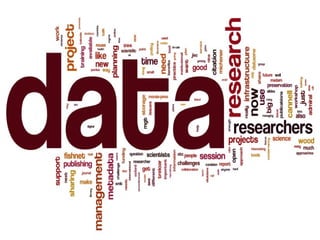
DATA
The word data is the plural of datum, though
data is commonly used to represent both
singular and plural forms.
Data is the measurement of the attributes or
characteristics of entities like people, places,
things, and events.
The measurements are usually represented by
symbols like numbers, alphabetical, and other
characters.
Data can be numeric, text, image or voice.
INFORMATION
Information refers to processed data. It is
meaningful and helps in making decisions.
A company launches a new product, say, a face
wash and gives a pound of 5ml free of cost to
100 families. After a week, a survey result
decides how to proceed with the marketing
campaign.
The meterological department collects the
weather measurements data, which is then
processed into a chart for making a weather
forecast.
MULTIMEDIA
Multimedia can be defined as an
integration of sound, animation, still
images, and video along with computing
technology.
 Multimedia files occupy more space
due to the sound and picture files.
Multimedia Software is available on CD-
ROMs.
MULTIMEDIA
Uses of Multimedia:
1) Adding Sound Files
2) Creating 3-D effects in different ways
3) Learning a new language by interacting using
the written and spoken words
4) Creating animated birthday cards
MULTIMEDIA
Different Categories
of Multimedia:
1) Interactive
2) Entertainment
3) Information System
Multimedia
Requirements :
1) CPU
2) RAM
3) Audio
4) Video
5) Hard Disk.
NETWORKING
A computer network is a set of computers connected
together for the purpose of sharing resources. 
There are two terms that are commonly associated
with networking – servers and workstations.
Servers - A server is a computer program or a
machine that waits for requests from other machines
or software (clients) and responds to them.
Workstation – It is the computer that is directly used by
some one to do work. A workstation can also act as a
server when file or printer sharing is enabled.
NETWORKING
Hardware Requirements for
Networking :
1) Network Interface Card (NIC)
2) Registered Jack-45 (RJ-45)
3) Hub
4) Switch
5) Modem ( Modulator-Demodulator)
6)Router
NETWORKING
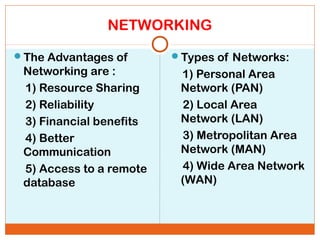
The Advantages of
Networking are :
1) Resource Sharing
2) Reliability
3) Financial benefits
4) Better
Communication
5) Access to a remote
database
Types of Networks:
1) Personal Area
Network (PAN)
2) Local Area
Network (LAN)
3) Metropolitan Area
Network (MAN)
4) Wide Area Network
(WAN)
THANK YOU

Communication technology

  • 1.
    Communication Technology Done by: M.GAGANSRI SAI CLASS – 9 SECTION – A/1 ROLL NO.2
  • 2.
    Introduction Communication is theessence of human civilization. The development of communication technology has changed the means and modes of communication. Now people communicate through e-mails, mobiles, video calls, etc. The main ides is to transfer the data or information at high speed.
  • 3.
  • 5.
    DATA The word datais the plural of datum, though data is commonly used to represent both singular and plural forms. Data is the measurement of the attributes or characteristics of entities like people, places, things, and events. The measurements are usually represented by symbols like numbers, alphabetical, and other characters. Data can be numeric, text, image or voice.
  • 7.
    INFORMATION Information refers toprocessed data. It is meaningful and helps in making decisions. A company launches a new product, say, a face wash and gives a pound of 5ml free of cost to 100 families. After a week, a survey result decides how to proceed with the marketing campaign. The meterological department collects the weather measurements data, which is then processed into a chart for making a weather forecast.
  • 9.
    MULTIMEDIA Multimedia can bedefined as an integration of sound, animation, still images, and video along with computing technology.  Multimedia files occupy more space due to the sound and picture files. Multimedia Software is available on CD- ROMs.
  • 10.
    MULTIMEDIA Uses of Multimedia: 1)Adding Sound Files 2) Creating 3-D effects in different ways 3) Learning a new language by interacting using the written and spoken words 4) Creating animated birthday cards
  • 11.
    MULTIMEDIA Different Categories of Multimedia: 1)Interactive 2) Entertainment 3) Information System Multimedia Requirements : 1) CPU 2) RAM 3) Audio 4) Video 5) Hard Disk.
  • 13.
    NETWORKING A computer network is aset of computers connected together for the purpose of sharing resources.  There are two terms that are commonly associated with networking – servers and workstations. Servers - A server is a computer program or a machine that waits for requests from other machines or software (clients) and responds to them. Workstation – It is the computer that is directly used by some one to do work. A workstation can also act as a server when file or printer sharing is enabled.
  • 14.
    NETWORKING Hardware Requirements for Networking: 1) Network Interface Card (NIC) 2) Registered Jack-45 (RJ-45) 3) Hub 4) Switch 5) Modem ( Modulator-Demodulator) 6)Router
  • 15.
    NETWORKING The Advantages of Networkingare : 1) Resource Sharing 2) Reliability 3) Financial benefits 4) Better Communication 5) Access to a remote database Types of Networks: 1) Personal Area Network (PAN) 2) Local Area Network (LAN) 3) Metropolitan Area Network (MAN) 4) Wide Area Network (WAN)
  • 16.