Class Discussions –Introduction to
Communication Technology
1. Icebreaker Discussion
Question:
“How many different communication technologies
did you use this morning before coming to class?”
CT vs ICTDebate
Split the class into two groups:
Group A: Argues that Communication Technology (phones, radio, TV)
has had the biggest impact.
Group B: Argues that ICT (internet, computers, apps) is more
transformative.
👉 Debate Topic:
“Which has had the biggest impact on society: Communication
Technology or ICT?”
Encourage short reflections: “What did you learn from this debate?”
7.
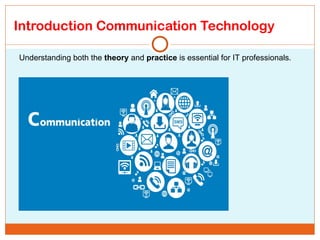
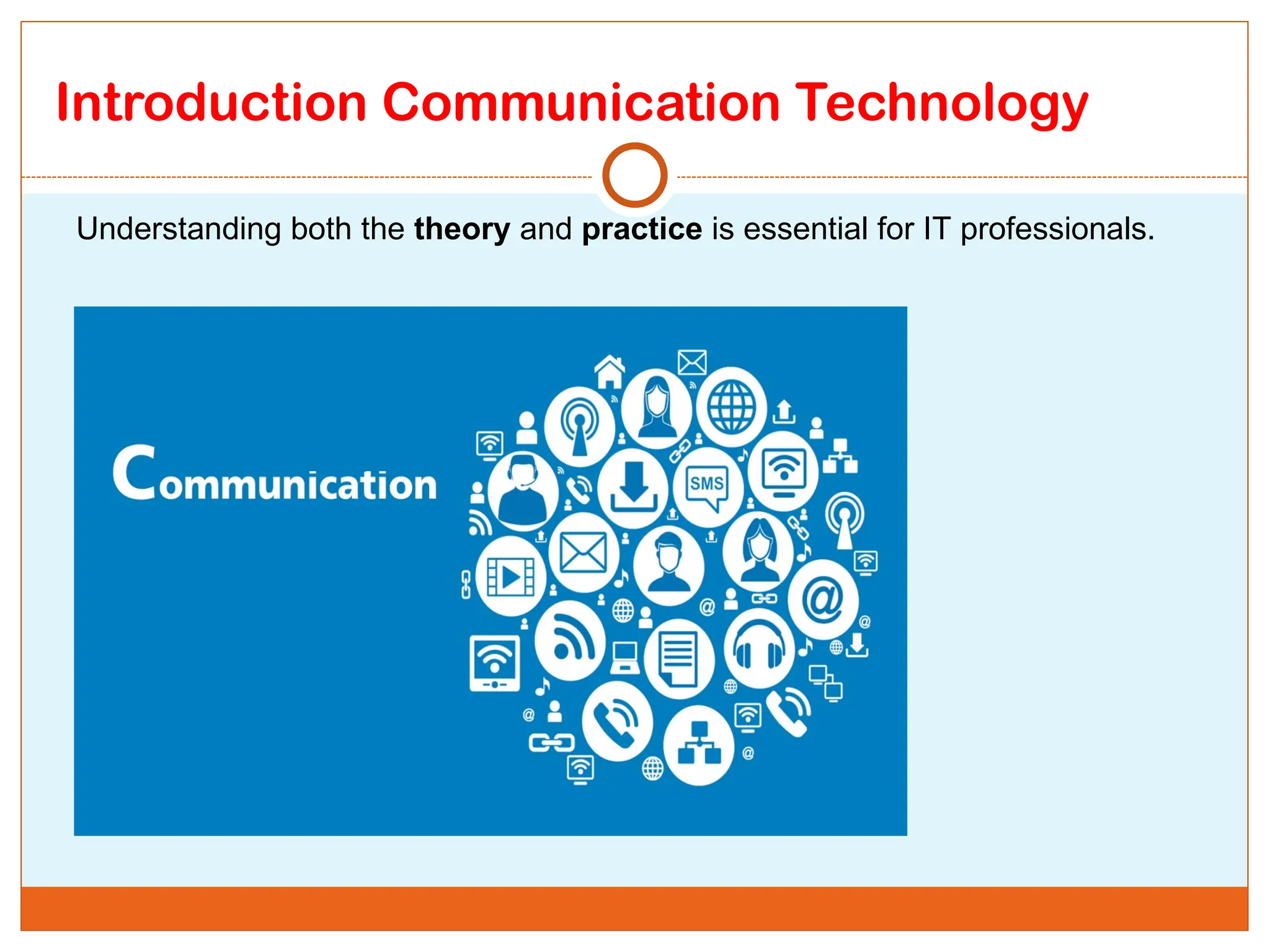
Introduction
Communication isthe essence of human
civilization.
The development of communication
technology has changed the means and modes
of communication.
Now people communicate through e-mails,
mobiles, video calls, etc.
The main ides is to transfer the data or
information at high speed.
8.
Introduction to CommunicationTechnology
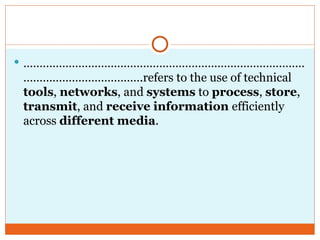
Communication technology refers to the
tools, systems, and processes used to
transmit, receive, and share information
between individuals, groups, or
machines.
9.
Introduction to CommunicationTechnology
It combines principles of
communication with advances in
technology to make information
exchange faster, easier, and more
effective.
10.
From theinvention of the printing press and the
telegraph to the rise of mobile phones, satellites,
and the internet, communication technology has
transformed the way people interact and access
knowledge. Today, it plays a central role in
education, business, healthcare, governance,
entertainment, and social connections.
Introduction to Communication Technology
11.
Core communication technology
At its core, communication technology involves
three main elements:
The Medium – devices or channels such as phones,
radio, TV, or digital platforms.
The Message – the information being shared,
whether text, sound, video, or data.
The Audience – the individuals or systems
receiving and interpreting the message.
Components of CommunicationTechnology
Activity 1:
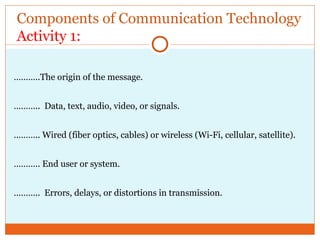
………..The origin of the message.
……….. Data, text, audio, video, or signals.
……….. Wired (fiber optics, cables) or wireless (Wi-Fi, cellular, satellite).
……….. End user or system.
……….. Errors, delays, or distortions in transmission.
14.
Components of CommunicationTechnology
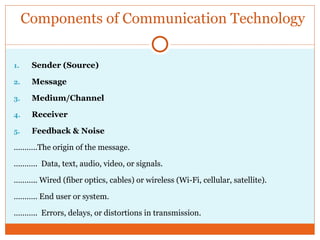
1. Sender (Source)
2. Message
3. Medium/Channel
4. Receiver
5. Feedback & Noise
………..The origin of the message.
……….. Data, text, audio, video, or signals.
……….. Wired (fiber optics, cables) or wireless (Wi-Fi, cellular, satellite).
……….. End user or system.
……….. Errors, delays, or distortions in transmission.
15.
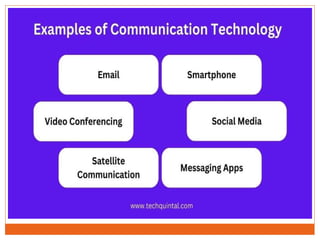
Modern Applications
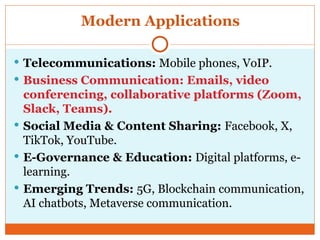
Telecommunications:Mobile phones, VoIP.
Business Communication: Emails, video
conferencing, collaborative platforms (Zoom,
Slack, Teams).
Social Media & Content Sharing: Facebook, X,
TikTok, YouTube.
E-Governance & Education: Digital platforms, e-
learning.
Emerging Trends: 5G, Blockchain communication,
AI chatbots, Metaverse communication.
16.
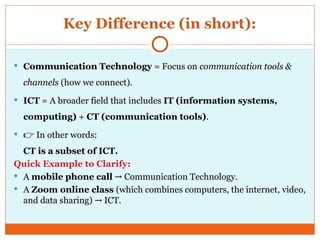
Key Difference (inshort):
Communication Technology = Focus on communication tools &
channels (how we connect).
ICT = A broader field that includes IT (information systems,
computing) + CT (communication tools).
👉 In other words:
CT is a subset of ICT.
Quick Example to Clarify:
A mobile phone call Communication Technology.
→
A Zoom online class (which combines computers, the internet, video,
and data sharing) ICT.
→
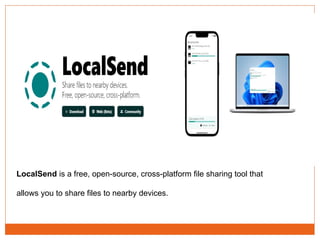
LocalSend is afree, open-source, cross-platform file sharing tool that
allows you to share files to nearby devices.
21.
DATA
The worddata is the plural of datum, though
data is commonly used to represent both
singular and plural forms.
Data is the measurement of the attributes or
characteristics of entities like people, places,
things, and events.
The measurements are usually represented by
symbols like numbers, alphabetical, and other
characters.
Data can be numeric, text, image or voice.
23.
INFORMATION
Information refersto processed data. It is
meaningful and helps in making decisions.
A company launches a new product, say, a face
wash and gives a pound of 5ml free of cost to
100 families. After a week, a survey result
decides how to proceed with the marketing
campaign.
The meterological department collects the
weather measurements data, which is then
processed into a chart for making a weather
forecast.
25.
MULTIMEDIA
Multimedia canbe defined as an
integration of sound, animation, still
images, and video along with computing
technology.
Multimedia files occupy more space
due to the sound and picture files.
Multimedia Software is available on CD-
ROMs.
26.
MULTIMEDIA
Uses ofMultimedia:
1) Adding Sound Files
2) Creating 3-D effects in different ways
3) Learning a new language by interacting using
the written and spoken words
4) Creating animated birthday cards
27.
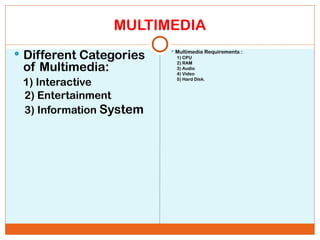
MULTIMEDIA
Different Categories
ofMultimedia:
1) Interactive
2) Entertainment
3) Information System
Multimedia Requirements :
1) CPU
2) RAM
3) Audio
4) Video
5) Hard Disk.
29.
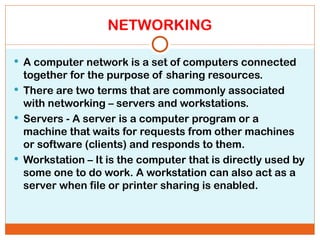
NETWORKING
A computernetwork is a set of computers connected
together for the purpose of sharing resources.
There are two terms that are commonly associated
with networking – servers and workstations.
Servers - A server is a computer program or a
machine that waits for requests from other machines
or software (clients) and responds to them.
Workstation – It is the computer that is directly used by
some one to do work. A workstation can also act as a
server when file or printer sharing is enabled.
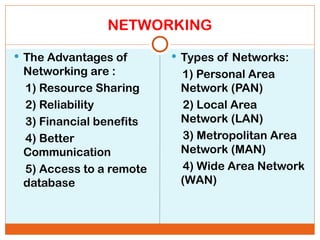
NETWORKING
The Advantagesof
Networking are :
1) Resource Sharing
2) Reliability
3) Financial benefits
4) Better
Communication
5) Access to a remote
database
Types of Networks:
1) Personal Area
Network (PAN)
2) Local Area
Network (LAN)
3) Metropolitan Area
Network (MAN)
4) Wide Area Network
(WAN)
32.
Case Study Discussion
Present a short case: “During the
COVID-19 pandemic, online learning
became the main mode of education.
What were the advantages and
challenges?”






![20260201 [FOSDEM] gomodjail - library sandboxing for Go modules.pdf](https://cdn.slidesharecdn.com/ss_thumbnails/20260201fosdemgomodjail-librarysandboxingforgomodules-260201225659-76609ec4-thumbnail.jpg?width=640&height=640&fit=bounds)


