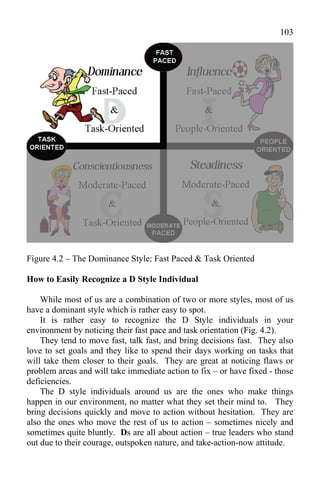
1
2

    Are you ready to find out more about why you
    behave and communicate the way you do?

    Would you like to become a more effective
    communicator and more effective at accomplishing
    your goals?

    Do you want to understand why your coworkers,
    managers, subordinates, friends, and family
    members behave and communicate the way they
    do?

    Do you want to learn how to recognize and
    understand different personality and behavioral
    styles?

    Do you want to learn how to most effectively
    communicate with people of different personality
    and behavioral styles?

    Are you willing to invest some time to improve
    your communication and people skills?

    If you answered yes to any of the above, read on…
3


  Communication-Skills
               Magic
Improve Your Relationships & Productivity
    through Better Understanding Your
Personality Style and the Personality Styles
           of those Around You


               E.G. Sebastian

                www.egSebastian.com
            www.iReadBodyLanguage.com
          www.CommunicationSkillsMagic.com
4
Timshel Books Publishing


Copyright © 2009 - E.G. Sebastian

All rights reserved. No part of this publication may be reproduced in any format; nor
distributed, or transmitted in any form, without prior written permission of the publisher.
To quote parts of the material, please send request for permission to the publisher to the
following address:

Timshel Publishing
Attn: E.G. Sebastian
330 Robert Smalls Pkwy, Ste 24
Beaufort, SC 29906
mailto:support@egSebastian.com


Ordering Information:
Order at www.CommunicationSkillsMagic.com               or    from    the   publisher    at
www.TimshelPublishing.com


    This book is available in paper-back format at quantity discounts. To
     get a volume quote, please view Appendix C at the end of the book;
             call TOLL FREE 877 379-3793, or visit us online at
         www.CommunicationSkillsMagic/Volume_Discount.html


                             ISBN #: 978-1-61623-249-8
                         Printed in the United States of America
5


 Make your next event a smashing success!


      Invite E.G. Sebastian to present a keynote speech,
  or to present one – or several - of your break-out sessions:

             - Improving Team Effectiveness
           - Improving Managers’ Effectiveness
           - Conflict Management & Prevention
            - How to Motivate Your Employees
         - How to Deal with Difficult Customers
   - How to Deal with Difficult Employees and Coworkers
  - Improve Productivity through Improved Communication
- Improve Sales Performance through Understanding Your Sales
                Style and the Four Buying Styles
   - How to Understand and Meet Your Customers’ Needs


                   For more information,
           contact E.G. toll FREE at 877 379-3793,
                 visit www.egSebastian.com
       or by email at mailto:support@egSebastian.com
6
7


I dedicate this book to all my clients– past, present, and future clients –
        who give me the privilege to impact their lives through
            my workshops, keynotes, and personal coaching;

         … and to my beautiful wife, Aida, who provides me
        day after day with her unconditional love and support;
    and my three children Alexa, Philip, and Adriana- who are the
           joy of my life and are the best kids in the world
                                   
          Thanks guys for your support and for believing in me!

                                    …

              … and to Thomas Schlosser (1982 – 1998),
                     my youngest cousin; victim to
                    daily verbal and physical abuse;
                 who, in a desperate moment, decided
                  to end it all at the young age of 15.
               If I forgot to say it while I had a chance,
                       I say it now: “I love you!”
8

    Would you like a quick overview of the DISC behavioral model and
       learn how it can help you eliminate conflict and improve your
                    relationships with those around you?
         Sign up online to our FREE 7-Part mini-eCourse, entitled
           Communication is More than Just Talk, Talk, Talk…
              To sign up, visit www.egSebastian.com today!


              FREE TRAINING VIDEOS
                  Get Communication-Skills Magic Today
                   to get access to the Training Videos
    Visit www.CommunicationSkillsMagic.com and buy your copy
    today!
              eBook: $9.97; Book + eBook + Bonus $19.97

    This is what you’ll find here:
    - Short history and intro to the DISC Behavioral Model concept
    - Discover your personality style
    - Explore your personality style’s strengths and weaknesses
    - Learn how to easily recognize different personality styles
    - Learn HOW to connect effectively with people of different styles
    - Discover the expectations each style has of you
    - On-the-job behavioral tendencies of each style
    - Explore ways to motivate different personality styles (great for
    managers and parents)
    - How to deal with conflict with different styles
    - Discover the ideal environment in which each style is most
    productive and feels most “at home”
    - Challenge areas of the four styles (communication and
    taskcompletion)
    - Explore effective ways to deal with the difficult people around you
    - Explore how to connect most effectively with your clients
    - Simple communication secrets to client retention
    - Improve your productivity by capitalizing on your strengths and
    raising your awareness of your weaknesses
    - and more… (new videos added monthly)
9
What others are saying about E.G.’s DISC programs?


This presentation brought me to the understanding how everyone is wired
differently and to be aware of these differences. I learned to respect and
better understand my coworkers.

Melissa Nelley - Communications Manager
DISC Presentation Participant
                                ___

I don't want to say that your presentation was informational - it was
rather TRANSFORMATIONAL. Now I have a more in-depth
understanding of why my employees behave the way they behave, and I
can clearly see that they have a better understanding of my
communication and management style. It definitely changed the whole
dynamics of the workplace.

Michael McCalvey - Chiropractor (and his team)
Improve Communication Skills through Understanding Behavior (DiSC)
workshop participants, about 45 days after the event
                                  ___

A workshop that reminded all of us that everyone is motivated differently
and helped us better understand different people with different personality
types. E.G.'s style appeals to all types which encourages participation
with everyone.

Carlotta Ungaro - President, Ch. of Commerce
DISC Presentation Participant
                                   ___

A presentation that I highly recommend for any group.

Liz Mitchel - Tourism Marketing Director
DISC Presentation Participant
10
Definitely a must-attend event for social workers. After this presentation I
have a much better understanding of my clients’ behavioral tendencies.
Thank you for a very informative and entertaining presentation.

Danet Vernon - Social Worker
Improve Communication Skills through Understanding Behavior (DiSC)
workshop participant
                                ___

A wonderful session that helped me learn how to better manage and
motivate my staff. Would I recommend this to others? Yes, Do it!

Hailey Orozco - Manager
DISC Presentation Participant
                                   ___

A great presentation that helped me understand how to better
communicate with different types of personalities.

Ivey McClam - Membership Services Director,
DISC Presentation Participant
                               ___

A wonderful learning experience! I enjoyed learning more about the
people I work with and being more open and receptive to [individual]
differences.

Catherine Hipp - Director of Tourism
DISC Presentation Participant
                                  ___

A very enjoyable presentation where I learned how to better interact with
my coworkers.

Megan Krebs - Member Services Sales Associate
DISC Presentation Participant
11
I enjoyed discovering my personality type and finding out my coworkers
personalities.

L.B. - Member Services Coordinator
DISC Presentation Participant
                                ___

This session helped me better understand who I am, as well as better
communicate and interact with my coworkers.

Jennifer Mead - Admin Assistant
DISC Presentation Participant
                                   ___

I learned to identify different personalities in children and adults, and
learned how to most effectively communicate with each type. This is some
information that I can apply immediately in my field.

Melissa Johnson - Different Personalities, Different Needs, Teachers'
Mini-Conference participant
                                  ___

It helped me better understand myself and better understand my students,
hopefully to make me a better teacher to each child.

Susan Hollister - Different Personalities, Different Needs, Teachers' Mini-
Conference participant


       Invite E.G. Sebastian to speak at your next event!
     Call Toll Free 877 379-3793 for details and availability
                                   Visit
                    www.egsebastian.com/meet_e_g_
                   to see the E.G.’s presentation topics
12

                                          Table of Contents


Communication-Skills Magic ........................................................................................ 3
What others are saying about E.G.’s DISC programs?..................................................... 9
SELF-COACHING WORKSHEET I ................................................................................ 18
How Committed Am I to Improving my Communication Skills?..................................... 18

Introduction............................................................................................................. 25
Effective Communication – The Most Important Life-Skill.............................................. 26
How to Use this Book?..................................................................................................... 27
Who Will Benefit From the Information in this Book?..................................................... 29
Why Can’t We All Get Along Better?............................................................................... 31
The Cost of Poor Communication & Conflict on Our Society ......................................... 31
Take an Honest Look in the Mirror ................................................................................. 33
Three Steps to Successful Relationships .......................................................................... 34
Not All Relationships are Created Equal......................................................................... 35
SELF-ASSESSMENT How Successful am I in My Relationships?................................. 36
You Can Easily Improve Your Communication Skills...................................................... 41

Chapter 1                  Elements of Effective Communication .......................................... 43
The Definition of “Effective Communication” ................................................................ 44
The #1 Key to Effective Communication.......................................................................... 44
Effective Communication Starts with Effective Listening ................................................ 45
Personality Style Theories ............................................................................................... 47
The DISC Behavioral System........................................................................................... 49
Personality Style vs. Behavioral Style.............................................................................. 52
Most People Are Not Weird – They are Simply Differently Wired................................... 54
Power Tip #1           Commit to listening at a deeper level to those around you.................... 55

Chapter 2                An Introduction to the DISC Behavioral System ........................... 57
Follow The Golden People-Smart Rule! .......................................................................... 58
The Basics of the DISC Behavioral System...................................................................... 59
13
This System Works!.......................................................................................................... 62
The Journey Starts with Understanding Yourself ............................................................ 64
Power Tip #2           Focus on the strengths of those around you!.......................................... 69

Chapter 3                 The DISC Behavioral Model ............................................................ 70
Most People’s Behaviors Are Highly Predictable ........................................................... 71
Understanding Your Behavioral Style ............................................................................. 76
Understanding Others’ Behavioral Styles ....................................................................... 77
Common Characteristics of the Four Behavioral Styles.................................................. 78
Common Characteristics: A Humorous Look  .............................................................. 82
Funny and Practical “Facts”: Fast Pace vs. Moderate Paced individuals.................... 82
Funny and Practical “Facts”: Task Oriented vs. People Oriented................................ 83
How to Recognize Different Behavioral Styles ................................................................ 85
General Tendencies of the Four DISC Styles .................................................................. 89
DISC Statistics ................................................................................................................. 92
You Are in Charge of Your Behavior ............................................................................... 93
Power Tip #3.................................................................................................................... 96
Avoid judging others based on their perceived behavioral style! .................................... 96

Chapter 4                 The Dominance Style......................................................................... 98
Famous High D Examples:.............................................................................................. 98
The Dominance (D) Style – Quick Overview ................................................................... 99
How to Easily Recognize a D Style Individual............................................................... 103
Jim, the Super Achiever ................................................................................................. 104
Communication Style ..................................................................................................... 105
Strengths and Weaknesses ............................................................................................. 105
Challenge Areas............................................................................................................. 108
Knowledge is Power! Take control of your weaknesses! ............................................... 109
Expectations of Others................................................................................................... 112
How to Deal with Conflict when Dealing with a D Style Individual.............................. 112
Dominance Style - Born Leaders ................................................................................... 114
How to Motivate the D Style Individual......................................................................... 115
What Demotivates D Style Individuals........................................................................... 116
14
D Style Most Popular Career Choices........................................................................... 117
Power Tip #4 Keep your D styles busy! ....................................................................... 118
Dominance Style: Improve Your Relationships and Effectiveness Self-Coaching
Worksheet ...................................................................................................................... 119

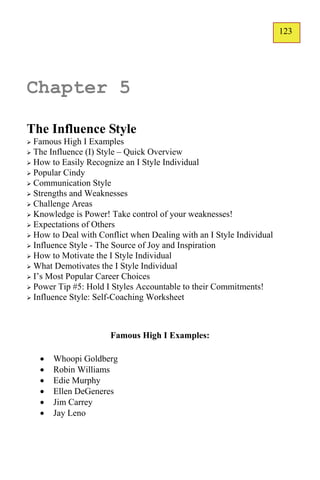
Chapter 5                   The Influence Style.......................................................................... 123
Famous High I Examples: ............................................................................................. 123
The Influence (I) Style – Quick Overview ...................................................................... 124
How to Easily Recognize an I Style Individual ................... Error! Bookmark not defined.
Popular Cindy..................................................................... Error! Bookmark not defined.
Communication Style .......................................................... Error! Bookmark not defined.
Strengths and Weaknesses .................................................. Error! Bookmark not defined.
Challenge Areas.................................................................. Error! Bookmark not defined.
Knowledge is Power! Take control of your weaknesses! .... Error! Bookmark not defined.
Expectations of Others........................................................ Error! Bookmark not defined.
How to Deal with Conflict when Dealing with an I Style Individual Error! Bookmark not
defined.
Influence Style - The Source of Joy and Inspiration ........... Error! Bookmark not defined.
How to Motivate the I Style Individual ............................... Error! Bookmark not defined.
What Demotivates I Style Individuals ................................. Error! Bookmark not defined.
I Style Most Popular Career Choices ................................. Error! Bookmark not defined.
Power Tip #5 ................................... Hold I styles accountable to their commitments!
............................................................................................ Error! Bookmark not defined.
Influence Style: Improve Your Relationships and Effectiveness Self-Coaching Worksheet
 ....................................................................................................................................... 124

Chapter 6                   The Steadiness Style ........................................................................ 128
Famous High S Examples:............................................................................................. 128
The Steadiness (S) Style – Quick Overview......................... Error! Bookmark not defined.
How to Easily Recognize an S Style Individual .................. Error! Bookmark not defined.
Friendly and Efficient Julia ................................................ Error! Bookmark not defined.
Communication Style .......................................................... Error! Bookmark not defined.
Strengths and Weaknesses .................................................. Error! Bookmark not defined.
Challenge Areas.................................................................. Error! Bookmark not defined.
15
Knowledge is Power! Take control of your weaknesses! .... Error! Bookmark not defined.
Expectations of Others........................................................ Error! Bookmark not defined.
How to Deal with Conflict when Dealing with an S Style Individual Error! Bookmark not
defined.
Steadiness Style – the “Real Best Friend”.......................... Error! Bookmark not defined.
How to Motivate the S Style Individual............................... Error! Bookmark not defined.
What Demotivates the S Style Individual ............................ Error! Bookmark not defined.
S’s Most Popular Career Choices ...................................... Error! Bookmark not defined.
Power Tip #6 Be patient and gentle with the S styles around you!. Error! Bookmark not
defined.
Steadiness Style: Improve Your Relationships and Effectiveness Self-Coaching Worksheet
....................................................................................................................................... 129

Chapter 7                 The Conscientiousness Style ............................................................ 133
Famous High C Examples: ............................................................................................ 133
The Conscientiousness (C) Style – Quick Overview ........... Error! Bookmark not defined.
How to Easily Recognize a C Style Individual.................... Error! Bookmark not defined.
Systematic Tom ................................................................... Error! Bookmark not defined.
Communication Style .......................................................... Error! Bookmark not defined.
Strengths and Weaknesses .................................................. Error! Bookmark not defined.
Challenge Areas.................................................................. Error! Bookmark not defined.
Knowledge is Power! Take control of your weaknesses!.... Error! Bookmark not defined.
Expectations of Others........................................................ Error! Bookmark not defined.
How to Deal with Conflict when Dealing with a C Style Individual. Error! Bookmark not
defined.
Conscientiousness Style – the Critical Thinker................... Error! Bookmark not defined.
How to Motivate the C Style Individual .............................. Error! Bookmark not defined.
What Demotivates C Style Individuals................................ Error! Bookmark not defined.
C Style Most Popular Career Choices ................................ Error! Bookmark not defined.
Power Tip #6 Develop a deep appreciation for the C styles in your environment! ..Error!
Bookmark not defined.
Conscientiousness Style: Improve Your Relationships and Effectiveness Self-Coaching
Worksheet ...................................................................................................................... 134

Chapter 8                 The Four Styles at a Glance ............................................................. 137
16
The Four Styles at a Glance................................................ Error! Bookmark not defined.
General Behavioral Tendencies of the Four Styles........................................................ 138
Common Characteristics of the Styles ........................................................................... 139
Strengths of the Four Styles ................................................ Error! Bookmark not defined.
Challenge Areas of the Four Styles..................................... Error! Bookmark not defined.
Communication Tendencies of the Four Styles ................... Error! Bookmark not defined.
What the Four Styles Expect of You.................................... Error! Bookmark not defined.
Can Improve Performance And Relationships by… ........... Error! Bookmark not defined.
Learning Styles of the Four Behavioral Styles.................... Error! Bookmark not defined.
How to Communicate Effectively with the Four Styles ....... Error! Bookmark not defined.
The Four Styles at Work ..................................................... Error! Bookmark not defined.
How to Motivate the Four Styles......................................... Error! Bookmark not defined.
What Demotivates the Four Styles at Work ........................ Error! Bookmark not defined.
How to Manage the Four Styles.......................................... Error! Bookmark not defined.
How to Communicate Effectively with Your D, I, S, or C Manager.. Error! Bookmark not
defined.
D, I, S, and C Style Customers’ Expectations of You.......... Error! Bookmark not defined.
How to Defuse Conflict with the Four Styles ...................... Error! Bookmark not defined.
Celebrity DISC Styles ......................................................... Error! Bookmark not defined.
Power Tip #8 Increase your acceptance of everyone around you! ............................... 141

About the Author ......................................................................................................... 145

Works Cited.................................................................................................................. 147

APPENDIX A - Invite E.G. Sebastian to speak at your next event!........................ 148
Keynotes......................................................................................................................... 149
APPENDIX B - Performance/Leadership Development Coaching/Mentoring ..... 150

APPENDIX C– Volume Discount .................................................................... 151

APPENDIX D - 7 Ways to Say “NO” Without Hurting Others’ Feelings............ 152

APPENDIX E ............................................................................................................... 155
Become a DISC Trainer/Facilitator/Consultant/Coach ................................................ 155
     Each facilitator kit includes:................................................................................. 155
17
18


SELF-COACHING WORKSHEET I

How Committed Am I to Improving
my Communication Skills?
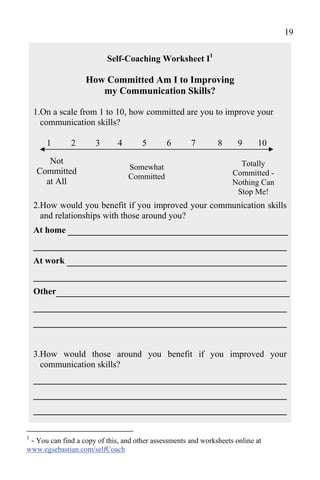
19

                          Self-Coaching Worksheet I1

                   How Committed Am I to Improving
                      my Communication Skills?

    1.On a scale from 1 to 10, how committed are you to improve your
      communication skills?

       1      2       3       4       5       6       7        8      9     10

       Not                                                            Totally
                                  Somewhat
    Committed                                                       Committed -
                                  Committed
      at All                                                        Nothing Can
                                                                     Stop Me!
    2.How would you benefit if you improved your communication skills
      and relationships with those around you?
    At home _________________________________
    ______________________________________
    At work _________________________________
    ______________________________________
    Other___________________________________
    ______________________________________
    ______________________________________

    3.How would those around you benefit if you improved your
      communication skills?
    ______________________________________
    ______________________________________
    ______________________________________

1
 - You can find a copy of this, and other assessments and worksheets online at
www.egsebastian.com/selfCoach
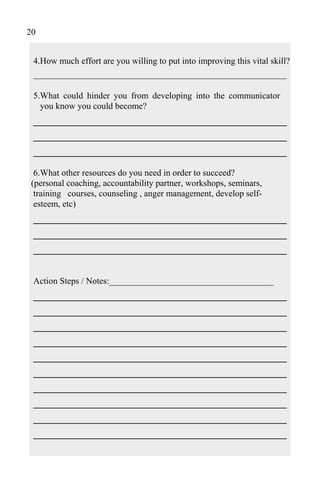
20


 4.How much effort are you willing to put into improving this vital skill?
 _________________________________________________________

 5.What could hinder you from developing into the communicator
   you know you could become?
 ______________________________________
 ______________________________________
 ______________________________________
  6.What other resources do you need in order to succeed?
 (personal coaching, accountability partner, workshops, seminars,
  training courses, counseling , anger management, develop self-
  esteem, etc)
 ______________________________________
 ______________________________________
 ______________________________________

 Action Steps / Notes:_____________________________________
 ______________________________________
 ______________________________________
 ______________________________________
 ______________________________________
 ______________________________________
 ______________________________________
 ______________________________________
 ______________________________________
 ______________________________________
 ______________________________________
21

Action Steps / Notes(continued): ________________________________
 ______________________________________
 ______________________________________
 ______________________________________
 ______________________________________
 ______________________________________
 ______________________________________
 ______________________________________
 ______________________________________
 ______________________________________
 ______________________________________
 ______________________________________
 ______________________________________
 ______________________________________
 ______________________________________
 ______________________________________
 ______________________________________
 ______________________________________
 ______________________________________
 ______________________________________
 ______________________________________
 ______________________________________
 ______________________________________
 ______________________________________
 ______________________________________
 ______________________________________
22


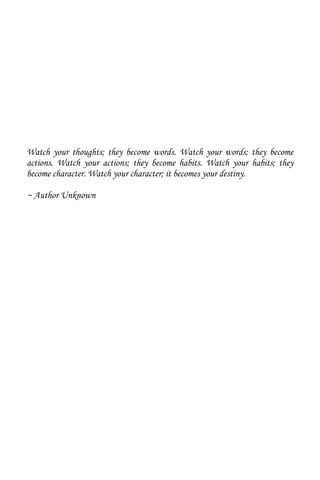
Watch your thoughts; they become words. Watch your words; they become
actions. Watch your actions; they become habits. Watch your habits; they
become character. Watch your character; it becomes your destiny.

~ Author Unknown
23
24


 Learning to understand and successfully manage diverse behaviors is a
              primary prerequisite to becoming effective
               at developing good communication skills
                   and building lasting relationships.

            This book was designed to help you recognize
           and better understand different behavioral styles
                   – yours and of those around you -
       and will provide you a thorough guide to communicate
     more effectively with everyone in your environment based on
              understanding the needs of each individual.
25


Introduction
 Effective Communication – The Most Important Life-Skill
 How to Use this Book?
 Who Will Benefit from the Information in this Book?
 Why Can’t We All Get Along Better?
 The Cost of Poor Communication & Conflict on Our Society
 Take an Honest Look in the Mirror
 Three Steps to Successful Relationships
 Not All Relationships are Created Equal
 Self-Assessment I -How Successful Am I in My Relationships?
 You Can Easily Improve Your Communication Skills
26
Effective Communication – The Most Important Life-Skill

    Let me ask you a question: How Creating better relationships
would it impact your life, at this very
                                             through improving one’s
moment, if you could significantly
improve your relationships with your communication skills is most
coworkers,         managers        and/or crucial to anyone’s success,
subordinates, clients, parents, spouse, both in one’s personal and
child(ren), and other significant people professional life.
in your life?
    What if there was a system that could help you better understand your
behavior and the behavior of those around you, and as a result improve
your personal and/or professional relationships? Would it be worth the
effort to give that system a try?
    If you could improve your relationships dramatically, how much stress
would be taken away from your days? How much more joy you’d get out
of your time spent with your family and friends? How much more
satisfaction you’d have at your workplace?
    Creating better relationships, through improving one’s communication
and people skills, is not only possible for anyone who is wiling to put forth
the necessary effort, but it is also undeniably the most crucial to any
individual’s success, both at home and at work.
    In fact, I’d go so far to say that good communication and people skills
are the most important skills one can acquire. There’s no amount of
organizational and technical skills that can make up for the lack of good
communication skills both at home and at work (except, perhaps, in some
highly technical or repetitive mechanical jobs where one can get by
without communicating much with others).
    Effective communication is an art -
Period. And as with any art out there, Good communication and
we do not find too many people who people skills are the most
truly master this art. Luckily, becoming important skills one can
an “artist” of effective communication acquire. There’s no amount
does not require high IQ, advanced of               organizational     and
degrees, or any special talent. By technical skills that can
learning the concepts laid out in the make up for the lack of
pages of this book you will undoubtedly good communication skills
be on your way to becoming a much both at home and at work.
better communicator.
27
    As Ralph Waldo Emerson said, “Every artist was first an amateur,”
and the same applies to effective communication: you have to start
somewhere and through applying what you’ll learn in the following pages
you’ll start seeing major positive changes on how you relate to people and
how people start relating to you. Indeed, if you do take the time to apply
the concepts in this book, your people skills – and hence your
relationships – will “magically” rise to a level you only dreamt of
accomplishing.


How to Use this Book?

     This is not one of those books that you’d read in one sitting than throw
it back on to the book shelf. If you choose to read the whole book in one
sitting, that’s great, but then come back and apply step by step what you
read, especially the chapters that describe your style and the styles of the
people you want to improve your relationships with.
     You can also pick up the book as needed to read up on how to deal
with a certain behavioral style in conflict, how to motivate that person,
what are their strengths and weaknesses, hot to communicate most
effectively with them, etc.

     If you want to accelerate your learning and to take maximum
advantage of the information laid out in the book, follow these steps:
  1.   Skip the intro chapter and go to page 66 (What is Your Behavioral
       Style?) to get a basic idea of what is your personality/behavioral
       style. In later chapters this information will help you understand
       why you get along better with some personality styles while people
       of certain personality styles tend to annoy you; as well as you’ll find
       some specific suggestions that will help you become more
       productive, a better communicator, and more effective at building
       successful relationships.
  2.   Next, make sure to get a thorough - really thorough! -
       understanding of the information in Chapter 3 (especially the first
       sub-chapter titled Most People’s Behaviors are Highly Predictable.
       Chapter 3 will help you discover how to recognize the 4 main
       behavioral styles (or personality styles). The rest of the book is in
       large part built on the information in Chapter 3.
28
    3.    Explore chapters 4, 5, 6, or 7 to learn about your behavioral style or
          the behavioral style of someone you want to improve your
          communication with.
    4.    Explore Chapter 8 to find out specific information on specific
          applications on any one of the four personality/behavioral styles
          (strengths, weaknesses, motivators, ideal environment, how to deal
          with each style in conflict, etc.).

    Optional
    5. Do you want to learn and apply the information laid out in the book
       most successfully?

          Teach it to others! Research has showed that when we take
          something that we just learned and we teach it to others, our learning
          improves dramatically.
          FREE handouts and basic PowerPoint slides available at
          www.-------------------_______----- -- please credit E.G. Sebastian
          and Communication-Skills Magic with the source of your
          information


           To fully learn and anchor these concepts, teach them to others!
                You can find a FREE handout, basic PowerPoint slides,
                   and instructions at www.--------------------------- 1.

               Support your teaching with providing participants with a
         hard copy of this book. See volume discount prices in Appendix B,
            or online at www.CommunicationSkillsMagic.com/volume,
                                or call 877 379-3793

                If you would like to become a Certified DISC Trainer,
                           view the information online at
                         www.egSebastian.com/certified,
                          or call Toll Free 877 379-3793


1
  - Please visit www.CommunicationSkillsMagic.com and purchase a copy of the book or
the eBook to get access to these resources
29
Who Will Benefit From the Information in this Book?

     When it comes to creating and maintaining successful relationships
and effectively communicating with those around us, most of us dabble in
the dark and communicate with others based on our instincts and past
experiences; which sometimes works and at other times we end up
frustrated with those around us and with ourselves.
     This book provides some simple, yet powerful, information that will
without a doubt help you become a better communicator and improve your
relationships with everyone around you. And the good news is that this is
not a “band aid” method that will last for a short time, or one that works
only with a few people around you. Throughout the book, you will be
exposed to concepts and strategies that will help you become the
successful communicator you always wanted to be.
     No, these are not exaggerated statements – every year millions of
individuals are exposed to these concepts1 through company-sponsored
training sessions, public seminars, tele-conferences, audio-products,
books, articles, etc. The concepts laid out in the book are the same
concepts taught to many Fortune 500 companies and to organizations of
all sizes all over the world.
     In the past more than three decades, more than 40 million people have
been exposed to this information – this is probably the highest testimony
to the popularity, effectiveness, and timelessness of these concepts.

   The information outlined throughout the book will be useful for
anyone who wants to improve their relationships, such as:
       Employees who understand that good communication skills are
      at least as important to a person’s success as their technical skills
       Managers who want to: (1) improve their communication with
      employees, (2) learn to motivate each employee more effectively,
      and (3) want to understand what environments are most conducive
      to bringing out peak performance in each personality style
       Sales professionals who want to serve their clients more
      effectively and increase sales as a result of relating with more ease
      to prospective and existing clients
       Solo professionals who want to improve their relationships
      with their clients and have a desire to better understand their
      clients’ motivators and needs

1
 -Known as The DISC Behavioral Model , The DISC Behavioral System, The Universal
Language DISC, The Platinum Rule, etc., all of which are based on the concepts
originally developed by psychologist William Moulton Marston, around 1927.
30
         Anyone who wants to improve their relationships with those
        around them (great for parents, spouses, etc.)
   Managers and employees will benefit from understanding and
applying the information in this book the following 7 ways:
     1.     Help managers better understand their employees’ behavior,
            communication style, needs, and motivation
     2.     Help managers and employees better understand customers’
            and clients’ needs, motivators, and communication style
     3.     Help employees get a better understanding of why their
            coworkers behave the way they do
     4.     Considerably reduce stress resulting from conflicts and
            personality clashes
     5.     Positively affect the bottom line by creating a customer and
            employee friendly environment
     6.     Gain new clients and keep existing ones with more ease due to
            a better understanding of their needs
     7.     Improve self-confidence due to improved communication
            skills and better understanding of self and others

   For certain professionals it is crucial to have good people skills; have
at least a basic understanding of human behavior and have great
communication skills. For these professionals it is of outmost importance
to be familiar with the information in this book. Some of these
professions are:
        Managers
        Teachers
        Counselors
        Healthcare Professionals
        Social Services Providers
        Customer Service Reps
        Sales Professionals (Real Estate, Insurance, Financial Services,
           etc.)
        And anyone who works directly with people and need the
           ability to influence, motivate, or assist in a significant way


     Organizations that put strong emphasis on providing this, or
     similar behavioral or personality style training, inevitably end up
     creating a workplace climate where everyone feels valued and
     understood, and where customers and clients feel that their needs
     are met and receive customer service beyond their expectations.
31
Why Can’t We All Get Along Better?

    Have you ever wondered why people around you behave the way they
do? Did you ever wish that some of your family members, friends, or
coworkers were a bit easier to communicate with? Have you ever found
yourself wishing that some people around you were less difficult? Unless
you are some relationship guru, it is more than likely that you have asked
yourself these, or similar questions, regarding the behavior of the people
around you.
    Why are some people so hard to get along with? Why aren’t we able
to connect with everyone who we meet and maintain harmonious
relationships? What causes the instant disconnect with some of the people
around us? Is there anything that can be done that would help us improve
our relationships with everyone around us – even with those who we
perhaps perceive as difficult at the present moment?
    These are the questions the chapters of this book will help answer.


The Cost of Poor Communication & Conflict on Our Society

    Life can be really challenging when          Undoubtedly
people around us don’t get along and/or          communication       skills
when we can’t seem to be able to get along       are the most important
with others. Lack of good communication          skills one can acquire.
skills destroy families, poison workplace        Anyone who lacks good
morale, and leads to lots of stress that could   communication       skills
easily be avoided.                               goes      through     life
    Undoubtedly communication skills are         destined to encounter
                                                 frequent conflicts and
the most important skills one can acquire.
                                                 misunderstandings
Anyone who lacks good communication
                                                 combined       with    an
skills goes through life destined to encounter   inability to maintain
frequent conflicts and misunderstandings         effective relationships in
combined with an inability to maintain           either     personal     or
effective relationships in either personal or    professional life.
professional life.
32
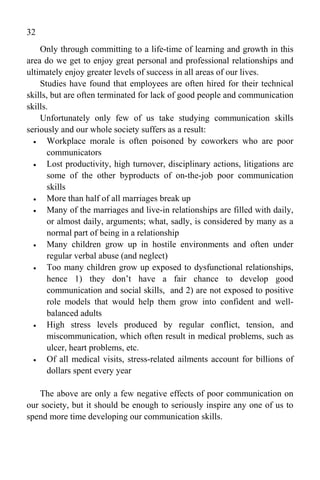
    Only through committing to a life-time of learning and growth in this
area do we get to enjoy great personal and professional relationships and
ultimately enjoy greater levels of success in all areas of our lives.
    Studies have found that employees are often hired for their technical
skills, but are often terminated for lack of good people and communication
skills.
    Unfortunately only few of us take studying communication skills
seriously and our whole society suffers as a result:
      Workplace morale is often poisoned by coworkers who are poor
       communicators
      Lost productivity, high turnover, disciplinary actions, litigations are
       some of the other byproducts of on-the-job poor communication
       skills
      More than half of all marriages break up
      Many of the marriages and live-in relationships are filled with daily,
       or almost daily, arguments; what, sadly, is considered by many as a
       normal part of being in a relationship
      Many children grow up in hostile environments and often under
       regular verbal abuse (and neglect)
      Too many children grow up exposed to dysfunctional relationships,
       hence 1) they don’t have a fair chance to develop good
       communication and social skills, and 2) are not exposed to positive
       role models that would help them grow into confident and well-
       balanced adults
      High stress levels produced by regular conflict, tension, and
       miscommunication, which often result in medical problems, such as
       ulcer, heart problems, etc.
      Of all medical visits, stress-related ailments account for billions of
       dollars spent every year

   The above are only a few negative effects of poor communication on
our society, but it should be enough to seriously inspire any one of us to
spend more time developing our communication skills.
33
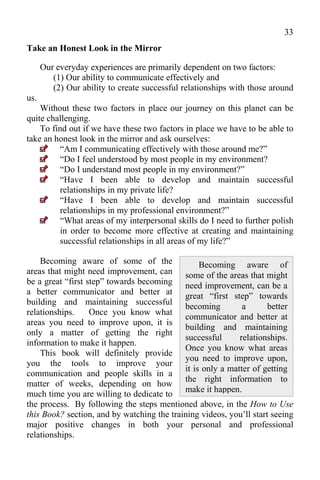
Take an Honest Look in the Mirror

      Our everyday experiences are primarily dependent on two factors:
         (1) Our ability to communicate effectively and
         (2) Our ability to create successful relationships with those around
us.
    Without these two factors in place our journey on this planet can be
quite challenging.
    To find out if we have these two factors in place we have to be able to
take an honest look in the mirror and ask ourselves:
          “Am I communicating effectively with those around me?”
          “Do I feel understood by most people in my environment?
          “Do I understand most people in my environment?”
          “Have I been able to develop and maintain successful
          relationships in my private life?
          “Have I been able to develop and maintain successful
          relationships in my professional environment?”
          “What areas of my interpersonal skills do I need to further polish
          in order to become more effective at creating and maintaining
          successful relationships in all areas of my life?”

    Becoming aware of some of the                Becoming aware of
areas that might need improvement, can some of the areas that might
be a great “first step” towards becoming need improvement, can be a
a better communicator and better at great “first step” towards
building and maintaining successful
                                            becoming         a       better
relationships.     Once you know what
                                            communicator and better at
areas you need to improve upon, it is
                                            building and maintaining
only a matter of getting the right
                                            successful      relationships.
information to make it happen.
                                            Once you know what areas
    This book will definitely provide
                                            you need to improve upon,
you the tools to improve your
                                            it is only a matter of getting
communication and people skills in a
                                            the right information to
matter of weeks, depending on how
                                            make it happen.
much time you are willing to dedicate to
the process. By following the steps mentioned above, in the How to Use
this Book? section, and by watching the training videos, you’ll start seeing
major positive changes in both your personal and professional
relationships.
34
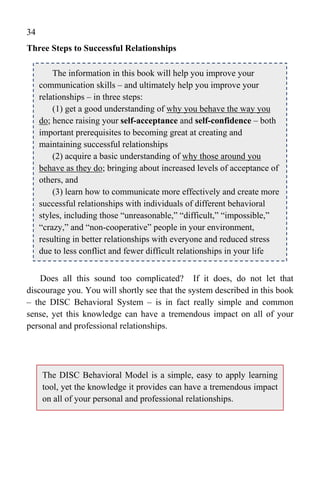
Three Steps to Successful Relationships

         The information in this book will help you improve your
     communication skills – and ultimately help you improve your
     relationships – in three steps:
         (1) get a good understanding of why you behave the way you
     do; hence raising your self-acceptance and self-confidence – both
     important prerequisites to becoming great at creating and
     maintaining successful relationships
         (2) acquire a basic understanding of why those around you
     behave as they do; bringing about increased levels of acceptance of
     others, and
         (3) learn how to communicate more effectively and create more
     successful relationships with individuals of different behavioral
     styles, including those “unreasonable,” “difficult,” “impossible,”
     “crazy,” and “non-cooperative” people in your environment,
     resulting in better relationships with everyone and reduced stress
     due to less conflict and fewer difficult relationships in your life


    Does all this sound too complicated? If it does, do not let that
discourage you. You will shortly see that the system described in this book
– the DISC Behavioral System – is in fact really simple and common
sense, yet this knowledge can have a tremendous impact on all of your
personal and professional relationships.


     The DISC Behavioral Model is a simple, easy to apply learning
     tool, yet the knowledge it provides can have a tremendous impact
     on all of your personal and professional relationships.
35
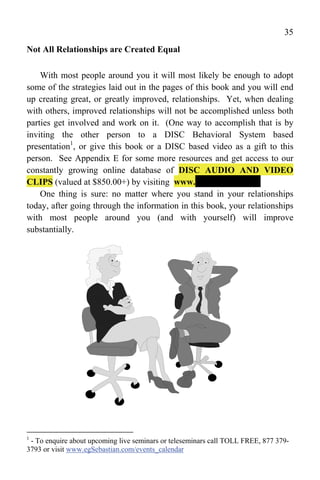
Not All Relationships are Created Equal

    With most people around you it will most likely be enough to adopt
some of the strategies laid out in the pages of this book and you will end
up creating great, or greatly improved, relationships. Yet, when dealing
with others, improved relationships will not be accomplished unless both
parties get involved and work on it. (One way to accomplish that is by
inviting the other person to a DISC Behavioral System based
presentation1, or give this book or a DISC based video as a gift to this
person. See Appendix E for some more resources and get access to our
constantly growing online database of DISC AUDIO AND VIDEO
CLIPS (valued at $850.00+) by visiting www.----------------------
    One thing is sure: no matter where you stand in your relationships
today, after going through the information in this book, your relationships
with most people around you (and with yourself) will improve
substantially.


1
 - To enquire about upcoming live seminars or teleseminars call TOLL FREE, 877 379-
3793 or visit www.egSebastian.com/events_calendar
36


SELF-ASSESSMENT
How Successful am I in My Relationships?
37

                              Self-Assessment
                   How Successful am I in my Relationships?

    Circle One:
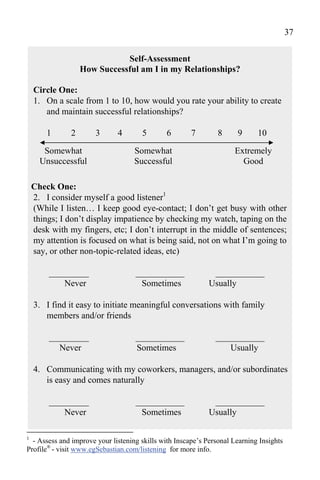
    1. On a scale from 1 to 10, how would you rate your ability to create
       and maintain successful relationships?

        1      2       3      4       5        6       7        8     9      10

       Somewhat                     Somewhat                         Extremely
      Unsuccessful                  Successful                         Good

    Check One:
    2. I consider myself a good listener1
    (While I listen… I keep good eye-contact; I don’t get busy with other
    things; I don’t display impatience by checking my watch, taping on the
    desk with my fingers, etc; I don’t interrupt in the middle of sentences;
    my attention is focused on what is being said, not on what I’m going to
    say, or other non-topic-related ideas, etc)

         _________                  ___________               ___________
             Never                   Sometimes               Usually

    3. I find it easy to initiate meaningful conversations with family
       members and/or friends

         _________                  ___________                ___________
           Never                    Sometimes                     Usually

    4. Communicating with my coworkers, managers, and/or subordinates
       is easy and comes naturally

         _________                  ___________               ___________
             Never                   Sometimes               Usually

1
  - Assess and improve your listening skills with Inscape’s Personal Learning Insights
Profile® - visit www.egSebastian.com/listening for more info.
38

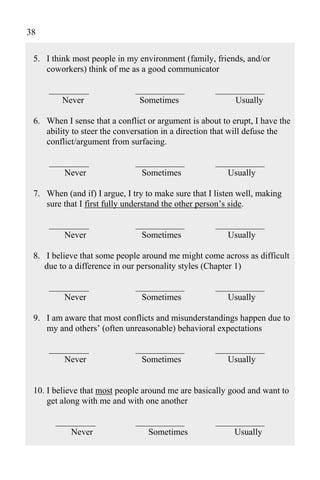
 5. I think most people in my environment (family, friends, and/or
    coworkers) think of me as a good communicator

     _________                ___________            ___________
        Never                  Sometimes                 Usually

 6. When I sense that a conflict or argument is about to erupt, I have the
    ability to steer the conversation in a direction that will defuse the
    conflict/argument from surfacing.

     _________                ___________            ___________
         Never                 Sometimes                Usually

 7. When (and if) I argue, I try to make sure that I listen well, making
    sure that I first fully understand the other person’s side.

     _________                ___________            ___________
         Never                 Sometimes                Usually

 8. I believe that some people around me might come across as difficult
    due to a difference in our personality styles (Chapter 1)

     _________                ___________            ___________
         Never                 Sometimes                Usually

 9. I am aware that most conflicts and misunderstandings happen due to
    my and others’ (often unreasonable) behavioral expectations

     _________                ___________            ___________
         Never                 Sometimes                Usually


 10. I believe that most people around me are basically good and want to
     get along with me and with one another

       _________              ___________            ___________
           Never                 Sometimes               Usually
39

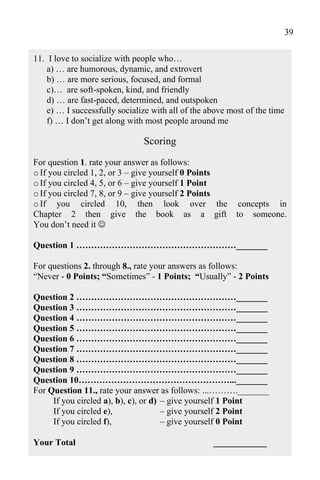
11. I love to socialize with people who…
    a) … are humorous, dynamic, and extrovert
    b) … are more serious, focused, and formal
    c)… are soft-spoken, kind, and friendly
    d) … are fast-paced, determined, and outspoken
    e) … I successfully socialize with all of the above most of the time
    f) … I don’t get along with most people around me

                               Scoring

For question 1. rate your answer as follows:
o If you circled 1, 2, or 3 – give yourself 0 Points
o If you circled 4, 5, or 6 – give yourself 1 Point
o If you circled 7, 8, or 9 – give yourself 2 Points
o If you circled 10, then look over the                    concepts in
Chapter 2 then give the book as a gift                    to someone.
You don’t need it 

Question 1 ………………………………………………_______

For questions 2. through 8., rate your answers as follows:
“Never - 0 Points; “Sometimes” - 1 Points; “Usually” - 2 Points

Question 2 ………………………………………………_______
Question 3 ………………………………………………_______
Question 4 ………………………………………………_______
Question 5 ………………………………………………_______
Question 6 ………………………………………………_______
Question 7 ………………………………………………_______
Question 8 ………………………………………………_______
Question 9 ………………………………………………_______
Question 10……………………………………………..._______
For Question 11., rate your answer as follows: ...………._______
     If you circled a), b), c), or d) – give yourself 1 Point
     If you circled e),               – give yourself 2 Point
     If you circled f),               – give yourself 0 Point

Your Total                                         ____________
40
Now check where your points fall:

 15 to 22 Points
 If your totals equal 15 or more, you should be rather proud of yourself.
 You either already spent some considerable time on developing your
 communication skills, or you got some good mentors or great
 upbringing; or perhaps you intuitively are adopting the right behaviors
 around people with different personality styles. Either way, you
 already have a good foundation on which you can continue building
 on. Surely you will find the concepts in the chapters ahead to greatly
 complement your already existing communication skills.

 8 to 14 Points
 If your totals equaled between 8 and 14 points, you probably get along
 well with some people, while with others it seems that there’s some
 type of barrier in between the two of you. At times, you might even
 think that there might be something wrong with the other person (jerk,
 dumb, idiot, or other “creative” labels); or you might wander at times
 if there’s something wrong with you.
 This book will definitely be a great tool for you – you already posses
 some of the fundamentals of creating successful relationships. The
 info ahead might provide you with the missing link to transform you
 into the communicator you always wanted to become.

 0 to 7 - Points
 OK – you probably think that we live in a cruel world, where everyone
 is out there to get you. Or even worth, you might feel that you are not
 worthy enough to be out there and socialize with others. You probably
 spend lots of time in one of two extremes: 1) either arguing and/or
 being angry or 2) being hurt and withdrawn. If you have not
 committed yet to go through a complete communication skills
 makeover, the chances are that you’ll stop reading this book before
 you’ll finish Chapter 1. Hopefully, you got this book as part of your
 commitment to improving your communication skills and your
 relationships; in which case, Congratulations! Commit and follow
 through. This book will be an invaluable tool for you on your personal
 growth journey.
41
You Can Easily Improve Your Communication Skills

      Yes, you can become a better communicator and create considerably
more successful relationships if you are willing to put forth some effort,
and equally importantly you commit to the process. Simply by reading
this book already shows your commitment to improving your
interpersonal skills. Congratulations for that! 
    Regardless of your score, this book will help you better understand
those around you and will show you specific ways to deal with individuals
who at this point might be perceived by you as difficult. After you’ll start
to apply what you learn throughout the following pages, you’ll find that
you will dramatically raise your ability to create and maintain successful
relationships.
    Commit to learning and applying the concepts in the following pages
and you will undoubtedly go on creating better relationships with most
people around you.

   To better anchor your learning, go ahead and teach these concepts to
others. You will find that these concepts are really simple and easy to
remember, and the more you’ll share it with others, the more you’ll
deepen your understanding of these concepts.
   You can find FREE handouts and PowerPoint slides that you can use
while sharing this info with others, at www.-------------------------------1
(On the same page you’ll have access to more trainer resources.)


1
 - Please credit E.G. Sebastian’s “Communication-Skills Magic” with the source
of your handouts and PowerPoint.
42


                      The quality of your life
                   - both at work and at home -
     is highly dependent on the quality of your relationships!

                                                          E.G. Sebastian
43


Chapter 1
Elements of Effective Communication
 The Definition of “Effective Communication”
 The #1 Key to Effective Communication
 Effective Communication Starts with Effective Listening
 Personality Style Theories
 The DISC Behavioral System
 Personality Style vs. Behavioral Style
 Most People Are Not Weird – They are Simply Differently Wired
 Power Tip #1: Commit to Listening at a Deeper Level
44
The Definition of “Effective Communication”


   Effective communication is 1) the two way process – an exchange of
 ideas between two or more people - where all parties feel understood,
 respected, accepted, and are comfortable to freely share ideas; and 2)
 the ability to create and maintain harmonious relationships

         Effective communication does NOT (!) contain threats, name-
     calling, poking fun at the other person’s expense, sarcasm,
     inducing shame or guilty feelings, or restricting the other
     person’s freedom of expression – in one word, to communicate
     effectively one needs to be aware of the other person’s needs.


   As you noticed in the highlighted info-box above, the concept of freely
expressing one’s ideas is stressed and underlined. “Freedom to express
oneself” comes from the feeling of being understood and feeling respected
enough to dare to speak out freely.


The #1 Key to Effective Communication

    Effective communication cannot be accomplished unless one is aware
of personality/behavioral style differences. A talkative, gregarious person
expects most people around them to smile, talk openly about things, while
also being considerate to others’
feelings. An outspoken, bottom-line Through               learning       to
type person expects everyone to be understand                     different
brief and to the point, leave emotions behavioral and personality
out of the conversation, and be tough styles, you will soon find that
enough to take the honest and blunt most people who you thought
truth. Put these two people to work in of as weird are simply
the same office and tensions and
                                            differently wired and are
conflict will brew in a matter of days,
                                            100% as “normal” as you or I.
unless at least one of them is aware of
45
differences in behavioral or personality styles and knows how to talk the
other personality styles “languege.”
    Many of us have acquired some of this “wisdom” instinctively and
through observation. We just learn about some people that “he’s just like
that” and we try to accommodate.
    However, if we do take the time to truly understand why those around
us behave the way they do, we’ll all undoubtedly become more effective
communicators and more successful at maintaining great relationships
with everyone around us.


Effective Communication Starts with Effective Listening

    Most effective communication courses put great emphasis on
developing great verbal skills; however, only a few of those programs
emphasize the crucial importance of good listening skills.           Fact is,
however, that without good listening skills, effective communication is not
possible. And what only few people know, listening skills are learned –
most of us are not born with it.
    Steven Covey, in his book Seven Habits of Highly Effective People1
stresses the importance of listening (Habit 5): Seek first to understand,
then to be understood. Many of us get tangled up in trying to get our point
across, while the other person tries the same, and all that’s happening is
two people speaking but NOT communicating.
    So, yes, good communication skills start with good listening. Besides,
let’s face it, God/nature gave us two ears and only one mouth – shouldn’t
that be a clear message that we should listen twice as much as we speak?
    Only by taking the conscious effort to really listen to those around us –
and by observing some highly visible behavioral tendencies (that we’ll
cover in later chapters) – will ensure a good foundation to communicating
effectively with loved ones, coworkers, or anyone with who we decide
that it’s important to get along well.

    What does the term good listening skills mean?


1
 - Steven Covey, Seven Habits of Highly Effective People. Simon and Schuster,
New York 1989 (pg 239)
46
    There are at least three levels of listening that we tend to adopt on a
daily basis – which one describes your listening habits more closely?

    Level 1 – While the other person speaks, I look at the person some of
the time, I even nod my head at times in approval or disapproval, but most
of the time I think about what I will answer (or even worse, I think about
something totally unrelated to the topic). I regularly interrupt the other
person; often with a totally unrelated topic.

     Level 2 – While the other person talks, I keep good eye contact and
listen to what the other person says, trying to really comprehend what I’m
hearing. My mind does not wonder away to unrelated topics and my
comments are directly related to the topic of discussion.

    Level 3 – I listen to the other person with all my senses and I often
“hear” even what is not expressed verbally. The person might tell me a
fairly mundane story with a smile on her face, but I can sense if something
is not right or if the person is bothered by something, depressed, or
otherwise indisposed.

     Of course, most of us tend to swing between the three levels, but each
of us tends to spend more time listening at one level or another;
unfortunately many of us tend to be stuck in Level 1 listening. Ideally, we
should all strive to listen at level two, and occasionally at level three.
     With a little effort – and conscious regular practice - anyone can learn
to listen at level two:
          Keep good eye contact
          Listen intently to what the other person is saying
          Do not allow your mind to wonder away; consciously focus on
              the message that is being conveyed to you, trying to
              understand it (vs. thinking on what to reply to it)
          Ask questions related to the topic of discussion to help you
              understand better what is being said. This will also allow the
              other person see that you are really listening.
          Do not distract yourself (and the other person) with other
              tasks, such as shuffling papers, reading emails, jiggling your
              pocket change or your keys, playing with your hair, etc.
          Smile when appropriate
47
     Most of us experience level three listening one time or another;
however, most of us do not need to listen that deeply. This level of
listening is mostly used by counselors, social workers, mental health
workers (psychologists, psychiatrists, etc.), personal coaches, and other
professionals. Parents also often experience this level of listening.
     To be an effective communicator, take conscious effort to adopt the
above bullet points to improve your level two listening. When you learn
to listen well, your communication with those around you will improve
significantly.
     Good listening skills are a habit that can be developed. Combined
with “reading” the behavioral or personality style of those around you,
you’ll become the great communicator you always wanted to be.


Personality Style Theories

    For centuries there has been much research trying to better understand
human behavior, and by today we have a plethora of assessments and
systems that help us better understand ourselves and those around us. Of
the many assessments and behavioral theories developed throughout
times, the existence of four main temperaments, personality styles, or
behavioral styles seemed to be one common element in most theories.
Some of the most popular ones are described below:

Hippocrates’ Bodily Fluids Theory
    Around 400 B.C., Hippocrates, also known as "the father of
medicine," developed the concept of temperaments.                  Unlike his
predecessors who believed in the influence of the stars on human
behavior, Hippocrates attributed one’s temperament to a person’s level of
certain bodily fluids (or humors): blood, bill, black bill, and phlegm.
    Hippocrates’ bodily fluid theory became the basis of most research on
personality, temperament, and behavioral types/styles.
    Hippocrates identified four basic temperaments:
1. Choleric,
2. Phlegmatic,
3. Sanguine, and
4. Melancholy
    Hippocrates’ theory is still widely used; however, further research has
showed that it was not the bodily fluids that caused people to have
48
different temperaments, but rather one’s genetic makeup and
environmental factors. Years of research also improved the description of
the four types.
Carl Jung’s Psychological Types
    In 1921, Dr. Carl Jung published his book Psychological Types, a book
in which he described sixteen personality types, which he then categorizes
into four main types:
        1. the intuitor,
        2. the thinker,
        3. the feeler, and
        4. the sensor.

The Myers-Briggs Type Indicator (MBTI)
    The MBTI is based on Carl Yung’s work - Psychological Types,
published in 1921 - and was developed in the 1940s by Katherine Cook
Briggs and her daughter Isabel Briggs Myers.
It breaks down personality types into four broad dichotomies (groups of
contradicting terms):
1. introversion/extroversion,
2. sensing/intuition,
3. thinking/feeling, and
4. judging/perceiving.
    Depending on how the combination of these 4 dichotomies relate to a
person, the MBTI groups people into 16 personality types

Keirsey Sorter
    David Keirsey and Marylin Bates took the theories of Myers-Briggs
and developed their own temperament sorter. In 1978 they published their
findings in their book entitled Please Understand Me (Prometheus
Nemesis Books).
The Bates’ gave more user friendly names to the different types (vs. the
multi-letter descriptors in the MBTI) and narrowed it down to 4 main
temperament styles:
1.Artisan,
2. Guardian,
3. Rational, and
4. Idealist.
49
The Enneagram
    The Enneagram thought to be introduced to the West (most likely
coming from East) by the Russian George Ivanovitch Gurdieff. It was
popularized in the United States by Don Richard Riso who further
developed Gurdieff and others’ work to develop a more complete and user
friendly version.
Unlike most personality theories, the Enneagram divides personalities in
nine types: 1. Reformer, 2. Helper, 3. Motivator, 4. Artist, 5. Thinker, 6.
Skeptic, 7. Generalist, 8. Leader, and 9. Peacemaker.


The DISC Behavioral System

    The DISC Behavioral Model was originally developed by William
Moulton Marston in the 1920’s, who published his findings in his book
The Emotions of Normal People, in 1928. In the next decades, several
researchers and companies have built on Marston’s findings, till 1970
when John Geier and Dorothy Downey created the DISC Personal Profile
System.
    The DISC Personal Profile System – like most other personality
theories - also identified 4 styles:

       1.   Dominance
       2.   Influence
       3.   Steadiness
       4.   Conscientiousness

    In the next 30 years – following the creation of the DISC Personal
Profile System – the DISC behavioral style profile (or DISC assessment,
as some call it) was thoroughly researched and tested for validity and
reliability and was continuously improved till the DISC based profile and
DISC based seminars became one of the most popular behavioral-system-
based learning tools on the market. By today more than 40 million1


1
    - Based on Inscape Publishing, Inc. research
50
individuals worldwide have either completed a DISC profile1 or have
participated in a DISC seminar.
    A highly distinguishing characteristic of the DISC Behavioral System
is that it helps individuals go beyond better understanding themselves,
build more successful relationships, and improve performance – all
extremely helpful characteristics; however, the DISC Behavioral System
also helps in easily recognizing different behavioral styles that one
encounters on a daily basis and provides simple and easy-to-remember
guidance on how to most effectively communicate with each style.

        A highly distinguishing characteristic of the DISC Behavioral
    System is that it helps you recognize individuals of different behavioral
    styles around you, and provides simple and easy-to-remember guidance
    on how to most effectively communicate with each style.


     This additional element of helping me (the author) understand those
around me was what made me fall in love with DISC. As I sat through my
first 4-hours DISC seminar, it felt as if someone had turned the light on in
the realm of my relationships. Suddenly I understood sooo many things
about myself and others – things that bugged me since I was in elementary
school. “Why did I see humor (fun) in everything?” “Why was I so
outgoing and getting into so much trouble” “How come other kids were
able to be so conscientious and obedient, while I
was always impulsive and disobedient?” All … my attempt to
                                                    understand       those
questions that stayed with me till adulthood.
                                                    around me was
     With the understanding I gained in that first limited by my biased
DISC seminar came a level of acceptance of perception of “right”
myself and the diverse people with different and “wrong” as seen
behavioral styles around me; acceptance that I through the lens of
have not experienced prior to that event. my personality and
                                                    behavioral style.
Suddenly I realized that for years my attempt to

1
 - You can complete the DiSC® Classic Profile and view a brief description of it - and a
sample profile - online at www.egsebastian.com/disc_classic
51
understand those around me was limited by my biased perception of
“right” and “wrong” as seen through the lens of my personality and
behavioral style. Suddenly I understood family members, friends and
coworkers who for years I labeled as “pushy,” “airhead,” “softy,”
“nitpicky,” and other labels that wouldn’t look very pretty in print. This
new understanding – especially of my close family members - was worth
to me more than if I had won the jackpot on the lottery.
    After that first fateful event I became a much better father and
husband: more understanding and patient when facing behavioral and
communication differences that I now embraced in those that I love.
Interacting with my business clients took on a totally different form as
well, treating now everyone as they wanted to be treated - based on my
understanding of each individual client’s behavioral style1.
    But before I get carried away and write 6 pages on how DISC has
changed my relationships with family members, friends, and clients, it’s
enough to say that I was so much affected by that first DISC seminar that I
decided to learn everything I could about it, get trained, go to school, get
certified – whatever it took – and get out there and affect others’ lives, the
same way as mine was affected.
    That is how I became a full-time DISC facilitator, trainer, and
consultant, and that is why this book is based on the DISC behavioral
system. I believe the DISC behavioral system is the best tool for helping
anyone better understand human behavior – both one’s own behavior and
the behavior of others. Read the book carefully – and do participate in a
live DISC seminar2 if you have a chance – and see how it will positively
affect your relationships with everyone around you.


1
  - Most individual clients are given a DiSC® PPSS* assessment at the beginning of our
business or coaching relationship, which proves extremely helpful for both of us; the
knowledge gained this way empowers me to treat the client as she or he wants to be
treated. This tool also helps me – as a coach and consultant – to get an understanding of
the client’s risk taking tolerance, fears, motivators, strengths, weaknesses, etc. See a
more detailed description of the DiSC PPSS at www.egsebastian.com/disc_ppss
* DiSC is a registered trademark of Inscape Publishing, Inc.
2
  - To enquire about upcoming live seminars or teleseminars call TOLL FREE, 877 379-
3793 or visit www.egSebastian.com/events_calendar
52
Personality Style vs. Behavioral Style


    Personality Style = refers to a person’s relatively stable psychological
    and behavioral characteristics - the way the person views the world
    and relates to it. Personality remains, more or less, the same across
    various situations1.

    Behavioral Style = the set of behaviors one tends to adopt on a
    consistent basis.
    It does not measure, nor is dependent, on one’s intelligence, IQ,
    education level, or mental health.

     For many of us there’s probably not one day passing by without
hearing the word “personality.” We hear it at home or at work when
speaking about someone: “She has a cheerful personality,” “He is sooo
boring – he has no personality at all,” and other similar comments. Fact
is, of course, that each one of us has personality, and we all have different
personalities.
     When it comes to personality, there has been a debate for years that
scientists do not seem to be able to come to terms with; regarding whether
personality is something that is genetically imprinted in us or is it
something that’s shaped by the environment. The truth probably lies in
between the two extremes: we are born with a certain genetic
predisposition towards a certain personality style, but our personalities are
also greatly shaped by our environment.
     Maternity nurses who studied personality or behavioral styles say that
they recognize a child’s styles a few hours after birth. Parents of multiple
children also know that each child can be extremely different from one
another right from the first day; and as a parent of three children, I can
attest to that. So, yes, all evidence shows that we are born with different
personality styles, but then that style is shaped by the environment as one
goes through stages of life.


1
 - Martin E.P. Seligman et. Al., Abnormal Psychology. W.W. Norton & Company, Inc.,
pg 371
53
    Can one’s personality or behavioral style change? This is a question
that regularly comes up in my DISC-based presentations and workshops.
As I describe the four main DISC styles, people occasionally perceive one
style as more favorable then the others, and they wish they could change
their style to mirror the one they like.
    No, we cannot change our personality style. Much of it, as I
mentioned above, is determined by our genetic makeup and there’s
nothing we can do about that. The good news is that each of the four main
styles has its distinct set of strengths, as well as weaknesses, and by
capitalizing on our strengths we can each become more productive; and by
understanding our style’s weaknesses, we can take steps to improve in
those areas.
    While we cannot change our personality style, what we can control,
however, is our behavior. Regardless of our personality style, we can
choose to adopt behaviors that are most effective in different situations,
and through awareness or our strengths and weaknesses and self-control
we can choose to eliminate or redirect behaviors that don’t serve us in
creating the relationships we want to create with those around us or hinder
us in our productivity and attainment of our goals.
    Our personalities are expressed through our behaviors, but unlike
personality style – which is more or less stable - our behaviors are
adaptable. In the pages of this book we’ll talk about “behavioral styles,”
which are also rather stable; but once one becomes aware of his or her
behavioral style, the individual has more control over it and can choose to
adopt more effective behaviors in order to better connect and
communicate with people of different personality/behavioral styles.
    In the later chapters you’ll discover the four main behavioral styles
and you’ll learn that it is up to you to adopt behaviors from any of the four
styles in order to get along and communicate most effectively with
everyone around you.


          You’ve encountered in your reading so far the terms
  “personality style” and “behavioral style”; since the information
 in this book is based on the DISC Behavioral System, we’ll go on
      using throughout the book the term behavioral style.
54
Most People Are Not Weird – They are Simply Differently Wired

    In some of our interactions with others – at times, even when we meet
total strangers - we feel connected instantly; we seem to hit it off and chat
right away about all kinds of personal,
political, or just trivial topics. On the other
                                                 There are two sides to
hand, there are those individuals who we
meet, work with, or otherwise get in touch every coin.               Is it
regularly, and not even years of interacting possible that the people
with them can create any type of sense of we see as behaving
connectedness to them. We just can’t seem inappropriately might
to be able to relate to them, or even worse,
we are annoyed by some of these people view us as the ones who
each time we meet them. And, of course, behave out of sync?
most people we meet are somewhere in
between these two extremes.
    In a society where we encourage and celebrate freedom of speech and
promote respect for individual differences, it is only normal that we face
almost on a daily basis behaviors that at times may seem – to say the least
– odd; or even inappropriate, annoying, and stressful. But let’s face it,
there are two sides to every coin. Is it possible that the people we see as
behaving inappropriately might view us as the ones who behave out of
sync?
 Through learning to understand different behavioral and personality
 styles you will soon find that most people who you thought of as weird
 are simply differently wired – have a different personality style from
 yours - and are 100% as “normal” as you or I.

    Who is right and who is wrong? Is it possible that neither is right or
wrong?
    Fact is, we get along best with people who have similar behavioral (or
personality) styles as ours, and we often view those who have different
personality styles as “weirdoes,” “strange,” and other creative labels.
    Can we do anything to change the behavior of our coworkers,
customers, family members, or friends who might come across at times as
unreasonable, non-cooperative, argumentative, or otherwise difficult?
Most likely not; but we can definitely learn to better understand their
behaviors and communicate more effectively with each individual based
on that understanding. Learning to understand different behavioral styles
also greatly affects our perception of those around us; it will help us see
people as “different,” not “difficult.”
55


Power Tip #1
Commit to listening at a deeper level to those around you

We all like people who listen to us; none of us like poor listeners and
those who interrupt us constantly.

Improve your relationships by listening more carefully to those
around you and try to empathize – listen more carefully and take a
conscious effort to understand the other person’s side “of the story.”

Real listening skills are expressed through
 keeping good eye contact
 asking questions related to the topic
 not interrupting – especially not with an unrelated topic or idea (a
true “deadly sin” and a hallmark of ineffective listeners)
 listening to what is being said, vs. getting lost in thoughts the
conversation brings up, or other non-topic related thoughts;
 nod occasionally (constant nodding is perceived as annoying by
most people)
 do not perform tasks while listening (typing, numbers-crunching,
looking for something, etc.)
56

NOTES: _____________________________________
_____________________________________________
_____________________________________________
_____________________________________________
_____________________________________________
_____________________________________________
_____________________________________________
_____________________________________________
_____________________________________________
_____________________________________________
_____________________________________________
_____________________________________________
_____________________________________________
_____________________________________________
_____________________________________________
_____________________________________________
_____________________________________________
_____________________________________________
_____________________________________________
_____________________________________________
_____________________________________________
_____________________________________________
_____________________________________________
_____________________________________________
_____________________________________________
_____________________________________________
_____________________________________________
_____________________________________________
_____________________________________________
_____________________________________________
57


Chapter 2
An Introduction to the DISC Behavioral System
 Follow The Golden People-Smart Rule!
 The Basics of the DISC Behavioral System

 This System Works!
 The Journey Starts with Understanding Yourself

 What is Your Behavioral Style?

 Power Tip #2: Focus on the Strengths of Those Around You
58
Follow The Golden People-Smart Rule!


     Warning!!! When it comes to communicating with others,
     applying The Golden Rule can be extremely counterproductive!


    We’ve been taught ever since childhood to follow The Golden Rule
“Do unto others as you would have them do unto you,” but when it comes
to effective communication, The Golden Rule can be straight out
counterproductive and can result in conflict and constant tension with
certain people around you. What we all need to realize is that not
everybody wants to be treated the same way as each of us do.
    Steven Covey, in his book 7 Habits of Highly Effective People1, says
that the Golden Rule should be rather understood as "Understand [others]
deeply as individuals, the way you would want to be understood, and then
treat them in the terms of that understanding." This gives the golden rule
a quite significant tweak, and we’ll call this rule “The People-Smart
Rule,” which put in simpler language would sound something like,
Respect others by treating them as THEY want to be treated (vs. treating
them as YOU would want to be treated).
    The Golden Rule is basically about “respect” – respect others by
doing to them what you don’t mind being done unto you – and what better
way is to show your respect to those around you than by trying to
understand how they want to be treated and treat them accordingly.

              You need to realize that most people do not want
               to be treated the way you want to be treated.


   Just think about it for a moment…
   We all know people who are very private and totally dislike "nosy"
questions, while others not only don't mind, but welcome any types of
questions (introvert vs. extrovert). Now, should the extrovert person treat


1
 - Steven Covey, Seven Habits of Highly Effective People. Simon and Schuster,
New York, 1989 (pg. 192)
59
everyone as she would like to be treated? (Or vice-versa?) We all know
that’s rarely a good way to build great relationships.
    To become effective communicators, we need to learn to recognize the
behavioral styles of those around us and treat them as they want to be
treated


                        The People-Smart Rule:
       Respect others by treating them as THEY want to be treated
                    (vs. treating them as YOU want to be treated)


    When we apply The Golden Rule, we treat others through the
assumption that “This is how I want to be treated, and that’s how I’ll treat
you too.” The People-Smart Rule, on the other hand, teaches to first try to
understand how those around you want to be treated, and treat them
accordingly.
    How would one do that? You might ask…
This book, through introducing you to the DISC Behavioral System, will
provide the necessary guidance on helping you easily recognize the
different behavioral styles around you, understand each style’s needs, and
you’ll be introduced to concrete strategies on how to effectively
communicate with each individual based on that understanding. That is,
you will learn to treat everyone the way they want to be treated.


The Basics of the DISC Behavioral System

    Have you ever wondered why some people around you are always on
the go, upbeat, and seem to have no fear of anything, while others seem to
be more withdrawn, controlled, and often
worry about all kinds of “trivial” things?        Human behavior is
    Have you wondered why YOU behave the very complex and we
way you do?                                       are all very unique, but
    Human behavior is very complex and we you’ll be surprised to
are all very unique, but you’ll be surprised to learn how predictable
learn how predictable each of us is in more each of us is in more
ways than you have ever imagined.                 ways than you have
    The good news is that, with a little effort, ever imagined.
anyone can learn to recognize and understand
60


Figure 2.1 – DISC describes behavior in four styles: Dominance,
Influence, Steadiness, and Conscientiousness1
    …………………...
different behavioral styles, simply by noticing a few externally observable
behaviors, and have an instant understanding of a person’s communication
and behavioral tendencies. Then armed with that knowledge, it’s only a
matter of applying what you’ll learn in this book to build better, more
successful relationship with anyone
around you.                                    You      will   learn    to
                                               recognize the 4 main
                                               DISC behavioral styles
    The DISC Behavioral Model (See Fig. around you, understand
2.1) is a learning tool that will help you
                                               each style’s needs, and
better understand why you behave as you
                                               you’ll be introduced to
do, why those around you behave as they
                                               concrete strategies on how
do, will help you better manage your
                                               to treat everyone the way
expectations of those around you, and
                                               THEY want to be treated.
through this knowledge you will be
1
 - The terms “Dominance, Influence, Conscientiousness, and Steadiness” are terms
originally used by Inscape Publishing, Inc
61
empowered to create better relationships with mostly anyone around you.
      DISC explores behavior across four styles: 1. Dominance (D), 2.
Influence (I), 3. Steadiness (S), and 4. Conscientiousness (C); hence the
acronym DISC. Each style – D, I, S, and C – is described through a set of
behaviors that enables us to explore and better understand the behavioral
styles and the combination of styles of the individuals we encounter in our
everyday interactions.
      A person would be considered to be D, I, S, or C style, based on the
person’s natural tendency to adopt behaviors from a particular style’s set
of behaviors. For example, if someone tends to adopt mostly behaviors from
the Steadiness set of behaviors, we would call this person a Steadiness
style (or S style) person. Or if someone seems to consistently display
behaviors from both the Conscientiousness and the Dominance set of
behaviors, we’d call this person a DC or CD style individual. We will get
into more details on this a little later in this chapter, and more in depth in,
Chapters 4, 5, 6, and 7.

   A distinctive characteristic of the DISC Behavioral Model - as
compared to other personality and behavioral theories - is the simplicity of
the four-quadrant model that allows anyone to easily recognize the
behavioral styles of the individuals around us (see Fig. 2.1 on previous
page).    This understanding of the styles often results in increased
acceptance of individuals with diverse behaviors, enables one to
communicate more effectively with each style, while also aiding in
understanding each style’s
    motivators
    demotivators
    strengths
    fears
    possible weaknesses
    communication style
    expectations of others
    possible conflict triggers
    compatibility with individuals of each style
    and other behavioral tendencies (explored in more details in
       Chapters 4, 5, 6, and 7; as well as in Chapter 9).
62


    It is important to understand that one’s personality style does not
predetermine someone to being “good” or “bad” – it is a person’s
belief’s and values that will ultimately influence a person’s actions and
tendency to do good or bad.


This System Works!

   More than 40 million1 people worldwide have used Inscape Publishing
DiSC®2 profiles to help them better understand themselves, better
understand others, and to improve their relationships.
   The DISC model has been used in the past three decades by everyday
people from all walks of life, as well as companies of all sizes (including
Fortune 500 companies) to help employees:
    explore their behavior and the behavior of those around them in a
       safe and non-judgmental manner
    improve communication skills
    reduce workplace conflict
    increase acceptance of diverse behaviors
    improve productivity
    improve team effectiveness
    improve team spirit
    and more…

    While most popular personality and behavioral systems on the market
are great at helping understand a person’s own behavior, there are only a
very few that help understand others’ behaviors as well. And that’s one of
the attraction factor and benefit that the DISC Behavioral Model provides.
    By learning to recognize and understand the different behavioral styles
of those around us, coupled with understanding each style’s behavioral
and communication tendencies can be extremely useful in most areas of
our lives, such as…

1
  - Based on Inscape Publishing, Inc. data. Inscape Publishing is the leading provider of
DiSC® and other learning instruments, providing learning tools in 25 languages in more
than 50 countries (www.InscapePublishing.com )
2
  DiSC® - with lower case “i” is an Inscape Publishing , Inc trademark
63
On the Job:
    managers can better manage and motivate their subordinates due to
      better understanding employees’ needs, motivators, fears,
      strengths, possible weaknesses, and other general behavioral
      tendencies
    improve communication with coworkers
    reduce conflict, hence more time is spent productively
    improve team spirit
    improved productivity due to better employee relationships and
      less time spent on conflict, misunderstandings, etc.
    improved employee retention due to creating a better workplace
      environment

In Coaching Applications to help clients or employees
    understand their strengths and weaknesses
    capitalize on their strengths
    became aware of, and work on, weaknesses
    become more effective at completing tasks and accomplishing
      goals
    raise awareness of how to effectively sell to different styles (for
      sales professionals)
    deal more effectively with conflict
    avoid conflict

In Romantic Relationships:
    increased understanding and acceptance of the other person
    reduced conflict
    improved communication

For Parents:
    increased understanding and acceptance of the child’s behavior
    easier parenting due to a better understanding of the child’s needs,
      motivators, and natural drive
    reduced conflict
    improved communication
   These are only some of the top applications. This system is applied in
many other areas as well, such as improving relationships with:
        siblings,
        parents,
        in schools to improve teachers’ understanding of their students
           (and improve communication with other staff members),
64
             nurses, to better understand their patients (and improve
              communication with other hospital employees),
             for clergy, to better understand their members,
             and a myriad more areas


The Journey Starts with Understanding Yourself

“Know yourself” - Socrates (Circa 470–399 BC)

    Understanding others’ behaviors was a pursuit of mankind since the
beginning of civilization and we still continue pursuing this quest of trying
to understand the intricacies of the human mind and the behaviors it
orchestrates. Let’s face it, life would be so much easier if we were able to
better understand the behaviors of those around us.
    But, before we discuss others’ behaviors, let’s explore a little closer to
home:
    Do you know why YOU behave as you do?
    Have you got any idea why you approach and pursue your tasks and
    goals as you do vs. how others do it?
    Do you notice yourself when you are being difficult once in a while?
    Do you understand why you are being difficult at those times?
    Do you have any idea why some perceive you as a great person while
    others just don’t seem to appreciate you?
    Understanding the answers to these questions will undoubtedly lead to
improving your relationships and ultimately your whole life1.
    Sun Tsu (circa 544 -496 AD) in his timeless military strategy book
“The Art of War2” said: So it is said that if you know your enemies and
know yourself, you will not be imperiled in a hundred battles; if you do not
know your enemies but do know yourself, you will win one and lose one; if
you do not know your enemies nor yourself, you will be imperiled in every
single battle.


1
 - One of the benefits of becoming familiar with the DISC Behavioral System is its
coverage of each style’s effectiveness in initiating and completing tasks and goals, which
often determines one’s success on the job and private life.
2-
   Sun Tzu, The Art of War. Shambhala, 2005
65
    Sun Tsu’s teachings on the value of knowing one’s enemy and self are
entirely transferable to our relationships. And while we (hopefully) can’t
call the other party in any of our relationships “enemy,” they can easily
turn into something similar to an enemy if we don’t have a basic
understanding of why we do what we do and why the other person
behaves as he or she does.
    Hence, Sun Tsu’s teaching translated into “relationship language”
would be: if you understand the behavior of those around you and
understand your own behavior, you will avoid hundreds of conflicts; if you
do not understand others but do know yourself, you will avoid some
conflict and get drawn into some; if you do not understand others’
behaviors nor yours, you are doomed to spend most of your life in conflict
and miscommunication.

     Many participants in my seminars say that (one of) the greatest benefit
they get from participating in my DISC presentation was primarily the
better understanding of themselves – the realization that “it is OK to be
who I am – I am “normal,” and this realization leads to a great sense of
self-acceptance. In many cases, this self-acceptance results in instant
higher confidence levels due to understanding that there’s “nothing wrong
with me – I am not broken.”
Participants become more aware of What would Sun Tzu say?
their strengths and learn how they can If you understand the
better capitalize on them; as well as behavior of those around you
they get to face some of their and understand your own
weaknesses and learn to better accept behavior, you will avoid
them or use this new knowledge to hundreds of conflicts; if you
work towards improving some weaker do not understand others but
areas.                                    do know yourself, you will
     So, let’s get started and find out, avoid some conflict and get
first of all, what is YOUR behavioral drawn into some; if you do
style; which, in turn, will help you get not      understand       others’
a better understanding of your            behaviors nor yours, you are
behavioral         tendencies       and doomed to spend most of your
communication style.                      life    in      conflict    and
     Take a few minutes and explore miscommunication.
the next sub-chapter entitled “What is
66
Your Behavioral Style 1?” to get an idea of what is YOUR style. This
way, as you read on, you’ll be able to focus your attention on parts of the
book that will help you better understand the behavioral style that you
might adopt more naturally and start exploring ways on how to improve
your communication skills and productivity.


What is Your Behavioral Style?

    Take a few minutes now to review a brief description of the four
styles, and check the one that you feel describes you most closely.


____ Dominance (D) Style (Fast Paced/Task Oriented)

    D style individuals are characterized by fast pace, fast rate of speech, a
strong desire of being in charge, and are highly focused on accomplishing
goals and completing tasks. On the job, they are the ones who lead by
example, while also will push everyone to perform and leave little room
for personal chit-chat. They know what they want, they go for it, and they
expect those around them to do the same. D style individuals are goal-
oriented, process driven, and often turn out to become real achievers. At
times, due to their drive to accomplish goals and their high focus to
complete the tasks they work on, they are perceived as cold, pushy,
inpatient, and as having little consideration for the feelings of those around
them.
    D’s try to avoid, whenever possible, routine work, and environments
where they are not given the freedom to be in charge (at least) of their own
actions, and are not allowed to move at their own (fast) pace. (See a more
detailed description of the D – Dominance Style - in Chapter 4)

1
 - To take the validated and reliable DiSC® (2.0 or PPSS) assessment, please visit
www.egsebastian.com/assessments
67
_____ Influence (I) Style (Fast Paced/People Oriented)

    I style individuals are characterized by fast pace - both in actions and
speech – and a love to socialize. I style individuals are easily recognized
by their high energy levels, enthusiasm, and their openness to interaction
with others at any moment of the day. They tend to almost constantly
smile and be ready to share a joke, a (humorous) story, or listen to others’
stories (even though, listening is not their main strength – they rather talk
than listen). They come across as friendly, enthusiastic, and passionate;
and at times can be perceived as fake (too much smiling and enthusiasm)
and tiring (too much talking).
    I’s style individuals dislike environments where they are not given the
freedom to interact with others, have to perform routine and detail-
oriented activities, or are not given a chance for quick and regular
recognition. (See a more detailed description of the I – Influence Style -
in Chapter 5)

_____ Steadiness (S) Style (Moderate Paced/People Oriented)

    S style individuals are characterized by being moderate paced - both in
speech rate and physical movement – and by a strong tendency to support
others. S style individuals enjoy being around people, and due to their
tendency of being more thoughtful and caring, they are great listeners and
come across as friendly and warm. S style people are calm, amiable, and
supportive. They are perceived by many to be the sweetest people in the
world and most of us enjoy having them around us. Due to their calm,
cautious, and hesitant nature, at times they can come across as being a bit
slow at performing certain tasks and slow at making decisions.
    S style individuals will often try to avoid fast-paced environments with
unpredictable work schedules, and will stay away as much as possible
from any situations where they would have to put up with regular conflict
or otherwise stressful situations.. (See a more detailed description of the S
– Steadiness Style - in Chapter 6)
68
_____ Conscientiousness (C) Style (Moderate Paced/Task Oriented)

    C Style individuals are characterized by being cautious, moderate
paced, and highly task oriented. C style individuals enjoy working
individually or with a small group of other C style individuals. They like
getting deeply involved in performing tasks and do not like to be
interrupted while working. They tend to be very particular about doing an
excellent job and are very organized. Due to their natural tendency to be
analytical and questioning, C style individuals are great in any area where
accuracy and precision is needed. To the other three styles, C style
individuals can at times come across as distant, perfectionist, and overly
nit-picky.
    C style individuals will try to avoid fast-paced environments where
they’d have to make quick decisions, spend most of their time on social
niceties, and where they would have no time to plan carefully their days.
(See a more detailed description of the C – Conscientiousness Style - in
Chapter 7)


Remember! No one is purely one style or another; we are all a
combination of two or more of the styles described above1.


     Important!

The DISC Behavioral Model does not suggest that we are stuck in one
behavioral style or another (!). It is designed to raise awareness of our
behavioral tendencies; then use this knowledge to take control – or gain
acceptance – of our weaknesses and limitations, while focusing on
capitalizing on our strengths.


1
 - To take the validated and reliable DiSC® (2.0 or PPSS) assessment, please visit
www.egsebastian.com/assessments
69


Power Tip #2
Focus on the strengths of those around you!
Improve your relationships by noticing the strengths of those
around you and by showing your appreciation for those strengths;
especially try to notice the strengths of those people who in the
past you might have only noticed their weaknesses.
Understand that often the people who you might dislike most
(perhaps due to their personality style that’s opposite to yours)
possess strengths that best complement your weaknesses. In a
business environment often these people are the ones who you
need most in order to be most effective.
70


Chapter 3
The DISC Behavioral Model
 Most People’s Behaviors are Highly Predictable
 Understanding Your Behavioral Style
 Understanding Others’ Behavioral Styles
 Common Characteristics of the Four Behavioral Styles
 Common Characteristics: A Humorous Look 
 Funny and Practical “Facts” - Fast Pace vs. Moderate Paced individuals
 Funny and Practical “Facts” - Task Oriented vs. People Oriented
 How to Recognize Different Behavioral Styles
 General Tendencies of the Four DISC Styles
 DISC Statistics
 You Are in Charge of Your Behavior
 Power Tip #3: Avoid Judging Others…
71
Most People’s Behaviors Are Highly Predictable

     Our day to day life experiences are greatly shaped by our perception of
the world, our behaviors, and perception of those around us – and
therefore how we relate to people and events. But we also posses certain
traits that we are born with that contribute to a great extent to shaping our
personalities and behaviors, and hence determine to a high degree how we
relate to the world (and people) around us. Due to this mix, we are all
unique beings creating a colorful world of diverse behaviors
     While it is a fact that we humans are extremely complex beings,
displaying infinitely diverse behaviors, it might surprise you to see that
based on some observable behavioral clues, how very much predictable
many of our behaviors tend to be.
     We have known at least since Hippocrates (circa 400 BC) that there
were four main behavioral styles (or temperaments, as Hippocrates called
them) and those findings were supported by modern research as well
(though his original theory of bodily fluids influencing one’s temperament
was discredited). The four styles are rather easy to recognize once one
learns what clues to look for.
      The clues to one’s behavioral style are few and simple. Research1 has
shown that we tend to display a specific set of behaviors based on two
factors (or clues):
     (1) a person’s pace and
     (2) a person’s people vs. task orientation. (See Fig. 3.1)


    Important!
The DISC Behavioral Model does not suggest that we are stuck in one
behavioral style or another (!). It is designed to raise awareness of our
behavioral tendencies; then use this knowledge to take control – or gain
acceptance – of our weaknesses and limitations, while focusing on
capitalizing on our strengths.


1
 - The DISC Behavioral Model is based on William Moulton Marston’s research.
Inscape Publishing, Inc built on Marston’s findings…. Request a copy of the research
conducted by Inscape Publishing, Inc., by sending an email to support@egSebastian.com
72
     Clue #1: Pace
     Does this person usually move and talk at a faster pace OR more
     moderate pace?

                  Some of us tend to be more
                  1) outgoing: speak fast, move fast, bring quick decisions;
                  while others tend to be more
                  2) reserved: move and talk at a more moderate pace, as well
                  as take their time to think through all variables before
                  bringing a decision.

    Obviously, it is easy to recognize those who display behaviors from
either of these two extremes; many individuals, however, are somewhere
on the continuum in between the two extremes.
    Clue #2: Task vs. People Orientation
    Does this person a) usually enjoy socializing, OR b) usually prefers
              working on task-oriented activities (or talk about task-
              oriented topics)

                a) Some love to be most of the time around people, love to
                socialize, and like to work in environments where they can
                spend considerable time working with people (nurses, social
                workers, teachers, actors1, etc)

                b) while others prefer to spend most of their time working on
                tasks, building something, doing research, working with
                concepts, and other task-oriented activities (engineers,
                pharmacists, accountants, pilots, etc.)

Again, it is easy to recognize those who display behaviors from either of
these extremes; you will find, however, that most individuals are
somewhere on the continuum in between the two extremes.


1
  - See a list of careers preferred by each behavioral style at the end of Chapter 4, 5, 6,
and 7.
73


Figure 3.1 – Pace and People vs. Task Orientation

    As you probably noticed, I repeated the “clues” to one’s behavioral
style several times in the previous pages, and I’ll go over them a few more
times in the next few pages, and with good reason. Repetition is the
mother of learning, right? Besides, I want you to remember to watch for
these clues when interacting with those around you. Remembering these
clues is the first step to identifying,
understanding, and ultimately improving While it is a fact that we
your communication with the individuals humans are extremely
with different behavioral styles in your complex beings, it might
                                                  surprise you to see that
environment. As you read on you will
                                                  based       on      some
learn that these two factors (pace and task observable behavioral
vs. people orientation) greatly determine an clues, how very much
individual’s behavioral style and the predictable many of our
behaviors one tends to display consistently.      behaviors tend to be.
74
   Based on pace and orientation, the DISC Behavioral System will help
you explore human behavior in four main styles: (See Fig. 3.1 on pg. 73)

Dominance (D) – fast paced and task oriented
Outspoken and determined, D’s are dynamic, goal-oriented people who
like to take charge, bring quick decisions, and want quick results

Influence (I) – fast paced and people oriented
Enthusiastic and friendly, I’s are outgoing, high-energy people who like to
influence others with their wit, humor, and persuasive skills

Steadiness (S) – moderate paced and people oriented
Caring and supportive, S’s are calm and kind people, who are great at
providing support and comfort to others, follow rules, are great listeners
and great team players.

Conscientiousness (C) - moderate paced and task oriented
Cautious and detail-oriented, C’s are focused and dependable people who
love to work with tasks and concepts; like to plan their work and are
committed to quality and accuracy in all areas.
    Once you recognize the dominant style
of another person, you can easily predict a A person’s dominant
whole set of behaviors of that person, as behavioral             style   is
well as better understand WHY that person         determined by one’s
behaves as she does. This information tendency to display
allows the person familiar with the DISC behaviors from one
system to better understand why someone particular dimension (D,
                                                  I, S, or C) on a
behaves the way she does and improve
                                                  consistent basis.
communication based on that understanding.
    For example, if someone you know, seems to always be in a hurry,
talks fast, might not naturally smile too often, and tends to speak her mind
with little or no inhibitions (but without using stories or humor), sticking
mostly to the bottom line, this person is most likely a “Dominance (D)
Style” individual. You’ll find the behavioral tendencies of this style
described in detail in Chapter 4.
    If someone around you talks fast, moves fast, loves to tell stories and
is humorous; as well as smiles most of the time, this person is most likely
75
an “Influence (I) Style” individual.             You’ll find the behavioral
tendencies of this style described in detail in Chapter 5.
    Another behavioral style that tends to smiles a lot, but in a more subtle
way, is the “Steadiness (S) Style”; however, this person is more moderate
paced both when talking and completing tasks or activities. The S Style is
the best listener of all behavioral styles, is extremely supportive and
friendly, and is more likely to abide by rules and traditions than either the
D or the I style individuals. You’ll find the behavioral tendencies of this
style described in detail in Chapter 6.
    Finally, you’ll recognize the “Conscientiousness(C) Style” individual
by their tendency to be more reserved and cautious most of the time, talk
at a more moderate pace, think of life as “serious business,” take the tasks
they work on more seriously than any of the other styles, and are very
particular about details, accuracy, and
                                                The      beauty    of    the
following rules. You’ll find the
                                                Behavioral Style concept is
behavioral tendencies of this style
                                                that it does not necessarily
described in detail in Chapter 7.
! The beauty of the Behavioral Style lock or another, but teaches
                                                style
                                                      anyone rigidly in one
concept is that it does not necessarily us that we can flex our style,
lock anyone rigidly in one style or enabling most of us to adopt
another, but teaches us that we can flex different behavioral styles
our style, enabling most of us to adopt as needed in different
different behavioral styles as needed in situations.
different situations. For example, one
might display a different behavioral style while at home talking to one’s
spouse or child, and a different behavioral style while at work. Even at
work, one might adopt a different style when interacting with a pleasant
coworker vs. when interacting with a strict manager or a coworker who is
perceived as difficult; and might adopt a different style while providing
service to a customer.

! While we can all flex – or adapt - our behaviors as needed, based on
different situational needs, we all have a dominant behavioral style that is
observable on a daily basis. A person’s dominant behavioral style is
determined by one’s tendency to display behaviors from one particular
style (D, I, S, or C1) on a consistent basis.

1
    - The four styles are described in Chapters 4, 5, 6, and 7
76
Understanding Your Behavioral Style

    As we talk about behavioral styles it is Once you learn about
important to note (again) that nobody is your behavioral style and
purely one style or another. Even those who become aware of your
take a DISC profile1 (or assessment) and natural strengths and
find that they are purely one particular style weaknesses, you can
will find themselves adopting regularly choose to reach more into
behaviors from the other three styles (and the adjacent behavioral
especially from the two adjacent ones). We dimensions that will aid
all possess the ability to adopt behaviors you in becoming more
from each style and most of us do adopt effective in any given
behaviors from different styles to fit the situation.
demands of the different situations we face.
    For example, if someone is a high D – outspoken and determined –
who tends to be driven, focused on goals and tasks, and spends little time
nurturing relationships; when needed, this person will – or can, if he or she
chooses to – take time to socialize and perhaps even be humorous (I style
behavior), get organized and focus 100 percent on quality (C style
behavior), or be kind and caring (S style behavior).
    The same is true for the other three styles: each style has the ability to
adopt behaviors from the other styles as required by different situations.
Well.., with some limitations.
    I’m sure you noticed that some behaviors come more naturally to you,
while others take some real effort. For some of us socializing comes
naturally, while for others it feels like a dreadful stumbling block; for
some, attention to detail comes naturally and seemingly with ease, while
for others it is a constant struggle. Some of us are great at listening to
others’ complaints, joyful stories, etc., while others have to force
themselves to listen, and more often then not, they’ll interrupt the speaker
and/or find an excuse to leave.
    Once you learn about your behavioral style and become aware of your
natural strengths and weaknesses, you can choose to reach more into the


1
 - To take the validated and reliable DiSC® Classic Profile, and view a brief description
of it online, visit www.egSebastian.com/disc_classic
77
adjacent behavioral styles to aid you in becoming more effective in any
given situation.
    Yes, you will most likely find that you feel more comfortable adopting
behaviors from one particular style – or styles – but with that awareness,
you will be empowered to choose to adopt behaviors from the other styles,
aiding you in becoming more effective in building your relationships and
be more effective at accomplishing your goals.


Understanding Others’ Behavioral Styles

    Learning about the behavioral styles of others will allow you to
instantly recognize the different styles in your environment and
understand why each behaves as he or she does, giving you an edge on
facilitating your communication with everyone around you.
    Often you will recognize a specific behavioral style – D, I, S, or C - in
the individuals around you; some people, however, will display behaviors
from a combination of two, or even three, styles. In this case interpreting
the person’s behavioral style can be more challenging, but with little
practice anyone can identify combinations of styles, such as DC, SC, ISC,
SCD1, etc.
    A good place to start is to get a good understanding of each of the four
behavioral styles. So let’s get more familiar with our general behavioral
tendencies by first exploring some common characteristics of the styles.


    Remember!
No behavioral style is better or worse! Each and every style has its
strengths and weaknesses. You can become the “best you” when you get
a good understanding of your style, learn to capitalize on your strengths,
and – if you choose to – work on some of your weak areas. You are
already perfect as you are – you just have to use your gifts to your
advantage.


1
  - - Visit www.egSebastian.com/15 to learn more about the 15 Behavioral Styles Blends
If you completed a DiSC® 2.0 or DiSC 2Plus profile, you can find a detailed description
of the 15 Behavioral Style Blends on the last 6 pages of your profile
78


Figure 3.2 – Behavior tendencies based on a person’s Pace

Common Characteristics of the Four Behavioral Styles

    When it comes to human behavior, people can be categorized by a
myriad of criteria: extrovert/introvert, outgoing/reserved, active/passive,
accepting/questioning, impulsive/careful, etc., etc.
    However, for the sake of simplicity, AND because that’s all we need
for our purposes, we’ll consider only two such criteria that will help us
recognize different behavioral styles. These two criteria also give us the
two axes that will help us build the DISC model:

           1. Vertical Axis: Is this person Faster Paced or more
              Moderate Paced? (Fig 3.2)
           AND
           2. Horizontal Axis: Is this person People Oriented or more
              Task Oriented? (Fig. 3.3)
79
   Simply by noticing a one’s pace, one can safely expect a whole set of
behaviors (Fig 3.2):

    Fast Paced People tend to talk fast, move fast, and often come across
as confident individuals; while also tend to consistently display the
following behaviors:
     make quick decisions
     are often impulsive
     are positive and expect things to turn out right
     are great at starting projects; not always great at finishing projects
     are enthusiastic and more energetic (than moderate paced people)
     they are impulsive and get involved easier in whatever goes on
       around them (including conflict)
     often tradition breakers
     believe rules were made to be broken (or at least bent)
     love change

   Moderate Paced People tend to talk at a slower pace, move slower,
and often come across as reserved or even shy; while they also tend to
consistently display the following behaviors:
    are hesitant and take their time to make decisions
    can be (a bit) worrisome (often about trivial matters)
    are poor starters of new projects
    great finisher (once they do start something, they make sure to
       bring it to completion)
    are more reserved, and at times might even come across as shy
    they have ability to focus on the project they work on, and are less
       interested in getting involved with other “distractions”
    calm and controlled
    conservative – respect traditions
    believe rules were made to be followed
    expects others to read their mind (they often do not express their
       wants, needs, or hurts, but rather expect those around them to
       somehow magically guess what’s going on in their mind)
    they like stable environments and often resist change

    The second criteria that will help you recognize a person’s DISC style,
is a person’s tendency to be more People Oriented or Task Oriented. By
simply noticing these tendencies, we can again safely expect some very
specific behavioral tendencies. (See Fig. 3.3)
80


Figure 3.3 – Behavior tendencies based on a person’s People vs. Task
Orientation

Task-Oriented People

    Task-oriented individuals (Fig. 3.3) enjoy working with tasks,
concepts, numbers, etc. They also tend to consistently display the
following behaviors:

        like to plan ahead, and derive satisfaction from developing and
         implementing processes
        have a natural tendency to be analytical
81
      will give 100% attention to the tasks they are working on, and they
       do not like to socialize while working on a task
      tend to approach things in a logical manner
      tend NOT to give much importance to – or display – “soft”
       emotions
      tend to be judgmental and critical of other’s behaviors
      question the validity or accuracy of information they hear or
       receive
      due to the high focus on task-completion, they can come across as
       distant, cold, or unfriendly

People-Oriented People

   People-oriented individuals (Fig. 3.3, pg 80) enjoy socializing and
working with others. They also tend to consistently display the following
behaviors:
    tend to be more accepting of people’s behaviors
    tend to be more accepting of what they hear
    genuinely care about coworkers, friends, family members, and
       even total strangers
    derive great satisfaction from working with people
    are in touch with their emotions and they often express their
       emotions freely in conversations
    are very approachable, easygoing, and friendly
    have great sense of humor and are always ready to entertain or be
       entertained
    truly enjoy helping others and can come across as “people
       pleasers”
    due to high focus on developing and maintaining good
       relationships, task completion can become of secondary
       importance (which can make them look a bit sloppy at times)
    cry at sad movies

    By joining these two axes: 1) Pace-based tendencies and 2) Task vs.
People orientation tendencies, we get the DISC Behavioral Model (See
Fig. 3.1 on 73). Chapters 4 through 7 will describe in detail each style.
82
Common Characteristics: A Humorous Look 

                        Funny and Practical “Facts”:
                 Fast Pace vs. Moderate Paced individuals
                                  Fast Paced                 Moderate Paced
                                (D & I Styles)                 (S & C Styles)
                           Always drive at the           Drive at – or below –
 When driving…             maximum speed
                                                         the maximum allowed
                           “allowed” (around 10
                           mph above speed limit)        speed
 When driving up to a      Will accelerate, trying to    Will stop, even if they
 traffic light that just                                 are almost under the
                           make it before it turns red
 turned yellow…                                          traffic light
                           High energy and               Steady work-pace, with
 When working…             enthusiastic, combined        low enthusiasm.
                           with little patience.         They will finish what
                           Tend to task-hop.             they started.
                                                         First think… think…
 When bringing             Act first - think later.      think… then act.
 decisions…                They make decisions on        They make decisions
                           impulse.                      once they have
                                                         considered all angles.
                           Just Do It! … and learn       Read the instructions
                           as they go. They often        and/or do thorough
                           apply “creativity” when       research before
 When approaching          completing tasks, often       proceeding. They
 tasks…                    using their intuition, or     follow instructions to
                           best guess, to proceed.       the letter. When
                           When building something       building something and
                           and they have a few extra     they have an extra part
                           parts left, they are happy    left, they’ll spend hours
                           that the manufacturer         trying to figure out
                           provided spare parts.         where that part belongs.
                           Can never cook the same       Follows recipe each
 When cooking…             food twice – each time
                                                         time to the letter (why
                           applies creativity to the
                           recipe                        reinvent the wheel?)
                           Sometimes eats “on the        Sits down and eats
 When eating…              move,” while driving, or      “properly.” Often
                           while working. Eats out       plans ahead and
                           a lot.                        prepares own food.
 In social settings…       Smooth networkers             Can come across as shy
                                                         and withdrawn
83
                    Funny and Practical “Facts”:
                 Task Oriented vs. People Oriented

                            Task Oriented            People Oriented
                             C & D Styles               S & I Styles
                         Great at planning and     Great at providing
On the job…                                        good customer
                         executing tasks           service
                         Great at completing       Great at team-work
                         tasks individually
                         Fact-based and            Considers others’
                         bottom-line. Often        feelings. Facts are of
                         lacks tact and finesse.   secondary importance.
                         Question most things      Accepting with most
In communication…        they hear                 things they hear
                         Blunt - will hurt         They genuinely care
                         others feelings           about others’ feelings
                         (without being aware      and try not to offend
                         of it)                    anyone
                         Maintains a serious       Tend to smile every
                         facial expression;        time someone talks to
                         seldom smiles             them
Tend to bring            Logic and facts           Feelings and
decisions based on…                                emotions
                                                   Open book.
Expressing               Guarded and               Expresses emotions
emotions...              inexpressive              freely
                                                   (cries at sad movies)
                     In black and white            In color
They see the world … (they live guided by          (they live guided by
                     logic and facts)              emotions and feelings)
                     Outspoken and direct          Will try to avoid
                     (The D will be blunt;         conflict with
When in conflict…    the C will be more            whatever means
                     diplomatic, or might          necessary. Might
                     not express their             swallow insults and
                     frustration at all, till it   injustices in order to
                     “over-boils”)                 maintain peace
They enjoy…          Working on projects           Socializing
84


       Attention!
     The DISC Behavioral System was not designed to label the
     individuals around us. Its sole purpose is to help us better
     understand our own behavior and the behaviors of those around
     us and use this understanding to improve our communication with
     everyone.
     The behaviors listed under each style are purely strong
     tendencies. Often people learn to improve upon their weaknesses
     and adopt behaviors from neighboring behavioral dimensions to
     make them more effective at creating successful relationships;
     and become more effective at setting and accomplishing goals.
85
How to Recognize Different Behavioral Styles

    The “magic” of the DISC Behavioral Model is that there is no magic
to recognizing the DISC styles of those around you. As you saw it in the
information covered in the previous sub-chapter, it is rather easy for
anyone to recognize a few observable behaviors that would give away a
person’s behavioral style.
    One of the most obvious and easily observable differences in one’s
behavioral style is the pace at which a person talks, moves, and brings
decisions. Then, with a little conversation and observation of a person, we
can identify whether this person is more People Oriented or Task
Oriented.

Here’s a recap of what to look for:

If someone is…

Fast Paced and Task Oriented, this person would be called a Dominance
(D) style individual (See Fig. 3.5, next page)

Fast Paced and People Oriented, this person would be called an Influence
(I) style individual

Moderate Paced and People Oriented, this person would be called a
Steadiness (S) style individual

Moderate Paced and Task Oriented, this person would be called a
Conscientiousness (C) style individual

    At times all it takes is a few minutes of conversation with someone –
or observing someone in their interaction with others - and we can get a
clear idea of that person’s behavioral style based on that person’s pace and
task vs. people orientation. At other times it can take longer to “read” a
person’s behavioral style.
    As I mentioned earlier, nobody is purely D, I, S, or C style. We are all
a combination of two or more of the styles at different intensities, and
that’s what makes those around us so diverse. And while we all are a
blend of each of the four styles, most of us have
a highly recognizable dominant style that is expressed most of the times.
That is when we are in surroundings where we feel comfortable enough
not to put on the mask of compliance – the mask that we wear to satisfy
others’ expectations of us.
86


Figure 3.5 – Easily recognize the four styles based on pace, and task vs.
people orientation

    When “reading” people’s behavioral styles, we’ll usually notice a
person’s dominant style, which usually is all we need in order to
communicate more effectively with those around us.
    For example, if someone is fast paced, totally focused on what they do,
seem not to welcome socializing (at that moment), and talk in brief and to-
the-point sentences (D Style), you’d know not to waist this person’s time
with stories and humor, but rather keep the conversation short, focused,
and bottom line. (See more in Chapter 4, The Dominance Style)
    On the other hand, if someone is fast paced and seems to love to
socialize, freely share their stories, and are humorous (I Style), feel free to
share your own stories and be humorous yourself; or simply listen with a
smile and occasionally comment on what is being said. You’ll soon learn
that when talking to I style individuals, you don’t have to talk much –
they’ll do most of the talking. But they do expect you to smile and nod
87
enthusiastically as you listen to their stories and humor. (See more in
Chapter 5, The Influence Style)

    When you find that someone is more moderate paced, listens well,
smiles, and comes across as kind and supportive (S Style), you’ll find that
this person will always be there for you to listen to your stories, humor, or
problems; and will listen well and try to support you in any way he or she
can. You’ll also find that this person is hesitant to do anything outside of
his or her routine and resists change, hence you’d not try to dump on them
sudden changes, nor request them to do things that they don’t feel
comfortable with. (See more in Chapter 6, The Steadiness Style)
    When you’ll meet individuals who are moderate paced, and who
clearly seem less interested in socializing and are more focused on task-
oriented activities, (C Style), you’ll want to keep your conversation
focused, bottom line, and be prepared to listen to some in-depth
information. You’ll notice that this style devotes considerable time on
becoming really good at what they do and put lots of thought into their
actions; therefore, when they share, you should better be ready to listen
well1. (See more in Chapter 7, The Conscientiousness Style)

    It is important to note that most of us are somewhere in between the
two extremes on both axis. Needless to say that it is the easiest to
recognize the DISC style of people who “live” on the extremes of each
axes; that is, the people who are either very fast-paced or very slow paced;
AND are either very sociable – people
                                                   It is important to
oriented – or tend to spend their lives on remember             that    the
task-related activities (crunch numbers, purpose of reading a
conduct research, build computers or other person’s style is not to
gadgets, plan, strategize, are process driven, label that person – its
etc.)                                              sole purpose is to use
    It is harder to read the people who that understanding to
display Pace and Orientation2 tendencies communicate                  more
that are close towards the middle of BOTH effectively with those
axes. As long as a person displays strong around you.

1
   - Just like the S Style, C style individuals do not like sudden changes and like to follow
set routines
2
  - People vs. Task orientation
88
behavioral tendencies at least on one of the two axes, you’ll be able to use
what you learned in this book to communicate more effectively and
maintain a successful relationship with this person.
     You will notice that most people will be rather easy to read. Some
people will “give away” their behavioral style in a few seconds in a
conversation, or even before they start speaking:
     D Style – you recognize them as they walk fast, move fast, and have a
determined look – they often talk in brief sentences and can be quite blunt
at times
     I Style – are easily recognized as they move fast, have a big smile,
expressive face and eyes, are talkative and humorous, and use expressive
body language (when they see you, they might raise their hands high up,
or motion as if ready to give you a hug, etc.)
     S Style – can be recognized as they move “comfortably,” seem
constantly calm (even lethargic at times), might display a slight smile, and
their face almost radiates the message “I’m kind and approachable”
     C Style – can be recognized by their moderate pace, their intense focus
as they get involved in a task, and might keep a serious facial expression
even when someone approaches them to initiate a conversation with them

    When initiating a conversation, the I and the S styles will naturally
smile; while the pure, high D’s and C’s tend to keep a “poker” face or
even a tensed face, almost like saying “Why are you bothering me?” Of
course, depending on the environment, even the high D’s and C’s will
(learn to) smile and be approachable. And since most of us are a
combination of styles, most Ds and Cs are a combination with I or S
styles, hence will be more sociable and smile more often.
    It is important to remember that the purpose of reading a person’s style
is not to label that person – it’s sole purpose is to use that understanding to
communicate more effectively with that person. If, for example, you work
in management position, that knowledge can be “translated” into
communicating more effectively, being able to motivate your subordinates
with more ease, or use this knowledge to help your subordinates become
more productive. (See Chapters 4, 5, 6, and 7 for more on how to
motivate each style)
89
    Organizations of all sizes use assessments1 to learn about their
employees’ DISC behavioral style. Often, these companies also provide
DISC training to their employees and management teams to help them
improve communication, team-effectiveness, reduce conflict, and improve
productivity.
    Now that we can easily recognize the D, I, S, and C styles, let’s take a
brief look at some of the general tendencies of each style.


General Tendencies of the Four DISC Styles

    We all behave as we behave at any given While we all do what
moment for one of two reasons: 1) to gain we do to gain pleasure
pleasure or 2) to avoid pain. It’s that simple.       or to avoid pain, we
    The complexity of this “simple equation” are still infinitely
comes in when we take in account that most different due to our
of us perceive different things as “pleasure” or perception of what
“pain”. Some of us totally love to be in “pleasure” and “pain”
charge and associate pleasure and satisfaction mean to each of us
with it, while others perceive it as a total individually.
painful and uncomfortable task and associate
frustration and discomfort with it. Some of us love repetitive tasks – be
that crunching numbers for hours everyday, working on an assembly line,
providing telephone customer service for endless hours, etc. – while others
will do their outmost best to avoid such tasks.
    So, while we all do what we do to gain pleasure or to avoid pain, we
are still infinitely different due to our perception of what is “pleasure” and
what is “pain.” And in spite of all our vast differences, we all have
behaviors that are highly predictable, based on ones personality or
behavioral style.

    In chapters 4, 5, 6, and 7 we’ll explore in depth each behavioral style,
but before we jump into the thick of it, here is a quick overview of the four
styles (Figure 3.6, on next page):


1
    - Visit www.egSebastian.com/assessments for more info
90


            Outspoken                     Enthusiastic
            Wants to Control              Talkative
            Results Oriented              Easygoing
            Process-Driven                Relationship-Driven
            Decisive                      Involved
            Leads by Example              Humorous

         Can be come across as         Can come across as
         ● Cold                         ●   Impulsive
         ● Pushy                        ●   Disorganized
         ● Inconsiderate                ●   Tiring
         ● Aggressive                   ●   Fake


            Cautious                      Supportive
            Organized                     Friendly
            Analytical                    Cooperative
            Quality-Driven                Stability-Driven
            Accurate                      Great Listener
            Dependable                    Calm

        Can come across as             Can come across as
         ●   Distant                    ●   Slow
         ●   Perfectionist              ●   Passive
         ●   Nitpicky                   ●   Hesitant
         ●   Antisocial                 ●   Easily Manipulated


Figure 3.6 – General Behavioral Tendencies of the Four Styles
91
    By now you surely started recognizing the different styles in your
environment. You probably noticed that most people around you are
consistently investing some effort to work on their weaker areas; while
others seem to totally give in to their natural tendencies.
    While it is not always easy to put up with different styles’ weaknesses,
at least by now you’ve learned that those behaviors are not displayed to
annoy you or anyone in particular, but it is rather due to each person’s
natural wiring. It is not personal – everyone is doing their best with what
they have.


       Important!
 Do not use your newly found self-knowledge as an excuse!
 As you read through the pages of the book and start getting a better
 understanding of your strengths and weaknesses, use what you learn
 to help you become more effective, both at communicating with
 others and at accomplishing goals. Do not use this knowledge to
 justify your ineffective behaviors by throwing your hands to the sky
 and say “Well, that’s simply how I am!”:

 D styles – try to slow down (at least once in a while), show empathy,
 and take a conscientious effort to listen deeply to those around you
 I styles – try to talk less (and do more), listen more, and
 continuously work on your planning and “staying organized” skills
 S styles – practice being more assertive and take initiative
 C styles – understand that not everything needs perfection; work on
 your people skills by trying to become more accepting and
 supportive with those around you

 * Chapters 4 through 7 explores in detail each of the four styles and
 each chapter has a section that suggests specific ways on how each
 style can become more productive and more successful at creating
 and maintaining successful relationships
92
DISC Statistics

   According to research1 performed, by Inscape Publishing, Inc.2, the
approximate makeup of each behavioral style is as follows:

Pure Styles:
      High D (Developer)         – 7%
      High I (Promoter)          – 8%
      High S (Specialist)        – 2%
      High C (Objective Thinker) – 7%

Combinations of Styles3:
     DI (Inspirational)4           – 11%           SC (Perfectionist – 16%
     DI (Result-Oriented)          – 8%            SD (Achiever)      – 1%
     DC (Creative)                 – 18%           SI (Agent)         – 2%
     ID (Persuader)                – 5%            SDC (Investigator) – 1%
     IS (Counselor)                – 5%            CIS (Practitioner) – 5%
     IC (Appraiser)                – 4%

    When we look at each style - regardless whether a style is purely D, I,
S, or C, or in combination with other styles - it is interesting to notice that
most styles are represented in our environment in almost equal numbers.
(The totals do not add up to 100% because most of us are a combination of
two or more styles and that’s reflected in the overlapping data above.)

1
  - Source: “DiSC® Facilitator Report,” by Inscape Publishing.
 The research has been performed on a sample population of more than 20,000
individuals. To see the demographic brake-down of the participants, you can request
Inscape research reports by contacting support@egSebastian.com
2
  - Inscape is the world’s leading provider of DiSC® assessments and other DiSC-based
products (facilitator kits, action planners, etc). See www.egSebastian.com for a detailed
list of Inscape DiSC solutions
3
  - The first letter stands for the primary style; for example: DI = scored highest in the
Dominance style and scored 2nd highest in Influence style.
4
   - Visit www.egSebastian.com/15 to learn more about the 15 Behavioral Styles Blends
If you completed a DiSC 2.0 or DiSC 2Plus profile, you can find a detailed description of
the 15 Behavioral Style Blends on the last 6 pages of your profile
93
You Are in Charge of Your Behavior

    The beauty of the DISC Behavioral System is that it promotes the
ability to choose appropriate behaviors from the D, I, S, or C set of
behaviors depending on what behaviors different situations require.
Regardless of your behavioral style, you can choose to adapt to any
particular situation by “borrowing” behaviors from any of the four styles.
    And while most of us already do this instinctively, there are also some
deeper underlying “forces” that play a role here. Before we choose to take
the effort to adapt behaviors from any of the neighboring behavioral
styles, the questions that arise in our subconscious are 1) do I have enough
motivation to choose the “appropriate” set of behaviors in this situation (if
I don’t, I can get fired, I lose respect, get into a major unwanted conflict,
etc), or 2) are the behaviors that seem appropriate in the moment in line
with my natural behavioral style?
    If the answer is yes to any of those questions, we’ll do what seems
right in the moment; but if the behaviors that are thought of as
“appropriate” are not in line with our natural style, nor are there any strong
incentives to motivate us to apply those behaviors, most of us, by default,
go with our natural style.

    I have met people who at work were very courteous with clients,
displaying great patience and good listening skills (adopt behaviors that
seem appropriate in the moment); yet in their home environment they
tended to be jumpy, short-fused, and explosive, having almost daily
arguments and conflict (allowed their natural style to take over completely
– probably a sky high D, in this case).
    Others are the exact opposite. I’ve met managers who at work are
really decisive, demanding, and even loud and aggressive; yet at home
they are really calm, humorous, patient, or straight out quiet and
withdrawn; and allow the spouse – or significant other - to be in charge (at
least with most mundane matters).

    What is going on with these people? It is almost like they live double
lives.
    Well, in a way, they do live a double life, as most of us do once in a
while when it comes to “borrowing” behaviors from different behavioral
styles. Individuals with great people skills (or/and who studied DISC or
other personality style system) will adopt whatever behavior is needed in
94
order to accomplish maximum results in any
given situation. We can be like a chameleon1 …when you decide to
when it comes to adopting behaviors from the adopt behaviors from
four styles.      At least, that’s what most the             other       three
effective communicators tend to do.                 dimensions          when
    Yes, some people take pride in treating facing              people      of
everyone the same way, but that is rarely           different styles, that’s
effective. We all have different needs and when you’ll become
want to be treated in a certain way. Some of most             effective      at
us expect (and at times demand) others to creating                         and
respect our privacy and don’t like it when          maintaining successful
others pry in our personal life (C style); while relationships            with
others are an open book and welcome mostly          everyone around you.
any personal questions (I style). Some expect
others to bundle things up and express any problem in a polite way and
with a smile (S style); while others expect those around them to tell them
straight in their face whatever problem might arise, without softening or
bundling up the information (D style).
    Most of us adapt our behaviors depending on the different situations
we find ourselves in, and for most of us it is not a conscious choice - we
just do it out of respect for those around us. Yet for others it is a challenge
to flex their adaptive “muscles” and tend to be stuck rigidly in their
behavioral style.
    If you find that you are one of those people who is uni-dimensional
(that is, you are stuck in consistently displaying behaviors only from one
of the behavioral styles), you need to understand that at any moment you
have the whole array of the behaviors from the other three styles at your
fingertips as well. And when you decide to adopt behaviors from the
neighboring behavioral styles, when facing people of different styles,
that’s when you’ll become most effective at creating and maintaining
successful relationships with everyone around you.

    Think of the sets of behaviors in the four styles as four bowls of fruits;
for example, a bowl of cherries, strawberries, blueberries, and grapes.
You might prefer one fruit over another, but any of the fruits in the four
bowls are available to you at any time. And while you might prefer

1
 - Chameleons adapt to their environment by changing their color into the color of their
surroundings
95
cherries over the other fruits, you might choose We expect others to
to eat the other fruits for their nutritional treat us the way we
benefits.                                               want to be treated,
    Same applies to the four sets of behaviors in it’s just fair to try to
the four behavioral styles. You naturally prefer treat others as they
adopting behaviors from one or two sets of want to be treated
behaviors (D, I, S, or C), but for the sake of
more effective communication – and often for the sake of peace or to
create a sense of connectedness - you can at any time reach in any of the
styles and pick the behaviors that fit best the situation.
    Some of these behaviors might not come naturally to some of us, but
we can always choose to use them in order to maximize our
communication effectiveness with those around us. Remember, simply
reach in the appropriate set of behaviors of any of the four styles – just as
you’d reach to get a different fruit from a different bowl - and pick the
appropriate behavior – or set of behaviors - that will bring best results in
any particular situation.
    Would this be considered as deceptive or untrue to one’s true self?
Definitely not! Shouldn’t we be consistent and treat everyone the same
way? No, not by far… Just think about it – think about the people around
you. Do you want everyone to treat you as they treat most people; or
would you rather have those around you respect your needs and treat you
AS YOU WANT TO BE TREATED?
    Fact is, we all want to be treated based on our needs and expectations.
And as we expect others to treat us the way WE WANT TO BE
TREATED, it’s just fair to try to treat others AS THEY WANT TO BE
TREATED. to accomplish this, you would simply learn to “flex” – or
adapt – your behaviors in order to communicate most effectively and to
accomplish maximum results in the shortest time.
    For example, regardless of one’s style, we all find ourselves needing to
take charge once in a while, be decisive, and say it as it is (D); we find
ourselves in situations when we enjoy telling a humorous story and just
have a great time with those around us (I); we at times find ourselves
kindly and patiently listening to someone’s complaint or story (S); and we
all find ourselves being real sticklers for details when needed, such as at
tax time, or while helping someone solve a problem.
96
    Do we have to fake those behaviors? No. We simply adopt those
behaviors because in those situations that’s what is needed in order to
accomplish the results we seek. Same applies to our everyday situations
while dealing with coworkers, family members, bosses, or anyone in our
environment. You can “borrow” at any time appropriate behaviors from
the any of the DISC styles to bring about the most desired results.


      Important!
 The DISC Behavioral System was NOT designed to label or to judge
 the individuals around us. It is simply a tool that can help better
 understand your own behavior and the behavioral tendencies and
 needs of the people you interact with on a daily basis.
 This understanding of behavioral tendencies and the needs of each
 style can help improve your communication and relationships with
 everyone around you.


     Power Tip #3
     Avoid judging others based on their perceived behavioral style!

     Be careful no to label or judge those around you based on
     your new awareness of the DISC behavioral styles!

     Recognizing the behavioral style of those around you is
     important and CAN BE extremely helpful, but can be highly
     disabling when used to judge others. Use this knowledge to
     enhance your communication and relationships with those
     around you, NOT to judge others.
97

NOTES: _____________________________________
_____________________________________________
_____________________________________________
_____________________________________________
_____________________________________________
_____________________________________________
_____________________________________________
_____________________________________________
_____________________________________________
_____________________________________________
_____________________________________________
_____________________________________________
_____________________________________________
_____________________________________________
_____________________________________________
_____________________________________________
_____________________________________________
_____________________________________________
_____________________________________________
_____________________________________________
_____________________________________________
_____________________________________________
_____________________________________________
_____________________________________________
_____________________________________________
_____________________________________________
_____________________________________________
_____________________________________________
_____________________________________________
98


Chapter 4

The Dominance Style
 Famous High D Examples
 The Dominance(D) Style – Quick Overview
 How to Easily Recognize a D Style Individual
 Jim, the Super Achiever
 Communication Style
 Strengths and Weaknesses
 Challenge Areas
 Knowledge is Power! Take control of your weaknesses!
 Expectations of Others
 How to Deal with Conflict when Dealing with a D Style Individual
 Dominance Style - Born “Leaders”
 How to Motivate the D Style Individual
 What Demotivates the D Style Individual
 D’s Most Popular Career Choices
 Power Tip #4: Keep Your D Styles Busy
 Dominance Style: Self-Coaching Worksheet


                         Famous High D Examples:

         Martin Luther King1
         Hilary Rodham Clinton
         Barbara Walters
         Denzel Washington (in Déjà Vu, American Gangster, Inside Man…)
         Robert De Niro (in Analyze This [DI], Showtime, The Mission…)
         Al Pacino (The Recruit, The Insider, City Hall…)
         Madonna (the singer)


1
    - DC combination
99


The Dominance (D) Style – Quick Overview


    Dominance (D) – fast paced and task oriented
    D’s are determined and dynamic people who like to take charge,
    bring quick decisions, and want quick results


             Do you tend to move fast, talk fast, and bring quick decisions?
             Do you prefer planning and working on tasks, concepts, and
             ideas? (vs. spending most time interacting with others)
             Are you more interested in working on projects and performing
             hands-on activities that lead to accomplishing goals?
             Do you tend to be outspoken and blunt?
             Do you enjoy setting and accomplishing goals?
             Do you tend to be inpatient and demanding with those around
             you?
             Do you like challenges?
             Do you like to be in charge?


    If you answered “yes” to most of these questions, then you most likely
are a high D –Dominance - style1 individual, or a combination of two or
more styles with some high D traits.
    Or perhaps you know someone in your environment who fits this
description. If yes, it is most likely that this person is
a D style individuals and displays most of the behaviors described in this
chapter.


1
 To get an accurate idea of what is your behavioral style, complete the valid and reliable
DiSC® 2.0, DiSC 2Plus, or DiSC PPSS profile, at www.egsebastian.com/disc_classic
100


Figure 4.1 – D style individuals charge towards their objectives,
powerfully like a tank, while also pushing those around them to take
action

    D style individuals are most easily spotted by noticing who in your
environment has the drive and attitude of a high-speed tank. Ds are
success- and results-driven individuals who tend to move towards their
goals forcefully, often disregarding others’ feelings or interests (just like a
tank). Most Ds also have a rather explosive temper, which luckily many
learn to control and are constantly trying NOT to step on others’ toes.

    Individuals who are faster paced and are more interested in dealing
with tasks and concepts, tend to adopt mostly behaviors from this set of
behaviors (see pg. 101) and we call them Dominance (D) Style
individuals. This chapter describes in detail the behavioral tendencies of
Dominance (D) style individuals.

      When a person tends to adopt mostly behaviors from the
      Dominance (D) style set of behaviors on a consistent basis,
                  this person would be called a
                           D Style individual
                         (or Dominance Style Individual)
101


               – Fast Paced/Task Oriented –

        The Dominance(D) Behavioral Style
Dominance style individuals tend to consistently adopt most of
the following behaviors:

General Tendencies
      Likes high-speed environments
      Likes to set and accomplish goals
      Likes to overcome challenges
      Comes across as confident (at times even arrogant)
      Takes initiative
      Likes to be in charge
      Natural leader (can become dictatorial)
      Tends to bring quick decisions
      Effective problem-solver
      Once they make a decision they go for it with outmost
      determination
      Dislikes repetitive activities

Communication Style
    Tends to talk and move at a faster pace
    In conversations focuses on facts vs. emotions
    Tends to be inpatient
    Can be blunt and outspoken
    Can become verbally aggressive when provoked or when
    trying to get an “important” point across
    Challenges the status quo
    Challenges authority

D Style Motto: “Just do it!”
102
     D style individuals are probably best
characterized by their fearless, no-excuses, Approximate percentage
                                                       of high D style
“just do it” attitude. When facing a
                                                   individuals in the US:
challenge or obstacle, D style individuals
are the type of people who will go through              Men - 31%
it, above it, around it, or under it – they
will do whatever it takes till they make it            Women 24%
happen.
     D style individuals strive on change; hence they will take any
opportunity to improve things in their environment and will take charge to
make those changes happen.
     When at work, they do not like to be interrupted with personal stories,
jokes, or other non-job related chit-chat. D style individuals can often
come across as if they were on a mission. They can spend days, weeks,
months, and years on pursuing personal and professional goals; at times to
the detriment of their social ties.
     Outside of the job, Ds have no problem socializing as long as others
are patient enough to listen to their exciting “stories” – which usually will
gravitate around job-related and/or task related topics. They are not very
good at listening to other people’s stories, especially when the stories
involve long descriptions of emotionally charged events. While they want
to be emotionally connected to others, they often find themselves
unwilling to invest time in nurturing their relationships.
     When they capitalize on their strengths, high D style individuals often
become great achievers; when they abuse their strengths, they become
workaholics and can alienate others due to their “obsession” with their
work, quick temper, and blunt communication style.
     Due to their strong determination and total focus towards
accomplishing their short- and long-term goals, D style individuals can
often seem a bit distant, pushy, and inconsiderate. What we need to
understand, though, is that they do not mean to upset anyone around them;
they just simply are so focused on their tasks and are so goal-driven that
everything else often becomes of secondary importance in their lives.
103


Figure 4.2 – The Dominance Style: Fast Paced & Task Oriented

How to Easily Recognize a D Style Individual

    While most of us are a combination of two or more styles, most of us
have a dominant style which is rather easy to spot.
    It is rather easy to recognize the D Style individuals in your
environment by noticing their fast pace and task orientation (Fig. 4.2).
    They tend to move fast, talk fast, and bring decisions fast. They also
love to set goals and they like to spend their days working on tasks that
will take them closer to their goals. They are great at noticing flaws or
problem areas and will take immediate action to fix – or have fixed - those
deficiencies.
    The D style individuals around us are the ones who make things
happen in our environment, no matter what they set their mind to. They
bring decisions quickly and move to action without hesitation. They are
also the ones who move the rest of us to action – sometimes nicely and
sometimes quite bluntly. Ds are all about action – true leaders who stand
out due to their courage, outspoken nature, and take-action-now attitude.
104


                           Jim, the Super Achiever

      Jim1’s days start early every day of the week. He’ll work out every
    morning at 5:30 at a community gym and he will arrive at his office
    sometimes between 6:45 and 7:00 am. He starts his day with planning.
      Throughout the day he tries to follow his plan, though he often will
    modify the plan as he feels necessary. When he attends meetings, he
    speaks up, most of the time in a serious tone, and often challenges
    other people’s views and ideas. He often raises his voice to make a
    point or to express strong criticism of ideas that he dislikes.
      He maximizes every moment of the day and regularly sees new
    opportunities that he jumps on instantly. He is an avid investor, and
    whenever he sees an opportunity for a quick return, he invests with no
    hesitation. It is not rare that his investments net him tens of thousands
    of dollars within days. While he also, at times, loses considerable
    amounts of money on these deals, he is confident in his abilities, does
    not “invest” his emotions in his dealings, and he has a high tolerance
    for risk.
      Jim is a construction engineer and owns a construction company. He
    used to do most of the designs himself, but now he hires other
    engineers to do his building designs and other complex planning. He
    enjoys spending his time getting new clients, while also often ventures
    out to unrelated money-making ventures.
      While Jim has a beautiful wife and three children, most of the days
    he gets home at about 8:00 or 9:00 pm, and spends most of his week-
    ends hunting or on some other sports trips. He is a great provider for
    his family and once a year he spends 7 to 10 days traveling to a fancy
    vacation spot with his wife and children.
      Jim is a great example of a high D style individual.


1
    - Not his real name.
105
Communication Style

      high D’s are determined people who place more emphasize on
      accomplishing their goals and tend to spend less time on nurturing
      relationships
      are fast paced talkers
      they tend to speak with authority in their voice; hence they come
      across as confident; at times can come across as pushy and
      domineering
      are focused on the bottom line and accomplishing tasks or goals;
      they often take a conscious effort NOT to waist time on social
      niceties (though this is most of the time a natural tendency, rather
      than choice)
      they expect everyone around them to be focused and task oriented
      just like them, and when that’s not happening they will often
      verbally – but often not very politely – encourage those around
      them to move to action
      they do not like to spend time on listening to stories, jokes, or
      unfocused chatter; nor do they like to engage in emotionally
      charged conversations
      they tend to be more interested in task oriented conversations, and
      definitely more interested in taking action than talking about taking
      action


Strengths and Weaknesses

   Here are some of the D style strengths:
      quick decision maker
      believes in his or her abilities      It is important to note that
      brave and fearless
                                        each style’s “strengths” are
      they have high tolerance to
      risk                              truly strengths when used in
      will speak up on issues that      moderation. As uncle Ben
      are important to them             said in the movie Spiderman
      loves to plan and implement       “With great powers come
      those plans immediately           great responsibilities” – and
      a born leader - likes to take     the same applies to each
      charge and make things            style’s strengths…
      happen
106
       goal-oriented - they know what they want and they go for it
       once they set their mind to something, usually they’ll go for it
       100% till they make it happen
       adventurous - manifested through regular traveling and hiking
       trips, participating in combat (or otherwise aggressive) sports, or
       getting involved in other high energy and entertaining activities
       outspoken – we always know how we stand with our Ds
       is able to work in fast-pace and high-stress environments, where he
       usually gets great satisfaction out of staying on top of things
       loves to work individually
       works at a fast pace, is usually focused, and very productive
       notices areas needing improvement and instantly comes up with
       innovative ideas; wants to take action immediately on those ideas
       is competitive and achievement-driven
       great problem solver

    It is important to note that each style’s “strengths” are truly strengths
when used in moderation. As uncle Ben said in the movie Spiderman
“With great powers come great responsibilities” – and the same applies to
each style’s strengths. Our strengths are perceived as such only when we
keep them under control (or when used responsibly, to use uncle Ben’s
term). Out of control, regardless of what style one might be, our strengths
become weaknesses.
    Our weaknesses are often nothing else but our strengths pushed to
extremes. Yes, most often it is that simple; however, at times the very
behaviors that we think of strengths can be perceived by others as
weaknesses, no matter to what degree we use them.
    Most of the conflict, misunderstandings, or other types of challenges
that we get into, are most often the result of allowing our strengths to get
out of control. Most of us know our weaknesses and we try to stay away
from behaviors that make them surface. More often than not, however, it
is our strengths – pushed to extremes - that get us in trouble.


           Your weaknesses are often the result of allowing
                your strengths to get out of control.

    Here’s a list of some of the D style individuals’ strengths that can turn
into weaknesses when allowed to get out of control:
107


    Strengths UNDER Control         Strengths OUT OF Control
           Adventurous                   Reckless / Impulsive
               Brave
                                      Back-stabbing / Pushy /
            Ambitious                 Dissatisfied / Fanatical /
                                            Workaholic
             Assertive                 Pushy / Demanding /
                                        Bossy / Dictatorial
              Leader
            Competitive                  Cruel / Merciless /
                                           / Hard-headed
             Confident                 Arrogant / Disrespectful
            Controlled                   Cold / Emotionless
            Determined                  Aggressive / Stubborn
                                         Disregards others’
            Independent
                                         opinions, input, etc.
           Goal Oriented
                                       Workaholic / Obsessive
            Productive
           High Achiever
             Honest                        Blunt / Sarcastic /
            Outspoken                    Tactless / Offensive /
                                   Easily Angered / Argumentative
             Direct                            /Defiant
                                     Challenges the status-quo
            Innovative                  / challenges authority
             Observant                      Fault-Finding
             Persistent                 Stubborn / Impatient
                                    Inconsiderate / Emotionless /
              Tough
                                             Intolerant

Table 4.1 – Dominance Style: Strengths become weaknesses when pushed
to extremes
108
Challenge Areas

         Dominance style individuals are highly driven and want to be high-
          achievers, but often neglect the human element and end up
          overlooking the importance of creating and maintaining successful
          social ties (both at work and at home)
         Love to take action but get easily bored with tasks that take too
          long to complete or require too much detail work
         Love others to listen to them, but are unwilling to listen to others
         At work they want to be respected; at home they want to be loved -
          but are unwilling to
          - listen carefully,
          - show emotions or empathy for others emotions,
          - accept others’ strengths and weaknesses (are openly critical of
            others),
          - and often allow themselves to overpower others in a dictatorial
            manner
         They believe they are always right. They want others’ input, but
          often, without even meaning, they discourage others from sharing
          ideas by verbally overpowering them and dismissing or harshly
          criticizing their ideas.
         They have a difficult time working for non-assertive managers
         Have difficulty accepting authority, as well as following rules and
          regulations; they like to do things their way. They like to work
          independently and be in control of their actions.
         They tend to be quick at noticing and pointing out faults, mistakes,
          irregularities, etc., which often creates conflict or tension with
          those around them
         Their trust in others’ abilities is rather low; they want to do
          everything themselves and often have difficulty delegating
         They assume that due to their hard work, everyone loves them and
          accepts them as they are. The truth is that everyday people lose
          jobs and/or end up divorcing or breaking up due to lack of
          communicating with tact and finesse.
         They have difficulty working side-by-side with moderate paced
          individuals who are highly in touch with their emotions (S and SI
          style individuals). They get stressed by the other person’s slow
          pace, hesitance, and regular emotion oriented communication.
         Ds are often impatient, have a short fuse, and tend to lose their
          temper really easily. This can create a barrier to successfully
          creating and maintaining relationships with certain people around
          them (especially with S styles, but any other style as well)
109
Knowledge is Power! Take control of your weaknesses!

    Nobody is perfect. Of course you heard that at least three million
times this year alone; and while it does sound cliché, it is 100% true.
Nobody is perfect – not even you. Sorry if that disappoints you.
    And I do realize that if you are a D style, you might have thought that
you were the alpha and omega, but I’m pretty sure that even you know
that you have areas that can take some improvement work. Relax, we all
do. We all have our strengths and weaknesses. And the good news is that
most of our weaknesses are simply the result of abusing our strengths.
Often we can simply take a conscious effort to tone down our strengths in
order to become more effective at communicating with those around us.
    Understand that most of your strengths – fast paced, bottom line,
driven, etc. - are your best allies in accomplishing your goals, but at the
same time , they are the very traits that can make you less effective in
maintaining successful relationships.
    Here are some areas where D’s can take a conscious effort to bring
about some improvement:
     Control your urge to tell those around you what to do or what not
        to do (except if you are in a leadership position – but even then
        give your subordinates a chance to think for themselves whenever
        possible)
     Try to realize that your way is not the only way; allow those
        around you to feel more free around you (not threatened, not
        judged, controlled by you, or nagged by you)
     Once in a while make a conscious effort to slow down and listen
        to those around you – that is really listen1 (put your judgments
        aside, control your urge to give advice or dismiss what you hear,
        remain calm and smile, etc.)
     Think about possible consequences before you jump into things (or
        before you get into an argument with someone)
     When working (or socializing) as part of a group, try to step back
        once in a while and let others take charge
     When explaining a project or process, try to slow down and don’t
        just blurt out the bottom line. Make sure to present it in enough


1
  - See pg. 45, Effective Communication Starts with Effective Listening, for more on
listening skills
110
       detail so everyone will understand how you got to your final
       conclusion.
      Consider other people’s feelings! Understand that others might be
       more in touch with their emotional world and expect some
       empathy and tact from you
      Try not to use others’ every little slip up as a reason to pick a fight.
       Pick your fights wisely; or even better, practice self-control and
       stop verbally overpowering those around you. Your actions and
       attitude already show those around you that you are not someone
       to mess with; use your verbal “powers” sparingly.
      When bringing decisions or changing a course of action, take a
       conscious effort to communicate it clearly with those who will be
       affected by your new course of action
      In your pursuit for accomplishment and on-the-job advancement,
       try not to step on others’ toes – this can be really counterproductive
       in the long run
      Accept the fact that we are all different and possess different
       strengths. Raise your acceptance levels of those around you by
       learning to appreciate the strengths of each style (and, if you are in
       management, capitalize upon those strengths).
      Try       to      criticize     less      and       support      more.
       Some people around you need your support, and they need you do
       it with patience and some warmth. If you are in management
       position, understand that some employees (especially S style)
       might be intimidated by your dynamic and straightforward
       personality. They need you to slow down a bit and talk to them in
       their “language” (S style “language”: slow down, smile if possible,
       listen carefully, and provide detailed instruction on what needs to
       be      done      and       HOW       you      expect      it    done).
       If you are a parent, this is probably a most important area for you
       to be aware off, especially if your kids are of any of the other three
       styles. Read the description of the other styles and understand that
       each style approaches communication, task-management, and life
       in general differently – approaches that we do not control. Learn
       to accept your children’s behavioral style and learn to speak the
       language of their style (have fun with the I, listen carefully and be
       nice to the S style child, and take time to build things and discuss
       things with your C style child).
111
        Praise and reward those around you when catching them doing a
         good job - especially if you are in a management position or a
         parent). Most people like to be praised for what they do right, and
         they’ll do more of it when they feel appreciated.
        Understand that just because you think you are right, it does not
         automatically mean you are right. Keep an open mind and learn to
         listen better to what the other party has to say. And remember, not
         everything is black or white.
        Try to go for “win-win” when dealing with others – be that
         workplace conflict, a business deal, or an argument with a family
         member. In the long run it will serve you much better than the
         default “win-lose” behavior
        Learn some small-talk skills1; it will serve you greatly in the long
         run.
        If you have a temper problem (as most Ds do), learn some anger
         management techniques (often regular meditation and positive
         affirmations      can      take     care     of     the     problem).
         This is important for multiple reasons: for example, if you have
         regular outburst on the job, you’ll be viewed as unstable and
         people will start avoiding you; and if you are a parent, you should
         make it a top priority to learn to control your temper for the sake of
         everyone involved.
        Commit to spend time regularly – at least weekly – with an S style
         person, and practice speaking their “language”: slow down, listen
         to them, and smile as you listen or when you talk; sit down and
         lean back, relax. Learning S style behaviors is the key for you to
         improve your personal relationships. Capitalize on your S style
         acquaintances – learn from them!
        Relax! Spend time nurturing your relationships; and your mental
         and physical health.
        Dare to smile more often.
        Capitalize on your strengths and you’ll be a high achiever; allow
         your strengths to get out of control, and you’ll become antisocial
         and a workaholic.

1
  - Most D style individuals are great networkers and great at small talk, but small talk
does not always come naturally to them – it is something that some Ds have to still
realize why it is necessary and include it in their behavior repertoire. (Some D style
individuals view small talk as non-sense, waste-of-time-chit-chat)
112
Expectations of Others

   Here’s what D’s expect from everyone around them:

       Be brief and to the point – don’t waist my time!
       If you have something to say (as in, something negative or possibly
        conflict-triggering), say it to my face, and don’t dance around it.
        Just tell me as it is
     Listen to what I’m saying, and listen well (‘cause I won’t say it
        twice)
     Don’t waist my time with chit-chat, jokes, stories, or “worthless”
        small talk- get to the point!
     You got a job to do, so just do it; do fast, and do it well
     Take initiative – be a self-starter!
     Be competent – know what you’re doing – I don’t have the
        patience to teach you.
     Be competent – know what you’re talking about – I don’t have the
        patience to listen to gibberish.
    When their expectations are not met, Ds can become irritable,
impatient, critical, and bossy with those around them. Just like every
other style, they believe that everyone else should be just like them (fast
paced, bottom-line, self-starters, driven, etc). Understanding the diverse
nature of different behavioral styles will improve the Ds acceptance levels
of others, understanding that people around them are not weird, but simply
differently wired.


How to Deal with Conflict when Dealing with a D Style Individual

      Run! You can’t win. This is a behavioral style that can really blow
       the lid off and will fight like a tiger. Better wait till they calm down.
      An alternative to the above point is to stand your ground, but let them
       vent first – they will get more upset if you interrupt them – and then
       use logic and data to respond to their outburst; unless while listening
       you came to the realization that they are right, in which case feel free
       to agree with them. (They usually are very practical, though not
       always very thorough in planning their course of action; they often
       make things up as they go. They believe in “shoot” then ‘aim”
       philosophy.)
113
        Best is to wait till they calm down; chances are that they will
         approach you to apologize and resolve the conflict in a civilized
         manner.
        Once they are calm you can share your side and ask them to try to
         view both sides in an objective manner (which they are incapable to
         do while in anger-mode).
        If you are a manager, supervisor, or in other leadership role: if you
         notice anger or disobedience, 1) let the person vent first AND/OR 2)
         stop him firmly and ask him to come back after he calms down.
        Do not try to appeal to their emotions! Questions such as “How
         would it make YOU feel, if I treated you this way” have no meaning
         to them.
        Do not try to persuade them through examples (stories) – they have
         no patience to listen to them, and while you talk, they’ll either think
         of what they’ll say, or most likely they’ll interrupt you.
        The only way to persuade them (when they are calm) is through facts,
         data, numbers, and logic.


       Remember!
       In conflict, the truth is rarely “black” or “white” – more often then not
       both of you might be right; you just have to be willing to take time to
       understand each other’s point of view and…
    1. agree to disagree agreeably, or
    2. come to the realization that the issue at hand can be viewed in multiple
       ways and you are both right, or
    3. come up with a happy medium (compromise), or
    4. synergize1: come up with a better solution than any of you originally
       had – a solution that will satisfy both of you


1
 - Steven Covey, Seven Habits of Highly Effective People. Simon and Schuster.
New York, 1989 (pg 221)
114
Dominance Style - Born Leaders

    High D style individuals are the ones who are called by many “born
leaders.” And while you will often hear that there’s no such thing as a
“born leader,” High D style individuals are every bit of a leader – perhaps
not always in the way as we think of the term “leader” and “leadership”
these days, but they are definitely people who take charge without
hesitation and lead those around them. Which, yes, sometimes it can
translate into driving everyone crazy around them due to their high pace,
lack of patience, desire to be in charge, and tendency to jump into things
without weighing much the pros and cons.
    Usually Ds are more interested in forging ahead with their plans than
worrying about how their actions and bottom-line-communication might
affect those around them.

    High D’s are often very charismatic individuals due to their confidence
and purpose-driven lifestyles.        Unfortunately their “purpose-driven
lifestyle” is not always positive (they could come across as pushy
workaholics), which just shows that they are also just regular “mortals”
like any one of us, except for them it comes a bit more naturally to take
charge and lead others.
    In a group environment high D’s often end up becoming group leader,
president, etc. and they will do an excellent job at getting things done.
    Of course, as I stated in earlier chapters, anyone can reach into the D
set of behaviors and choose to take control and lead. We all have met I, S,
and C behavioral style individuals who are great managers, political
leaders, or are filling some other type of leadership roles. Anyone can
choose to take charge and lead – it is a question of will and motivation. It
might not come naturally at first, but it’s being done everyday by people
of all personality/behavioral styles and there’s no magic to it. Probably
Nike would give you the best advice on this: Just do it!
    Perhaps one major difference among the four styles when it comes to
leadership (managing others) is that D style individuals not only can do a
great job as managers, but they also enjoy it tremendously. The other
three styles can also do a great job (while approaching it totally
differently), but often they do not derive the same satisfaction as the D
style individuals do.
115
How to Motivate the D Style Individual

    Regardless whether we are talking about an employee, child, a spouse,
or significant other, there are a few simple ways to motivate these highly
driven individuals. While many of the suggestions below apply to
motivating employees, there are also some that can be equally applied in
other types of relationships.

        Let them feel in complete charge of projects - "I want you to be in
         charge," or similar statements are music to a D’s ears. They love to
         take initiative and not have to wait for others’ approval.
        Give them bottom-line instructions, without over explaining – they
         like to feel that they came up with the main solution(s)
        Give them challenging tasks. Ds get a great deal of satisfaction
         from overcoming challenging situations and from completing tasks
         that most find unattainable or stressful.
        Set tangible rewards for accomplishing goals, such as financial
         rewards, advancement opportunities, or increased authority.
        When working in teams, give the D style individual the authority
         to be in charge. Make them team-leader, project leader, or other
         title that would let team members know who is in charge. (The
         title is mostly necessary for team members – the D style employee
         will press forward and push others regardless whether they have a
         title or not. Having a title simply helps others know who is in
         charge of the project, hence be more accepting of the D’s
         leadership; as well as let’s the D style individual know that their
         efforts are appreciated.)


       Remember!
    Motivating others can be “tricky.” You can ONLY motivate people to do
    things they are interested in. Trying to motivate different styles to
    complete tasks that are totally against their behavioral tendencies can be
    futile and ineffective. Take the effort to recognize the behavioral style of
    the person who you are working with and motivate them by allowing
    them to capitalize on their natural strengths1.

1
 - Have your employee(s) take a DiSC® PPSS (or DiSC 2.0) to ensure that you get an
accurate reading of the person’s behavioral style. The DiSC profile will also suggest
ways to motivate the person most effectively – for more details and to see a sample
profile, visit www.egSebastian.com/assessments
116
What Demotivates D Style Individuals

    Working around overly verbose and unfocused individuals
      A slow environment that’s void of opportunities for overcoming
       challenges and has no rewards for the D’s competitive and fast-
       paced nature
      Needing to report on every move they make
      Monotonous work
      A micro-managing manager or supervisor
117
                                                     1
D Style Most Popular Career Choices

    Professional Athlete Bill Collector**                          Financial Managers
    Ambulance Driver     Corrections Officer                       Construction Worker
    Correspondent* or ** Courier                                   Court Reporters
    Entrepreneur         Executive                                 Firefighter
    Judge**              Farmer and Rancher                        Agricultural Manager
    First Line SupervisorGeneral Manager                           HR Manager**
    Financial Services   Industrial Production                     Instructional
    Sales Agent **       Manager                                   Coordinator***
    Construction         Landscape                                 Painters
    Equipment Operator   Architect**                               (construction)
    Emergency Medical    Medical Services                          Police and Detective
    Technician (EMS)     Manager***                                Supervisor
    Interviewer** or *** Journalist                                Photojournalist
     Paramedic           Personnel Recruiter*                      Racecar Driver
    Consultant**         Movie Director                            Program Manager
    Stucco Mason**       Producer                                  Stuntman
    Project Manager      Purchasing Agent*                         Sales Manager
    Insurance (and other)Training and                              Emergency
    Sales Agent* or **   Development                               Management
                         Manager*                                  Specialist (EMS)
    Construction Manager Customer Service                          Youth Program
                         Supervisor/Manager                        Director*
    Architectural        Real Estate Developer                     Ship and Boat
    Engineer                                                       Captain
    Lawyer**             FBI/CIA Agent                             Navy Seal
    Drill Instructor     Police Officer                            State Highway Patrol
    Politician           Sports Coach                              Public Speaker*
    Deputy Sheriff       Probation Officer                         Marketing Manager
             2
    Military Serviceman Military Officer                           Pilot**
    Carpenter            Real Estate Agent*                        Actor
    Foreman              Restaurant Manager                        Reporter
    Rap Artist           Rock Star*                                Plasterer**
Table 4.2 – D Style Most Popular Career Choices

1
     - view a description of most of the above careers at www.-----------------------------
2
    - US Army, Marine Corps, Navy, Air Force, Coast Guard…
118

* - often in DI combination
** - often in DC combination
*** - often in DCI combination

     These are only a few of the careers most D’s tend to enjoy, due to the
 fast-paced environments they provide, combined with plenty of
 opportunities to face and solve challenges.
     If your behavioral style blend contains two (or three) styles at about
 the same intensity1 levels, remember to check the most popular career
 choices for your secondary style as well. If, for example, you are a DC
 style individual, you’ll probably enjoy several of the careers listed in the
 C’s Most Popular Career Choices at the end of Chapter 7.


     Power Tip #4

     Keep your D styles busy!
     Managers, Spouses, Teachers, & Parents: you better give your high D
     something to solve or “conquer,” or else they’ll end up blowing up in
     unexpected directions. Sky high Ds are like a loaded gun that’s ready
     to be fired, and if you don’t aim them to the right target, they’ll blow
     up in the wrong direction. S and C style managers, spouses and
     parents often expect their D style employee/spouse/child to conform to
     rules and “be nice.” What you have to realize, though, is that the inner
     “engine” of the D is pushing them to take serious action, and if there’s
     no action, they’ll create it.

     Get the Ds in your life early on as your allies. Put them in charge of
     things. Keep them busy with challenging tasks and they’ll be your
     most valuable allies in your life – people that you can depend on to
     make things happen.


 1
  To get an accurate idea of your behavioral style, complete the valid and reliable DiSC®
 2.0, DiSC 2Plus, or DiSC PPSS profile, at www.egsebastian.com/disc_classic
119
Dominance Style: Improve Your Relationships and Effectiveness Self-
Coaching Worksheet
(Print out a blank self-coaching sheet at www.egSebastian.com/selfcoach )

1. What are my strengths that I’m most proud of?
_____________________________________________
_____________________________________________
_____________________________________________
2. What are some of my strengths that make me most effective in my
   environment?
_____________________________________________
_____________________________________________
_____________________________________________
3. What are some of my strengths that are (perhaps) perceived as
weaknesses in my environment?
_____________________________________________
_____________________________________________
_____________________________________________
4. What are some of my weaknesses that make me less effective in my
environment?
_____________________________________________
_____________________________________________
_____________________________________________
5. Based on what I read in this chapter (and on what I already knew), what
can I do to become more effective at creating and maintaining successful
relationships in my workplace and/or at home? (Pages 109 - 111)
_____________________________________________
_____________________________________________
_____________________________________________
_____________________________________________
120
6. Based on what I read in this chapter (and on what I already knew), what
can I do to become more effective at setting and accomplishing personal
and professional goals? (Pages 109 - 111)
_____________________________________________
_____________________________________________
_____________________________________________
_____________________________________________
_____________________________________________
_____________________________________________
_____________________________________________
_____________________________________________
7. Is it an option to speak to my supervisor (or coworkers) and ask to be
assigned tasks that are more in line with my strengths? If yes, how would
I approach him/her/them about it?
_____________________________________________
_____________________________________________
_____________________________________________
_____________________________________________
_____________________________________________
8. What else can I do to become more effective in all areas of my life?
(Based on what you read – e.g., talk to spouse or significant other about
your style and your style’s needs, behavioral tendencies; how can you
improve your relationship with loved ones, etc.)
_____________________________________________
_____________________________________________
_____________________________________________
_____________________________________________
_____________________________________________
_____________________________________________
_____________________________________________
_____________________________________________
121

_____________________________________________
_____________________________________________
_____________________________________________
_____________________________________________
_____________________________________________
_____________________________________________
_____________________________________________
_____________________________________________
_____________________________________________
_____________________________________________
_____________________________________________
_____________________________________________
_____________________________________________
_____________________________________________
_____________________________________________
_____________________________________________
_____________________________________________
_____________________________________________
_____________________________________________
_____________________________________________
_____________________________________________
_____________________________________________
_____________________________________________
_____________________________________________
_____________________________________________
_____________________________________________
_____________________________________________
_____________________________________________
_____________________________________________
_____________________________________________
122


       Remember!
    Each of the four sets of behaviors are available to you!
    Just like when having access to four bowls of fruits, you might prefer
    one fruit over the other, but it is up to you to reach in one or the other
    bowl and consume any of the four fruits.
    The same applies to the four styles. They are at your fingertips at all
    times and it is up to you to reach in any of the four sets of behavior (D,
    I, S, or C) to make you more effective in any social situation. It might
    not always feel very comfortable or natural1, but it is the most effective
    way to creating and maintaining successful relationships.


1
 - D’s have difficulty slowing down and listening well; I styles often have difficulty
being bottom-line in delivering information; S styles often find it hard to be assertive and
direct; and Cs at times find it difficult to loosen up and socialize freely– when we become
aware of these blind spots, we can take conscious effort to address them.
123
                                                                      123


Chapter 5

The Influence Style
 Famous High I Examples
 The Influence (I) Style – Quick Overview
 How to Easily Recognize an I Style Individual
 Popular Cindy
 Communication Style
 Strengths and Weaknesses
 Challenge Areas
 Knowledge is Power! Take control of your weaknesses!
 Expectations of Others
 How to Deal with Conflict when Dealing with an I Style Individual
 Influence Style - The Source of Joy and Inspiration
 How to Motivate the I Style Individual
 What Demotivates the I Style Individual
 I’s Most Popular Career Choices
 Power Tip #5: Hold I Styles Accountable to their Commitments!
 Influence Style: Self-Coaching Worksheet


                      Famous High I Examples:

       Whoopi Goldberg
       Robin Williams
       Edie Murphy
       Ellen DeGeneres
       Jim Carrey
       Jay Leno
151
124


Influence Style: Improve Your Relationships and Effectiveness Self-
Coaching Worksheet
(Print out a blank self-coaching sheet at www.egSebastian.com/SelfCoach )

1. What are my strengths that I’m most proud of?
_____________________________________________
_____________________________________________
_____________________________________________
3. What are some of my strengths that make me most effective in my
   environment?
_____________________________________________
_____________________________________________
_____________________________________________
3. What are some of my strengths that are (perhaps) perceived as
weaknesses in my environment?
_____________________________________________
_____________________________________________
_____________________________________________
4. What are some of my weaknesses that make me less effective in my
environment?
_____________________________________________
_____________________________________________
_____________________________________________
5. Based on what I read in this chapter (and on what I already knew), what
can I do to become more effective at creating and maintaining successful
relationships in my workplace and/or at home? (Pages 138 -142)
_____________________________________________
_____________________________________________
_____________________________________________
152
                                                                        125
6. Based on what I read in this chapter (and on what I already knew), what
can I do to become more effective at setting and accomplishing personal
and professional goals? (Pages 138 -142)
_____________________________________________
_____________________________________________
_____________________________________________
_____________________________________________
_____________________________________________
_____________________________________________
_____________________________________________
_____________________________________________
7. Is it an option to speak to my supervisor (or coworkers) and ask to be
assigned tasks that are more in line with my strengths? If yes, how would
I approach him/her/them about it?
_____________________________________________
_____________________________________________
_____________________________________________
_____________________________________________
_____________________________________________
8. What else can I do to become more effective in all areas of my life?
(Based on what you read – e.g., talk to spouse or significant other about
your style and your style’s needs, behavioral tendencies; how can you
improve your relationship with loved ones, etc.)
_____________________________________________
_____________________________________________
_____________________________________________
_____________________________________________
_____________________________________________
_____________________________________________
_____________________________________________
_____________________________________________
153
126

_____________________________________________
_____________________________________________
_____________________________________________
_____________________________________________
_____________________________________________
_____________________________________________
_____________________________________________
_____________________________________________
_____________________________________________
_____________________________________________
_____________________________________________
_____________________________________________
_____________________________________________
_____________________________________________
_____________________________________________
_____________________________________________
_____________________________________________
_____________________________________________
_____________________________________________
_____________________________________________
_____________________________________________
_____________________________________________
_____________________________________________
_____________________________________________
_____________________________________________
_____________________________________________
_____________________________________________
_____________________________________________
_____________________________________________
154
                                                                      127


    Remember!
No behavioral style is better or worse! Each and every style has its
strengths and weaknesses. You can become the “best you” when you get
a good understanding of your style, learn to capitalize on your strengths,
and – if you choose to – work on some of your weak areas. You are
already perfect as you are – you just have to use your gifts to your
advantage.
155
128


Chapter 6
The Steadiness Style
 The Steadiness (S) Style – Quick Overview
 How to Easily Recognize an S Style Individual
 Friendly and Efficient Julia
 Communication Style
 Strengths and Weaknesses
 Challenge Areas
 Knowledge is Power! Take control of your weaknesses!
 Expectations of Others
 How to Deal with Conflict when Dealing with an S Style Individual
 Steadiness Style – the “Real Best Friend”
 How to Motivate the S Style Individual
 What Demotivates the S Style Individual
 S’s Most Popular Career Choices
 Power Tip #6: Be patient and gentle with the S styles around you!
 Steadiness Style: Self-Coaching Worksheet


                    Famous High S Examples:

       Mahatma Gandhi
       Barbara Bush
       John Denver (SI)
       Forest Whitaker (SC)
       Meg Ryan
       Tom Brokaw
       President Jimmy Carter
180
                                                                            129
Steadiness Style: Improve Your Relationships and Effectiveness Self-
Coaching Worksheet
(Print out a blank self-coaching sheet at www.egSebastian.com/SelfCoach )

1. What are my strengths that I’m most proud of?
_____________________________________________
_____________________________________________
_____________________________________________
4. What are some of my strengths that make me most effective in my
   environment?
_____________________________________________
_____________________________________________
_____________________________________________
3. What are some of my strengths that are (perhaps) perceived as
weaknesses in my environment?
_____________________________________________
_____________________________________________
_____________________________________________
4. What are some of my weaknesses that make me less effective in my
environment?
_____________________________________________
_____________________________________________
_____________________________________________
5. Based on what I read in this chapter (and on what I already knew), what
can I do to become more effective at creating and maintaining successful
relationships in my workplace and/or at home? (Pages 168 -171)
_____________________________________________
_____________________________________________
_____________________________________________
_____________________________________________
181
130
6. Based on what I read in this chapter (and on what I already knew), what
can I do to become more effective at setting and accomplishing personal
and professional goals? (Pages 168 -171)
_____________________________________________
_____________________________________________
_____________________________________________
_____________________________________________
_____________________________________________
_____________________________________________
_____________________________________________
_____________________________________________
7. Is it an option to speak to my supervisor (or coworkers) and ask to be
assigned tasks that are more in line with my strengths? If yes, how would
I approach him/her/them about it?
_____________________________________________
_____________________________________________
_____________________________________________
_____________________________________________
_____________________________________________
8. What else can I do to become more effective in all areas of my life?
(Based on what you read – e.g., talk to spouse or significant other about
your style and your style’s needs, behavioral tendencies; how can you
improve your relationship with loved ones, etc.)
_____________________________________________
_____________________________________________
_____________________________________________
_____________________________________________
_____________________________________________
_____________________________________________
_____________________________________________
_____________________________________________
182
                                          131

_____________________________________________
_____________________________________________
_____________________________________________
_____________________________________________
_____________________________________________
_____________________________________________
_____________________________________________
_____________________________________________
_____________________________________________
_____________________________________________
_____________________________________________
_____________________________________________
_____________________________________________
_____________________________________________
_____________________________________________
_____________________________________________
_____________________________________________
_____________________________________________
_____________________________________________
_____________________________________________
_____________________________________________
_____________________________________________
_____________________________________________
_____________________________________________
_____________________________________________
_____________________________________________
_____________________________________________
_____________________________________________
_____________________________________________
_____________________________________________
183
132


      Important!
 The DISC Behavioral System was NOT designed to label or to judge
 the individuals around us. It is simply a tool that can help better
 understand your own behavior and the behavioral tendencies and
 needs of the people you interact with on a daily basis.
 This understanding of behavioral tendencies and the needs of each
 style can help improve your communication and relationships with
 everyone around you.
184
                                                                   133


Chapter 7
The Conscientiousness Style
 The Conscientiousness (C) Style – Quick Overview
 How to Easily Recognize a C Style Individual
 Systematic Tom
 Communication Style
 Strengths and Weaknesses
 Challenge Areas
 Knowledge is Power! Take control of your weaknesses!
 Expectations of Others
 How to Deal with Conflict when Dealing with a C Style Individual
 Conscientiousness Style – The Critical Thinker
 How to Motivate the C Style Individual
 What Demotivates the C Style Individual
 C Style Most Popular Career Choices
 Power Tip #6: Develop a Deep Appreciation for the C Styles in Your
  Environment
 Conscientiousness Style: Self-Coaching Worksheet


                   Famous High C Examples:

          Bill Gates
          Martha Stuart
          Sandra Bullock
          Jenifer Aniston, in the movie The Break-Up
          Steve Martin, in the movie Shopgirl
          Robin Williams, in the movie Final Cut
217
134
Conscientiousness Style: Improve Your Relationships and Effectiveness
Self-Coaching Worksheet
(Print out a blank self-coaching sheet at www.egSebastian.com/selfcoach )

1. What are my strengths that I’m most proud of?
_____________________________________________
_____________________________________________
_____________________________________________
5. What are some of my strengths that make me most effective in my
   environment?
_____________________________________________
_____________________________________________
_____________________________________________
3. What are some of my strengths that are (perhaps) perceived as
weaknesses in my environment?
_____________________________________________
_____________________________________________
_____________________________________________
4. What are some of my weaknesses that make me less effective in my
environment?
_____________________________________________
_____________________________________________
_____________________________________________
5. Based on what I read in this chapter (and on what I already knew), what
can I do to become more effective at creating and maintaining successful
relationships in my workplace and/or at home? (Pages 199 - 204)
_____________________________________________
_____________________________________________
_____________________________________________
_____________________________________________
218
                                                                        135
6. Based on what I read in this chapter (and on what I already knew), what
can I do to become more effective at setting and accomplishing personal
and professional goals? (Pages 199 - 204)
_____________________________________________
_____________________________________________
_____________________________________________
_____________________________________________
_____________________________________________
_____________________________________________
_____________________________________________
_____________________________________________
7. Is it an option to speak to my supervisor (or coworkers) and ask to be
assigned tasks that are more in line with my strengths? If yes, how would
I approach him/her/them about it?
_____________________________________________
_____________________________________________
_____________________________________________
_____________________________________________
_____________________________________________
8. What else can I do to become more effective in all areas of my life?
(Based on what you read – e.g., talk to spouse or significant other about
your style and your style’s needs, behavioral tendencies; how can you
improve your relationship with loved ones, etc.)
_____________________________________________
_____________________________________________
_____________________________________________
_____________________________________________
_____________________________________________
_____________________________________________
_____________________________________________
_____________________________________________
219
136

_____________________________________________
_____________________________________________
_____________________________________________
_____________________________________________
_____________________________________________
_____________________________________________
_____________________________________________
_____________________________________________
_____________________________________________
_____________________________________________
_____________________________________________
_____________________________________________
_____________________________________________
_____________________________________________
_____________________________________________
_____________________________________________
_____________________________________________
_____________________________________________
_____________________________________________
_____________________________________________
_____________________________________________
_____________________________________________
_____________________________________________
_____________________________________________
_____________________________________________
_____________________________________________
_____________________________________________
_____________________________________________
220
                                                                   137
                 See a sample Facilitator Report at
                     tian.com/sample_reports1


Chapter 8

The Four Styles at a Glance
 The Four Styles at a Glance
 General Behavioral Tendencies of the Four Styles
 Common Characteristics of the Styles
 Strengths of the Four Styles
 Challenge Areas of the Four Styles
 Communication Tendencies of the Four Style
 What the Four Styles Expect of You
 Can Improve Performance and Relationships by…
 Learning Styles of the Four Behavioral Styles
 How to Communicate Most Effectively with the Four Styles
 The Four Styles at Work
 How to Motivate the Four Styles
 What Demotivates the Four Styles
 How to Manage the Four Styles
 How to Communicate Effectively with Your D, I, S, or C Manager
 D, I, S, and C Style Customers’ Expectations of You
 How to Defuse Conflict with the Four Styles
 Celebrities DISC Styles
224
138
      General Behavioral Tendencies of the Four Styles


                                         Enthusiastic
          Dynamic
                                         Talkative
          Process-Driven
                                         Persuasive
          Outspoken
                                         Entertaining
          Wants to Control
                                         Easygoing
          Practical
                                         Relationship-Driven
          Results Oriented
                                         Involved
          Bottom Line
                                         Humorous
          Decisive

       Can come across as          Can come across as
       ● Bossy                    ●       Impulsive
       ● Inconsiderate            ●       Disorganized
       ● Inpatient                ●       Tiring
       ● Aggressive               ●       Fake


          Cautious                        Supportive
          Organized                       Friendly
          Analytical                      Considerate
          Thorough                        Humble
          Quality-Driven                  Cooperative
          Accurate                        Stability-Driven
          Dependable                      Great Listener
          Formal                          Calm
      Can come across as              Can come across as
       ●   Distant                    ●    Slow
       ●   Perfectionist              ●    Passive
       ●   Nitpicky                   ●    Hesitant / Shy
       ●   Antisocial                 ●    Easily Manipulated
225
                                                                       139


Figure 9.1 – Visual depiction of common characteristics of the four styles
(highlighted in black)


Common Characteristics of the Styles

    As we explored the four main behavioral styles, you had a chance to
observe the vast differences among the styles. The good news is, that each
style has something in common with two adjacent styles. Figure 9.2 gives
you a good visual depiction, while Table 9.2 provides a more detailed
description of the common elements o f the four styles.
226
140
                Fast Paced1                        Moderate Paced2
          Individuals Tend to be…              Individuals Tend to be…

             Active                              Worrisome
             Outgoing                            Poor Starter
             Optimistic                          Great Finisher
             Great Starter                       Reserved
             Poor Finisher                       Careful
             Energetic                           Hesitant
             Impulsive                           Calm
             Involved                            Conservative
             Positive                            Controlled
             Enthusiastic                        Likes Routine Tasks
             Tradition Breaker                   Follows Rules
             Dislikes Routine Tasks              Resists Change
             Likes To Bend the Rules             Expect Others to Guess
             Outspoken                            their    Thoughts   and
             Welcomes Change                      Expectations

               Task Oriented3                      People Oriented4
          Individuals Tend to be…              Individuals Tend to be…

              Questioning                        Accepting
              Distant                            Friendly
              Logical                            Talkative
              Critical                           Humorous
              Likes to Plan                      Caring
              Analytical                         People Pleaser
              Focused                            Easy Going
              Process-Oriented                   Relationships-Driven
              Unemotional                        Displays Emotions

Table 9.2 – Common characteristics of the four styles

1
  - Dominance (D) and Influence (I)
2
  - Steadiness (S) and Conscientiousness (C)
3
  - Conscientiousness (C) and Dominance (D)
4
  - Steadiness (S) and Influence (I)
242
                                                                        141


Remember!
    The information in this chapter is broken down to the bare basics in
order to give you an easy-to-view DISC-in-action tools; to read more
about any of the areas covered in this chapter, look up the specific areas
that you are interested in Chapters 4 (Dominance), 5 (Influence), 6
(Steadiness) and 7 (Conscientiousness).
    For example, if you want to read more on how to deal with conflict
with a Conscientiousness (C) style individual, you’d look up Chapter 7
and look for How to Deal with Conflict when Dealing with a C Style
Individual. Use the Table of Contents at the beginning of the book for
easier navigation.


   Power Tip #8

   Increase your acceptance of everyone around you!

   Effective communication – and as a result, successful relationships –
   are only possible if you learn to accept those around you
   unconditionally. To accomplish this, get a good understanding of
   the behavioral tendencies of the four styles; then as you go through
   your days interacting with others, notice each person’s behavioral
   style and instead of judging others, stressing about differences, or
   even worse, getting into conflict with others, simply notice a
   person’s style and realize that most of their behaviors are 100% as
   normal as your behaviors, except they are wired with a different
   focus of what matters and how to approach what matters.
   When you master the “art” of unconditional acceptance of those
   around you, that’s when you’ll start being perceived as a “master”
   communicator, and a great person that everyone will enjoy being
   around.
243
142


                              The Missing Link…

                       Do You Want to Take
                     Your Communication Skills
                          a Notch Higher?

           7-Part FREE Body Language eCourse

                   www.iReadBodyLanguage.com

                     Learn to Read People Like a Book!
                                    &
          Understand What Your Body Language Conveys To Others

   -      Find out what your habitual body language tells others about you
   -      Discover which body language signs give away your confidence
          level, discomfort, fear, and more…
      -   Find out about subtle non-verbal cues that give away when
          someone is attracted to you
      -   Easily spot lies and deception
      -   Learn to read others body language and understand when
          someone would rather be walking on broken glass than listening
          to you
      -   Body language to a avoid when in business/professional settings
      -   Explore body language postures that you can adopt to come
          across – and feel – confident at all times

                             To sign up, go to

                 www.iReadBodyLanguage.com
244
                                                                              143


                          Author’s Last Note
"Most relationships are not made in heaven. They come in kits and you
have to put them together yourself."
                                                       - Anonymous -


Creating a More Peaceful World One Person at a Time…

    In 2003 I participated in a 4-hour DISC seminar and it changed the dynamics
of all my relationships. I’m saying this without any exaggeration: DISC has made
me a much better person – a more peaceful and understanding being; I became a
much better husband, parent, son, coach/consultant – and a much more effective
communicator in general with everyone around me.
    I believe that DISC can have the same effect on you and anyone who takes
the effort to learn these concepts. I truly believe that through my efforts, the
efforts of other DISC trainers, and through your efforts to spread the DISC
concepts, we can create a more peaceful world one person at a time…

   In the past 5 years, I attempted to affect others’ lives the same way as mine
was affected by the first DISC seminar I attended. By the date of publishing this
book, I have helped thousands of people improve their communication skills, and
people skills in general, through my workshops, seminars, coaching, teleclasses,
eCourses, and my audio and video programs.

    I truly believe that simply by attempting to better understand those around us,
will raise our acceptance levels of everyone and will dramatically reduce stress
and conflict that was originally present due to the lack of understanding of the
behaviors of those who surround us.

     In the past, I used to judge people from the “box” of my personality style,
expecting everyone to be just like me – enthusiastic, smiling, friendly, easy-
going, chatty, etc., etc. – so, so many unrealistic expectations… Through DISC I
learned that we are all different IN VERY PREDICTABLE WAYS, and through
that predictability I could easily recognize different personality – or behavioral
245
144
styles – around me and understand WHY some people were so dramatically
different from me. But, unlike in the past, now I welcome these differences and I
experience dramatically reduced (almost none) frustration, stress, and conflict
with those around me.

    I hope that this book will serve you – or already has served you - as a catalyst
in improving your communication skills and your relationships.

    If you have found these concepts useful and want to share a DISC success
story, please email it to me to eg@egSebastian.com, with DISC SUCCESS
STORY in the subject line. With your permission I will publish your story on
my website or in other upcoming publications.
    Thank you for taking the time to read my book and I hope to meet you in
person at one of my future live events…


                              The End
                                    and…
      …the beginning of better communication and improved
                      relationships, right?
247
                                                                                         145
                     About the Author

    E G Sebastian is a dynamic speaker who never fails
to keep his audience engaged with his high value
presentations, humor, and interaction with the
participants. His years of management experience,
linked with his more than 15-years experience as a
motivator and personal coach, make him the speaker of
choice for programs related to personal & professional
growth.

    E.G. is available to speak internationally. He speaks six languages and
presents in four: English, Spanish, Hungarian, and Romanian.

     E.G.’s fascination with Effective Communication began at an early age. He
grew up in a cult-like environment where as a child he faced countless
restrictions. He was not allowed to have friends who were not of his family’s
faith (which there were none in his neighborhood), was restricted to listening
only religious music, and he was physically and verbally abused almost on a
daily basis1.
     As a result of his strict upbringing, he developed some very poor social skills
and spent his childhood feeling alienated from his classmates and the other
children in his neighborhood. He’d spend his days watching other children play
and wonder how they were able to play so freely; and wondered why he (E.G.)
was not able to join them and enjoy their company. During this period – ages 7
to 17 – he’d resolve most of his verbal misunderstandings with fist-fights, which
got him in trouble quite often.

     He started reading books on psychology, self-improvement, and effective
communication at the early age of nine, and in the following years he became a
regular at the city library and read all the books that he could put his hands on in
these topics. By his twenties he read literally hundreds of books on the topic of
self-improvement.)
                                             *
     By today, E.G. is happily married and has three children – Alexandra 12,
Philip 11, and Adriana-Bianca 1 – and he prides himself in having a super-
successful marriage, where arguments and raised voice is a very rare occurrence.
He also broke the chain of abuse. It is said that abused children will become
abusive parents, but E.G. took control of his “dark side” and raises his kids with

1
 - At age 14 the physical abuse suddenly stopped and in the following years E.G.
developed a great relationship with his parents. Presently E.G.’s parents are the best
grandparents any grandchild could dream about.
248
146
no spanking or other type of physical or verbal abuse. Furthermore he is very
proud of the fact that he spends hours of quality time with his family every week,
rollerblading, swimming, hiking, biking, camping, playing music together, and
all kind of other activities that he engages into in order to keep a strong
relationship with his children and wife.

    Both E.G.’s wife and his children are proficient in the “language” of DISC,
which helps them understand each other better and communicate with one
another based on respecting each family member’s behavioral style. While it
sounds like “work,” it really becomes natural once one understands a loved ones
communication and behavioral style.


    E.G.’s professional career started in 1990, at age 23, as an interpreter –
Hungarian/English/German/Romanian/Chinese, helping foreign investors set up
their companies in Hungary; then in 1991 he became the general manager and
49% owner of a Chinese-Hungarian joint venture - an export-import company -
which he successfully managed till 1995. In the following years, E.G. shifted
his career into his area of passion: performance coaching and public speaking.

    E.G. is the past area governor - for two consecutive years - of Toastmasters
International, a non-profit organization that helps individuals develop public
speaking and leadership skills He has a bachelor's degree in business
management, is a certified empowerment coach, a certified seminar leader
(though the American Seminar Leaders Association), and is an Inscape Certified
DiSC Behavioral System Trainer/Facilitator.
249
                                                        147


                    Works Cited

1. Steven Covey, Seven Habits of Highly Effective People.
   Simon and Schuster, 1989

2. Sun Tzu, The Art of War. Shambhala, 2005

3. Martin E.P. Seligman et. Al., Abnormal Psychology.
   W.W. Norton & Company, Inc., 2001

4. William Moulton Marston, The Emotions of Normal
   People, London: Kegan Paul 1928. (International Library
   of Psychology, Philosophy and Scientific Method)
250
148


                              APPENDIX A
     Invite E.G. Sebastian to speak at your next event!
    Let E.G. energize and entertain your group, while providing high
    quality information. E.G.’s presentations often include magic and
    plenty of humor, while also energizing his audiences with a multitude
    of group activities and self-discovery activities.

    Visit www.egsebastian.com/events_calendar for a list of upcoming
    events

                  For date availability and for more information
                       please call Toll Free at 877 379-3793
                      or send eMail to eg@egSebastian.com

    Here are some of the DiSC®1-based topics E.G. presents:
      Performance
         - Maximizing Your Strengths as a Manager
         - Recognizing and Removing Your Employees' Barriers to
         Performance
         - How to Motivate Your Employees - Getting the Most from
         Your Key Contributors
          Communication
           - Different People, Different Needs – Improve Your Customer
           Service through Better Understanding their Needs
           - Communication Skills Magic – Improve Your Personal &
           Professional Relationships
           - Understanding and Adapting to Different Behavioral Styles
          Conflict
           - Managing Conflict and Resistance
           - How to Deal with Difficult Coworkers/Customers
                                          .
          Interpersonal
           - Understanding and Using Your Strengths to Your Advantage
           - Improve Your Confidence & Communication Skills by
           Building Greater Self-Awareness
                                        .

1
    - DiSC® with lower case “i” is an Inscape Publishing, Inc trademark
251
                                                                    149

            APPENDIX A – Continued…
   Sales
    - Building a Sales Relationship
    - How to be More Responsive to Customer Differences

   Team
    - Improving Team Effectiveness
    - Improving Team Motivation
                                  .
   Coaching Skills Training (for managers, social workers, and
    counselors)
    - Understanding Your Clients'/Employees' Needs
    - Tools & Techniques to Coach Your Employees to Increased On-the-
    Job Effectiveness
    - Tools & Techniques to Coach Your Clients to more personal &
    professional success
                                  .
   Stress Management
    - 12 Effective Stress Management Techniques in a Fast-Paced World


                           Keynotes
                 For Adult & Youth Events
   Your Success Story Starts Today!
   The 7 Building Blocks of Success
   Your Attitude Determines Your Altitude
   Leadership in the New Millennium
   Communication is More than Just Talk
   Transform Your Life into a Work of Art
252
150

                          APPENDIX B


            Performance/Leadership Development
                    Coaching/Mentoring
 Would you like to improve your leadership skills? Or… do you have
 employees or managers who are not performing to their full potential?

 E.G. Sebastian provides performance and leadership development coaching
 to help you maximize your performance and leadership skills:
    learn about your behavioral style’s strengths and weaknesses
    discover your behavioral style’s “natural” barriers to top performance in
       your field
    get coached to brake your “natural barriers to top performance
    learn to easily recognize your subordinates’ behavioral styles
    learn how to communicate most effectively with employees and
       managers of different behavioral styles
    explore simple yet powerful ways to motivate your employees most
       effectively
    discover how to deal with – and even prevent - conflict with employees
       or managers of different styles
    raise your awareness of your weaknesses and gain control over them
    improve your overall performance by learning how to capitalize on your
       strengths

      Behind every successful individual there is a coach or a mentor
               Take your leadership skills to the next level!

                     90 Days Money-Back Guarantee!
                You either notice considerable results in your
                  performance and communication skills,
                          or you get 100% refund!

              Call Toll Free 877 379-3793 for more information,
             or inquire by email at support@egSebastian.com
253
                                                       151


                 APPENDIX C


          – Volume Discount –
      Communication-Skills Magic


Communication-Skills Magic – Volume Discount Prices:


10 to 50 copies - $17.97

51 to 100       - $16.97

101 to 500      - $14.97

500 to 1000     - $12.97

1000+ copies    - $11.97


For more information, please call Toll Free 877 379-3793
254
152


                         APPENDIX D

                   7 Ways to Say “NO”
              Without Hurting Others’ Feelings
   For two of the styles – the D and C styles - saying “NO” comes
 rather naturally. They are so focused on moving towards completing
 their tasks – or towards their goals – that they can care less of how a
 “NO” would affect others’ feelings. They are pretty good at
 interrupting chit-chatty coworkers, clients, etc. and are great at
 accomplishing whatever they set their mind to.

   However, two of the stiles – the I and the S (and especially the S
 style) – have great concern for others’ feelings; therefore they often
 say yes to things that they would rather not do. Even when they have
 a full schedule and someone asks for a favor, they most often will say
 “YES.”

 Things to consider:
     1.What do you say “NO” to, when you say “YES” to things that
       you don’t want to do?
       Whenever you say “yes” just to please those around you, you
       say “NO” to things that matter to you, such as completing your
       tasks, self-care, spending more time with your family, etc.
     2.What message do you send if you say “yes” to most people that
       ask for favors, or simply regularly abuse your time by
       demanding a listening ear?
       That you are helpful and kind? Maybe… That you are easily
       manipulated… That you are not assertive… Think about it!
     3.When you say “yes” to things that you don’t really want to do,
       you disrespect both yourself and the other person; and in the
       long run you’ll probably develop resentment against the other
       person. To avoid this, respect yourself and the other person by
       learning to say “NO.”
     4.Saying “YES” too often, just to please those around you, will
       very likely lead to unnecessary stress and possibly burnout.
255
                                                                      153


Scenario:
You are working on completing your tasks and a coworker, friend,
family member, etc. shows up and asks you for a “small” favor that
requires you to interrupt what you are doing (or requires you to
stay late / give up your weekend / etc.) and spend considerable
time on completing that “small” favor.

How do you say “NO” without hurting that person’s feelings?

1. The “YES, but…” technique
“I would love to help you with that…
“That sounds like fun…
“Of course, I’d be glad to….
 … but right now I’m in the middle of a project that I must finish
today.”
Then you reach for your planner (or not) and say “Would Thursday
afternoon be a good time for me to help you with that?”

You can use endless variations of the above method; and if the
person really needs your help, then they’ll wait till you have the
time for it. Chances are, however, that most people will take care
of whatever they need without your involvement. Fact is, people
are drawn to your kind and helpful attitude, and some can easily
get “addicted” to requesting your help for all kinds of trivial (or not
so trivial) matters.

2. The “not an expert” technique
“I’d love to help you with that, but I’m not very good
at…(whatever the task implies)” or… “… I really don’t think I’m
the right person to help you with this.”
Of course, you can use this technique only if there’s at least a bit of
truth behind it.

3. The “I already have plans” technique
“I’d really love to go / I’d really love to help you, but (this sounds
like a time-consuming project and) I already have plans for this
afternoon/week-end/etc. If you really need my help, we can try to
squeeze it in next week sometimes”
256
154

   4. The “What’s the priority?” technique
      If your boss (or spouse, etc.) wants to dump a new task on you,
      while you already work on some time-consuming task(s)…
      “I’m already working on […], which you’ve suggested I finish
      before the end of the day. Which one has a higher priority?”

   5. The “I’d rather not…” technique
      “I’d love to help you, but with the hectic schedule I have these days,
      I’d probably do a sloppy job at it. I’d rather not do it than mess it
      up.”

   6. The “Let me get back to you on that” technique
      “Let me check my planner and I’ll get back to you on that before
      the end of the day”
      If you are a busy “bee,” chances are that your schedule is busier
      than you’d like to; so get back to the person and be honest. Let
      them know that your schedule is really full; but if they can’t find
      anyone, you’d be glad to help on “next Friday afternoon.”

   7. The “Just say ‘NO’” technique
      “Sorry, I can’t right now – I’m in the middle of […] something and
      I have this pile to finish before the end of the day/week…”

   It is ok to say “NO” once in a while. Sometimes you are just so busy
   with ongoing projects that it’d be really silly to take on some more
   tasks. And if someone can’t understand that, they deserve to have their
   feelings hurt; that way they won’t bother you any soon. Besides,
   practicing saying a firm “NO,” shows assertiveness and self-
   confidence.

   Of course, make sure you don’t “over-practice” saying “NO.” People
   love you because you are helpful and kind. Don’t spoil your image by
   saying “no” to everything; but don’t let others take advantage of you
   either. Keep things in balance by saying “NO” (in one of the above
   ways or their variations) whenever you can’t comfortably accommodate
   others’ requests, or when helping others would cut into your
   personal/family time.

   REMEMBER! Whenever you say “NO” in any of the above forms,
   stay calm and project confidence; and most importantly, do not lie in
   order to refuse someone’s request – you don’t want to tarnish your
   reputation…
257
                                                                         155


                               APPENDIX E

                 Become a DISC
       Trainer/Facilitator/Consultant/Coach
    Provide companies with DISC training or consulting; or provide one-on-
    one or group coaching utilizing DISC concepts.

    Visit www.egsebastian.com/products_by_application to see Inscape’s
    DiSC® 1 (and other) assessments in different applications (Change
    Management, Coaching, Customer Service, Sales, Diversity, Leadership,
    Management Development, Teams, and Time Management).

                  Get started in a matter of days with the
                       Facilitator Kit of your choice!
      Each facilitator kit includes:

         Scripted modules that can be used as stand-alone workshops or
      can be combined into half-day or full-day seminars
       Professionally designed, customizable PowerPoint slides
       Professional designed and customizable handouts for creating
      participant manuals
       Professional training DVD with individually selectable segments
      (DVD to be used during presentation, as well as to train the trainer)

                   See complete details and view sample videos at

                   http://egsebastian.com/facilitator_kits
             For more information, please call Toll Free 877 379-3793!

                Or contact us by eMail at support@egSebastian.com


1
    DiSC® with lower case “i” is an Inscape Publishing, Inc trademark
258
156


          Communication Skills Magic
                 How to Understand and
        Motivate Your Employees Most Effectively

         180-Minutes 2-CD Set with Workbook


  With instant
 mp3 download
 available at no
   extra cost!


 In this program you will learn:
 o How to easily recognize each behavioral style in your environment
 o How to communicate most effectively with each style
 o How to prevent conflict with each style
 o How to deal with conflict with each style
 o How to create an environment that’s most inductive for higher
   productivity for each style
 o How to motivate each style
 o How to coach each style towards higher performance

                   Price: $47.00 + Shipping and Handling
                      (Allow 7 to 10 days for delivery)

                         For more info or to order,
        Please visit www.egSebastian.com/cdMot
                       or call Toll Free 877 379-3793
259
                                                                       157


            Communication Skills Magic
        Improve Your Relationship with Your Child
            and Spouse (or Significant Other)
           120-Minutes CD with Workbook


 With instant
mp3 download
available at no
  extra cost!


How would it impact your life at the present moment if you could
dramatically improve your relationships with your loved ones? How much
conflict and stress would be eliminated from your days...? How much more
joyful moments could you share with those you love?

In this program you will learn:
- better understand your own personality and communication style
- easily recognize the (four) personality and communication style of your
    loved ones
- learn strategies on how to flex your communication style in order to
    communicate with your loved ones more effectively based on their
    natural communication and behavioral tendencies
- explore what naturally motivates the personality style of your loved ones
- learn simple strategies on how to prevent conflict with your loved ones
- find out how to deal with conflict with each style
- become a better parent or spouse by becoming a masterful communicator

                  Price: $37.00 + Shipping and Handling
                     (Allow 7 to 10 days for delivery)

                        For more info or to order,
         Please visit www.egSebastian.com/cdFam
                      or call Toll Free 877 379-3793
260
158

                              Order Form
Please send me the following product (s):

                                             Price     Quantity        Total

Communication Skills Magic (soft cover) $17.95       _______ _______
(For volume discount – above 10 copies – please see Appendix C)

Communication Skills Magic – How to
Understand and Motivate Your Employees
Most Effectively (90-min. Audio CD)   $27.00           ________      _______

Communication Skills Magic
 – Improve Your Relationship with Your
Child and Spouse or Significant Other
(120-min. Audio CD)                    $37.00          ________      _______


Shipping & Handling:                        $5.50      ________      _______
(Buying more than one product?
Please add $1.00 for every additional item)           ________      _______

International Shipping:                     $7.50      ________      _______
(Please add $3.50 for every additional item)

Payment ___ Check ___ Credit Card:

___ Visa ___ Master Card ___ PayPal (use links on previous pages)

Name on Card:________________________________________________

Card Number:_____________________________ Exp. Date: __________

Fax Orders on this Form to: 843 470-9096 (Attn: E.G. Performance Solutions)
TOLL FREE Telephone Orders: 877 379 3793 International: 843 379-3793
Email Orders to: support@egSebastian.com
Send Postal Orders to: E.G. Performance Solutions, 330 Robert Smalls Pkwy, Ste
24, Beaufort, SC 29906
261
                                                                  159


    Make your next event a smashing
                success!


       Invite E.G. Sebastian to present a keynote speech,
     or to present one, or several, of your break-out sessions:

-   Improve Your Productivity through Better Understanding Your
    Behavioral Style
-   Improve Your Relationships through Better Understanding
    Yourself and Others’ Behavioral Styles
-   Improving Team Effectiveness
-   Improving Managers’ Effectiveness
-   Conflict Management & Prevention
-   How to Motivate Your Employees
-   How to Deal with Difficult Customers
-   How to Deal with Difficult Employees and Coworkers
-   Improve Sales Performance through Understanding Your Sales
    Style and the Four Buying Styles
-   How to Understand and Meet Your Customers’ Needs


             For more information,
contact E.G. Sebastian toll FREE at 877 379-3793,
           visit www.egSebastian.com
 or by email at mailto:support@egSebastian.com
262
160


 To learn more about Inscape learning tools and facilitator kits, please
             visit http://egsebastian.com/facilitator_kits ,
         or call TOLL FREE 877 379-3793 for more information.


      Sign up for FREE Online Video Training and Tutorials
            at www.egSebastian.com/FREE_Training
263
                                                                            161

Get Access to the Missing Chapters!
Visit www.CommunicationSkillsMagic.com Or buy with one click:

eBook - $9.97 – http://snipurl.com/CommunicationSkillsMagic
                            Instant Delivery

Paper Back - $19.97 -
http://snipurl.com/CommunicationSkillsMagicBook

Both links include the Instantly Downloadable Communication Skills
Magic eBook
& a BONUS eBook:

Make ‘Em Lough
by Tom Antion
(Delivered more than 5000 paid speeches)

    300+ pages packed with practical information. See below a brief description:
     Over 1000 advanced speaking tips and techniques
     Pre-program Questionnaire . . . Adapt it or use it as is.
     Comprehensive International Section . . . Don't panic when you face a
       foreign audience.
     Heirloom Handouts . . . They'll keep them forever when you use these
       tips.
     The Lastest, Greatest Seating Methods . . . Easy to use diagrams.
     Professional Level Introductions . . . Advanced Template. You fill in
       the blanks.
     Wake 'em Up Openings . . . 4 types of formula openings so you'll
       always have a variety.
     Instantly Usable Speaker Material . . . .Some lines just never get old.
     Attention Gaining Devices . . . You'll make insomniacs out of the
       audience members when you use these 11 simple techniques.
     Speaking Formulas . . . Why beat your head against the wall to
       develop material. Just fill in the blanks.
     147 Hard Hitting Closings . . . When you deliver these, they'll know you
       were there.
     Material Selection . . . Learn how to make appropriate choices to suit
       any audience.
263
162
         Tons of Professional Level Delivery Tips . . . and I mean TONS! More
          than any other presentation skills book anywhere. I guarantee it.
         51 Stage Fright Strategies . . . Simply pick the mix that calms you
          down.
         Timing . . . Learn the secrets of knowing when to pause.
         Humor Placement . . . Where does it go? When should I use humor?
         You won't have to wonder anymore.
         5 Genius Techniques . . . Move over Einstein. You've got the theory of
          relativity, but I've got the microphone.
         Bomproofing . . . You'll never deliver a dud after your learn these
          tricks.
         Saver Lines . . . Learn what to say to turn a turkey into a swan.
         100 Pre-planned ad-libs . . . You'll look like a quick wit when you use
          these lines.
         Stage Movement . . . Where's the power on stage. This section tells
          you.
         Clothing Tips . . . Patterns, solids, pockets, ties, jewelry . . . a potpouri
          of handy info.
         6 Involvement Techniques . . . Audiences demand it . . . now you have
          lots of ways to deliver it.
         Emotional Language . . . Learn how to pick your words to push their
          buttons.
         Practice Techniques . . . Fantastic tricks that make you look
          smooooooooth . . . and they take no time at all.
         34 Ways to Be Funny . . . and only 1 is has anything to do with
          joketelling.
         Storytelling . . . You will really learn how to paint pictures in the
          audiences member's minds . . . 27 dos and don'ts tell you how.
         148 Sources and Organization of Material . . . Find your stuff fast with
          these handy tips.
         Audio Visual Equipment . . . How to get the most out of the old
          standbys.
         Visual Design including the psychology of color . . . Kodak helped me
          on this chapter.
         Completely indexed . . . .I spent 4 days from midnight to 4:00 AM
          indexing this book myself. I guarantee you can find what you want
         FAST!
         Appendix: This section (by itself) has more information than is included
          in many other presentation books.
         Action Plan
         Speaker Resources
         Room Setup Checklists
264
                                                                       163
      Tips for Television & Videotape and Videoconferencing
      Banquet / Luncheon Tips
      Speaking Glossary
      Giant Bibliography

Wake 'em Up! Has 19 Chapters In All and Includes 3 Bonus Chapters
1. Technical & Financial Presentations
2. Sales Presentations
3. Tips for Women Presenters by 12 of the Top Female speakers in the
USA

Here’s what others are saying about Wake’Em UP


Wake ‘em Up teaches you to be irresistible as a presenter. Also,
Foreword by:
Mark Victor Hansen,Co-author of the #1 New York Times Best-selling
series, Chicken Soup for the Soul

Mastering the skills in Tom’s book will virtually guarantee that you
will always be in demand as a speaker. Also, Backword by:
Dottie Walters, President, Walters International Speakers Bureau, Co-
author Speak and Grow Rich

At Hawaiian Tropic we believe that fun and excitement keep our
corporate staff and distributors productive. Tom can teach you how
to create this excitement every time you address a group.
Ron Rice, Owner and Founder, Hawaiian Tropic/Tanning Research Labs.,
Inc.

Tom’s materials will cut five years of a speaker’s learning curve.
Cavett Robert, Founder and Chairman Emeritus, National Speakers
Association

In Wake ‘em Up, Tom Antion teaches us how to get our message
across, do it with humor, and keep the audience awake all at the same
time. That’s great, although I’ve learned through experience that
when I’m not doing 1 and 2, I prefer that the audience doze off. It
makes my getaway easier.
Gene Perrett, Author and head comedy writer for Bob Hope
265
164


More Resources from E.G. Sebastian:

www.discChat.com
www.egSebastian.com
www.discSalesStyles.com
www.discBuyingStyles.com
www.iReadBodyLanguage.com
www.BecomeAdiscTrainer.com
www.CommunicationSkillsMagic.com

Communication skills-magic-e book-freechapters

  • 1.
  • 2.
    2 Are you ready to find out more about why you behave and communicate the way you do? Would you like to become a more effective communicator and more effective at accomplishing your goals? Do you want to understand why your coworkers, managers, subordinates, friends, and family members behave and communicate the way they do? Do you want to learn how to recognize and understand different personality and behavioral styles? Do you want to learn how to most effectively communicate with people of different personality and behavioral styles? Are you willing to invest some time to improve your communication and people skills? If you answered yes to any of the above, read on…
  • 3.
    3 Communication-Skills Magic Improve Your Relationships & Productivity through Better Understanding Your Personality Style and the Personality Styles of those Around You E.G. Sebastian www.egSebastian.com www.iReadBodyLanguage.com www.CommunicationSkillsMagic.com
  • 4.
    4 Timshel Books Publishing Copyright© 2009 - E.G. Sebastian All rights reserved. No part of this publication may be reproduced in any format; nor distributed, or transmitted in any form, without prior written permission of the publisher. To quote parts of the material, please send request for permission to the publisher to the following address: Timshel Publishing Attn: E.G. Sebastian 330 Robert Smalls Pkwy, Ste 24 Beaufort, SC 29906 mailto:support@egSebastian.com Ordering Information: Order at www.CommunicationSkillsMagic.com or from the publisher at www.TimshelPublishing.com This book is available in paper-back format at quantity discounts. To get a volume quote, please view Appendix C at the end of the book; call TOLL FREE 877 379-3793, or visit us online at www.CommunicationSkillsMagic/Volume_Discount.html ISBN #: 978-1-61623-249-8 Printed in the United States of America
  • 5.
    5 Make yournext event a smashing success! Invite E.G. Sebastian to present a keynote speech, or to present one – or several - of your break-out sessions: - Improving Team Effectiveness - Improving Managers’ Effectiveness - Conflict Management & Prevention - How to Motivate Your Employees - How to Deal with Difficult Customers - How to Deal with Difficult Employees and Coworkers - Improve Productivity through Improved Communication - Improve Sales Performance through Understanding Your Sales Style and the Four Buying Styles - How to Understand and Meet Your Customers’ Needs For more information, contact E.G. toll FREE at 877 379-3793, visit www.egSebastian.com or by email at mailto:support@egSebastian.com
  • 6.
  • 7.
    7 I dedicate thisbook to all my clients– past, present, and future clients – who give me the privilege to impact their lives through my workshops, keynotes, and personal coaching; … and to my beautiful wife, Aida, who provides me day after day with her unconditional love and support; and my three children Alexa, Philip, and Adriana- who are the joy of my life and are the best kids in the world  Thanks guys for your support and for believing in me! … … and to Thomas Schlosser (1982 – 1998), my youngest cousin; victim to daily verbal and physical abuse; who, in a desperate moment, decided to end it all at the young age of 15. If I forgot to say it while I had a chance, I say it now: “I love you!”
  • 8.
    8 Would you like a quick overview of the DISC behavioral model and learn how it can help you eliminate conflict and improve your relationships with those around you? Sign up online to our FREE 7-Part mini-eCourse, entitled Communication is More than Just Talk, Talk, Talk… To sign up, visit www.egSebastian.com today! FREE TRAINING VIDEOS Get Communication-Skills Magic Today to get access to the Training Videos Visit www.CommunicationSkillsMagic.com and buy your copy today! eBook: $9.97; Book + eBook + Bonus $19.97 This is what you’ll find here: - Short history and intro to the DISC Behavioral Model concept - Discover your personality style - Explore your personality style’s strengths and weaknesses - Learn how to easily recognize different personality styles - Learn HOW to connect effectively with people of different styles - Discover the expectations each style has of you - On-the-job behavioral tendencies of each style - Explore ways to motivate different personality styles (great for managers and parents) - How to deal with conflict with different styles - Discover the ideal environment in which each style is most productive and feels most “at home” - Challenge areas of the four styles (communication and taskcompletion) - Explore effective ways to deal with the difficult people around you - Explore how to connect most effectively with your clients - Simple communication secrets to client retention - Improve your productivity by capitalizing on your strengths and raising your awareness of your weaknesses - and more… (new videos added monthly)
  • 9.
    9 What others aresaying about E.G.’s DISC programs? This presentation brought me to the understanding how everyone is wired differently and to be aware of these differences. I learned to respect and better understand my coworkers. Melissa Nelley - Communications Manager DISC Presentation Participant ___ I don't want to say that your presentation was informational - it was rather TRANSFORMATIONAL. Now I have a more in-depth understanding of why my employees behave the way they behave, and I can clearly see that they have a better understanding of my communication and management style. It definitely changed the whole dynamics of the workplace. Michael McCalvey - Chiropractor (and his team) Improve Communication Skills through Understanding Behavior (DiSC) workshop participants, about 45 days after the event ___ A workshop that reminded all of us that everyone is motivated differently and helped us better understand different people with different personality types. E.G.'s style appeals to all types which encourages participation with everyone. Carlotta Ungaro - President, Ch. of Commerce DISC Presentation Participant ___ A presentation that I highly recommend for any group. Liz Mitchel - Tourism Marketing Director DISC Presentation Participant
  • 10.
    10 Definitely a must-attendevent for social workers. After this presentation I have a much better understanding of my clients’ behavioral tendencies. Thank you for a very informative and entertaining presentation. Danet Vernon - Social Worker Improve Communication Skills through Understanding Behavior (DiSC) workshop participant ___ A wonderful session that helped me learn how to better manage and motivate my staff. Would I recommend this to others? Yes, Do it! Hailey Orozco - Manager DISC Presentation Participant ___ A great presentation that helped me understand how to better communicate with different types of personalities. Ivey McClam - Membership Services Director, DISC Presentation Participant ___ A wonderful learning experience! I enjoyed learning more about the people I work with and being more open and receptive to [individual] differences. Catherine Hipp - Director of Tourism DISC Presentation Participant ___ A very enjoyable presentation where I learned how to better interact with my coworkers. Megan Krebs - Member Services Sales Associate DISC Presentation Participant
  • 11.
    11 I enjoyed discoveringmy personality type and finding out my coworkers personalities. L.B. - Member Services Coordinator DISC Presentation Participant ___ This session helped me better understand who I am, as well as better communicate and interact with my coworkers. Jennifer Mead - Admin Assistant DISC Presentation Participant ___ I learned to identify different personalities in children and adults, and learned how to most effectively communicate with each type. This is some information that I can apply immediately in my field. Melissa Johnson - Different Personalities, Different Needs, Teachers' Mini-Conference participant ___ It helped me better understand myself and better understand my students, hopefully to make me a better teacher to each child. Susan Hollister - Different Personalities, Different Needs, Teachers' Mini- Conference participant Invite E.G. Sebastian to speak at your next event! Call Toll Free 877 379-3793 for details and availability Visit www.egsebastian.com/meet_e_g_ to see the E.G.’s presentation topics
  • 12.
    12 Table of Contents Communication-Skills Magic ........................................................................................ 3 What others are saying about E.G.’s DISC programs?..................................................... 9 SELF-COACHING WORKSHEET I ................................................................................ 18 How Committed Am I to Improving my Communication Skills?..................................... 18 Introduction............................................................................................................. 25 Effective Communication – The Most Important Life-Skill.............................................. 26 How to Use this Book?..................................................................................................... 27 Who Will Benefit From the Information in this Book?..................................................... 29 Why Can’t We All Get Along Better?............................................................................... 31 The Cost of Poor Communication & Conflict on Our Society ......................................... 31 Take an Honest Look in the Mirror ................................................................................. 33 Three Steps to Successful Relationships .......................................................................... 34 Not All Relationships are Created Equal......................................................................... 35 SELF-ASSESSMENT How Successful am I in My Relationships?................................. 36 You Can Easily Improve Your Communication Skills...................................................... 41 Chapter 1 Elements of Effective Communication .......................................... 43 The Definition of “Effective Communication” ................................................................ 44 The #1 Key to Effective Communication.......................................................................... 44 Effective Communication Starts with Effective Listening ................................................ 45 Personality Style Theories ............................................................................................... 47 The DISC Behavioral System........................................................................................... 49 Personality Style vs. Behavioral Style.............................................................................. 52 Most People Are Not Weird – They are Simply Differently Wired................................... 54 Power Tip #1 Commit to listening at a deeper level to those around you.................... 55 Chapter 2 An Introduction to the DISC Behavioral System ........................... 57 Follow The Golden People-Smart Rule! .......................................................................... 58 The Basics of the DISC Behavioral System...................................................................... 59
  • 13.
    13 This System Works!..........................................................................................................62 The Journey Starts with Understanding Yourself ............................................................ 64 Power Tip #2 Focus on the strengths of those around you!.......................................... 69 Chapter 3 The DISC Behavioral Model ............................................................ 70 Most People’s Behaviors Are Highly Predictable ........................................................... 71 Understanding Your Behavioral Style ............................................................................. 76 Understanding Others’ Behavioral Styles ....................................................................... 77 Common Characteristics of the Four Behavioral Styles.................................................. 78 Common Characteristics: A Humorous Look  .............................................................. 82 Funny and Practical “Facts”: Fast Pace vs. Moderate Paced individuals.................... 82 Funny and Practical “Facts”: Task Oriented vs. People Oriented................................ 83 How to Recognize Different Behavioral Styles ................................................................ 85 General Tendencies of the Four DISC Styles .................................................................. 89 DISC Statistics ................................................................................................................. 92 You Are in Charge of Your Behavior ............................................................................... 93 Power Tip #3.................................................................................................................... 96 Avoid judging others based on their perceived behavioral style! .................................... 96 Chapter 4 The Dominance Style......................................................................... 98 Famous High D Examples:.............................................................................................. 98 The Dominance (D) Style – Quick Overview ................................................................... 99 How to Easily Recognize a D Style Individual............................................................... 103 Jim, the Super Achiever ................................................................................................. 104 Communication Style ..................................................................................................... 105 Strengths and Weaknesses ............................................................................................. 105 Challenge Areas............................................................................................................. 108 Knowledge is Power! Take control of your weaknesses! ............................................... 109 Expectations of Others................................................................................................... 112 How to Deal with Conflict when Dealing with a D Style Individual.............................. 112 Dominance Style - Born Leaders ................................................................................... 114 How to Motivate the D Style Individual......................................................................... 115 What Demotivates D Style Individuals........................................................................... 116
  • 14.
    14 D Style MostPopular Career Choices........................................................................... 117 Power Tip #4 Keep your D styles busy! ....................................................................... 118 Dominance Style: Improve Your Relationships and Effectiveness Self-Coaching Worksheet ...................................................................................................................... 119 Chapter 5 The Influence Style.......................................................................... 123 Famous High I Examples: ............................................................................................. 123 The Influence (I) Style – Quick Overview ...................................................................... 124 How to Easily Recognize an I Style Individual ................... Error! Bookmark not defined. Popular Cindy..................................................................... Error! Bookmark not defined. Communication Style .......................................................... Error! Bookmark not defined. Strengths and Weaknesses .................................................. Error! Bookmark not defined. Challenge Areas.................................................................. Error! Bookmark not defined. Knowledge is Power! Take control of your weaknesses! .... Error! Bookmark not defined. Expectations of Others........................................................ Error! Bookmark not defined. How to Deal with Conflict when Dealing with an I Style Individual Error! Bookmark not defined. Influence Style - The Source of Joy and Inspiration ........... Error! Bookmark not defined. How to Motivate the I Style Individual ............................... Error! Bookmark not defined. What Demotivates I Style Individuals ................................. Error! Bookmark not defined. I Style Most Popular Career Choices ................................. Error! Bookmark not defined. Power Tip #5 ................................... Hold I styles accountable to their commitments! ............................................................................................ Error! Bookmark not defined. Influence Style: Improve Your Relationships and Effectiveness Self-Coaching Worksheet ....................................................................................................................................... 124 Chapter 6 The Steadiness Style ........................................................................ 128 Famous High S Examples:............................................................................................. 128 The Steadiness (S) Style – Quick Overview......................... Error! Bookmark not defined. How to Easily Recognize an S Style Individual .................. Error! Bookmark not defined. Friendly and Efficient Julia ................................................ Error! Bookmark not defined. Communication Style .......................................................... Error! Bookmark not defined. Strengths and Weaknesses .................................................. Error! Bookmark not defined. Challenge Areas.................................................................. Error! Bookmark not defined.
  • 15.
    15 Knowledge is Power!Take control of your weaknesses! .... Error! Bookmark not defined. Expectations of Others........................................................ Error! Bookmark not defined. How to Deal with Conflict when Dealing with an S Style Individual Error! Bookmark not defined. Steadiness Style – the “Real Best Friend”.......................... Error! Bookmark not defined. How to Motivate the S Style Individual............................... Error! Bookmark not defined. What Demotivates the S Style Individual ............................ Error! Bookmark not defined. S’s Most Popular Career Choices ...................................... Error! Bookmark not defined. Power Tip #6 Be patient and gentle with the S styles around you!. Error! Bookmark not defined. Steadiness Style: Improve Your Relationships and Effectiveness Self-Coaching Worksheet ....................................................................................................................................... 129 Chapter 7 The Conscientiousness Style ............................................................ 133 Famous High C Examples: ............................................................................................ 133 The Conscientiousness (C) Style – Quick Overview ........... Error! Bookmark not defined. How to Easily Recognize a C Style Individual.................... Error! Bookmark not defined. Systematic Tom ................................................................... Error! Bookmark not defined. Communication Style .......................................................... Error! Bookmark not defined. Strengths and Weaknesses .................................................. Error! Bookmark not defined. Challenge Areas.................................................................. Error! Bookmark not defined. Knowledge is Power! Take control of your weaknesses!.... Error! Bookmark not defined. Expectations of Others........................................................ Error! Bookmark not defined. How to Deal with Conflict when Dealing with a C Style Individual. Error! Bookmark not defined. Conscientiousness Style – the Critical Thinker................... Error! Bookmark not defined. How to Motivate the C Style Individual .............................. Error! Bookmark not defined. What Demotivates C Style Individuals................................ Error! Bookmark not defined. C Style Most Popular Career Choices ................................ Error! Bookmark not defined. Power Tip #6 Develop a deep appreciation for the C styles in your environment! ..Error! Bookmark not defined. Conscientiousness Style: Improve Your Relationships and Effectiveness Self-Coaching Worksheet ...................................................................................................................... 134 Chapter 8 The Four Styles at a Glance ............................................................. 137
  • 16.
    16 The Four Stylesat a Glance................................................ Error! Bookmark not defined. General Behavioral Tendencies of the Four Styles........................................................ 138 Common Characteristics of the Styles ........................................................................... 139 Strengths of the Four Styles ................................................ Error! Bookmark not defined. Challenge Areas of the Four Styles..................................... Error! Bookmark not defined. Communication Tendencies of the Four Styles ................... Error! Bookmark not defined. What the Four Styles Expect of You.................................... Error! Bookmark not defined. Can Improve Performance And Relationships by… ........... Error! Bookmark not defined. Learning Styles of the Four Behavioral Styles.................... Error! Bookmark not defined. How to Communicate Effectively with the Four Styles ....... Error! Bookmark not defined. The Four Styles at Work ..................................................... Error! Bookmark not defined. How to Motivate the Four Styles......................................... Error! Bookmark not defined. What Demotivates the Four Styles at Work ........................ Error! Bookmark not defined. How to Manage the Four Styles.......................................... Error! Bookmark not defined. How to Communicate Effectively with Your D, I, S, or C Manager.. Error! Bookmark not defined. D, I, S, and C Style Customers’ Expectations of You.......... Error! Bookmark not defined. How to Defuse Conflict with the Four Styles ...................... Error! Bookmark not defined. Celebrity DISC Styles ......................................................... Error! Bookmark not defined. Power Tip #8 Increase your acceptance of everyone around you! ............................... 141 About the Author ......................................................................................................... 145 Works Cited.................................................................................................................. 147 APPENDIX A - Invite E.G. Sebastian to speak at your next event!........................ 148 Keynotes......................................................................................................................... 149 APPENDIX B - Performance/Leadership Development Coaching/Mentoring ..... 150 APPENDIX C– Volume Discount .................................................................... 151 APPENDIX D - 7 Ways to Say “NO” Without Hurting Others’ Feelings............ 152 APPENDIX E ............................................................................................................... 155 Become a DISC Trainer/Facilitator/Consultant/Coach ................................................ 155 Each facilitator kit includes:................................................................................. 155
  • 17.
  • 18.
    18 SELF-COACHING WORKSHEET I HowCommitted Am I to Improving my Communication Skills?
  • 19.
    19 Self-Coaching Worksheet I1 How Committed Am I to Improving my Communication Skills? 1.On a scale from 1 to 10, how committed are you to improve your communication skills? 1 2 3 4 5 6 7 8 9 10 Not Totally Somewhat Committed Committed - Committed at All Nothing Can Stop Me! 2.How would you benefit if you improved your communication skills and relationships with those around you? At home _________________________________ ______________________________________ At work _________________________________ ______________________________________ Other___________________________________ ______________________________________ ______________________________________ 3.How would those around you benefit if you improved your communication skills? ______________________________________ ______________________________________ ______________________________________ 1 - You can find a copy of this, and other assessments and worksheets online at www.egsebastian.com/selfCoach
  • 20.
    20 4.How mucheffort are you willing to put into improving this vital skill? _________________________________________________________ 5.What could hinder you from developing into the communicator you know you could become? ______________________________________ ______________________________________ ______________________________________ 6.What other resources do you need in order to succeed? (personal coaching, accountability partner, workshops, seminars, training courses, counseling , anger management, develop self- esteem, etc) ______________________________________ ______________________________________ ______________________________________ Action Steps / Notes:_____________________________________ ______________________________________ ______________________________________ ______________________________________ ______________________________________ ______________________________________ ______________________________________ ______________________________________ ______________________________________ ______________________________________ ______________________________________
  • 21.
    21 Action Steps /Notes(continued): ________________________________ ______________________________________ ______________________________________ ______________________________________ ______________________________________ ______________________________________ ______________________________________ ______________________________________ ______________________________________ ______________________________________ ______________________________________ ______________________________________ ______________________________________ ______________________________________ ______________________________________ ______________________________________ ______________________________________ ______________________________________ ______________________________________ ______________________________________ ______________________________________ ______________________________________ ______________________________________ ______________________________________ ______________________________________ ______________________________________
  • 22.
    22 Watch your thoughts;they become words. Watch your words; they become actions. Watch your actions; they become habits. Watch your habits; they become character. Watch your character; it becomes your destiny. ~ Author Unknown
  • 23.
  • 24.
    24 Learning tounderstand and successfully manage diverse behaviors is a primary prerequisite to becoming effective at developing good communication skills and building lasting relationships. This book was designed to help you recognize and better understand different behavioral styles – yours and of those around you - and will provide you a thorough guide to communicate more effectively with everyone in your environment based on understanding the needs of each individual.
  • 25.
    25 Introduction  Effective Communication– The Most Important Life-Skill  How to Use this Book?  Who Will Benefit from the Information in this Book?  Why Can’t We All Get Along Better?  The Cost of Poor Communication & Conflict on Our Society  Take an Honest Look in the Mirror  Three Steps to Successful Relationships  Not All Relationships are Created Equal  Self-Assessment I -How Successful Am I in My Relationships?  You Can Easily Improve Your Communication Skills
  • 26.
    26 Effective Communication –The Most Important Life-Skill Let me ask you a question: How Creating better relationships would it impact your life, at this very through improving one’s moment, if you could significantly improve your relationships with your communication skills is most coworkers, managers and/or crucial to anyone’s success, subordinates, clients, parents, spouse, both in one’s personal and child(ren), and other significant people professional life. in your life? What if there was a system that could help you better understand your behavior and the behavior of those around you, and as a result improve your personal and/or professional relationships? Would it be worth the effort to give that system a try? If you could improve your relationships dramatically, how much stress would be taken away from your days? How much more joy you’d get out of your time spent with your family and friends? How much more satisfaction you’d have at your workplace? Creating better relationships, through improving one’s communication and people skills, is not only possible for anyone who is wiling to put forth the necessary effort, but it is also undeniably the most crucial to any individual’s success, both at home and at work. In fact, I’d go so far to say that good communication and people skills are the most important skills one can acquire. There’s no amount of organizational and technical skills that can make up for the lack of good communication skills both at home and at work (except, perhaps, in some highly technical or repetitive mechanical jobs where one can get by without communicating much with others). Effective communication is an art - Period. And as with any art out there, Good communication and we do not find too many people who people skills are the most truly master this art. Luckily, becoming important skills one can an “artist” of effective communication acquire. There’s no amount does not require high IQ, advanced of organizational and degrees, or any special talent. By technical skills that can learning the concepts laid out in the make up for the lack of pages of this book you will undoubtedly good communication skills be on your way to becoming a much both at home and at work. better communicator.
  • 27.
    27 As Ralph Waldo Emerson said, “Every artist was first an amateur,” and the same applies to effective communication: you have to start somewhere and through applying what you’ll learn in the following pages you’ll start seeing major positive changes on how you relate to people and how people start relating to you. Indeed, if you do take the time to apply the concepts in this book, your people skills – and hence your relationships – will “magically” rise to a level you only dreamt of accomplishing. How to Use this Book? This is not one of those books that you’d read in one sitting than throw it back on to the book shelf. If you choose to read the whole book in one sitting, that’s great, but then come back and apply step by step what you read, especially the chapters that describe your style and the styles of the people you want to improve your relationships with. You can also pick up the book as needed to read up on how to deal with a certain behavioral style in conflict, how to motivate that person, what are their strengths and weaknesses, hot to communicate most effectively with them, etc. If you want to accelerate your learning and to take maximum advantage of the information laid out in the book, follow these steps: 1. Skip the intro chapter and go to page 66 (What is Your Behavioral Style?) to get a basic idea of what is your personality/behavioral style. In later chapters this information will help you understand why you get along better with some personality styles while people of certain personality styles tend to annoy you; as well as you’ll find some specific suggestions that will help you become more productive, a better communicator, and more effective at building successful relationships. 2. Next, make sure to get a thorough - really thorough! - understanding of the information in Chapter 3 (especially the first sub-chapter titled Most People’s Behaviors are Highly Predictable. Chapter 3 will help you discover how to recognize the 4 main behavioral styles (or personality styles). The rest of the book is in large part built on the information in Chapter 3.
  • 28.
    28 3. Explore chapters 4, 5, 6, or 7 to learn about your behavioral style or the behavioral style of someone you want to improve your communication with. 4. Explore Chapter 8 to find out specific information on specific applications on any one of the four personality/behavioral styles (strengths, weaknesses, motivators, ideal environment, how to deal with each style in conflict, etc.). Optional 5. Do you want to learn and apply the information laid out in the book most successfully? Teach it to others! Research has showed that when we take something that we just learned and we teach it to others, our learning improves dramatically. FREE handouts and basic PowerPoint slides available at www.-------------------_______----- -- please credit E.G. Sebastian and Communication-Skills Magic with the source of your information To fully learn and anchor these concepts, teach them to others! You can find a FREE handout, basic PowerPoint slides, and instructions at www.--------------------------- 1. Support your teaching with providing participants with a hard copy of this book. See volume discount prices in Appendix B, or online at www.CommunicationSkillsMagic.com/volume, or call 877 379-3793 If you would like to become a Certified DISC Trainer, view the information online at www.egSebastian.com/certified, or call Toll Free 877 379-3793 1 - Please visit www.CommunicationSkillsMagic.com and purchase a copy of the book or the eBook to get access to these resources
  • 29.
    29 Who Will BenefitFrom the Information in this Book? When it comes to creating and maintaining successful relationships and effectively communicating with those around us, most of us dabble in the dark and communicate with others based on our instincts and past experiences; which sometimes works and at other times we end up frustrated with those around us and with ourselves. This book provides some simple, yet powerful, information that will without a doubt help you become a better communicator and improve your relationships with everyone around you. And the good news is that this is not a “band aid” method that will last for a short time, or one that works only with a few people around you. Throughout the book, you will be exposed to concepts and strategies that will help you become the successful communicator you always wanted to be. No, these are not exaggerated statements – every year millions of individuals are exposed to these concepts1 through company-sponsored training sessions, public seminars, tele-conferences, audio-products, books, articles, etc. The concepts laid out in the book are the same concepts taught to many Fortune 500 companies and to organizations of all sizes all over the world. In the past more than three decades, more than 40 million people have been exposed to this information – this is probably the highest testimony to the popularity, effectiveness, and timelessness of these concepts. The information outlined throughout the book will be useful for anyone who wants to improve their relationships, such as:  Employees who understand that good communication skills are at least as important to a person’s success as their technical skills  Managers who want to: (1) improve their communication with employees, (2) learn to motivate each employee more effectively, and (3) want to understand what environments are most conducive to bringing out peak performance in each personality style  Sales professionals who want to serve their clients more effectively and increase sales as a result of relating with more ease to prospective and existing clients  Solo professionals who want to improve their relationships with their clients and have a desire to better understand their clients’ motivators and needs 1 -Known as The DISC Behavioral Model , The DISC Behavioral System, The Universal Language DISC, The Platinum Rule, etc., all of which are based on the concepts originally developed by psychologist William Moulton Marston, around 1927.
  • 30.
    30  Anyone who wants to improve their relationships with those around them (great for parents, spouses, etc.) Managers and employees will benefit from understanding and applying the information in this book the following 7 ways: 1. Help managers better understand their employees’ behavior, communication style, needs, and motivation 2. Help managers and employees better understand customers’ and clients’ needs, motivators, and communication style 3. Help employees get a better understanding of why their coworkers behave the way they do 4. Considerably reduce stress resulting from conflicts and personality clashes 5. Positively affect the bottom line by creating a customer and employee friendly environment 6. Gain new clients and keep existing ones with more ease due to a better understanding of their needs 7. Improve self-confidence due to improved communication skills and better understanding of self and others For certain professionals it is crucial to have good people skills; have at least a basic understanding of human behavior and have great communication skills. For these professionals it is of outmost importance to be familiar with the information in this book. Some of these professions are:  Managers  Teachers  Counselors  Healthcare Professionals  Social Services Providers  Customer Service Reps  Sales Professionals (Real Estate, Insurance, Financial Services, etc.)  And anyone who works directly with people and need the ability to influence, motivate, or assist in a significant way Organizations that put strong emphasis on providing this, or similar behavioral or personality style training, inevitably end up creating a workplace climate where everyone feels valued and understood, and where customers and clients feel that their needs are met and receive customer service beyond their expectations.
  • 31.
    31 Why Can’t WeAll Get Along Better? Have you ever wondered why people around you behave the way they do? Did you ever wish that some of your family members, friends, or coworkers were a bit easier to communicate with? Have you ever found yourself wishing that some people around you were less difficult? Unless you are some relationship guru, it is more than likely that you have asked yourself these, or similar questions, regarding the behavior of the people around you. Why are some people so hard to get along with? Why aren’t we able to connect with everyone who we meet and maintain harmonious relationships? What causes the instant disconnect with some of the people around us? Is there anything that can be done that would help us improve our relationships with everyone around us – even with those who we perhaps perceive as difficult at the present moment? These are the questions the chapters of this book will help answer. The Cost of Poor Communication & Conflict on Our Society Life can be really challenging when Undoubtedly people around us don’t get along and/or communication skills when we can’t seem to be able to get along are the most important with others. Lack of good communication skills one can acquire. skills destroy families, poison workplace Anyone who lacks good morale, and leads to lots of stress that could communication skills easily be avoided. goes through life Undoubtedly communication skills are destined to encounter frequent conflicts and the most important skills one can acquire. misunderstandings Anyone who lacks good communication combined with an skills goes through life destined to encounter inability to maintain frequent conflicts and misunderstandings effective relationships in combined with an inability to maintain either personal or effective relationships in either personal or professional life. professional life.
  • 32.
    32 Only through committing to a life-time of learning and growth in this area do we get to enjoy great personal and professional relationships and ultimately enjoy greater levels of success in all areas of our lives. Studies have found that employees are often hired for their technical skills, but are often terminated for lack of good people and communication skills. Unfortunately only few of us take studying communication skills seriously and our whole society suffers as a result:  Workplace morale is often poisoned by coworkers who are poor communicators  Lost productivity, high turnover, disciplinary actions, litigations are some of the other byproducts of on-the-job poor communication skills  More than half of all marriages break up  Many of the marriages and live-in relationships are filled with daily, or almost daily, arguments; what, sadly, is considered by many as a normal part of being in a relationship  Many children grow up in hostile environments and often under regular verbal abuse (and neglect)  Too many children grow up exposed to dysfunctional relationships, hence 1) they don’t have a fair chance to develop good communication and social skills, and 2) are not exposed to positive role models that would help them grow into confident and well- balanced adults  High stress levels produced by regular conflict, tension, and miscommunication, which often result in medical problems, such as ulcer, heart problems, etc.  Of all medical visits, stress-related ailments account for billions of dollars spent every year The above are only a few negative effects of poor communication on our society, but it should be enough to seriously inspire any one of us to spend more time developing our communication skills.
  • 33.
    33 Take an HonestLook in the Mirror Our everyday experiences are primarily dependent on two factors: (1) Our ability to communicate effectively and (2) Our ability to create successful relationships with those around us. Without these two factors in place our journey on this planet can be quite challenging. To find out if we have these two factors in place we have to be able to take an honest look in the mirror and ask ourselves: “Am I communicating effectively with those around me?” “Do I feel understood by most people in my environment? “Do I understand most people in my environment?” “Have I been able to develop and maintain successful relationships in my private life? “Have I been able to develop and maintain successful relationships in my professional environment?” “What areas of my interpersonal skills do I need to further polish in order to become more effective at creating and maintaining successful relationships in all areas of my life?” Becoming aware of some of the Becoming aware of areas that might need improvement, can some of the areas that might be a great “first step” towards becoming need improvement, can be a a better communicator and better at great “first step” towards building and maintaining successful becoming a better relationships. Once you know what communicator and better at areas you need to improve upon, it is building and maintaining only a matter of getting the right successful relationships. information to make it happen. Once you know what areas This book will definitely provide you need to improve upon, you the tools to improve your it is only a matter of getting communication and people skills in a the right information to matter of weeks, depending on how make it happen. much time you are willing to dedicate to the process. By following the steps mentioned above, in the How to Use this Book? section, and by watching the training videos, you’ll start seeing major positive changes in both your personal and professional relationships.
  • 34.
    34 Three Steps toSuccessful Relationships The information in this book will help you improve your communication skills – and ultimately help you improve your relationships – in three steps: (1) get a good understanding of why you behave the way you do; hence raising your self-acceptance and self-confidence – both important prerequisites to becoming great at creating and maintaining successful relationships (2) acquire a basic understanding of why those around you behave as they do; bringing about increased levels of acceptance of others, and (3) learn how to communicate more effectively and create more successful relationships with individuals of different behavioral styles, including those “unreasonable,” “difficult,” “impossible,” “crazy,” and “non-cooperative” people in your environment, resulting in better relationships with everyone and reduced stress due to less conflict and fewer difficult relationships in your life Does all this sound too complicated? If it does, do not let that discourage you. You will shortly see that the system described in this book – the DISC Behavioral System – is in fact really simple and common sense, yet this knowledge can have a tremendous impact on all of your personal and professional relationships. The DISC Behavioral Model is a simple, easy to apply learning tool, yet the knowledge it provides can have a tremendous impact on all of your personal and professional relationships.
  • 35.
    35 Not All Relationshipsare Created Equal With most people around you it will most likely be enough to adopt some of the strategies laid out in the pages of this book and you will end up creating great, or greatly improved, relationships. Yet, when dealing with others, improved relationships will not be accomplished unless both parties get involved and work on it. (One way to accomplish that is by inviting the other person to a DISC Behavioral System based presentation1, or give this book or a DISC based video as a gift to this person. See Appendix E for some more resources and get access to our constantly growing online database of DISC AUDIO AND VIDEO CLIPS (valued at $850.00+) by visiting www.---------------------- One thing is sure: no matter where you stand in your relationships today, after going through the information in this book, your relationships with most people around you (and with yourself) will improve substantially. 1 - To enquire about upcoming live seminars or teleseminars call TOLL FREE, 877 379- 3793 or visit www.egSebastian.com/events_calendar
  • 36.
  • 37.
    37 Self-Assessment How Successful am I in my Relationships? Circle One: 1. On a scale from 1 to 10, how would you rate your ability to create and maintain successful relationships? 1 2 3 4 5 6 7 8 9 10 Somewhat Somewhat Extremely Unsuccessful Successful Good Check One: 2. I consider myself a good listener1 (While I listen… I keep good eye-contact; I don’t get busy with other things; I don’t display impatience by checking my watch, taping on the desk with my fingers, etc; I don’t interrupt in the middle of sentences; my attention is focused on what is being said, not on what I’m going to say, or other non-topic-related ideas, etc) _________ ___________ ___________ Never Sometimes Usually 3. I find it easy to initiate meaningful conversations with family members and/or friends _________ ___________ ___________ Never Sometimes Usually 4. Communicating with my coworkers, managers, and/or subordinates is easy and comes naturally _________ ___________ ___________ Never Sometimes Usually 1 - Assess and improve your listening skills with Inscape’s Personal Learning Insights Profile® - visit www.egSebastian.com/listening for more info.
  • 38.
    38 5. Ithink most people in my environment (family, friends, and/or coworkers) think of me as a good communicator _________ ___________ ___________ Never Sometimes Usually 6. When I sense that a conflict or argument is about to erupt, I have the ability to steer the conversation in a direction that will defuse the conflict/argument from surfacing. _________ ___________ ___________ Never Sometimes Usually 7. When (and if) I argue, I try to make sure that I listen well, making sure that I first fully understand the other person’s side. _________ ___________ ___________ Never Sometimes Usually 8. I believe that some people around me might come across as difficult due to a difference in our personality styles (Chapter 1) _________ ___________ ___________ Never Sometimes Usually 9. I am aware that most conflicts and misunderstandings happen due to my and others’ (often unreasonable) behavioral expectations _________ ___________ ___________ Never Sometimes Usually 10. I believe that most people around me are basically good and want to get along with me and with one another _________ ___________ ___________ Never Sometimes Usually
  • 39.
    39 11. I loveto socialize with people who… a) … are humorous, dynamic, and extrovert b) … are more serious, focused, and formal c)… are soft-spoken, kind, and friendly d) … are fast-paced, determined, and outspoken e) … I successfully socialize with all of the above most of the time f) … I don’t get along with most people around me Scoring For question 1. rate your answer as follows: o If you circled 1, 2, or 3 – give yourself 0 Points o If you circled 4, 5, or 6 – give yourself 1 Point o If you circled 7, 8, or 9 – give yourself 2 Points o If you circled 10, then look over the concepts in Chapter 2 then give the book as a gift to someone. You don’t need it  Question 1 ………………………………………………_______ For questions 2. through 8., rate your answers as follows: “Never - 0 Points; “Sometimes” - 1 Points; “Usually” - 2 Points Question 2 ………………………………………………_______ Question 3 ………………………………………………_______ Question 4 ………………………………………………_______ Question 5 ………………………………………………_______ Question 6 ………………………………………………_______ Question 7 ………………………………………………_______ Question 8 ………………………………………………_______ Question 9 ………………………………………………_______ Question 10……………………………………………..._______ For Question 11., rate your answer as follows: ...………._______ If you circled a), b), c), or d) – give yourself 1 Point If you circled e), – give yourself 2 Point If you circled f), – give yourself 0 Point Your Total ____________
  • 40.
    40 Now check whereyour points fall: 15 to 22 Points If your totals equal 15 or more, you should be rather proud of yourself. You either already spent some considerable time on developing your communication skills, or you got some good mentors or great upbringing; or perhaps you intuitively are adopting the right behaviors around people with different personality styles. Either way, you already have a good foundation on which you can continue building on. Surely you will find the concepts in the chapters ahead to greatly complement your already existing communication skills. 8 to 14 Points If your totals equaled between 8 and 14 points, you probably get along well with some people, while with others it seems that there’s some type of barrier in between the two of you. At times, you might even think that there might be something wrong with the other person (jerk, dumb, idiot, or other “creative” labels); or you might wander at times if there’s something wrong with you. This book will definitely be a great tool for you – you already posses some of the fundamentals of creating successful relationships. The info ahead might provide you with the missing link to transform you into the communicator you always wanted to become. 0 to 7 - Points OK – you probably think that we live in a cruel world, where everyone is out there to get you. Or even worth, you might feel that you are not worthy enough to be out there and socialize with others. You probably spend lots of time in one of two extremes: 1) either arguing and/or being angry or 2) being hurt and withdrawn. If you have not committed yet to go through a complete communication skills makeover, the chances are that you’ll stop reading this book before you’ll finish Chapter 1. Hopefully, you got this book as part of your commitment to improving your communication skills and your relationships; in which case, Congratulations! Commit and follow through. This book will be an invaluable tool for you on your personal growth journey.
  • 41.
    41 You Can EasilyImprove Your Communication Skills Yes, you can become a better communicator and create considerably more successful relationships if you are willing to put forth some effort, and equally importantly you commit to the process. Simply by reading this book already shows your commitment to improving your interpersonal skills. Congratulations for that!  Regardless of your score, this book will help you better understand those around you and will show you specific ways to deal with individuals who at this point might be perceived by you as difficult. After you’ll start to apply what you learn throughout the following pages, you’ll find that you will dramatically raise your ability to create and maintain successful relationships. Commit to learning and applying the concepts in the following pages and you will undoubtedly go on creating better relationships with most people around you. To better anchor your learning, go ahead and teach these concepts to others. You will find that these concepts are really simple and easy to remember, and the more you’ll share it with others, the more you’ll deepen your understanding of these concepts. You can find FREE handouts and PowerPoint slides that you can use while sharing this info with others, at www.-------------------------------1 (On the same page you’ll have access to more trainer resources.) 1 - Please credit E.G. Sebastian’s “Communication-Skills Magic” with the source of your handouts and PowerPoint.
  • 42.
    42 The quality of your life - both at work and at home - is highly dependent on the quality of your relationships! E.G. Sebastian
  • 43.
    43 Chapter 1 Elements ofEffective Communication  The Definition of “Effective Communication”  The #1 Key to Effective Communication  Effective Communication Starts with Effective Listening  Personality Style Theories  The DISC Behavioral System  Personality Style vs. Behavioral Style  Most People Are Not Weird – They are Simply Differently Wired  Power Tip #1: Commit to Listening at a Deeper Level
  • 44.
    44 The Definition of“Effective Communication” Effective communication is 1) the two way process – an exchange of ideas between two or more people - where all parties feel understood, respected, accepted, and are comfortable to freely share ideas; and 2) the ability to create and maintain harmonious relationships Effective communication does NOT (!) contain threats, name- calling, poking fun at the other person’s expense, sarcasm, inducing shame or guilty feelings, or restricting the other person’s freedom of expression – in one word, to communicate effectively one needs to be aware of the other person’s needs. As you noticed in the highlighted info-box above, the concept of freely expressing one’s ideas is stressed and underlined. “Freedom to express oneself” comes from the feeling of being understood and feeling respected enough to dare to speak out freely. The #1 Key to Effective Communication Effective communication cannot be accomplished unless one is aware of personality/behavioral style differences. A talkative, gregarious person expects most people around them to smile, talk openly about things, while also being considerate to others’ feelings. An outspoken, bottom-line Through learning to type person expects everyone to be understand different brief and to the point, leave emotions behavioral and personality out of the conversation, and be tough styles, you will soon find that enough to take the honest and blunt most people who you thought truth. Put these two people to work in of as weird are simply the same office and tensions and differently wired and are conflict will brew in a matter of days, 100% as “normal” as you or I. unless at least one of them is aware of
  • 45.
    45 differences in behavioralor personality styles and knows how to talk the other personality styles “languege.” Many of us have acquired some of this “wisdom” instinctively and through observation. We just learn about some people that “he’s just like that” and we try to accommodate. However, if we do take the time to truly understand why those around us behave the way they do, we’ll all undoubtedly become more effective communicators and more successful at maintaining great relationships with everyone around us. Effective Communication Starts with Effective Listening Most effective communication courses put great emphasis on developing great verbal skills; however, only a few of those programs emphasize the crucial importance of good listening skills. Fact is, however, that without good listening skills, effective communication is not possible. And what only few people know, listening skills are learned – most of us are not born with it. Steven Covey, in his book Seven Habits of Highly Effective People1 stresses the importance of listening (Habit 5): Seek first to understand, then to be understood. Many of us get tangled up in trying to get our point across, while the other person tries the same, and all that’s happening is two people speaking but NOT communicating. So, yes, good communication skills start with good listening. Besides, let’s face it, God/nature gave us two ears and only one mouth – shouldn’t that be a clear message that we should listen twice as much as we speak? Only by taking the conscious effort to really listen to those around us – and by observing some highly visible behavioral tendencies (that we’ll cover in later chapters) – will ensure a good foundation to communicating effectively with loved ones, coworkers, or anyone with who we decide that it’s important to get along well. What does the term good listening skills mean? 1 - Steven Covey, Seven Habits of Highly Effective People. Simon and Schuster, New York 1989 (pg 239)
  • 46.
    46 There are at least three levels of listening that we tend to adopt on a daily basis – which one describes your listening habits more closely? Level 1 – While the other person speaks, I look at the person some of the time, I even nod my head at times in approval or disapproval, but most of the time I think about what I will answer (or even worse, I think about something totally unrelated to the topic). I regularly interrupt the other person; often with a totally unrelated topic. Level 2 – While the other person talks, I keep good eye contact and listen to what the other person says, trying to really comprehend what I’m hearing. My mind does not wonder away to unrelated topics and my comments are directly related to the topic of discussion. Level 3 – I listen to the other person with all my senses and I often “hear” even what is not expressed verbally. The person might tell me a fairly mundane story with a smile on her face, but I can sense if something is not right or if the person is bothered by something, depressed, or otherwise indisposed. Of course, most of us tend to swing between the three levels, but each of us tends to spend more time listening at one level or another; unfortunately many of us tend to be stuck in Level 1 listening. Ideally, we should all strive to listen at level two, and occasionally at level three. With a little effort – and conscious regular practice - anyone can learn to listen at level two:  Keep good eye contact  Listen intently to what the other person is saying  Do not allow your mind to wonder away; consciously focus on the message that is being conveyed to you, trying to understand it (vs. thinking on what to reply to it)  Ask questions related to the topic of discussion to help you understand better what is being said. This will also allow the other person see that you are really listening.  Do not distract yourself (and the other person) with other tasks, such as shuffling papers, reading emails, jiggling your pocket change or your keys, playing with your hair, etc.  Smile when appropriate
  • 47.
    47 Most of us experience level three listening one time or another; however, most of us do not need to listen that deeply. This level of listening is mostly used by counselors, social workers, mental health workers (psychologists, psychiatrists, etc.), personal coaches, and other professionals. Parents also often experience this level of listening. To be an effective communicator, take conscious effort to adopt the above bullet points to improve your level two listening. When you learn to listen well, your communication with those around you will improve significantly. Good listening skills are a habit that can be developed. Combined with “reading” the behavioral or personality style of those around you, you’ll become the great communicator you always wanted to be. Personality Style Theories For centuries there has been much research trying to better understand human behavior, and by today we have a plethora of assessments and systems that help us better understand ourselves and those around us. Of the many assessments and behavioral theories developed throughout times, the existence of four main temperaments, personality styles, or behavioral styles seemed to be one common element in most theories. Some of the most popular ones are described below: Hippocrates’ Bodily Fluids Theory Around 400 B.C., Hippocrates, also known as "the father of medicine," developed the concept of temperaments. Unlike his predecessors who believed in the influence of the stars on human behavior, Hippocrates attributed one’s temperament to a person’s level of certain bodily fluids (or humors): blood, bill, black bill, and phlegm. Hippocrates’ bodily fluid theory became the basis of most research on personality, temperament, and behavioral types/styles. Hippocrates identified four basic temperaments: 1. Choleric, 2. Phlegmatic, 3. Sanguine, and 4. Melancholy Hippocrates’ theory is still widely used; however, further research has showed that it was not the bodily fluids that caused people to have
  • 48.
    48 different temperaments, butrather one’s genetic makeup and environmental factors. Years of research also improved the description of the four types. Carl Jung’s Psychological Types In 1921, Dr. Carl Jung published his book Psychological Types, a book in which he described sixteen personality types, which he then categorizes into four main types: 1. the intuitor, 2. the thinker, 3. the feeler, and 4. the sensor. The Myers-Briggs Type Indicator (MBTI) The MBTI is based on Carl Yung’s work - Psychological Types, published in 1921 - and was developed in the 1940s by Katherine Cook Briggs and her daughter Isabel Briggs Myers. It breaks down personality types into four broad dichotomies (groups of contradicting terms): 1. introversion/extroversion, 2. sensing/intuition, 3. thinking/feeling, and 4. judging/perceiving. Depending on how the combination of these 4 dichotomies relate to a person, the MBTI groups people into 16 personality types Keirsey Sorter David Keirsey and Marylin Bates took the theories of Myers-Briggs and developed their own temperament sorter. In 1978 they published their findings in their book entitled Please Understand Me (Prometheus Nemesis Books). The Bates’ gave more user friendly names to the different types (vs. the multi-letter descriptors in the MBTI) and narrowed it down to 4 main temperament styles: 1.Artisan, 2. Guardian, 3. Rational, and 4. Idealist.
  • 49.
    49 The Enneagram The Enneagram thought to be introduced to the West (most likely coming from East) by the Russian George Ivanovitch Gurdieff. It was popularized in the United States by Don Richard Riso who further developed Gurdieff and others’ work to develop a more complete and user friendly version. Unlike most personality theories, the Enneagram divides personalities in nine types: 1. Reformer, 2. Helper, 3. Motivator, 4. Artist, 5. Thinker, 6. Skeptic, 7. Generalist, 8. Leader, and 9. Peacemaker. The DISC Behavioral System The DISC Behavioral Model was originally developed by William Moulton Marston in the 1920’s, who published his findings in his book The Emotions of Normal People, in 1928. In the next decades, several researchers and companies have built on Marston’s findings, till 1970 when John Geier and Dorothy Downey created the DISC Personal Profile System. The DISC Personal Profile System – like most other personality theories - also identified 4 styles: 1. Dominance 2. Influence 3. Steadiness 4. Conscientiousness In the next 30 years – following the creation of the DISC Personal Profile System – the DISC behavioral style profile (or DISC assessment, as some call it) was thoroughly researched and tested for validity and reliability and was continuously improved till the DISC based profile and DISC based seminars became one of the most popular behavioral-system- based learning tools on the market. By today more than 40 million1 1 - Based on Inscape Publishing, Inc. research
  • 50.
    50 individuals worldwide haveeither completed a DISC profile1 or have participated in a DISC seminar. A highly distinguishing characteristic of the DISC Behavioral System is that it helps individuals go beyond better understanding themselves, build more successful relationships, and improve performance – all extremely helpful characteristics; however, the DISC Behavioral System also helps in easily recognizing different behavioral styles that one encounters on a daily basis and provides simple and easy-to-remember guidance on how to most effectively communicate with each style. A highly distinguishing characteristic of the DISC Behavioral System is that it helps you recognize individuals of different behavioral styles around you, and provides simple and easy-to-remember guidance on how to most effectively communicate with each style. This additional element of helping me (the author) understand those around me was what made me fall in love with DISC. As I sat through my first 4-hours DISC seminar, it felt as if someone had turned the light on in the realm of my relationships. Suddenly I understood sooo many things about myself and others – things that bugged me since I was in elementary school. “Why did I see humor (fun) in everything?” “Why was I so outgoing and getting into so much trouble” “How come other kids were able to be so conscientious and obedient, while I was always impulsive and disobedient?” All … my attempt to understand those questions that stayed with me till adulthood. around me was With the understanding I gained in that first limited by my biased DISC seminar came a level of acceptance of perception of “right” myself and the diverse people with different and “wrong” as seen behavioral styles around me; acceptance that I through the lens of have not experienced prior to that event. my personality and behavioral style. Suddenly I realized that for years my attempt to 1 - You can complete the DiSC® Classic Profile and view a brief description of it - and a sample profile - online at www.egsebastian.com/disc_classic
  • 51.
    51 understand those aroundme was limited by my biased perception of “right” and “wrong” as seen through the lens of my personality and behavioral style. Suddenly I understood family members, friends and coworkers who for years I labeled as “pushy,” “airhead,” “softy,” “nitpicky,” and other labels that wouldn’t look very pretty in print. This new understanding – especially of my close family members - was worth to me more than if I had won the jackpot on the lottery. After that first fateful event I became a much better father and husband: more understanding and patient when facing behavioral and communication differences that I now embraced in those that I love. Interacting with my business clients took on a totally different form as well, treating now everyone as they wanted to be treated - based on my understanding of each individual client’s behavioral style1. But before I get carried away and write 6 pages on how DISC has changed my relationships with family members, friends, and clients, it’s enough to say that I was so much affected by that first DISC seminar that I decided to learn everything I could about it, get trained, go to school, get certified – whatever it took – and get out there and affect others’ lives, the same way as mine was affected. That is how I became a full-time DISC facilitator, trainer, and consultant, and that is why this book is based on the DISC behavioral system. I believe the DISC behavioral system is the best tool for helping anyone better understand human behavior – both one’s own behavior and the behavior of others. Read the book carefully – and do participate in a live DISC seminar2 if you have a chance – and see how it will positively affect your relationships with everyone around you. 1 - Most individual clients are given a DiSC® PPSS* assessment at the beginning of our business or coaching relationship, which proves extremely helpful for both of us; the knowledge gained this way empowers me to treat the client as she or he wants to be treated. This tool also helps me – as a coach and consultant – to get an understanding of the client’s risk taking tolerance, fears, motivators, strengths, weaknesses, etc. See a more detailed description of the DiSC PPSS at www.egsebastian.com/disc_ppss * DiSC is a registered trademark of Inscape Publishing, Inc. 2 - To enquire about upcoming live seminars or teleseminars call TOLL FREE, 877 379- 3793 or visit www.egSebastian.com/events_calendar
  • 52.
    52 Personality Style vs.Behavioral Style Personality Style = refers to a person’s relatively stable psychological and behavioral characteristics - the way the person views the world and relates to it. Personality remains, more or less, the same across various situations1. Behavioral Style = the set of behaviors one tends to adopt on a consistent basis. It does not measure, nor is dependent, on one’s intelligence, IQ, education level, or mental health. For many of us there’s probably not one day passing by without hearing the word “personality.” We hear it at home or at work when speaking about someone: “She has a cheerful personality,” “He is sooo boring – he has no personality at all,” and other similar comments. Fact is, of course, that each one of us has personality, and we all have different personalities. When it comes to personality, there has been a debate for years that scientists do not seem to be able to come to terms with; regarding whether personality is something that is genetically imprinted in us or is it something that’s shaped by the environment. The truth probably lies in between the two extremes: we are born with a certain genetic predisposition towards a certain personality style, but our personalities are also greatly shaped by our environment. Maternity nurses who studied personality or behavioral styles say that they recognize a child’s styles a few hours after birth. Parents of multiple children also know that each child can be extremely different from one another right from the first day; and as a parent of three children, I can attest to that. So, yes, all evidence shows that we are born with different personality styles, but then that style is shaped by the environment as one goes through stages of life. 1 - Martin E.P. Seligman et. Al., Abnormal Psychology. W.W. Norton & Company, Inc., pg 371
  • 53.
    53 Can one’s personality or behavioral style change? This is a question that regularly comes up in my DISC-based presentations and workshops. As I describe the four main DISC styles, people occasionally perceive one style as more favorable then the others, and they wish they could change their style to mirror the one they like. No, we cannot change our personality style. Much of it, as I mentioned above, is determined by our genetic makeup and there’s nothing we can do about that. The good news is that each of the four main styles has its distinct set of strengths, as well as weaknesses, and by capitalizing on our strengths we can each become more productive; and by understanding our style’s weaknesses, we can take steps to improve in those areas. While we cannot change our personality style, what we can control, however, is our behavior. Regardless of our personality style, we can choose to adopt behaviors that are most effective in different situations, and through awareness or our strengths and weaknesses and self-control we can choose to eliminate or redirect behaviors that don’t serve us in creating the relationships we want to create with those around us or hinder us in our productivity and attainment of our goals. Our personalities are expressed through our behaviors, but unlike personality style – which is more or less stable - our behaviors are adaptable. In the pages of this book we’ll talk about “behavioral styles,” which are also rather stable; but once one becomes aware of his or her behavioral style, the individual has more control over it and can choose to adopt more effective behaviors in order to better connect and communicate with people of different personality/behavioral styles. In the later chapters you’ll discover the four main behavioral styles and you’ll learn that it is up to you to adopt behaviors from any of the four styles in order to get along and communicate most effectively with everyone around you. You’ve encountered in your reading so far the terms “personality style” and “behavioral style”; since the information in this book is based on the DISC Behavioral System, we’ll go on using throughout the book the term behavioral style.
  • 54.
    54 Most People AreNot Weird – They are Simply Differently Wired In some of our interactions with others – at times, even when we meet total strangers - we feel connected instantly; we seem to hit it off and chat right away about all kinds of personal, political, or just trivial topics. On the other There are two sides to hand, there are those individuals who we meet, work with, or otherwise get in touch every coin. Is it regularly, and not even years of interacting possible that the people with them can create any type of sense of we see as behaving connectedness to them. We just can’t seem inappropriately might to be able to relate to them, or even worse, we are annoyed by some of these people view us as the ones who each time we meet them. And, of course, behave out of sync? most people we meet are somewhere in between these two extremes. In a society where we encourage and celebrate freedom of speech and promote respect for individual differences, it is only normal that we face almost on a daily basis behaviors that at times may seem – to say the least – odd; or even inappropriate, annoying, and stressful. But let’s face it, there are two sides to every coin. Is it possible that the people we see as behaving inappropriately might view us as the ones who behave out of sync? Through learning to understand different behavioral and personality styles you will soon find that most people who you thought of as weird are simply differently wired – have a different personality style from yours - and are 100% as “normal” as you or I. Who is right and who is wrong? Is it possible that neither is right or wrong? Fact is, we get along best with people who have similar behavioral (or personality) styles as ours, and we often view those who have different personality styles as “weirdoes,” “strange,” and other creative labels. Can we do anything to change the behavior of our coworkers, customers, family members, or friends who might come across at times as unreasonable, non-cooperative, argumentative, or otherwise difficult? Most likely not; but we can definitely learn to better understand their behaviors and communicate more effectively with each individual based on that understanding. Learning to understand different behavioral styles also greatly affects our perception of those around us; it will help us see people as “different,” not “difficult.”
  • 55.
    55 Power Tip #1 Committo listening at a deeper level to those around you We all like people who listen to us; none of us like poor listeners and those who interrupt us constantly. Improve your relationships by listening more carefully to those around you and try to empathize – listen more carefully and take a conscious effort to understand the other person’s side “of the story.” Real listening skills are expressed through  keeping good eye contact  asking questions related to the topic  not interrupting – especially not with an unrelated topic or idea (a true “deadly sin” and a hallmark of ineffective listeners)  listening to what is being said, vs. getting lost in thoughts the conversation brings up, or other non-topic related thoughts;  nod occasionally (constant nodding is perceived as annoying by most people)  do not perform tasks while listening (typing, numbers-crunching, looking for something, etc.)
  • 56.
    56 NOTES: _____________________________________ _____________________________________________ _____________________________________________ _____________________________________________ _____________________________________________ _____________________________________________ _____________________________________________ _____________________________________________ _____________________________________________ _____________________________________________ _____________________________________________ _____________________________________________ _____________________________________________ _____________________________________________ _____________________________________________ _____________________________________________ _____________________________________________ _____________________________________________ _____________________________________________ _____________________________________________ _____________________________________________ _____________________________________________ _____________________________________________ _____________________________________________ _____________________________________________ _____________________________________________ _____________________________________________ _____________________________________________ _____________________________________________ _____________________________________________
  • 57.
    57 Chapter 2 An Introductionto the DISC Behavioral System  Follow The Golden People-Smart Rule!  The Basics of the DISC Behavioral System  This System Works!  The Journey Starts with Understanding Yourself  What is Your Behavioral Style?  Power Tip #2: Focus on the Strengths of Those Around You
  • 58.
    58 Follow The GoldenPeople-Smart Rule! Warning!!! When it comes to communicating with others, applying The Golden Rule can be extremely counterproductive! We’ve been taught ever since childhood to follow The Golden Rule “Do unto others as you would have them do unto you,” but when it comes to effective communication, The Golden Rule can be straight out counterproductive and can result in conflict and constant tension with certain people around you. What we all need to realize is that not everybody wants to be treated the same way as each of us do. Steven Covey, in his book 7 Habits of Highly Effective People1, says that the Golden Rule should be rather understood as "Understand [others] deeply as individuals, the way you would want to be understood, and then treat them in the terms of that understanding." This gives the golden rule a quite significant tweak, and we’ll call this rule “The People-Smart Rule,” which put in simpler language would sound something like, Respect others by treating them as THEY want to be treated (vs. treating them as YOU would want to be treated). The Golden Rule is basically about “respect” – respect others by doing to them what you don’t mind being done unto you – and what better way is to show your respect to those around you than by trying to understand how they want to be treated and treat them accordingly. You need to realize that most people do not want to be treated the way you want to be treated. Just think about it for a moment… We all know people who are very private and totally dislike "nosy" questions, while others not only don't mind, but welcome any types of questions (introvert vs. extrovert). Now, should the extrovert person treat 1 - Steven Covey, Seven Habits of Highly Effective People. Simon and Schuster, New York, 1989 (pg. 192)
  • 59.
    59 everyone as shewould like to be treated? (Or vice-versa?) We all know that’s rarely a good way to build great relationships. To become effective communicators, we need to learn to recognize the behavioral styles of those around us and treat them as they want to be treated The People-Smart Rule: Respect others by treating them as THEY want to be treated (vs. treating them as YOU want to be treated) When we apply The Golden Rule, we treat others through the assumption that “This is how I want to be treated, and that’s how I’ll treat you too.” The People-Smart Rule, on the other hand, teaches to first try to understand how those around you want to be treated, and treat them accordingly. How would one do that? You might ask… This book, through introducing you to the DISC Behavioral System, will provide the necessary guidance on helping you easily recognize the different behavioral styles around you, understand each style’s needs, and you’ll be introduced to concrete strategies on how to effectively communicate with each individual based on that understanding. That is, you will learn to treat everyone the way they want to be treated. The Basics of the DISC Behavioral System Have you ever wondered why some people around you are always on the go, upbeat, and seem to have no fear of anything, while others seem to be more withdrawn, controlled, and often worry about all kinds of “trivial” things? Human behavior is Have you wondered why YOU behave the very complex and we way you do? are all very unique, but Human behavior is very complex and we you’ll be surprised to are all very unique, but you’ll be surprised to learn how predictable learn how predictable each of us is in more each of us is in more ways than you have ever imagined. ways than you have The good news is that, with a little effort, ever imagined. anyone can learn to recognize and understand
  • 60.
    60 Figure 2.1 –DISC describes behavior in four styles: Dominance, Influence, Steadiness, and Conscientiousness1 …………………... different behavioral styles, simply by noticing a few externally observable behaviors, and have an instant understanding of a person’s communication and behavioral tendencies. Then armed with that knowledge, it’s only a matter of applying what you’ll learn in this book to build better, more successful relationship with anyone around you. You will learn to recognize the 4 main DISC behavioral styles The DISC Behavioral Model (See Fig. around you, understand 2.1) is a learning tool that will help you each style’s needs, and better understand why you behave as you you’ll be introduced to do, why those around you behave as they concrete strategies on how do, will help you better manage your to treat everyone the way expectations of those around you, and THEY want to be treated. through this knowledge you will be 1 - The terms “Dominance, Influence, Conscientiousness, and Steadiness” are terms originally used by Inscape Publishing, Inc
  • 61.
    61 empowered to createbetter relationships with mostly anyone around you. DISC explores behavior across four styles: 1. Dominance (D), 2. Influence (I), 3. Steadiness (S), and 4. Conscientiousness (C); hence the acronym DISC. Each style – D, I, S, and C – is described through a set of behaviors that enables us to explore and better understand the behavioral styles and the combination of styles of the individuals we encounter in our everyday interactions. A person would be considered to be D, I, S, or C style, based on the person’s natural tendency to adopt behaviors from a particular style’s set of behaviors. For example, if someone tends to adopt mostly behaviors from the Steadiness set of behaviors, we would call this person a Steadiness style (or S style) person. Or if someone seems to consistently display behaviors from both the Conscientiousness and the Dominance set of behaviors, we’d call this person a DC or CD style individual. We will get into more details on this a little later in this chapter, and more in depth in, Chapters 4, 5, 6, and 7. A distinctive characteristic of the DISC Behavioral Model - as compared to other personality and behavioral theories - is the simplicity of the four-quadrant model that allows anyone to easily recognize the behavioral styles of the individuals around us (see Fig. 2.1 on previous page). This understanding of the styles often results in increased acceptance of individuals with diverse behaviors, enables one to communicate more effectively with each style, while also aiding in understanding each style’s  motivators  demotivators  strengths  fears  possible weaknesses  communication style  expectations of others  possible conflict triggers  compatibility with individuals of each style  and other behavioral tendencies (explored in more details in Chapters 4, 5, 6, and 7; as well as in Chapter 9).
  • 62.
    62 It is important to understand that one’s personality style does not predetermine someone to being “good” or “bad” – it is a person’s belief’s and values that will ultimately influence a person’s actions and tendency to do good or bad. This System Works! More than 40 million1 people worldwide have used Inscape Publishing DiSC®2 profiles to help them better understand themselves, better understand others, and to improve their relationships. The DISC model has been used in the past three decades by everyday people from all walks of life, as well as companies of all sizes (including Fortune 500 companies) to help employees:  explore their behavior and the behavior of those around them in a safe and non-judgmental manner  improve communication skills  reduce workplace conflict  increase acceptance of diverse behaviors  improve productivity  improve team effectiveness  improve team spirit  and more… While most popular personality and behavioral systems on the market are great at helping understand a person’s own behavior, there are only a very few that help understand others’ behaviors as well. And that’s one of the attraction factor and benefit that the DISC Behavioral Model provides. By learning to recognize and understand the different behavioral styles of those around us, coupled with understanding each style’s behavioral and communication tendencies can be extremely useful in most areas of our lives, such as… 1 - Based on Inscape Publishing, Inc. data. Inscape Publishing is the leading provider of DiSC® and other learning instruments, providing learning tools in 25 languages in more than 50 countries (www.InscapePublishing.com ) 2 DiSC® - with lower case “i” is an Inscape Publishing , Inc trademark
  • 63.
    63 On the Job:  managers can better manage and motivate their subordinates due to better understanding employees’ needs, motivators, fears, strengths, possible weaknesses, and other general behavioral tendencies  improve communication with coworkers  reduce conflict, hence more time is spent productively  improve team spirit  improved productivity due to better employee relationships and less time spent on conflict, misunderstandings, etc.  improved employee retention due to creating a better workplace environment In Coaching Applications to help clients or employees  understand their strengths and weaknesses  capitalize on their strengths  became aware of, and work on, weaknesses  become more effective at completing tasks and accomplishing goals  raise awareness of how to effectively sell to different styles (for sales professionals)  deal more effectively with conflict  avoid conflict In Romantic Relationships:  increased understanding and acceptance of the other person  reduced conflict  improved communication For Parents:  increased understanding and acceptance of the child’s behavior  easier parenting due to a better understanding of the child’s needs, motivators, and natural drive  reduced conflict  improved communication These are only some of the top applications. This system is applied in many other areas as well, such as improving relationships with:  siblings,  parents,  in schools to improve teachers’ understanding of their students (and improve communication with other staff members),
  • 64.
    64  nurses, to better understand their patients (and improve communication with other hospital employees),  for clergy, to better understand their members,  and a myriad more areas The Journey Starts with Understanding Yourself “Know yourself” - Socrates (Circa 470–399 BC) Understanding others’ behaviors was a pursuit of mankind since the beginning of civilization and we still continue pursuing this quest of trying to understand the intricacies of the human mind and the behaviors it orchestrates. Let’s face it, life would be so much easier if we were able to better understand the behaviors of those around us. But, before we discuss others’ behaviors, let’s explore a little closer to home: Do you know why YOU behave as you do? Have you got any idea why you approach and pursue your tasks and goals as you do vs. how others do it? Do you notice yourself when you are being difficult once in a while? Do you understand why you are being difficult at those times? Do you have any idea why some perceive you as a great person while others just don’t seem to appreciate you? Understanding the answers to these questions will undoubtedly lead to improving your relationships and ultimately your whole life1. Sun Tsu (circa 544 -496 AD) in his timeless military strategy book “The Art of War2” said: So it is said that if you know your enemies and know yourself, you will not be imperiled in a hundred battles; if you do not know your enemies but do know yourself, you will win one and lose one; if you do not know your enemies nor yourself, you will be imperiled in every single battle. 1 - One of the benefits of becoming familiar with the DISC Behavioral System is its coverage of each style’s effectiveness in initiating and completing tasks and goals, which often determines one’s success on the job and private life. 2- Sun Tzu, The Art of War. Shambhala, 2005
  • 65.
    65 Sun Tsu’s teachings on the value of knowing one’s enemy and self are entirely transferable to our relationships. And while we (hopefully) can’t call the other party in any of our relationships “enemy,” they can easily turn into something similar to an enemy if we don’t have a basic understanding of why we do what we do and why the other person behaves as he or she does. Hence, Sun Tsu’s teaching translated into “relationship language” would be: if you understand the behavior of those around you and understand your own behavior, you will avoid hundreds of conflicts; if you do not understand others but do know yourself, you will avoid some conflict and get drawn into some; if you do not understand others’ behaviors nor yours, you are doomed to spend most of your life in conflict and miscommunication. Many participants in my seminars say that (one of) the greatest benefit they get from participating in my DISC presentation was primarily the better understanding of themselves – the realization that “it is OK to be who I am – I am “normal,” and this realization leads to a great sense of self-acceptance. In many cases, this self-acceptance results in instant higher confidence levels due to understanding that there’s “nothing wrong with me – I am not broken.” Participants become more aware of What would Sun Tzu say? their strengths and learn how they can If you understand the better capitalize on them; as well as behavior of those around you they get to face some of their and understand your own weaknesses and learn to better accept behavior, you will avoid them or use this new knowledge to hundreds of conflicts; if you work towards improving some weaker do not understand others but areas. do know yourself, you will So, let’s get started and find out, avoid some conflict and get first of all, what is YOUR behavioral drawn into some; if you do style; which, in turn, will help you get not understand others’ a better understanding of your behaviors nor yours, you are behavioral tendencies and doomed to spend most of your communication style. life in conflict and Take a few minutes and explore miscommunication. the next sub-chapter entitled “What is
  • 66.
    66 Your Behavioral Style1?” to get an idea of what is YOUR style. This way, as you read on, you’ll be able to focus your attention on parts of the book that will help you better understand the behavioral style that you might adopt more naturally and start exploring ways on how to improve your communication skills and productivity. What is Your Behavioral Style? Take a few minutes now to review a brief description of the four styles, and check the one that you feel describes you most closely. ____ Dominance (D) Style (Fast Paced/Task Oriented) D style individuals are characterized by fast pace, fast rate of speech, a strong desire of being in charge, and are highly focused on accomplishing goals and completing tasks. On the job, they are the ones who lead by example, while also will push everyone to perform and leave little room for personal chit-chat. They know what they want, they go for it, and they expect those around them to do the same. D style individuals are goal- oriented, process driven, and often turn out to become real achievers. At times, due to their drive to accomplish goals and their high focus to complete the tasks they work on, they are perceived as cold, pushy, inpatient, and as having little consideration for the feelings of those around them. D’s try to avoid, whenever possible, routine work, and environments where they are not given the freedom to be in charge (at least) of their own actions, and are not allowed to move at their own (fast) pace. (See a more detailed description of the D – Dominance Style - in Chapter 4) 1 - To take the validated and reliable DiSC® (2.0 or PPSS) assessment, please visit www.egsebastian.com/assessments
  • 67.
    67 _____ Influence (I)Style (Fast Paced/People Oriented) I style individuals are characterized by fast pace - both in actions and speech – and a love to socialize. I style individuals are easily recognized by their high energy levels, enthusiasm, and their openness to interaction with others at any moment of the day. They tend to almost constantly smile and be ready to share a joke, a (humorous) story, or listen to others’ stories (even though, listening is not their main strength – they rather talk than listen). They come across as friendly, enthusiastic, and passionate; and at times can be perceived as fake (too much smiling and enthusiasm) and tiring (too much talking). I’s style individuals dislike environments where they are not given the freedom to interact with others, have to perform routine and detail- oriented activities, or are not given a chance for quick and regular recognition. (See a more detailed description of the I – Influence Style - in Chapter 5) _____ Steadiness (S) Style (Moderate Paced/People Oriented) S style individuals are characterized by being moderate paced - both in speech rate and physical movement – and by a strong tendency to support others. S style individuals enjoy being around people, and due to their tendency of being more thoughtful and caring, they are great listeners and come across as friendly and warm. S style people are calm, amiable, and supportive. They are perceived by many to be the sweetest people in the world and most of us enjoy having them around us. Due to their calm, cautious, and hesitant nature, at times they can come across as being a bit slow at performing certain tasks and slow at making decisions. S style individuals will often try to avoid fast-paced environments with unpredictable work schedules, and will stay away as much as possible from any situations where they would have to put up with regular conflict or otherwise stressful situations.. (See a more detailed description of the S – Steadiness Style - in Chapter 6)
  • 68.
    68 _____ Conscientiousness (C)Style (Moderate Paced/Task Oriented) C Style individuals are characterized by being cautious, moderate paced, and highly task oriented. C style individuals enjoy working individually or with a small group of other C style individuals. They like getting deeply involved in performing tasks and do not like to be interrupted while working. They tend to be very particular about doing an excellent job and are very organized. Due to their natural tendency to be analytical and questioning, C style individuals are great in any area where accuracy and precision is needed. To the other three styles, C style individuals can at times come across as distant, perfectionist, and overly nit-picky. C style individuals will try to avoid fast-paced environments where they’d have to make quick decisions, spend most of their time on social niceties, and where they would have no time to plan carefully their days. (See a more detailed description of the C – Conscientiousness Style - in Chapter 7) Remember! No one is purely one style or another; we are all a combination of two or more of the styles described above1. Important! The DISC Behavioral Model does not suggest that we are stuck in one behavioral style or another (!). It is designed to raise awareness of our behavioral tendencies; then use this knowledge to take control – or gain acceptance – of our weaknesses and limitations, while focusing on capitalizing on our strengths. 1 - To take the validated and reliable DiSC® (2.0 or PPSS) assessment, please visit www.egsebastian.com/assessments
  • 69.
    69 Power Tip #2 Focuson the strengths of those around you! Improve your relationships by noticing the strengths of those around you and by showing your appreciation for those strengths; especially try to notice the strengths of those people who in the past you might have only noticed their weaknesses. Understand that often the people who you might dislike most (perhaps due to their personality style that’s opposite to yours) possess strengths that best complement your weaknesses. In a business environment often these people are the ones who you need most in order to be most effective.
  • 70.
    70 Chapter 3 The DISCBehavioral Model  Most People’s Behaviors are Highly Predictable  Understanding Your Behavioral Style  Understanding Others’ Behavioral Styles  Common Characteristics of the Four Behavioral Styles  Common Characteristics: A Humorous Look   Funny and Practical “Facts” - Fast Pace vs. Moderate Paced individuals  Funny and Practical “Facts” - Task Oriented vs. People Oriented  How to Recognize Different Behavioral Styles  General Tendencies of the Four DISC Styles  DISC Statistics  You Are in Charge of Your Behavior  Power Tip #3: Avoid Judging Others…
  • 71.
    71 Most People’s BehaviorsAre Highly Predictable Our day to day life experiences are greatly shaped by our perception of the world, our behaviors, and perception of those around us – and therefore how we relate to people and events. But we also posses certain traits that we are born with that contribute to a great extent to shaping our personalities and behaviors, and hence determine to a high degree how we relate to the world (and people) around us. Due to this mix, we are all unique beings creating a colorful world of diverse behaviors While it is a fact that we humans are extremely complex beings, displaying infinitely diverse behaviors, it might surprise you to see that based on some observable behavioral clues, how very much predictable many of our behaviors tend to be. We have known at least since Hippocrates (circa 400 BC) that there were four main behavioral styles (or temperaments, as Hippocrates called them) and those findings were supported by modern research as well (though his original theory of bodily fluids influencing one’s temperament was discredited). The four styles are rather easy to recognize once one learns what clues to look for. The clues to one’s behavioral style are few and simple. Research1 has shown that we tend to display a specific set of behaviors based on two factors (or clues): (1) a person’s pace and (2) a person’s people vs. task orientation. (See Fig. 3.1) Important! The DISC Behavioral Model does not suggest that we are stuck in one behavioral style or another (!). It is designed to raise awareness of our behavioral tendencies; then use this knowledge to take control – or gain acceptance – of our weaknesses and limitations, while focusing on capitalizing on our strengths. 1 - The DISC Behavioral Model is based on William Moulton Marston’s research. Inscape Publishing, Inc built on Marston’s findings…. Request a copy of the research conducted by Inscape Publishing, Inc., by sending an email to support@egSebastian.com
  • 72.
    72 Clue #1: Pace Does this person usually move and talk at a faster pace OR more moderate pace? Some of us tend to be more 1) outgoing: speak fast, move fast, bring quick decisions; while others tend to be more 2) reserved: move and talk at a more moderate pace, as well as take their time to think through all variables before bringing a decision. Obviously, it is easy to recognize those who display behaviors from either of these two extremes; many individuals, however, are somewhere on the continuum in between the two extremes. Clue #2: Task vs. People Orientation Does this person a) usually enjoy socializing, OR b) usually prefers working on task-oriented activities (or talk about task- oriented topics) a) Some love to be most of the time around people, love to socialize, and like to work in environments where they can spend considerable time working with people (nurses, social workers, teachers, actors1, etc) b) while others prefer to spend most of their time working on tasks, building something, doing research, working with concepts, and other task-oriented activities (engineers, pharmacists, accountants, pilots, etc.) Again, it is easy to recognize those who display behaviors from either of these extremes; you will find, however, that most individuals are somewhere on the continuum in between the two extremes. 1 - See a list of careers preferred by each behavioral style at the end of Chapter 4, 5, 6, and 7.
  • 73.
    73 Figure 3.1 –Pace and People vs. Task Orientation As you probably noticed, I repeated the “clues” to one’s behavioral style several times in the previous pages, and I’ll go over them a few more times in the next few pages, and with good reason. Repetition is the mother of learning, right? Besides, I want you to remember to watch for these clues when interacting with those around you. Remembering these clues is the first step to identifying, understanding, and ultimately improving While it is a fact that we your communication with the individuals humans are extremely with different behavioral styles in your complex beings, it might surprise you to see that environment. As you read on you will based on some learn that these two factors (pace and task observable behavioral vs. people orientation) greatly determine an clues, how very much individual’s behavioral style and the predictable many of our behaviors one tends to display consistently. behaviors tend to be.
  • 74.
    74 Based on pace and orientation, the DISC Behavioral System will help you explore human behavior in four main styles: (See Fig. 3.1 on pg. 73) Dominance (D) – fast paced and task oriented Outspoken and determined, D’s are dynamic, goal-oriented people who like to take charge, bring quick decisions, and want quick results Influence (I) – fast paced and people oriented Enthusiastic and friendly, I’s are outgoing, high-energy people who like to influence others with their wit, humor, and persuasive skills Steadiness (S) – moderate paced and people oriented Caring and supportive, S’s are calm and kind people, who are great at providing support and comfort to others, follow rules, are great listeners and great team players. Conscientiousness (C) - moderate paced and task oriented Cautious and detail-oriented, C’s are focused and dependable people who love to work with tasks and concepts; like to plan their work and are committed to quality and accuracy in all areas. Once you recognize the dominant style of another person, you can easily predict a A person’s dominant whole set of behaviors of that person, as behavioral style is well as better understand WHY that person determined by one’s behaves as she does. This information tendency to display allows the person familiar with the DISC behaviors from one system to better understand why someone particular dimension (D, I, S, or C) on a behaves the way she does and improve consistent basis. communication based on that understanding. For example, if someone you know, seems to always be in a hurry, talks fast, might not naturally smile too often, and tends to speak her mind with little or no inhibitions (but without using stories or humor), sticking mostly to the bottom line, this person is most likely a “Dominance (D) Style” individual. You’ll find the behavioral tendencies of this style described in detail in Chapter 4. If someone around you talks fast, moves fast, loves to tell stories and is humorous; as well as smiles most of the time, this person is most likely
  • 75.
    75 an “Influence (I)Style” individual. You’ll find the behavioral tendencies of this style described in detail in Chapter 5. Another behavioral style that tends to smiles a lot, but in a more subtle way, is the “Steadiness (S) Style”; however, this person is more moderate paced both when talking and completing tasks or activities. The S Style is the best listener of all behavioral styles, is extremely supportive and friendly, and is more likely to abide by rules and traditions than either the D or the I style individuals. You’ll find the behavioral tendencies of this style described in detail in Chapter 6. Finally, you’ll recognize the “Conscientiousness(C) Style” individual by their tendency to be more reserved and cautious most of the time, talk at a more moderate pace, think of life as “serious business,” take the tasks they work on more seriously than any of the other styles, and are very particular about details, accuracy, and The beauty of the following rules. You’ll find the Behavioral Style concept is behavioral tendencies of this style that it does not necessarily described in detail in Chapter 7. ! The beauty of the Behavioral Style lock or another, but teaches style anyone rigidly in one concept is that it does not necessarily us that we can flex our style, lock anyone rigidly in one style or enabling most of us to adopt another, but teaches us that we can flex different behavioral styles our style, enabling most of us to adopt as needed in different different behavioral styles as needed in situations. different situations. For example, one might display a different behavioral style while at home talking to one’s spouse or child, and a different behavioral style while at work. Even at work, one might adopt a different style when interacting with a pleasant coworker vs. when interacting with a strict manager or a coworker who is perceived as difficult; and might adopt a different style while providing service to a customer. ! While we can all flex – or adapt - our behaviors as needed, based on different situational needs, we all have a dominant behavioral style that is observable on a daily basis. A person’s dominant behavioral style is determined by one’s tendency to display behaviors from one particular style (D, I, S, or C1) on a consistent basis. 1 - The four styles are described in Chapters 4, 5, 6, and 7
  • 76.
    76 Understanding Your BehavioralStyle As we talk about behavioral styles it is Once you learn about important to note (again) that nobody is your behavioral style and purely one style or another. Even those who become aware of your take a DISC profile1 (or assessment) and natural strengths and find that they are purely one particular style weaknesses, you can will find themselves adopting regularly choose to reach more into behaviors from the other three styles (and the adjacent behavioral especially from the two adjacent ones). We dimensions that will aid all possess the ability to adopt behaviors you in becoming more from each style and most of us do adopt effective in any given behaviors from different styles to fit the situation. demands of the different situations we face. For example, if someone is a high D – outspoken and determined – who tends to be driven, focused on goals and tasks, and spends little time nurturing relationships; when needed, this person will – or can, if he or she chooses to – take time to socialize and perhaps even be humorous (I style behavior), get organized and focus 100 percent on quality (C style behavior), or be kind and caring (S style behavior). The same is true for the other three styles: each style has the ability to adopt behaviors from the other styles as required by different situations. Well.., with some limitations. I’m sure you noticed that some behaviors come more naturally to you, while others take some real effort. For some of us socializing comes naturally, while for others it feels like a dreadful stumbling block; for some, attention to detail comes naturally and seemingly with ease, while for others it is a constant struggle. Some of us are great at listening to others’ complaints, joyful stories, etc., while others have to force themselves to listen, and more often then not, they’ll interrupt the speaker and/or find an excuse to leave. Once you learn about your behavioral style and become aware of your natural strengths and weaknesses, you can choose to reach more into the 1 - To take the validated and reliable DiSC® Classic Profile, and view a brief description of it online, visit www.egSebastian.com/disc_classic
  • 77.
    77 adjacent behavioral stylesto aid you in becoming more effective in any given situation. Yes, you will most likely find that you feel more comfortable adopting behaviors from one particular style – or styles – but with that awareness, you will be empowered to choose to adopt behaviors from the other styles, aiding you in becoming more effective in building your relationships and be more effective at accomplishing your goals. Understanding Others’ Behavioral Styles Learning about the behavioral styles of others will allow you to instantly recognize the different styles in your environment and understand why each behaves as he or she does, giving you an edge on facilitating your communication with everyone around you. Often you will recognize a specific behavioral style – D, I, S, or C - in the individuals around you; some people, however, will display behaviors from a combination of two, or even three, styles. In this case interpreting the person’s behavioral style can be more challenging, but with little practice anyone can identify combinations of styles, such as DC, SC, ISC, SCD1, etc. A good place to start is to get a good understanding of each of the four behavioral styles. So let’s get more familiar with our general behavioral tendencies by first exploring some common characteristics of the styles. Remember! No behavioral style is better or worse! Each and every style has its strengths and weaknesses. You can become the “best you” when you get a good understanding of your style, learn to capitalize on your strengths, and – if you choose to – work on some of your weak areas. You are already perfect as you are – you just have to use your gifts to your advantage. 1 - - Visit www.egSebastian.com/15 to learn more about the 15 Behavioral Styles Blends If you completed a DiSC® 2.0 or DiSC 2Plus profile, you can find a detailed description of the 15 Behavioral Style Blends on the last 6 pages of your profile
  • 78.
    78 Figure 3.2 –Behavior tendencies based on a person’s Pace Common Characteristics of the Four Behavioral Styles When it comes to human behavior, people can be categorized by a myriad of criteria: extrovert/introvert, outgoing/reserved, active/passive, accepting/questioning, impulsive/careful, etc., etc. However, for the sake of simplicity, AND because that’s all we need for our purposes, we’ll consider only two such criteria that will help us recognize different behavioral styles. These two criteria also give us the two axes that will help us build the DISC model: 1. Vertical Axis: Is this person Faster Paced or more Moderate Paced? (Fig 3.2) AND 2. Horizontal Axis: Is this person People Oriented or more Task Oriented? (Fig. 3.3)
  • 79.
    79 Simply by noticing a one’s pace, one can safely expect a whole set of behaviors (Fig 3.2): Fast Paced People tend to talk fast, move fast, and often come across as confident individuals; while also tend to consistently display the following behaviors:  make quick decisions  are often impulsive  are positive and expect things to turn out right  are great at starting projects; not always great at finishing projects  are enthusiastic and more energetic (than moderate paced people)  they are impulsive and get involved easier in whatever goes on around them (including conflict)  often tradition breakers  believe rules were made to be broken (or at least bent)  love change Moderate Paced People tend to talk at a slower pace, move slower, and often come across as reserved or even shy; while they also tend to consistently display the following behaviors:  are hesitant and take their time to make decisions  can be (a bit) worrisome (often about trivial matters)  are poor starters of new projects  great finisher (once they do start something, they make sure to bring it to completion)  are more reserved, and at times might even come across as shy  they have ability to focus on the project they work on, and are less interested in getting involved with other “distractions”  calm and controlled  conservative – respect traditions  believe rules were made to be followed  expects others to read their mind (they often do not express their wants, needs, or hurts, but rather expect those around them to somehow magically guess what’s going on in their mind)  they like stable environments and often resist change The second criteria that will help you recognize a person’s DISC style, is a person’s tendency to be more People Oriented or Task Oriented. By simply noticing these tendencies, we can again safely expect some very specific behavioral tendencies. (See Fig. 3.3)
  • 80.
    80 Figure 3.3 –Behavior tendencies based on a person’s People vs. Task Orientation Task-Oriented People Task-oriented individuals (Fig. 3.3) enjoy working with tasks, concepts, numbers, etc. They also tend to consistently display the following behaviors:  like to plan ahead, and derive satisfaction from developing and implementing processes  have a natural tendency to be analytical
  • 81.
    81  will give 100% attention to the tasks they are working on, and they do not like to socialize while working on a task  tend to approach things in a logical manner  tend NOT to give much importance to – or display – “soft” emotions  tend to be judgmental and critical of other’s behaviors  question the validity or accuracy of information they hear or receive  due to the high focus on task-completion, they can come across as distant, cold, or unfriendly People-Oriented People People-oriented individuals (Fig. 3.3, pg 80) enjoy socializing and working with others. They also tend to consistently display the following behaviors:  tend to be more accepting of people’s behaviors  tend to be more accepting of what they hear  genuinely care about coworkers, friends, family members, and even total strangers  derive great satisfaction from working with people  are in touch with their emotions and they often express their emotions freely in conversations  are very approachable, easygoing, and friendly  have great sense of humor and are always ready to entertain or be entertained  truly enjoy helping others and can come across as “people pleasers”  due to high focus on developing and maintaining good relationships, task completion can become of secondary importance (which can make them look a bit sloppy at times)  cry at sad movies By joining these two axes: 1) Pace-based tendencies and 2) Task vs. People orientation tendencies, we get the DISC Behavioral Model (See Fig. 3.1 on 73). Chapters 4 through 7 will describe in detail each style.
  • 82.
    82 Common Characteristics: AHumorous Look  Funny and Practical “Facts”: Fast Pace vs. Moderate Paced individuals Fast Paced Moderate Paced (D & I Styles) (S & C Styles) Always drive at the Drive at – or below – When driving… maximum speed the maximum allowed “allowed” (around 10 mph above speed limit) speed When driving up to a Will accelerate, trying to Will stop, even if they traffic light that just are almost under the make it before it turns red turned yellow… traffic light High energy and Steady work-pace, with When working… enthusiastic, combined low enthusiasm. with little patience. They will finish what Tend to task-hop. they started. First think… think… When bringing Act first - think later. think… then act. decisions… They make decisions on They make decisions impulse. once they have considered all angles. Just Do It! … and learn Read the instructions as they go. They often and/or do thorough apply “creativity” when research before When approaching completing tasks, often proceeding. They tasks… using their intuition, or follow instructions to best guess, to proceed. the letter. When When building something building something and and they have a few extra they have an extra part parts left, they are happy left, they’ll spend hours that the manufacturer trying to figure out provided spare parts. where that part belongs. Can never cook the same Follows recipe each When cooking… food twice – each time time to the letter (why applies creativity to the recipe reinvent the wheel?) Sometimes eats “on the Sits down and eats When eating… move,” while driving, or “properly.” Often while working. Eats out plans ahead and a lot. prepares own food. In social settings… Smooth networkers Can come across as shy and withdrawn
  • 83.
    83 Funny and Practical “Facts”: Task Oriented vs. People Oriented Task Oriented People Oriented C & D Styles S & I Styles Great at planning and Great at providing On the job… good customer executing tasks service Great at completing Great at team-work tasks individually Fact-based and Considers others’ bottom-line. Often feelings. Facts are of lacks tact and finesse. secondary importance. Question most things Accepting with most In communication… they hear things they hear Blunt - will hurt They genuinely care others feelings about others’ feelings (without being aware and try not to offend of it) anyone Maintains a serious Tend to smile every facial expression; time someone talks to seldom smiles them Tend to bring Logic and facts Feelings and decisions based on… emotions Open book. Expressing Guarded and Expresses emotions emotions... inexpressive freely (cries at sad movies) In black and white In color They see the world … (they live guided by (they live guided by logic and facts) emotions and feelings) Outspoken and direct Will try to avoid (The D will be blunt; conflict with When in conflict… the C will be more whatever means diplomatic, or might necessary. Might not express their swallow insults and frustration at all, till it injustices in order to “over-boils”) maintain peace They enjoy… Working on projects Socializing
  • 84.
    84 Attention! The DISC Behavioral System was not designed to label the individuals around us. Its sole purpose is to help us better understand our own behavior and the behaviors of those around us and use this understanding to improve our communication with everyone. The behaviors listed under each style are purely strong tendencies. Often people learn to improve upon their weaknesses and adopt behaviors from neighboring behavioral dimensions to make them more effective at creating successful relationships; and become more effective at setting and accomplishing goals.
  • 85.
    85 How to RecognizeDifferent Behavioral Styles The “magic” of the DISC Behavioral Model is that there is no magic to recognizing the DISC styles of those around you. As you saw it in the information covered in the previous sub-chapter, it is rather easy for anyone to recognize a few observable behaviors that would give away a person’s behavioral style. One of the most obvious and easily observable differences in one’s behavioral style is the pace at which a person talks, moves, and brings decisions. Then, with a little conversation and observation of a person, we can identify whether this person is more People Oriented or Task Oriented. Here’s a recap of what to look for: If someone is… Fast Paced and Task Oriented, this person would be called a Dominance (D) style individual (See Fig. 3.5, next page) Fast Paced and People Oriented, this person would be called an Influence (I) style individual Moderate Paced and People Oriented, this person would be called a Steadiness (S) style individual Moderate Paced and Task Oriented, this person would be called a Conscientiousness (C) style individual At times all it takes is a few minutes of conversation with someone – or observing someone in their interaction with others - and we can get a clear idea of that person’s behavioral style based on that person’s pace and task vs. people orientation. At other times it can take longer to “read” a person’s behavioral style. As I mentioned earlier, nobody is purely D, I, S, or C style. We are all a combination of two or more of the styles at different intensities, and that’s what makes those around us so diverse. And while we all are a blend of each of the four styles, most of us have a highly recognizable dominant style that is expressed most of the times. That is when we are in surroundings where we feel comfortable enough not to put on the mask of compliance – the mask that we wear to satisfy others’ expectations of us.
  • 86.
    86 Figure 3.5 –Easily recognize the four styles based on pace, and task vs. people orientation When “reading” people’s behavioral styles, we’ll usually notice a person’s dominant style, which usually is all we need in order to communicate more effectively with those around us. For example, if someone is fast paced, totally focused on what they do, seem not to welcome socializing (at that moment), and talk in brief and to- the-point sentences (D Style), you’d know not to waist this person’s time with stories and humor, but rather keep the conversation short, focused, and bottom line. (See more in Chapter 4, The Dominance Style) On the other hand, if someone is fast paced and seems to love to socialize, freely share their stories, and are humorous (I Style), feel free to share your own stories and be humorous yourself; or simply listen with a smile and occasionally comment on what is being said. You’ll soon learn that when talking to I style individuals, you don’t have to talk much – they’ll do most of the talking. But they do expect you to smile and nod
  • 87.
    87 enthusiastically as youlisten to their stories and humor. (See more in Chapter 5, The Influence Style) When you find that someone is more moderate paced, listens well, smiles, and comes across as kind and supportive (S Style), you’ll find that this person will always be there for you to listen to your stories, humor, or problems; and will listen well and try to support you in any way he or she can. You’ll also find that this person is hesitant to do anything outside of his or her routine and resists change, hence you’d not try to dump on them sudden changes, nor request them to do things that they don’t feel comfortable with. (See more in Chapter 6, The Steadiness Style) When you’ll meet individuals who are moderate paced, and who clearly seem less interested in socializing and are more focused on task- oriented activities, (C Style), you’ll want to keep your conversation focused, bottom line, and be prepared to listen to some in-depth information. You’ll notice that this style devotes considerable time on becoming really good at what they do and put lots of thought into their actions; therefore, when they share, you should better be ready to listen well1. (See more in Chapter 7, The Conscientiousness Style) It is important to note that most of us are somewhere in between the two extremes on both axis. Needless to say that it is the easiest to recognize the DISC style of people who “live” on the extremes of each axes; that is, the people who are either very fast-paced or very slow paced; AND are either very sociable – people It is important to oriented – or tend to spend their lives on remember that the task-related activities (crunch numbers, purpose of reading a conduct research, build computers or other person’s style is not to gadgets, plan, strategize, are process driven, label that person – its etc.) sole purpose is to use It is harder to read the people who that understanding to display Pace and Orientation2 tendencies communicate more that are close towards the middle of BOTH effectively with those axes. As long as a person displays strong around you. 1 - Just like the S Style, C style individuals do not like sudden changes and like to follow set routines 2 - People vs. Task orientation
  • 88.
    88 behavioral tendencies atleast on one of the two axes, you’ll be able to use what you learned in this book to communicate more effectively and maintain a successful relationship with this person. You will notice that most people will be rather easy to read. Some people will “give away” their behavioral style in a few seconds in a conversation, or even before they start speaking: D Style – you recognize them as they walk fast, move fast, and have a determined look – they often talk in brief sentences and can be quite blunt at times I Style – are easily recognized as they move fast, have a big smile, expressive face and eyes, are talkative and humorous, and use expressive body language (when they see you, they might raise their hands high up, or motion as if ready to give you a hug, etc.) S Style – can be recognized as they move “comfortably,” seem constantly calm (even lethargic at times), might display a slight smile, and their face almost radiates the message “I’m kind and approachable” C Style – can be recognized by their moderate pace, their intense focus as they get involved in a task, and might keep a serious facial expression even when someone approaches them to initiate a conversation with them When initiating a conversation, the I and the S styles will naturally smile; while the pure, high D’s and C’s tend to keep a “poker” face or even a tensed face, almost like saying “Why are you bothering me?” Of course, depending on the environment, even the high D’s and C’s will (learn to) smile and be approachable. And since most of us are a combination of styles, most Ds and Cs are a combination with I or S styles, hence will be more sociable and smile more often. It is important to remember that the purpose of reading a person’s style is not to label that person – it’s sole purpose is to use that understanding to communicate more effectively with that person. If, for example, you work in management position, that knowledge can be “translated” into communicating more effectively, being able to motivate your subordinates with more ease, or use this knowledge to help your subordinates become more productive. (See Chapters 4, 5, 6, and 7 for more on how to motivate each style)
  • 89.
    89 Organizations of all sizes use assessments1 to learn about their employees’ DISC behavioral style. Often, these companies also provide DISC training to their employees and management teams to help them improve communication, team-effectiveness, reduce conflict, and improve productivity. Now that we can easily recognize the D, I, S, and C styles, let’s take a brief look at some of the general tendencies of each style. General Tendencies of the Four DISC Styles We all behave as we behave at any given While we all do what moment for one of two reasons: 1) to gain we do to gain pleasure pleasure or 2) to avoid pain. It’s that simple. or to avoid pain, we The complexity of this “simple equation” are still infinitely comes in when we take in account that most different due to our of us perceive different things as “pleasure” or perception of what “pain”. Some of us totally love to be in “pleasure” and “pain” charge and associate pleasure and satisfaction mean to each of us with it, while others perceive it as a total individually. painful and uncomfortable task and associate frustration and discomfort with it. Some of us love repetitive tasks – be that crunching numbers for hours everyday, working on an assembly line, providing telephone customer service for endless hours, etc. – while others will do their outmost best to avoid such tasks. So, while we all do what we do to gain pleasure or to avoid pain, we are still infinitely different due to our perception of what is “pleasure” and what is “pain.” And in spite of all our vast differences, we all have behaviors that are highly predictable, based on ones personality or behavioral style. In chapters 4, 5, 6, and 7 we’ll explore in depth each behavioral style, but before we jump into the thick of it, here is a quick overview of the four styles (Figure 3.6, on next page): 1 - Visit www.egSebastian.com/assessments for more info
  • 90.
    90  Outspoken  Enthusiastic  Wants to Control  Talkative  Results Oriented  Easygoing  Process-Driven  Relationship-Driven  Decisive  Involved  Leads by Example  Humorous Can be come across as Can come across as ● Cold ● Impulsive ● Pushy ● Disorganized ● Inconsiderate ● Tiring ● Aggressive ● Fake  Cautious  Supportive  Organized  Friendly  Analytical  Cooperative  Quality-Driven  Stability-Driven  Accurate  Great Listener  Dependable  Calm Can come across as Can come across as ● Distant ● Slow ● Perfectionist ● Passive ● Nitpicky ● Hesitant ● Antisocial ● Easily Manipulated Figure 3.6 – General Behavioral Tendencies of the Four Styles
  • 91.
    91 By now you surely started recognizing the different styles in your environment. You probably noticed that most people around you are consistently investing some effort to work on their weaker areas; while others seem to totally give in to their natural tendencies. While it is not always easy to put up with different styles’ weaknesses, at least by now you’ve learned that those behaviors are not displayed to annoy you or anyone in particular, but it is rather due to each person’s natural wiring. It is not personal – everyone is doing their best with what they have. Important! Do not use your newly found self-knowledge as an excuse! As you read through the pages of the book and start getting a better understanding of your strengths and weaknesses, use what you learn to help you become more effective, both at communicating with others and at accomplishing goals. Do not use this knowledge to justify your ineffective behaviors by throwing your hands to the sky and say “Well, that’s simply how I am!”: D styles – try to slow down (at least once in a while), show empathy, and take a conscientious effort to listen deeply to those around you I styles – try to talk less (and do more), listen more, and continuously work on your planning and “staying organized” skills S styles – practice being more assertive and take initiative C styles – understand that not everything needs perfection; work on your people skills by trying to become more accepting and supportive with those around you * Chapters 4 through 7 explores in detail each of the four styles and each chapter has a section that suggests specific ways on how each style can become more productive and more successful at creating and maintaining successful relationships
  • 92.
    92 DISC Statistics According to research1 performed, by Inscape Publishing, Inc.2, the approximate makeup of each behavioral style is as follows: Pure Styles: High D (Developer) – 7% High I (Promoter) – 8% High S (Specialist) – 2% High C (Objective Thinker) – 7% Combinations of Styles3: DI (Inspirational)4 – 11% SC (Perfectionist – 16% DI (Result-Oriented) – 8% SD (Achiever) – 1% DC (Creative) – 18% SI (Agent) – 2% ID (Persuader) – 5% SDC (Investigator) – 1% IS (Counselor) – 5% CIS (Practitioner) – 5% IC (Appraiser) – 4% When we look at each style - regardless whether a style is purely D, I, S, or C, or in combination with other styles - it is interesting to notice that most styles are represented in our environment in almost equal numbers. (The totals do not add up to 100% because most of us are a combination of two or more styles and that’s reflected in the overlapping data above.) 1 - Source: “DiSC® Facilitator Report,” by Inscape Publishing. The research has been performed on a sample population of more than 20,000 individuals. To see the demographic brake-down of the participants, you can request Inscape research reports by contacting support@egSebastian.com 2 - Inscape is the world’s leading provider of DiSC® assessments and other DiSC-based products (facilitator kits, action planners, etc). See www.egSebastian.com for a detailed list of Inscape DiSC solutions 3 - The first letter stands for the primary style; for example: DI = scored highest in the Dominance style and scored 2nd highest in Influence style. 4 - Visit www.egSebastian.com/15 to learn more about the 15 Behavioral Styles Blends If you completed a DiSC 2.0 or DiSC 2Plus profile, you can find a detailed description of the 15 Behavioral Style Blends on the last 6 pages of your profile
  • 93.
    93 You Are inCharge of Your Behavior The beauty of the DISC Behavioral System is that it promotes the ability to choose appropriate behaviors from the D, I, S, or C set of behaviors depending on what behaviors different situations require. Regardless of your behavioral style, you can choose to adapt to any particular situation by “borrowing” behaviors from any of the four styles. And while most of us already do this instinctively, there are also some deeper underlying “forces” that play a role here. Before we choose to take the effort to adapt behaviors from any of the neighboring behavioral styles, the questions that arise in our subconscious are 1) do I have enough motivation to choose the “appropriate” set of behaviors in this situation (if I don’t, I can get fired, I lose respect, get into a major unwanted conflict, etc), or 2) are the behaviors that seem appropriate in the moment in line with my natural behavioral style? If the answer is yes to any of those questions, we’ll do what seems right in the moment; but if the behaviors that are thought of as “appropriate” are not in line with our natural style, nor are there any strong incentives to motivate us to apply those behaviors, most of us, by default, go with our natural style. I have met people who at work were very courteous with clients, displaying great patience and good listening skills (adopt behaviors that seem appropriate in the moment); yet in their home environment they tended to be jumpy, short-fused, and explosive, having almost daily arguments and conflict (allowed their natural style to take over completely – probably a sky high D, in this case). Others are the exact opposite. I’ve met managers who at work are really decisive, demanding, and even loud and aggressive; yet at home they are really calm, humorous, patient, or straight out quiet and withdrawn; and allow the spouse – or significant other - to be in charge (at least with most mundane matters). What is going on with these people? It is almost like they live double lives. Well, in a way, they do live a double life, as most of us do once in a while when it comes to “borrowing” behaviors from different behavioral styles. Individuals with great people skills (or/and who studied DISC or other personality style system) will adopt whatever behavior is needed in
  • 94.
    94 order to accomplishmaximum results in any given situation. We can be like a chameleon1 …when you decide to when it comes to adopting behaviors from the adopt behaviors from four styles. At least, that’s what most the other three effective communicators tend to do. dimensions when Yes, some people take pride in treating facing people of everyone the same way, but that is rarely different styles, that’s effective. We all have different needs and when you’ll become want to be treated in a certain way. Some of most effective at us expect (and at times demand) others to creating and respect our privacy and don’t like it when maintaining successful others pry in our personal life (C style); while relationships with others are an open book and welcome mostly everyone around you. any personal questions (I style). Some expect others to bundle things up and express any problem in a polite way and with a smile (S style); while others expect those around them to tell them straight in their face whatever problem might arise, without softening or bundling up the information (D style). Most of us adapt our behaviors depending on the different situations we find ourselves in, and for most of us it is not a conscious choice - we just do it out of respect for those around us. Yet for others it is a challenge to flex their adaptive “muscles” and tend to be stuck rigidly in their behavioral style. If you find that you are one of those people who is uni-dimensional (that is, you are stuck in consistently displaying behaviors only from one of the behavioral styles), you need to understand that at any moment you have the whole array of the behaviors from the other three styles at your fingertips as well. And when you decide to adopt behaviors from the neighboring behavioral styles, when facing people of different styles, that’s when you’ll become most effective at creating and maintaining successful relationships with everyone around you. Think of the sets of behaviors in the four styles as four bowls of fruits; for example, a bowl of cherries, strawberries, blueberries, and grapes. You might prefer one fruit over another, but any of the fruits in the four bowls are available to you at any time. And while you might prefer 1 - Chameleons adapt to their environment by changing their color into the color of their surroundings
  • 95.
    95 cherries over theother fruits, you might choose We expect others to to eat the other fruits for their nutritional treat us the way we benefits. want to be treated, Same applies to the four sets of behaviors in it’s just fair to try to the four behavioral styles. You naturally prefer treat others as they adopting behaviors from one or two sets of want to be treated behaviors (D, I, S, or C), but for the sake of more effective communication – and often for the sake of peace or to create a sense of connectedness - you can at any time reach in any of the styles and pick the behaviors that fit best the situation. Some of these behaviors might not come naturally to some of us, but we can always choose to use them in order to maximize our communication effectiveness with those around us. Remember, simply reach in the appropriate set of behaviors of any of the four styles – just as you’d reach to get a different fruit from a different bowl - and pick the appropriate behavior – or set of behaviors - that will bring best results in any particular situation. Would this be considered as deceptive or untrue to one’s true self? Definitely not! Shouldn’t we be consistent and treat everyone the same way? No, not by far… Just think about it – think about the people around you. Do you want everyone to treat you as they treat most people; or would you rather have those around you respect your needs and treat you AS YOU WANT TO BE TREATED? Fact is, we all want to be treated based on our needs and expectations. And as we expect others to treat us the way WE WANT TO BE TREATED, it’s just fair to try to treat others AS THEY WANT TO BE TREATED. to accomplish this, you would simply learn to “flex” – or adapt – your behaviors in order to communicate most effectively and to accomplish maximum results in the shortest time. For example, regardless of one’s style, we all find ourselves needing to take charge once in a while, be decisive, and say it as it is (D); we find ourselves in situations when we enjoy telling a humorous story and just have a great time with those around us (I); we at times find ourselves kindly and patiently listening to someone’s complaint or story (S); and we all find ourselves being real sticklers for details when needed, such as at tax time, or while helping someone solve a problem.
  • 96.
    96 Do we have to fake those behaviors? No. We simply adopt those behaviors because in those situations that’s what is needed in order to accomplish the results we seek. Same applies to our everyday situations while dealing with coworkers, family members, bosses, or anyone in our environment. You can “borrow” at any time appropriate behaviors from the any of the DISC styles to bring about the most desired results. Important! The DISC Behavioral System was NOT designed to label or to judge the individuals around us. It is simply a tool that can help better understand your own behavior and the behavioral tendencies and needs of the people you interact with on a daily basis. This understanding of behavioral tendencies and the needs of each style can help improve your communication and relationships with everyone around you. Power Tip #3 Avoid judging others based on their perceived behavioral style! Be careful no to label or judge those around you based on your new awareness of the DISC behavioral styles! Recognizing the behavioral style of those around you is important and CAN BE extremely helpful, but can be highly disabling when used to judge others. Use this knowledge to enhance your communication and relationships with those around you, NOT to judge others.
  • 97.
    97 NOTES: _____________________________________ _____________________________________________ _____________________________________________ _____________________________________________ _____________________________________________ _____________________________________________ _____________________________________________ _____________________________________________ _____________________________________________ _____________________________________________ _____________________________________________ _____________________________________________ _____________________________________________ _____________________________________________ _____________________________________________ _____________________________________________ _____________________________________________ _____________________________________________ _____________________________________________ _____________________________________________ _____________________________________________ _____________________________________________ _____________________________________________ _____________________________________________ _____________________________________________ _____________________________________________ _____________________________________________ _____________________________________________ _____________________________________________
  • 98.
    98 Chapter 4 The DominanceStyle  Famous High D Examples  The Dominance(D) Style – Quick Overview  How to Easily Recognize a D Style Individual  Jim, the Super Achiever  Communication Style  Strengths and Weaknesses  Challenge Areas  Knowledge is Power! Take control of your weaknesses!  Expectations of Others  How to Deal with Conflict when Dealing with a D Style Individual  Dominance Style - Born “Leaders”  How to Motivate the D Style Individual  What Demotivates the D Style Individual  D’s Most Popular Career Choices  Power Tip #4: Keep Your D Styles Busy  Dominance Style: Self-Coaching Worksheet Famous High D Examples:  Martin Luther King1  Hilary Rodham Clinton  Barbara Walters  Denzel Washington (in Déjà Vu, American Gangster, Inside Man…)  Robert De Niro (in Analyze This [DI], Showtime, The Mission…)  Al Pacino (The Recruit, The Insider, City Hall…)  Madonna (the singer) 1 - DC combination
  • 99.
    99 The Dominance (D)Style – Quick Overview Dominance (D) – fast paced and task oriented D’s are determined and dynamic people who like to take charge, bring quick decisions, and want quick results Do you tend to move fast, talk fast, and bring quick decisions? Do you prefer planning and working on tasks, concepts, and ideas? (vs. spending most time interacting with others) Are you more interested in working on projects and performing hands-on activities that lead to accomplishing goals? Do you tend to be outspoken and blunt? Do you enjoy setting and accomplishing goals? Do you tend to be inpatient and demanding with those around you? Do you like challenges? Do you like to be in charge? If you answered “yes” to most of these questions, then you most likely are a high D –Dominance - style1 individual, or a combination of two or more styles with some high D traits. Or perhaps you know someone in your environment who fits this description. If yes, it is most likely that this person is a D style individuals and displays most of the behaviors described in this chapter. 1 To get an accurate idea of what is your behavioral style, complete the valid and reliable DiSC® 2.0, DiSC 2Plus, or DiSC PPSS profile, at www.egsebastian.com/disc_classic
  • 100.
    100 Figure 4.1 –D style individuals charge towards their objectives, powerfully like a tank, while also pushing those around them to take action D style individuals are most easily spotted by noticing who in your environment has the drive and attitude of a high-speed tank. Ds are success- and results-driven individuals who tend to move towards their goals forcefully, often disregarding others’ feelings or interests (just like a tank). Most Ds also have a rather explosive temper, which luckily many learn to control and are constantly trying NOT to step on others’ toes. Individuals who are faster paced and are more interested in dealing with tasks and concepts, tend to adopt mostly behaviors from this set of behaviors (see pg. 101) and we call them Dominance (D) Style individuals. This chapter describes in detail the behavioral tendencies of Dominance (D) style individuals. When a person tends to adopt mostly behaviors from the Dominance (D) style set of behaviors on a consistent basis, this person would be called a D Style individual (or Dominance Style Individual)
  • 101.
    101 – Fast Paced/Task Oriented – The Dominance(D) Behavioral Style Dominance style individuals tend to consistently adopt most of the following behaviors: General Tendencies Likes high-speed environments Likes to set and accomplish goals Likes to overcome challenges Comes across as confident (at times even arrogant) Takes initiative Likes to be in charge Natural leader (can become dictatorial) Tends to bring quick decisions Effective problem-solver Once they make a decision they go for it with outmost determination Dislikes repetitive activities Communication Style Tends to talk and move at a faster pace In conversations focuses on facts vs. emotions Tends to be inpatient Can be blunt and outspoken Can become verbally aggressive when provoked or when trying to get an “important” point across Challenges the status quo Challenges authority D Style Motto: “Just do it!”
  • 102.
    102 D style individuals are probably best characterized by their fearless, no-excuses, Approximate percentage of high D style “just do it” attitude. When facing a individuals in the US: challenge or obstacle, D style individuals are the type of people who will go through Men - 31% it, above it, around it, or under it – they will do whatever it takes till they make it Women 24% happen. D style individuals strive on change; hence they will take any opportunity to improve things in their environment and will take charge to make those changes happen. When at work, they do not like to be interrupted with personal stories, jokes, or other non-job related chit-chat. D style individuals can often come across as if they were on a mission. They can spend days, weeks, months, and years on pursuing personal and professional goals; at times to the detriment of their social ties. Outside of the job, Ds have no problem socializing as long as others are patient enough to listen to their exciting “stories” – which usually will gravitate around job-related and/or task related topics. They are not very good at listening to other people’s stories, especially when the stories involve long descriptions of emotionally charged events. While they want to be emotionally connected to others, they often find themselves unwilling to invest time in nurturing their relationships. When they capitalize on their strengths, high D style individuals often become great achievers; when they abuse their strengths, they become workaholics and can alienate others due to their “obsession” with their work, quick temper, and blunt communication style. Due to their strong determination and total focus towards accomplishing their short- and long-term goals, D style individuals can often seem a bit distant, pushy, and inconsiderate. What we need to understand, though, is that they do not mean to upset anyone around them; they just simply are so focused on their tasks and are so goal-driven that everything else often becomes of secondary importance in their lives.
  • 103.
    103 Figure 4.2 –The Dominance Style: Fast Paced & Task Oriented How to Easily Recognize a D Style Individual While most of us are a combination of two or more styles, most of us have a dominant style which is rather easy to spot. It is rather easy to recognize the D Style individuals in your environment by noticing their fast pace and task orientation (Fig. 4.2). They tend to move fast, talk fast, and bring decisions fast. They also love to set goals and they like to spend their days working on tasks that will take them closer to their goals. They are great at noticing flaws or problem areas and will take immediate action to fix – or have fixed - those deficiencies. The D style individuals around us are the ones who make things happen in our environment, no matter what they set their mind to. They bring decisions quickly and move to action without hesitation. They are also the ones who move the rest of us to action – sometimes nicely and sometimes quite bluntly. Ds are all about action – true leaders who stand out due to their courage, outspoken nature, and take-action-now attitude.
  • 104.
    104 Jim, the Super Achiever Jim1’s days start early every day of the week. He’ll work out every morning at 5:30 at a community gym and he will arrive at his office sometimes between 6:45 and 7:00 am. He starts his day with planning. Throughout the day he tries to follow his plan, though he often will modify the plan as he feels necessary. When he attends meetings, he speaks up, most of the time in a serious tone, and often challenges other people’s views and ideas. He often raises his voice to make a point or to express strong criticism of ideas that he dislikes. He maximizes every moment of the day and regularly sees new opportunities that he jumps on instantly. He is an avid investor, and whenever he sees an opportunity for a quick return, he invests with no hesitation. It is not rare that his investments net him tens of thousands of dollars within days. While he also, at times, loses considerable amounts of money on these deals, he is confident in his abilities, does not “invest” his emotions in his dealings, and he has a high tolerance for risk. Jim is a construction engineer and owns a construction company. He used to do most of the designs himself, but now he hires other engineers to do his building designs and other complex planning. He enjoys spending his time getting new clients, while also often ventures out to unrelated money-making ventures. While Jim has a beautiful wife and three children, most of the days he gets home at about 8:00 or 9:00 pm, and spends most of his week- ends hunting or on some other sports trips. He is a great provider for his family and once a year he spends 7 to 10 days traveling to a fancy vacation spot with his wife and children. Jim is a great example of a high D style individual. 1 - Not his real name.
  • 105.
    105 Communication Style high D’s are determined people who place more emphasize on accomplishing their goals and tend to spend less time on nurturing relationships are fast paced talkers they tend to speak with authority in their voice; hence they come across as confident; at times can come across as pushy and domineering are focused on the bottom line and accomplishing tasks or goals; they often take a conscious effort NOT to waist time on social niceties (though this is most of the time a natural tendency, rather than choice) they expect everyone around them to be focused and task oriented just like them, and when that’s not happening they will often verbally – but often not very politely – encourage those around them to move to action they do not like to spend time on listening to stories, jokes, or unfocused chatter; nor do they like to engage in emotionally charged conversations they tend to be more interested in task oriented conversations, and definitely more interested in taking action than talking about taking action Strengths and Weaknesses Here are some of the D style strengths: quick decision maker believes in his or her abilities It is important to note that brave and fearless each style’s “strengths” are they have high tolerance to risk truly strengths when used in will speak up on issues that moderation. As uncle Ben are important to them said in the movie Spiderman loves to plan and implement “With great powers come those plans immediately great responsibilities” – and a born leader - likes to take the same applies to each charge and make things style’s strengths… happen
  • 106.
    106 goal-oriented - they know what they want and they go for it once they set their mind to something, usually they’ll go for it 100% till they make it happen adventurous - manifested through regular traveling and hiking trips, participating in combat (or otherwise aggressive) sports, or getting involved in other high energy and entertaining activities outspoken – we always know how we stand with our Ds is able to work in fast-pace and high-stress environments, where he usually gets great satisfaction out of staying on top of things loves to work individually works at a fast pace, is usually focused, and very productive notices areas needing improvement and instantly comes up with innovative ideas; wants to take action immediately on those ideas is competitive and achievement-driven great problem solver It is important to note that each style’s “strengths” are truly strengths when used in moderation. As uncle Ben said in the movie Spiderman “With great powers come great responsibilities” – and the same applies to each style’s strengths. Our strengths are perceived as such only when we keep them under control (or when used responsibly, to use uncle Ben’s term). Out of control, regardless of what style one might be, our strengths become weaknesses. Our weaknesses are often nothing else but our strengths pushed to extremes. Yes, most often it is that simple; however, at times the very behaviors that we think of strengths can be perceived by others as weaknesses, no matter to what degree we use them. Most of the conflict, misunderstandings, or other types of challenges that we get into, are most often the result of allowing our strengths to get out of control. Most of us know our weaknesses and we try to stay away from behaviors that make them surface. More often than not, however, it is our strengths – pushed to extremes - that get us in trouble. Your weaknesses are often the result of allowing your strengths to get out of control. Here’s a list of some of the D style individuals’ strengths that can turn into weaknesses when allowed to get out of control:
  • 107.
    107 Strengths UNDER Control Strengths OUT OF Control Adventurous Reckless / Impulsive Brave Back-stabbing / Pushy / Ambitious Dissatisfied / Fanatical / Workaholic Assertive Pushy / Demanding / Bossy / Dictatorial Leader Competitive Cruel / Merciless / / Hard-headed Confident Arrogant / Disrespectful Controlled Cold / Emotionless Determined Aggressive / Stubborn Disregards others’ Independent opinions, input, etc. Goal Oriented Workaholic / Obsessive Productive High Achiever Honest Blunt / Sarcastic / Outspoken Tactless / Offensive / Easily Angered / Argumentative Direct /Defiant Challenges the status-quo Innovative / challenges authority Observant Fault-Finding Persistent Stubborn / Impatient Inconsiderate / Emotionless / Tough Intolerant Table 4.1 – Dominance Style: Strengths become weaknesses when pushed to extremes
  • 108.
    108 Challenge Areas  Dominance style individuals are highly driven and want to be high- achievers, but often neglect the human element and end up overlooking the importance of creating and maintaining successful social ties (both at work and at home)  Love to take action but get easily bored with tasks that take too long to complete or require too much detail work  Love others to listen to them, but are unwilling to listen to others  At work they want to be respected; at home they want to be loved - but are unwilling to - listen carefully, - show emotions or empathy for others emotions, - accept others’ strengths and weaknesses (are openly critical of others), - and often allow themselves to overpower others in a dictatorial manner  They believe they are always right. They want others’ input, but often, without even meaning, they discourage others from sharing ideas by verbally overpowering them and dismissing or harshly criticizing their ideas.  They have a difficult time working for non-assertive managers  Have difficulty accepting authority, as well as following rules and regulations; they like to do things their way. They like to work independently and be in control of their actions.  They tend to be quick at noticing and pointing out faults, mistakes, irregularities, etc., which often creates conflict or tension with those around them  Their trust in others’ abilities is rather low; they want to do everything themselves and often have difficulty delegating  They assume that due to their hard work, everyone loves them and accepts them as they are. The truth is that everyday people lose jobs and/or end up divorcing or breaking up due to lack of communicating with tact and finesse.  They have difficulty working side-by-side with moderate paced individuals who are highly in touch with their emotions (S and SI style individuals). They get stressed by the other person’s slow pace, hesitance, and regular emotion oriented communication.  Ds are often impatient, have a short fuse, and tend to lose their temper really easily. This can create a barrier to successfully creating and maintaining relationships with certain people around them (especially with S styles, but any other style as well)
  • 109.
    109 Knowledge is Power!Take control of your weaknesses! Nobody is perfect. Of course you heard that at least three million times this year alone; and while it does sound cliché, it is 100% true. Nobody is perfect – not even you. Sorry if that disappoints you. And I do realize that if you are a D style, you might have thought that you were the alpha and omega, but I’m pretty sure that even you know that you have areas that can take some improvement work. Relax, we all do. We all have our strengths and weaknesses. And the good news is that most of our weaknesses are simply the result of abusing our strengths. Often we can simply take a conscious effort to tone down our strengths in order to become more effective at communicating with those around us. Understand that most of your strengths – fast paced, bottom line, driven, etc. - are your best allies in accomplishing your goals, but at the same time , they are the very traits that can make you less effective in maintaining successful relationships. Here are some areas where D’s can take a conscious effort to bring about some improvement:  Control your urge to tell those around you what to do or what not to do (except if you are in a leadership position – but even then give your subordinates a chance to think for themselves whenever possible)  Try to realize that your way is not the only way; allow those around you to feel more free around you (not threatened, not judged, controlled by you, or nagged by you)  Once in a while make a conscious effort to slow down and listen to those around you – that is really listen1 (put your judgments aside, control your urge to give advice or dismiss what you hear, remain calm and smile, etc.)  Think about possible consequences before you jump into things (or before you get into an argument with someone)  When working (or socializing) as part of a group, try to step back once in a while and let others take charge  When explaining a project or process, try to slow down and don’t just blurt out the bottom line. Make sure to present it in enough 1 - See pg. 45, Effective Communication Starts with Effective Listening, for more on listening skills
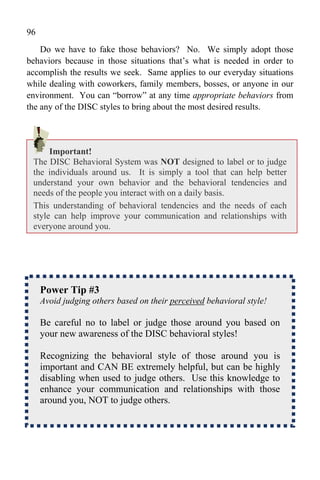
  • 110.
    110 detail so everyone will understand how you got to your final conclusion.  Consider other people’s feelings! Understand that others might be more in touch with their emotional world and expect some empathy and tact from you  Try not to use others’ every little slip up as a reason to pick a fight. Pick your fights wisely; or even better, practice self-control and stop verbally overpowering those around you. Your actions and attitude already show those around you that you are not someone to mess with; use your verbal “powers” sparingly.  When bringing decisions or changing a course of action, take a conscious effort to communicate it clearly with those who will be affected by your new course of action  In your pursuit for accomplishment and on-the-job advancement, try not to step on others’ toes – this can be really counterproductive in the long run  Accept the fact that we are all different and possess different strengths. Raise your acceptance levels of those around you by learning to appreciate the strengths of each style (and, if you are in management, capitalize upon those strengths).  Try to criticize less and support more. Some people around you need your support, and they need you do it with patience and some warmth. If you are in management position, understand that some employees (especially S style) might be intimidated by your dynamic and straightforward personality. They need you to slow down a bit and talk to them in their “language” (S style “language”: slow down, smile if possible, listen carefully, and provide detailed instruction on what needs to be done and HOW you expect it done). If you are a parent, this is probably a most important area for you to be aware off, especially if your kids are of any of the other three styles. Read the description of the other styles and understand that each style approaches communication, task-management, and life in general differently – approaches that we do not control. Learn to accept your children’s behavioral style and learn to speak the language of their style (have fun with the I, listen carefully and be nice to the S style child, and take time to build things and discuss things with your C style child).
  • 111.
    111  Praise and reward those around you when catching them doing a good job - especially if you are in a management position or a parent). Most people like to be praised for what they do right, and they’ll do more of it when they feel appreciated.  Understand that just because you think you are right, it does not automatically mean you are right. Keep an open mind and learn to listen better to what the other party has to say. And remember, not everything is black or white.  Try to go for “win-win” when dealing with others – be that workplace conflict, a business deal, or an argument with a family member. In the long run it will serve you much better than the default “win-lose” behavior  Learn some small-talk skills1; it will serve you greatly in the long run.  If you have a temper problem (as most Ds do), learn some anger management techniques (often regular meditation and positive affirmations can take care of the problem). This is important for multiple reasons: for example, if you have regular outburst on the job, you’ll be viewed as unstable and people will start avoiding you; and if you are a parent, you should make it a top priority to learn to control your temper for the sake of everyone involved.  Commit to spend time regularly – at least weekly – with an S style person, and practice speaking their “language”: slow down, listen to them, and smile as you listen or when you talk; sit down and lean back, relax. Learning S style behaviors is the key for you to improve your personal relationships. Capitalize on your S style acquaintances – learn from them!  Relax! Spend time nurturing your relationships; and your mental and physical health.  Dare to smile more often.  Capitalize on your strengths and you’ll be a high achiever; allow your strengths to get out of control, and you’ll become antisocial and a workaholic. 1 - Most D style individuals are great networkers and great at small talk, but small talk does not always come naturally to them – it is something that some Ds have to still realize why it is necessary and include it in their behavior repertoire. (Some D style individuals view small talk as non-sense, waste-of-time-chit-chat)
  • 112.
    112 Expectations of Others Here’s what D’s expect from everyone around them:  Be brief and to the point – don’t waist my time!  If you have something to say (as in, something negative or possibly conflict-triggering), say it to my face, and don’t dance around it. Just tell me as it is  Listen to what I’m saying, and listen well (‘cause I won’t say it twice)  Don’t waist my time with chit-chat, jokes, stories, or “worthless” small talk- get to the point!  You got a job to do, so just do it; do fast, and do it well  Take initiative – be a self-starter!  Be competent – know what you’re doing – I don’t have the patience to teach you.  Be competent – know what you’re talking about – I don’t have the patience to listen to gibberish. When their expectations are not met, Ds can become irritable, impatient, critical, and bossy with those around them. Just like every other style, they believe that everyone else should be just like them (fast paced, bottom-line, self-starters, driven, etc). Understanding the diverse nature of different behavioral styles will improve the Ds acceptance levels of others, understanding that people around them are not weird, but simply differently wired. How to Deal with Conflict when Dealing with a D Style Individual  Run! You can’t win. This is a behavioral style that can really blow the lid off and will fight like a tiger. Better wait till they calm down.  An alternative to the above point is to stand your ground, but let them vent first – they will get more upset if you interrupt them – and then use logic and data to respond to their outburst; unless while listening you came to the realization that they are right, in which case feel free to agree with them. (They usually are very practical, though not always very thorough in planning their course of action; they often make things up as they go. They believe in “shoot” then ‘aim” philosophy.)
  • 113.
    113  Best is to wait till they calm down; chances are that they will approach you to apologize and resolve the conflict in a civilized manner.  Once they are calm you can share your side and ask them to try to view both sides in an objective manner (which they are incapable to do while in anger-mode).  If you are a manager, supervisor, or in other leadership role: if you notice anger or disobedience, 1) let the person vent first AND/OR 2) stop him firmly and ask him to come back after he calms down.  Do not try to appeal to their emotions! Questions such as “How would it make YOU feel, if I treated you this way” have no meaning to them.  Do not try to persuade them through examples (stories) – they have no patience to listen to them, and while you talk, they’ll either think of what they’ll say, or most likely they’ll interrupt you.  The only way to persuade them (when they are calm) is through facts, data, numbers, and logic. Remember! In conflict, the truth is rarely “black” or “white” – more often then not both of you might be right; you just have to be willing to take time to understand each other’s point of view and… 1. agree to disagree agreeably, or 2. come to the realization that the issue at hand can be viewed in multiple ways and you are both right, or 3. come up with a happy medium (compromise), or 4. synergize1: come up with a better solution than any of you originally had – a solution that will satisfy both of you 1 - Steven Covey, Seven Habits of Highly Effective People. Simon and Schuster. New York, 1989 (pg 221)
  • 114.
    114 Dominance Style -Born Leaders High D style individuals are the ones who are called by many “born leaders.” And while you will often hear that there’s no such thing as a “born leader,” High D style individuals are every bit of a leader – perhaps not always in the way as we think of the term “leader” and “leadership” these days, but they are definitely people who take charge without hesitation and lead those around them. Which, yes, sometimes it can translate into driving everyone crazy around them due to their high pace, lack of patience, desire to be in charge, and tendency to jump into things without weighing much the pros and cons. Usually Ds are more interested in forging ahead with their plans than worrying about how their actions and bottom-line-communication might affect those around them. High D’s are often very charismatic individuals due to their confidence and purpose-driven lifestyles. Unfortunately their “purpose-driven lifestyle” is not always positive (they could come across as pushy workaholics), which just shows that they are also just regular “mortals” like any one of us, except for them it comes a bit more naturally to take charge and lead others. In a group environment high D’s often end up becoming group leader, president, etc. and they will do an excellent job at getting things done. Of course, as I stated in earlier chapters, anyone can reach into the D set of behaviors and choose to take control and lead. We all have met I, S, and C behavioral style individuals who are great managers, political leaders, or are filling some other type of leadership roles. Anyone can choose to take charge and lead – it is a question of will and motivation. It might not come naturally at first, but it’s being done everyday by people of all personality/behavioral styles and there’s no magic to it. Probably Nike would give you the best advice on this: Just do it! Perhaps one major difference among the four styles when it comes to leadership (managing others) is that D style individuals not only can do a great job as managers, but they also enjoy it tremendously. The other three styles can also do a great job (while approaching it totally differently), but often they do not derive the same satisfaction as the D style individuals do.
  • 115.
    115 How to Motivatethe D Style Individual Regardless whether we are talking about an employee, child, a spouse, or significant other, there are a few simple ways to motivate these highly driven individuals. While many of the suggestions below apply to motivating employees, there are also some that can be equally applied in other types of relationships.  Let them feel in complete charge of projects - "I want you to be in charge," or similar statements are music to a D’s ears. They love to take initiative and not have to wait for others’ approval.  Give them bottom-line instructions, without over explaining – they like to feel that they came up with the main solution(s)  Give them challenging tasks. Ds get a great deal of satisfaction from overcoming challenging situations and from completing tasks that most find unattainable or stressful.  Set tangible rewards for accomplishing goals, such as financial rewards, advancement opportunities, or increased authority.  When working in teams, give the D style individual the authority to be in charge. Make them team-leader, project leader, or other title that would let team members know who is in charge. (The title is mostly necessary for team members – the D style employee will press forward and push others regardless whether they have a title or not. Having a title simply helps others know who is in charge of the project, hence be more accepting of the D’s leadership; as well as let’s the D style individual know that their efforts are appreciated.) Remember! Motivating others can be “tricky.” You can ONLY motivate people to do things they are interested in. Trying to motivate different styles to complete tasks that are totally against their behavioral tendencies can be futile and ineffective. Take the effort to recognize the behavioral style of the person who you are working with and motivate them by allowing them to capitalize on their natural strengths1. 1 - Have your employee(s) take a DiSC® PPSS (or DiSC 2.0) to ensure that you get an accurate reading of the person’s behavioral style. The DiSC profile will also suggest ways to motivate the person most effectively – for more details and to see a sample profile, visit www.egSebastian.com/assessments
  • 116.
    116 What Demotivates DStyle Individuals  Working around overly verbose and unfocused individuals  A slow environment that’s void of opportunities for overcoming challenges and has no rewards for the D’s competitive and fast- paced nature  Needing to report on every move they make  Monotonous work  A micro-managing manager or supervisor
  • 117.
    117 1 D Style Most Popular Career Choices Professional Athlete Bill Collector** Financial Managers Ambulance Driver Corrections Officer Construction Worker Correspondent* or ** Courier Court Reporters Entrepreneur Executive Firefighter Judge** Farmer and Rancher Agricultural Manager First Line SupervisorGeneral Manager HR Manager** Financial Services Industrial Production Instructional Sales Agent ** Manager Coordinator*** Construction Landscape Painters Equipment Operator Architect** (construction) Emergency Medical Medical Services Police and Detective Technician (EMS) Manager*** Supervisor Interviewer** or *** Journalist Photojournalist Paramedic Personnel Recruiter* Racecar Driver Consultant** Movie Director Program Manager Stucco Mason** Producer Stuntman Project Manager Purchasing Agent* Sales Manager Insurance (and other)Training and Emergency Sales Agent* or ** Development Management Manager* Specialist (EMS) Construction Manager Customer Service Youth Program Supervisor/Manager Director* Architectural Real Estate Developer Ship and Boat Engineer Captain Lawyer** FBI/CIA Agent Navy Seal Drill Instructor Police Officer State Highway Patrol Politician Sports Coach Public Speaker* Deputy Sheriff Probation Officer Marketing Manager 2 Military Serviceman Military Officer Pilot** Carpenter Real Estate Agent* Actor Foreman Restaurant Manager Reporter Rap Artist Rock Star* Plasterer** Table 4.2 – D Style Most Popular Career Choices 1 - view a description of most of the above careers at www.----------------------------- 2 - US Army, Marine Corps, Navy, Air Force, Coast Guard…
  • 118.
    118 * - oftenin DI combination ** - often in DC combination *** - often in DCI combination These are only a few of the careers most D’s tend to enjoy, due to the fast-paced environments they provide, combined with plenty of opportunities to face and solve challenges. If your behavioral style blend contains two (or three) styles at about the same intensity1 levels, remember to check the most popular career choices for your secondary style as well. If, for example, you are a DC style individual, you’ll probably enjoy several of the careers listed in the C’s Most Popular Career Choices at the end of Chapter 7. Power Tip #4 Keep your D styles busy! Managers, Spouses, Teachers, & Parents: you better give your high D something to solve or “conquer,” or else they’ll end up blowing up in unexpected directions. Sky high Ds are like a loaded gun that’s ready to be fired, and if you don’t aim them to the right target, they’ll blow up in the wrong direction. S and C style managers, spouses and parents often expect their D style employee/spouse/child to conform to rules and “be nice.” What you have to realize, though, is that the inner “engine” of the D is pushing them to take serious action, and if there’s no action, they’ll create it. Get the Ds in your life early on as your allies. Put them in charge of things. Keep them busy with challenging tasks and they’ll be your most valuable allies in your life – people that you can depend on to make things happen. 1 To get an accurate idea of your behavioral style, complete the valid and reliable DiSC® 2.0, DiSC 2Plus, or DiSC PPSS profile, at www.egsebastian.com/disc_classic
  • 119.
    119 Dominance Style: ImproveYour Relationships and Effectiveness Self- Coaching Worksheet (Print out a blank self-coaching sheet at www.egSebastian.com/selfcoach ) 1. What are my strengths that I’m most proud of? _____________________________________________ _____________________________________________ _____________________________________________ 2. What are some of my strengths that make me most effective in my environment? _____________________________________________ _____________________________________________ _____________________________________________ 3. What are some of my strengths that are (perhaps) perceived as weaknesses in my environment? _____________________________________________ _____________________________________________ _____________________________________________ 4. What are some of my weaknesses that make me less effective in my environment? _____________________________________________ _____________________________________________ _____________________________________________ 5. Based on what I read in this chapter (and on what I already knew), what can I do to become more effective at creating and maintaining successful relationships in my workplace and/or at home? (Pages 109 - 111) _____________________________________________ _____________________________________________ _____________________________________________ _____________________________________________
  • 120.
    120 6. Based onwhat I read in this chapter (and on what I already knew), what can I do to become more effective at setting and accomplishing personal and professional goals? (Pages 109 - 111) _____________________________________________ _____________________________________________ _____________________________________________ _____________________________________________ _____________________________________________ _____________________________________________ _____________________________________________ _____________________________________________ 7. Is it an option to speak to my supervisor (or coworkers) and ask to be assigned tasks that are more in line with my strengths? If yes, how would I approach him/her/them about it? _____________________________________________ _____________________________________________ _____________________________________________ _____________________________________________ _____________________________________________ 8. What else can I do to become more effective in all areas of my life? (Based on what you read – e.g., talk to spouse or significant other about your style and your style’s needs, behavioral tendencies; how can you improve your relationship with loved ones, etc.) _____________________________________________ _____________________________________________ _____________________________________________ _____________________________________________ _____________________________________________ _____________________________________________ _____________________________________________ _____________________________________________
  • 121.
    121 _____________________________________________ _____________________________________________ _____________________________________________ _____________________________________________ _____________________________________________ _____________________________________________ _____________________________________________ _____________________________________________ _____________________________________________ _____________________________________________ _____________________________________________ _____________________________________________ _____________________________________________ _____________________________________________ _____________________________________________ _____________________________________________ _____________________________________________ _____________________________________________ _____________________________________________ _____________________________________________ _____________________________________________ _____________________________________________ _____________________________________________ _____________________________________________ _____________________________________________ _____________________________________________ _____________________________________________ _____________________________________________ _____________________________________________ _____________________________________________
  • 122.
    122 Remember! Each of the four sets of behaviors are available to you! Just like when having access to four bowls of fruits, you might prefer one fruit over the other, but it is up to you to reach in one or the other bowl and consume any of the four fruits. The same applies to the four styles. They are at your fingertips at all times and it is up to you to reach in any of the four sets of behavior (D, I, S, or C) to make you more effective in any social situation. It might not always feel very comfortable or natural1, but it is the most effective way to creating and maintaining successful relationships. 1 - D’s have difficulty slowing down and listening well; I styles often have difficulty being bottom-line in delivering information; S styles often find it hard to be assertive and direct; and Cs at times find it difficult to loosen up and socialize freely– when we become aware of these blind spots, we can take conscious effort to address them.
  • 123.
    123 123 Chapter 5 The Influence Style  Famous High I Examples  The Influence (I) Style – Quick Overview  How to Easily Recognize an I Style Individual  Popular Cindy  Communication Style  Strengths and Weaknesses  Challenge Areas  Knowledge is Power! Take control of your weaknesses!  Expectations of Others  How to Deal with Conflict when Dealing with an I Style Individual  Influence Style - The Source of Joy and Inspiration  How to Motivate the I Style Individual  What Demotivates the I Style Individual  I’s Most Popular Career Choices  Power Tip #5: Hold I Styles Accountable to their Commitments!  Influence Style: Self-Coaching Worksheet Famous High I Examples:  Whoopi Goldberg  Robin Williams  Edie Murphy  Ellen DeGeneres  Jim Carrey  Jay Leno
  • 124.
    151 124 Influence Style: ImproveYour Relationships and Effectiveness Self- Coaching Worksheet (Print out a blank self-coaching sheet at www.egSebastian.com/SelfCoach ) 1. What are my strengths that I’m most proud of? _____________________________________________ _____________________________________________ _____________________________________________ 3. What are some of my strengths that make me most effective in my environment? _____________________________________________ _____________________________________________ _____________________________________________ 3. What are some of my strengths that are (perhaps) perceived as weaknesses in my environment? _____________________________________________ _____________________________________________ _____________________________________________ 4. What are some of my weaknesses that make me less effective in my environment? _____________________________________________ _____________________________________________ _____________________________________________ 5. Based on what I read in this chapter (and on what I already knew), what can I do to become more effective at creating and maintaining successful relationships in my workplace and/or at home? (Pages 138 -142) _____________________________________________ _____________________________________________ _____________________________________________
  • 125.
    152 125 6. Based on what I read in this chapter (and on what I already knew), what can I do to become more effective at setting and accomplishing personal and professional goals? (Pages 138 -142) _____________________________________________ _____________________________________________ _____________________________________________ _____________________________________________ _____________________________________________ _____________________________________________ _____________________________________________ _____________________________________________ 7. Is it an option to speak to my supervisor (or coworkers) and ask to be assigned tasks that are more in line with my strengths? If yes, how would I approach him/her/them about it? _____________________________________________ _____________________________________________ _____________________________________________ _____________________________________________ _____________________________________________ 8. What else can I do to become more effective in all areas of my life? (Based on what you read – e.g., talk to spouse or significant other about your style and your style’s needs, behavioral tendencies; how can you improve your relationship with loved ones, etc.) _____________________________________________ _____________________________________________ _____________________________________________ _____________________________________________ _____________________________________________ _____________________________________________ _____________________________________________ _____________________________________________
  • 126.
    153 126 _____________________________________________ _____________________________________________ _____________________________________________ _____________________________________________ _____________________________________________ _____________________________________________ _____________________________________________ _____________________________________________ _____________________________________________ _____________________________________________ _____________________________________________ _____________________________________________ _____________________________________________ _____________________________________________ _____________________________________________ _____________________________________________ _____________________________________________ _____________________________________________ _____________________________________________ _____________________________________________ _____________________________________________ _____________________________________________ _____________________________________________ _____________________________________________ _____________________________________________ _____________________________________________ _____________________________________________ _____________________________________________ _____________________________________________
  • 127.
    154 127 Remember! No behavioral style is better or worse! Each and every style has its strengths and weaknesses. You can become the “best you” when you get a good understanding of your style, learn to capitalize on your strengths, and – if you choose to – work on some of your weak areas. You are already perfect as you are – you just have to use your gifts to your advantage.
  • 128.
    155 128 Chapter 6 The SteadinessStyle  The Steadiness (S) Style – Quick Overview  How to Easily Recognize an S Style Individual  Friendly and Efficient Julia  Communication Style  Strengths and Weaknesses  Challenge Areas  Knowledge is Power! Take control of your weaknesses!  Expectations of Others  How to Deal with Conflict when Dealing with an S Style Individual  Steadiness Style – the “Real Best Friend”  How to Motivate the S Style Individual  What Demotivates the S Style Individual  S’s Most Popular Career Choices  Power Tip #6: Be patient and gentle with the S styles around you!  Steadiness Style: Self-Coaching Worksheet Famous High S Examples:  Mahatma Gandhi  Barbara Bush  John Denver (SI)  Forest Whitaker (SC)  Meg Ryan  Tom Brokaw  President Jimmy Carter
  • 129.
    180 129 Steadiness Style: Improve Your Relationships and Effectiveness Self- Coaching Worksheet (Print out a blank self-coaching sheet at www.egSebastian.com/SelfCoach ) 1. What are my strengths that I’m most proud of? _____________________________________________ _____________________________________________ _____________________________________________ 4. What are some of my strengths that make me most effective in my environment? _____________________________________________ _____________________________________________ _____________________________________________ 3. What are some of my strengths that are (perhaps) perceived as weaknesses in my environment? _____________________________________________ _____________________________________________ _____________________________________________ 4. What are some of my weaknesses that make me less effective in my environment? _____________________________________________ _____________________________________________ _____________________________________________ 5. Based on what I read in this chapter (and on what I already knew), what can I do to become more effective at creating and maintaining successful relationships in my workplace and/or at home? (Pages 168 -171) _____________________________________________ _____________________________________________ _____________________________________________ _____________________________________________
  • 130.
    181 130 6. Based onwhat I read in this chapter (and on what I already knew), what can I do to become more effective at setting and accomplishing personal and professional goals? (Pages 168 -171) _____________________________________________ _____________________________________________ _____________________________________________ _____________________________________________ _____________________________________________ _____________________________________________ _____________________________________________ _____________________________________________ 7. Is it an option to speak to my supervisor (or coworkers) and ask to be assigned tasks that are more in line with my strengths? If yes, how would I approach him/her/them about it? _____________________________________________ _____________________________________________ _____________________________________________ _____________________________________________ _____________________________________________ 8. What else can I do to become more effective in all areas of my life? (Based on what you read – e.g., talk to spouse or significant other about your style and your style’s needs, behavioral tendencies; how can you improve your relationship with loved ones, etc.) _____________________________________________ _____________________________________________ _____________________________________________ _____________________________________________ _____________________________________________ _____________________________________________ _____________________________________________ _____________________________________________
  • 131.
    182 131 _____________________________________________ _____________________________________________ _____________________________________________ _____________________________________________ _____________________________________________ _____________________________________________ _____________________________________________ _____________________________________________ _____________________________________________ _____________________________________________ _____________________________________________ _____________________________________________ _____________________________________________ _____________________________________________ _____________________________________________ _____________________________________________ _____________________________________________ _____________________________________________ _____________________________________________ _____________________________________________ _____________________________________________ _____________________________________________ _____________________________________________ _____________________________________________ _____________________________________________ _____________________________________________ _____________________________________________ _____________________________________________ _____________________________________________ _____________________________________________
  • 132.
    183 132 Important! The DISC Behavioral System was NOT designed to label or to judge the individuals around us. It is simply a tool that can help better understand your own behavior and the behavioral tendencies and needs of the people you interact with on a daily basis. This understanding of behavioral tendencies and the needs of each style can help improve your communication and relationships with everyone around you.
  • 133.
    184 133 Chapter 7 The Conscientiousness Style  The Conscientiousness (C) Style – Quick Overview  How to Easily Recognize a C Style Individual  Systematic Tom  Communication Style  Strengths and Weaknesses  Challenge Areas  Knowledge is Power! Take control of your weaknesses!  Expectations of Others  How to Deal with Conflict when Dealing with a C Style Individual  Conscientiousness Style – The Critical Thinker  How to Motivate the C Style Individual  What Demotivates the C Style Individual  C Style Most Popular Career Choices  Power Tip #6: Develop a Deep Appreciation for the C Styles in Your Environment  Conscientiousness Style: Self-Coaching Worksheet Famous High C Examples:  Bill Gates  Martha Stuart  Sandra Bullock  Jenifer Aniston, in the movie The Break-Up  Steve Martin, in the movie Shopgirl  Robin Williams, in the movie Final Cut
  • 134.
    217 134 Conscientiousness Style: ImproveYour Relationships and Effectiveness Self-Coaching Worksheet (Print out a blank self-coaching sheet at www.egSebastian.com/selfcoach ) 1. What are my strengths that I’m most proud of? _____________________________________________ _____________________________________________ _____________________________________________ 5. What are some of my strengths that make me most effective in my environment? _____________________________________________ _____________________________________________ _____________________________________________ 3. What are some of my strengths that are (perhaps) perceived as weaknesses in my environment? _____________________________________________ _____________________________________________ _____________________________________________ 4. What are some of my weaknesses that make me less effective in my environment? _____________________________________________ _____________________________________________ _____________________________________________ 5. Based on what I read in this chapter (and on what I already knew), what can I do to become more effective at creating and maintaining successful relationships in my workplace and/or at home? (Pages 199 - 204) _____________________________________________ _____________________________________________ _____________________________________________ _____________________________________________
  • 135.
    218 135 6. Based on what I read in this chapter (and on what I already knew), what can I do to become more effective at setting and accomplishing personal and professional goals? (Pages 199 - 204) _____________________________________________ _____________________________________________ _____________________________________________ _____________________________________________ _____________________________________________ _____________________________________________ _____________________________________________ _____________________________________________ 7. Is it an option to speak to my supervisor (or coworkers) and ask to be assigned tasks that are more in line with my strengths? If yes, how would I approach him/her/them about it? _____________________________________________ _____________________________________________ _____________________________________________ _____________________________________________ _____________________________________________ 8. What else can I do to become more effective in all areas of my life? (Based on what you read – e.g., talk to spouse or significant other about your style and your style’s needs, behavioral tendencies; how can you improve your relationship with loved ones, etc.) _____________________________________________ _____________________________________________ _____________________________________________ _____________________________________________ _____________________________________________ _____________________________________________ _____________________________________________ _____________________________________________
  • 136.
    219 136 _____________________________________________ _____________________________________________ _____________________________________________ _____________________________________________ _____________________________________________ _____________________________________________ _____________________________________________ _____________________________________________ _____________________________________________ _____________________________________________ _____________________________________________ _____________________________________________ _____________________________________________ _____________________________________________ _____________________________________________ _____________________________________________ _____________________________________________ _____________________________________________ _____________________________________________ _____________________________________________ _____________________________________________ _____________________________________________ _____________________________________________ _____________________________________________ _____________________________________________ _____________________________________________ _____________________________________________ _____________________________________________
  • 137.
    220 137 See a sample Facilitator Report at tian.com/sample_reports1 Chapter 8 The Four Styles at a Glance  The Four Styles at a Glance  General Behavioral Tendencies of the Four Styles  Common Characteristics of the Styles  Strengths of the Four Styles  Challenge Areas of the Four Styles  Communication Tendencies of the Four Style  What the Four Styles Expect of You  Can Improve Performance and Relationships by…  Learning Styles of the Four Behavioral Styles  How to Communicate Most Effectively with the Four Styles  The Four Styles at Work  How to Motivate the Four Styles  What Demotivates the Four Styles  How to Manage the Four Styles  How to Communicate Effectively with Your D, I, S, or C Manager  D, I, S, and C Style Customers’ Expectations of You  How to Defuse Conflict with the Four Styles  Celebrities DISC Styles
  • 138.
    224 138 General Behavioral Tendencies of the Four Styles  Enthusiastic  Dynamic  Talkative  Process-Driven  Persuasive  Outspoken  Entertaining  Wants to Control  Easygoing  Practical  Relationship-Driven  Results Oriented  Involved  Bottom Line  Humorous  Decisive Can come across as Can come across as ● Bossy ● Impulsive ● Inconsiderate ● Disorganized ● Inpatient ● Tiring ● Aggressive ● Fake  Cautious  Supportive  Organized  Friendly  Analytical  Considerate  Thorough  Humble  Quality-Driven  Cooperative  Accurate  Stability-Driven  Dependable  Great Listener  Formal  Calm Can come across as Can come across as ● Distant ● Slow ● Perfectionist ● Passive ● Nitpicky ● Hesitant / Shy ● Antisocial ● Easily Manipulated
  • 139.
    225 139 Figure 9.1 – Visual depiction of common characteristics of the four styles (highlighted in black) Common Characteristics of the Styles As we explored the four main behavioral styles, you had a chance to observe the vast differences among the styles. The good news is, that each style has something in common with two adjacent styles. Figure 9.2 gives you a good visual depiction, while Table 9.2 provides a more detailed description of the common elements o f the four styles.
  • 140.
    226 140 Fast Paced1 Moderate Paced2 Individuals Tend to be… Individuals Tend to be…  Active  Worrisome  Outgoing  Poor Starter  Optimistic  Great Finisher  Great Starter  Reserved  Poor Finisher  Careful  Energetic  Hesitant  Impulsive  Calm  Involved  Conservative  Positive  Controlled  Enthusiastic  Likes Routine Tasks  Tradition Breaker  Follows Rules  Dislikes Routine Tasks  Resists Change  Likes To Bend the Rules  Expect Others to Guess  Outspoken their Thoughts and  Welcomes Change Expectations Task Oriented3 People Oriented4 Individuals Tend to be… Individuals Tend to be…  Questioning  Accepting  Distant  Friendly  Logical  Talkative  Critical  Humorous  Likes to Plan  Caring  Analytical  People Pleaser  Focused  Easy Going  Process-Oriented  Relationships-Driven  Unemotional  Displays Emotions Table 9.2 – Common characteristics of the four styles 1 - Dominance (D) and Influence (I) 2 - Steadiness (S) and Conscientiousness (C) 3 - Conscientiousness (C) and Dominance (D) 4 - Steadiness (S) and Influence (I)
  • 141.
    242 141 Remember! The information in this chapter is broken down to the bare basics in order to give you an easy-to-view DISC-in-action tools; to read more about any of the areas covered in this chapter, look up the specific areas that you are interested in Chapters 4 (Dominance), 5 (Influence), 6 (Steadiness) and 7 (Conscientiousness). For example, if you want to read more on how to deal with conflict with a Conscientiousness (C) style individual, you’d look up Chapter 7 and look for How to Deal with Conflict when Dealing with a C Style Individual. Use the Table of Contents at the beginning of the book for easier navigation. Power Tip #8 Increase your acceptance of everyone around you! Effective communication – and as a result, successful relationships – are only possible if you learn to accept those around you unconditionally. To accomplish this, get a good understanding of the behavioral tendencies of the four styles; then as you go through your days interacting with others, notice each person’s behavioral style and instead of judging others, stressing about differences, or even worse, getting into conflict with others, simply notice a person’s style and realize that most of their behaviors are 100% as normal as your behaviors, except they are wired with a different focus of what matters and how to approach what matters. When you master the “art” of unconditional acceptance of those around you, that’s when you’ll start being perceived as a “master” communicator, and a great person that everyone will enjoy being around.
  • 142.
    243 142 The Missing Link… Do You Want to Take Your Communication Skills a Notch Higher? 7-Part FREE Body Language eCourse www.iReadBodyLanguage.com Learn to Read People Like a Book! & Understand What Your Body Language Conveys To Others - Find out what your habitual body language tells others about you - Discover which body language signs give away your confidence level, discomfort, fear, and more… - Find out about subtle non-verbal cues that give away when someone is attracted to you - Easily spot lies and deception - Learn to read others body language and understand when someone would rather be walking on broken glass than listening to you - Body language to a avoid when in business/professional settings - Explore body language postures that you can adopt to come across – and feel – confident at all times To sign up, go to www.iReadBodyLanguage.com
  • 143.
    244 143 Author’s Last Note "Most relationships are not made in heaven. They come in kits and you have to put them together yourself." - Anonymous - Creating a More Peaceful World One Person at a Time… In 2003 I participated in a 4-hour DISC seminar and it changed the dynamics of all my relationships. I’m saying this without any exaggeration: DISC has made me a much better person – a more peaceful and understanding being; I became a much better husband, parent, son, coach/consultant – and a much more effective communicator in general with everyone around me. I believe that DISC can have the same effect on you and anyone who takes the effort to learn these concepts. I truly believe that through my efforts, the efforts of other DISC trainers, and through your efforts to spread the DISC concepts, we can create a more peaceful world one person at a time… In the past 5 years, I attempted to affect others’ lives the same way as mine was affected by the first DISC seminar I attended. By the date of publishing this book, I have helped thousands of people improve their communication skills, and people skills in general, through my workshops, seminars, coaching, teleclasses, eCourses, and my audio and video programs. I truly believe that simply by attempting to better understand those around us, will raise our acceptance levels of everyone and will dramatically reduce stress and conflict that was originally present due to the lack of understanding of the behaviors of those who surround us. In the past, I used to judge people from the “box” of my personality style, expecting everyone to be just like me – enthusiastic, smiling, friendly, easy- going, chatty, etc., etc. – so, so many unrealistic expectations… Through DISC I learned that we are all different IN VERY PREDICTABLE WAYS, and through that predictability I could easily recognize different personality – or behavioral
  • 144.
    245 144 styles – aroundme and understand WHY some people were so dramatically different from me. But, unlike in the past, now I welcome these differences and I experience dramatically reduced (almost none) frustration, stress, and conflict with those around me. I hope that this book will serve you – or already has served you - as a catalyst in improving your communication skills and your relationships. If you have found these concepts useful and want to share a DISC success story, please email it to me to eg@egSebastian.com, with DISC SUCCESS STORY in the subject line. With your permission I will publish your story on my website or in other upcoming publications. Thank you for taking the time to read my book and I hope to meet you in person at one of my future live events… The End and… …the beginning of better communication and improved relationships, right?
  • 145.
    247 145 About the Author E G Sebastian is a dynamic speaker who never fails to keep his audience engaged with his high value presentations, humor, and interaction with the participants. His years of management experience, linked with his more than 15-years experience as a motivator and personal coach, make him the speaker of choice for programs related to personal & professional growth. E.G. is available to speak internationally. He speaks six languages and presents in four: English, Spanish, Hungarian, and Romanian. E.G.’s fascination with Effective Communication began at an early age. He grew up in a cult-like environment where as a child he faced countless restrictions. He was not allowed to have friends who were not of his family’s faith (which there were none in his neighborhood), was restricted to listening only religious music, and he was physically and verbally abused almost on a daily basis1. As a result of his strict upbringing, he developed some very poor social skills and spent his childhood feeling alienated from his classmates and the other children in his neighborhood. He’d spend his days watching other children play and wonder how they were able to play so freely; and wondered why he (E.G.) was not able to join them and enjoy their company. During this period – ages 7 to 17 – he’d resolve most of his verbal misunderstandings with fist-fights, which got him in trouble quite often. He started reading books on psychology, self-improvement, and effective communication at the early age of nine, and in the following years he became a regular at the city library and read all the books that he could put his hands on in these topics. By his twenties he read literally hundreds of books on the topic of self-improvement.) * By today, E.G. is happily married and has three children – Alexandra 12, Philip 11, and Adriana-Bianca 1 – and he prides himself in having a super- successful marriage, where arguments and raised voice is a very rare occurrence. He also broke the chain of abuse. It is said that abused children will become abusive parents, but E.G. took control of his “dark side” and raises his kids with 1 - At age 14 the physical abuse suddenly stopped and in the following years E.G. developed a great relationship with his parents. Presently E.G.’s parents are the best grandparents any grandchild could dream about.
  • 146.
    248 146 no spanking orother type of physical or verbal abuse. Furthermore he is very proud of the fact that he spends hours of quality time with his family every week, rollerblading, swimming, hiking, biking, camping, playing music together, and all kind of other activities that he engages into in order to keep a strong relationship with his children and wife. Both E.G.’s wife and his children are proficient in the “language” of DISC, which helps them understand each other better and communicate with one another based on respecting each family member’s behavioral style. While it sounds like “work,” it really becomes natural once one understands a loved ones communication and behavioral style. E.G.’s professional career started in 1990, at age 23, as an interpreter – Hungarian/English/German/Romanian/Chinese, helping foreign investors set up their companies in Hungary; then in 1991 he became the general manager and 49% owner of a Chinese-Hungarian joint venture - an export-import company - which he successfully managed till 1995. In the following years, E.G. shifted his career into his area of passion: performance coaching and public speaking. E.G. is the past area governor - for two consecutive years - of Toastmasters International, a non-profit organization that helps individuals develop public speaking and leadership skills He has a bachelor's degree in business management, is a certified empowerment coach, a certified seminar leader (though the American Seminar Leaders Association), and is an Inscape Certified DiSC Behavioral System Trainer/Facilitator.
  • 147.
    249 147 Works Cited 1. Steven Covey, Seven Habits of Highly Effective People. Simon and Schuster, 1989 2. Sun Tzu, The Art of War. Shambhala, 2005 3. Martin E.P. Seligman et. Al., Abnormal Psychology. W.W. Norton & Company, Inc., 2001 4. William Moulton Marston, The Emotions of Normal People, London: Kegan Paul 1928. (International Library of Psychology, Philosophy and Scientific Method)
  • 148.
    250 148 APPENDIX A Invite E.G. Sebastian to speak at your next event! Let E.G. energize and entertain your group, while providing high quality information. E.G.’s presentations often include magic and plenty of humor, while also energizing his audiences with a multitude of group activities and self-discovery activities. Visit www.egsebastian.com/events_calendar for a list of upcoming events For date availability and for more information please call Toll Free at 877 379-3793 or send eMail to eg@egSebastian.com Here are some of the DiSC®1-based topics E.G. presents:  Performance - Maximizing Your Strengths as a Manager - Recognizing and Removing Your Employees' Barriers to Performance - How to Motivate Your Employees - Getting the Most from Your Key Contributors  Communication - Different People, Different Needs – Improve Your Customer Service through Better Understanding their Needs - Communication Skills Magic – Improve Your Personal & Professional Relationships - Understanding and Adapting to Different Behavioral Styles  Conflict - Managing Conflict and Resistance - How to Deal with Difficult Coworkers/Customers .  Interpersonal - Understanding and Using Your Strengths to Your Advantage - Improve Your Confidence & Communication Skills by Building Greater Self-Awareness . 1 - DiSC® with lower case “i” is an Inscape Publishing, Inc trademark
  • 149.
    251 149 APPENDIX A – Continued…  Sales - Building a Sales Relationship - How to be More Responsive to Customer Differences  Team - Improving Team Effectiveness - Improving Team Motivation .  Coaching Skills Training (for managers, social workers, and counselors) - Understanding Your Clients'/Employees' Needs - Tools & Techniques to Coach Your Employees to Increased On-the- Job Effectiveness - Tools & Techniques to Coach Your Clients to more personal & professional success .  Stress Management - 12 Effective Stress Management Techniques in a Fast-Paced World Keynotes For Adult & Youth Events  Your Success Story Starts Today!  The 7 Building Blocks of Success  Your Attitude Determines Your Altitude  Leadership in the New Millennium  Communication is More than Just Talk  Transform Your Life into a Work of Art
  • 150.
    252 150 APPENDIX B Performance/Leadership Development Coaching/Mentoring Would you like to improve your leadership skills? Or… do you have employees or managers who are not performing to their full potential? E.G. Sebastian provides performance and leadership development coaching to help you maximize your performance and leadership skills:  learn about your behavioral style’s strengths and weaknesses  discover your behavioral style’s “natural” barriers to top performance in your field  get coached to brake your “natural barriers to top performance  learn to easily recognize your subordinates’ behavioral styles  learn how to communicate most effectively with employees and managers of different behavioral styles  explore simple yet powerful ways to motivate your employees most effectively  discover how to deal with – and even prevent - conflict with employees or managers of different styles  raise your awareness of your weaknesses and gain control over them  improve your overall performance by learning how to capitalize on your strengths Behind every successful individual there is a coach or a mentor Take your leadership skills to the next level! 90 Days Money-Back Guarantee! You either notice considerable results in your performance and communication skills, or you get 100% refund! Call Toll Free 877 379-3793 for more information, or inquire by email at support@egSebastian.com
  • 151.
    253 151 APPENDIX C – Volume Discount – Communication-Skills Magic Communication-Skills Magic – Volume Discount Prices: 10 to 50 copies - $17.97 51 to 100 - $16.97 101 to 500 - $14.97 500 to 1000 - $12.97 1000+ copies - $11.97 For more information, please call Toll Free 877 379-3793
  • 152.
    254 152 APPENDIX D 7 Ways to Say “NO” Without Hurting Others’ Feelings For two of the styles – the D and C styles - saying “NO” comes rather naturally. They are so focused on moving towards completing their tasks – or towards their goals – that they can care less of how a “NO” would affect others’ feelings. They are pretty good at interrupting chit-chatty coworkers, clients, etc. and are great at accomplishing whatever they set their mind to. However, two of the stiles – the I and the S (and especially the S style) – have great concern for others’ feelings; therefore they often say yes to things that they would rather not do. Even when they have a full schedule and someone asks for a favor, they most often will say “YES.” Things to consider: 1.What do you say “NO” to, when you say “YES” to things that you don’t want to do? Whenever you say “yes” just to please those around you, you say “NO” to things that matter to you, such as completing your tasks, self-care, spending more time with your family, etc. 2.What message do you send if you say “yes” to most people that ask for favors, or simply regularly abuse your time by demanding a listening ear? That you are helpful and kind? Maybe… That you are easily manipulated… That you are not assertive… Think about it! 3.When you say “yes” to things that you don’t really want to do, you disrespect both yourself and the other person; and in the long run you’ll probably develop resentment against the other person. To avoid this, respect yourself and the other person by learning to say “NO.” 4.Saying “YES” too often, just to please those around you, will very likely lead to unnecessary stress and possibly burnout.
  • 153.
    255 153 Scenario: You are working on completing your tasks and a coworker, friend, family member, etc. shows up and asks you for a “small” favor that requires you to interrupt what you are doing (or requires you to stay late / give up your weekend / etc.) and spend considerable time on completing that “small” favor. How do you say “NO” without hurting that person’s feelings? 1. The “YES, but…” technique “I would love to help you with that… “That sounds like fun… “Of course, I’d be glad to…. … but right now I’m in the middle of a project that I must finish today.” Then you reach for your planner (or not) and say “Would Thursday afternoon be a good time for me to help you with that?” You can use endless variations of the above method; and if the person really needs your help, then they’ll wait till you have the time for it. Chances are, however, that most people will take care of whatever they need without your involvement. Fact is, people are drawn to your kind and helpful attitude, and some can easily get “addicted” to requesting your help for all kinds of trivial (or not so trivial) matters. 2. The “not an expert” technique “I’d love to help you with that, but I’m not very good at…(whatever the task implies)” or… “… I really don’t think I’m the right person to help you with this.” Of course, you can use this technique only if there’s at least a bit of truth behind it. 3. The “I already have plans” technique “I’d really love to go / I’d really love to help you, but (this sounds like a time-consuming project and) I already have plans for this afternoon/week-end/etc. If you really need my help, we can try to squeeze it in next week sometimes”
  • 154.
    256 154 4. The “What’s the priority?” technique If your boss (or spouse, etc.) wants to dump a new task on you, while you already work on some time-consuming task(s)… “I’m already working on […], which you’ve suggested I finish before the end of the day. Which one has a higher priority?” 5. The “I’d rather not…” technique “I’d love to help you, but with the hectic schedule I have these days, I’d probably do a sloppy job at it. I’d rather not do it than mess it up.” 6. The “Let me get back to you on that” technique “Let me check my planner and I’ll get back to you on that before the end of the day” If you are a busy “bee,” chances are that your schedule is busier than you’d like to; so get back to the person and be honest. Let them know that your schedule is really full; but if they can’t find anyone, you’d be glad to help on “next Friday afternoon.” 7. The “Just say ‘NO’” technique “Sorry, I can’t right now – I’m in the middle of […] something and I have this pile to finish before the end of the day/week…” It is ok to say “NO” once in a while. Sometimes you are just so busy with ongoing projects that it’d be really silly to take on some more tasks. And if someone can’t understand that, they deserve to have their feelings hurt; that way they won’t bother you any soon. Besides, practicing saying a firm “NO,” shows assertiveness and self- confidence. Of course, make sure you don’t “over-practice” saying “NO.” People love you because you are helpful and kind. Don’t spoil your image by saying “no” to everything; but don’t let others take advantage of you either. Keep things in balance by saying “NO” (in one of the above ways or their variations) whenever you can’t comfortably accommodate others’ requests, or when helping others would cut into your personal/family time. REMEMBER! Whenever you say “NO” in any of the above forms, stay calm and project confidence; and most importantly, do not lie in order to refuse someone’s request – you don’t want to tarnish your reputation…
  • 155.
    257 155 APPENDIX E Become a DISC Trainer/Facilitator/Consultant/Coach Provide companies with DISC training or consulting; or provide one-on- one or group coaching utilizing DISC concepts. Visit www.egsebastian.com/products_by_application to see Inscape’s DiSC® 1 (and other) assessments in different applications (Change Management, Coaching, Customer Service, Sales, Diversity, Leadership, Management Development, Teams, and Time Management). Get started in a matter of days with the Facilitator Kit of your choice! Each facilitator kit includes:  Scripted modules that can be used as stand-alone workshops or can be combined into half-day or full-day seminars  Professionally designed, customizable PowerPoint slides  Professional designed and customizable handouts for creating participant manuals  Professional training DVD with individually selectable segments (DVD to be used during presentation, as well as to train the trainer) See complete details and view sample videos at http://egsebastian.com/facilitator_kits For more information, please call Toll Free 877 379-3793! Or contact us by eMail at support@egSebastian.com 1 DiSC® with lower case “i” is an Inscape Publishing, Inc trademark
  • 156.
    258 156 Communication Skills Magic How to Understand and Motivate Your Employees Most Effectively 180-Minutes 2-CD Set with Workbook With instant mp3 download available at no extra cost! In this program you will learn: o How to easily recognize each behavioral style in your environment o How to communicate most effectively with each style o How to prevent conflict with each style o How to deal with conflict with each style o How to create an environment that’s most inductive for higher productivity for each style o How to motivate each style o How to coach each style towards higher performance Price: $47.00 + Shipping and Handling (Allow 7 to 10 days for delivery) For more info or to order, Please visit www.egSebastian.com/cdMot or call Toll Free 877 379-3793
  • 157.
    259 157 Communication Skills Magic Improve Your Relationship with Your Child and Spouse (or Significant Other) 120-Minutes CD with Workbook With instant mp3 download available at no extra cost! How would it impact your life at the present moment if you could dramatically improve your relationships with your loved ones? How much conflict and stress would be eliminated from your days...? How much more joyful moments could you share with those you love? In this program you will learn: - better understand your own personality and communication style - easily recognize the (four) personality and communication style of your loved ones - learn strategies on how to flex your communication style in order to communicate with your loved ones more effectively based on their natural communication and behavioral tendencies - explore what naturally motivates the personality style of your loved ones - learn simple strategies on how to prevent conflict with your loved ones - find out how to deal with conflict with each style - become a better parent or spouse by becoming a masterful communicator Price: $37.00 + Shipping and Handling (Allow 7 to 10 days for delivery) For more info or to order, Please visit www.egSebastian.com/cdFam or call Toll Free 877 379-3793
  • 158.
    260 158 Order Form Please send me the following product (s): Price Quantity Total Communication Skills Magic (soft cover) $17.95 _______ _______ (For volume discount – above 10 copies – please see Appendix C) Communication Skills Magic – How to Understand and Motivate Your Employees Most Effectively (90-min. Audio CD) $27.00 ________ _______ Communication Skills Magic – Improve Your Relationship with Your Child and Spouse or Significant Other (120-min. Audio CD) $37.00 ________ _______ Shipping & Handling: $5.50 ________ _______ (Buying more than one product? Please add $1.00 for every additional item) ________ _______ International Shipping: $7.50 ________ _______ (Please add $3.50 for every additional item) Payment ___ Check ___ Credit Card: ___ Visa ___ Master Card ___ PayPal (use links on previous pages) Name on Card:________________________________________________ Card Number:_____________________________ Exp. Date: __________ Fax Orders on this Form to: 843 470-9096 (Attn: E.G. Performance Solutions) TOLL FREE Telephone Orders: 877 379 3793 International: 843 379-3793 Email Orders to: support@egSebastian.com Send Postal Orders to: E.G. Performance Solutions, 330 Robert Smalls Pkwy, Ste 24, Beaufort, SC 29906
  • 159.
    261 159 Make your next event a smashing success! Invite E.G. Sebastian to present a keynote speech, or to present one, or several, of your break-out sessions: - Improve Your Productivity through Better Understanding Your Behavioral Style - Improve Your Relationships through Better Understanding Yourself and Others’ Behavioral Styles - Improving Team Effectiveness - Improving Managers’ Effectiveness - Conflict Management & Prevention - How to Motivate Your Employees - How to Deal with Difficult Customers - How to Deal with Difficult Employees and Coworkers - Improve Sales Performance through Understanding Your Sales Style and the Four Buying Styles - How to Understand and Meet Your Customers’ Needs For more information, contact E.G. Sebastian toll FREE at 877 379-3793, visit www.egSebastian.com or by email at mailto:support@egSebastian.com
  • 160.
    262 160 To learnmore about Inscape learning tools and facilitator kits, please visit http://egsebastian.com/facilitator_kits , or call TOLL FREE 877 379-3793 for more information. Sign up for FREE Online Video Training and Tutorials at www.egSebastian.com/FREE_Training
  • 161.
    263 161 Get Access to the Missing Chapters! Visit www.CommunicationSkillsMagic.com Or buy with one click: eBook - $9.97 – http://snipurl.com/CommunicationSkillsMagic Instant Delivery Paper Back - $19.97 - http://snipurl.com/CommunicationSkillsMagicBook Both links include the Instantly Downloadable Communication Skills Magic eBook & a BONUS eBook: Make ‘Em Lough by Tom Antion (Delivered more than 5000 paid speeches) 300+ pages packed with practical information. See below a brief description:  Over 1000 advanced speaking tips and techniques  Pre-program Questionnaire . . . Adapt it or use it as is.  Comprehensive International Section . . . Don't panic when you face a foreign audience.  Heirloom Handouts . . . They'll keep them forever when you use these tips.  The Lastest, Greatest Seating Methods . . . Easy to use diagrams.  Professional Level Introductions . . . Advanced Template. You fill in the blanks.  Wake 'em Up Openings . . . 4 types of formula openings so you'll always have a variety.  Instantly Usable Speaker Material . . . .Some lines just never get old.  Attention Gaining Devices . . . You'll make insomniacs out of the audience members when you use these 11 simple techniques.  Speaking Formulas . . . Why beat your head against the wall to develop material. Just fill in the blanks.  147 Hard Hitting Closings . . . When you deliver these, they'll know you were there.  Material Selection . . . Learn how to make appropriate choices to suit any audience.
  • 162.
    263 162  Tons of Professional Level Delivery Tips . . . and I mean TONS! More than any other presentation skills book anywhere. I guarantee it.  51 Stage Fright Strategies . . . Simply pick the mix that calms you down.  Timing . . . Learn the secrets of knowing when to pause.  Humor Placement . . . Where does it go? When should I use humor?  You won't have to wonder anymore.  5 Genius Techniques . . . Move over Einstein. You've got the theory of relativity, but I've got the microphone.  Bomproofing . . . You'll never deliver a dud after your learn these tricks.  Saver Lines . . . Learn what to say to turn a turkey into a swan.  100 Pre-planned ad-libs . . . You'll look like a quick wit when you use these lines.  Stage Movement . . . Where's the power on stage. This section tells you.  Clothing Tips . . . Patterns, solids, pockets, ties, jewelry . . . a potpouri of handy info.  6 Involvement Techniques . . . Audiences demand it . . . now you have lots of ways to deliver it.  Emotional Language . . . Learn how to pick your words to push their buttons.  Practice Techniques . . . Fantastic tricks that make you look smooooooooth . . . and they take no time at all.  34 Ways to Be Funny . . . and only 1 is has anything to do with joketelling.  Storytelling . . . You will really learn how to paint pictures in the audiences member's minds . . . 27 dos and don'ts tell you how.  148 Sources and Organization of Material . . . Find your stuff fast with these handy tips.  Audio Visual Equipment . . . How to get the most out of the old standbys.  Visual Design including the psychology of color . . . Kodak helped me on this chapter.  Completely indexed . . . .I spent 4 days from midnight to 4:00 AM indexing this book myself. I guarantee you can find what you want  FAST!  Appendix: This section (by itself) has more information than is included in many other presentation books.  Action Plan  Speaker Resources  Room Setup Checklists
  • 163.
    264 163  Tips for Television & Videotape and Videoconferencing  Banquet / Luncheon Tips  Speaking Glossary  Giant Bibliography Wake 'em Up! Has 19 Chapters In All and Includes 3 Bonus Chapters 1. Technical & Financial Presentations 2. Sales Presentations 3. Tips for Women Presenters by 12 of the Top Female speakers in the USA Here’s what others are saying about Wake’Em UP Wake ‘em Up teaches you to be irresistible as a presenter. Also, Foreword by: Mark Victor Hansen,Co-author of the #1 New York Times Best-selling series, Chicken Soup for the Soul Mastering the skills in Tom’s book will virtually guarantee that you will always be in demand as a speaker. Also, Backword by: Dottie Walters, President, Walters International Speakers Bureau, Co- author Speak and Grow Rich At Hawaiian Tropic we believe that fun and excitement keep our corporate staff and distributors productive. Tom can teach you how to create this excitement every time you address a group. Ron Rice, Owner and Founder, Hawaiian Tropic/Tanning Research Labs., Inc. Tom’s materials will cut five years of a speaker’s learning curve. Cavett Robert, Founder and Chairman Emeritus, National Speakers Association In Wake ‘em Up, Tom Antion teaches us how to get our message across, do it with humor, and keep the audience awake all at the same time. That’s great, although I’ve learned through experience that when I’m not doing 1 and 2, I prefer that the audience doze off. It makes my getaway easier. Gene Perrett, Author and head comedy writer for Bob Hope
  • 164.
    265 164 More Resources fromE.G. Sebastian: www.discChat.com www.egSebastian.com www.discSalesStyles.com www.discBuyingStyles.com www.iReadBodyLanguage.com www.BecomeAdiscTrainer.com www.CommunicationSkillsMagic.com