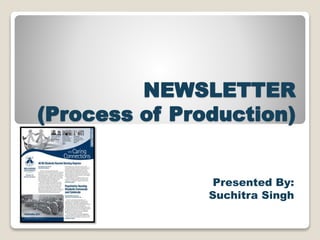

NEWSLETTER
(Process of Production)
Presented By:
Suchitra Singh
INTRODUCTION
 A newsletter is a regularly
distributed publication that is generally about
one main topic of interest to its subscribers.
 Newspapers and leaflets are types of
newsletters.
 For example, newsletters are distributed at
schools to inform parents about things that
happen in that school.
 Newsletters must offer valuable information,
and they should be short and to the point.
 To accomplish that, know your audience, and
offer them what they want.
 Short, frequent newsletters that contain timely
information are preferable to longer,
infrequent newsletters.
 Try to provide something for everyone by
including a variety of short articles in each
issue.
 The variety increases the chance that at least
one article will interest your audience and
entice them to contact you.
TYPES
 Newsletters are published by clubs, churches,
societies, associations, and businesses—
especially companies—to provide information of
interest to members, customers, or employees.
 A newsletter may be considered "grey literature".
Newsletters delivered electronically via email (e-
Newsletters) have gained rapid acceptance for the
same reasons email in general has gained popularity
over printed correspondence.
Purposes
 Some newsletters are created as money-making
ventures and sold directly to subscribers.
 Sending newsletters to customers and prospects is a
common marketing strategy, which can have benefits
and drawbacks.
 Public organizations emit newsletters in order to
improve or maintain their reputation in the society.
 General attributes of newsletters include news and
upcoming events of the related organization, as well
as contact information.
How to Write a Good Newsletter
 Consider your audience. Before deciding on what
content you need for your newsletter printing, take a
moment to define your audience; gather
demographics, and decide what topics will interest
them.
 For instance, an audience of mostly middle-aged
women probably won't be interested in a detailed
article explaining a product. Instead, choose a topic
that will connect with them--specifically on a
personal level.
 Choose your topic. Include a variety of topics
and sections that will make your newsletter
more interesting to a variety of audience.
 Just as a newspaper contains different
sections, your newsletter should incorporate
similar sections such as a response section,
letters to the editor, industry news, and
featured articles. Include tips or customer
reviews within boxes to break up the layout.
Plan Newsletter’s Content:
 Tips or how-to articles on getting more
benefits from your products or services.
 An editorial about a topic of recent interest.
 Reviews of new products or announcements of
new services.
 Special promotions.
 Customer news or success stories.
 An employee profile or an interview with an
expert.
 Ask questions. Keep all information accurate.
Use the six questions to give your newsletter
versatility: who, what, when, where, why and
how.
 The best articles incorporate all six of these
questions and answers, if applicable.
 This may require some research such as
interviewing, but it is worth it if you want to
make an effective newsletter with your
audience's opinions expressed.
 Research your topic. Writing subjectively can
severely harm your credibility. Without proper
research, you risk presenting incorrect or
inaccurate information, which may offend or
confuse your audience.
 Provide information such as statistics, expert
opinions, and quotes to prove the validity of
your research. Make sure to give the source
(e.g., magazine, website, book) credit where
credit is due.
 Make it understandable. Use concise and
comprehensible vocabulary to ensure
readability. Avoid verbose language. For
instance, rather than using an adverb/verb
combo, use a verb that denotes the same
meaning.
 Use interesting headlines. Write dynamic headlines
by using action verbs that evokes curiosity.
 Without an interesting headline, readers may skim
over your articles, because they find it uninteresting.
 Headlines are one of the keys to creating loyal
readers, since a well-written headline means a well-
read article means a well-read newsletter.
 Also, if any of your articles are more than a few
paragraphs long, use subheadings to break up the
text.
 Proofread. After writing your articles, proofread for
typos and then edit all articles for consistency of tone
and voice.
 Never leave proofreading to your spell and grammar
check tools.
 They are great for preliminary editing but poor
substitutes for manual editing. Have someone else
look over your newsletter for typos, since you can
easily skip over them after staring at the text too
long.
 And don't forget that you can't edit enough. Once
you've thought you edited enough, go over it one
more time.
 Even just a few typos will annoy readers enough for
them to disregard you as a professional.
THANK YOU

Newsletter

  • 1.
  • 2.
    INTRODUCTION  A newsletteris a regularly distributed publication that is generally about one main topic of interest to its subscribers.  Newspapers and leaflets are types of newsletters.  For example, newsletters are distributed at schools to inform parents about things that happen in that school.
  • 3.
     Newsletters mustoffer valuable information, and they should be short and to the point.  To accomplish that, know your audience, and offer them what they want.  Short, frequent newsletters that contain timely information are preferable to longer, infrequent newsletters.
  • 4.
     Try toprovide something for everyone by including a variety of short articles in each issue.  The variety increases the chance that at least one article will interest your audience and entice them to contact you.
  • 5.
    TYPES  Newsletters arepublished by clubs, churches, societies, associations, and businesses— especially companies—to provide information of interest to members, customers, or employees.  A newsletter may be considered "grey literature". Newsletters delivered electronically via email (e- Newsletters) have gained rapid acceptance for the same reasons email in general has gained popularity over printed correspondence.
  • 6.
    Purposes  Some newslettersare created as money-making ventures and sold directly to subscribers.  Sending newsletters to customers and prospects is a common marketing strategy, which can have benefits and drawbacks.  Public organizations emit newsletters in order to improve or maintain their reputation in the society.  General attributes of newsletters include news and upcoming events of the related organization, as well as contact information.
  • 7.
    How to Writea Good Newsletter  Consider your audience. Before deciding on what content you need for your newsletter printing, take a moment to define your audience; gather demographics, and decide what topics will interest them.  For instance, an audience of mostly middle-aged women probably won't be interested in a detailed article explaining a product. Instead, choose a topic that will connect with them--specifically on a personal level.
  • 8.
     Choose yourtopic. Include a variety of topics and sections that will make your newsletter more interesting to a variety of audience.  Just as a newspaper contains different sections, your newsletter should incorporate similar sections such as a response section, letters to the editor, industry news, and featured articles. Include tips or customer reviews within boxes to break up the layout.
  • 9.
    Plan Newsletter’s Content: Tips or how-to articles on getting more benefits from your products or services.  An editorial about a topic of recent interest.  Reviews of new products or announcements of new services.  Special promotions.  Customer news or success stories.  An employee profile or an interview with an expert.
  • 10.
     Ask questions.Keep all information accurate. Use the six questions to give your newsletter versatility: who, what, when, where, why and how.  The best articles incorporate all six of these questions and answers, if applicable.  This may require some research such as interviewing, but it is worth it if you want to make an effective newsletter with your audience's opinions expressed.
  • 11.
     Research yourtopic. Writing subjectively can severely harm your credibility. Without proper research, you risk presenting incorrect or inaccurate information, which may offend or confuse your audience.  Provide information such as statistics, expert opinions, and quotes to prove the validity of your research. Make sure to give the source (e.g., magazine, website, book) credit where credit is due.
  • 12.
     Make itunderstandable. Use concise and comprehensible vocabulary to ensure readability. Avoid verbose language. For instance, rather than using an adverb/verb combo, use a verb that denotes the same meaning.
  • 13.
     Use interestingheadlines. Write dynamic headlines by using action verbs that evokes curiosity.  Without an interesting headline, readers may skim over your articles, because they find it uninteresting.  Headlines are one of the keys to creating loyal readers, since a well-written headline means a well- read article means a well-read newsletter.  Also, if any of your articles are more than a few paragraphs long, use subheadings to break up the text.
  • 14.
     Proofread. Afterwriting your articles, proofread for typos and then edit all articles for consistency of tone and voice.  Never leave proofreading to your spell and grammar check tools.  They are great for preliminary editing but poor substitutes for manual editing. Have someone else look over your newsletter for typos, since you can easily skip over them after staring at the text too long.
  • 15.
     And don'tforget that you can't edit enough. Once you've thought you edited enough, go over it one more time.  Even just a few typos will annoy readers enough for them to disregard you as a professional.
  • 16.