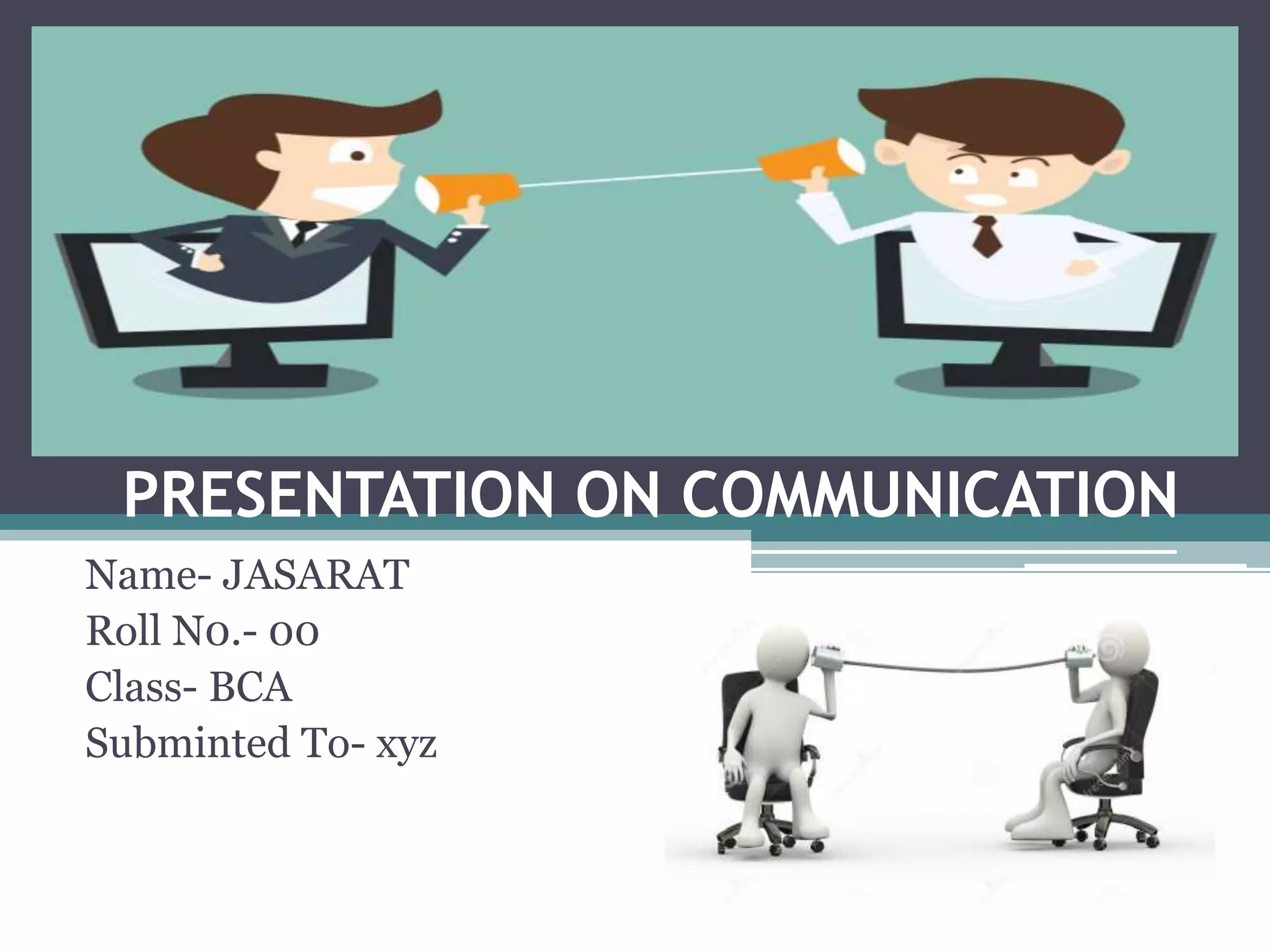
PRESENTATION ON COMMUNICATION
Name- JASARAT
Roll N0.- 00
Class- BCA
Subminted To- xyz
CONTENTS
 Introduction of communication
 Process of communication
 Features of communication
 Models of communication
 Theories of communication
 Communication barriers
 To overcome the barriers of
communication
INTRODUCTION OF
COMMUNICATION
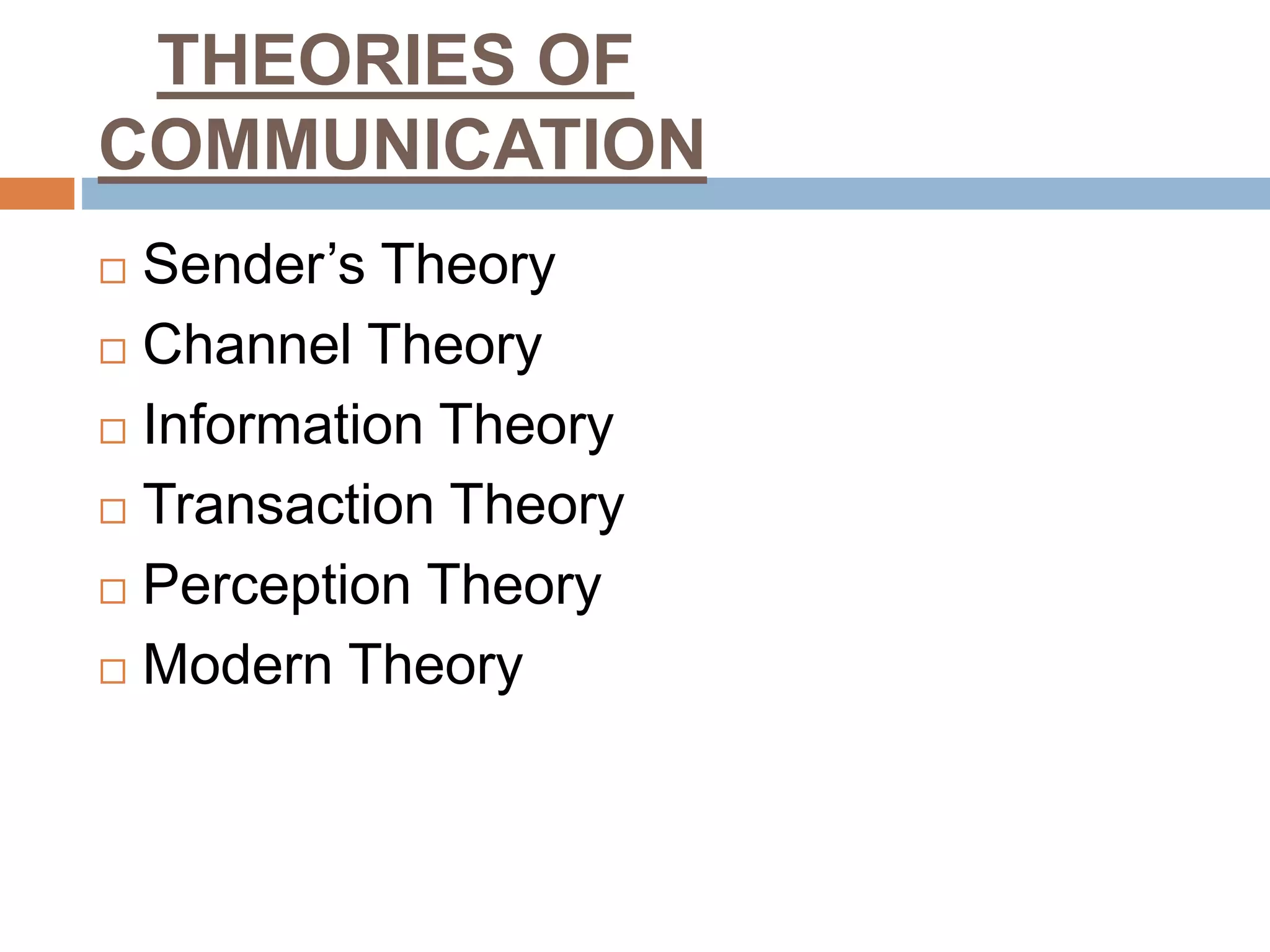
The word ‘’communication’’ in english has
been derived from latin word ‘’communis’’
which means to makes common.
The communication is a common
understanding of ideas, thoughts and
informations through minds of the sender
to the receiver.
PROCESS OF
COMMUNICATION
 Ideas
 Sender
 Message
 Encoding
 Medium
 Channel
 Receiver
 Decoding
 Feedback
FEATURES OF
COMMUNICATION
 Continuous process
 Universal
 Unavoidable
 Social process
 Dynamic process
 Selective
 purposeful
MODELS OF
COMMUNICATION
 Shannon-Weaver Model
 Schramm’s Model
 Berlo’s Model
 Murphy’s Model
 Katz- Lazarsfeld Model
 westley-Maclean Model
THEORIES OF
COMMUNICATION
 Sender’s Theory
 Channel Theory
 Information Theory
 Transaction Theory
 Perception Theory
 Modern Theory
COMMUNICATION
BARRIERS
 Semantic or language barriers
 Personal barriers
 Organisational barriers
 Emotional or perception barriers
 Physical barriers
 Cultural barriers
LANGUAGE BARRIERS
Language barriers
are those barriers
that are related to
language.
Language barriers
are concerned with
the problems in the
process of
encoding and
decoding the
message into
PERSONAL BARRIERS
Personal barriers
are personally
connected with
the sender and the
reciever.
Personal barriers
are related to
superiors and the
subordinates..
ORGANISATIONAL
BARRIERS
Organisational
barriers arise at
the organizational
level where
communication is
affected at the
employee level.
EMOTIONAL BARRIERS
 Emotional barriers
are related to the
mental condition
of both the parties.
PHYSICAL BARRIERS
Physical barriers are
those barriers
which are
concerned with
the external
environment of the
sender and the
receiver.
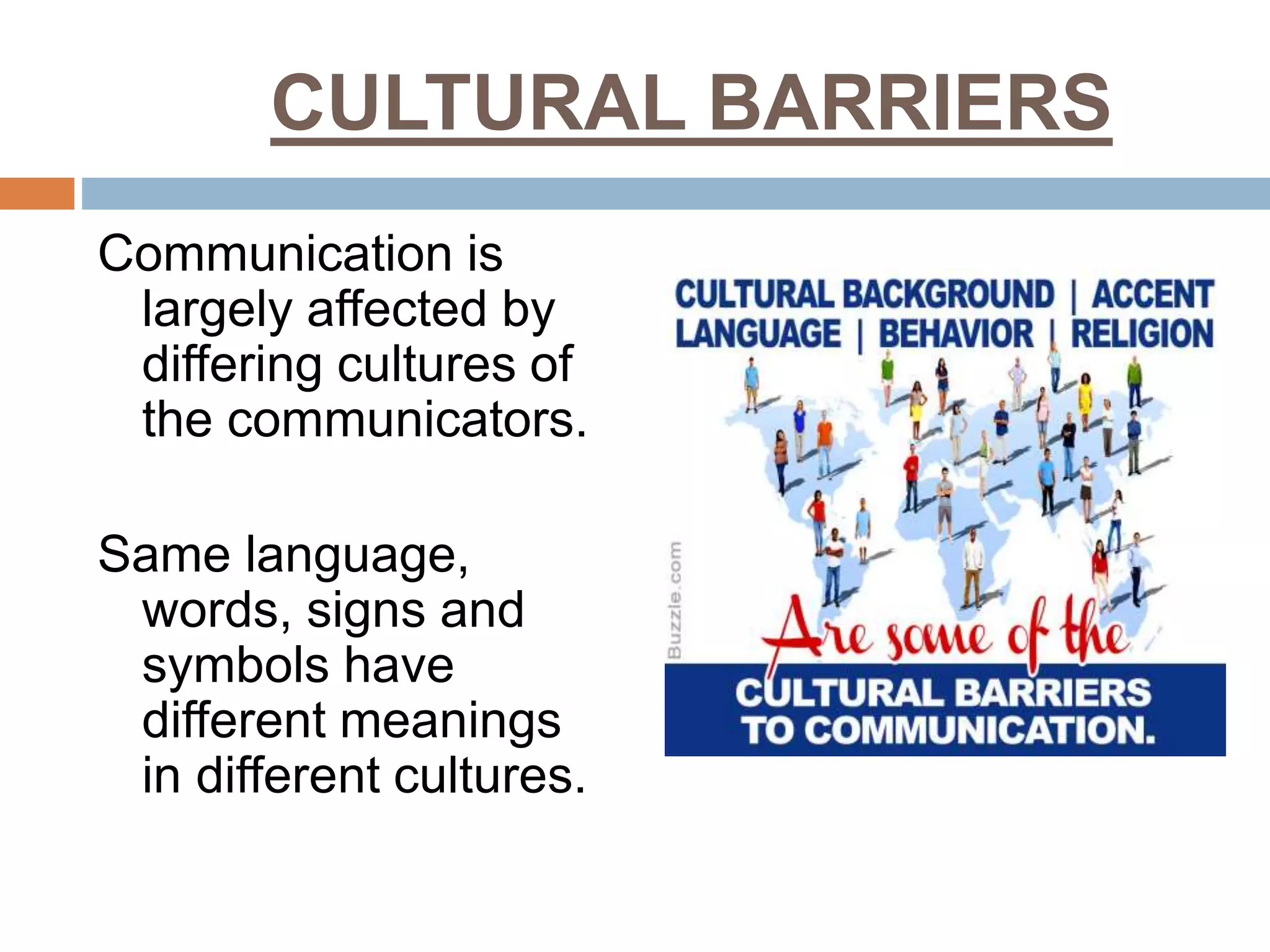
CULTURAL BARRIERS
Communication is
largely affected by
differing cultures of
the communicators.
Same language,
words, signs and
symbols have
different meanings
in different cultures.
TO OVER THE BARRIERS OF
COMMUNICATION
 Clarity of purpose
 Clarifying the ideas
 Overcoming differences in language
 Active listening
 Have an open mind
 Attitude
Communication skills

Communication skills