Chapter 1:
The People and The Field
Meredyth Fellows, West Chester University of PA
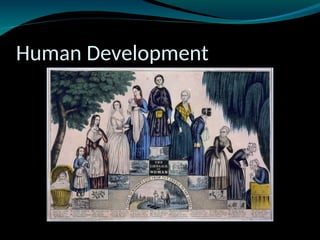
Human Development
Who We Are and What We Study
• Lifespan development: the scientific study of human
development throughout life
▫ Conception, Infancy, Childhood, Adolescence,
Emerging Adulthood, and Adulthood
▫ Gerontology
• Study of lifespan development is multidisciplinary
• Developmentalists explore
▫ Predictable milestones in development
▫ Individual differences
 Nature versus Nurture
 Temperament, Talent, Traits
▫ Normative and non-normative transitions
Four Contexts of Development
 Cohort: birth group
 e.g., baby boom cohort
 Socioeconomic Status (SES)
 education and income level
 Developed world; Developing world
 Culture
 Collectivist (for the group) and Individualist (for the
individual).
 Gender
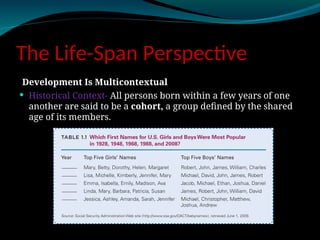
The Life-Span Perspective
Development Is Multicontextual
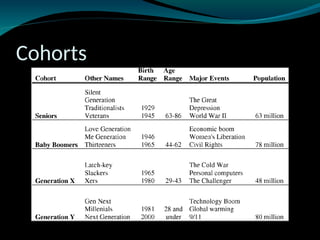
 Historical Context- All persons born within a few years of one
another are said to be a cohort, a group defined by the shared
age of its members.
Cohorts
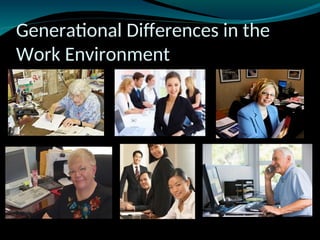
Generational Differences in the
Work Environment
The Traditionalists
The Traditionalists
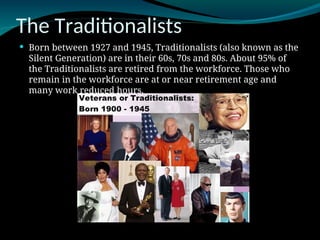
 Born between 1927 and 1945, Traditionalists (also known as the
Silent Generation) are in their 60s, 70s and 80s. About 95% of
the Traditionalists are retired from the workforce. Those who
remain in the workforce are at or near retirement age and
many work reduced hours.
The Traditionalists
 Hardworking: Raised by turn-of-the-century farmers,
Traditionalists brought a strong work ethic into the factories of
industrialized society. Traditionalists grew up during lean times
and consider work a privilege. This generation believes you
earn your own way through hard work. Traditionalists are
willing put in long, grueling hours to get ahead in their careers.
 Loyal: Traditionalists are civic-minded and loyal to their
country and employer. Unlike younger generations Generation
Y and Generation X, many Traditionalists worked for the same
employer their entire life and are less likely to change jobs to
advance their careers than younger generations.
The Traditionalists
 Submissive: Raised in a paternalistic
environment, Traditionalists were taught to
respect authority. Traditionalists are good team
players and generally don’t ruffle any feathers or
initiate conflict in the workplace.
 Tech-Challenged: Of all four generations in
today's workplace, the Traditionalists are slow to
change their work habits. As a whole, they are
less technologically adept than the younger
generations.
The Traditionalists
 Traditional: Traditionalists value traditional
morals, safety and security as well as conformity,
commitment and consistency. They prefer brick-
and-mortar educational institutions and
traditional lecture formats to online, web-based
education.
The Babyboomers
The Babyboomers
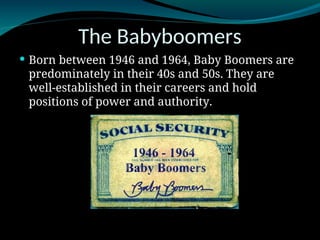
 Born between 1946 and 1964, Baby Boomers are
predominately in their 40s and 50s. They are
well-established in their careers and hold
positions of power and authority.
The Babyboomers
 Work-Centric: Baby Boomers are extremely
hardworking and motivated by position, perks
and prestige. Baby Boomers relish long work
weeks and define themselves by their
professional accomplishments. Since they
sacrificed a great deal to get where they are in
their career, this workaholic generation believes
that Generation X and Generation Y should pay
their dues and conform to a culture of overwork.
Baby Boomers may criticize younger generations
for a lack of work ethic and commitment to the
workplace.
The Babyboomers
 Independent: Baby Boomers are confident, independent and
self-reliant. This generation grew up in an era of reform and
believe they can change the world. They questioned established
authority systems and challenged the status quo.
 Goal-Oriented: With increased educational and financial
opportunities than previous generations, Baby Boomers are
achievement-oriented, dedicated and career-focused. They
welcome exciting, challenging projects and strive to make a
difference.
The Babyboomers
 Competitive: Since Baby Boomers equate work
and position with self-worth, they are quite
competitive in the workplace. They are clever,
resourceful and strive to win. Boomers believe in
hierarchal structure and rankism and may have
a hard time adjusting to workplace flexibility
trends. They believe in "face time" at the office
and may fault younger generations for working
remotely.
The GenXers
The GenXers
 Generation X encompasses the 44 to 50 million
Americans born between 1965 and 1980. This
generation marks the period of birth decline after
the baby boom and is significantly smaller than
previous and succeeding generations.
 Members of Generation X are largely in their 30’s
and early 40’s. On the whole, they are more
ethnically diverse and better educated than the
Baby Boomers. Over 60% of Generation X attended
college.
The GenXers
 Individualistic: Generation X came of age in an
era of two-income families, rising divorce rates
and a faltering economy. Women were joining
the workforce in large numbers, spawning an
age of “latch-key” children. As a result,
Generation X is independent, resourceful and
self-sufficient. In the workplace, Generation X
values freedom and responsibility. Many in this
generation display a casual disdain for authority
and structured work hours. They dislike being
micro-managed and embrace a hands-off
management philosophy.
The GenXers
 Technologically Adept: The Generation X
mentality reflects a shift from a manufacturing
economy to a service economy. The first
generation to grow up with computers,
technology is woven into their lives. This
generation is comfortable using PDAs,
cellphones, e-mail, laptops, Blackberrys and
other technology employed in the workplace.
The GenXers
 Flexible: Many Gen Xers lived through tough
economic times in the 1980s and saw their
workaholic parents lose hard-earned positions.
Thus, Generation X is less committed to one
employer and more willing to change jobs to get
ahead than previous generations. They adapt
well to change and are tolerant of alternative
lifestyles. Generation X is ambitious and eager to
learn new skills but want to accomplish things
on their own terms.
The GenXers
 Value Work/Life Balance: Unlike previous
generations, members of Generation X work to
live rather than live to work. They appreciate fun
in the workplace and espouse a work hard/play
hard mentality. Generation X managers often
incorporate humor and games into work
activities.
The GenYs
The GenYs
 Below are a few common traits that define
Generation Y. Born After 1980
 Tech-Savvy: Generation Y grew up with technology
and rely on it to perform their jobs better. Armed
with BlackBerrys, laptops, cellphones and other
gadgets, Generation Y is plugged-in 24 hours a day,
7 days a week. This generation prefers to
communicate through e-mail and text messaging
rather than face-to-face contact and prefers
webinars and online technology to traditional
lecture-based presentations.
The GenYs
 Family-Centric: The fast-track has lost much of
its appeal for Generation Y who is willing to
trade high pay for fewer billable hours, flexible
schedules and a better work/life balance. While
older generations may view this attitude as
narcissistic or lacking commitment, discipline
and drive, Generation Y professionals have a
different vision of workplace expectations and
prioritize family over work.
The GenYs
 Achievement-Oriented: Nurtured and
pampered by parents who did not want to make
the mistakes of the previous generation,
Generation Y is confident, ambitious and
achievement-oriented. They have high
expectations of their employers, seek out new
challenges and are not afraid to question
authority. Generation Y wants meaningful work
and a solid learning curve.
The GenYs
 Team-Oriented: As children, Generation Y participated in team
sports, play groups and other group activities. They value
teamwork and seek the input and affirmation of others. Part of
a no-person-left-behind generation, Generation Y is loyal,
committed and wants to be included and involved.
 Attention-Craving: Generation Y craves attention in the forms
of feedback and guidance. They appreciate being kept in the
loop and seek frequent praise and reassurance. Generation Y
may benefit greatly from mentors who can help guide and
develop their young careers.
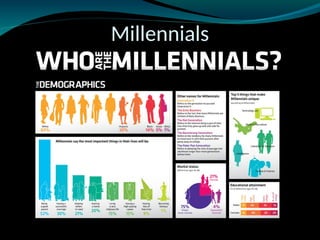
Millennials
Changing Conceptions of
Childhood
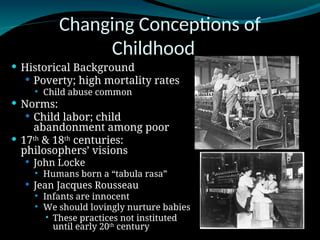
 Historical Background
 Poverty; high mortality rates
 Child abuse common
 Norms:
 Child labor; child
abandonment among poor
 17th
& 18th
centuries:
philosophers’ visions
 John Locke
 Humans born a “tabula rasa”
 Jean Jacques Rousseau
 Infants are innocent
 We should lovingly nurture babies
 These practices not instituted
until early 20th
century
Changing Conceptions of Childhood
 Late 19th
Century: kinder, gentler view of children
 Childhood protected, dependent life stage
 Universal education: primary school mandatory
 20th
Century: Adolescence: identified by G. Stanley
Hall
 Stage of “Storm and Stress” between childhood and
adulthood
 In the 1930s, President Franklin Roosevelt ordered high
school attendance as mandatory.
 Emerging Adulthood: newest life stage
 Age 18 to late 20s
 Time for personal exploration
Changing Conceptions of Later Life:
Adulthood and Old Age
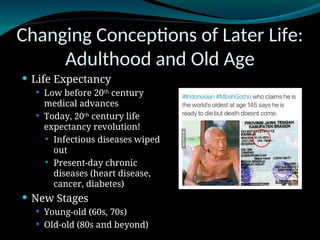
 Life Expectancy
 Low before 20th
century
medical advances
 Today, 20th
century life
expectancy revolution!
 Infectious diseases wiped
out
 Present-day chronic
diseases (heart disease,
cancer, diabetes)
 New Stages
 Young-old (60s, 70s)
 Old-old (80s and beyond)
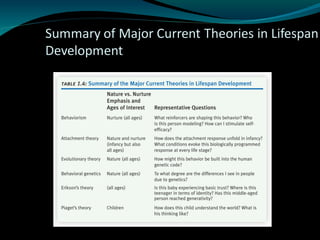
Theories of Development
 Theory
 Any perspective that attempts to explain individual
behavior
 Allows us to predict behavior
 Presents ideas for interventions to improve behavior
 Nature/Nurture
 Are we shaped by biological/genetic forces or is the
environment more influential?
 We’ll look at each theory from this perspective.
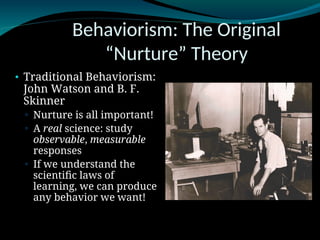
Behaviorism: The Original
“Nurture” Theory
• Traditional Behaviorism:
John Watson and B. F.
Skinner
▫ Nurture is all important!
▫ A real science: study
observable, measurable
responses
▫ If we understand the
scientific laws of
learning, we can produce
any behavior we want!
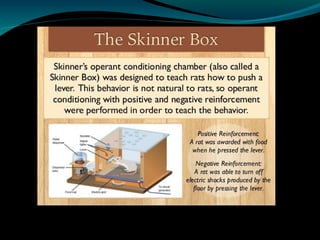
B. F. Skinner: Operant Conditioning
 Conditioning = Learning
 Operant Conditioning
 The law of learning that determines any
voluntary response (rewards and punishments)
 Variable reinforcement schedules
 We behave a certain way because we are
reinforced (rewarded) for certain behaviors.
 Any behavior that is reinforced is likely to be repeated.
 Any behavior that is not reinforced is likely to be
extinguished.
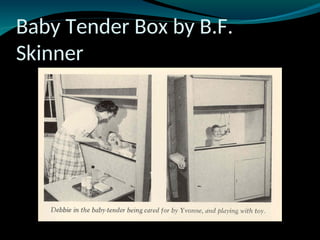
Baby Tender Box by B.F.
Skinner
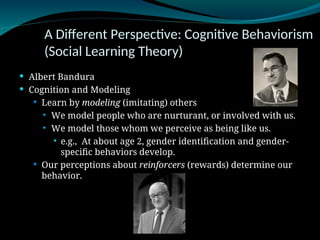
A Different Perspective: Cognitive Behaviorism
(Social Learning Theory)
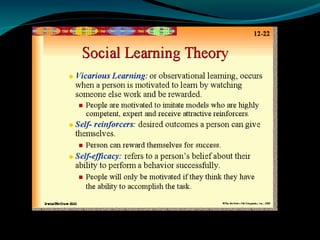
 Albert Bandura
 Cognition and Modeling
 Learn by modeling (imitating) others
 We model people who are nurturant, or involved with us.
 We model those whom we perceive as being like us.
 e.g., At about age 2, gender identification and gender-
specific behaviors develop.
 Our perceptions about reinforcers (rewards) determine our
behavior.
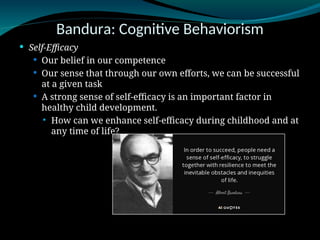
Bandura: Cognitive Behaviorism
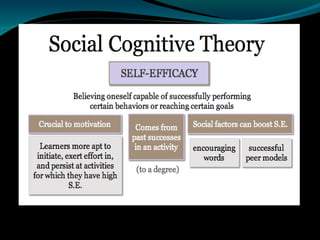
 Self-Efficacy
 Our belief in our competence
 Our sense that through our own efforts, we can be successful
at a given task
 A strong sense of self-efficacy is an important factor in
healthy child development.
 How can we enhance self-efficacy during childhood and at
any time of life?
Attachment Theory (mid-20th
Century):
Nature, Nurture, and Love
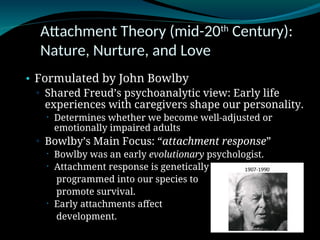
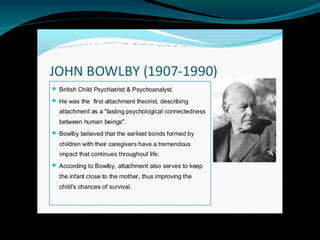
• Formulated by John Bowlby
▫ Shared Freud’s psychoanalytic view: Early life
experiences with caregivers shape our personality.
 Determines whether we become well-adjusted or
emotionally impaired adults
▫ Bowlby’s Main Focus: “attachment response”
 Bowlby was an early evolutionary psychologist.
 Attachment response is genetically
programmed into our species to
promote survival.
 Early attachments affect
development.
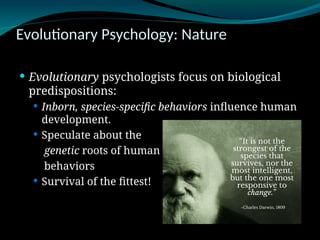
Evolutionary Psychology: Nature
 Evolutionary psychologists focus on biological
predispositions:
 Inborn, species-specific behaviors influence human
development.
 Speculate about the
genetic roots of human
behaviors
 Survival of the fittest!
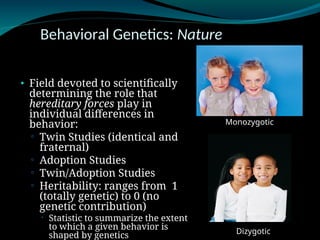
Behavioral Genetics: Nature
• Field devoted to scientifically
determining the role that
hereditary forces play in
individual differences in
behavior:
▫ Twin Studies (identical and
fraternal)
▫ Adoption Studies
▫ Twin/Adoption Studies
▫ Heritability: ranges from 1
(totally genetic) to 0 (no
genetic contribution)
 Statistic to summarize the extent
to which a given behavior is
shaped by genetics
Monozygotic
Dizygotic
Nature and Nurture Combined
 Nature interacts with Nurture when studying human
development!
 Evocative Forces
 Inborn talents and temperamental tendencies naturally
evoke certain responses from others.
 Bidirectional forces in relationships
 Active Forces
 We actively select our environments based on our genetic
tendencies.
 Person Environment Fit
− crucial to flourishing in life!
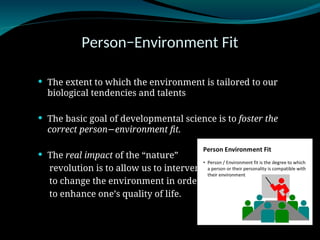
Person−Environment Fit
 The extent to which the environment is tailored to our
biological tendencies and talents
 The basic goal of developmental science is to foster the
correct person environment fit.
−
 The real impact of the “nature”
revolution is to allow us to intervene
to change the environment in order
to enhance one’s quality of life.
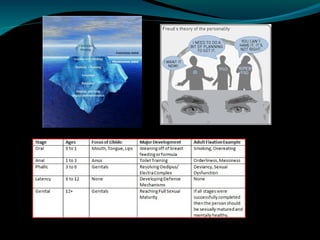
Age-Linked Theories: Freud
 Psychoanalytic Theory
 Analyzes our psyche or “inner life”
 Deterministic: “mothering” during first five
years determines adult personality and mental
health
 Id, Ego, Superego
 Age-Linked Stages
 Focus on erogenous zones
 Oral, Anal, Phallic, Latency
 Therapy = Psychoanalysis
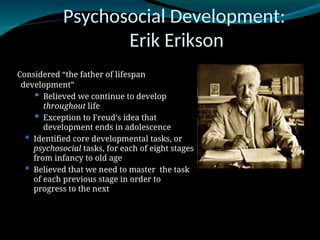
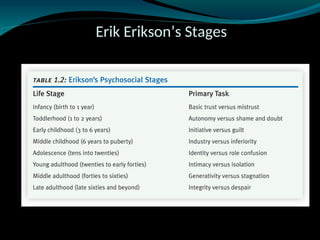
Psychosocial Development:
Erik Erikson
Considered “the father of lifespan
development”
 Believed we continue to develop
throughout life
 Exception to Freud’s idea that
development ends in adolescence
 Identified core developmental tasks, or
psychosocial tasks, for each of eight stages
from infancy to old age
 Believed that we need to master the task
of each previous stage in order to
progress to the next
Erik Erikson’s Stages
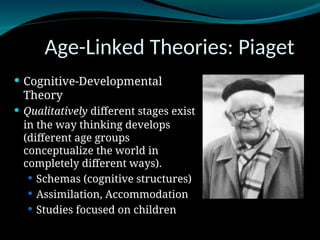
Age-Linked Theories: Piaget
 Cognitive-Developmental
Theory
 Qualitatively different stages exist
in the way thinking develops
(different age groups
conceptualize the world in
completely different ways).
 Schemas (cognitive structures)
 Assimilation, Accommodation
 Studies focused on children
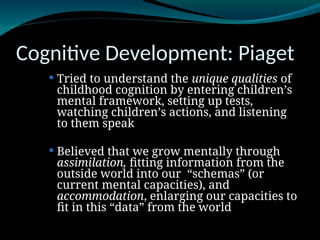
Cognitive Development: Piaget
 Tried to understand the unique qualities of
childhood cognition by entering children’s
mental framework, setting up tests,
watching children’s actions, and listening
to them speak
 Believed that we grow mentally through
assimilation, fitting information from the
outside world into our “schemas” (or
current mental capacities), and
accommodation, enlarging our capacities to
fit in this “data” from the world
A Preview of Piaget’s Stages
The Developmental Systems
Perspective
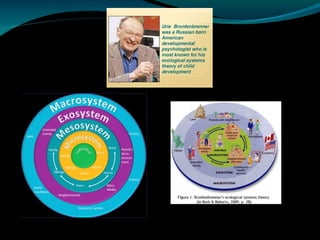
 Urie Bronfenbrenner:
Highlighted multidirectional forces in human
development
The total ecology, or life situation of the child,
influences his/her development.
 Developmental Systems Approach:
Stresses the need to use many different approaches
in understanding human behavior
We must look at the interaction of processes (genes,
environment, family, society, culture).
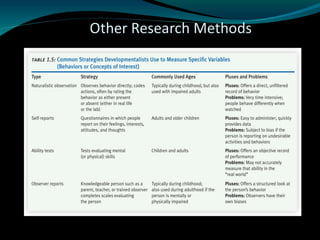
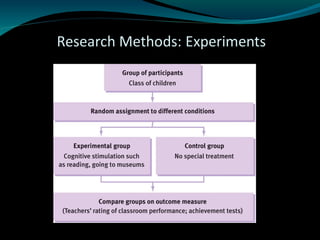
Research Methods
 Two standard research strategies:
 Correlational Study
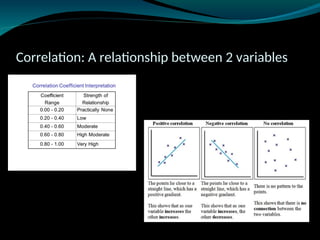
 Researchers chart the relationships between
variables.
 Correlation does not mean causation!
 Experiments
 Randomly assign individuals to groups.
 Give each group a different treatment.
 Experimental group and Control group
 Determine if intervention produced a predicted
effect.
 Experiments can determine cause! (cause and effect)
Correlation: A relationship between 2 variables
Cross-Sectional and Longitudinal Studies: How do
we change with age?
 Cross-Sectional
 Testing and comparing different age groups at
the same time
 Gives differences between age groups
 Does not tell us the changes that occur with age
 Longitudinal
 Test at intervals – one group over many years
 Dunedin Multidisciplinary and Development
Study
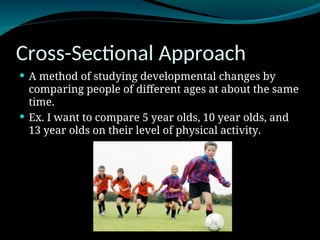
Cross-Sectional Approach
 A method of studying developmental changes by
comparing people of different ages at about the same
time.
 Ex. I want to compare 5 year olds, 10 year olds, and
13 year olds on their level of physical activity.
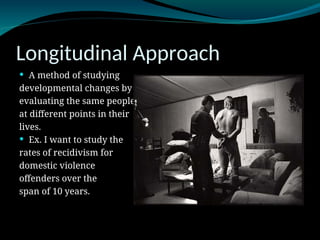
Longitudinal Approach
 A method of studying
developmental changes by
evaluating the same people
at different points in their
lives.
 Ex. I want to study the
rates of recidivism for
domestic violence
offenders over the
span of 10 years.
Quantitative and Qualitative
Research
 Quantitative
 The typical research mode in developmental
science using groups and statistical analyses to
make general predictions about behavior
 Qualitative
 Scientist not interested in numerical comparisons
 Studying the life of a single person through
observation and interviews, or observing a single
individual in depth
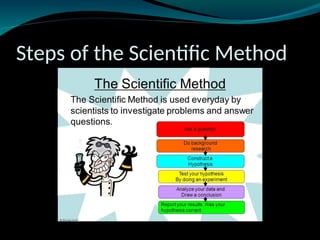
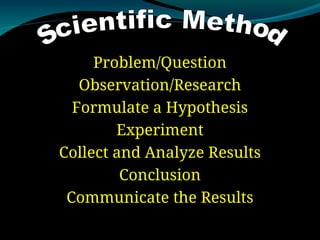
Steps of the Scientific Method
Problem/Question
Observation/Research
Formulate a Hypothesis
Experiment
Collect and Analyze Results
Conclusion
Communicate the Results
Steps of the
Scientific Method
1.
1. Problem/Question
Problem/Question: Develop a question or
problem that can be solved through
experimentation.
(Do people generally assume that people who
are physically attractive are more likely to
be intelligent, friendly, and display good
judgment?)
Steps of the
Scientific Method
2. Observation/Research
Observation/Research:
Make observations and
research your topic of
interest.
Conduct a Literature Review
Steps of the
Scientific Method
3. Formulate a Hypothesis
Formulate a Hypothesis:
Predict a possible answer to
the problem or question.
People generally assume that
people who are physically
attractive are more likely to be
intelligent, friendly, and
display good judgment.
Steps of the
Scientific Method
4. Experiment
Experiment: Develop and follow a
procedure.
Include a detailed materials list.
The outcome must be measurable
(quantifiable).
Interviews were conducted on participants
that were asked to rate on appearance.
Steps of the
Scientific Method
5. Collect and Analyze Results
Collect and Analyze Results:
Modify the procedure if needed.
Confirm the results by retesting.
Include tables, graphs, and
photographs.
Steps of the
Scientific Method
6. Conclusion
Conclusion: Include a
statement that accepts or
rejects the hypothesis.
Make recommendations for
further study and possible
improvements to the
procedure.
Steps of the
Scientific Method
7. Communicate the Results
Communicate the Results:
Be prepared to present the
project to an audience.
Expect questions from the
audience.
The Halo Effect
 Study Conducted by: Richard E. Nisbett and Timothy DeCamp
Wilson
 Study Conducted in 1977 at the University of Michigan
 Experiment Details: The Halo Effect states that people
generally assume that people who are physically attractive are
more likely to be intelligent, friendly, and display good
judgment. In order to prove their theory Nisbett and DeCamp
Wilson created a study to prove that people have little
awareness of the nature of the Halo Effect, and that it
influences their personal judgments, inferences and the
production of a more complex social behavior.
The Halo Effect
 In the experiment, college students were the research
participants and were asked to evaluate a psychology instructor
as they view him in a videotaped interview. The students were
randomly assigned to one of two groups, and each group was
shown one of two different interviews with the same instructor
who is a native French-speaking Belgian who spoke English
with a fairly noticeable accent. In the first video, the instructor
presented himself as someone likable, respectful of his students’
intelligence and motives, flexible in his approach to teaching
and enthusiastic about his subject matter. In the second
interview, he presented himself as much more unlikable. He
was cold and distrustful toward the students and was quite
rigid in his teaching style.
The Halo Effect
 After watching the videos, the subjects were asked to rate the
lecturer on physical appearance, mannerisms and his accent,
even though his mannerisms and accent were kept the same in
both versions of videos. The subjects were asked to rate the
professor on an 8-point scale ranging from “like extremely” to
“dislike extremely.” Subjects were also told that the researchers
were interested in knowing “how much their liking for the
teacher influenced the ratings they just made.” Other subjects
were asked to identify how much the characteristics they just
rated influenced their liking of the teacher.
The Halo Effect
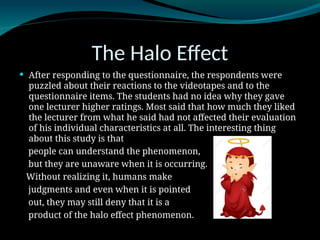
 After responding to the questionnaire, the respondents were
puzzled about their reactions to the videotapes and to the
questionnaire items. The students had no idea why they gave
one lecturer higher ratings. Most said that how much they liked
the lecturer from what he said had not affected their evaluation
of his individual characteristics at all. The interesting thing
about this study is that
people can understand the phenomenon,
but they are unaware when it is occurring.
Without realizing it, humans make
judgments and even when it is pointed
out, they may still deny that it is a
product of the halo effect phenomenon.
EXPERIMENTAL RESEARCH (CONT’D)
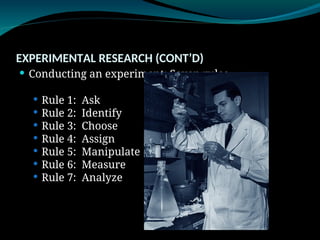
 Conducting an experiment: Seven rules
 Rule 1: Ask
 Rule 2: Identify
 Rule 3: Choose
 Rule 4: Assign
 Rule 5: Manipulate
 Rule 6: Measure
 Rule 7: Analyze
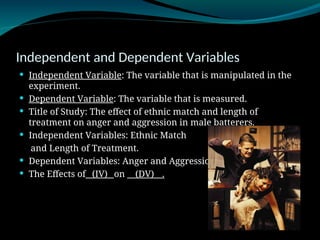
Independent and Dependent Variables
 Independent Variable: The variable that is manipulated in the
experiment.
 Dependent Variable: The variable that is measured.
 Title of Study: The effect of ethnic match and length of
treatment on anger and aggression in male batterers.
 Independent Variables: Ethnic Match
and Length of Treatment.
 Dependent Variables: Anger and Aggression
 The Effects of_ (IV) _on __(DV)__.
Control Group
In a scientific experiment, the
control is the group that serves as
the standard of comparison.
The control group may be a “no
treatment" or an “experimenter
selected” group.
Control Group
The control group is exposed to the
same conditions as the experimental
group, except for the variable being
tested.
All experiments should have a control
group.
Operational Definition
 A description of an abstract property in terms of
a concrete condition that can be measured!
 Define: Anger, Love, Quality of Live
Case Methods/Case Studies
 A method of gathering
scientific knowledge by
studying a single
individual.
Frequency Distribution
 A graphical representation of the measurements of a
sample that are arranged by the number of times
each measurement was observed.
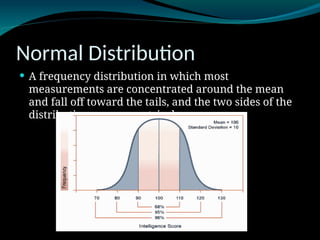
Normal Distribution
 A frequency distribution in which most
measurements are concentrated around the mean
and fall off toward the tails, and the two sides of the
distribution are symmetrical.
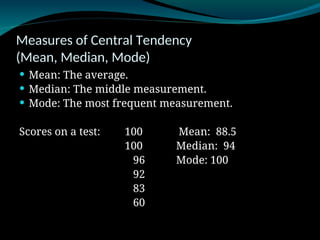
Measures of Central Tendency
(Mean, Median, Mode)
 Mean: The average.
 Median: The middle measurement.
 Mode: The most frequent measurement.
Scores on a test: 100 Mean: 88.5
100 Median: 94
96 Mode: 100
92
83
60
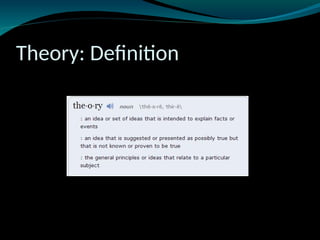
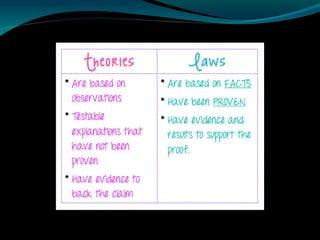
Theory: Definition
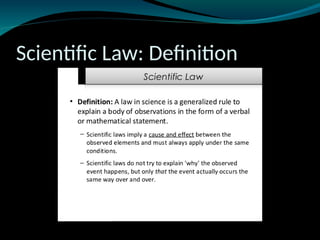
Scientific Law: Definition
Ethics
 Informed Consent: A written agreement to participate in a
study made by a person who has been informed of all the risks
that participation may entail.
Ethics
 Debriefing: A verbal description of the true nature and purpose
of a study that psychologists provide to people after they have
participated in the study.
The End

Experiencing the lifespan Chapter+1+Murphy

  • 1.
    Chapter 1: The Peopleand The Field Meredyth Fellows, West Chester University of PA
  • 2.
  • 3.
    Who We Areand What We Study • Lifespan development: the scientific study of human development throughout life ▫ Conception, Infancy, Childhood, Adolescence, Emerging Adulthood, and Adulthood ▫ Gerontology • Study of lifespan development is multidisciplinary • Developmentalists explore ▫ Predictable milestones in development ▫ Individual differences  Nature versus Nurture  Temperament, Talent, Traits ▫ Normative and non-normative transitions
  • 4.
    Four Contexts ofDevelopment  Cohort: birth group  e.g., baby boom cohort  Socioeconomic Status (SES)  education and income level  Developed world; Developing world  Culture  Collectivist (for the group) and Individualist (for the individual).  Gender
  • 5.
    The Life-Span Perspective DevelopmentIs Multicontextual  Historical Context- All persons born within a few years of one another are said to be a cohort, a group defined by the shared age of its members.
  • 7.
  • 9.
    Generational Differences inthe Work Environment
  • 10.
  • 11.
    The Traditionalists  Bornbetween 1927 and 1945, Traditionalists (also known as the Silent Generation) are in their 60s, 70s and 80s. About 95% of the Traditionalists are retired from the workforce. Those who remain in the workforce are at or near retirement age and many work reduced hours.
  • 12.
    The Traditionalists  Hardworking:Raised by turn-of-the-century farmers, Traditionalists brought a strong work ethic into the factories of industrialized society. Traditionalists grew up during lean times and consider work a privilege. This generation believes you earn your own way through hard work. Traditionalists are willing put in long, grueling hours to get ahead in their careers.  Loyal: Traditionalists are civic-minded and loyal to their country and employer. Unlike younger generations Generation Y and Generation X, many Traditionalists worked for the same employer their entire life and are less likely to change jobs to advance their careers than younger generations.
  • 13.
    The Traditionalists  Submissive:Raised in a paternalistic environment, Traditionalists were taught to respect authority. Traditionalists are good team players and generally don’t ruffle any feathers or initiate conflict in the workplace.  Tech-Challenged: Of all four generations in today's workplace, the Traditionalists are slow to change their work habits. As a whole, they are less technologically adept than the younger generations.
  • 14.
    The Traditionalists  Traditional:Traditionalists value traditional morals, safety and security as well as conformity, commitment and consistency. They prefer brick- and-mortar educational institutions and traditional lecture formats to online, web-based education.
  • 15.
  • 16.
    The Babyboomers  Bornbetween 1946 and 1964, Baby Boomers are predominately in their 40s and 50s. They are well-established in their careers and hold positions of power and authority.
  • 17.
    The Babyboomers  Work-Centric:Baby Boomers are extremely hardworking and motivated by position, perks and prestige. Baby Boomers relish long work weeks and define themselves by their professional accomplishments. Since they sacrificed a great deal to get where they are in their career, this workaholic generation believes that Generation X and Generation Y should pay their dues and conform to a culture of overwork. Baby Boomers may criticize younger generations for a lack of work ethic and commitment to the workplace.
  • 18.
    The Babyboomers  Independent:Baby Boomers are confident, independent and self-reliant. This generation grew up in an era of reform and believe they can change the world. They questioned established authority systems and challenged the status quo.  Goal-Oriented: With increased educational and financial opportunities than previous generations, Baby Boomers are achievement-oriented, dedicated and career-focused. They welcome exciting, challenging projects and strive to make a difference.
  • 19.
    The Babyboomers  Competitive:Since Baby Boomers equate work and position with self-worth, they are quite competitive in the workplace. They are clever, resourceful and strive to win. Boomers believe in hierarchal structure and rankism and may have a hard time adjusting to workplace flexibility trends. They believe in "face time" at the office and may fault younger generations for working remotely.
  • 20.
  • 21.
    The GenXers  GenerationX encompasses the 44 to 50 million Americans born between 1965 and 1980. This generation marks the period of birth decline after the baby boom and is significantly smaller than previous and succeeding generations.  Members of Generation X are largely in their 30’s and early 40’s. On the whole, they are more ethnically diverse and better educated than the Baby Boomers. Over 60% of Generation X attended college.
  • 22.
    The GenXers  Individualistic:Generation X came of age in an era of two-income families, rising divorce rates and a faltering economy. Women were joining the workforce in large numbers, spawning an age of “latch-key” children. As a result, Generation X is independent, resourceful and self-sufficient. In the workplace, Generation X values freedom and responsibility. Many in this generation display a casual disdain for authority and structured work hours. They dislike being micro-managed and embrace a hands-off management philosophy.
  • 23.
    The GenXers  TechnologicallyAdept: The Generation X mentality reflects a shift from a manufacturing economy to a service economy. The first generation to grow up with computers, technology is woven into their lives. This generation is comfortable using PDAs, cellphones, e-mail, laptops, Blackberrys and other technology employed in the workplace.
  • 24.
    The GenXers  Flexible:Many Gen Xers lived through tough economic times in the 1980s and saw their workaholic parents lose hard-earned positions. Thus, Generation X is less committed to one employer and more willing to change jobs to get ahead than previous generations. They adapt well to change and are tolerant of alternative lifestyles. Generation X is ambitious and eager to learn new skills but want to accomplish things on their own terms.
  • 25.
    The GenXers  ValueWork/Life Balance: Unlike previous generations, members of Generation X work to live rather than live to work. They appreciate fun in the workplace and espouse a work hard/play hard mentality. Generation X managers often incorporate humor and games into work activities.
  • 26.
  • 27.
    The GenYs  Beloware a few common traits that define Generation Y. Born After 1980  Tech-Savvy: Generation Y grew up with technology and rely on it to perform their jobs better. Armed with BlackBerrys, laptops, cellphones and other gadgets, Generation Y is plugged-in 24 hours a day, 7 days a week. This generation prefers to communicate through e-mail and text messaging rather than face-to-face contact and prefers webinars and online technology to traditional lecture-based presentations.
  • 28.
    The GenYs  Family-Centric:The fast-track has lost much of its appeal for Generation Y who is willing to trade high pay for fewer billable hours, flexible schedules and a better work/life balance. While older generations may view this attitude as narcissistic or lacking commitment, discipline and drive, Generation Y professionals have a different vision of workplace expectations and prioritize family over work.
  • 29.
    The GenYs  Achievement-Oriented:Nurtured and pampered by parents who did not want to make the mistakes of the previous generation, Generation Y is confident, ambitious and achievement-oriented. They have high expectations of their employers, seek out new challenges and are not afraid to question authority. Generation Y wants meaningful work and a solid learning curve.
  • 30.
    The GenYs  Team-Oriented:As children, Generation Y participated in team sports, play groups and other group activities. They value teamwork and seek the input and affirmation of others. Part of a no-person-left-behind generation, Generation Y is loyal, committed and wants to be included and involved.  Attention-Craving: Generation Y craves attention in the forms of feedback and guidance. They appreciate being kept in the loop and seek frequent praise and reassurance. Generation Y may benefit greatly from mentors who can help guide and develop their young careers.
  • 31.
  • 32.
    Changing Conceptions of Childhood Historical Background  Poverty; high mortality rates  Child abuse common  Norms:  Child labor; child abandonment among poor  17th & 18th centuries: philosophers’ visions  John Locke  Humans born a “tabula rasa”  Jean Jacques Rousseau  Infants are innocent  We should lovingly nurture babies  These practices not instituted until early 20th century
  • 33.
    Changing Conceptions ofChildhood  Late 19th Century: kinder, gentler view of children  Childhood protected, dependent life stage  Universal education: primary school mandatory  20th Century: Adolescence: identified by G. Stanley Hall  Stage of “Storm and Stress” between childhood and adulthood  In the 1930s, President Franklin Roosevelt ordered high school attendance as mandatory.  Emerging Adulthood: newest life stage  Age 18 to late 20s  Time for personal exploration
  • 34.
    Changing Conceptions ofLater Life: Adulthood and Old Age  Life Expectancy  Low before 20th century medical advances  Today, 20th century life expectancy revolution!  Infectious diseases wiped out  Present-day chronic diseases (heart disease, cancer, diabetes)  New Stages  Young-old (60s, 70s)  Old-old (80s and beyond)
  • 35.
    Theories of Development Theory  Any perspective that attempts to explain individual behavior  Allows us to predict behavior  Presents ideas for interventions to improve behavior  Nature/Nurture  Are we shaped by biological/genetic forces or is the environment more influential?  We’ll look at each theory from this perspective.
  • 36.
    Behaviorism: The Original “Nurture”Theory • Traditional Behaviorism: John Watson and B. F. Skinner ▫ Nurture is all important! ▫ A real science: study observable, measurable responses ▫ If we understand the scientific laws of learning, we can produce any behavior we want!
  • 38.
    B. F. Skinner:Operant Conditioning  Conditioning = Learning  Operant Conditioning  The law of learning that determines any voluntary response (rewards and punishments)  Variable reinforcement schedules  We behave a certain way because we are reinforced (rewarded) for certain behaviors.  Any behavior that is reinforced is likely to be repeated.  Any behavior that is not reinforced is likely to be extinguished.
  • 39.
    Baby Tender Boxby B.F. Skinner
  • 40.
    A Different Perspective:Cognitive Behaviorism (Social Learning Theory)  Albert Bandura  Cognition and Modeling  Learn by modeling (imitating) others  We model people who are nurturant, or involved with us.  We model those whom we perceive as being like us.  e.g., At about age 2, gender identification and gender- specific behaviors develop.  Our perceptions about reinforcers (rewards) determine our behavior.
  • 41.
    Bandura: Cognitive Behaviorism Self-Efficacy  Our belief in our competence  Our sense that through our own efforts, we can be successful at a given task  A strong sense of self-efficacy is an important factor in healthy child development.  How can we enhance self-efficacy during childhood and at any time of life?
  • 44.
    Attachment Theory (mid-20th Century): Nature,Nurture, and Love • Formulated by John Bowlby ▫ Shared Freud’s psychoanalytic view: Early life experiences with caregivers shape our personality.  Determines whether we become well-adjusted or emotionally impaired adults ▫ Bowlby’s Main Focus: “attachment response”  Bowlby was an early evolutionary psychologist.  Attachment response is genetically programmed into our species to promote survival.  Early attachments affect development.
  • 46.
    Evolutionary Psychology: Nature Evolutionary psychologists focus on biological predispositions:  Inborn, species-specific behaviors influence human development.  Speculate about the genetic roots of human behaviors  Survival of the fittest!
  • 47.
    Behavioral Genetics: Nature •Field devoted to scientifically determining the role that hereditary forces play in individual differences in behavior: ▫ Twin Studies (identical and fraternal) ▫ Adoption Studies ▫ Twin/Adoption Studies ▫ Heritability: ranges from 1 (totally genetic) to 0 (no genetic contribution)  Statistic to summarize the extent to which a given behavior is shaped by genetics Monozygotic Dizygotic
  • 48.
    Nature and NurtureCombined  Nature interacts with Nurture when studying human development!  Evocative Forces  Inborn talents and temperamental tendencies naturally evoke certain responses from others.  Bidirectional forces in relationships  Active Forces  We actively select our environments based on our genetic tendencies.  Person Environment Fit − crucial to flourishing in life!
  • 49.
    Person−Environment Fit  Theextent to which the environment is tailored to our biological tendencies and talents  The basic goal of developmental science is to foster the correct person environment fit. −  The real impact of the “nature” revolution is to allow us to intervene to change the environment in order to enhance one’s quality of life.
  • 50.
    Age-Linked Theories: Freud Psychoanalytic Theory  Analyzes our psyche or “inner life”  Deterministic: “mothering” during first five years determines adult personality and mental health  Id, Ego, Superego  Age-Linked Stages  Focus on erogenous zones  Oral, Anal, Phallic, Latency  Therapy = Psychoanalysis
  • 52.
    Psychosocial Development: Erik Erikson Considered“the father of lifespan development”  Believed we continue to develop throughout life  Exception to Freud’s idea that development ends in adolescence  Identified core developmental tasks, or psychosocial tasks, for each of eight stages from infancy to old age  Believed that we need to master the task of each previous stage in order to progress to the next
  • 53.
  • 54.
    Age-Linked Theories: Piaget Cognitive-Developmental Theory  Qualitatively different stages exist in the way thinking develops (different age groups conceptualize the world in completely different ways).  Schemas (cognitive structures)  Assimilation, Accommodation  Studies focused on children
  • 55.
    Cognitive Development: Piaget Tried to understand the unique qualities of childhood cognition by entering children’s mental framework, setting up tests, watching children’s actions, and listening to them speak  Believed that we grow mentally through assimilation, fitting information from the outside world into our “schemas” (or current mental capacities), and accommodation, enlarging our capacities to fit in this “data” from the world
  • 56.
    A Preview ofPiaget’s Stages
  • 58.
    The Developmental Systems Perspective Urie Bronfenbrenner: Highlighted multidirectional forces in human development The total ecology, or life situation of the child, influences his/her development.  Developmental Systems Approach: Stresses the need to use many different approaches in understanding human behavior We must look at the interaction of processes (genes, environment, family, society, culture).
  • 60.
    Research Methods  Twostandard research strategies:  Correlational Study  Researchers chart the relationships between variables.  Correlation does not mean causation!  Experiments  Randomly assign individuals to groups.  Give each group a different treatment.  Experimental group and Control group  Determine if intervention produced a predicted effect.  Experiments can determine cause! (cause and effect)
  • 61.
    Correlation: A relationshipbetween 2 variables
  • 64.
    Cross-Sectional and LongitudinalStudies: How do we change with age?  Cross-Sectional  Testing and comparing different age groups at the same time  Gives differences between age groups  Does not tell us the changes that occur with age  Longitudinal  Test at intervals – one group over many years  Dunedin Multidisciplinary and Development Study
  • 65.
    Cross-Sectional Approach  Amethod of studying developmental changes by comparing people of different ages at about the same time.  Ex. I want to compare 5 year olds, 10 year olds, and 13 year olds on their level of physical activity.
  • 66.
    Longitudinal Approach  Amethod of studying developmental changes by evaluating the same people at different points in their lives.  Ex. I want to study the rates of recidivism for domestic violence offenders over the span of 10 years.
  • 67.
    Quantitative and Qualitative Research Quantitative  The typical research mode in developmental science using groups and statistical analyses to make general predictions about behavior  Qualitative  Scientist not interested in numerical comparisons  Studying the life of a single person through observation and interviews, or observing a single individual in depth
  • 69.
    Steps of theScientific Method
  • 70.
    Problem/Question Observation/Research Formulate a Hypothesis Experiment Collectand Analyze Results Conclusion Communicate the Results
  • 71.
    Steps of the ScientificMethod 1. 1. Problem/Question Problem/Question: Develop a question or problem that can be solved through experimentation. (Do people generally assume that people who are physically attractive are more likely to be intelligent, friendly, and display good judgment?)
  • 72.
    Steps of the ScientificMethod 2. Observation/Research Observation/Research: Make observations and research your topic of interest. Conduct a Literature Review
  • 73.
    Steps of the ScientificMethod 3. Formulate a Hypothesis Formulate a Hypothesis: Predict a possible answer to the problem or question. People generally assume that people who are physically attractive are more likely to be intelligent, friendly, and display good judgment.
  • 74.
    Steps of the ScientificMethod 4. Experiment Experiment: Develop and follow a procedure. Include a detailed materials list. The outcome must be measurable (quantifiable). Interviews were conducted on participants that were asked to rate on appearance.
  • 75.
    Steps of the ScientificMethod 5. Collect and Analyze Results Collect and Analyze Results: Modify the procedure if needed. Confirm the results by retesting. Include tables, graphs, and photographs.
  • 76.
    Steps of the ScientificMethod 6. Conclusion Conclusion: Include a statement that accepts or rejects the hypothesis. Make recommendations for further study and possible improvements to the procedure.
  • 77.
    Steps of the ScientificMethod 7. Communicate the Results Communicate the Results: Be prepared to present the project to an audience. Expect questions from the audience.
  • 78.
    The Halo Effect Study Conducted by: Richard E. Nisbett and Timothy DeCamp Wilson  Study Conducted in 1977 at the University of Michigan  Experiment Details: The Halo Effect states that people generally assume that people who are physically attractive are more likely to be intelligent, friendly, and display good judgment. In order to prove their theory Nisbett and DeCamp Wilson created a study to prove that people have little awareness of the nature of the Halo Effect, and that it influences their personal judgments, inferences and the production of a more complex social behavior.
  • 79.
    The Halo Effect In the experiment, college students were the research participants and were asked to evaluate a psychology instructor as they view him in a videotaped interview. The students were randomly assigned to one of two groups, and each group was shown one of two different interviews with the same instructor who is a native French-speaking Belgian who spoke English with a fairly noticeable accent. In the first video, the instructor presented himself as someone likable, respectful of his students’ intelligence and motives, flexible in his approach to teaching and enthusiastic about his subject matter. In the second interview, he presented himself as much more unlikable. He was cold and distrustful toward the students and was quite rigid in his teaching style.
  • 80.
    The Halo Effect After watching the videos, the subjects were asked to rate the lecturer on physical appearance, mannerisms and his accent, even though his mannerisms and accent were kept the same in both versions of videos. The subjects were asked to rate the professor on an 8-point scale ranging from “like extremely” to “dislike extremely.” Subjects were also told that the researchers were interested in knowing “how much their liking for the teacher influenced the ratings they just made.” Other subjects were asked to identify how much the characteristics they just rated influenced their liking of the teacher.
  • 81.
    The Halo Effect After responding to the questionnaire, the respondents were puzzled about their reactions to the videotapes and to the questionnaire items. The students had no idea why they gave one lecturer higher ratings. Most said that how much they liked the lecturer from what he said had not affected their evaluation of his individual characteristics at all. The interesting thing about this study is that people can understand the phenomenon, but they are unaware when it is occurring. Without realizing it, humans make judgments and even when it is pointed out, they may still deny that it is a product of the halo effect phenomenon.
  • 82.
    EXPERIMENTAL RESEARCH (CONT’D) Conducting an experiment: Seven rules  Rule 1: Ask  Rule 2: Identify  Rule 3: Choose  Rule 4: Assign  Rule 5: Manipulate  Rule 6: Measure  Rule 7: Analyze
  • 83.
    Independent and DependentVariables  Independent Variable: The variable that is manipulated in the experiment.  Dependent Variable: The variable that is measured.  Title of Study: The effect of ethnic match and length of treatment on anger and aggression in male batterers.  Independent Variables: Ethnic Match and Length of Treatment.  Dependent Variables: Anger and Aggression  The Effects of_ (IV) _on __(DV)__.
  • 84.
    Control Group In ascientific experiment, the control is the group that serves as the standard of comparison. The control group may be a “no treatment" or an “experimenter selected” group.
  • 85.
    Control Group The controlgroup is exposed to the same conditions as the experimental group, except for the variable being tested. All experiments should have a control group.
  • 86.
    Operational Definition  Adescription of an abstract property in terms of a concrete condition that can be measured!  Define: Anger, Love, Quality of Live
  • 88.
    Case Methods/Case Studies A method of gathering scientific knowledge by studying a single individual.
  • 90.
    Frequency Distribution  Agraphical representation of the measurements of a sample that are arranged by the number of times each measurement was observed.
  • 91.
    Normal Distribution  Afrequency distribution in which most measurements are concentrated around the mean and fall off toward the tails, and the two sides of the distribution are symmetrical.
  • 92.
    Measures of CentralTendency (Mean, Median, Mode)  Mean: The average.  Median: The middle measurement.  Mode: The most frequent measurement. Scores on a test: 100 Mean: 88.5 100 Median: 94 96 Mode: 100 92 83 60
  • 93.
  • 94.
  • 96.
    Ethics  Informed Consent:A written agreement to participate in a study made by a person who has been informed of all the risks that participation may entail.
  • 97.
    Ethics  Debriefing: Averbal description of the true nature and purpose of a study that psychologists provide to people after they have participated in the study.
  • 98.
Editor's Notes

  • #57 Insert Table 1.4 here.