











Personal Finance for


Adam Nash
@adamnash
©2011-2018 Adam Nash
▪ I am not a financial planner

▪ This presentation is not financial advice

▪ You would be extremely foolish to make investment decisions
based on the content of this presentation or discussion

▪ The opinions in this deck are intended to provoke discussion &
further education
2
Caveats & Preface
©2011-2018 Adam Nash
▪ Poorly covered in traditional education, even top tier universities

▪ Not technically difficult, but the signal:noise ratio is terrible

▪ Massive impact on your life 

– Money is one of the top 3 reasons 

for marital problems
3
Why Personal Finance?
©2011-2018 Adam Nash
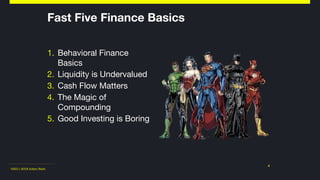
Fast Five Finance Basics
1. Behavioral Finance
Basics

2. Liquidity is Undervalued

3. Cash Flow Matters

4. The Magic of
Compounding

5. Good Investing is Boring
4
(show of hands)
BEHAVIORAL FINANCE BASICS:
How many of you think you are
rational with your money?
©2014 Wealthfront, Inc.
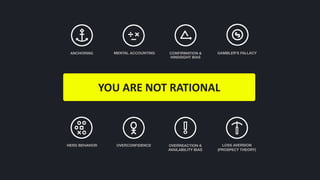
ANCHORING MENTAL ACCOUNTING CONFIRMATION &
HINDSIGHT BIAS
GAMBLER'S FALLACY
OVERCONFIDENCEHERD BEHAVIOR OVERREACTION &

AVAILABILITY BIAS
LOSS AVERSION
(PROSPECT THEORY)
YOU	ARE	NOT	RATIONAL
©2011-2018 Adam Nash
Anchoring
▪ People estimate answers to new
/ novel problems with a bias
towards reference points

▪ Example: 1974 Study

▪ Most common examples:

– Price you bought a stock at

– High point for a stock
7
©2011-2018 Adam Nash
Mental Accounting
▪ Money is fungible, but people put
it in separate “mental accounts”

▪ Lost movie tickets example

▪ “Found Money” problem

▪ Vacation fund & credit card debt
8
©2011-2018 Adam Nash
Confirmation & 

Hindsight Bias
▪ We selectively seek information
that supports pre-existing
theories, and ignore / dispute
information that disproves them

▪ We overestimate our ability to
predict the future based on the
“obviousness” of the past
(example: real estate)
9
©2011-2018 Adam Nash
Gambler's Fallacy
▪ We see patterns in independent,
random chains of events

▪ We believe that, based on series of
previous events, an outcome is
more likely than odds actually
suggest

▪ Coin flip example

▪ It's because with human behavior,
there are no “independent” events
10
©2011-2018 Adam Nash
Herd Behavior
▪ We have a tendency to mimic the
actions of the larger group

▪ Crowd psychology is a major
contributor to bubbles (believed)

▪ Easier to be “wrong with everyone”
than “right and alone”

▪ No one gets fired for buying IBM?
11
©2011-2018 Adam Nash
Overconfidence
▪ In one study, 74% of investment
managers believe they deliver above
average returns

▪ Positively correlated with High IQ...

▪ Learn humility early
12
©2011-2018 Adam Nash
Overreaction & 

Availability Bias
▪ Overreact to recent events

▪ Overweight recent trends

▪ Studies demonstrate that
checking stock prices daily
leads to more trading and worse
results on average

▪ Worse in high tech, because we
are immersed in “game
changers”
13
©2014 Wealthfront, Inc.
You have a 100% chance of gaining $500.B
You have $1,000 and you must

pick one of the following choices:
You have a 50% chance of gaining $1,000, and
a 50% chance of gaining $0.A
OR
©2014 Wealthfront, Inc.
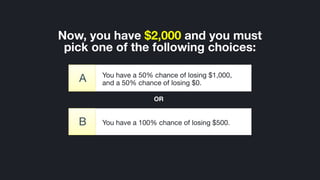
You have a 100% chance of losing $500.B
Now, you have $2,000 and you must
pick one of the following choices:
You have a 50% chance of losing $1,000,
and a 50% chance of losing $0.A
OR
©2011-2018 Adam Nash
Loss Aversion 

(aka Prospect Theory)
▪ We hate losses more than we
love winning

▪ Average loss aversion is 3:1 (!)

▪ Affects views on wide range of
situations, including taxes,
holding on to losing stocks,
“sunk cost” mistakes
16
IT'S	OK	TO	NOT	BE	RATIONAL
©2011-2018 Adam Nash
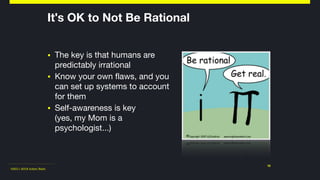
▪ The key is that humans are
predictably irrational

▪ Know your own flaws, and you
can set up systems to account
for them

▪ Self-awareness is key

(yes, my Mom is a
psychologist...)
18
It's OK to Not Be Rational
©2011-2018 Adam Nash
Liquidity is Undervalued
▪ Strictly defined: it's the quanti-
fication of how much money you
can get, and how fast

▪ Liquidity is the power to take
advantage of great investment
opportunities

▪ Liquidity is also, in the end, the
only thing that matters when you
need to pay for something
19
©2011-2018 Adam Nash
▪ In almost all cases,
liquidity is inversely
correlated with returns

▪ Examples: 

– Cash = very liquid

– Private equity = very illiquid

▪ Common mistake: Safety!
= Liquidity
20
Liquidity & Returns
©2011-2018 Adam Nash
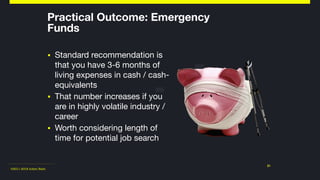
▪ Standard recommendation is
that you have 3-6 months of
living expenses in cash / cash-
equivalents

▪ That number increases if you
are in highly volatile industry /
career

▪ Worth considering length of
time for potential job search
21
Practical Outcome: Emergency
Funds
©2011-2018 Adam Nash
▪ The ultimate secret to personal
finance is quite simple: 

– Spend less than you make

(on an ongoing basis)

▪ Very easy to measure, but few
people do. Annual budget is a
great idea.

▪ Don't forget to model in annual
expenses & “personal spending”
22
Cash Flow Matters
©2011-2018 Adam Nash
▪ What's the right number? 

– There is no question - the more you save, the more
secure you are. 

Income comes & goes, but expenses / lifestyle are sticky!

▪ A lot of models assume working 40
years, and producing savings to
generate 80% of working income.

– These models don't actually match anyone's real world
experience.

– There are a lot of models out there, and rules of thumb,
but it's 

important to run the numbers yourself.
23
Savings Targets
©2011-2018 Adam Nash
▪ Not convinced that Albert
Einstein said it was the greatest
force in the universe.

▪ It's the key to almost all long
term financial planning.

▪ Exponentials are bad in
algorithmic cost, good in
savings returns.
24
The Magic of Compounding
©2011-2018 Adam Nash
▪ Rule of 72

▪ In Sheets, for each year, just use 

=POWER(1+rate, year)

▪ 4% over 20 years is 2.19x

▪ 8% over 20 years is 4.66x

▪ Careful: it works on debt just as well
as savings... in reverse!
25
Simple Model
©2011-2018 Adam Nash
The Benefits of 

An Early Start
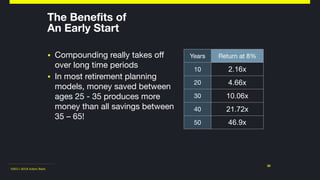
▪ Compounding really takes off
over long time periods

▪ In most retirement planning
models, money saved between
ages 25 - 35 produces more
money than all savings between
35 – 65!
26
Years Return at 8%
10 2.16x
20 4.66x
30 10.06x
40 21.72x
50 46.9x
©2011-2018 Adam Nash
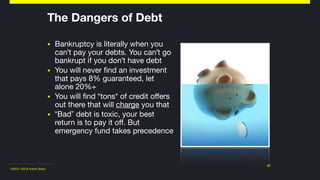
▪ Bankruptcy is literally when you
can't pay your debts. You can't go
bankrupt if you don't have debt

▪ You will never find an investment
that pays 8% guaranteed, let
alone 20%+

▪ You will find *tons* of credit offers
out there that will charge you that

▪ “Bad” debt is toxic, your best
return is to pay it off. But
emergency fund takes precedence
27
The Dangers of Debt
©2011-2018 Adam Nash
▪ No one wants to be average,
but with investing, average is
actually well above average.

▪ You will beat most mutual
funds, and a large majority of
your peers with simple, low-cost
index funds.

▪ Asset allocation explains ~90%
of the variance between fund
performance
28
Good Investing is Boring
©2011-2018 Adam Nash
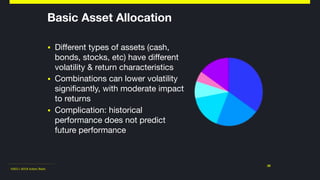
▪ Different types of assets (cash,
bonds, stocks, etc) have different
volatility & return characteristics

▪ Combinations can lower volatility
significantly, with moderate impact
to returns

▪ Complication: historical
performance does not predict
future performance
29
Basic Asset Allocation
©2011-2018 Adam Nash
▪ 2 hours of work per year

▪ Pick an asset allocation that is
appropriate for your emotional
character & time frame & goals

▪ For each asset class, pick cheap
index fund to represent

▪ Rebalance every 1-2 years

▪ http://blog.adamnash.com/2010/12/31/personal-
finance-how-to-rebalance-your-portfolio/
30
Simple Operating Model
©2011-2018 Adam Nash
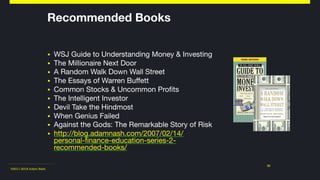
▪ WSJ Guide to Understanding Money & Investing

▪ The Millionaire Next Door

▪ A Random Walk Down Wall Street

▪ The Essays of Warren Buffett

▪ Common Stocks & Uncommon Profits

▪ The Intelligent Investor

▪ Devil Take the Hindmost

▪ When Genius Failed

▪ Against the Gods: The Remarkable Story of Risk

▪ http://blog.adamnash.com/2007/02/14/
personal-finance-education-series-2-
recommended-books/
31
Recommended Books

Personal Finance for Engineers (Coursera 2018)

  • 1.
  • 2.
    ©2011-2018 Adam Nash ▪I am not a financial planner ▪ This presentation is not financial advice ▪ You would be extremely foolish to make investment decisions based on the content of this presentation or discussion ▪ The opinions in this deck are intended to provoke discussion & further education 2 Caveats & Preface
  • 3.
    ©2011-2018 Adam Nash ▪Poorly covered in traditional education, even top tier universities ▪ Not technically difficult, but the signal:noise ratio is terrible ▪ Massive impact on your life – Money is one of the top 3 reasons 
 for marital problems 3 Why Personal Finance?
  • 4.
    ©2011-2018 Adam Nash FastFive Finance Basics 1. Behavioral Finance Basics 2. Liquidity is Undervalued 3. Cash Flow Matters 4. The Magic of Compounding 5. Good Investing is Boring 4
  • 5.
    (show of hands) BEHAVIORALFINANCE BASICS: How many of you think you are rational with your money?
  • 6.
    ©2014 Wealthfront, Inc. ANCHORINGMENTAL ACCOUNTING CONFIRMATION & HINDSIGHT BIAS GAMBLER'S FALLACY OVERCONFIDENCEHERD BEHAVIOR OVERREACTION &
 AVAILABILITY BIAS LOSS AVERSION (PROSPECT THEORY) YOU ARE NOT RATIONAL
  • 7.
    ©2011-2018 Adam Nash Anchoring ▪People estimate answers to new / novel problems with a bias towards reference points ▪ Example: 1974 Study ▪ Most common examples: – Price you bought a stock at – High point for a stock 7
  • 8.
    ©2011-2018 Adam Nash MentalAccounting ▪ Money is fungible, but people put it in separate “mental accounts” ▪ Lost movie tickets example ▪ “Found Money” problem ▪ Vacation fund & credit card debt 8
  • 9.
    ©2011-2018 Adam Nash Confirmation& 
 Hindsight Bias ▪ We selectively seek information that supports pre-existing theories, and ignore / dispute information that disproves them ▪ We overestimate our ability to predict the future based on the “obviousness” of the past (example: real estate) 9
  • 10.
    ©2011-2018 Adam Nash Gambler'sFallacy ▪ We see patterns in independent, random chains of events ▪ We believe that, based on series of previous events, an outcome is more likely than odds actually suggest ▪ Coin flip example ▪ It's because with human behavior, there are no “independent” events 10
  • 11.
    ©2011-2018 Adam Nash HerdBehavior ▪ We have a tendency to mimic the actions of the larger group ▪ Crowd psychology is a major contributor to bubbles (believed) ▪ Easier to be “wrong with everyone” than “right and alone” ▪ No one gets fired for buying IBM? 11
  • 12.
    ©2011-2018 Adam Nash Overconfidence ▪In one study, 74% of investment managers believe they deliver above average returns ▪ Positively correlated with High IQ... ▪ Learn humility early 12
  • 13.
    ©2011-2018 Adam Nash Overreaction& 
 Availability Bias ▪ Overreact to recent events ▪ Overweight recent trends ▪ Studies demonstrate that checking stock prices daily leads to more trading and worse results on average ▪ Worse in high tech, because we are immersed in “game changers” 13
  • 14.
    ©2014 Wealthfront, Inc. Youhave a 100% chance of gaining $500.B You have $1,000 and you must
 pick one of the following choices: You have a 50% chance of gaining $1,000, and a 50% chance of gaining $0.A OR
  • 15.
    ©2014 Wealthfront, Inc. Youhave a 100% chance of losing $500.B Now, you have $2,000 and you must pick one of the following choices: You have a 50% chance of losing $1,000, and a 50% chance of losing $0.A OR
  • 16.
    ©2011-2018 Adam Nash LossAversion 
 (aka Prospect Theory) ▪ We hate losses more than we love winning ▪ Average loss aversion is 3:1 (!) ▪ Affects views on wide range of situations, including taxes, holding on to losing stocks, “sunk cost” mistakes 16
  • 17.
  • 18.
    ©2011-2018 Adam Nash ▪The key is that humans are predictably irrational ▪ Know your own flaws, and you can set up systems to account for them ▪ Self-awareness is key
 (yes, my Mom is a psychologist...) 18 It's OK to Not Be Rational
  • 19.
    ©2011-2018 Adam Nash Liquidityis Undervalued ▪ Strictly defined: it's the quanti- fication of how much money you can get, and how fast ▪ Liquidity is the power to take advantage of great investment opportunities ▪ Liquidity is also, in the end, the only thing that matters when you need to pay for something 19
  • 20.
    ©2011-2018 Adam Nash ▪In almost all cases, liquidity is inversely correlated with returns ▪ Examples: – Cash = very liquid – Private equity = very illiquid ▪ Common mistake: Safety! = Liquidity 20 Liquidity & Returns
  • 21.
    ©2011-2018 Adam Nash ▪Standard recommendation is that you have 3-6 months of living expenses in cash / cash- equivalents ▪ That number increases if you are in highly volatile industry / career ▪ Worth considering length of time for potential job search 21 Practical Outcome: Emergency Funds
  • 22.
    ©2011-2018 Adam Nash ▪The ultimate secret to personal finance is quite simple: – Spend less than you make
 (on an ongoing basis) ▪ Very easy to measure, but few people do. Annual budget is a great idea. ▪ Don't forget to model in annual expenses & “personal spending” 22 Cash Flow Matters
  • 23.
    ©2011-2018 Adam Nash ▪What's the right number? – There is no question - the more you save, the more secure you are. 
 Income comes & goes, but expenses / lifestyle are sticky! ▪ A lot of models assume working 40 years, and producing savings to generate 80% of working income. – These models don't actually match anyone's real world experience. – There are a lot of models out there, and rules of thumb, but it's 
 important to run the numbers yourself. 23 Savings Targets
  • 24.
    ©2011-2018 Adam Nash ▪Not convinced that Albert Einstein said it was the greatest force in the universe. ▪ It's the key to almost all long term financial planning. ▪ Exponentials are bad in algorithmic cost, good in savings returns. 24 The Magic of Compounding
  • 25.
    ©2011-2018 Adam Nash ▪Rule of 72 ▪ In Sheets, for each year, just use 
 =POWER(1+rate, year) ▪ 4% over 20 years is 2.19x ▪ 8% over 20 years is 4.66x ▪ Careful: it works on debt just as well as savings... in reverse! 25 Simple Model
  • 26.
    ©2011-2018 Adam Nash TheBenefits of 
 An Early Start ▪ Compounding really takes off over long time periods ▪ In most retirement planning models, money saved between ages 25 - 35 produces more money than all savings between 35 – 65! 26 Years Return at 8% 10 2.16x 20 4.66x 30 10.06x 40 21.72x 50 46.9x
  • 27.
    ©2011-2018 Adam Nash ▪Bankruptcy is literally when you can't pay your debts. You can't go bankrupt if you don't have debt ▪ You will never find an investment that pays 8% guaranteed, let alone 20%+ ▪ You will find *tons* of credit offers out there that will charge you that ▪ “Bad” debt is toxic, your best return is to pay it off. But emergency fund takes precedence 27 The Dangers of Debt
  • 28.
    ©2011-2018 Adam Nash ▪No one wants to be average, but with investing, average is actually well above average. ▪ You will beat most mutual funds, and a large majority of your peers with simple, low-cost index funds. ▪ Asset allocation explains ~90% of the variance between fund performance 28 Good Investing is Boring
  • 29.
    ©2011-2018 Adam Nash ▪Different types of assets (cash, bonds, stocks, etc) have different volatility & return characteristics ▪ Combinations can lower volatility significantly, with moderate impact to returns ▪ Complication: historical performance does not predict future performance 29 Basic Asset Allocation
  • 30.
    ©2011-2018 Adam Nash ▪2 hours of work per year ▪ Pick an asset allocation that is appropriate for your emotional character & time frame & goals ▪ For each asset class, pick cheap index fund to represent ▪ Rebalance every 1-2 years ▪ http://blog.adamnash.com/2010/12/31/personal- finance-how-to-rebalance-your-portfolio/ 30 Simple Operating Model
  • 31.
    ©2011-2018 Adam Nash ▪WSJ Guide to Understanding Money & Investing ▪ The Millionaire Next Door ▪ A Random Walk Down Wall Street ▪ The Essays of Warren Buffett ▪ Common Stocks & Uncommon Profits ▪ The Intelligent Investor ▪ Devil Take the Hindmost ▪ When Genius Failed ▪ Against the Gods: The Remarkable Story of Risk ▪ http://blog.adamnash.com/2007/02/14/ personal-finance-education-series-2- recommended-books/ 31 Recommended Books