1
Common Musculoskeletal Injuries
and Implications for Recovery &
Exercise
Introduction
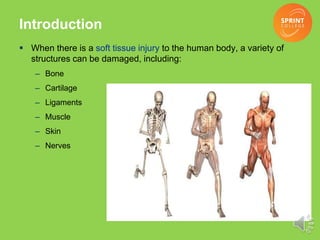
 When there is a soft tissue injury to the human body, a variety of
structures can be damaged, including:
– Bone
– Cartilage
– Ligaments
– Muscle
– Skin
– Nerves
The role of the Fitness Professional
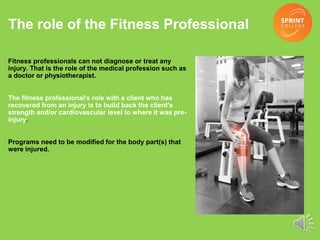
Fitness professionals can not diagnose or treat any
injury. That is the role of the medical profession such as
a doctor or physiotherapist.
The fitness professional's role with a client who has
recovered from an injury is to build back the client's
strength and/or cardiovascular level to where it was pre-
injury.
Programs need to be modified for the body part(s) that
were injured.
Muscle & Tendon Strains
 Muscle STRAINS are injuries in which the muscle works beyond its
capacity.
– Result in microscopic tears of the muscle fibers
– Frequent in the lower extremity and primarily occur in major
muscle groups
 Muscle strains of the hamstrings,
adductors, and calves are most
common.
 muscle strains are graded in terms of
severity.
Exercise mode to strengthen a strained
muscle (post Injury)
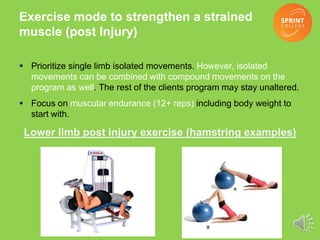
 Prioritize single limb isolated movements. However, isolated
movements can be combined with compound movements on the
program as well. The rest of the clients program may stay unaltered.
 Focus on muscular endurance (12+ reps) including body weight to
start with.
Lower limb post injury exercise (hamstring examples)
Lower limb post injury exercise
(Quadriceps example)
Lower limb post injury exercise
(Leg Adductors example)
Ligament Sprains
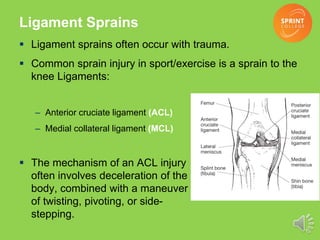
 Ligament sprains often occur with trauma.
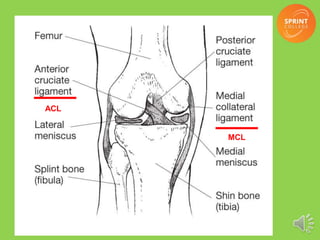
 Common sprain injury in sport/exercise is a sprain to the
knee Ligaments:
– Anterior cruciate ligament (ACL)
– Medial collateral ligament (MCL)
 The mechanism of an ACL injury
often involves deceleration of the
body, combined with a maneuver
of twisting, pivoting, or side-
stepping.
ACL
MCL
Ankle Sprains
 Lateral, or inversion, ankle sprains are the most common type.
(going over on one’s ankle)
 Medial, or eversion, ankle sprains are relatively rare.
 Signs and symptoms
– With lateral ankle sprains, the individual can often recall hearing a
“pop” or “tearing” sound and experiences swelling over the lateral
ankle.
– With medial sprains, there may be
medial swelling with tenderness
 Medical management
– Immobilization and physical therapy
Grading System for Ligament Sprains
Exercise mode to regain ligament
strength
All balance exercises that challenge the injured joint (Post
rehab) will strengthen the ligaments in that area.
The more balance an exercise requires the harder the
effort or load on the ligaments involved.
Exercise mode to regain ligament
strength
All balance exercises that challenge the injured joint (Post
rehab) will strengthen the ligaments in that area.
The more balance an exercise requires the harder the
effort or load on the ligaments involved.
Knee Cartilage Damage
 Damage to the joint surface of the knee often involves
damage to both the:
– Hyaline cartilage (Upper section of knee joint)
– Meniscus cartilage (lower section of knee joint)
 The most commonly reported knee injury is damage to
the menisci. (lower section of knee joint)
 The cartilage under the patella(kneecap) can also
become damaged, resulting in a condition called
chondromalacia.
 Knee Cartilage damage is common in high impact
and endurance activities.
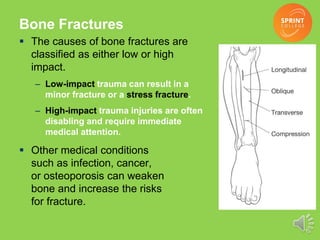
Bone Fractures
 The causes of bone fractures are
classified as either low or high
impact.
– Low-impact trauma can result in a
minor fracture or a stress fracture.
– High-impact trauma injuries are often
disabling and require immediate
medical attention.
 Other medical conditions
such as infection, cancer,
or osteoporosis can weaken
bone and increase the risks
for fracture.
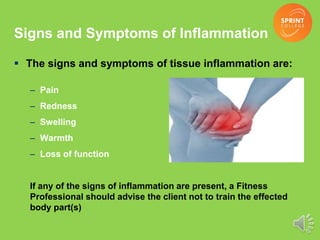
Signs and Symptoms of Inflammation
 The signs and symptoms of tissue inflammation are:
– Pain
– Redness
– Swelling
– Warmth
– Loss of function
If any of the signs of inflammation are present, a Fitness
Professional should advise the client not to train the effected
body part(s)
Acute Injury Management for
Inflammation
 If an acute injury occurs, early intervention often includes
medical management.
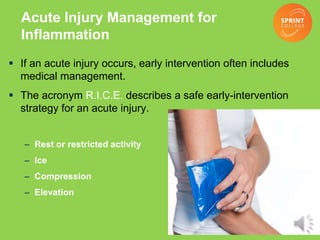
 The acronym R.I.C.E. describes a safe early-intervention
strategy for an acute injury.
– Rest or restricted activity
– Ice
– Compression
– Elevation
Rotator Cuff Injuries
 Common among individuals who engage in activities that involve
reaching the arms overhead repeatedly,
 i.e Swimming, Tennis, Heavy Weight Lifting etc
 Rotator cuff injury can be classified into two main categories.
– Acute
– Chronic
 Signs and symptoms
– Acute tears result in a sudden “tearing” sensation followed by immediate
pain and loss of motion.
– Chronic tears show a gradual worsening, with increased pain at night or
after increased activity.
 Medical management
– The client is typically restricted from performing overhead activities and
lifting heavy objects.
– If there is no progress with physical therapy or the tear is too severe,
surgery may be required to repair the torn muscle(s).
Exercises to strengthen the Rotator Cuff
muscles
Elbow Tendinitis
 Tendinitis of both the flexor and extensor muscle tendons of the elbow and
wrist can occur with overuse.
 Lateral epicondylitis (Tennis Elbow)
– Repetitive-trauma injury of the wrist extensor muscle tendons near their origin on the
lateral epicondyle
 Medial epicondylitis (Golfers Elbow)
– Repetitive-trauma injury of the wrist flexor muscle tendons near their origin on the
medial epicondyle
 Signs and symptoms
– Nagging elbow pain at the lateral or
medial epicondyle
Tennis Elbow
Exercise Programming Following
Elbow Tendinitis Rehabilitation
 Focus on improving posture and body positioning of the
sport (technique and form).
 Regain strength and flexibility of the flexor/pronator and
extensor/supinator muscle groups.(forearms)
 Avoid high-repetition activity at the elbow and wrist.
 Full elbow extension when performing shoulder raises
should be done with caution.
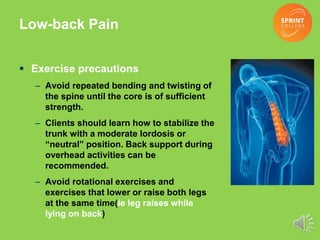
Low-back Pain
 Exercise precautions
– Avoid repeated bending and twisting of
the spine until the core is of sufficient
strength.
– Clients should learn how to stabilize the
trunk with a moderate lordosis or
“neutral” position. Back support during
overhead activities can be
recommended.
– Avoid rotational exercises and
exercises that lower or raise both legs
at the same time(ie leg raises while
lying on back)
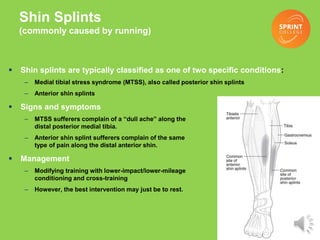
Shin Splints
(commonly caused by running)
 Shin splints are typically classified as one of two specific conditions:
– Medial tibial stress syndrome (MTSS), also called posterior shin splints
– Anterior shin splints
 Signs and symptoms
– MTSS sufferers complain of a “dull ache” along the
distal posterior medial tibia.
– Anterior shin splint sufferers complain of the same
type of pain along the distal anterior shin.
 Management
– Modifying training with lower-impact/lower-mileage
conditioning and cross-training
– However, the best intervention may just be to rest.
Exercise Programming Following
Rehabilitation for Shin Splints
 Cross-training to maintain adequate levels of fitness
is indicated in the early stages.
 Stretching
– Pain-free stretching of the calf muscles, especially the
soleus, for MTSS
– Stretching of the anterior compartment for anterior shin
splints
 Rest and modified activity are the primary
interventions for symptom relief.
 These clients may be sensitive to a rapid return to
activity or an extreme change in surfaces.
Soleus Muscle
Stretch
Gastrocnemius
Muscle Stretch
Shin Muscle Stretch
Record Keeping
 Keeping current and accurate records for every client is
essential for the Fitness Professional.
 The following information should be retained for every
client:
– Medical history
– Exercise record
– Incident report
– Correspondence with any
medical professionals.

Common musculoskeletal injuries

  • 1.
    1 Common Musculoskeletal Injuries andImplications for Recovery & Exercise
  • 2.
    Introduction  When thereis a soft tissue injury to the human body, a variety of structures can be damaged, including: – Bone – Cartilage – Ligaments – Muscle – Skin – Nerves
  • 3.
    The role ofthe Fitness Professional Fitness professionals can not diagnose or treat any injury. That is the role of the medical profession such as a doctor or physiotherapist. The fitness professional's role with a client who has recovered from an injury is to build back the client's strength and/or cardiovascular level to where it was pre- injury. Programs need to be modified for the body part(s) that were injured.
  • 4.
    Muscle & TendonStrains  Muscle STRAINS are injuries in which the muscle works beyond its capacity. – Result in microscopic tears of the muscle fibers – Frequent in the lower extremity and primarily occur in major muscle groups  Muscle strains of the hamstrings, adductors, and calves are most common.  muscle strains are graded in terms of severity.
  • 6.
    Exercise mode tostrengthen a strained muscle (post Injury)  Prioritize single limb isolated movements. However, isolated movements can be combined with compound movements on the program as well. The rest of the clients program may stay unaltered.  Focus on muscular endurance (12+ reps) including body weight to start with. Lower limb post injury exercise (hamstring examples)
  • 7.
    Lower limb postinjury exercise (Quadriceps example) Lower limb post injury exercise (Leg Adductors example)
  • 8.
    Ligament Sprains  Ligamentsprains often occur with trauma.  Common sprain injury in sport/exercise is a sprain to the knee Ligaments: – Anterior cruciate ligament (ACL) – Medial collateral ligament (MCL)  The mechanism of an ACL injury often involves deceleration of the body, combined with a maneuver of twisting, pivoting, or side- stepping.
  • 9.
  • 10.
    Ankle Sprains  Lateral,or inversion, ankle sprains are the most common type. (going over on one’s ankle)  Medial, or eversion, ankle sprains are relatively rare.  Signs and symptoms – With lateral ankle sprains, the individual can often recall hearing a “pop” or “tearing” sound and experiences swelling over the lateral ankle. – With medial sprains, there may be medial swelling with tenderness  Medical management – Immobilization and physical therapy
  • 11.
    Grading System forLigament Sprains
  • 12.
    Exercise mode toregain ligament strength All balance exercises that challenge the injured joint (Post rehab) will strengthen the ligaments in that area. The more balance an exercise requires the harder the effort or load on the ligaments involved.
  • 13.
    Exercise mode toregain ligament strength All balance exercises that challenge the injured joint (Post rehab) will strengthen the ligaments in that area. The more balance an exercise requires the harder the effort or load on the ligaments involved.
  • 14.
    Knee Cartilage Damage Damage to the joint surface of the knee often involves damage to both the: – Hyaline cartilage (Upper section of knee joint) – Meniscus cartilage (lower section of knee joint)  The most commonly reported knee injury is damage to the menisci. (lower section of knee joint)  The cartilage under the patella(kneecap) can also become damaged, resulting in a condition called chondromalacia.  Knee Cartilage damage is common in high impact and endurance activities.
  • 17.
    Bone Fractures  Thecauses of bone fractures are classified as either low or high impact. – Low-impact trauma can result in a minor fracture or a stress fracture. – High-impact trauma injuries are often disabling and require immediate medical attention.  Other medical conditions such as infection, cancer, or osteoporosis can weaken bone and increase the risks for fracture.
  • 18.
    Signs and Symptomsof Inflammation  The signs and symptoms of tissue inflammation are: – Pain – Redness – Swelling – Warmth – Loss of function If any of the signs of inflammation are present, a Fitness Professional should advise the client not to train the effected body part(s)
  • 19.
    Acute Injury Managementfor Inflammation  If an acute injury occurs, early intervention often includes medical management.  The acronym R.I.C.E. describes a safe early-intervention strategy for an acute injury. – Rest or restricted activity – Ice – Compression – Elevation
  • 20.
    Rotator Cuff Injuries Common among individuals who engage in activities that involve reaching the arms overhead repeatedly,  i.e Swimming, Tennis, Heavy Weight Lifting etc  Rotator cuff injury can be classified into two main categories. – Acute – Chronic  Signs and symptoms – Acute tears result in a sudden “tearing” sensation followed by immediate pain and loss of motion. – Chronic tears show a gradual worsening, with increased pain at night or after increased activity.  Medical management – The client is typically restricted from performing overhead activities and lifting heavy objects. – If there is no progress with physical therapy or the tear is too severe, surgery may be required to repair the torn muscle(s).
  • 21.
    Exercises to strengthenthe Rotator Cuff muscles
  • 22.
    Elbow Tendinitis  Tendinitisof both the flexor and extensor muscle tendons of the elbow and wrist can occur with overuse.  Lateral epicondylitis (Tennis Elbow) – Repetitive-trauma injury of the wrist extensor muscle tendons near their origin on the lateral epicondyle  Medial epicondylitis (Golfers Elbow) – Repetitive-trauma injury of the wrist flexor muscle tendons near their origin on the medial epicondyle  Signs and symptoms – Nagging elbow pain at the lateral or medial epicondyle
  • 23.
  • 24.
    Exercise Programming Following ElbowTendinitis Rehabilitation  Focus on improving posture and body positioning of the sport (technique and form).  Regain strength and flexibility of the flexor/pronator and extensor/supinator muscle groups.(forearms)  Avoid high-repetition activity at the elbow and wrist.  Full elbow extension when performing shoulder raises should be done with caution.
  • 26.
    Low-back Pain  Exerciseprecautions – Avoid repeated bending and twisting of the spine until the core is of sufficient strength. – Clients should learn how to stabilize the trunk with a moderate lordosis or “neutral” position. Back support during overhead activities can be recommended. – Avoid rotational exercises and exercises that lower or raise both legs at the same time(ie leg raises while lying on back)
  • 27.
    Shin Splints (commonly causedby running)  Shin splints are typically classified as one of two specific conditions: – Medial tibial stress syndrome (MTSS), also called posterior shin splints – Anterior shin splints  Signs and symptoms – MTSS sufferers complain of a “dull ache” along the distal posterior medial tibia. – Anterior shin splint sufferers complain of the same type of pain along the distal anterior shin.  Management – Modifying training with lower-impact/lower-mileage conditioning and cross-training – However, the best intervention may just be to rest.
  • 28.
    Exercise Programming Following Rehabilitationfor Shin Splints  Cross-training to maintain adequate levels of fitness is indicated in the early stages.  Stretching – Pain-free stretching of the calf muscles, especially the soleus, for MTSS – Stretching of the anterior compartment for anterior shin splints  Rest and modified activity are the primary interventions for symptom relief.  These clients may be sensitive to a rapid return to activity or an extreme change in surfaces.
  • 29.
  • 30.
  • 31.
    Record Keeping  Keepingcurrent and accurate records for every client is essential for the Fitness Professional.  The following information should be retained for every client: – Medical history – Exercise record – Incident report – Correspondence with any medical professionals.