Soft Tissue Injuries
NAME :- KALYAN OJHA
GROUP :- 319-A
Definition & Types
Definition :
Damage of muscles, ligaments and tendons
Types:
Contusion
Sprains
Strains
Tendinitis
Bursitis
Stress injuries
Causes, Recognition & Treatment
Contusion
Known as bruises, contusions are often caused by blunt force such as fall, kick or blows from fists and blunt
objects like helmets, bats etc. Contusions crush underlying muscle fibers and damage blood vessels without
breaking the skin.
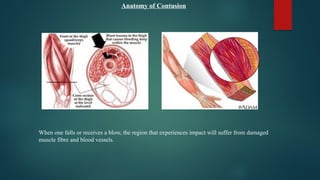
Anatomy of Contusion
When one falls or receives a blow, the region that experiences impact will suffer from damaged
muscle fibre and blood vessels.
Recognition
 Discolouration
 Swelling
 Pain
 Weak or stiff muscles
 Hematoma ( 积血,血块 )
Treatment: RICE method
 Rest
Rest to reduce mobility and protect the injured area as movements will trigger pain or aggravates the injury.
 Ice
Cold reduces blood flow to a particular area by constricting the blood vessel, which can significantly reduce inflammation and swelling that
causes pain, especially around a joint or a tendon. It can also temporarily decrease nerve activity and thus relieve pain.
 Compression
Wrap and elastic bandage over the sore region to restrict body fluids from passing through to reduce swelling, but note not to bandage too tightly.
 Elevation
Elevate the wounded region by using pillows or blankets while applying ice packs. Try to raise the part above heart level if
possible.
Notes
 Never apply ice directly to the injury or ice crystals will form in the skin cells, damaging the delicate skin tissue and slowing the blood flow,
depriving the tissues of oxygen.
 Remember not to wrap the bandage too tight or it will impede the flow of fluids thus deteriorate swelling.
What to do when certain equipments are not available?
We don’t carry around a first aid kit and ice all the time but accidents occur without alarm. There will be times when obtaining the right
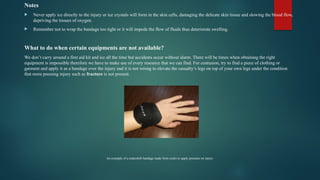
equipment is impossible therefore we have to make use of every resource that we can find. For contusion, try to find a piece of clothing or
garment and apply it as a bandage over the injury and it is not wrong to elevate the casualty’s legs on top of your own legs under the condition
that more pressing injury such as fracture is not present.
An example of a makeshift bandage made from socks to apply pressure on injury.
Sprains
The softer structures around bones and joints, often referred as the ligaments, muscle and tendons are soft
tissues that can be injured in several ways including vigorous movements that will overstretch thus partially tear
or completely rupture the tissues. Due to the mechanism of injury, sprain is commonly associated with sporting
events, especially running.
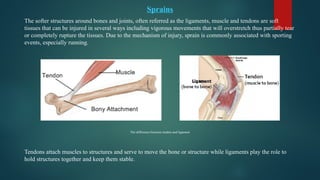
The difference between tendon and ligament
Tendons attach muscles to structures and serve to move the bone or structure while ligaments play the role to
hold structures together and keep them stable.
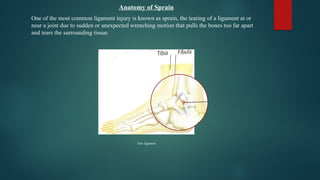
Anatomy of Sprain
One of the most common ligament injury is known as sprain, the tearing of a ligament at or
near a joint due to sudden or unexpected wrenching motion that pulls the bones too far apart
and tears the surrounding tissue.
Tore ligament
Recognition
 Pain
 Tenderness
 Difficulty in moving
 Swelling and bruising
Treatment
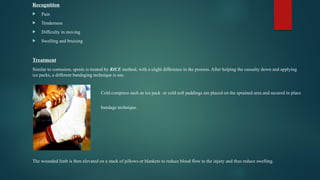
Similar to contusion, sprain is treated by RICE method, with a slight difference in the process. After helping the casualty down and applying
ice packs, a different bandaging technique is use.
Cold compress such as ice pack or cold soft paddings are placed on the sprained area and secured in place
by a ‘Figure of 8
bandage technique.
The wounded limb is then elevated on a stack of pillows or blankets to reduce blood flow to the injury and thus reduce swelling.
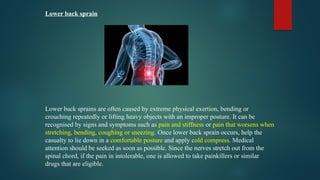
Lower back sprain
Lower back sprains are often caused by extreme physical exertion, bending or
crouching repeatedly or lifting heavy objects with an improper posture. It can be
recognised by signs and symptoms such as pain and stiffness or pain that worsens when
stretching, bending, coughing or sneezing. Once lower back sprain occurs, help the
casualty to lie down in a comfortable posture and apply cold compress. Medical
attention should be seeked as soon as possible. Since the nerves stretch out from the
spinal chord, if the pain in intolerable, one is allowed to take painkillers or similar
drugs that are eligible.
What NOT to do when having a sprain
Note HARM
 Heat
 Alcohol
 Running
 Massage
 Heat will speed up circulation, which is the last thing you want when trying to reduce
swelling.
 Alcohol thins blood and boosts circulation thus causes blood to flood the wound which will
aggravate swelling. Taking alcohol after an intense physical activity will also cause
dehydration.
 Movements such as running will tear at the injury and thus deteriorate the injury.
 It is not wrong to massage the sprained region, but improper techniques will cause harm
rather than promoting recovery.
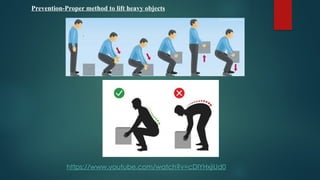
Prevention-Proper method to lift heavy objects
https://www.youtube.com/watch?v=cDIYHxjiUd0
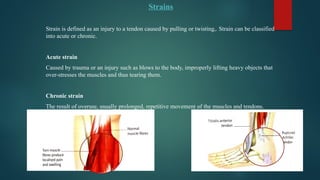
Strains
Strain is defined as an injury to a tendon caused by pulling or twisting,. Strain can be classified
into acute or chronic.
Acute strain
Caused by trauma or an injury such as blows to the body, improperly lifting heavy objects that
over-stresses the muscles and thus tearing them.
Chronic strain
The result of overuse, usually prolonged, repetitive movement of the muscles and tendons.
Recognition
 Muscle pain
 Swelling or bruising
 Severe muscle tear may cause hematoma
Treatment
Similar to both contusion and sprain, strain injuries can be treated by applying the
RICE method, and HARM should be taken note of. If the pain becomes unbearable,
one is allowed to consume painkillers and like eligible drugs if available.
Prevent injury
Warming up helps prepare the body for exercises by gradually increasing the heart
rate and circulation. This will loosen the joints and increase blood flow to the
muscles. Stretching the muscles prepares them for physical activity and
prevents injuries.
Tendinitis
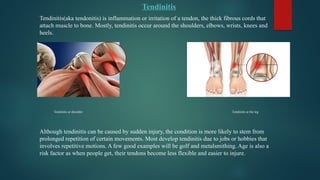
Tendinitis(aka tendonitis) is inflammation or irritation of a tendon, the thick fibrous cords that
attach muscle to bone. Mostly, tendinitis occur around the shoulders, elbows, wrists, knees and
heels.
Tendinitis at shoulder Tendinitis at the leg
Although tendinitis can be caused by sudden injury, the condition is more likely to stem from
prolonged repetition of certain movements. Most develop tendinitis due to jobs or hobbies that
involves repetitive motions. A few good examples will be golf and metalsmithing. Age is also a
risk factor as when people get, their tendons become less flexible and easier to injure.
Recognition
 Dull ache( 酸痛 )
 Tenderness
 Mild swelling
Treatment
Just like most soft tissue injuries, tendinitis can be treated by applying the RICE
method and prevent violating the no HARM rule.
The only notable additional will be dealing with the inflammation using anti-
inflammatories, such as ibuprofen or naproxen. The ibuprofen blocks the production
of prostaglandin, a group of lipids(a substance that insoluble in water, alcohol, ether
or chloroform) made at sites of tissue damage or infection that are involved in
dealing with injury and illness. Naproxen works by reducing the hormones that cause
inflammation. The naproxen may pose as a better option as its pain relief last longer
than ibuprofen, while being better for back pain or period pain over paracetamol.
Bursitis
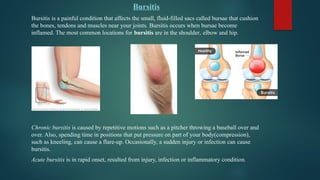
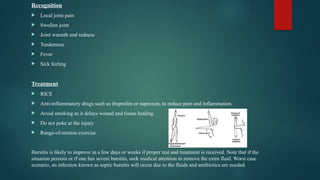
Bursitis is a painful condition that affects the small, fluid-filled sacs called bursae that cushion
the bones, tendons and muscles near your joints. Bursitis occurs when bursae become
inflamed. The most common locations for bursitis are in the shoulder, elbow and hip.
Chronic bursitis is caused by repetitive motions such as a pitcher throwing a baseball over and
over. Also, spending time in positions that put pressure on part of your body(compression),
such as kneeling, can cause a flare-up. Occasionally, a sudden injury or infection can cause
bursitis.
Acute bursitis is in rapid onset, resulted from injury, infection or inflammatory condition.
Recognition
 Local joint pain
 Swollen joint
 Joint warmth and redness
 Tenderness
 Fever
 Sick feeling
Treatment
 RICE
 Anti-inflammatory drugs such as ibuprofen or naproxen, to reduce pain and inflammation.
 Avoid smoking as it delays wound and tissue healing.
 Do not poke at the injury
 Range-of-motion exercise
Bursitis is likely to improve in a few days or weeks if proper rest and treatment is received. Note that if the
situation persists or if one has severe bursitis, seek medical attention to remove the extra fluid. Worst case
scenario, an infection known as septic bursitis will occur due to the fluids and antibiotics are needed.
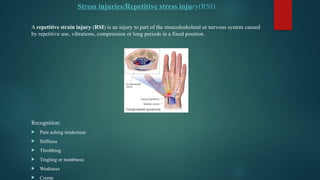
Stress injuries/Repetitive stress injury(RSI)
A repetitive strain injury (RSI) is an injury to part of the musculoskeletal or nervous system caused
by repetitive use, vibrations, compression or long periods in a fixed position.
Recognition:
 Pain aching tenderness
 Stiffness
 Throbbing
 Tingling or numbness
 Weakness
 Cramp
Treatment
 Medication – painkillers (only for inflammation)
 Cold compress(except for cramps)
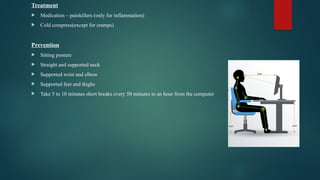
Prevention
 Sitting posture
 Straight and supported neck
 Supported wrist and elbow
 Supported feet and thighs
 Take 5 to 10 minutes short breaks every 50 minutes to an hour from the computer
Other types of soft tissue injury
 Incised wound
 Laceration
 Abrasion
 Puncture
 Stab wound
 Gunshot wound
 Amputation
Aim:
 Stop bleeding
 Reduce swelling
 Keep wound clean
 Prevent infection
Thanks for watching!

Understanding and Managing Soft Tissue Injuries Effectively

  • 1.
    Soft Tissue Injuries NAME:- KALYAN OJHA GROUP :- 319-A
  • 2.
    Definition & Types Definition: Damage of muscles, ligaments and tendons Types: Contusion Sprains Strains Tendinitis Bursitis Stress injuries
  • 3.
    Causes, Recognition &Treatment Contusion Known as bruises, contusions are often caused by blunt force such as fall, kick or blows from fists and blunt objects like helmets, bats etc. Contusions crush underlying muscle fibers and damage blood vessels without breaking the skin.
  • 4.
    Anatomy of Contusion Whenone falls or receives a blow, the region that experiences impact will suffer from damaged muscle fibre and blood vessels.
  • 5.
    Recognition  Discolouration  Swelling Pain  Weak or stiff muscles  Hematoma ( 积血,血块 ) Treatment: RICE method  Rest Rest to reduce mobility and protect the injured area as movements will trigger pain or aggravates the injury.  Ice Cold reduces blood flow to a particular area by constricting the blood vessel, which can significantly reduce inflammation and swelling that causes pain, especially around a joint or a tendon. It can also temporarily decrease nerve activity and thus relieve pain.  Compression Wrap and elastic bandage over the sore region to restrict body fluids from passing through to reduce swelling, but note not to bandage too tightly.  Elevation Elevate the wounded region by using pillows or blankets while applying ice packs. Try to raise the part above heart level if possible.
  • 6.
    Notes  Never applyice directly to the injury or ice crystals will form in the skin cells, damaging the delicate skin tissue and slowing the blood flow, depriving the tissues of oxygen.  Remember not to wrap the bandage too tight or it will impede the flow of fluids thus deteriorate swelling. What to do when certain equipments are not available? We don’t carry around a first aid kit and ice all the time but accidents occur without alarm. There will be times when obtaining the right equipment is impossible therefore we have to make use of every resource that we can find. For contusion, try to find a piece of clothing or garment and apply it as a bandage over the injury and it is not wrong to elevate the casualty’s legs on top of your own legs under the condition that more pressing injury such as fracture is not present. An example of a makeshift bandage made from socks to apply pressure on injury.
  • 7.
    Sprains The softer structuresaround bones and joints, often referred as the ligaments, muscle and tendons are soft tissues that can be injured in several ways including vigorous movements that will overstretch thus partially tear or completely rupture the tissues. Due to the mechanism of injury, sprain is commonly associated with sporting events, especially running. The difference between tendon and ligament Tendons attach muscles to structures and serve to move the bone or structure while ligaments play the role to hold structures together and keep them stable.
  • 8.
    Anatomy of Sprain Oneof the most common ligament injury is known as sprain, the tearing of a ligament at or near a joint due to sudden or unexpected wrenching motion that pulls the bones too far apart and tears the surrounding tissue. Tore ligament
  • 9.
    Recognition  Pain  Tenderness Difficulty in moving  Swelling and bruising Treatment Similar to contusion, sprain is treated by RICE method, with a slight difference in the process. After helping the casualty down and applying ice packs, a different bandaging technique is use. Cold compress such as ice pack or cold soft paddings are placed on the sprained area and secured in place by a ‘Figure of 8 bandage technique. The wounded limb is then elevated on a stack of pillows or blankets to reduce blood flow to the injury and thus reduce swelling.
  • 10.
    Lower back sprain Lowerback sprains are often caused by extreme physical exertion, bending or crouching repeatedly or lifting heavy objects with an improper posture. It can be recognised by signs and symptoms such as pain and stiffness or pain that worsens when stretching, bending, coughing or sneezing. Once lower back sprain occurs, help the casualty to lie down in a comfortable posture and apply cold compress. Medical attention should be seeked as soon as possible. Since the nerves stretch out from the spinal chord, if the pain in intolerable, one is allowed to take painkillers or similar drugs that are eligible.
  • 11.
    What NOT todo when having a sprain Note HARM  Heat  Alcohol  Running  Massage  Heat will speed up circulation, which is the last thing you want when trying to reduce swelling.  Alcohol thins blood and boosts circulation thus causes blood to flood the wound which will aggravate swelling. Taking alcohol after an intense physical activity will also cause dehydration.  Movements such as running will tear at the injury and thus deteriorate the injury.  It is not wrong to massage the sprained region, but improper techniques will cause harm rather than promoting recovery.
  • 12.
    Prevention-Proper method tolift heavy objects https://www.youtube.com/watch?v=cDIYHxjiUd0
  • 13.
    Strains Strain is definedas an injury to a tendon caused by pulling or twisting,. Strain can be classified into acute or chronic. Acute strain Caused by trauma or an injury such as blows to the body, improperly lifting heavy objects that over-stresses the muscles and thus tearing them. Chronic strain The result of overuse, usually prolonged, repetitive movement of the muscles and tendons.
  • 14.
    Recognition  Muscle pain Swelling or bruising  Severe muscle tear may cause hematoma Treatment Similar to both contusion and sprain, strain injuries can be treated by applying the RICE method, and HARM should be taken note of. If the pain becomes unbearable, one is allowed to consume painkillers and like eligible drugs if available. Prevent injury Warming up helps prepare the body for exercises by gradually increasing the heart rate and circulation. This will loosen the joints and increase blood flow to the muscles. Stretching the muscles prepares them for physical activity and prevents injuries.
  • 15.
    Tendinitis Tendinitis(aka tendonitis) isinflammation or irritation of a tendon, the thick fibrous cords that attach muscle to bone. Mostly, tendinitis occur around the shoulders, elbows, wrists, knees and heels. Tendinitis at shoulder Tendinitis at the leg Although tendinitis can be caused by sudden injury, the condition is more likely to stem from prolonged repetition of certain movements. Most develop tendinitis due to jobs or hobbies that involves repetitive motions. A few good examples will be golf and metalsmithing. Age is also a risk factor as when people get, their tendons become less flexible and easier to injure.
  • 16.
    Recognition  Dull ache(酸痛 )  Tenderness  Mild swelling Treatment Just like most soft tissue injuries, tendinitis can be treated by applying the RICE method and prevent violating the no HARM rule. The only notable additional will be dealing with the inflammation using anti- inflammatories, such as ibuprofen or naproxen. The ibuprofen blocks the production of prostaglandin, a group of lipids(a substance that insoluble in water, alcohol, ether or chloroform) made at sites of tissue damage or infection that are involved in dealing with injury and illness. Naproxen works by reducing the hormones that cause inflammation. The naproxen may pose as a better option as its pain relief last longer than ibuprofen, while being better for back pain or period pain over paracetamol.
  • 17.
    Bursitis Bursitis is apainful condition that affects the small, fluid-filled sacs called bursae that cushion the bones, tendons and muscles near your joints. Bursitis occurs when bursae become inflamed. The most common locations for bursitis are in the shoulder, elbow and hip. Chronic bursitis is caused by repetitive motions such as a pitcher throwing a baseball over and over. Also, spending time in positions that put pressure on part of your body(compression), such as kneeling, can cause a flare-up. Occasionally, a sudden injury or infection can cause bursitis. Acute bursitis is in rapid onset, resulted from injury, infection or inflammatory condition.
  • 18.
    Recognition  Local jointpain  Swollen joint  Joint warmth and redness  Tenderness  Fever  Sick feeling Treatment  RICE  Anti-inflammatory drugs such as ibuprofen or naproxen, to reduce pain and inflammation.  Avoid smoking as it delays wound and tissue healing.  Do not poke at the injury  Range-of-motion exercise Bursitis is likely to improve in a few days or weeks if proper rest and treatment is received. Note that if the situation persists or if one has severe bursitis, seek medical attention to remove the extra fluid. Worst case scenario, an infection known as septic bursitis will occur due to the fluids and antibiotics are needed.
  • 19.
    Stress injuries/Repetitive stressinjury(RSI) A repetitive strain injury (RSI) is an injury to part of the musculoskeletal or nervous system caused by repetitive use, vibrations, compression or long periods in a fixed position. Recognition:  Pain aching tenderness  Stiffness  Throbbing  Tingling or numbness  Weakness  Cramp
  • 20.
    Treatment  Medication –painkillers (only for inflammation)  Cold compress(except for cramps) Prevention  Sitting posture  Straight and supported neck  Supported wrist and elbow  Supported feet and thighs  Take 5 to 10 minutes short breaks every 50 minutes to an hour from the computer
  • 21.
    Other types ofsoft tissue injury  Incised wound  Laceration  Abrasion  Puncture  Stab wound  Gunshot wound  Amputation Aim:  Stop bleeding  Reduce swelling  Keep wound clean  Prevent infection
  • 22.