7 Common 
Mistakes 
In Go 
and when to avoid them
@Spf13 
Author of 
Hugo, Cobra, 
Afero, Viper & 
more
“As long as the 
world is turning 
and spinning, we're 
gonna be dizzy and 
we're gonna make 
mistakes.” 
–Mel Brooks
“Appreciate your 
mistakes for what 
they are: precious 
life lessons that 
can only be learned 
the hard way. “ 
–Al Franken
“If I had to live my 
life again, I'd make 
the same mistakes, 
only sooner.” 
– Tallulah Bankhead
7 Lessons 
I Wish I 
Learned 
Sooner
Mistake 1: 
Not 
Accepting 
Interfaces
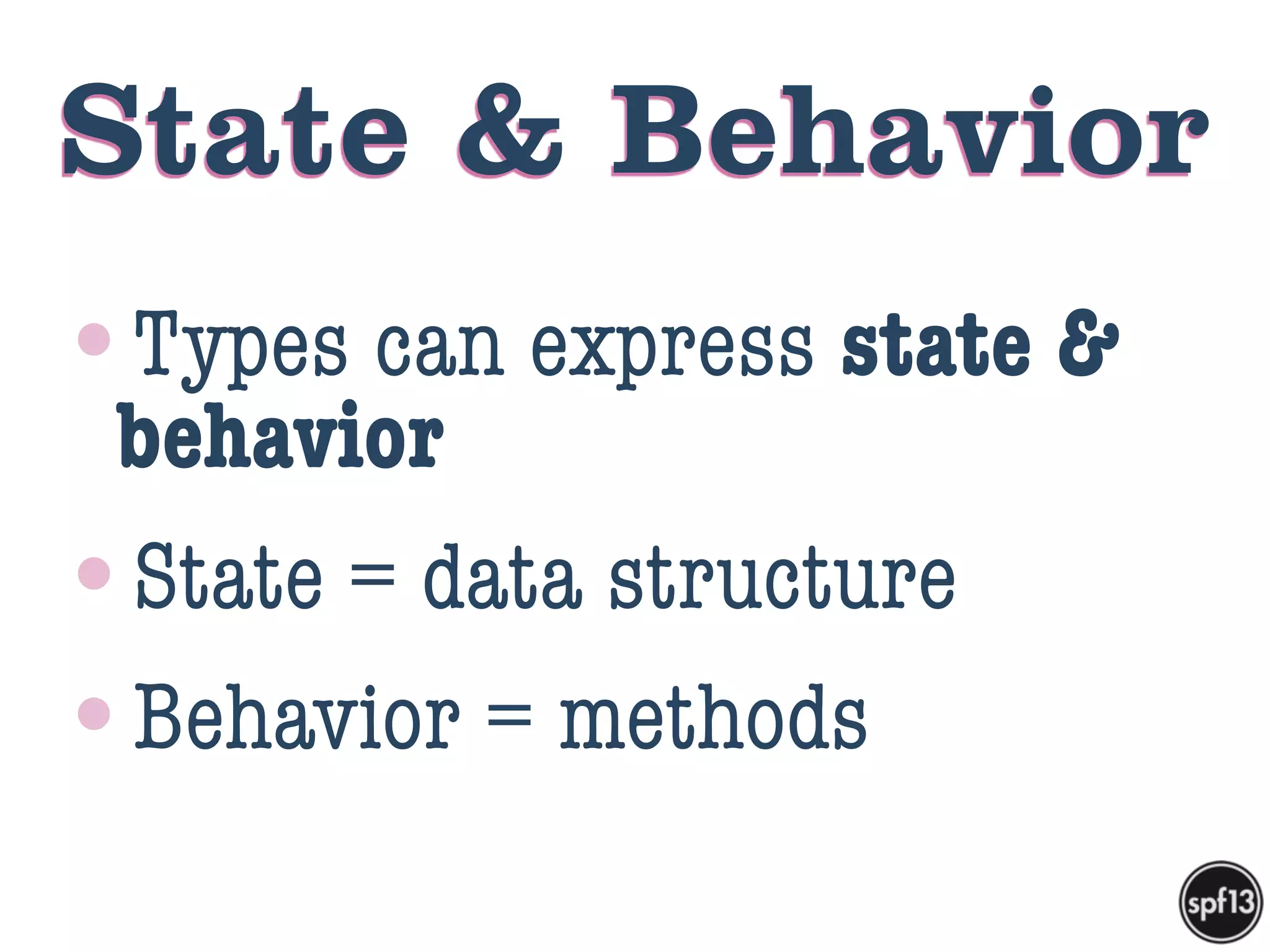
State & Behavior 
•Types can express state & 
behavior 
•State = data structure 
•Behavior = methods
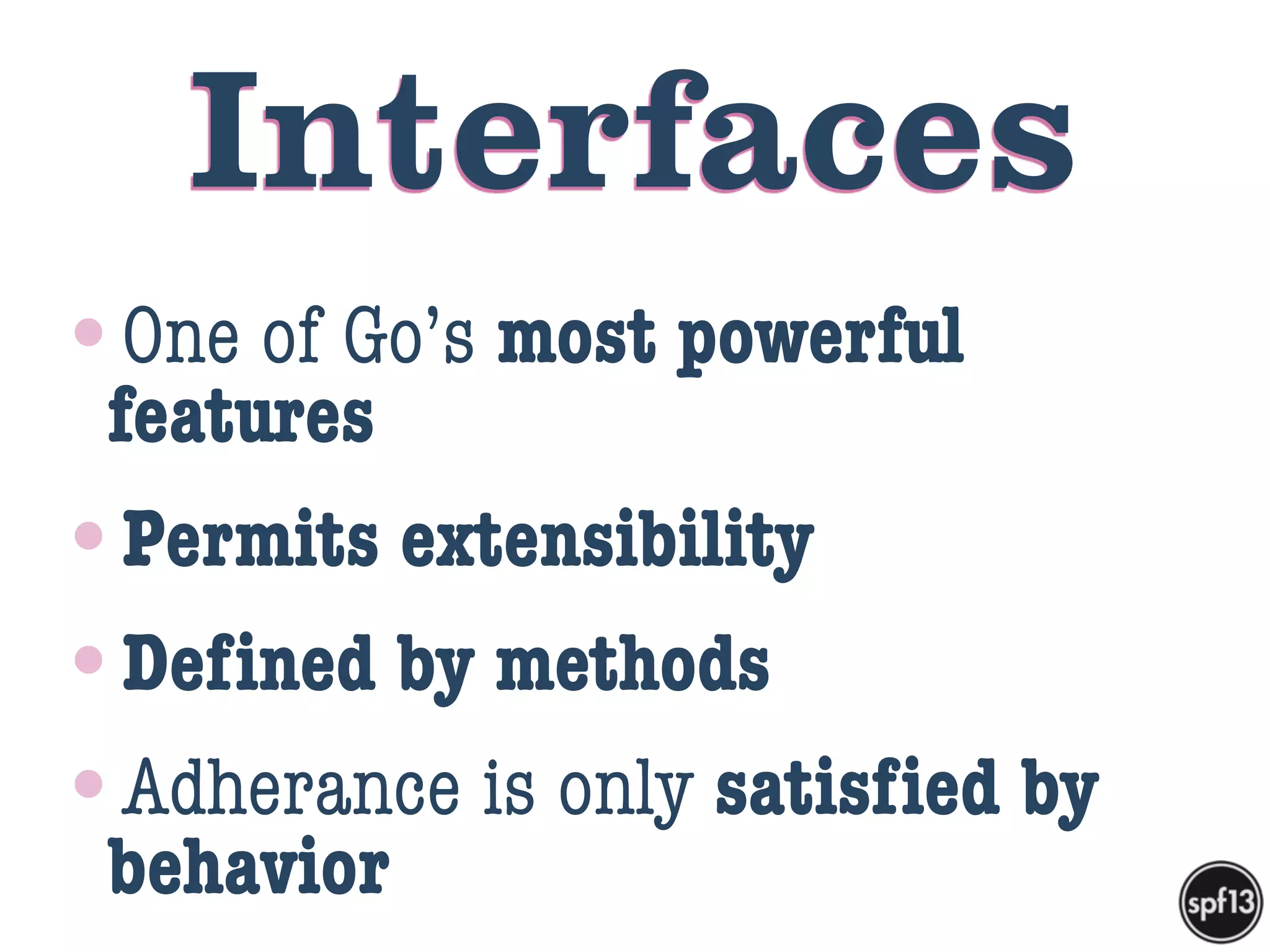
Interfaces 
•One of Go’s most powerful 
features 
•Permits extensibility 
•Defined by methods 
•Adherance is only satisfied by 
behavior
Example : []Byte 
type Source struct { 
Frontmatter []byte 
Content []byte 
}
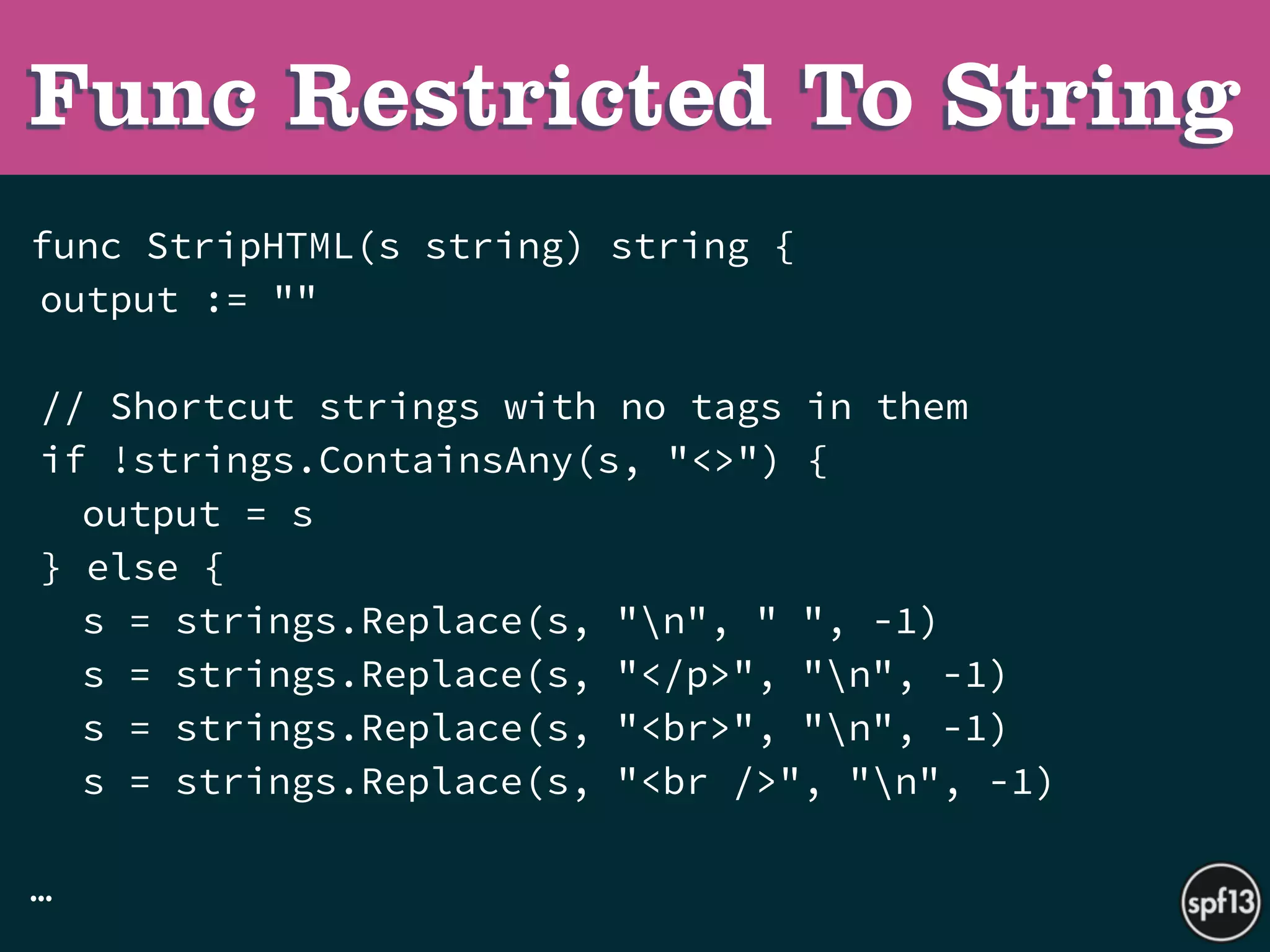
Func Restricted To String 
func StripHTML(s string) string { 
output := "" 
// Shortcut strings with no tags in them 
if !strings.ContainsAny(s, "<>") { 
output = s 
} else { 
s = strings.Replace(s, "n", " ", -1) 
s = strings.Replace(s, "</p>", "n", -1) 
s = strings.Replace(s, "<br>", "n", -1) 
s = strings.Replace(s, "<br />", "n", -1) 
…
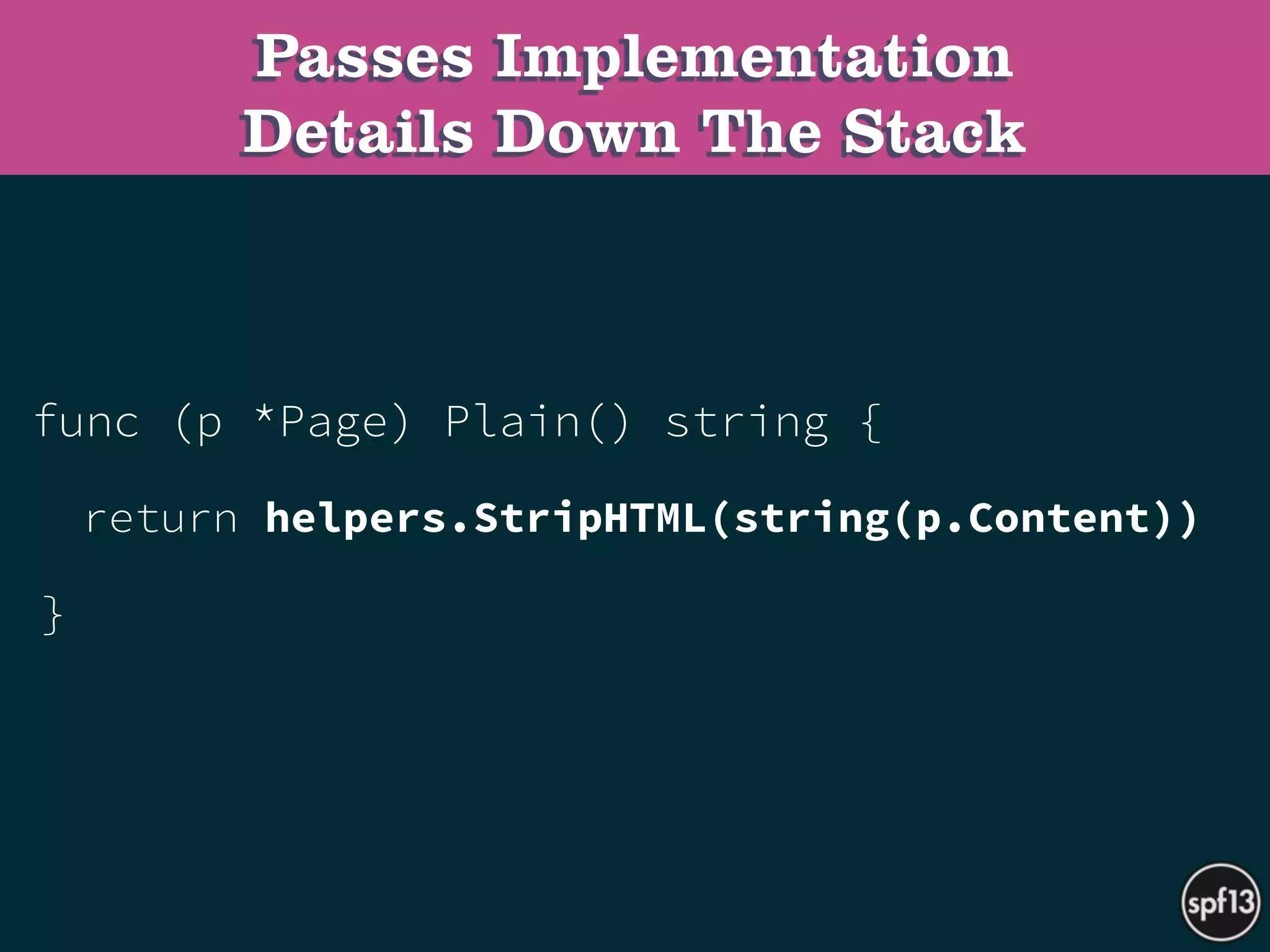
Passes Implementation 
Details Down The Stack 
func (p *Page) Plain() string { 
return helpers.StripHTML(string(p.Content)) 
}
Any Read() Works 
func StripHTML(r Reader) string { 
buf := new(bytes.Buffer) 
buf.ReadFrom(r) 
by := buf.Bytes() 
if bytes.ContainsAny(s, []byte("<>")) { 
by = bytes.Replace(by, []byte("n"), " ", -1) 
by = bytes.Replace(by, []byte("</p>"), "n", -1) 
by = bytes.Replace(by, []byte("<br>"), "n", -1) 
by = bytes.Replace(by, []byte("<br />"), "n", -1) 
…
type Source struct { 
Frontmatter []byte 
content []byte 
} 
type Reader interface { 
Read(p []byte) (n int, err error) 
} 
func (s *Source) Content() (Reader) { 
return bytes.NewReader(content) 
} 
Example : Read
type Source struct { 
Frontmatter []byte 
content []byte 
} 
type Reader interface { 
Read(p []byte) (n int, err error) 
} 
func (s *Source) Content() (Reader) { 
return bytes.NewReader(content) 
} 
Example : Read
type Source struct { 
Frontmatter []byte 
content []byte 
} 
type Reader interface { 
Read(p []byte) (n int, err error) 
} 
func (s *Source) Content() (Reader) { 
return bytes.NewReader(content) 
} 
Example : Read
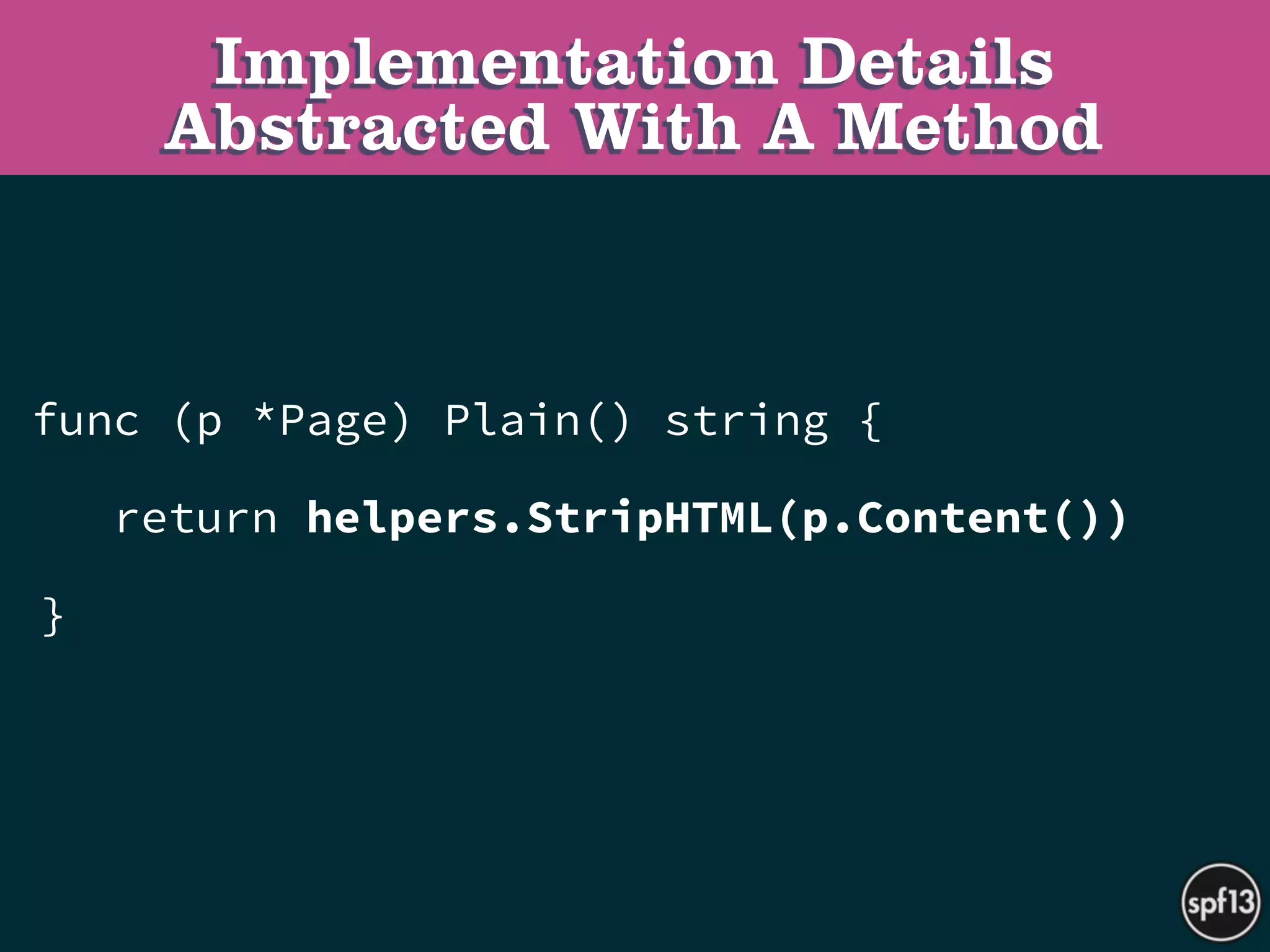
func (p *Page) Plain() string { 
return helpers.StripHTML(p.Content()) 
} 
Implementation Details 
Abstracted With A Method
Mistake 2: 
Thinking Of 
Errors As 
Strings
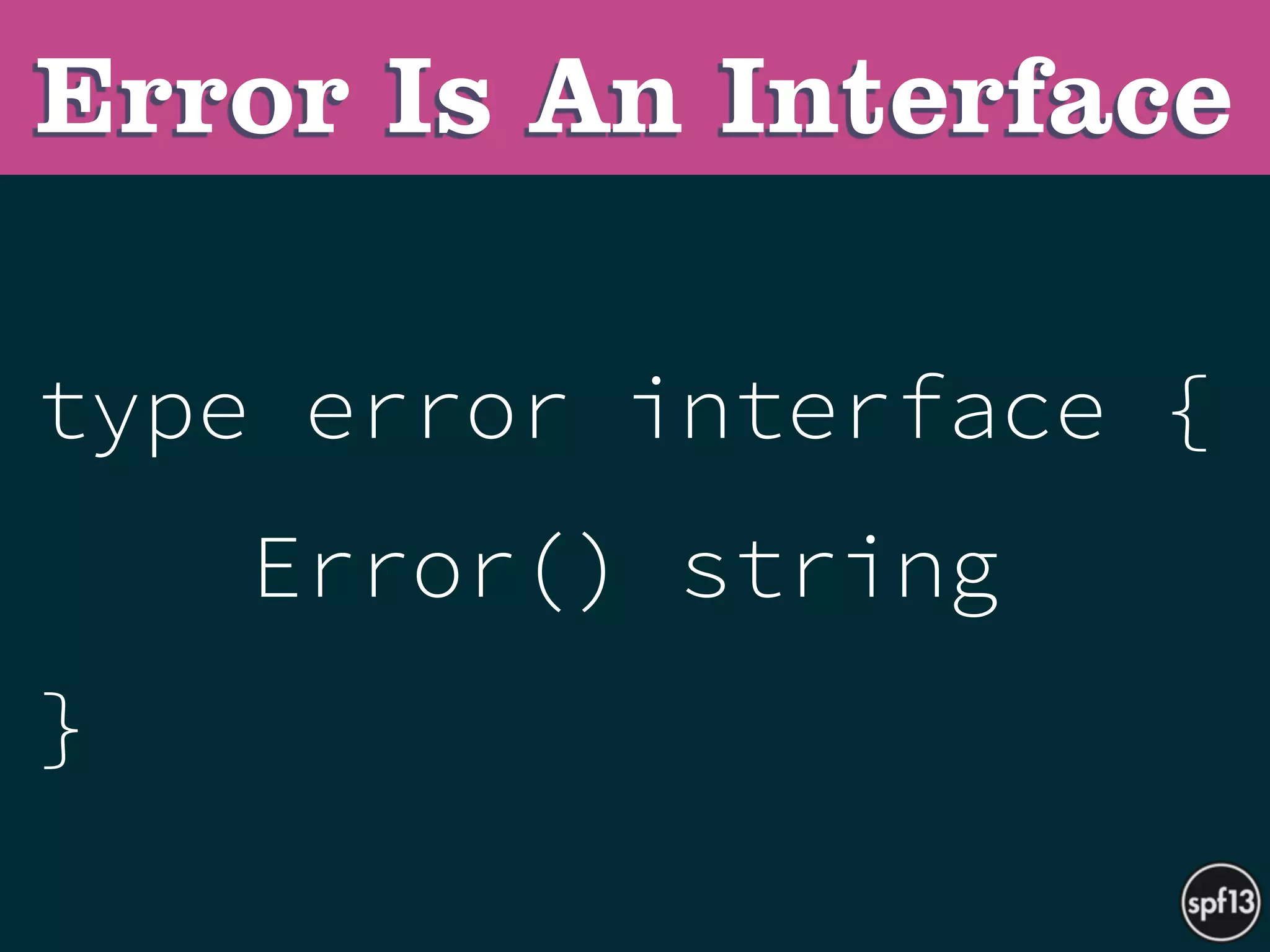
Error Is An Interface 
type error interface { 
Error() string 
}
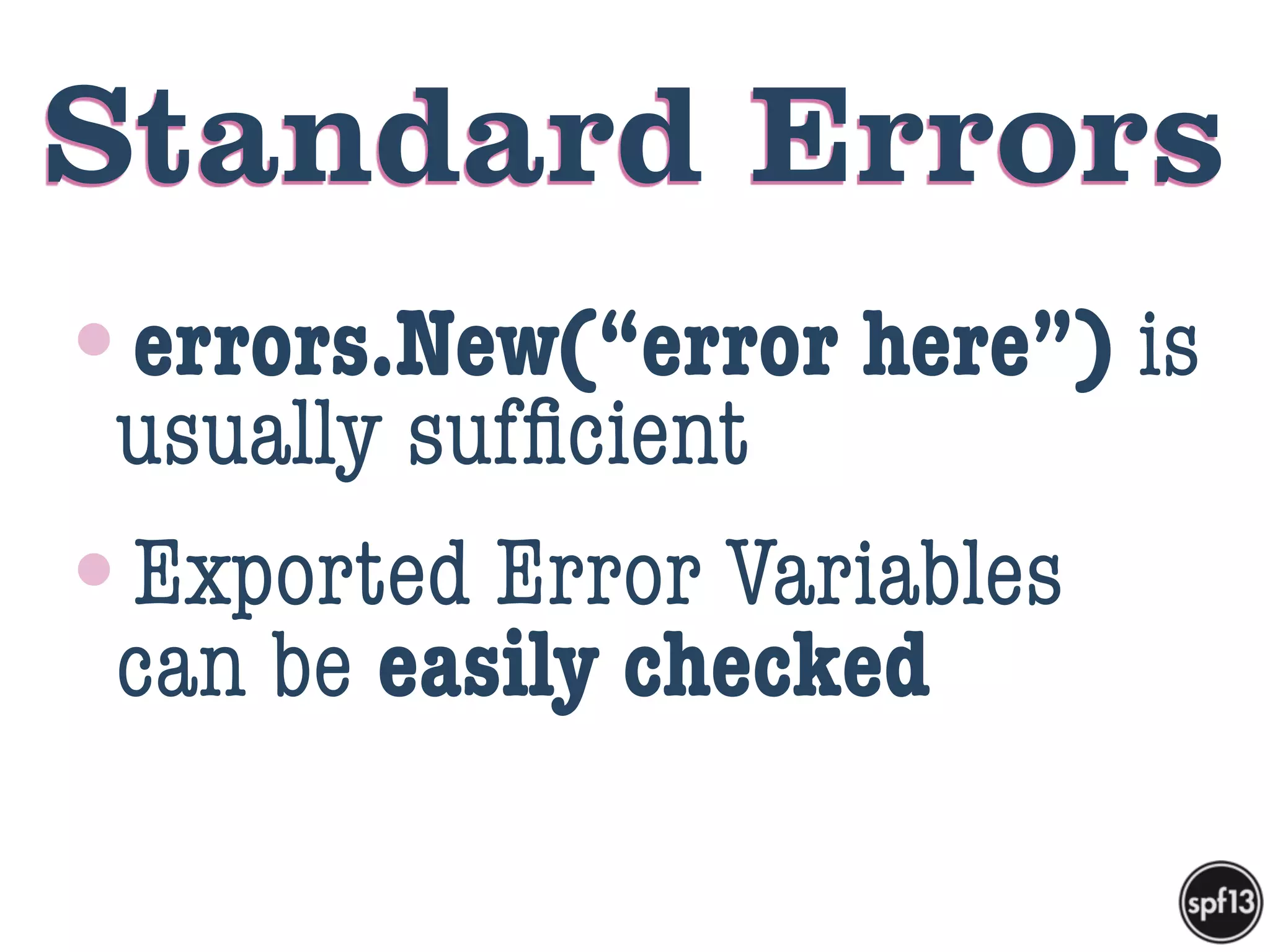
Standard Errors 
•errors.New(“error here”) is 
usually sufficient 
•Exported Error Variables 
can be easily checked
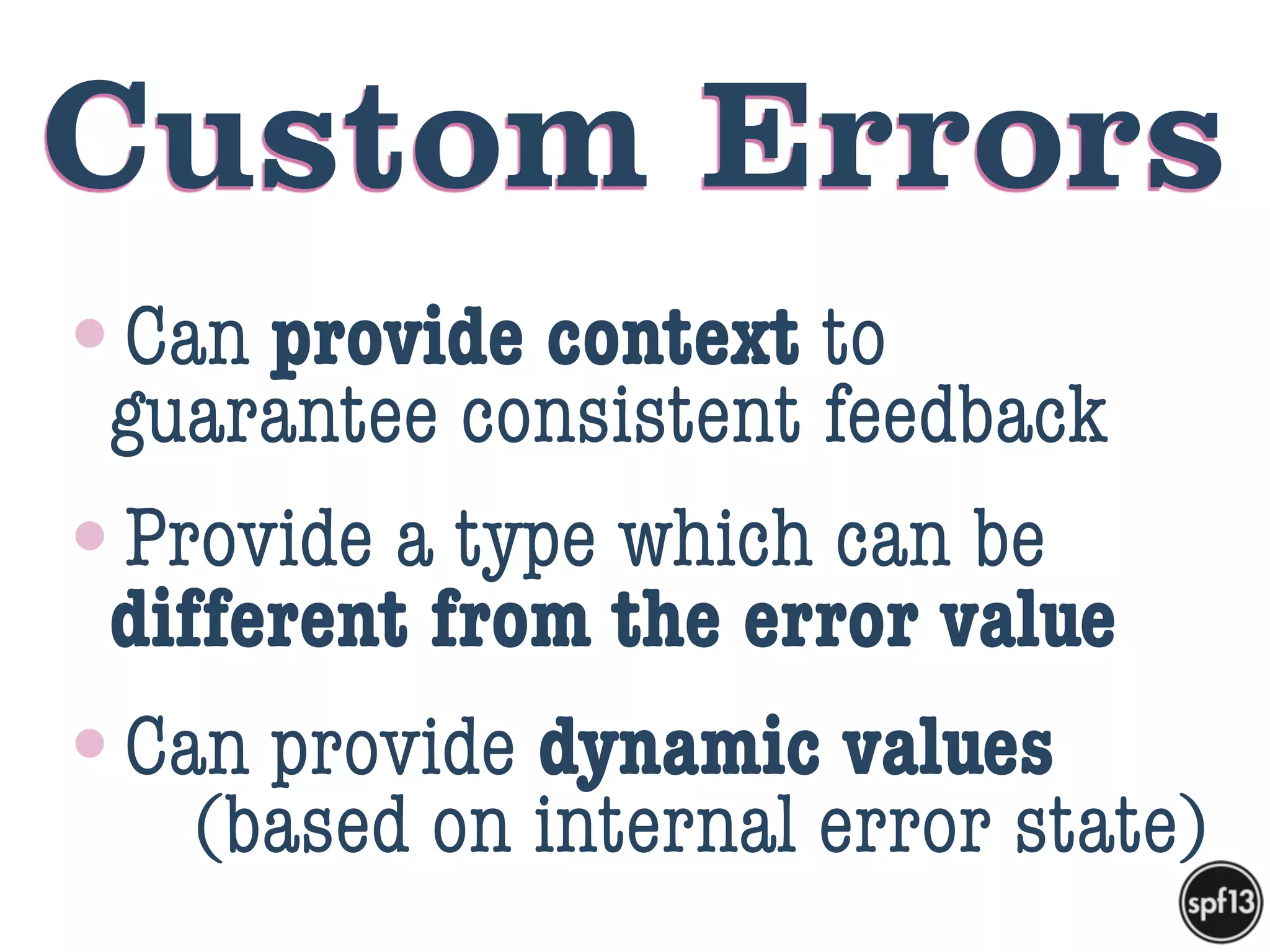
Custom Errors 
•Can provide context to 
guarantee consistent feedback 
•Provide a type which can be 
different from the error value 
•Can provide dynamic values 
(based on internal error state)
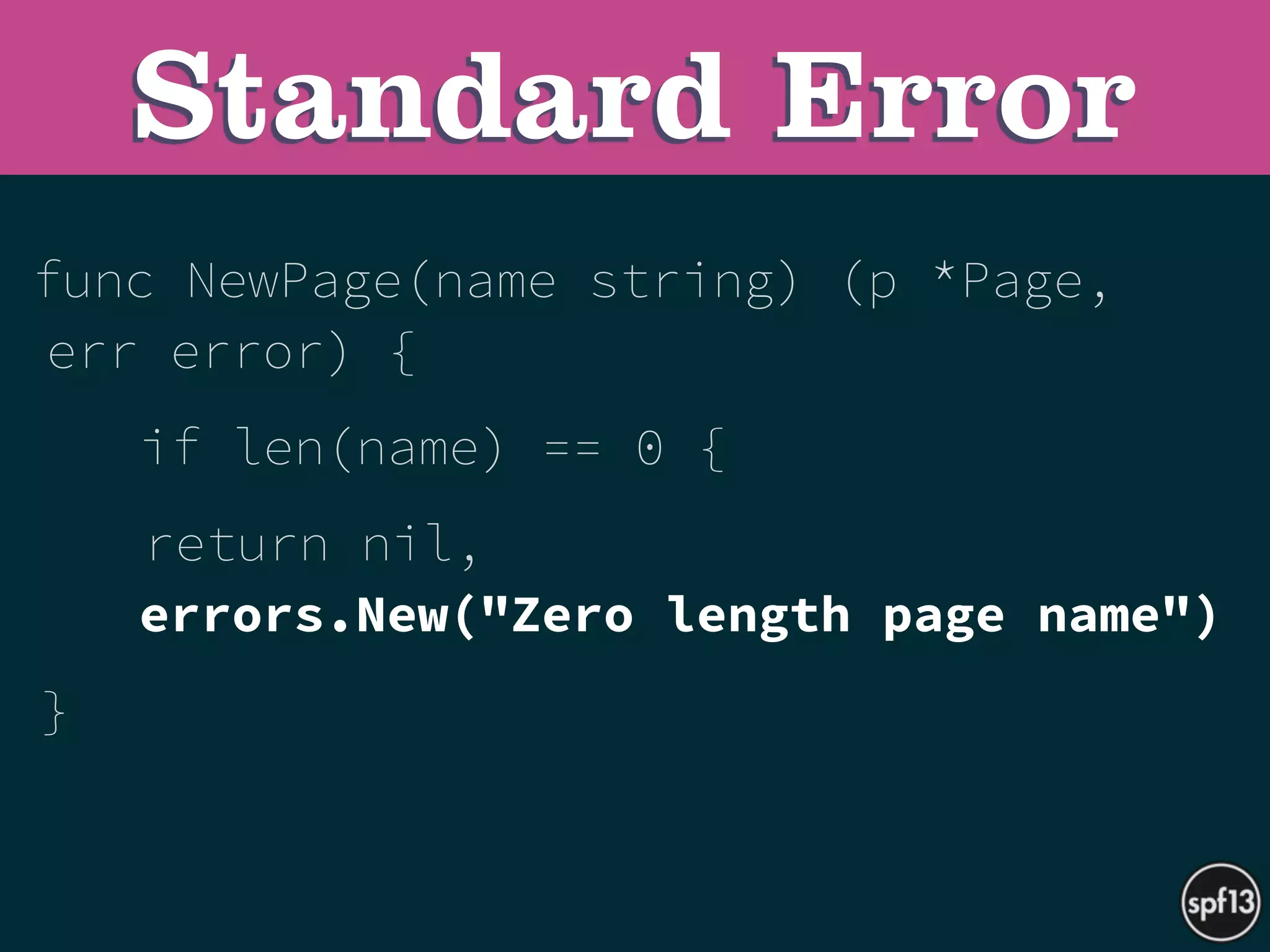
func NewPage(name string) (p *Page, 
err error) { 
if len(name) == 0 { 
return nil, 
errors.New("Zero length page name") 
} 
Standard Error
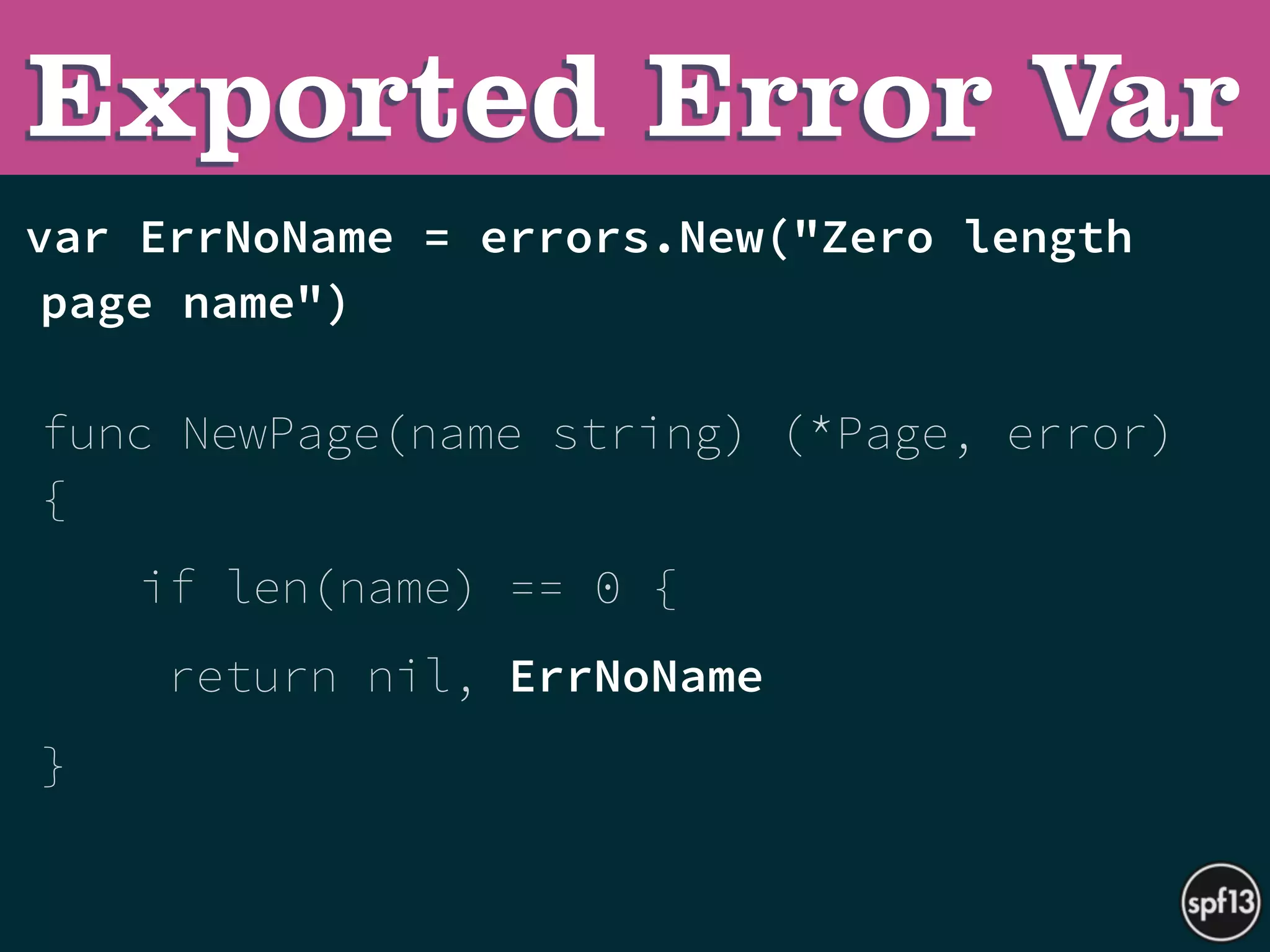
Exported Error Var 
var ErrNoName = errors.New("Zero length 
page name") 
func NewPage(name string) (*Page, error) 
{ 
if len(name) == 0 { 
return nil, ErrNoName 
}
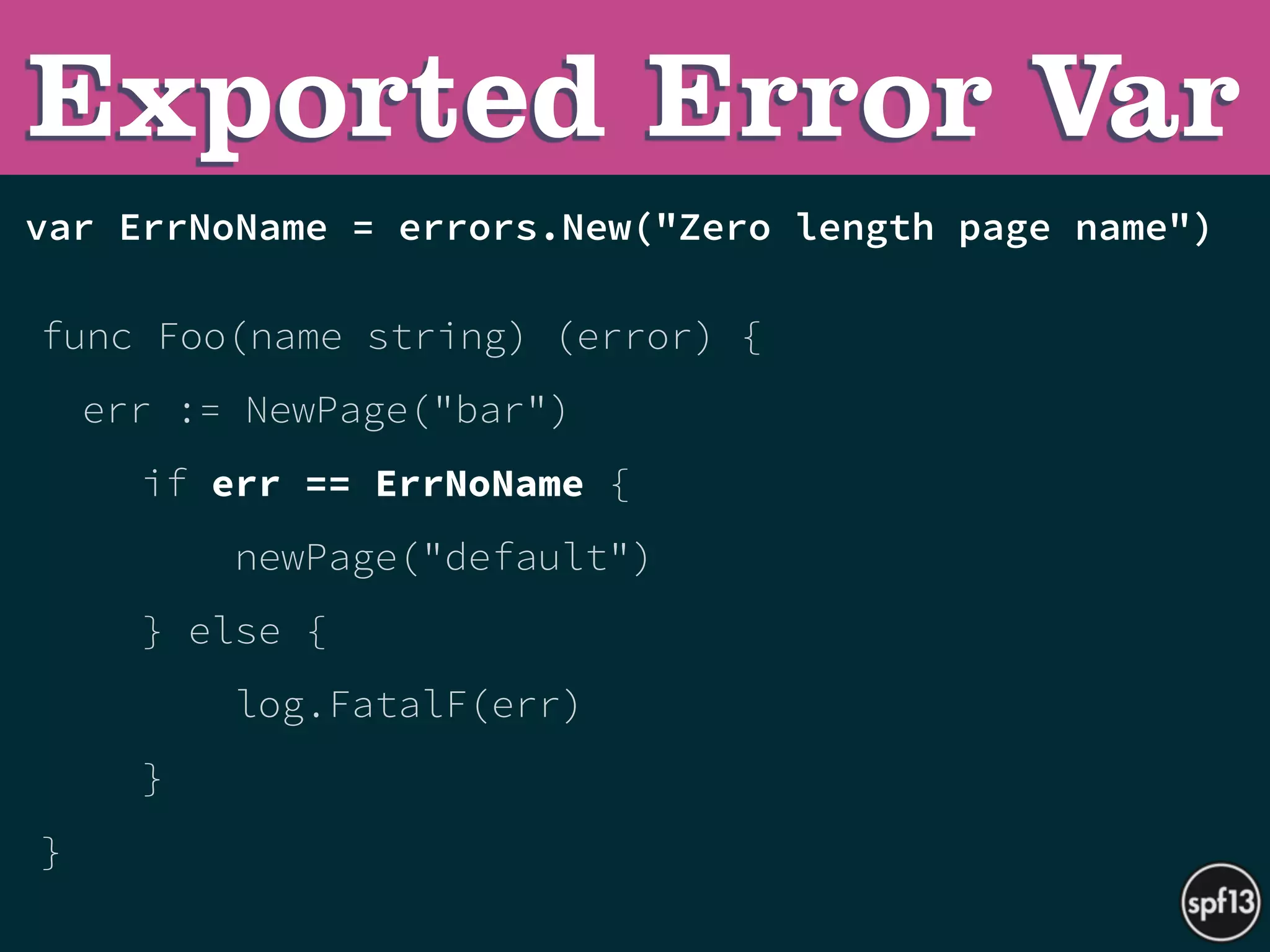
Exported Error Var 
var ErrNoName = errors.New("Zero length page name") 
func Foo(name string) (error) { 
err := NewPage("bar") 
if err == ErrNoName { 
newPage("default") 
} else { 
log.FatalF(err) 
} 
}
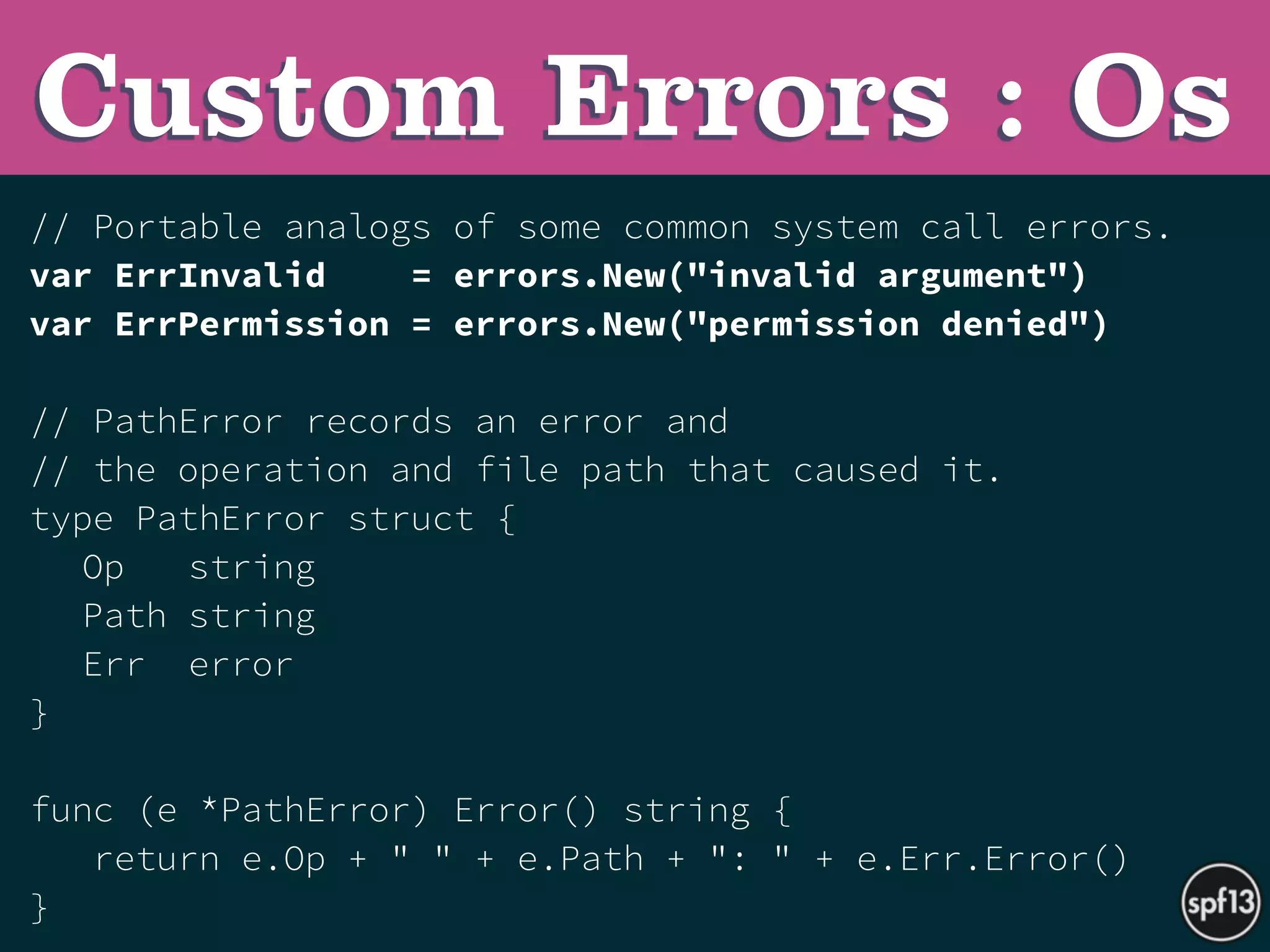
Custom Errors : Os 
// Portable analogs of some common system call errors. 
var ErrInvalid = errors.New("invalid argument") 
var ErrPermission = errors.New("permission denied") 
// PathError records an error and 
// the operation and file path that caused it. 
type PathError struct { 
Op string 
Path string 
Err error 
} 
func (e *PathError) Error() string { 
return e.Op + " " + e.Path + ": " + e.Err.Error() 
}
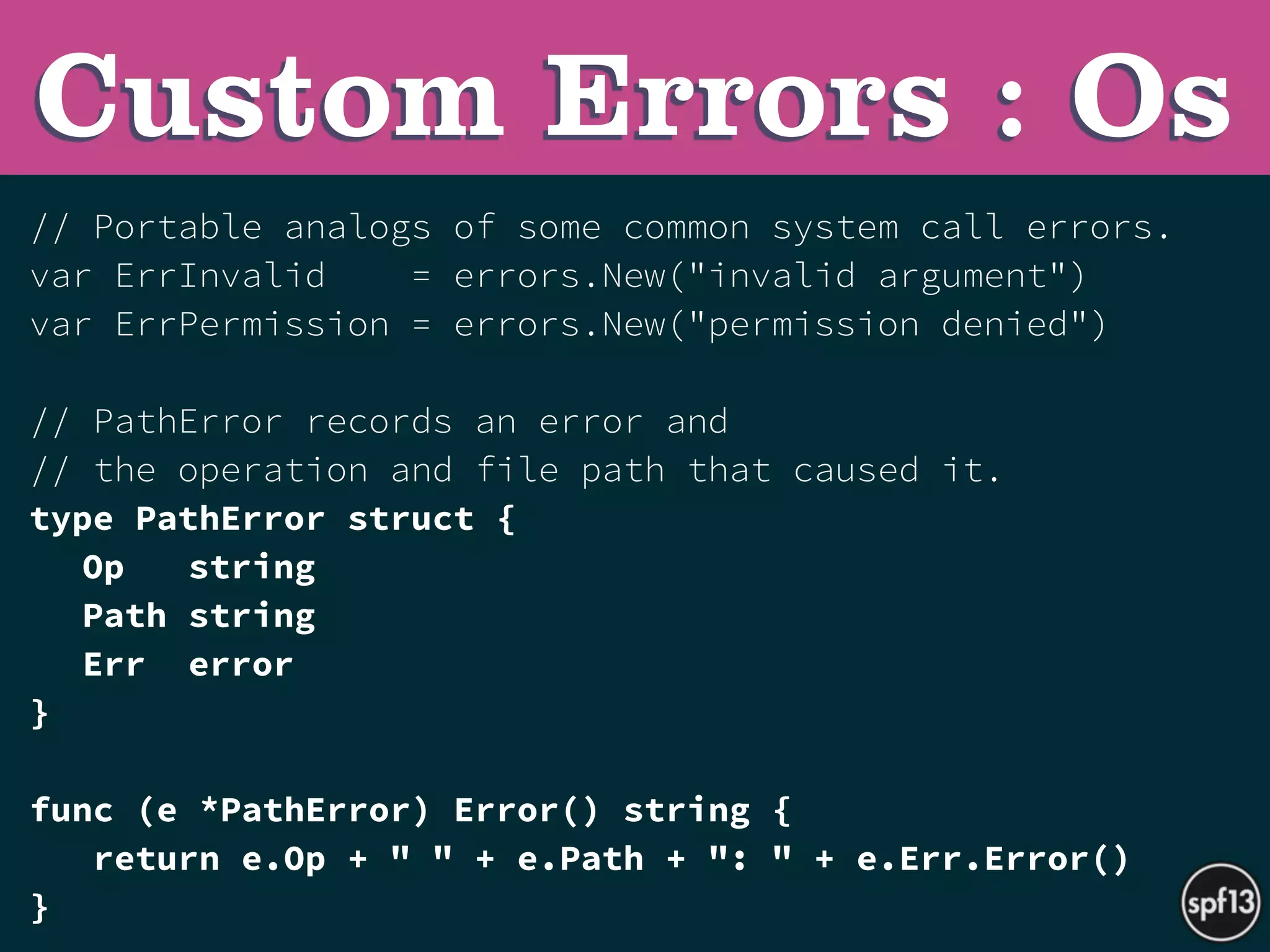
Custom Errors : Os 
// Portable analogs of some common system call errors. 
var ErrInvalid = errors.New("invalid argument") 
var ErrPermission = errors.New("permission denied") 
// PathError records an error and 
// the operation and file path that caused it. 
type PathError struct { 
Op string 
Path string 
Err error 
} 
func (e *PathError) Error() string { 
return e.Op + " " + e.Path + ": " + e.Err.Error() 
}
Custom Errors : Os 
func (f *File) WriteAt(b []byte, off int64) (n int, err error) { 
if f == nil { 
return 0, ErrInvalid 
} 
for len(b) > 0 { 
m, e := f.pwrite(b, off) 
if e != nil { 
err = &PathError{"write", f.name, e} 
break 
} 
n += m 
b = b[m:] 
off += int64(m) 
} 
return 
}
Custom Errors : Os 
func (f *File) WriteAt(b []byte, off int64) (n int, err error) { 
if f == nil { 
return 0, ErrInvalid 
} 
for len(b) > 0 { 
m, e := f.pwrite(b, off) 
if e != nil { 
err = &PathError{"write", f.name, e} 
break 
} 
n += m 
b = b[m:] 
off += int64(m) 
} 
return 
}
Custom Errors : Os 
func (f *File) WriteAt(b []byte, off int64) (n int, err error) { 
if f == nil { 
return 0, ErrInvalid 
} 
for len(b) > 0 { 
m, e := f.pwrite(b, off) 
if e != nil { 
err = &PathError{"write", f.name, e} 
break 
} 
n += m 
b = b[m:] 
off += int64(m) 
} 
return 
}
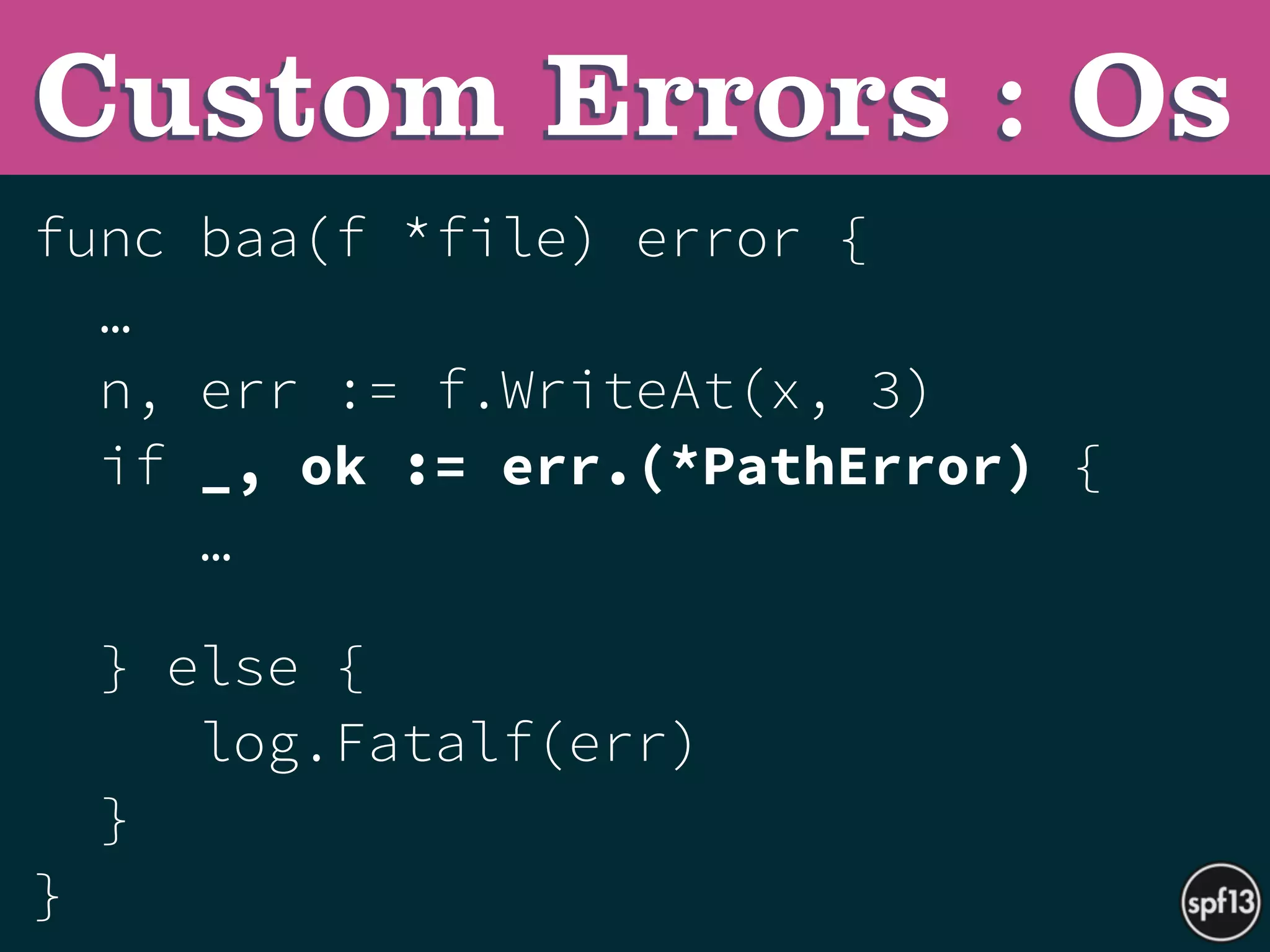
Custom Errors : Os 
func baa(f *file) error { 
… 
n, err := f.WriteAt(x, 3) 
if _, ok := err.(*PathError) { 
… 
} else { 
log.Fatalf(err) 
} 
}
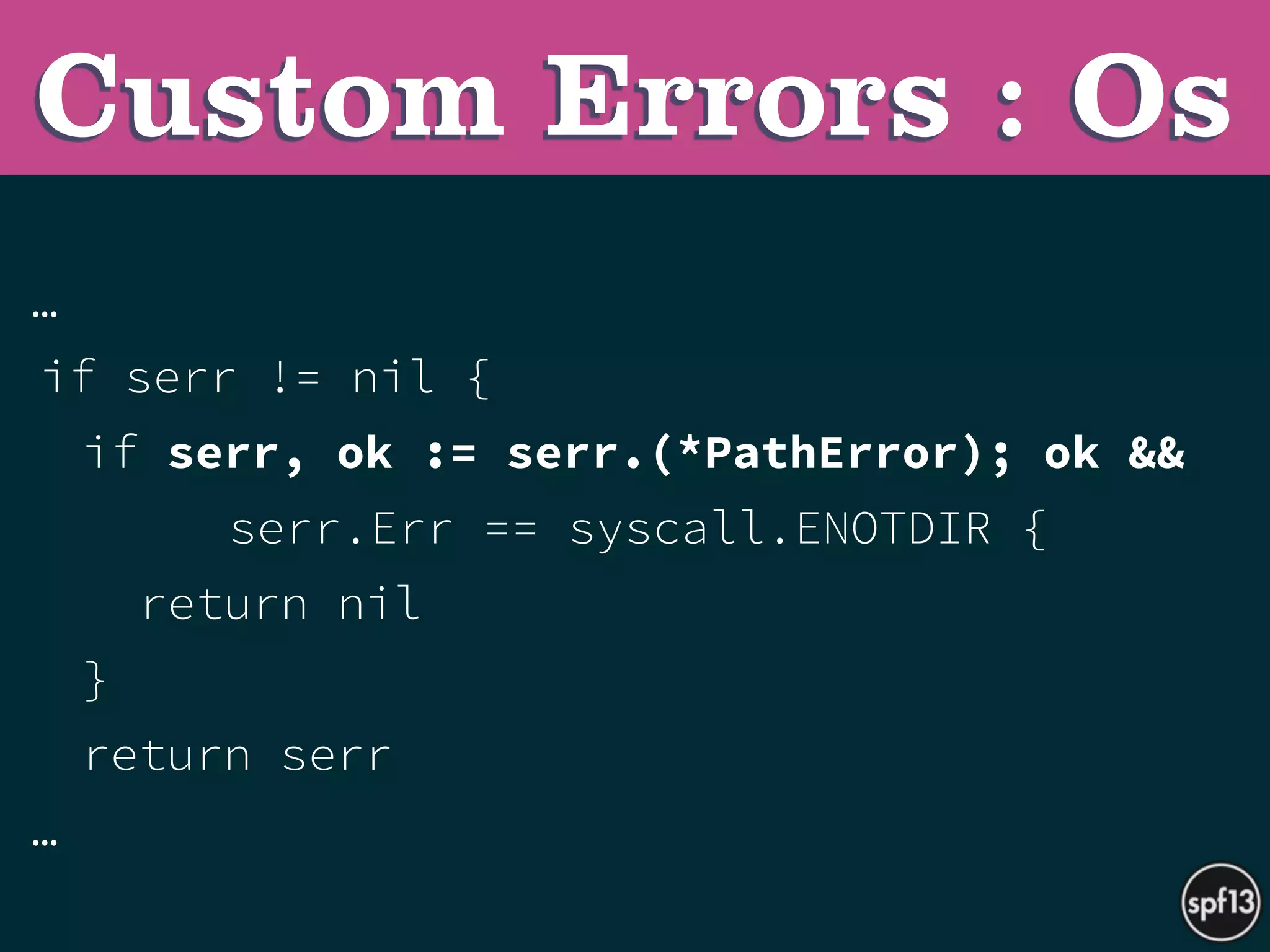
Custom Errors : Os 
… 
if serr != nil { 
if serr, ok := serr.(*PathError); ok && 
serr.Err == syscall.ENOTDIR { 
return nil 
} 
return serr 
…
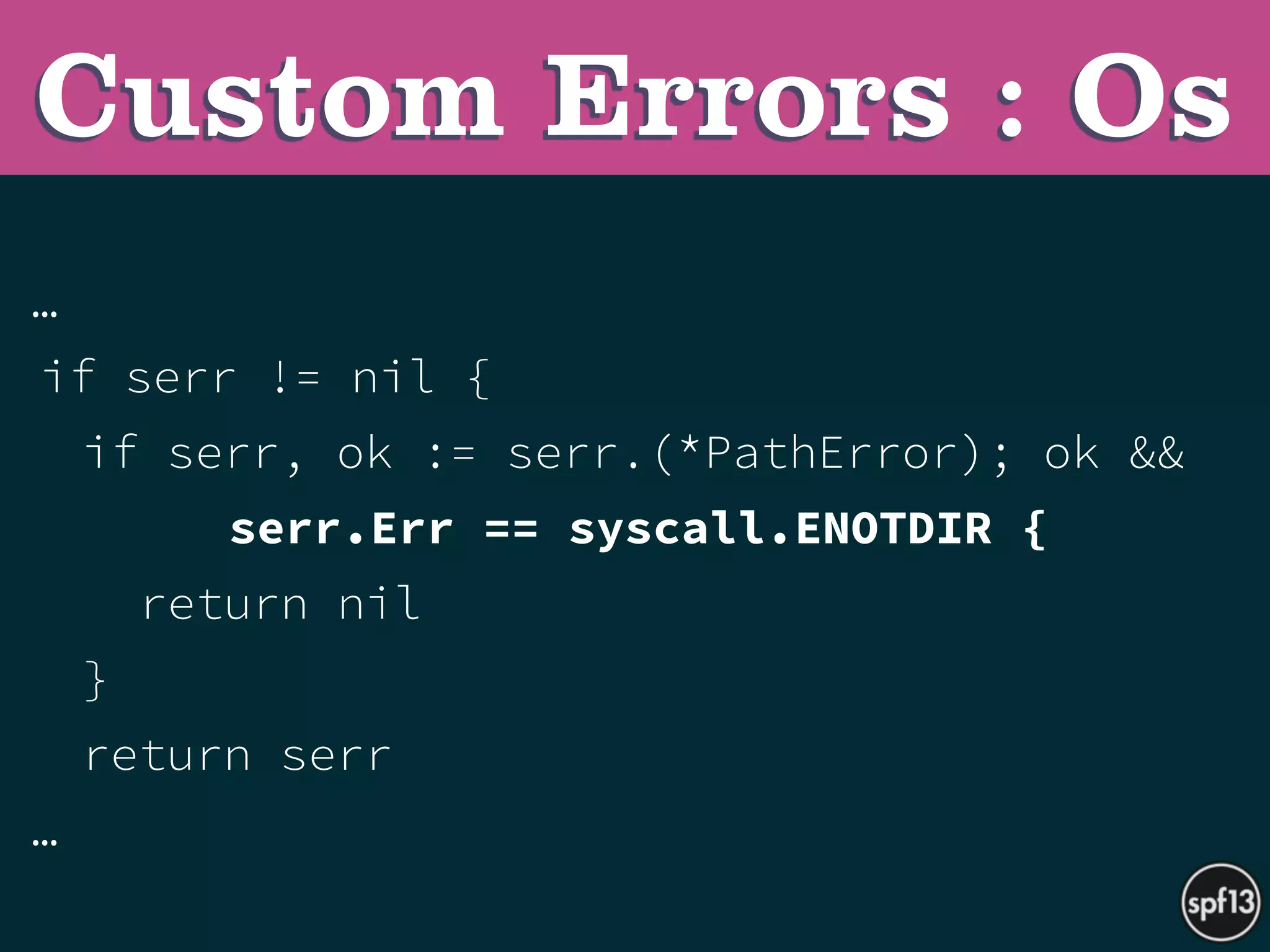
Custom Errors : Os 
… 
if serr != nil { 
if serr, ok := serr.(*PathError); ok && 
serr.Err == syscall.ENOTDIR { 
return nil 
} 
return serr 
…
Mistake 3: 
Requring 
Broad 
Interfaces
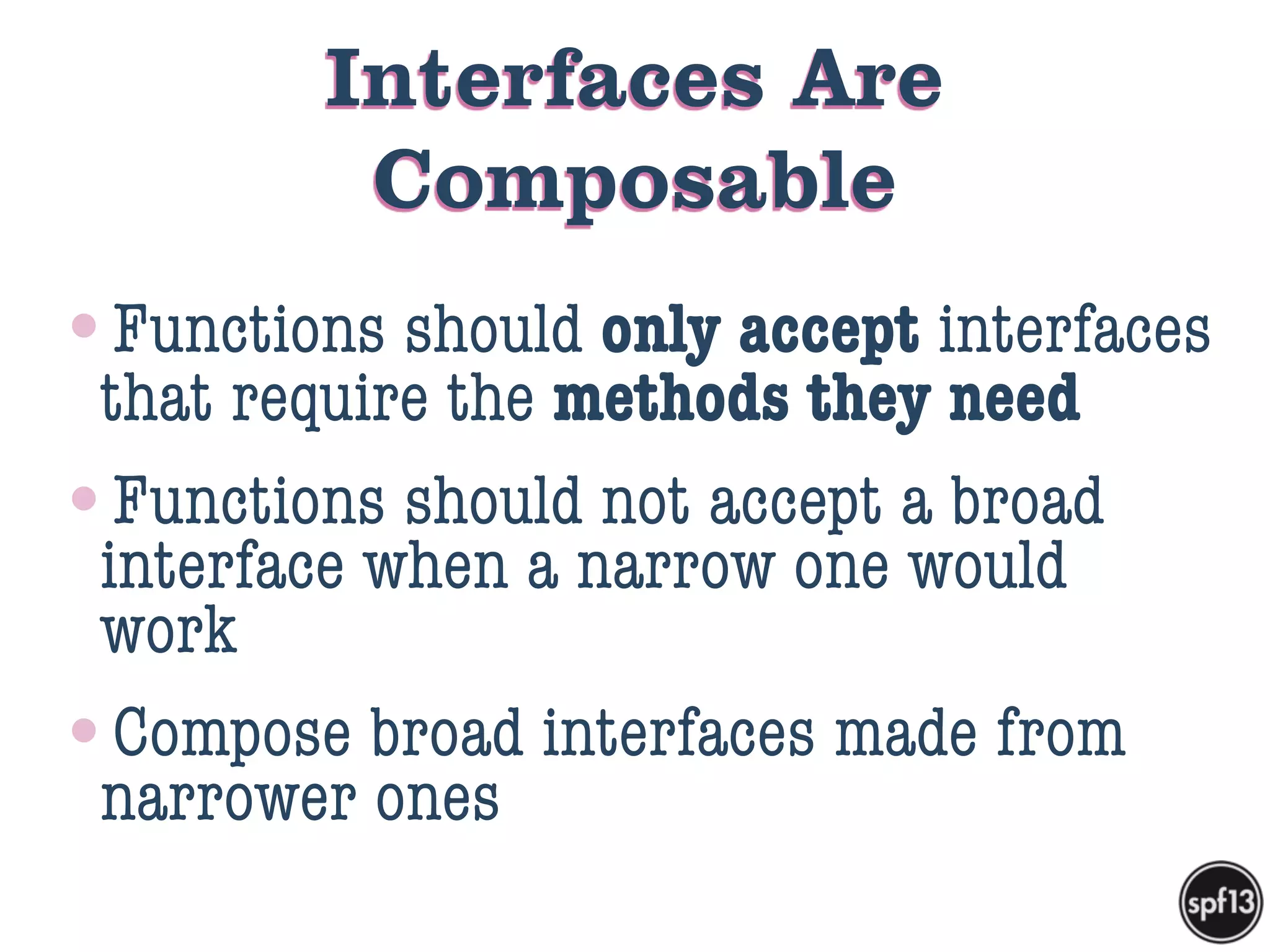
Interfaces Are 
Composable 
•Functions should only accept interfaces 
that require the methods they need 
•Functions should not accept a broad 
interface when a narrow one would 
work 
•Compose broad interfaces made from 
narrower ones
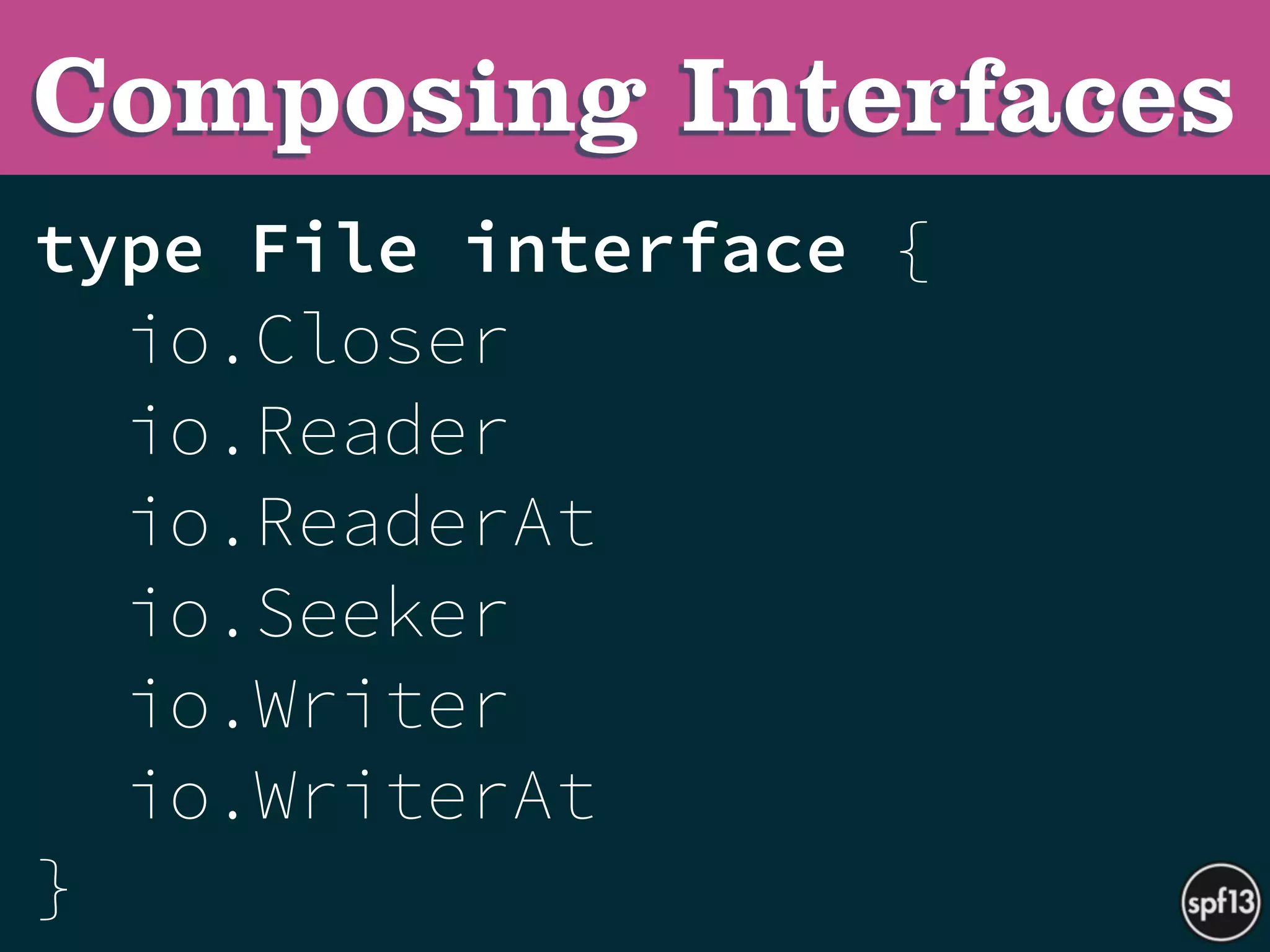
Composing Interfaces 
type File interface { 
io.Closer 
io.Reader 
io.ReaderAt 
io.Seeker 
io.Writer 
io.WriterAt 
}
Requiring Broad Interfaces 
func ReadIn(f File) { 
b := []byte{} 
n, err := f.Read(b) 
... 
}
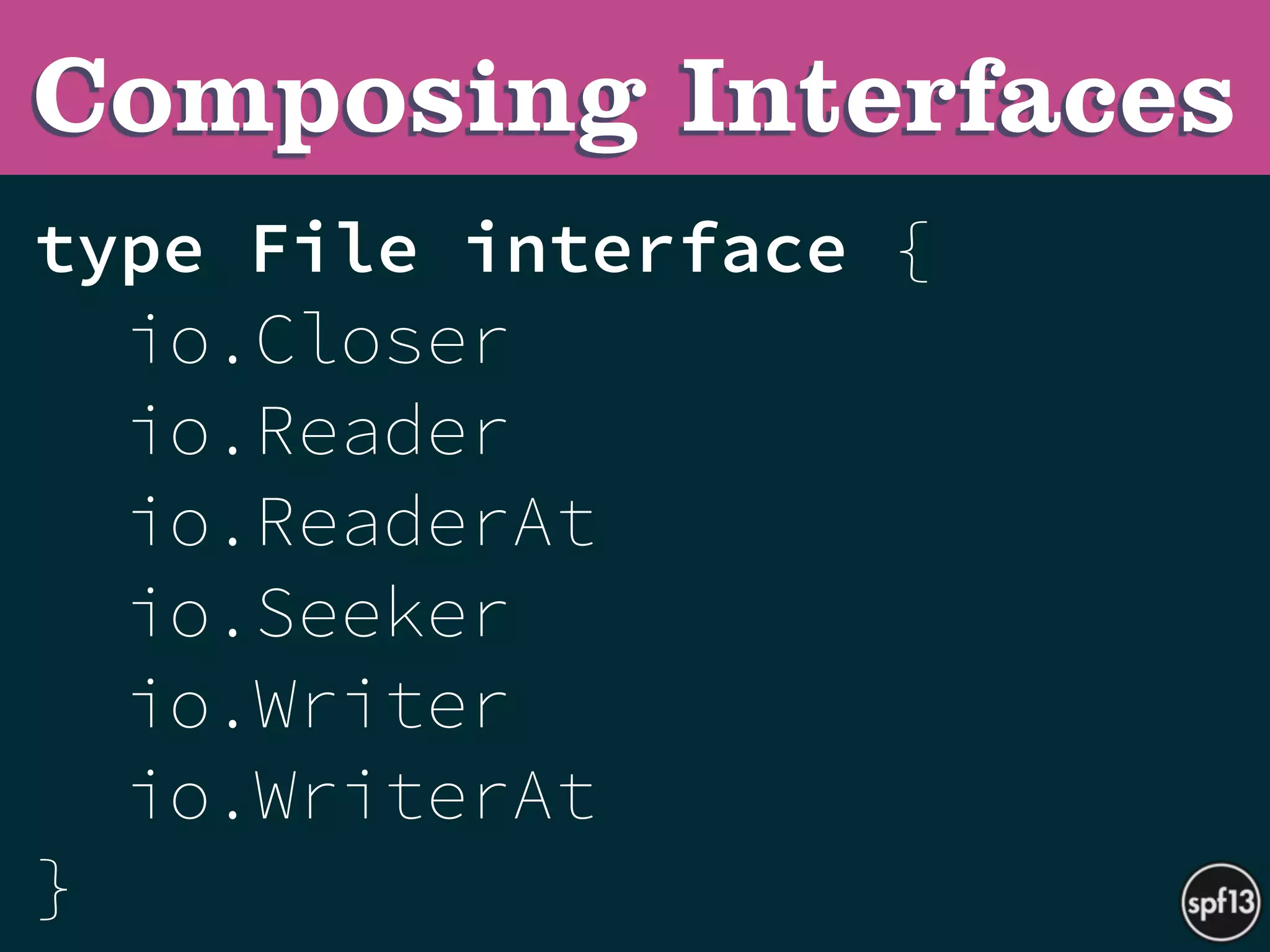
Composing Interfaces 
type File interface { 
io.Closer 
io.Reader 
io.ReaderAt 
io.Seeker 
io.Writer 
io.WriterAt 
}
Requiring Narrow Interfaces 
func ReadIn(r Reader) { 
b := []byte{} 
n, err := r.Read(b) 
... 
}
Mistake 4: 
Methods Vs 
Functions
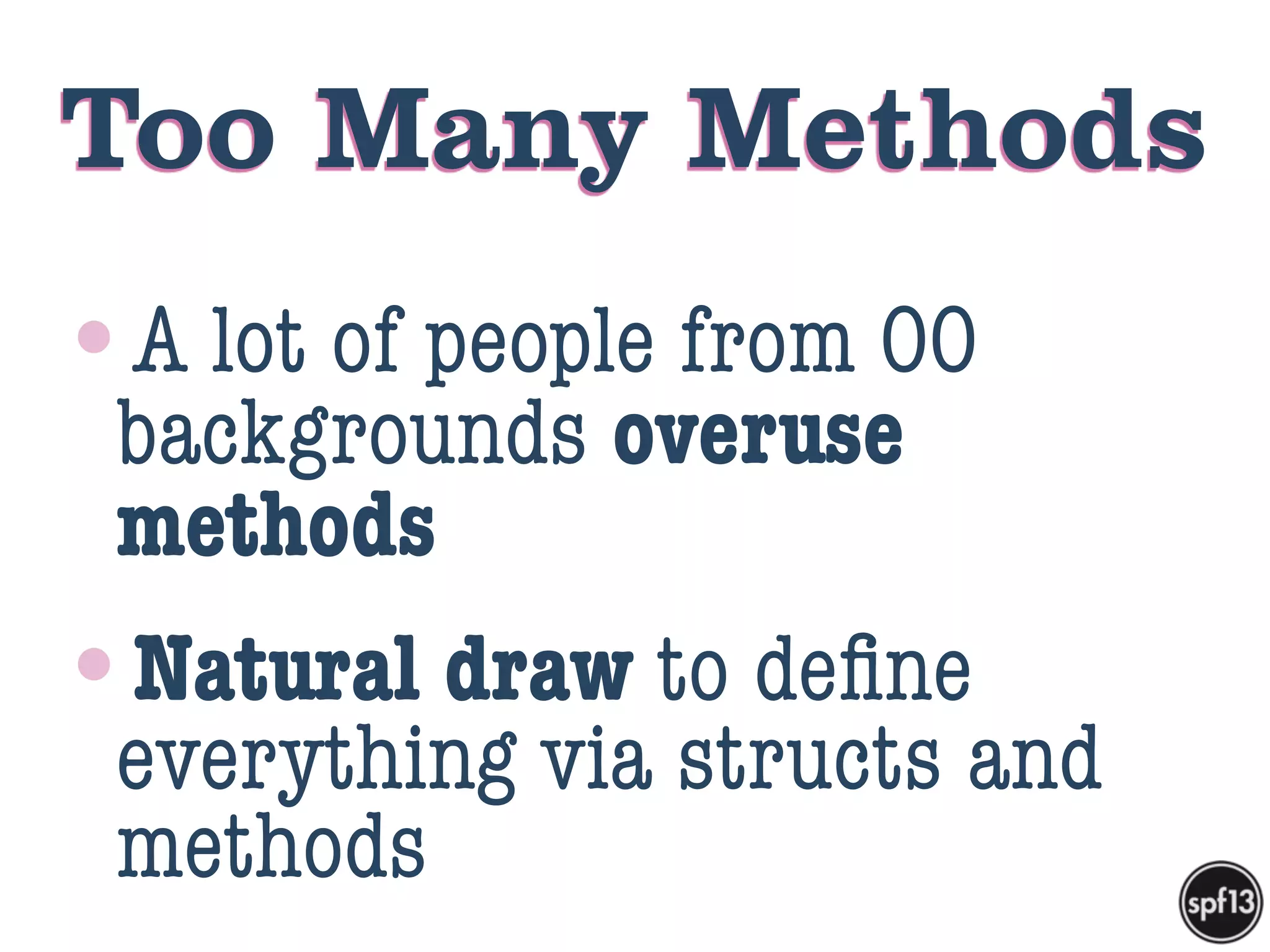
Too Many Methods 
•A lot of people from OO 
backgrounds overuse 
methods 
•Natural draw to define 
everything via structs and 
methods
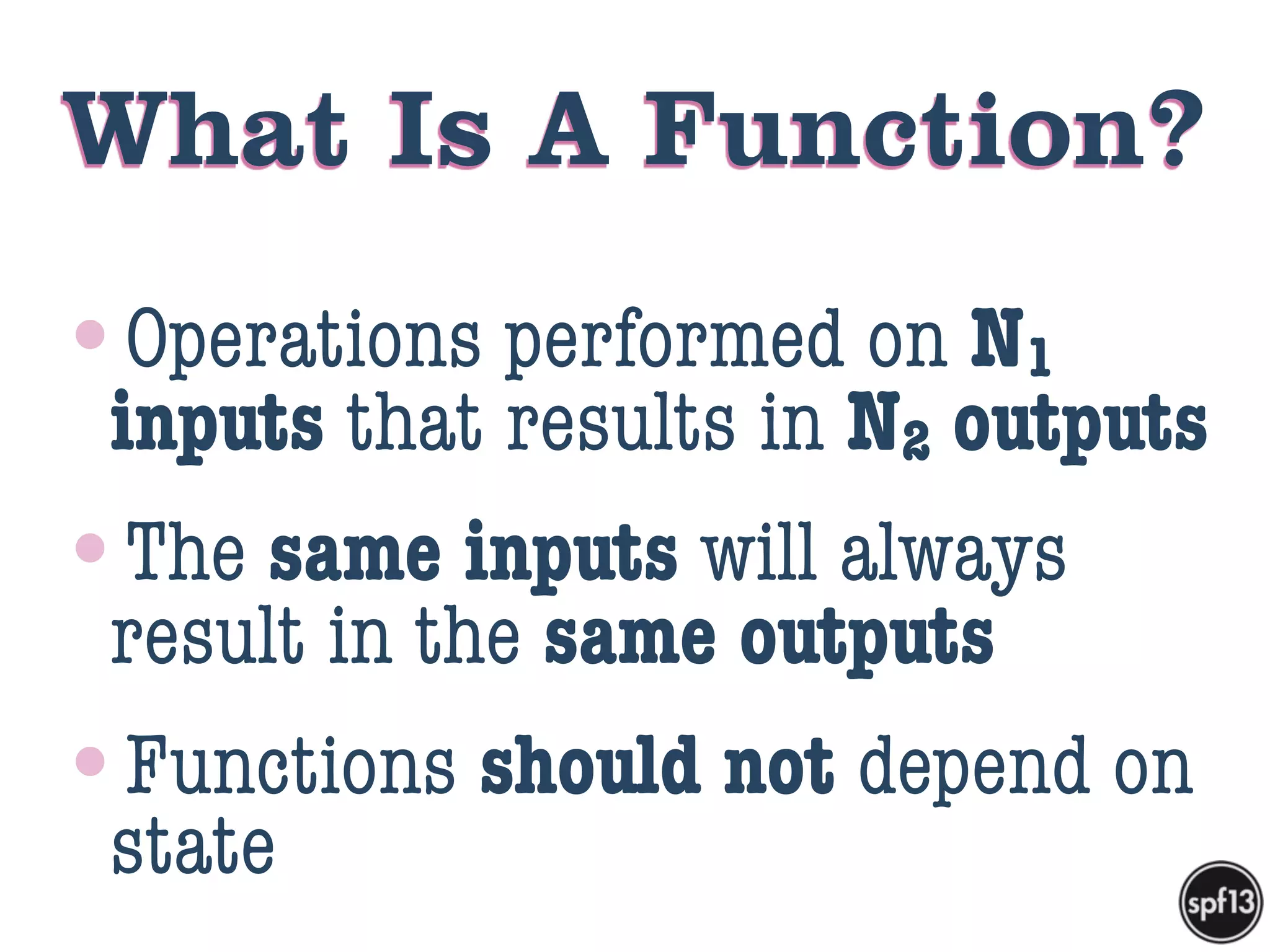
What Is A Function? 
•Operations performed on N1 
inputs that results in N2 outputs 
•The same inputs will always 
result in the same outputs 
•Functions should not depend on 
state
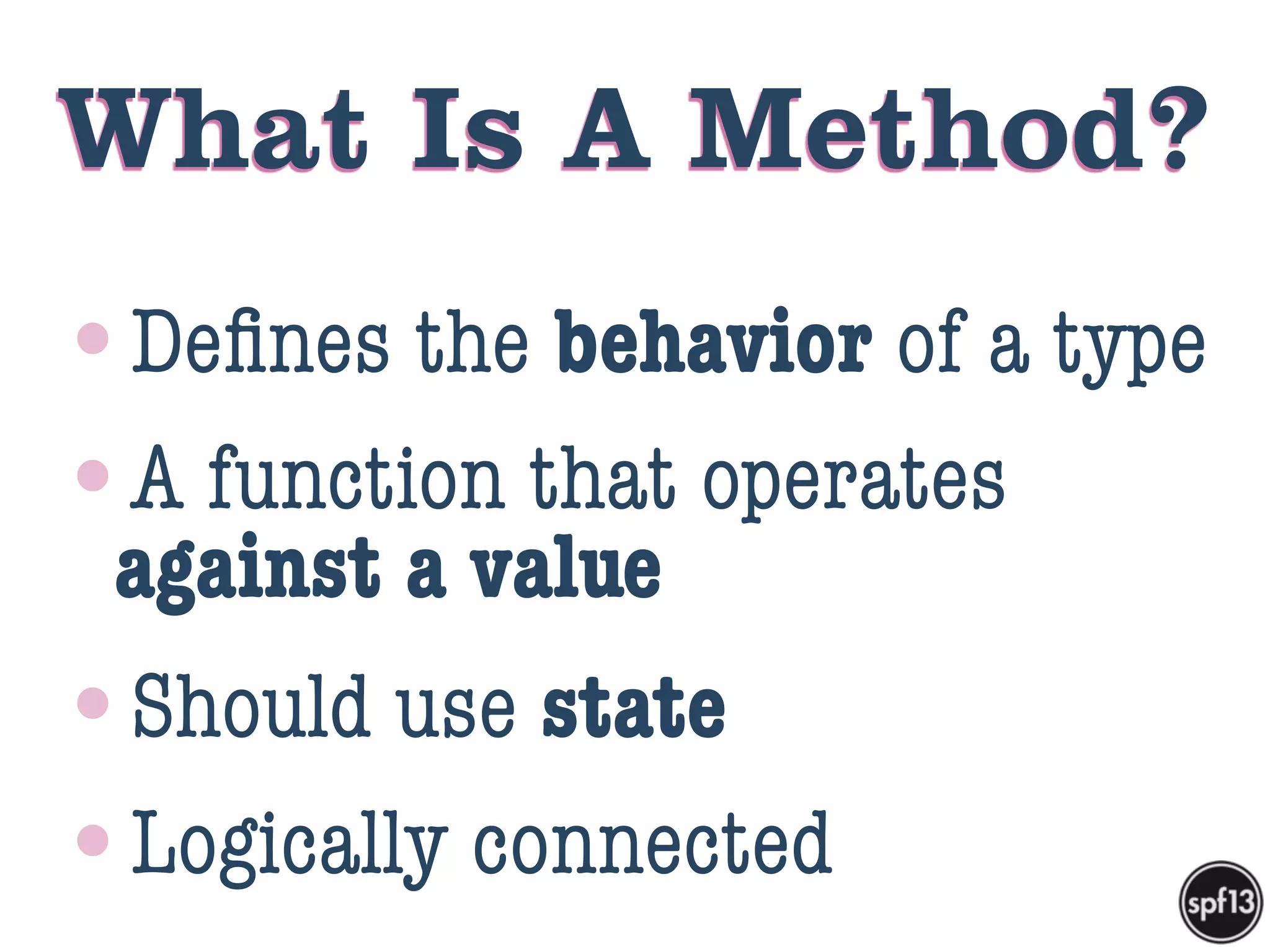
What Is A Method? 
•Defines the behavior of a type 
•A function that operates 
against a value 
•Should use state 
•Logically connected
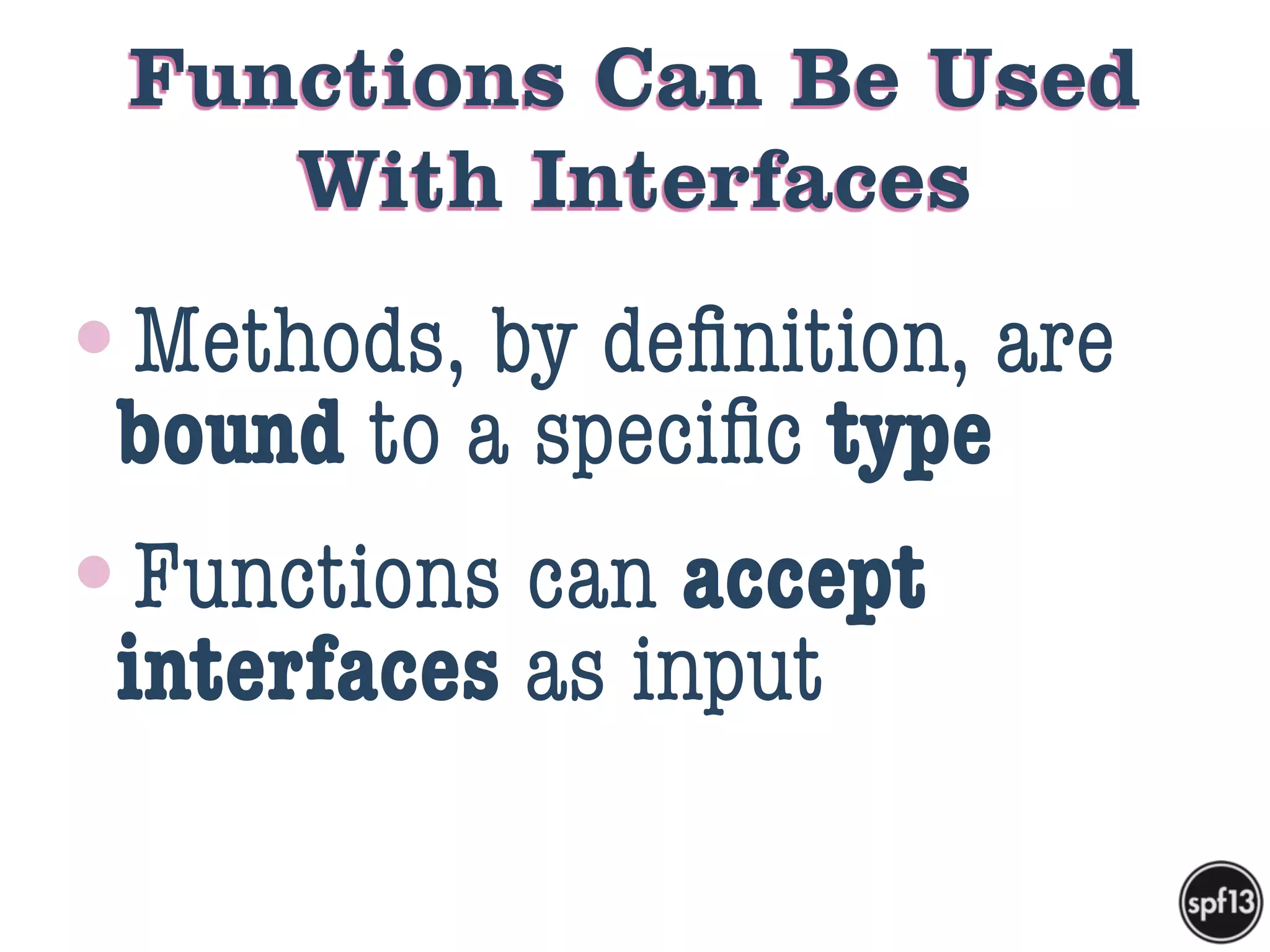
Functions Can Be Used 
With Interfaces 
•Methods, by definition, are 
bound to a specific type 
•Functions can accept 
interfaces as input
Example From Hugo 
func extractShortcodes(s string, p *Page, t 
Template) (string, map[string]shortcode, error) { 
... 
for { 
switch currItem.typ { 
... 
case tError: 
err := fmt.Errorf("%s:%d: %s", 
p.BaseFileName(), 
(p.lineNumRawContentStart() 
+ pt.lexer.lineNum() - 1), currItem) 
} 
} 
... 
}
Example From Hugo 
func extractShortcodes(s string, p *Page, t 
Template) (string, map[string]shortcode, error) { 
... 
for { 
switch currItem.typ { 
... 
case tError: 
err := fmt.Errorf("%s:%d: %s", 
p.BaseFileName(), 
(p.lineNumRawContentStart() 
+ pt.lexer.lineNum() - 1), currItem) 
} 
} 
... 
}
Mistake 5: 
Pointers Vs 
Values
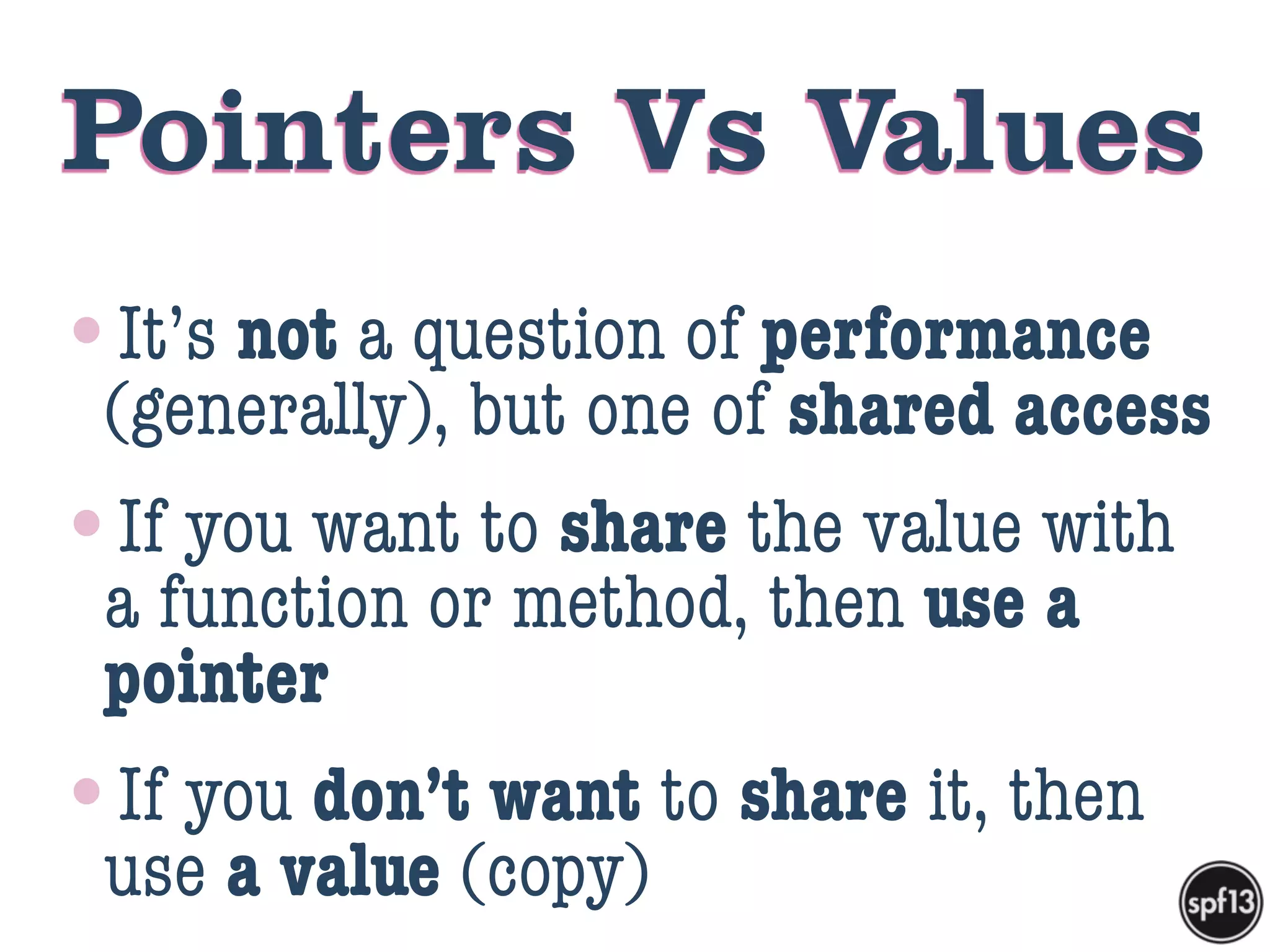
Pointers Vs Values 
•It’s not a question of performance 
(generally), but one of shared access 
•If you want to share the value with 
a function or method, then use a 
pointer 
•If you don’t want to share it, then 
use a value (copy)
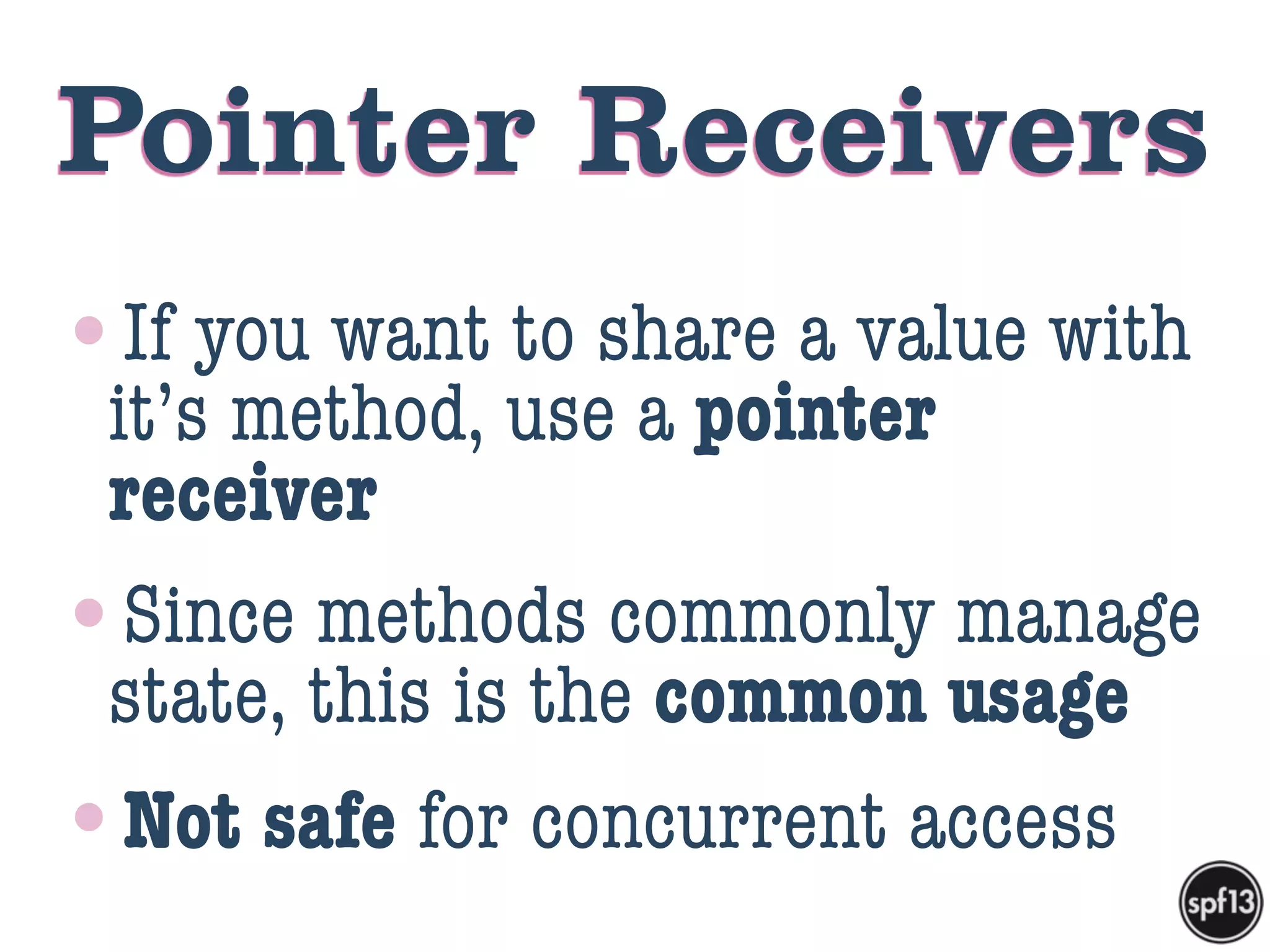
Pointer Receivers 
•If you want to share a value with 
it’s method, use a pointer 
receiver 
•Since methods commonly manage 
state, this is the common usage 
•Not safe for concurrent access
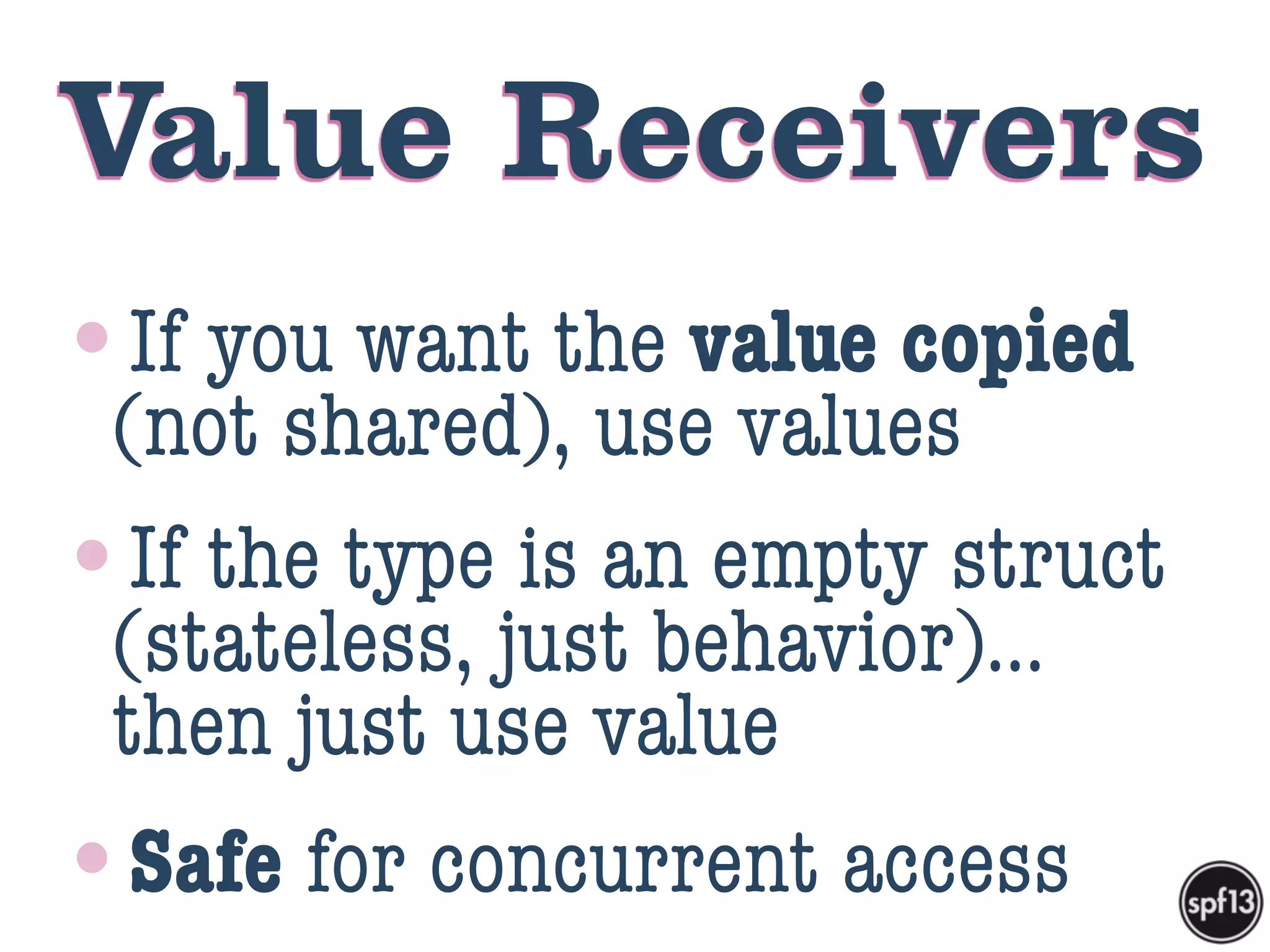
Value Receivers 
•If you want the value copied 
(not shared), use values 
•If the type is an empty struct 
(stateless, just behavior)… 
then just use value 
•Safe for concurrent access
Afero File 
type InMemoryFile struct { 
at int64 
name string 
data []byte 
closed bool 
} 
func (f *InMemoryFile) Close() error { 
atomic.StoreInt64(&f.at, 0) 
f.closed = true 
return nil 
}
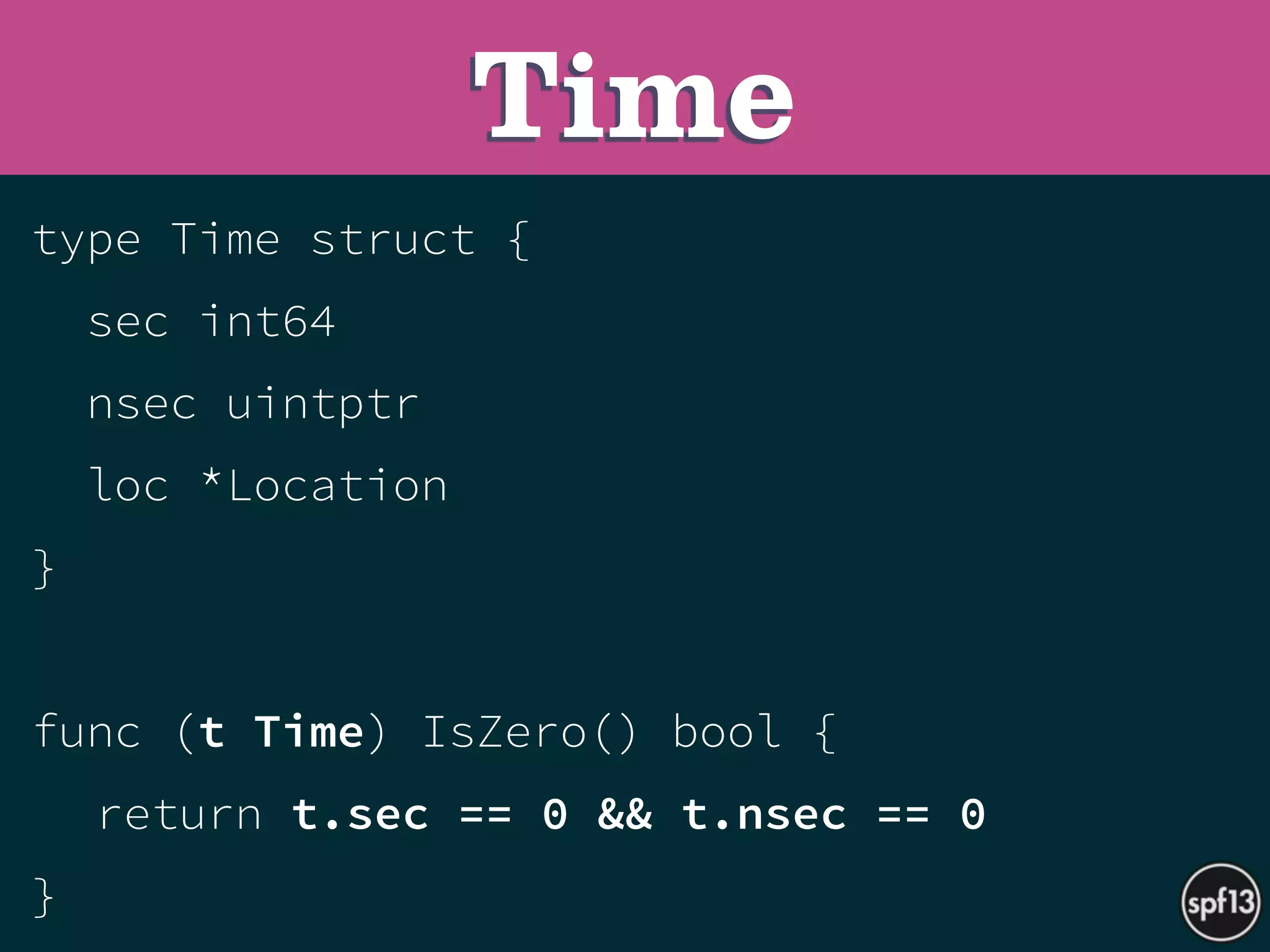
type Time struct { 
sec int64 
nsec uintptr 
loc *Location 
} 
func (t Time) IsZero() bool { 
return t.sec == 0 && t.nsec == 0 
} 
Time
Mistake 6: 
Not Using 
Io.Reader & 
Io.Writer
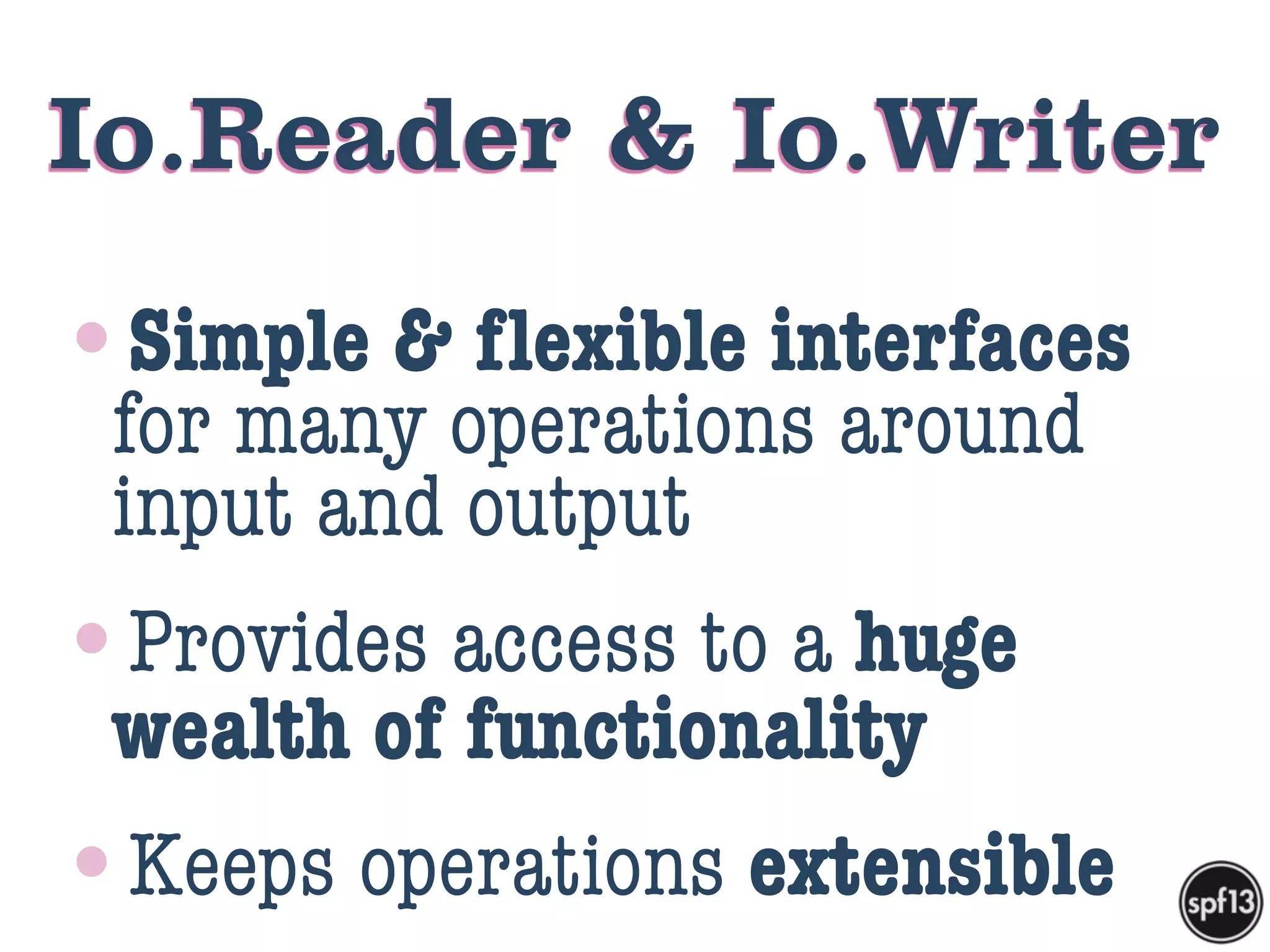
Io.Reader & Io.Writer 
•Simple & flexible interfaces 
for many operations around 
input and output 
•Provides access to a huge 
wealth of functionality 
•Keeps operations extensible
Io.Reader & Io.Writer 
type Reader interface { 
Read(p []byte) (n int, err error) 
} 
type Writer interface { 
Write(p []byte) (n int, err error) 
}
func (page *Page) saveSourceAs(path string) { 
b := new(bytes.Buffer) 
b.Write(page.Source.Content) 
page.saveSource(b.Bytes(), path) 
} 
func (page *Page) saveSource(by []byte, inpath 
string) { 
WriteToDisk(inpath, bytes.NewReader(by)) 
} 
Stop Doing This!!
func (page *Page) saveSourceAs(path string) { 
b := new(bytes.Buffer) 
b.Write(page.Source.Content) 
page.saveSource(b.Bytes(), path) 
} 
func (page *Page) saveSource(by []byte, inpath 
string) { 
WriteToDisk(inpath, bytes.NewReader(by)) 
} 
Stop Doing This!!
func (page *Page) saveSourceAs(path string) { 
b := new(bytes.Buffer) 
b.Write(page.Source.Content) 
page.saveSource(b.Bytes(), path) 
} 
func (page *Page) saveSource(by []byte, inpath 
string) { 
WriteToDisk(inpath, bytes.NewReader(by)) 
} 
Stop Doing This!! 
https://github.com/spf13/hugo/blob/master/hugolib/page.go#L582
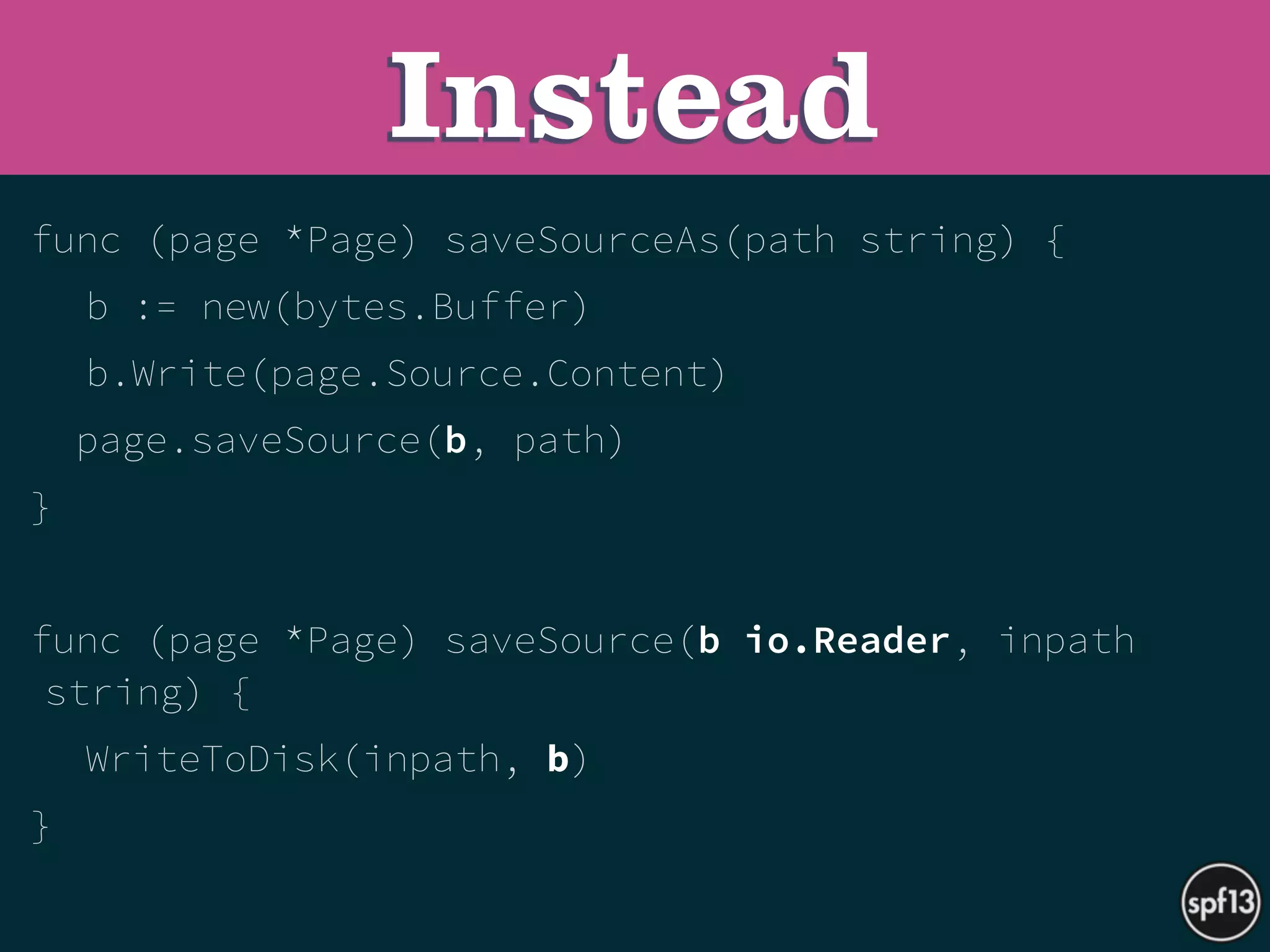
func (page *Page) saveSourceAs(path string) { 
b := new(bytes.Buffer) 
b.Write(page.Source.Content) 
page.saveSource(b, path) 
} 
func (page *Page) saveSource(b io.Reader, inpath 
string) { 
WriteToDisk(inpath, b) 
} 
Instead
Mistake 7: 
Ignoring 
Concurrent 
Access
Consider Concurrency 
•If you provide a library someone 
will use it concurrently 
•Data structures are not safe for 
concurrent access 
•Values aren’t safe, you need to 
create safe behavior around them
Making It Safe 
•Sync package provides behavior 
to make a value safe (Atomic/ 
Mutex) 
•Channels cordinate values 
across go routines by permitting 
one go routine to access at a 
time
Maps Are Not Safe 
func (m *MMFs) Create(name string) (File, error) { 
m.getData()[name] = MemFileCreate(name) 
m.registerDirs(m.getData()[name]) 
return m.getData()[name], nil 
}
Maps Are Not Safe 
func (m *MMFS) Create(name string) (File, error) { 
m.getData()[name] = MemFileCreate(name) 
m.registerDirs(m.getData()[name]) 
return m.getData()[name], nil 
}
Maps Are Not Safe 
panic: runtime error: invalid memory address or nil 
pointer dereference 
[signal 0xb code=0x1 addr=0x28 pc=0x1691a7] 
goroutine 90 [running]: 
runtime.panic(0x501ea0, 0x86b104) 
/usr/local/Cellar/go/1.3.3/libexec/src/pkg/runtime/ 
panic.c:279 +0xf5 
github.com/spf13/afero. 
(*MemMapFs).registerDirs(0xc208000860, 0x0, 0x0) 
/Users/spf13/gopath/src/github.com/spf13/afero/ 
memmap.go:88 +0x27
Maps Can Be Used Safely 
func (m *MMFS) Create(name string) (File, error) { 
m.lock() 
m.getData()[name] = MemFileCreate(name) 
m.unlock() 
m.registerDirs(m.getData()[name]) 
return m.getData()[name], nil 
}
Biggsest 
Mistake: 
Not Makimg 
Mistakes
@Spf13 
Author of 
Hugo, Cobra, 
Afero, Viper & 
more

7 Common mistakes in Go and when to avoid them

  • 1.
    7 Common Mistakes In Go and when to avoid them
  • 2.
    @Spf13 Author of Hugo, Cobra, Afero, Viper & more
  • 3.
    “As long asthe world is turning and spinning, we're gonna be dizzy and we're gonna make mistakes.” –Mel Brooks
  • 4.
    “Appreciate your mistakesfor what they are: precious life lessons that can only be learned the hard way. “ –Al Franken
  • 5.
    “If I hadto live my life again, I'd make the same mistakes, only sooner.” – Tallulah Bankhead
  • 6.
    7 Lessons IWish I Learned Sooner
  • 7.
    Mistake 1: Not Accepting Interfaces
  • 8.
    State & Behavior •Types can express state & behavior •State = data structure •Behavior = methods
  • 9.
    Interfaces •One ofGo’s most powerful features •Permits extensibility •Defined by methods •Adherance is only satisfied by behavior
  • 11.
    Example : []Byte type Source struct { Frontmatter []byte Content []byte }
  • 12.
    Func Restricted ToString func StripHTML(s string) string { output := "" // Shortcut strings with no tags in them if !strings.ContainsAny(s, "<>") { output = s } else { s = strings.Replace(s, "n", " ", -1) s = strings.Replace(s, "</p>", "n", -1) s = strings.Replace(s, "<br>", "n", -1) s = strings.Replace(s, "<br />", "n", -1) …
  • 13.
    Passes Implementation DetailsDown The Stack func (p *Page) Plain() string { return helpers.StripHTML(string(p.Content)) }
  • 14.
    Any Read() Works func StripHTML(r Reader) string { buf := new(bytes.Buffer) buf.ReadFrom(r) by := buf.Bytes() if bytes.ContainsAny(s, []byte("<>")) { by = bytes.Replace(by, []byte("n"), " ", -1) by = bytes.Replace(by, []byte("</p>"), "n", -1) by = bytes.Replace(by, []byte("<br>"), "n", -1) by = bytes.Replace(by, []byte("<br />"), "n", -1) …
  • 15.
    type Source struct{ Frontmatter []byte content []byte } type Reader interface { Read(p []byte) (n int, err error) } func (s *Source) Content() (Reader) { return bytes.NewReader(content) } Example : Read
  • 16.
    type Source struct{ Frontmatter []byte content []byte } type Reader interface { Read(p []byte) (n int, err error) } func (s *Source) Content() (Reader) { return bytes.NewReader(content) } Example : Read
  • 17.
    type Source struct{ Frontmatter []byte content []byte } type Reader interface { Read(p []byte) (n int, err error) } func (s *Source) Content() (Reader) { return bytes.NewReader(content) } Example : Read
  • 18.
    func (p *Page)Plain() string { return helpers.StripHTML(p.Content()) } Implementation Details Abstracted With A Method
  • 19.
    Mistake 2: ThinkingOf Errors As Strings
  • 20.
    Error Is AnInterface type error interface { Error() string }
  • 21.
    Standard Errors •errors.New(“errorhere”) is usually sufficient •Exported Error Variables can be easily checked
  • 22.
    Custom Errors •Canprovide context to guarantee consistent feedback •Provide a type which can be different from the error value •Can provide dynamic values (based on internal error state)
  • 23.
    func NewPage(name string)(p *Page, err error) { if len(name) == 0 { return nil, errors.New("Zero length page name") } Standard Error
  • 24.
    Exported Error Var var ErrNoName = errors.New("Zero length page name") func NewPage(name string) (*Page, error) { if len(name) == 0 { return nil, ErrNoName }
  • 25.
    Exported Error Var var ErrNoName = errors.New("Zero length page name") func Foo(name string) (error) { err := NewPage("bar") if err == ErrNoName { newPage("default") } else { log.FatalF(err) } }
  • 26.
    Custom Errors :Os // Portable analogs of some common system call errors. var ErrInvalid = errors.New("invalid argument") var ErrPermission = errors.New("permission denied") // PathError records an error and // the operation and file path that caused it. type PathError struct { Op string Path string Err error } func (e *PathError) Error() string { return e.Op + " " + e.Path + ": " + e.Err.Error() }
  • 27.
    Custom Errors :Os // Portable analogs of some common system call errors. var ErrInvalid = errors.New("invalid argument") var ErrPermission = errors.New("permission denied") // PathError records an error and // the operation and file path that caused it. type PathError struct { Op string Path string Err error } func (e *PathError) Error() string { return e.Op + " " + e.Path + ": " + e.Err.Error() }
  • 28.
    Custom Errors :Os func (f *File) WriteAt(b []byte, off int64) (n int, err error) { if f == nil { return 0, ErrInvalid } for len(b) > 0 { m, e := f.pwrite(b, off) if e != nil { err = &PathError{"write", f.name, e} break } n += m b = b[m:] off += int64(m) } return }
  • 29.
    Custom Errors :Os func (f *File) WriteAt(b []byte, off int64) (n int, err error) { if f == nil { return 0, ErrInvalid } for len(b) > 0 { m, e := f.pwrite(b, off) if e != nil { err = &PathError{"write", f.name, e} break } n += m b = b[m:] off += int64(m) } return }
  • 30.
    Custom Errors :Os func (f *File) WriteAt(b []byte, off int64) (n int, err error) { if f == nil { return 0, ErrInvalid } for len(b) > 0 { m, e := f.pwrite(b, off) if e != nil { err = &PathError{"write", f.name, e} break } n += m b = b[m:] off += int64(m) } return }
  • 31.
    Custom Errors :Os func baa(f *file) error { … n, err := f.WriteAt(x, 3) if _, ok := err.(*PathError) { … } else { log.Fatalf(err) } }
  • 32.
    Custom Errors :Os … if serr != nil { if serr, ok := serr.(*PathError); ok && serr.Err == syscall.ENOTDIR { return nil } return serr …
  • 33.
    Custom Errors :Os … if serr != nil { if serr, ok := serr.(*PathError); ok && serr.Err == syscall.ENOTDIR { return nil } return serr …
  • 34.
    Mistake 3: Requring Broad Interfaces
  • 35.
    Interfaces Are Composable •Functions should only accept interfaces that require the methods they need •Functions should not accept a broad interface when a narrow one would work •Compose broad interfaces made from narrower ones
  • 37.
    Composing Interfaces typeFile interface { io.Closer io.Reader io.ReaderAt io.Seeker io.Writer io.WriterAt }
  • 38.
    Requiring Broad Interfaces func ReadIn(f File) { b := []byte{} n, err := f.Read(b) ... }
  • 39.
    Composing Interfaces typeFile interface { io.Closer io.Reader io.ReaderAt io.Seeker io.Writer io.WriterAt }
  • 40.
    Requiring Narrow Interfaces func ReadIn(r Reader) { b := []byte{} n, err := r.Read(b) ... }
  • 41.
    Mistake 4: MethodsVs Functions
  • 42.
    Too Many Methods •A lot of people from OO backgrounds overuse methods •Natural draw to define everything via structs and methods
  • 43.
    What Is AFunction? •Operations performed on N1 inputs that results in N2 outputs •The same inputs will always result in the same outputs •Functions should not depend on state
  • 44.
    What Is AMethod? •Defines the behavior of a type •A function that operates against a value •Should use state •Logically connected
  • 45.
    Functions Can BeUsed With Interfaces •Methods, by definition, are bound to a specific type •Functions can accept interfaces as input
  • 47.
    Example From Hugo func extractShortcodes(s string, p *Page, t Template) (string, map[string]shortcode, error) { ... for { switch currItem.typ { ... case tError: err := fmt.Errorf("%s:%d: %s", p.BaseFileName(), (p.lineNumRawContentStart() + pt.lexer.lineNum() - 1), currItem) } } ... }
  • 48.
    Example From Hugo func extractShortcodes(s string, p *Page, t Template) (string, map[string]shortcode, error) { ... for { switch currItem.typ { ... case tError: err := fmt.Errorf("%s:%d: %s", p.BaseFileName(), (p.lineNumRawContentStart() + pt.lexer.lineNum() - 1), currItem) } } ... }
  • 49.
  • 50.
    Pointers Vs Values •It’s not a question of performance (generally), but one of shared access •If you want to share the value with a function or method, then use a pointer •If you don’t want to share it, then use a value (copy)
  • 51.
    Pointer Receivers •Ifyou want to share a value with it’s method, use a pointer receiver •Since methods commonly manage state, this is the common usage •Not safe for concurrent access
  • 52.
    Value Receivers •Ifyou want the value copied (not shared), use values •If the type is an empty struct (stateless, just behavior)… then just use value •Safe for concurrent access
  • 53.
    Afero File typeInMemoryFile struct { at int64 name string data []byte closed bool } func (f *InMemoryFile) Close() error { atomic.StoreInt64(&f.at, 0) f.closed = true return nil }
  • 54.
    type Time struct{ sec int64 nsec uintptr loc *Location } func (t Time) IsZero() bool { return t.sec == 0 && t.nsec == 0 } Time
  • 55.
    Mistake 6: NotUsing Io.Reader & Io.Writer
  • 56.
    Io.Reader & Io.Writer •Simple & flexible interfaces for many operations around input and output •Provides access to a huge wealth of functionality •Keeps operations extensible
  • 57.
    Io.Reader & Io.Writer type Reader interface { Read(p []byte) (n int, err error) } type Writer interface { Write(p []byte) (n int, err error) }
  • 59.
    func (page *Page)saveSourceAs(path string) { b := new(bytes.Buffer) b.Write(page.Source.Content) page.saveSource(b.Bytes(), path) } func (page *Page) saveSource(by []byte, inpath string) { WriteToDisk(inpath, bytes.NewReader(by)) } Stop Doing This!!
  • 60.
    func (page *Page)saveSourceAs(path string) { b := new(bytes.Buffer) b.Write(page.Source.Content) page.saveSource(b.Bytes(), path) } func (page *Page) saveSource(by []byte, inpath string) { WriteToDisk(inpath, bytes.NewReader(by)) } Stop Doing This!!
  • 61.
    func (page *Page)saveSourceAs(path string) { b := new(bytes.Buffer) b.Write(page.Source.Content) page.saveSource(b.Bytes(), path) } func (page *Page) saveSource(by []byte, inpath string) { WriteToDisk(inpath, bytes.NewReader(by)) } Stop Doing This!! https://github.com/spf13/hugo/blob/master/hugolib/page.go#L582
  • 62.
    func (page *Page)saveSourceAs(path string) { b := new(bytes.Buffer) b.Write(page.Source.Content) page.saveSource(b, path) } func (page *Page) saveSource(b io.Reader, inpath string) { WriteToDisk(inpath, b) } Instead
  • 63.
    Mistake 7: Ignoring Concurrent Access
  • 64.
    Consider Concurrency •Ifyou provide a library someone will use it concurrently •Data structures are not safe for concurrent access •Values aren’t safe, you need to create safe behavior around them
  • 65.
    Making It Safe •Sync package provides behavior to make a value safe (Atomic/ Mutex) •Channels cordinate values across go routines by permitting one go routine to access at a time
  • 67.
    Maps Are NotSafe func (m *MMFs) Create(name string) (File, error) { m.getData()[name] = MemFileCreate(name) m.registerDirs(m.getData()[name]) return m.getData()[name], nil }
  • 68.
    Maps Are NotSafe func (m *MMFS) Create(name string) (File, error) { m.getData()[name] = MemFileCreate(name) m.registerDirs(m.getData()[name]) return m.getData()[name], nil }
  • 69.
    Maps Are NotSafe panic: runtime error: invalid memory address or nil pointer dereference [signal 0xb code=0x1 addr=0x28 pc=0x1691a7] goroutine 90 [running]: runtime.panic(0x501ea0, 0x86b104) /usr/local/Cellar/go/1.3.3/libexec/src/pkg/runtime/ panic.c:279 +0xf5 github.com/spf13/afero. (*MemMapFs).registerDirs(0xc208000860, 0x0, 0x0) /Users/spf13/gopath/src/github.com/spf13/afero/ memmap.go:88 +0x27
  • 70.
    Maps Can BeUsed Safely func (m *MMFS) Create(name string) (File, error) { m.lock() m.getData()[name] = MemFileCreate(name) m.unlock() m.registerDirs(m.getData()[name]) return m.getData()[name], nil }
  • 71.
    Biggsest Mistake: NotMakimg Mistakes
  • 72.
    @Spf13 Author of Hugo, Cobra, Afero, Viper & more