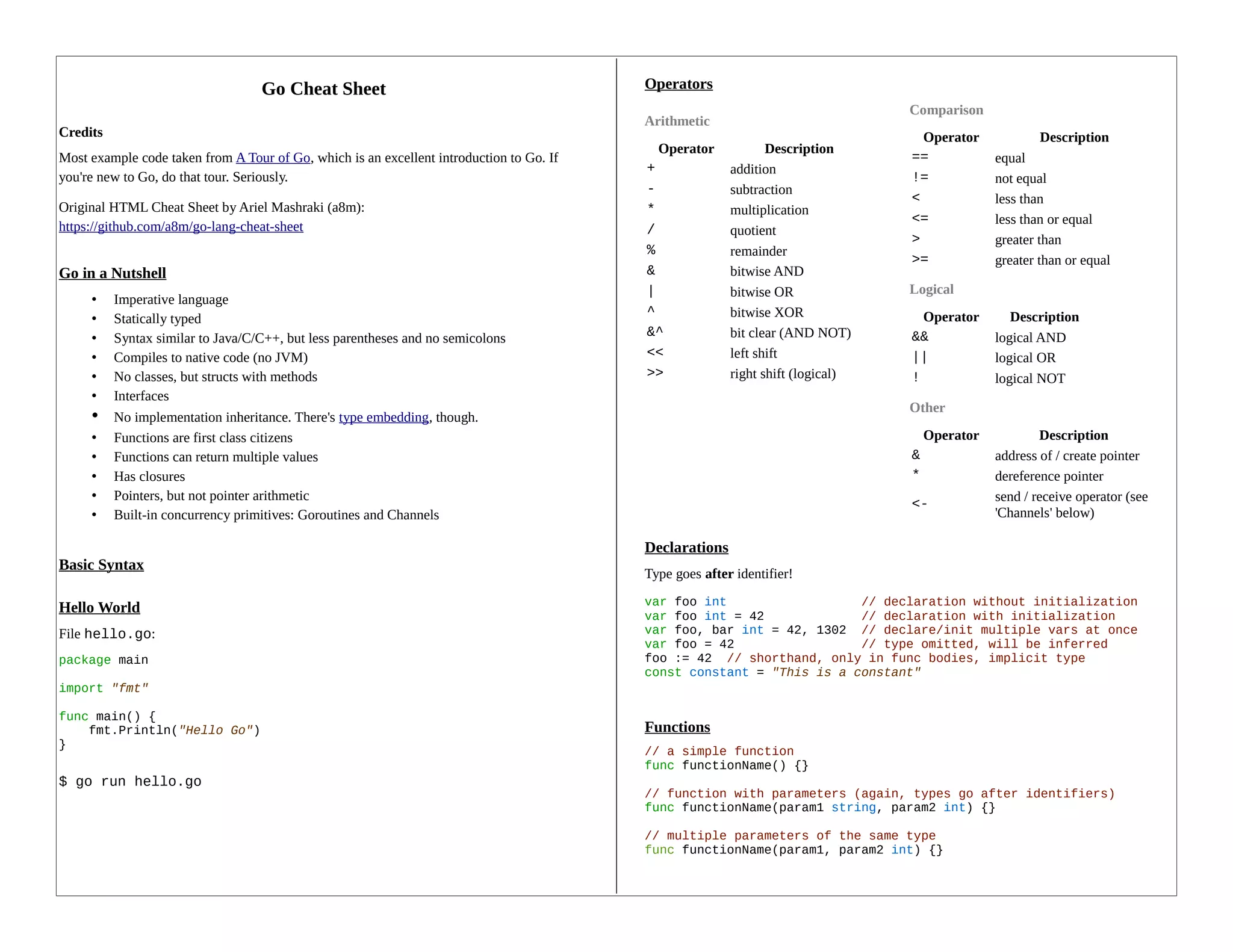
Go Cheat Sheet
Credits
Most example code taken from A Tour of Go, which is an excellent introduction to Go. If
you're new to Go, do that tour. Seriously.
Original HTML Cheat Sheet by Ariel Mashraki (a8m):
https://github.com/a8m/go-lang-cheat-sheet
Go in a Nutshell
• Imperative language
• Statically typed
• Syntax similar to Java/C/C++, but less parentheses and no semicolons
• Compiles to native code (no JVM)
• No classes, but structs with methods
• Interfaces
• No implementation inheritance. There's type embedding, though.
• Functions are first class citizens
• Functions can return multiple values
• Has closures
• Pointers, but not pointer arithmetic
• Built-in concurrency primitives: Goroutines and Channels
Basic Syntax
Hello World
File hello.go:
package main
import "fmt"
func main() {
fmt.Println("Hello Go")
}
$ go run hello.go
Operators
Arithmetic
Operator Description
+ addition
- subtraction
* multiplication
/ quotient
% remainder
& bitwise AND
| bitwise OR
^ bitwise XOR
&^ bit clear (AND NOT)
<< left shift
>> right shift (logical)
Comparison
Operator Description
== equal
!= not equal
< less than
<= less than or equal
> greater than
>= greater than or equal
Logical
Operator Description
&& logical AND
|| logical OR
! logical NOT
Other
Operator Description
& address of / create pointer
* dereference pointer
<- send / receive operator (see
'Channels' below)
Declarations
Type goes after identifier!
var foo int // declaration without initialization
var foo int = 42 // declaration with initialization
var foo, bar int = 42, 1302 // declare/init multiple vars at once
var foo = 42 // type omitted, will be inferred
foo := 42 // shorthand, only in func bodies, implicit type
const constant = "This is a constant"
Functions
// a simple function
func functionName() {}
// function with parameters (again, types go after identifiers)
func functionName(param1 string, param2 int) {}
// multiple parameters of the same type
func functionName(param1, param2 int) {}
Functions (cont)
// return type declaration
func functionName() int {
return 42
}
// Can return multiple values at once
func returnMulti() (int, string) {
return 42, "foobar"
}
var x, str = returnMulti()
// Return multiple named results simply by return
func returnMulti2() (n int, s string) {
n = 42
s = "foobar"
// n and s will be returned
return
}
var x, str = returnMulti2()
Functions As Values And Closures
func main() {
// assign a function to a name
add := func(a, b int) int {
return a + b
}
// use the name to call the function
fmt.Println(add(3, 4))
}
// Closures, lexically scoped: Functions can access values that were
// in scope when defining the function
func scope() func() int{
outer_var := 2
foo := func() int { return outer_var}
return foo
}
func another_scope() func() int{
// won't compile - outer_var and foo not defined in this scope
outer_var = 444
return foo
}
// Closures: don't mutate outer vars, instead redefine them!
func outer() (func() int, int) {
outer_var := 2 // NOTE outer_var is outside inner's scope
inner := func() int {
outer_var += 99 // attempt to mutate outer_var
return outer_var // => 101 (but outer_var is a newly redefined
// variable visible only inside inner)
}
return inner, outer_var // => 101, 2 (still!)
}
Functions (cont)
Variadic Functions
func main() {
fmt.Println(adder(1, 2, 3)) // 6
fmt.Println(adder(9, 9)) // 18
nums := []int{10, 20, 30}
fmt.Println(adder(nums...)) // 60
}
// Using ... before the type name of the last parameter indicates
// that it takes zero or more of those parameters.
// The function is invoked like any other function except we can
// pass as many arguments as we want.
func adder(args ...int) int {
total := 0
for _, v := range args { // Iterate over all args
total += v
}
return total
}
Built-in Types
bool
string
int int8 int16 int32 int64
uint uint8 uint16 uint32 uint64 uintptr
byte // alias for uint8
rune // alias for int32 ~= (Unicode code point) - Very Viking
float32 float64
complex64 complex128
Type Conversions
var i int = 42
var f float64 = float64(i)
var u uint = uint(f)
// alternative syntax
i := 42
f := float64(i)
u := uint(f)
Packages
• package declaration at top of every source file
• executables are in package main
• convention: package name == last name of import path
(import path math/rand => package rand)
• upper case identifier: exported (visible from other packages)
• Lower case identifier: private (not visible from other packages)
Control structures
If
func main() {
// Basic one
if x > 0 {
return x
} else {
return -x
}
// You can put one statement before the condition
if a := b + c; a < 42 {
return a
} else {
return a - 42
}
// Type assertion inside if
var val interface{}
val = "foo"
if str, ok := val.(string); ok {
fmt.Println(str)
}
}
Loops
// There's only `for`. No `while`, no `until`
for i := 1; i < 10; i++ {
}
for ; i < 10; { // while loop
}
for i < 10 { // can omit semicolons if there's only a condition
}
for { // can omit the condition ~ while (true)
}
Control structures (cont)
Switch
// switch statement
switch operatingSystem {
case "darwin":
fmt.Println("Mac OS Hipster")
// cases break automatically, no fallthrough by default
case "linux":
fmt.Println("Linux Geek")
default:
// Windows, BSD, ...
fmt.Println("Other")
}
// As with for and if, an assignment statement before the
// switch value is allowed
switch os := runtime.GOOS; os {
case "darwin": ...
}
Arrays, Slices, Ranges
Arrays
var a [10]int // int array with length 10. Length is part of type!
a[3] = 42 // set elements
i := a[3] // read elements
// declare and initialize
var a = [2]int{1, 2}
a := [2]int{1, 2} //shorthand
a := [...]int{1, 2} // elipsis -> Compiler figures out array length
Slices
var a []int // a slice – like an array, but length is unspecified
var a = []int {1, 2, 3, 4} // declare and initialize a slice
// (backed by given array implicitly)
a := []int{1, 2, 3, 4} // shorthand
chars := []string{0:"a", 2:"c", 1:"b"} // ["a", "b", "c"]
var b = a[lo:hi] // creates a slice (view of the array) from
// index lo to hi-1
var b = a[1:4] // slice from index 1 to 3
var b = a[:3] // missing low index implies 0
var b = a[3:] // missing high index implies len(a)
// create a slice with make
a = make([]byte, 5, 5) // first arg length, second capacity
a = make([]byte, 5) // capacity is optional
Arrays, Slices, Ranges (cont)
// create a slice from an array
x := [3]string{"Лайка", "Белка", "Стрелка"}
s := x[:] // a slice referencing the storage of x
Operations on Arrays and Slices
len(a) gives you the length of an array/a slice. It's a built-in function, not a attribute/method
on the array.
// loop over an array/a slice
for i, e := range a {
// i is the index, e the element
}
// if you only need e:
for _, e := range a {
// e is the element
}
// ...and if you only need the index
for i := range a {
}
// In Go pre-1.4, it is a compiler error to not use i and e.
// Go 1.4 introduced a variable-free form:
for range time.Tick(time.Second) {
// do it once a sec
}
Maps
var m map[string]int
m = make(map[string]int)
m["key"] = 42
fmt.Println(m["key"])
delete(m, "key")
elem, ok := m["key"] // test if key "key" is present, retrieve if so
// map literal
var m = map[string]Vertex{
"Bell Labs": {40.68433, -74.39967},
"Google": {37.42202, -122.08408},
}
Structs
There are no classes, only structs. Structs can have methods.
// A struct is a type. It's also a collection of fields
// Declaration
type Vertex struct {
X, Y int
}
// Creating
var v = Vertex{1, 2}
var v = Vertex{X: 1, Y: 2} // Creates a struct by defining values
// with keys
// Accessing members
v.X = 4
// You can declare methods on structs. The struct you want to declare
// the method on (the receiving type) comes between the func keyword
// and the method name. The struct is copied on each method call(!)
func (v Vertex) Abs() float64 {
return math.Sqrt(v.X*v.X + v.Y*v.Y)
}
// Call method
v.Abs()
// For mutating methods, you need to use a pointer (see below) to the
// Struct as the type. With this, the struct value is not copied for
// the method call.
func (v *Vertex) add(n float64) {
v.X += n
v.Y += n
}
Anonymous structs
Cheaper and safer than using map[string]interface{}.
point := struct {
X, Y int
}{1, 2}
Pointers
p := Vertex{1, 2} // p is a Vertex
q := &p // q is a pointer to a Vertex
r := &Vertex{1, 2} // r is also a pointer to a Vertex
// The type of a pointer to a Vertex is *Vertex
var s *Vertex = new(Vertex) // create ptr to a new struct instance
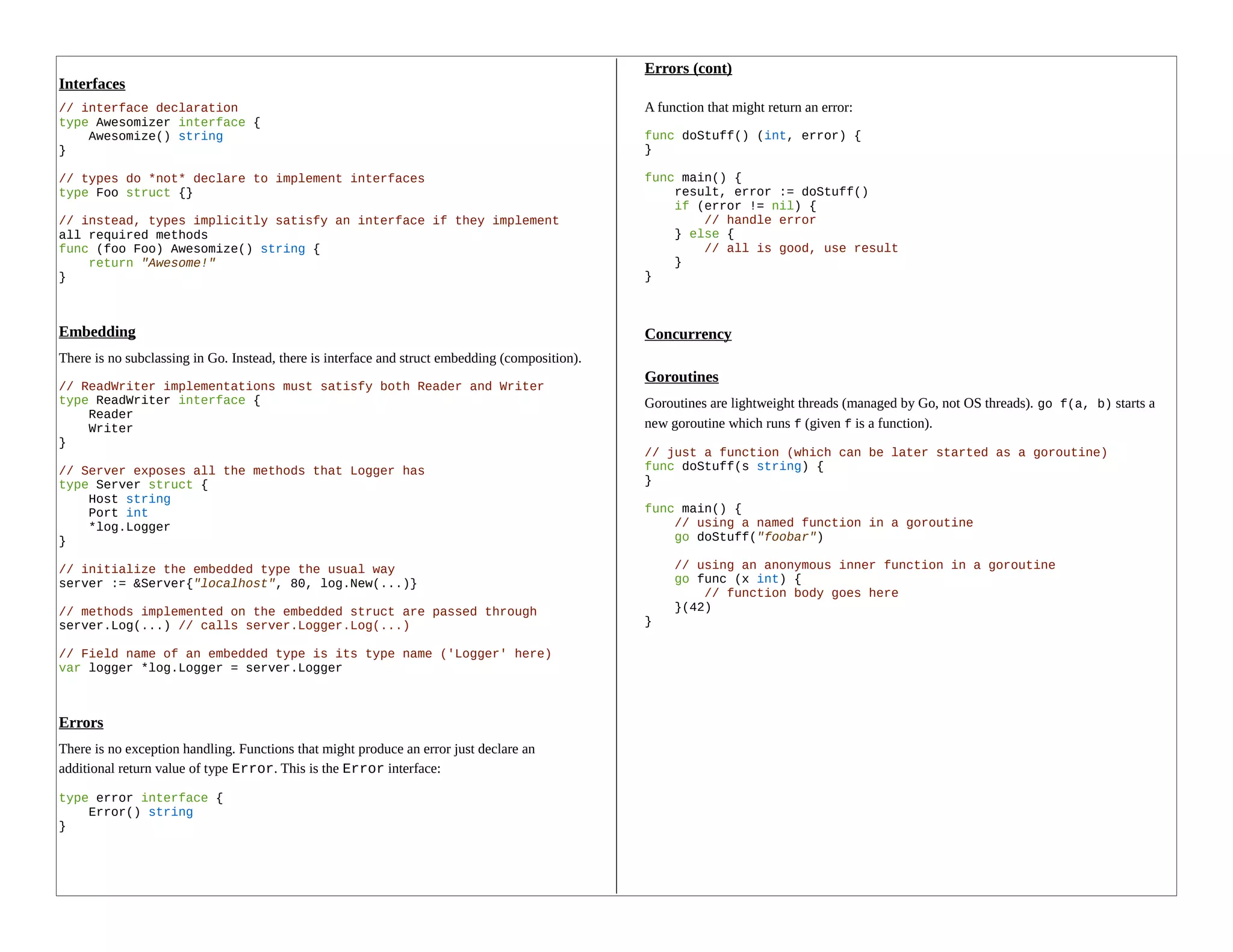
Interfaces
// interface declaration
type Awesomizer interface {
Awesomize() string
}
// types do *not* declare to implement interfaces
type Foo struct {}
// instead, types implicitly satisfy an interface if they implement
all required methods
func (foo Foo) Awesomize() string {
return "Awesome!"
}
Embedding
There is no subclassing in Go. Instead, there is interface and struct embedding (composition).
// ReadWriter implementations must satisfy both Reader and Writer
type ReadWriter interface {
Reader
Writer
}
// Server exposes all the methods that Logger has
type Server struct {
Host string
Port int
*log.Logger
}
// initialize the embedded type the usual way
server := &Server{"localhost", 80, log.New(...)}
// methods implemented on the embedded struct are passed through
server.Log(...) // calls server.Logger.Log(...)
// Field name of an embedded type is its type name ('Logger' here)
var logger *log.Logger = server.Logger
Errors
There is no exception handling. Functions that might produce an error just declare an
additional return value of type Error. This is the Error interface:
type error interface {
Error() string
}
Errors (cont)
A function that might return an error:
func doStuff() (int, error) {
}
func main() {
result, error := doStuff()
if (error != nil) {
// handle error
} else {
// all is good, use result
}
}
Concurrency
Goroutines
Goroutines are lightweight threads (managed by Go, not OS threads). go f(a, b) starts a
new goroutine which runs f (given f is a function).
// just a function (which can be later started as a goroutine)
func doStuff(s string) {
}
func main() {
// using a named function in a goroutine
go doStuff("foobar")
// using an anonymous inner function in a goroutine
go func (x int) {
// function body goes here
}(42)
}
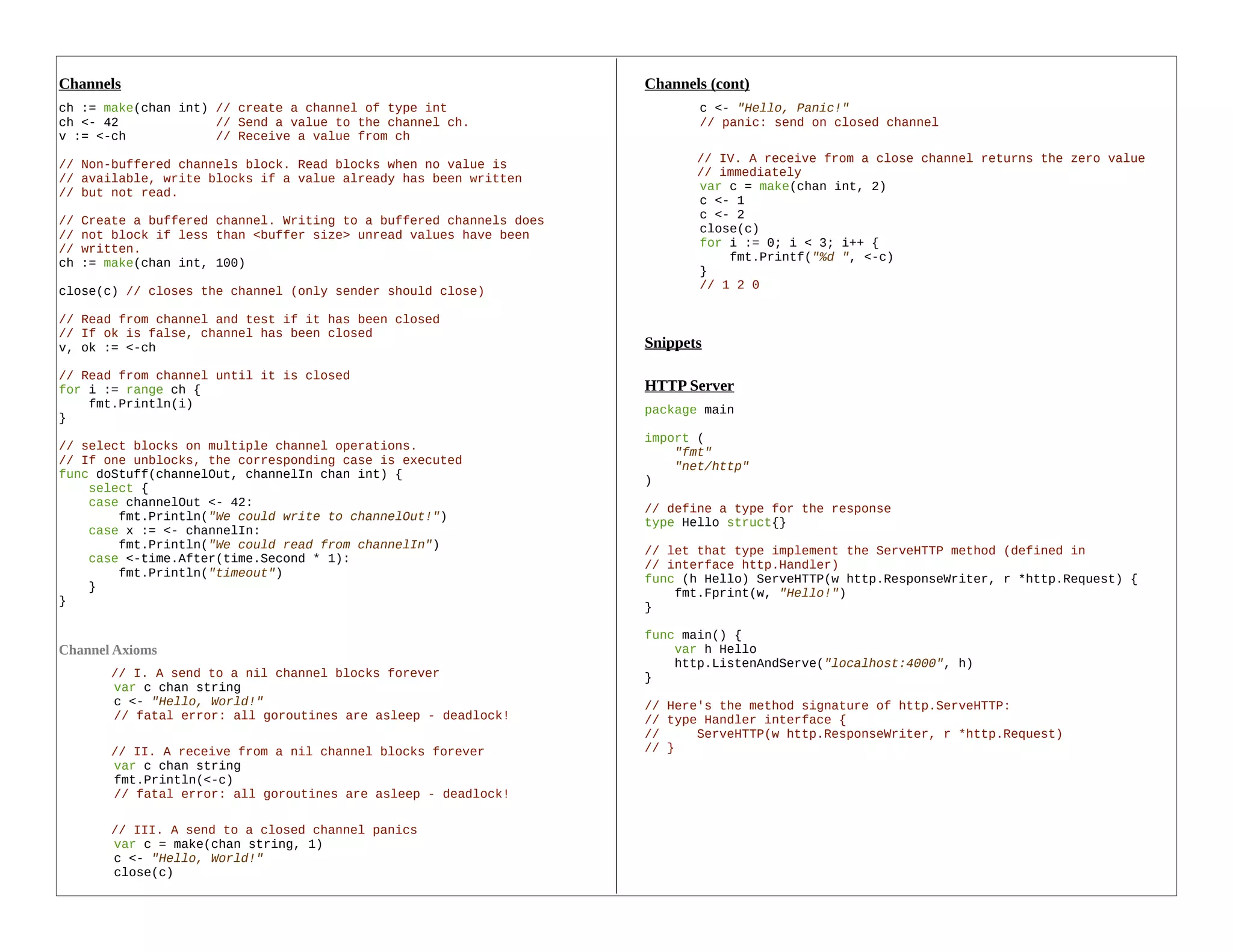
Channels
ch := make(chan int) // create a channel of type int
ch <- 42 // Send a value to the channel ch.
v := <-ch // Receive a value from ch
// Non-buffered channels block. Read blocks when no value is
// available, write blocks if a value already has been written
// but not read.
// Create a buffered channel. Writing to a buffered channels does
// not block if less than <buffer size> unread values have been
// written.
ch := make(chan int, 100)
close(c) // closes the channel (only sender should close)
// Read from channel and test if it has been closed
// If ok is false, channel has been closed
v, ok := <-ch
// Read from channel until it is closed
for i := range ch {
fmt.Println(i)
}
// select blocks on multiple channel operations.
// If one unblocks, the corresponding case is executed
func doStuff(channelOut, channelIn chan int) {
select {
case channelOut <- 42:
fmt.Println("We could write to channelOut!")
case x := <- channelIn:
fmt.Println("We could read from channelIn")
case <-time.After(time.Second * 1):
fmt.Println("timeout")
}
}
Channel Axioms
// I. A send to a nil channel blocks forever
var c chan string
c <- "Hello, World!"
// fatal error: all goroutines are asleep - deadlock!
// II. A receive from a nil channel blocks forever
var c chan string
fmt.Println(<-c)
// fatal error: all goroutines are asleep - deadlock!
// III. A send to a closed channel panics
var c = make(chan string, 1)
c <- "Hello, World!"
close(c)
Channels (cont)
c <- "Hello, Panic!"
// panic: send on closed channel
// IV. A receive from a close channel returns the zero value
// immediately
var c = make(chan int, 2)
c <- 1
c <- 2
close(c)
for i := 0; i < 3; i++ {
fmt.Printf("%d ", <-c)
}
// 1 2 0
Snippets
HTTP Server
package main
import (
"fmt"
"net/http"
)
// define a type for the response
type Hello struct{}
// let that type implement the ServeHTTP method (defined in
// interface http.Handler)
func (h Hello) ServeHTTP(w http.ResponseWriter, r *http.Request) {
fmt.Fprint(w, "Hello!")
}
func main() {
var h Hello
http.ListenAndServe("localhost:4000", h)
}
// Here's the method signature of http.ServeHTTP:
// type Handler interface {
// ServeHTTP(w http.ResponseWriter, r *http.Request)
// }

golang_refcard.pdf

  • 1.
    Go Cheat Sheet Credits Mostexample code taken from A Tour of Go, which is an excellent introduction to Go. If you're new to Go, do that tour. Seriously. Original HTML Cheat Sheet by Ariel Mashraki (a8m): https://github.com/a8m/go-lang-cheat-sheet Go in a Nutshell • Imperative language • Statically typed • Syntax similar to Java/C/C++, but less parentheses and no semicolons • Compiles to native code (no JVM) • No classes, but structs with methods • Interfaces • No implementation inheritance. There's type embedding, though. • Functions are first class citizens • Functions can return multiple values • Has closures • Pointers, but not pointer arithmetic • Built-in concurrency primitives: Goroutines and Channels Basic Syntax Hello World File hello.go: package main import "fmt" func main() { fmt.Println("Hello Go") } $ go run hello.go Operators Arithmetic Operator Description + addition - subtraction * multiplication / quotient % remainder & bitwise AND | bitwise OR ^ bitwise XOR &^ bit clear (AND NOT) << left shift >> right shift (logical) Comparison Operator Description == equal != not equal < less than <= less than or equal > greater than >= greater than or equal Logical Operator Description && logical AND || logical OR ! logical NOT Other Operator Description & address of / create pointer * dereference pointer <- send / receive operator (see 'Channels' below) Declarations Type goes after identifier! var foo int // declaration without initialization var foo int = 42 // declaration with initialization var foo, bar int = 42, 1302 // declare/init multiple vars at once var foo = 42 // type omitted, will be inferred foo := 42 // shorthand, only in func bodies, implicit type const constant = "This is a constant" Functions // a simple function func functionName() {} // function with parameters (again, types go after identifiers) func functionName(param1 string, param2 int) {} // multiple parameters of the same type func functionName(param1, param2 int) {}
  • 2.
    Functions (cont) // returntype declaration func functionName() int { return 42 } // Can return multiple values at once func returnMulti() (int, string) { return 42, "foobar" } var x, str = returnMulti() // Return multiple named results simply by return func returnMulti2() (n int, s string) { n = 42 s = "foobar" // n and s will be returned return } var x, str = returnMulti2() Functions As Values And Closures func main() { // assign a function to a name add := func(a, b int) int { return a + b } // use the name to call the function fmt.Println(add(3, 4)) } // Closures, lexically scoped: Functions can access values that were // in scope when defining the function func scope() func() int{ outer_var := 2 foo := func() int { return outer_var} return foo } func another_scope() func() int{ // won't compile - outer_var and foo not defined in this scope outer_var = 444 return foo } // Closures: don't mutate outer vars, instead redefine them! func outer() (func() int, int) { outer_var := 2 // NOTE outer_var is outside inner's scope inner := func() int { outer_var += 99 // attempt to mutate outer_var return outer_var // => 101 (but outer_var is a newly redefined // variable visible only inside inner) } return inner, outer_var // => 101, 2 (still!) } Functions (cont) Variadic Functions func main() { fmt.Println(adder(1, 2, 3)) // 6 fmt.Println(adder(9, 9)) // 18 nums := []int{10, 20, 30} fmt.Println(adder(nums...)) // 60 } // Using ... before the type name of the last parameter indicates // that it takes zero or more of those parameters. // The function is invoked like any other function except we can // pass as many arguments as we want. func adder(args ...int) int { total := 0 for _, v := range args { // Iterate over all args total += v } return total } Built-in Types bool string int int8 int16 int32 int64 uint uint8 uint16 uint32 uint64 uintptr byte // alias for uint8 rune // alias for int32 ~= (Unicode code point) - Very Viking float32 float64 complex64 complex128 Type Conversions var i int = 42 var f float64 = float64(i) var u uint = uint(f) // alternative syntax i := 42 f := float64(i) u := uint(f)
  • 3.
    Packages • package declarationat top of every source file • executables are in package main • convention: package name == last name of import path (import path math/rand => package rand) • upper case identifier: exported (visible from other packages) • Lower case identifier: private (not visible from other packages) Control structures If func main() { // Basic one if x > 0 { return x } else { return -x } // You can put one statement before the condition if a := b + c; a < 42 { return a } else { return a - 42 } // Type assertion inside if var val interface{} val = "foo" if str, ok := val.(string); ok { fmt.Println(str) } } Loops // There's only `for`. No `while`, no `until` for i := 1; i < 10; i++ { } for ; i < 10; { // while loop } for i < 10 { // can omit semicolons if there's only a condition } for { // can omit the condition ~ while (true) } Control structures (cont) Switch // switch statement switch operatingSystem { case "darwin": fmt.Println("Mac OS Hipster") // cases break automatically, no fallthrough by default case "linux": fmt.Println("Linux Geek") default: // Windows, BSD, ... fmt.Println("Other") } // As with for and if, an assignment statement before the // switch value is allowed switch os := runtime.GOOS; os { case "darwin": ... } Arrays, Slices, Ranges Arrays var a [10]int // int array with length 10. Length is part of type! a[3] = 42 // set elements i := a[3] // read elements // declare and initialize var a = [2]int{1, 2} a := [2]int{1, 2} //shorthand a := [...]int{1, 2} // elipsis -> Compiler figures out array length Slices var a []int // a slice – like an array, but length is unspecified var a = []int {1, 2, 3, 4} // declare and initialize a slice // (backed by given array implicitly) a := []int{1, 2, 3, 4} // shorthand chars := []string{0:"a", 2:"c", 1:"b"} // ["a", "b", "c"] var b = a[lo:hi] // creates a slice (view of the array) from // index lo to hi-1 var b = a[1:4] // slice from index 1 to 3 var b = a[:3] // missing low index implies 0 var b = a[3:] // missing high index implies len(a) // create a slice with make a = make([]byte, 5, 5) // first arg length, second capacity a = make([]byte, 5) // capacity is optional
  • 4.
    Arrays, Slices, Ranges(cont) // create a slice from an array x := [3]string{"Лайка", "Белка", "Стрелка"} s := x[:] // a slice referencing the storage of x Operations on Arrays and Slices len(a) gives you the length of an array/a slice. It's a built-in function, not a attribute/method on the array. // loop over an array/a slice for i, e := range a { // i is the index, e the element } // if you only need e: for _, e := range a { // e is the element } // ...and if you only need the index for i := range a { } // In Go pre-1.4, it is a compiler error to not use i and e. // Go 1.4 introduced a variable-free form: for range time.Tick(time.Second) { // do it once a sec } Maps var m map[string]int m = make(map[string]int) m["key"] = 42 fmt.Println(m["key"]) delete(m, "key") elem, ok := m["key"] // test if key "key" is present, retrieve if so // map literal var m = map[string]Vertex{ "Bell Labs": {40.68433, -74.39967}, "Google": {37.42202, -122.08408}, } Structs There are no classes, only structs. Structs can have methods. // A struct is a type. It's also a collection of fields // Declaration type Vertex struct { X, Y int } // Creating var v = Vertex{1, 2} var v = Vertex{X: 1, Y: 2} // Creates a struct by defining values // with keys // Accessing members v.X = 4 // You can declare methods on structs. The struct you want to declare // the method on (the receiving type) comes between the func keyword // and the method name. The struct is copied on each method call(!) func (v Vertex) Abs() float64 { return math.Sqrt(v.X*v.X + v.Y*v.Y) } // Call method v.Abs() // For mutating methods, you need to use a pointer (see below) to the // Struct as the type. With this, the struct value is not copied for // the method call. func (v *Vertex) add(n float64) { v.X += n v.Y += n } Anonymous structs Cheaper and safer than using map[string]interface{}. point := struct { X, Y int }{1, 2} Pointers p := Vertex{1, 2} // p is a Vertex q := &p // q is a pointer to a Vertex r := &Vertex{1, 2} // r is also a pointer to a Vertex // The type of a pointer to a Vertex is *Vertex var s *Vertex = new(Vertex) // create ptr to a new struct instance
  • 5.
    Interfaces // interface declaration typeAwesomizer interface { Awesomize() string } // types do *not* declare to implement interfaces type Foo struct {} // instead, types implicitly satisfy an interface if they implement all required methods func (foo Foo) Awesomize() string { return "Awesome!" } Embedding There is no subclassing in Go. Instead, there is interface and struct embedding (composition). // ReadWriter implementations must satisfy both Reader and Writer type ReadWriter interface { Reader Writer } // Server exposes all the methods that Logger has type Server struct { Host string Port int *log.Logger } // initialize the embedded type the usual way server := &Server{"localhost", 80, log.New(...)} // methods implemented on the embedded struct are passed through server.Log(...) // calls server.Logger.Log(...) // Field name of an embedded type is its type name ('Logger' here) var logger *log.Logger = server.Logger Errors There is no exception handling. Functions that might produce an error just declare an additional return value of type Error. This is the Error interface: type error interface { Error() string } Errors (cont) A function that might return an error: func doStuff() (int, error) { } func main() { result, error := doStuff() if (error != nil) { // handle error } else { // all is good, use result } } Concurrency Goroutines Goroutines are lightweight threads (managed by Go, not OS threads). go f(a, b) starts a new goroutine which runs f (given f is a function). // just a function (which can be later started as a goroutine) func doStuff(s string) { } func main() { // using a named function in a goroutine go doStuff("foobar") // using an anonymous inner function in a goroutine go func (x int) { // function body goes here }(42) }
  • 6.
    Channels ch := make(chanint) // create a channel of type int ch <- 42 // Send a value to the channel ch. v := <-ch // Receive a value from ch // Non-buffered channels block. Read blocks when no value is // available, write blocks if a value already has been written // but not read. // Create a buffered channel. Writing to a buffered channels does // not block if less than <buffer size> unread values have been // written. ch := make(chan int, 100) close(c) // closes the channel (only sender should close) // Read from channel and test if it has been closed // If ok is false, channel has been closed v, ok := <-ch // Read from channel until it is closed for i := range ch { fmt.Println(i) } // select blocks on multiple channel operations. // If one unblocks, the corresponding case is executed func doStuff(channelOut, channelIn chan int) { select { case channelOut <- 42: fmt.Println("We could write to channelOut!") case x := <- channelIn: fmt.Println("We could read from channelIn") case <-time.After(time.Second * 1): fmt.Println("timeout") } } Channel Axioms // I. A send to a nil channel blocks forever var c chan string c <- "Hello, World!" // fatal error: all goroutines are asleep - deadlock! // II. A receive from a nil channel blocks forever var c chan string fmt.Println(<-c) // fatal error: all goroutines are asleep - deadlock! // III. A send to a closed channel panics var c = make(chan string, 1) c <- "Hello, World!" close(c) Channels (cont) c <- "Hello, Panic!" // panic: send on closed channel // IV. A receive from a close channel returns the zero value // immediately var c = make(chan int, 2) c <- 1 c <- 2 close(c) for i := 0; i < 3; i++ { fmt.Printf("%d ", <-c) } // 1 2 0 Snippets HTTP Server package main import ( "fmt" "net/http" ) // define a type for the response type Hello struct{} // let that type implement the ServeHTTP method (defined in // interface http.Handler) func (h Hello) ServeHTTP(w http.ResponseWriter, r *http.Request) { fmt.Fprint(w, "Hello!") } func main() { var h Hello http.ListenAndServe("localhost:4000", h) } // Here's the method signature of http.ServeHTTP: // type Handler interface { // ServeHTTP(w http.ResponseWriter, r *http.Request) // }