What’s this “new” math? 
Quick 
Facts (and Opinions) on 
Common Core Math 
by Kristen Rose 
LVIS 4th Grade 
Google Images
The real issue is a rights issue, not a 
“math issue.” 
• 10th Amendment gives the states the right to 
control education 
– Most states adopted CCSS in 2010 
– Race to the Top was a federal money program that 
highly influenced most states to adopt CCSS 
• Backers of CCSS and backers of local standards 
are paying big money to sling mud, which is 
stirring uncertainty.
TIMSS Study 
Trends in Mathematics and Sciences Study 
• Happens every few years 
– 2011 was the latest 
• Tracks US 4th and 8th grade students in math 
and science compared to 40+ other countries 
• In 2011, 8 countries with scores higher than 
US in 4th grade math, 11 in 8th grade 
• Fact – US students have improved math scores 
since 1995 and 2007 studies 
• Opinion – We’re better than we look on paper.
TIMSS 2007 
When things started to change 
• TIMSS recorded thousands of teachers and 
classrooms around the world to compare and 
find strengths and weaknesses 
• Things that stuck out to me: 
– Teachers in other “top” countries put the 
responsibility of problem solving on the students 
instead of spoon feeding answers and using rote 
methods. 
– “Inch Deep, Mile Wide” vs. “Inch Wide, Mile 
Deep” became a major philosophy changer 
http://nces.ed.gov/timss/results11_math11.asp
Common Core Key Shifts in Math 
1. Greater focus on fewer topics 
– Fourth grade used to focus on over 5 different 
math strands, each with many subtopics. Now, our 
overarching focus is multiplication, division, and 
fractions 
2. Coherence: Linking topics and thinking across 
grades 
3. Rigor: Pursue conceptual understanding, 
procedural skills and fluency, and application 
with equal intensity
What CCSS has meant for me as a 
teacher… 
• Research to understand the change 
• Self education to deliver the new standards 
well and shift parent, student, and my thinking 
as painlessly as possible 
• Shifting myself from teaching students how to 
get an answer to teaching students how to 
think for themselves and apply what they 
know to solve complex problems. Yes, it’s been 
hard. It is getting a little easier.
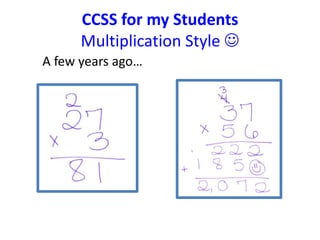
CCSS for my Students 
Multiplication Style  
A few years ago…
CCSS for my Students 
Multiplication Style  
Today’s method of madness: 
Building true understanding 
1 – Number sense, number sense, number sense 
2 – Modeling with manipulatives 
3 – Using conceptual methods 
(ways to solve problems) 
4 – Traditional methods 
5 – Application of skill
CCSS for my Students 
Multiplication Style  
Manipulatives – Place Value Chips 
Revisiting 27 x 3… 
Insert Place Value Chips Image 1
CCSS for my Students 
Multiplication Style  
Manipulatives – Place Value Chips 
Regrouped 
Insert Place Value Chips Image 2
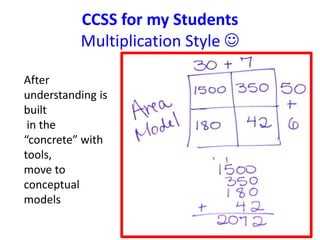
CCSS for my Students 
Multiplication Style  
After 
understanding is 
built 
in the 
“concrete” with 
tools, 
move to 
conceptual 
models
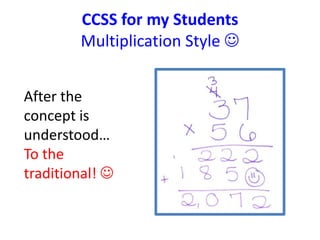
CCSS for my Students 
Multiplication Style  
After the 
concept is 
understood… 
To the 
traditional! 
CCSS for my Students 
Multiplication Style  
After the concept is understood… To the 
traditional!  
Some students continue to use the 
conceptual models, some use traditional 
models. The key to success is ending up 
at the same location, no matter the route 
taken. In my classes, it’s been about 
50/50.
CCSS for my Students 
Multiplication Style  
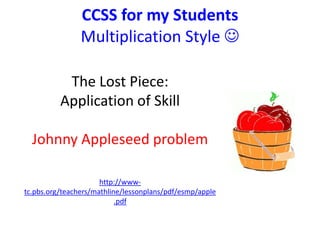
The Lost Piece: 
Application of Skill 
Johnny Appleseed problem 
http://www-tc. 
pbs.org/teachers/mathline/lessonplans/pdf/esmp/apple 
.pdf
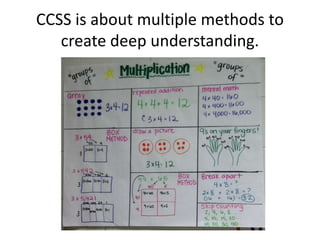
CCSS is about multiple methods to 
create deep understanding.
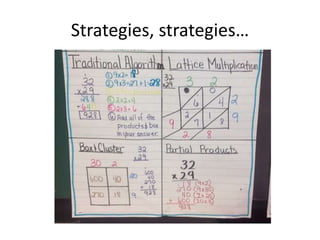
Strategies, strategies…

Common core presentation

  • 1.
    What’s this “new”math? Quick Facts (and Opinions) on Common Core Math by Kristen Rose LVIS 4th Grade Google Images
  • 2.
    The real issueis a rights issue, not a “math issue.” • 10th Amendment gives the states the right to control education – Most states adopted CCSS in 2010 – Race to the Top was a federal money program that highly influenced most states to adopt CCSS • Backers of CCSS and backers of local standards are paying big money to sling mud, which is stirring uncertainty.
  • 3.
    TIMSS Study Trendsin Mathematics and Sciences Study • Happens every few years – 2011 was the latest • Tracks US 4th and 8th grade students in math and science compared to 40+ other countries • In 2011, 8 countries with scores higher than US in 4th grade math, 11 in 8th grade • Fact – US students have improved math scores since 1995 and 2007 studies • Opinion – We’re better than we look on paper.
  • 4.
    TIMSS 2007 Whenthings started to change • TIMSS recorded thousands of teachers and classrooms around the world to compare and find strengths and weaknesses • Things that stuck out to me: – Teachers in other “top” countries put the responsibility of problem solving on the students instead of spoon feeding answers and using rote methods. – “Inch Deep, Mile Wide” vs. “Inch Wide, Mile Deep” became a major philosophy changer http://nces.ed.gov/timss/results11_math11.asp
  • 5.
    Common Core KeyShifts in Math 1. Greater focus on fewer topics – Fourth grade used to focus on over 5 different math strands, each with many subtopics. Now, our overarching focus is multiplication, division, and fractions 2. Coherence: Linking topics and thinking across grades 3. Rigor: Pursue conceptual understanding, procedural skills and fluency, and application with equal intensity
  • 6.
    What CCSS hasmeant for me as a teacher… • Research to understand the change • Self education to deliver the new standards well and shift parent, student, and my thinking as painlessly as possible • Shifting myself from teaching students how to get an answer to teaching students how to think for themselves and apply what they know to solve complex problems. Yes, it’s been hard. It is getting a little easier.
  • 7.
    CCSS for myStudents Multiplication Style  A few years ago…
  • 8.
    CCSS for myStudents Multiplication Style  Today’s method of madness: Building true understanding 1 – Number sense, number sense, number sense 2 – Modeling with manipulatives 3 – Using conceptual methods (ways to solve problems) 4 – Traditional methods 5 – Application of skill
  • 9.
    CCSS for myStudents Multiplication Style  Manipulatives – Place Value Chips Revisiting 27 x 3… Insert Place Value Chips Image 1
  • 10.
    CCSS for myStudents Multiplication Style  Manipulatives – Place Value Chips Regrouped Insert Place Value Chips Image 2
  • 11.
    CCSS for myStudents Multiplication Style  After understanding is built in the “concrete” with tools, move to conceptual models
  • 12.
    CCSS for myStudents Multiplication Style  After the concept is understood… To the traditional! 
  • 13.
    CCSS for myStudents Multiplication Style  After the concept is understood… To the traditional!  Some students continue to use the conceptual models, some use traditional models. The key to success is ending up at the same location, no matter the route taken. In my classes, it’s been about 50/50.
  • 14.
    CCSS for myStudents Multiplication Style  The Lost Piece: Application of Skill Johnny Appleseed problem http://www-tc. pbs.org/teachers/mathline/lessonplans/pdf/esmp/apple .pdf
  • 15.
    CCSS is aboutmultiple methods to create deep understanding.
  • 16.