Commercialization of Industrial Services
PD Dr. HeikoGebauer
Offering services ‘free of charge’ is a common practice in
manufacturing companies
Charging for services Examples
0% 20% 40% 60% 80% 100%
Employees
< 150
Employees
> 150
Overall
Percentage of services offered
Goodwill (for free)
Cost coverage
Profitable
Best practices
Second-hand product services
Traditional services such as spare parts,
repair, inspection, and maintenance
Disassembling, recycling, disposal services
Preventive maintenance contracts
Operational services
Need for actions
Marketing services
Business and technical consulting
Just-in-Time delivery services
Design and construction services
Cost-benefit analysis
Feasibility studies
Source: Swissmen – Wachstum durch Dienstleistungen (2005)
‚Free of charge services‘ limit service profitability and service
revenues
Service profitability Share of service revenue on total revenue
26%
29%
19%
14%
12%
0%
10%
20%
30%
40%
Totally
agree
Totally
disaggree
Percentage
Service offerings are profitable
0%
10%
20%
30%
40%
0-10%
10-20%
20-30%
30-40%
>40%
Share of service revenues
Percentage
Source: Swissmen – Wachstum durch Dienstleistungen (2005)
Companies need distinct criteria to decided between charging for
services or giving them away for free
Charging services separately
47 %
28 %9 %No
Yes
N = 44
Relatively highRelatively low
14 %
Criteria to distinct
services according how
to charge them
Source: TECTEM (2001): The benchmarking project Commercialization of industrial services - Final report, TECTEM, St. Gallen, Switzerland.
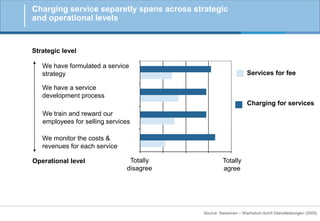
Charging service separetly spans across strategic
and operational levels
We train and reward our
employees for selling services
We monitor the costs &
revenues for each service
We have formulated a service
strategy
Totally
disagree
Services for fee
Charging for services
Totally
agree
Source: Swissmen – Wachstum durch Dienstleistungen (2005)
We have a service
development process
Strategic level
Operational level
How can companies start charging for services in
a more profitable way?
Selling services more profitable Building blocks for service commercialization
1) Recognizing that the company is
already in the service business
2) Industrializing internal service
processes
3) Creating a service-orientated sales
force
4) Focusing on customer processes
Source: Adaptedfrom Reinartz &Ulaga (2008, p. 95).
Service marketing
(external
communication)
Service culture
(internal
communication)
Cost
transparency
Service pricing
Source: Dietrich et al.. 2001.
Selling services more profitable (1)
1) Recognizing that the company
already deals with services
2) Industrializing internal service
processes
Key issues How do we currently sell services
across business units and
countries?
What are the best practices inside
our organisation?
Which services can be moved from
free to fee?
Which services are profit
generators/drains?
How can we ensure cost-efficient
service processes?
How can we tailor services to meet
customers’ needs?
Key goals To draw up a list of services we
currently provide to customers.
To generate revenue from easily
chargeable services.
To appoint a senior executive to
oversee the development of
service capabilities.
To standardise service processes
and control mechanisms.
To establish service platforms
flexible enough to meet the needs
of individual customers.
Source: Adaptedfrom Reinartz &Ulaga (2008, p. 95).
Selling services more profitable (2)
3) Creating a service-oriented sales
force
4) Focusing on customer processes
Key issues Is our sales force ready to
promote services along with
products?
Can we explain the benefits of our
services to customers?
Are we willing to move to longer
sales cycles?
Are our offerings aligned with the
goals and processes of our
customers?
Can we address their problems
holistically?
What further expertise do we need
Key goals To improve service-selling skills or
organise separate sales forces.
To instate incentive systems
promoting the sales of services.
To adopt tools for documenting
value and communicating it to
customers.
To describe in detail the core
concerns and operating processes
of our customers.
To shift performance indicators from
being activity-based to result-
orientated instead.
To draw up a checklist of the
capabilities necessary to
Source: Adaptedfrom Reinartz &Ulaga (2008, p. 95).
How can companies start charging for services in
a more profitable way?
Selling services more profitable Building blocks for service commercialization
1) Recognizing that the company is
already in the service business
2) Industrializing internal service
processes
3) Creating a service-orientated sales
force
4) Focusing on customer processes
Source: Adaptedfrom Reinartz &Ulaga (2008, p. 95).
Service marketing
(external
communication)
Service culture
(internal
communication)
Cost
transparency
Service pricing
Source: Dietrich et al.. 2001.
Service pricing options
Pricing
• Competitor
• Costs
• Benefit / Value
• Strategy
Pricing considerations
Price differentiation
Price bundling
Goodwill Price premium Separate charges
Service pricing: strategic options
Service pricing: operative options
Source: Schuh, Günther; Friedli, Thomas; Gebauer, Heiko (2004): Fit for Service: Industrie als Dienstleister. München : Hanser Verlag, 2004
Hands-on approach helps companies to improve
the commercialization of services
4. Developing solutions for
overcoming the barriers and
exploiting the enablers
3. Identification of barriers and
enablers for the commercialization
1. Analyzing the existing situation
2. Setting objectives for the
commercialization of services
Source: Schuh, Günther; Friedli, Thomas; Gebauer, Heiko (2004): Fit for Service: Industrie als Dienstleister. München : Hanser Verlag, 2004
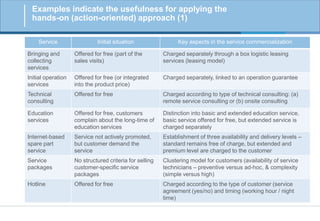
Examples indicate the usefulness for applying the
hands-on (action-oriented) approach (1)
Service Initial situation Key aspects in the service commercialization
Bringing and
collecting
services
Offered for free (part of the
sales visits)
Charged separately through a box logistic leasing
services (leasing model)
Initial operation
services
Offered for free (or integrated
into the product price)
Charged separately, linked to an operation guarantee
Technical
consulting
Offered for free Charged according to type of technical consulting: (a)
remote service consulting or (b) onsite consulting
Education
services
Offered for free, customers
complain about the long-time of
education services
Distinction into basic and extended education service,
basic service offered for free, but extended service is
charged separately
Internet-based
spare part
service
Service not actively promoted,
but customer demand the
service
Establishment of three availability and delivery levels –
standard remains free of charge, but extended and
premium level are charged to the customer
Service
packages
No structured criteria for selling
customer-specific service
packages
Clustering model for customers (availability of service
technicians – preventive versus ad-hoc, & complexity
(simple versus high)
Hotline Offered for free Charged according to the type of customer (service
agreement (yes/no) and timing (working hour / night
time)
Examples indicate the usefulness for applying the
hands-on (action-oriented) approach (2)
Service Initial situation Key aspects in the service commercialization
Hotline Offered for free Charged according to the type of customer call: (a) technical
consulting (first 15 minutes for free, more than 15 minutes fixed
consulting fee) (b) spare parts order – hotline costs covered by
spare parts price, (c) troubling shooting integrated into the repair
costs, (d) sales information remains free
Distributor
education
Offered for free (part of
distributor agreements)
Charged according to the success of distributors – (highly
successful distributor have to pay for education, but get a
discount for products, whereas less successful distributors pay
for the services, but do not get the discount, new distributors get
initial education for free)
Operator
training
Offered for free during
the installation
Charged separately as extended operator training, which is now
provided by specialists rather than the service technicians
QuickScan
inspection
Not offered (new
service)
Charged separately (cost coverage, no profit)
Customer
seminars
Offered for free Charged separately
Service level
agreements
Unstructured charges
for individual services
Charged separately through semi-fixed service level prices
(basic, extended, professional), semi-fixed means that there are
fix and variable costs (e.g. exchange parts)
Technical
feasibility
study
Offered for free (part of
the sales process)
Charges separately, but service charges are credited for the
product sales
Unaxis
Service level agreements and service pricing
Pre-SalesServices
- Installations layout
- Expositions / Trade fairs
- Documentation
- Engineering
- Professional articles
in magazines
- Calculations support
- Reference visits
- Seminars on professions
- Technical consulting
(Projects, Installations,
Commissioning,
Service, Service contracts,
Monthly sessions)
- Technological tests
- Technology consulting
SalesServices
- Documentation
- Spare parts contracts
- Warranty services
- Installation, Commissioning
- Projection
- Realisation of projects
- Training
- Special development
- Transport organisation
- Transport insurance
-
-
Translation of manuals
CD ROM Documentation
Pre-inspection-
After SalesServices
-
-
24 hours spare parts supply
24 hours hotline
- Old machinery maintenance
- Adjustments to existing
installations (Upgrade)
-
-
Education: Know-how transfer
Education: start-up package
-
-
Users training
Consulting
-
-
Documentation
Spare parts warehouse at the
customer`s location
- Electronic spare parts list
- Documentation
- Sale of spare parts
- Professional disposal of
damaged parts
-
-
Inspections
Inspection contracts
- Technical service within 24
hours
- Repairs
-
-
Trainings
Software adjustments
- Upgrades, conversions
- Maintenance
- Maintenance contract
(Modules),
Maintenance Unscheduled Maintenance
Scheduled Maintenance
Training
Training during
installation
Subsequent training
Training for new personnel
Spare parts Consumables
Other spare parts
Exchange program
Spare parts recycling
Repair of spare parts
Global spare parts management
Phase out
Kaeser compressors
Simply define a pricing approach for services
Initial product price Sales not including
services
Sales Discount
Sales including a pricing
approach for services
Spare parts and
preventive maintenance
Sales Discount
DrägerSafety
Commercializing of single services
Bringing and collecting services (the “Pendelbox)
 Additional revenue: 150‘000 CHF per year
 Investments – 3 working day (3’000 CHF) and box costs (5’000 CHF)
Safety certificates
 Additional revenue: 30’000 CHF
 Investment costs: 3’000 CHF
Educational services (Tunnel fire fighting)
 Additional revenue: 1’000’000 CHF
 Investment costs: 50 working days and 45’000 CHF
Conclusion
 Commercializing services is very complex and requires the analysis
of each single service
 Services can be turned from offered for „free“ to be charged
separately
 Service strategy, service culture, service marketing, and service
development are important enablers for the commercialization of
services
 Charging for services might disappoint customers, can face internal
resistance, and can lead to product price reductions
 Nevertheless, charging for services opens-up new sources of
revenue and/or can lead to cost improvements
 „What customer‘s don‘t pay for are not valued“

Commercialization

  • 1.
    Commercialization of IndustrialServices PD Dr. HeikoGebauer
  • 2.
    Offering services ‘freeof charge’ is a common practice in manufacturing companies Charging for services Examples 0% 20% 40% 60% 80% 100% Employees < 150 Employees > 150 Overall Percentage of services offered Goodwill (for free) Cost coverage Profitable Best practices Second-hand product services Traditional services such as spare parts, repair, inspection, and maintenance Disassembling, recycling, disposal services Preventive maintenance contracts Operational services Need for actions Marketing services Business and technical consulting Just-in-Time delivery services Design and construction services Cost-benefit analysis Feasibility studies Source: Swissmen – Wachstum durch Dienstleistungen (2005)
  • 3.
    ‚Free of chargeservices‘ limit service profitability and service revenues Service profitability Share of service revenue on total revenue 26% 29% 19% 14% 12% 0% 10% 20% 30% 40% Totally agree Totally disaggree Percentage Service offerings are profitable 0% 10% 20% 30% 40% 0-10% 10-20% 20-30% 30-40% >40% Share of service revenues Percentage Source: Swissmen – Wachstum durch Dienstleistungen (2005)
  • 4.
    Companies need distinctcriteria to decided between charging for services or giving them away for free Charging services separately 47 % 28 %9 %No Yes N = 44 Relatively highRelatively low 14 % Criteria to distinct services according how to charge them Source: TECTEM (2001): The benchmarking project Commercialization of industrial services - Final report, TECTEM, St. Gallen, Switzerland.
  • 5.
    Charging service separetlyspans across strategic and operational levels We train and reward our employees for selling services We monitor the costs & revenues for each service We have formulated a service strategy Totally disagree Services for fee Charging for services Totally agree Source: Swissmen – Wachstum durch Dienstleistungen (2005) We have a service development process Strategic level Operational level
  • 6.
    How can companiesstart charging for services in a more profitable way? Selling services more profitable Building blocks for service commercialization 1) Recognizing that the company is already in the service business 2) Industrializing internal service processes 3) Creating a service-orientated sales force 4) Focusing on customer processes Source: Adaptedfrom Reinartz &Ulaga (2008, p. 95). Service marketing (external communication) Service culture (internal communication) Cost transparency Service pricing Source: Dietrich et al.. 2001.
  • 7.
    Selling services moreprofitable (1) 1) Recognizing that the company already deals with services 2) Industrializing internal service processes Key issues How do we currently sell services across business units and countries? What are the best practices inside our organisation? Which services can be moved from free to fee? Which services are profit generators/drains? How can we ensure cost-efficient service processes? How can we tailor services to meet customers’ needs? Key goals To draw up a list of services we currently provide to customers. To generate revenue from easily chargeable services. To appoint a senior executive to oversee the development of service capabilities. To standardise service processes and control mechanisms. To establish service platforms flexible enough to meet the needs of individual customers. Source: Adaptedfrom Reinartz &Ulaga (2008, p. 95).
  • 8.
    Selling services moreprofitable (2) 3) Creating a service-oriented sales force 4) Focusing on customer processes Key issues Is our sales force ready to promote services along with products? Can we explain the benefits of our services to customers? Are we willing to move to longer sales cycles? Are our offerings aligned with the goals and processes of our customers? Can we address their problems holistically? What further expertise do we need Key goals To improve service-selling skills or organise separate sales forces. To instate incentive systems promoting the sales of services. To adopt tools for documenting value and communicating it to customers. To describe in detail the core concerns and operating processes of our customers. To shift performance indicators from being activity-based to result- orientated instead. To draw up a checklist of the capabilities necessary to Source: Adaptedfrom Reinartz &Ulaga (2008, p. 95).
  • 9.
    How can companiesstart charging for services in a more profitable way? Selling services more profitable Building blocks for service commercialization 1) Recognizing that the company is already in the service business 2) Industrializing internal service processes 3) Creating a service-orientated sales force 4) Focusing on customer processes Source: Adaptedfrom Reinartz &Ulaga (2008, p. 95). Service marketing (external communication) Service culture (internal communication) Cost transparency Service pricing Source: Dietrich et al.. 2001.
  • 10.
    Service pricing options Pricing •Competitor • Costs • Benefit / Value • Strategy Pricing considerations Price differentiation Price bundling Goodwill Price premium Separate charges Service pricing: strategic options Service pricing: operative options Source: Schuh, Günther; Friedli, Thomas; Gebauer, Heiko (2004): Fit for Service: Industrie als Dienstleister. München : Hanser Verlag, 2004
  • 11.
    Hands-on approach helpscompanies to improve the commercialization of services 4. Developing solutions for overcoming the barriers and exploiting the enablers 3. Identification of barriers and enablers for the commercialization 1. Analyzing the existing situation 2. Setting objectives for the commercialization of services Source: Schuh, Günther; Friedli, Thomas; Gebauer, Heiko (2004): Fit for Service: Industrie als Dienstleister. München : Hanser Verlag, 2004
  • 12.
    Examples indicate theusefulness for applying the hands-on (action-oriented) approach (1) Service Initial situation Key aspects in the service commercialization Bringing and collecting services Offered for free (part of the sales visits) Charged separately through a box logistic leasing services (leasing model) Initial operation services Offered for free (or integrated into the product price) Charged separately, linked to an operation guarantee Technical consulting Offered for free Charged according to type of technical consulting: (a) remote service consulting or (b) onsite consulting Education services Offered for free, customers complain about the long-time of education services Distinction into basic and extended education service, basic service offered for free, but extended service is charged separately Internet-based spare part service Service not actively promoted, but customer demand the service Establishment of three availability and delivery levels – standard remains free of charge, but extended and premium level are charged to the customer Service packages No structured criteria for selling customer-specific service packages Clustering model for customers (availability of service technicians – preventive versus ad-hoc, & complexity (simple versus high) Hotline Offered for free Charged according to the type of customer (service agreement (yes/no) and timing (working hour / night time)
  • 13.
    Examples indicate theusefulness for applying the hands-on (action-oriented) approach (2) Service Initial situation Key aspects in the service commercialization Hotline Offered for free Charged according to the type of customer call: (a) technical consulting (first 15 minutes for free, more than 15 minutes fixed consulting fee) (b) spare parts order – hotline costs covered by spare parts price, (c) troubling shooting integrated into the repair costs, (d) sales information remains free Distributor education Offered for free (part of distributor agreements) Charged according to the success of distributors – (highly successful distributor have to pay for education, but get a discount for products, whereas less successful distributors pay for the services, but do not get the discount, new distributors get initial education for free) Operator training Offered for free during the installation Charged separately as extended operator training, which is now provided by specialists rather than the service technicians QuickScan inspection Not offered (new service) Charged separately (cost coverage, no profit) Customer seminars Offered for free Charged separately Service level agreements Unstructured charges for individual services Charged separately through semi-fixed service level prices (basic, extended, professional), semi-fixed means that there are fix and variable costs (e.g. exchange parts) Technical feasibility study Offered for free (part of the sales process) Charges separately, but service charges are credited for the product sales
  • 14.
    Unaxis Service level agreementsand service pricing Pre-SalesServices - Installations layout - Expositions / Trade fairs - Documentation - Engineering - Professional articles in magazines - Calculations support - Reference visits - Seminars on professions - Technical consulting (Projects, Installations, Commissioning, Service, Service contracts, Monthly sessions) - Technological tests - Technology consulting SalesServices - Documentation - Spare parts contracts - Warranty services - Installation, Commissioning - Projection - Realisation of projects - Training - Special development - Transport organisation - Transport insurance - - Translation of manuals CD ROM Documentation Pre-inspection- After SalesServices - - 24 hours spare parts supply 24 hours hotline - Old machinery maintenance - Adjustments to existing installations (Upgrade) - - Education: Know-how transfer Education: start-up package - - Users training Consulting - - Documentation Spare parts warehouse at the customer`s location - Electronic spare parts list - Documentation - Sale of spare parts - Professional disposal of damaged parts - - Inspections Inspection contracts - Technical service within 24 hours - Repairs - - Trainings Software adjustments - Upgrades, conversions - Maintenance - Maintenance contract (Modules), Maintenance Unscheduled Maintenance Scheduled Maintenance Training Training during installation Subsequent training Training for new personnel Spare parts Consumables Other spare parts Exchange program Spare parts recycling Repair of spare parts Global spare parts management Phase out
  • 15.
    Kaeser compressors Simply definea pricing approach for services Initial product price Sales not including services Sales Discount Sales including a pricing approach for services Spare parts and preventive maintenance Sales Discount
  • 16.
    DrägerSafety Commercializing of singleservices Bringing and collecting services (the “Pendelbox)  Additional revenue: 150‘000 CHF per year  Investments – 3 working day (3’000 CHF) and box costs (5’000 CHF) Safety certificates  Additional revenue: 30’000 CHF  Investment costs: 3’000 CHF Educational services (Tunnel fire fighting)  Additional revenue: 1’000’000 CHF  Investment costs: 50 working days and 45’000 CHF
  • 17.
    Conclusion  Commercializing servicesis very complex and requires the analysis of each single service  Services can be turned from offered for „free“ to be charged separately  Service strategy, service culture, service marketing, and service development are important enablers for the commercialization of services  Charging for services might disappoint customers, can face internal resistance, and can lead to product price reductions  Nevertheless, charging for services opens-up new sources of revenue and/or can lead to cost improvements  „What customer‘s don‘t pay for are not valued“