Short Course : July 2013
By Prof S K Palekar
3 Sessions on Services Marketing
Audience : PGDM – IM
The objective is to prepare you for consulting, business
development and operations roles in IT and ITES industries
These slides will be put up on http://
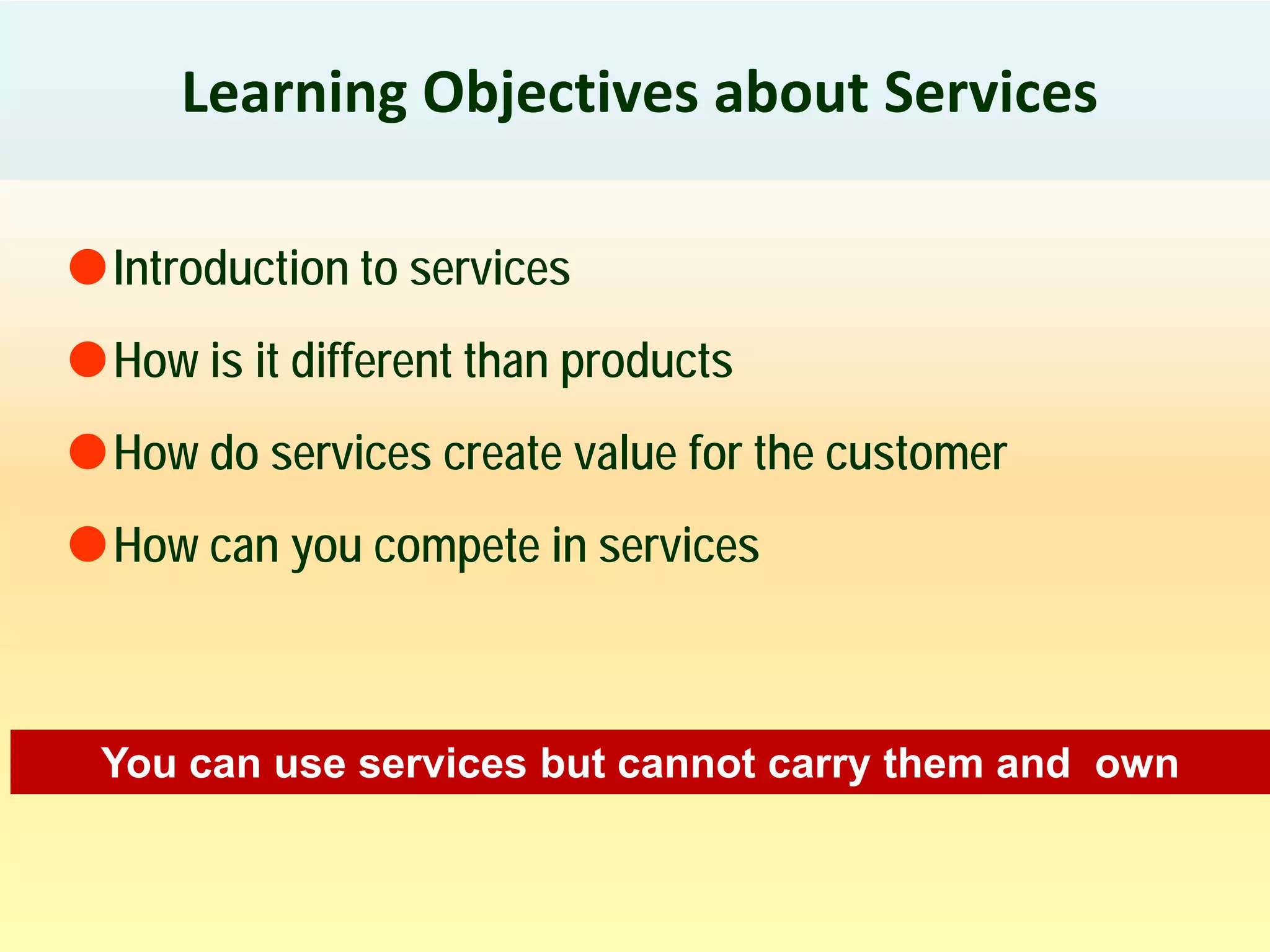
Learning Objectives about Services
Introduction to services
How is it different than products
How do services create value for the customer
How can you compete in services
You can use services but cannot carry them and own
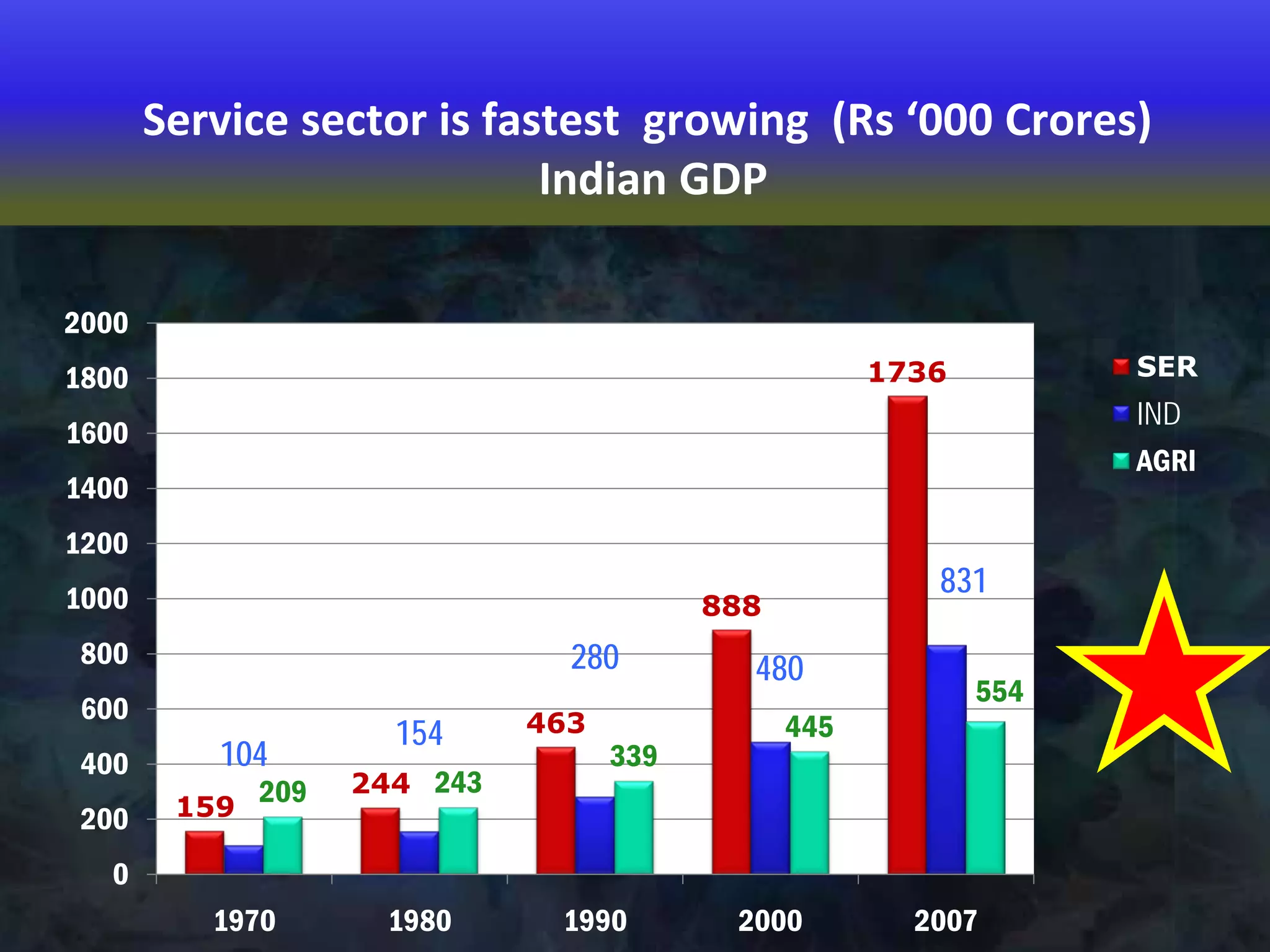
Service sector is fastest growing (Rs ‘000 Crores)
Indian GDP
159
244
463
888
1736
104
154
280 480
831
209 243
339
445
554
0
200
400
600
800
1000
1200
1400
1600
1800
2000
1970 1980 1990 2000 2007
SER
IND
AGRI
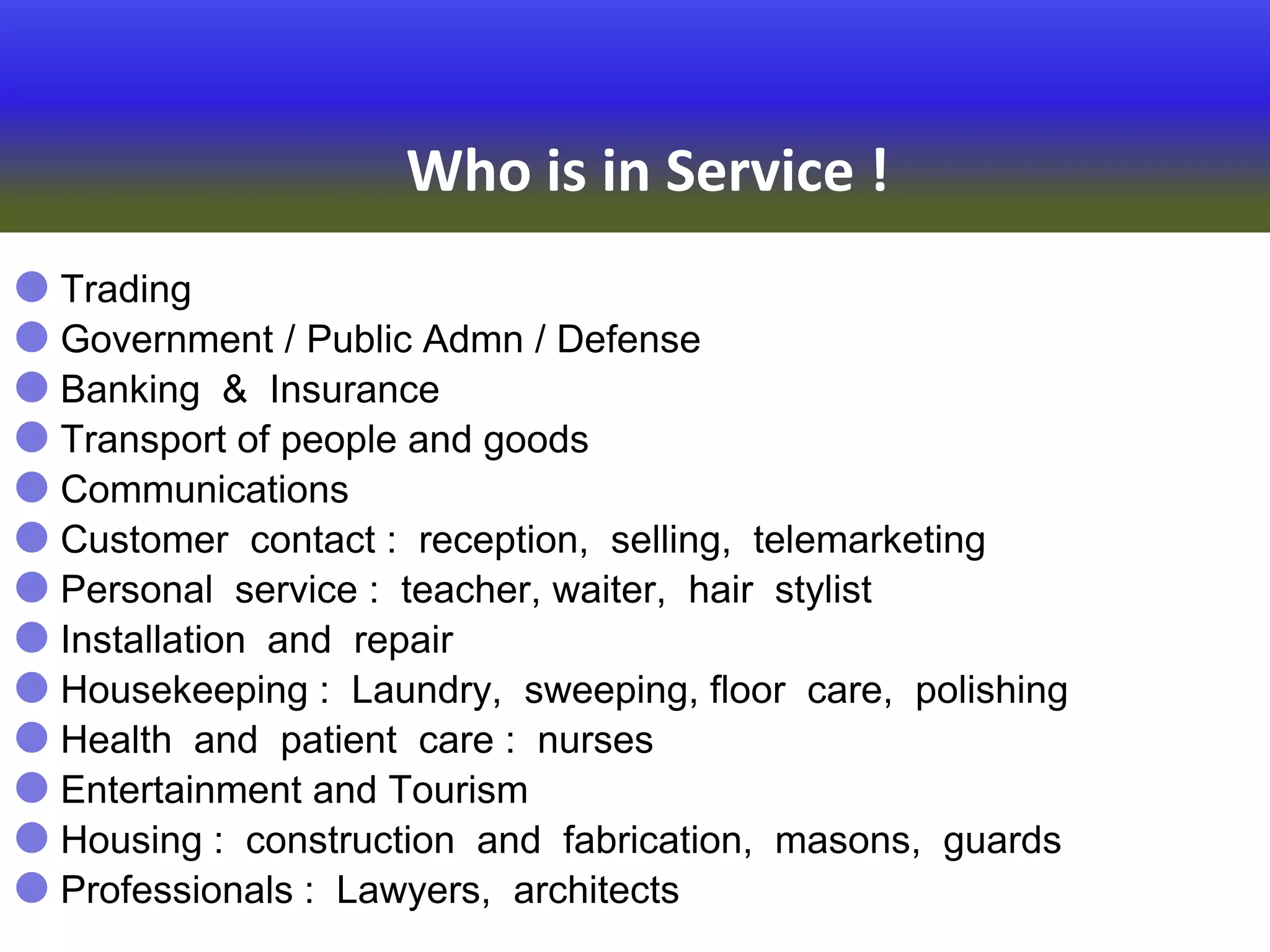
Who is in Service !
 Trading
 Government / Public Admn / Defense
 Banking & Insurance
 Transport of people and goods
 Communications
 Customer contact : reception, selling, telemarketing
 Personal service : teacher, waiter, hair stylist
 Installation and repair
 Housekeeping : Laundry, sweeping, floor care, polishing
 Health and patient care : nurses
 Entertainment and Tourism
 Housing : construction and fabrication, masons, guards
 Professionals : Lawyers, architects
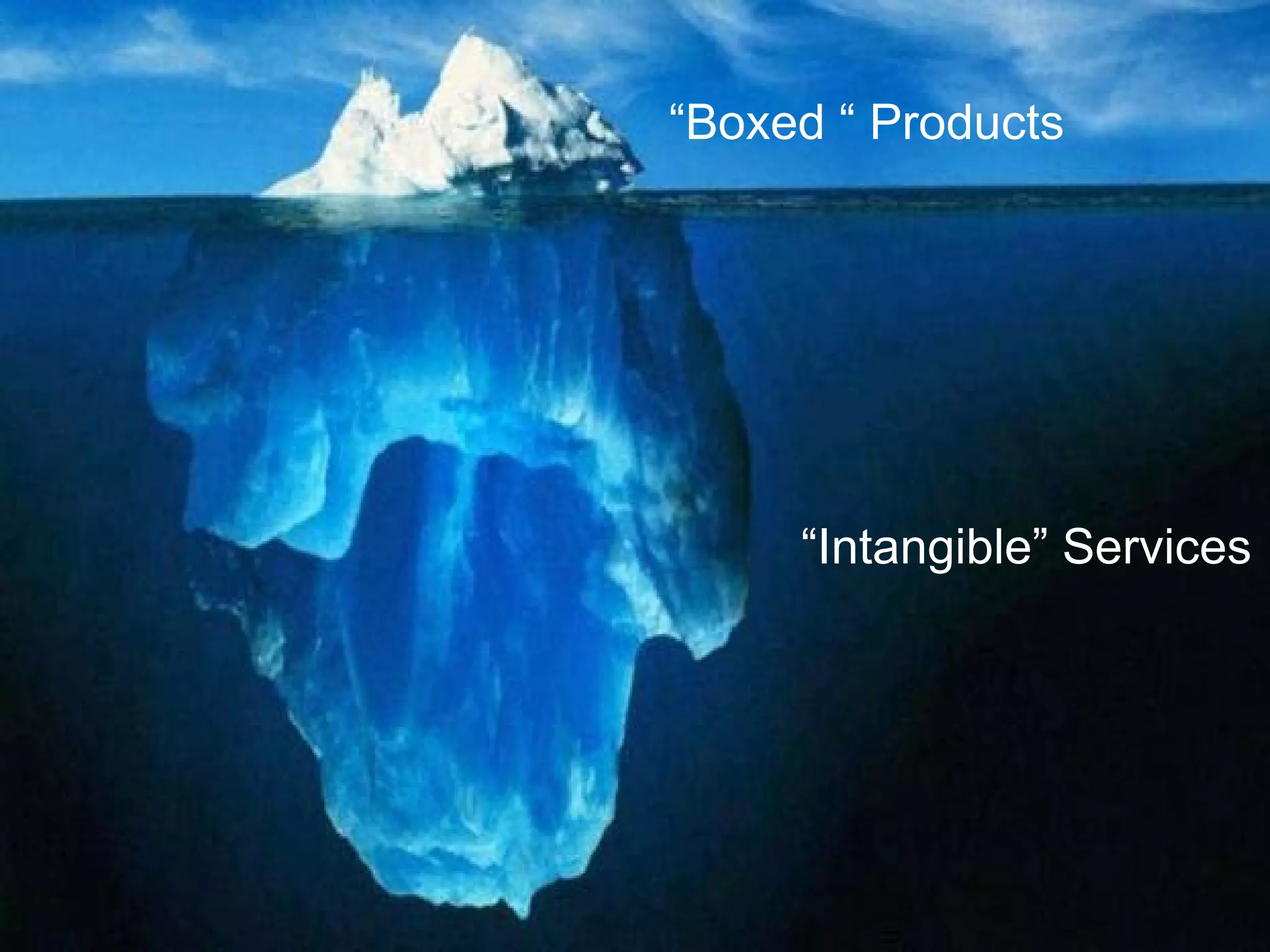
“Boxed “ Products
“Intangible” Services
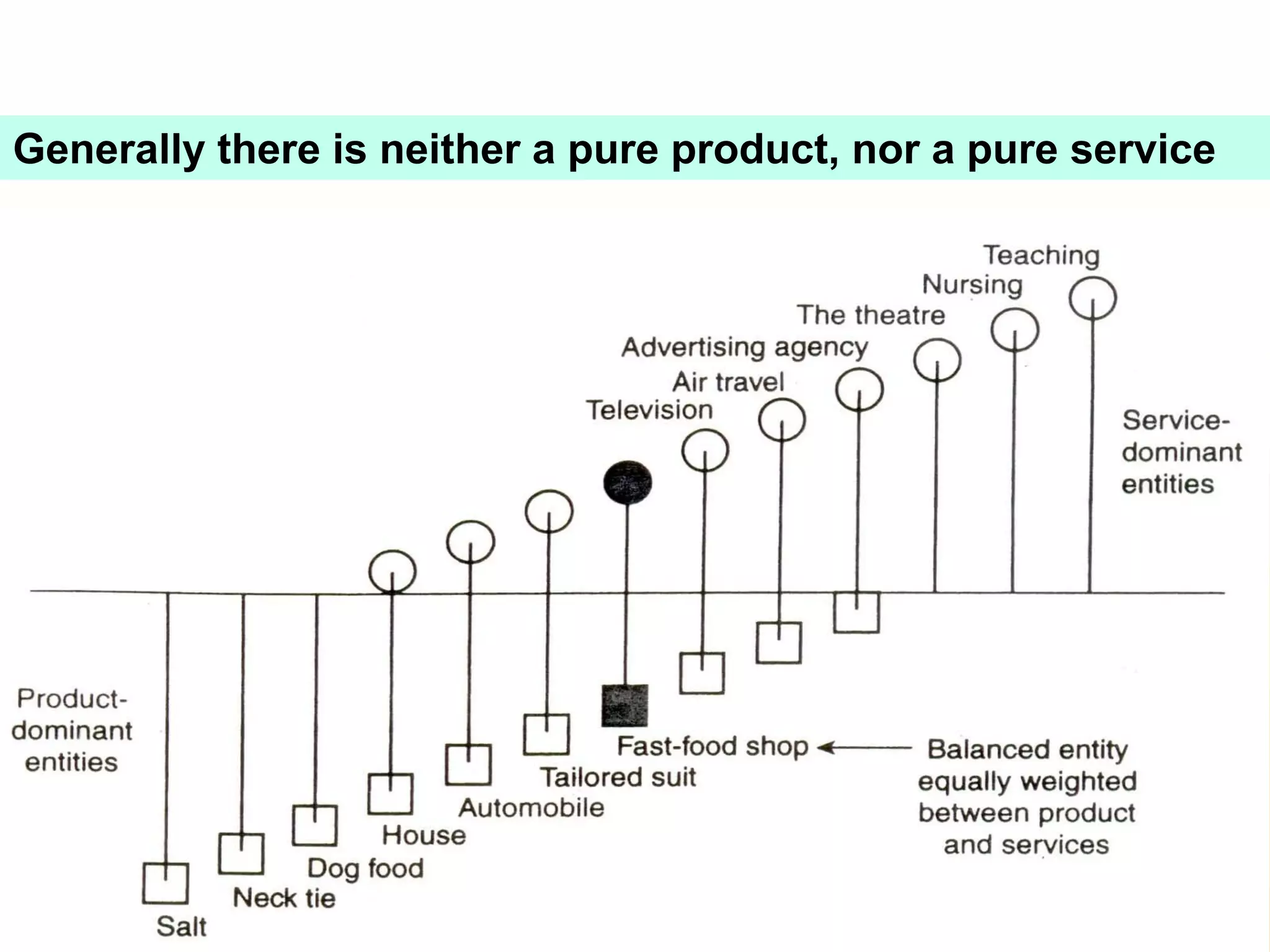
Generally there is neither a pure product, nor a pure service
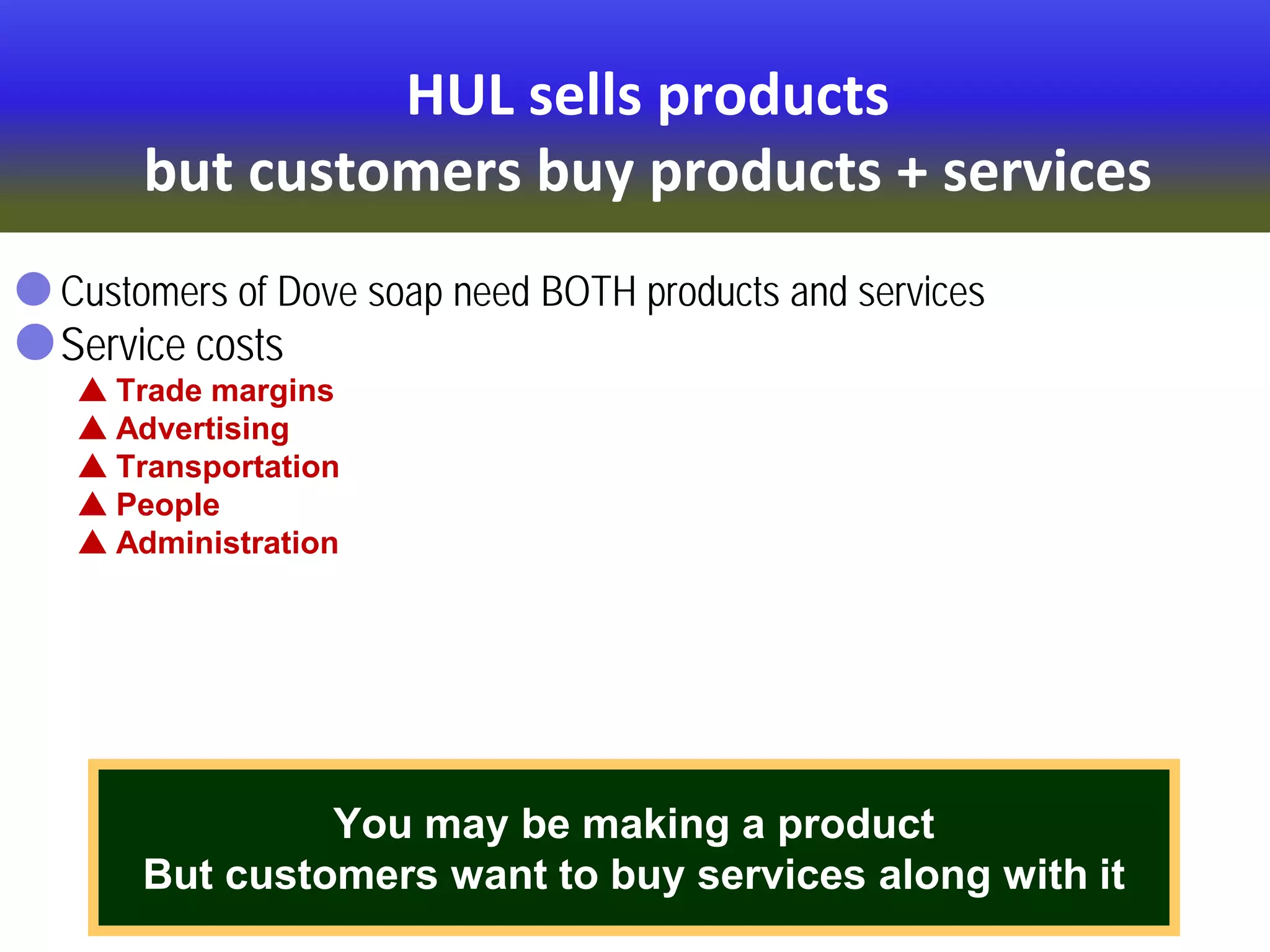
HUL sells products
but customers buy products + services
Customers of Dove soap need BOTH products and services
Service costs
 Trade margins
 Advertising
 Transportation
 People
 Administration
You may be making a product
But customers want to buy services along with it
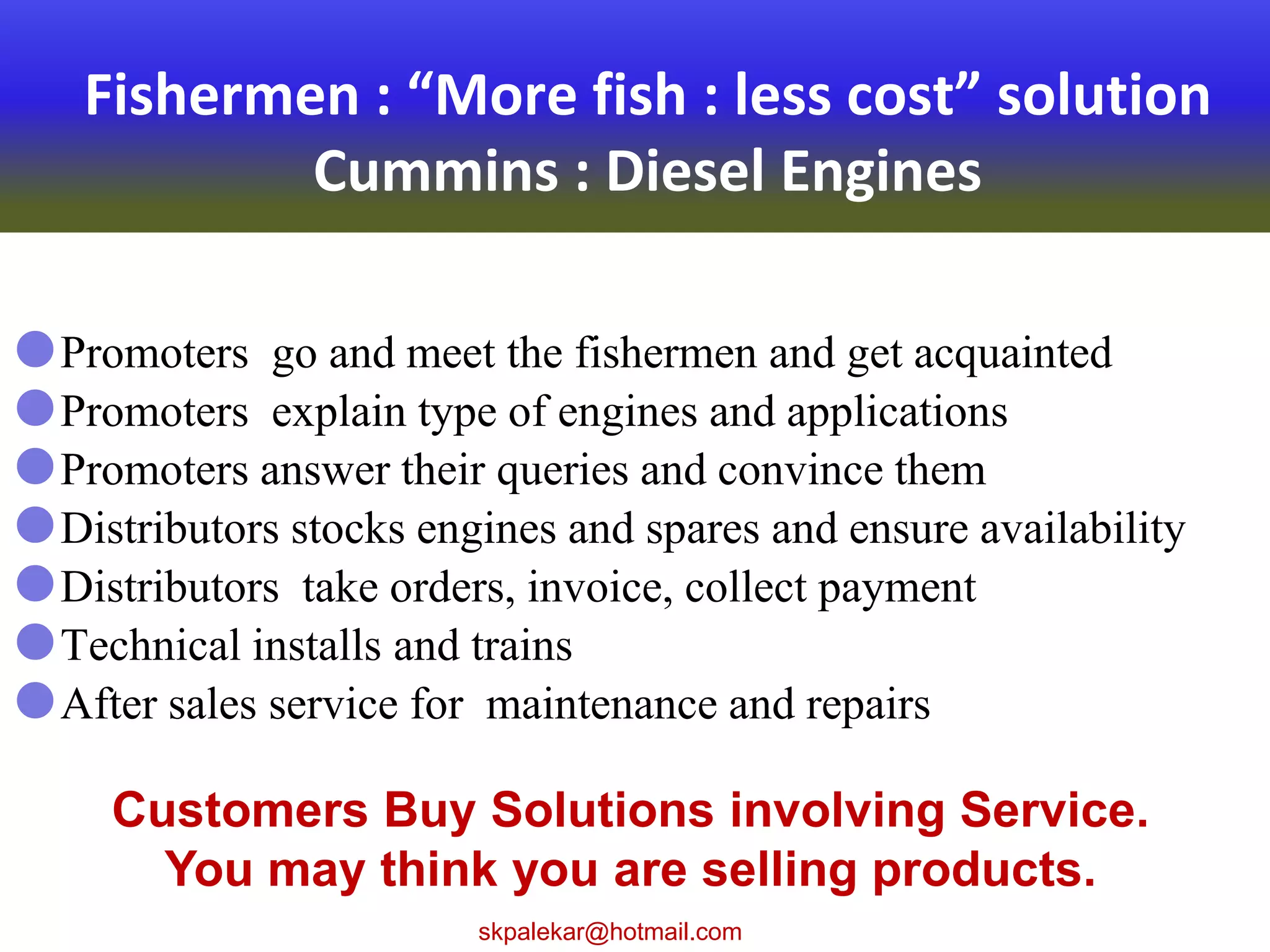
Fishermen : “More fish : less cost” solution
Cummins : Diesel Engines
Promoters go and meet the fishermen and get acquainted
Promoters explain type of engines and applications
Promoters answer their queries and convince them
Distributors stocks engines and spares and ensure availability
Distributors take orders, invoice, collect payment
Technical installs and trains
After sales service for maintenance and repairs
Customers Buy Solutions involving Service.
You may think you are selling products.
skpalekar@hotmail.com
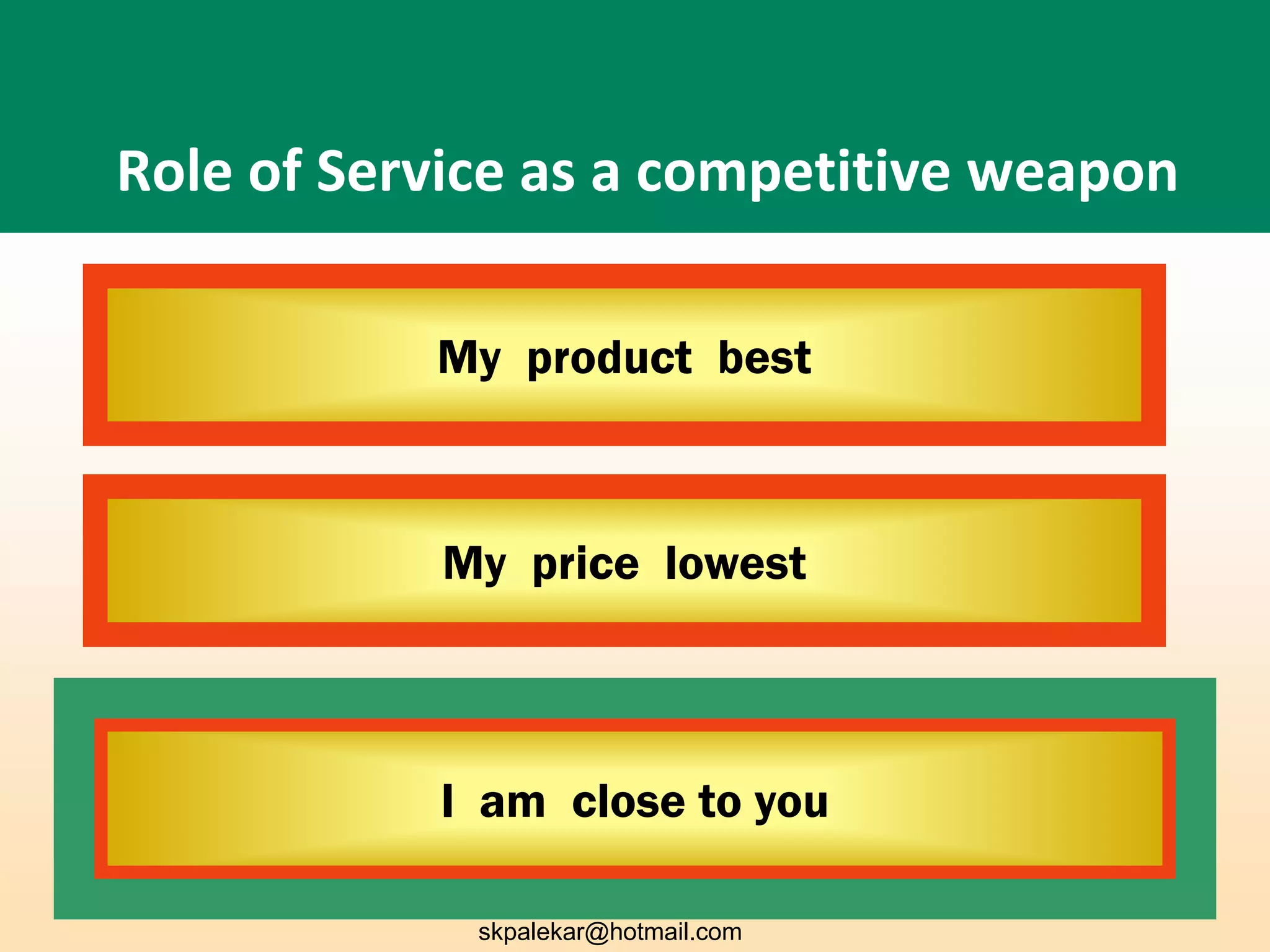
Role of Service as a competitive weapon
My product best
My price lowest
I am close to you
skpalekar@hotmail.com
Role of Service in a corporate turnaround
Scandinavian Airlines
skpalekar@hotmail.com
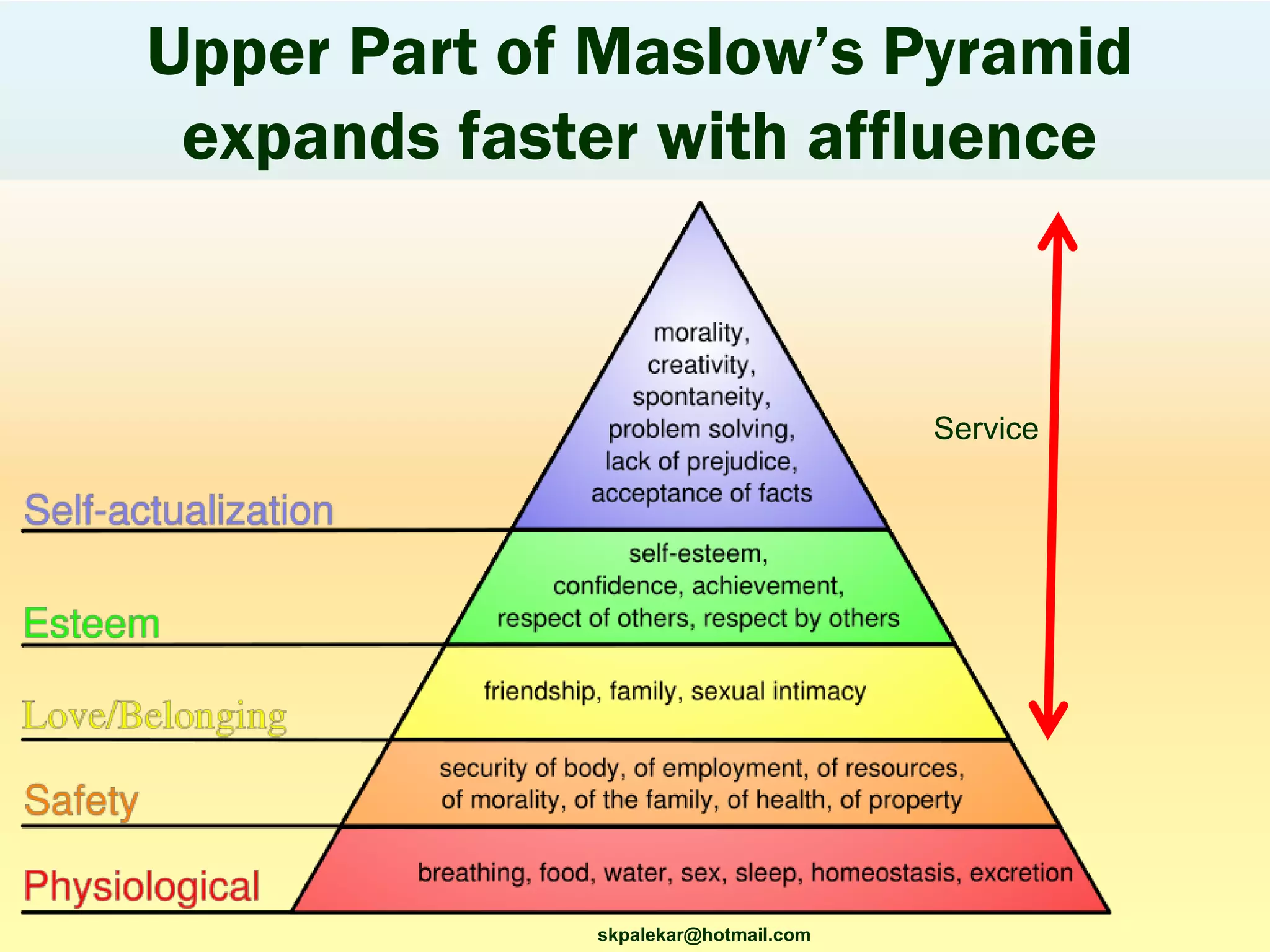
Upper Part of Maslow’s Pyramid
expands faster with affluence
Service
skpalekar@hotmail.com
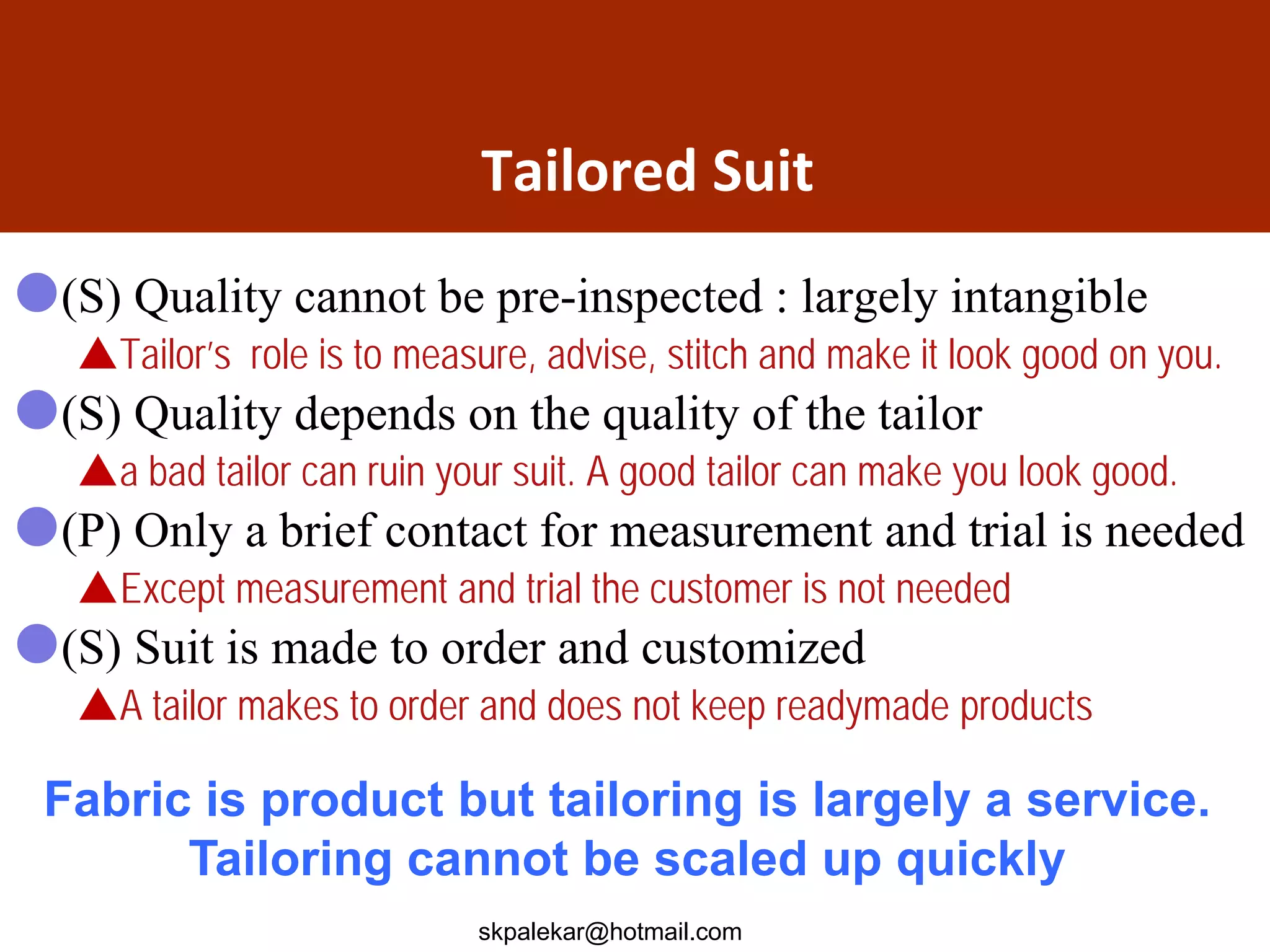
Tailored Suit
(S) Quality cannot be pre-inspected : largely intangible
Tailor’s role is to measure, advise, stitch and make it look good on you.
(S) Quality depends on the quality of the tailor
a bad tailor can ruin your suit. A good tailor can make you look good.
(P) Only a brief contact for measurement and trial is needed
Except measurement and trial the customer is not needed
(S) Suit is made to order and customized
A tailor makes to order and does not keep readymade products
Fabric is product but tailoring is largely a service.
Tailoring cannot be scaled up quickly
skpalekar@hotmail.com
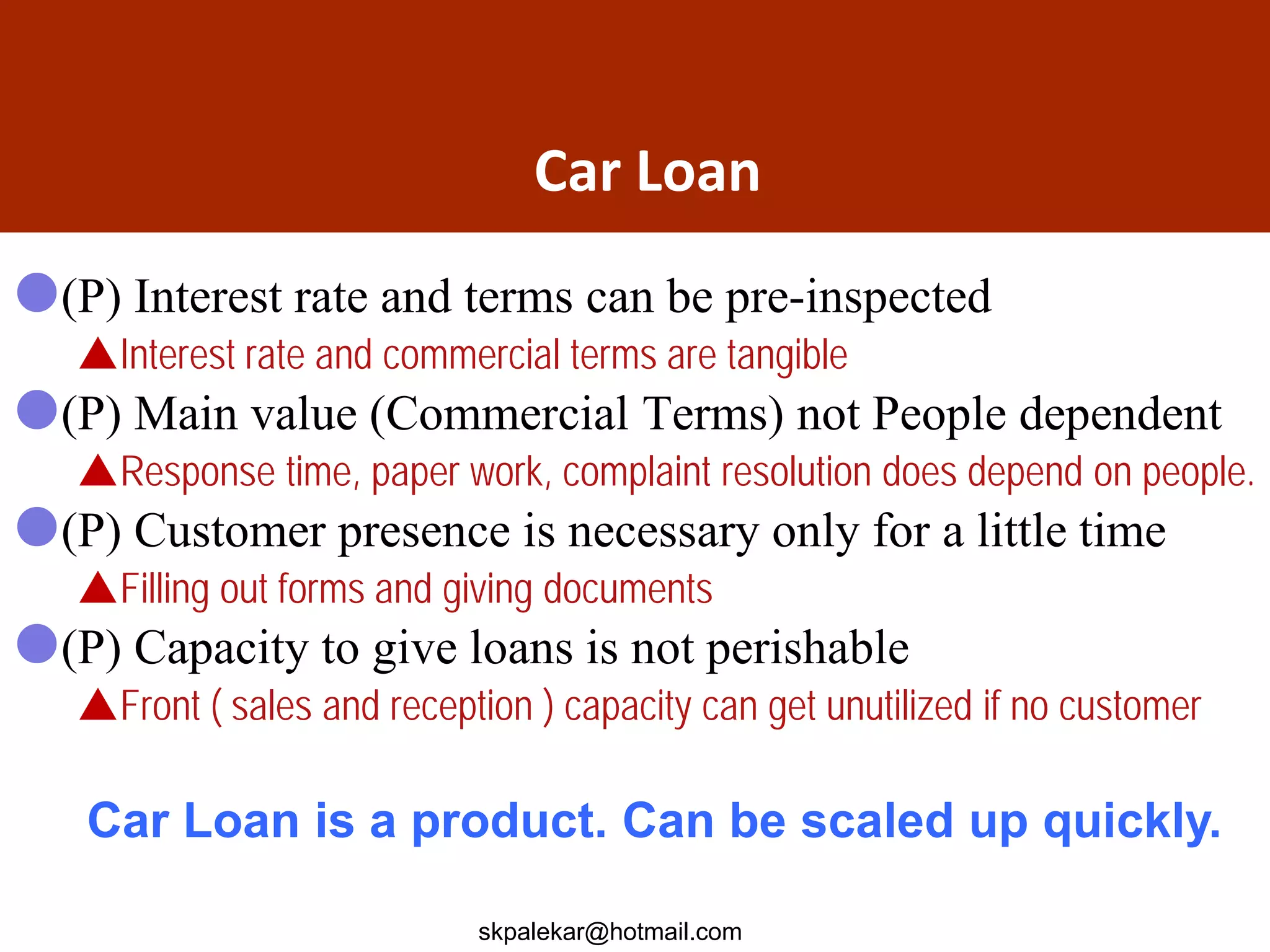
Car Loan
(P) Interest rate and terms can be pre-inspected
Interest rate and commercial terms are tangible
(P) Main value (Commercial Terms) not People dependent
Response time, paper work, complaint resolution does depend on people.
(P) Customer presence is necessary only for a little time
Filling out forms and giving documents
(P) Capacity to give loans is not perishable
Front ( sales and reception ) capacity can get unutilized if no customer
Car Loan is a product. Can be scaled up quickly.
skpalekar@hotmail.com
skpalekar@hotmail.com +9821046013
DUSHYANT CORPORATE TRAINERS
How Profit is Made
Value
Price
Cost
• Studying the market conditions
• Selecting the right customers
• Developing the right value proposition
• Selecting the right delivery channels
• To be different than the competition
• Purchasing efficiency
• Downgrading specifications
• Value engineering
• Reduction of waste
Profit
The Process of Marketing
Whom to serve ? Whom to fight?
Create Attractive value? Capture some of it ?
Go to market & “sell” the valueUndertake value creation activities
Measure satisfactionMeasure Profit
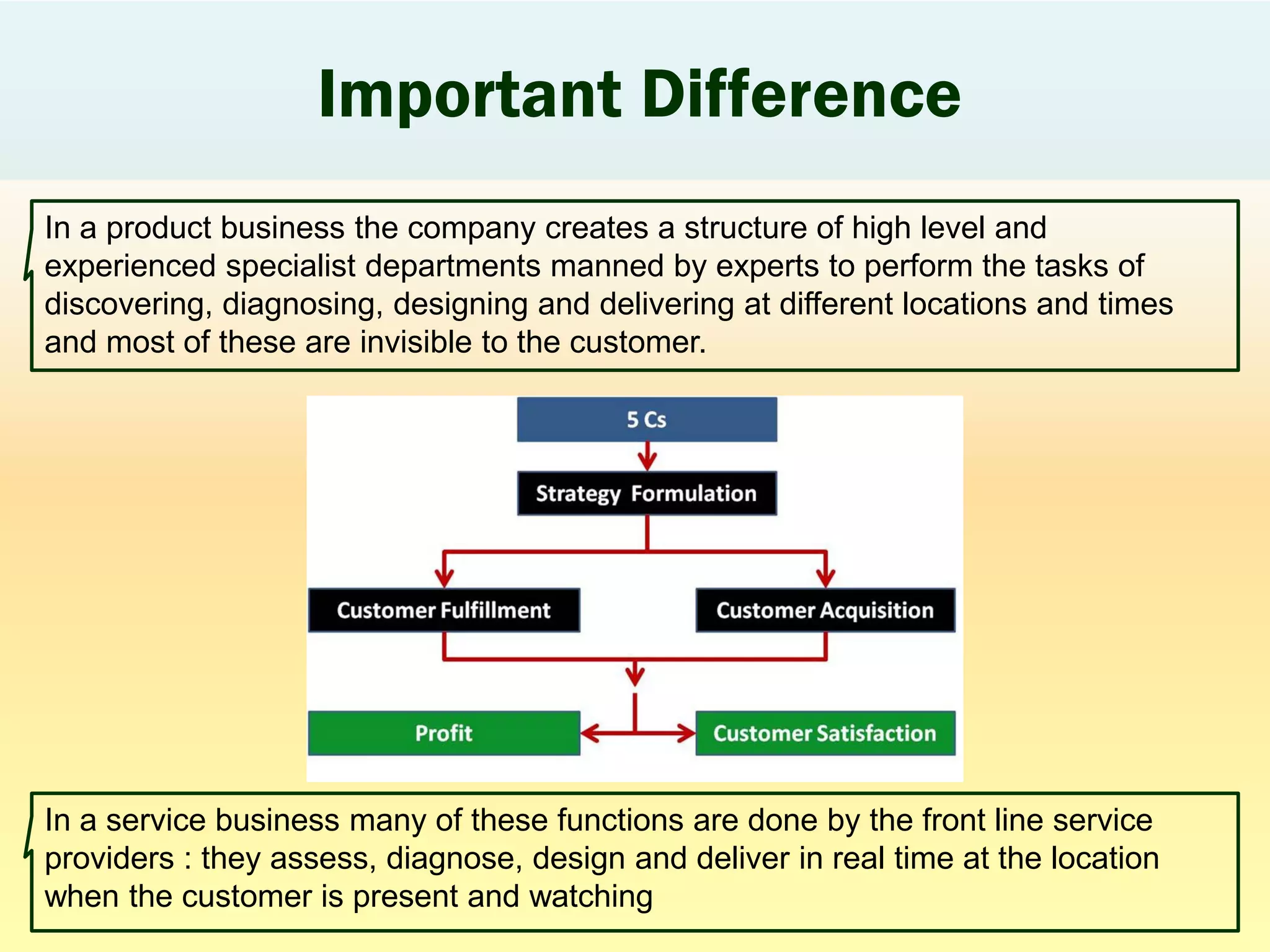
Important Difference
In a product business the company creates a structure of high level and
experienced specialist departments manned by experts to perform the tasks of
discovering, diagnosing, designing and delivering at different locations and times
and most of these are invisible to the customer.
In a service business many of these functions are done by the front line service
providers : they assess, diagnose, design and deliver in real time at the location
when the customer is present and watching
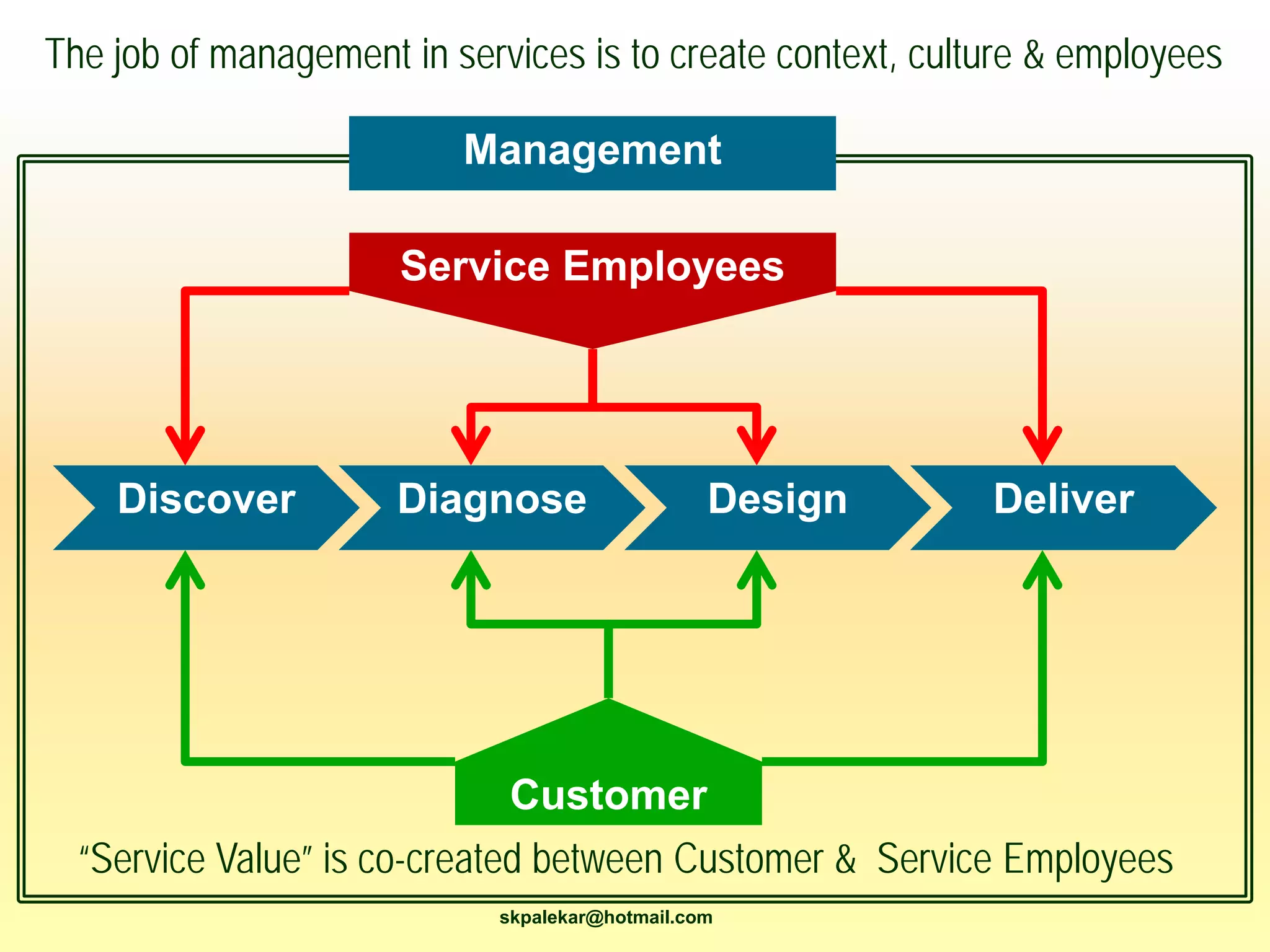
Discover Diagnose Design Deliver
Customer
Service Employees
Management
The job of management in services is to create context, culture & employees
“Service Value” is co-created between Customer & Service Employees
skpalekar@hotmail.com
Service Operations Model
Management
BuyerEmployee
A lot of value gets created in this interaction
Managing employees
To make them
Manage customers
Managing customer
Expectations
and satisfaction
Employees is the “first market”. Poor marketing
to them results into poor marketing ultimately
Selecting & Influencing employees.
Based on knowledge or attitude?
Actual interaction, observation and
demonstrated leadership
Nature of Service
Intangible
Low search attributes ( which can be inspected prior to purchase )
Person dependent
High in experience attributes ( can be felt but not inspected )
Reputation / Reference dependent
High in credence attributes ( cannot be felt also )
Needs each customer’s presence / input
Customer and provider needed in the same place at the same time
Perishable
Demand -Supply synchronization difficult , Capacity planning key.
Peak and Lean times a regular phenomenon.
Standardization and efficiency of machines   Customization and warmth of people
skpalekar@hotmail.com
TYPES OF SERVICES
BASED ON “CONTACT”
HIGH-END CONTACT SERVICES
 Professional services needing high level of education and experience
(architects, doctors, professors, lawyers, pilots)
MID END CONTACT SERVICES
 Technical services based on knowledge of technology. (nursing, tailoring,
repairing). Or Customer care services involving personality and social
skills (air hostess, handling complaints, salespersons, reception)
LOW END CONTACT SERVICES
 Routine services that can be performed by almost anyone with little
training. (cleaning, guard duty, door keeping)
AUTOMATABLE SERVICES
 Simple services which can be automated (shoe shine, vending packaged
products, ticketing on the net, giving cash against cards)
Different types of persons needed for service
RARE EXPERTISE / JUDGEMENT / SKILL
Expertise / Experience Lawyer
Perform Singer, Dancer, Teacher, Priest
Judgment / Decision Doctor
MEDIUM EXPERTISE / JUDGEMENT / SKILL
Empathy Sales Executives
Conversation / Sociability Customer Relation Executives
Awareness and Feedback Barber, Tailor
LOW EXPERTISE / JUDGEMENT / SKILL
Physique Laborer, Guard
skpalekar@hotmail.com
High Contact Service Encounters
S E R V I C E S C A P E
MOOD
INTERACTION
PERSON
TRAINING / EXPECTATIONS
RESOURCES
MOOD
SCRIPT / INTERACTION
M O M E N T O F T R U T H
PERSON
NEED
EXPECTATION
encounter
People-intensive Services
Costs
Main investment and cost is in
selection, training, motivation & retention of people
People Selection Criteria
Good social skills of dealing with customers individually
and to have a good EQ .
In professional service you need judgment and experience.
In performing arts you need flair, temperament
Trained to follow
Consultative, diagnostic, solution providing, counseling
Customer orientation at the front end
routine / standard operating process at the back end
Equipment –Intensive Services
Costs
Main investment and cost is in the machines
People Selection Criteria
Good technical qualification / knowledge
Trained to follow routine / standard operating process
Dealing with the Customer : Transactional
Classification
automated services
vending machines, automated car washes
monitored by unskilled labor
dry cleaning, door keepers, cleaning
operated by skilled labor
excavators, airline pilots,
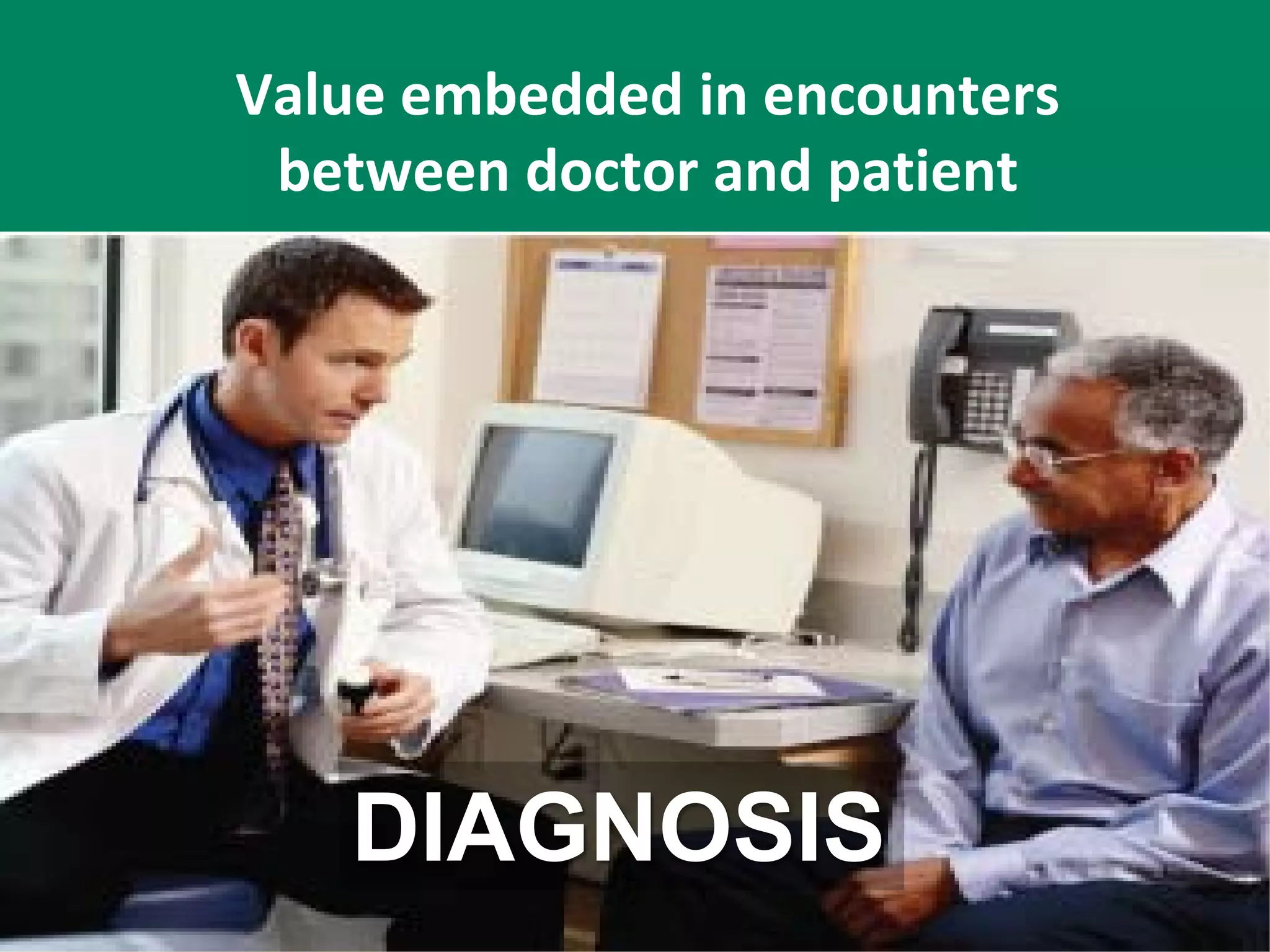
Value embedded in encounters
between doctor and patient
DIAGNOSIS
Value embedded in encounters
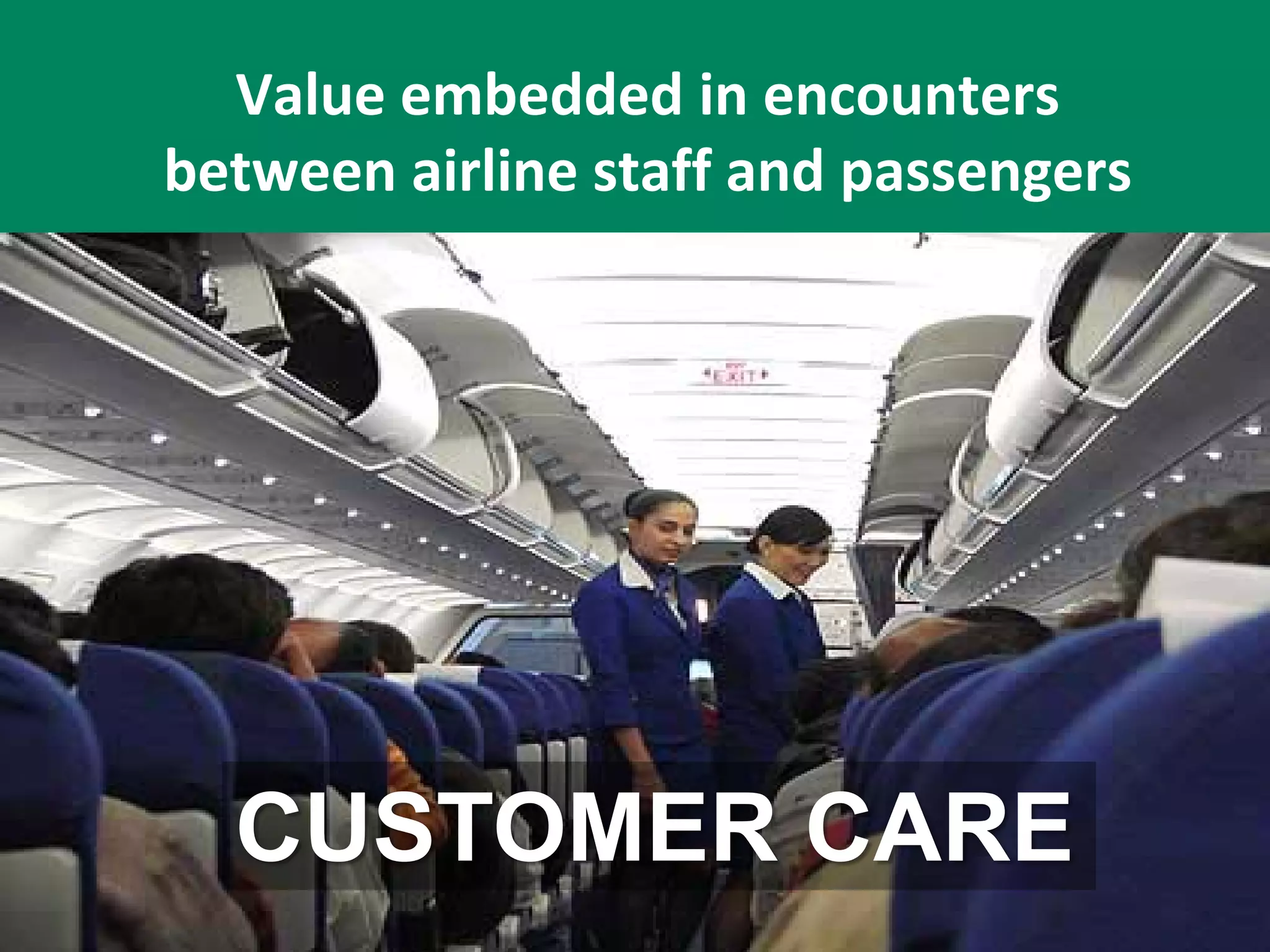
between airline staff and passengers
CUSTOMER CARE
Value embedded in encounters
between a singer and audience
ENTERTAINMENT
Value embedded in encounters
between a priest and parish
FAITH
High and Low Contact Service - 1
Location ( Where to locate )
High contact : Convenient to customer
Low contact : Near labor or Transportation source
Service Scape ( How to layout and do interiors)
High contact : set up like a customer reception / contact / service
area. Presentable, inviting, facilitate interaction with staff, and
waiting and serviceb.
Low contact : set up like a job work shop : for efficiency
 Quality Control
High Contact : customized benchmarks – customer present and
actively influences – can see all Ps - defects and all
Low Contact : since there is no customer during production, it is
possible to run using standard benchmarks and rework is possible
to correct the defects
High and Low Contact Service - 2
How the operations are organized ?
High Contact : Pace is set by the location and time of customer
requests for service. Customer is present, sees process,
intervenes, directs but also likes to see the process. A key issue is
how to handle demand peaks and how to shape the demand
Low Contact : Customer is absent and is concerned with
completion date and final result. He does not see the people and
the process. Hence grouping (batching) and scheduling is possible.
Pace can be set internally and can be the “average demand”.
Front Line Worker Skills
High Contact : Capable of interacting with customers, capable of
using judgment , capable of using his talent
Low Contact : Only Technical skills are needed
High and Low Contact Service - 3
Service Process
High contact : Mostly front-room activities. The service may
change during delivery in response to customer.
Low contact : Mostly backroom activities planned and executed
with minimal interference from customer
Service Package
High contact : Varies with customer : many choices and outcomes
Low contact : Fixed, less extensive
Product –Service continuum
 “Pure Product”   “Pure Service”
Teaching is almost pure service ( Mostly intangible )
Meal in a sit down diner is both product ( food) and service ( 3Ps)
Match box is almost a pure product
7 Ps of Marketing Mix” ( Way to influence the market )
4 Ps : Product like : Product, Place ( Location ), Price, Promotion
3 Ps : High contact like : People, Process, Physical Evidence / Proof
serviceProduct
INSPECTABLE
EXPERIENCED
BELIEVED
High Contact Service
value creation
Customers are homogenized
through filtration, access, fencing, selection
Service providers are selected
Through filtration, access, fencing, selection
To match with the expectations of the customers
Service providers are prepared to handle the job
Customer expectations / scripts are communicated
Service delivery process is taught
Servicescape is appropriate : Facilities and processes
Keep in mind technical logic, customer logic and employee logic
Mechanism to handle complaints and counsel
The ultimate objective is
The “service encounter" should be satisfying
for the customers as well as employees
In high contact service
Variations are common
On both the sides !
Mismatch of expectations is common
Complaints should not be treated as exceptions
Complaint handling mechanisms
Counseling is a regular business process
Customer recovery is an important process`
Positioning  Marketing Mix
Product
Product
Place
Price
Promotion
Service
People
Process
Physical Evidence ( Proof )
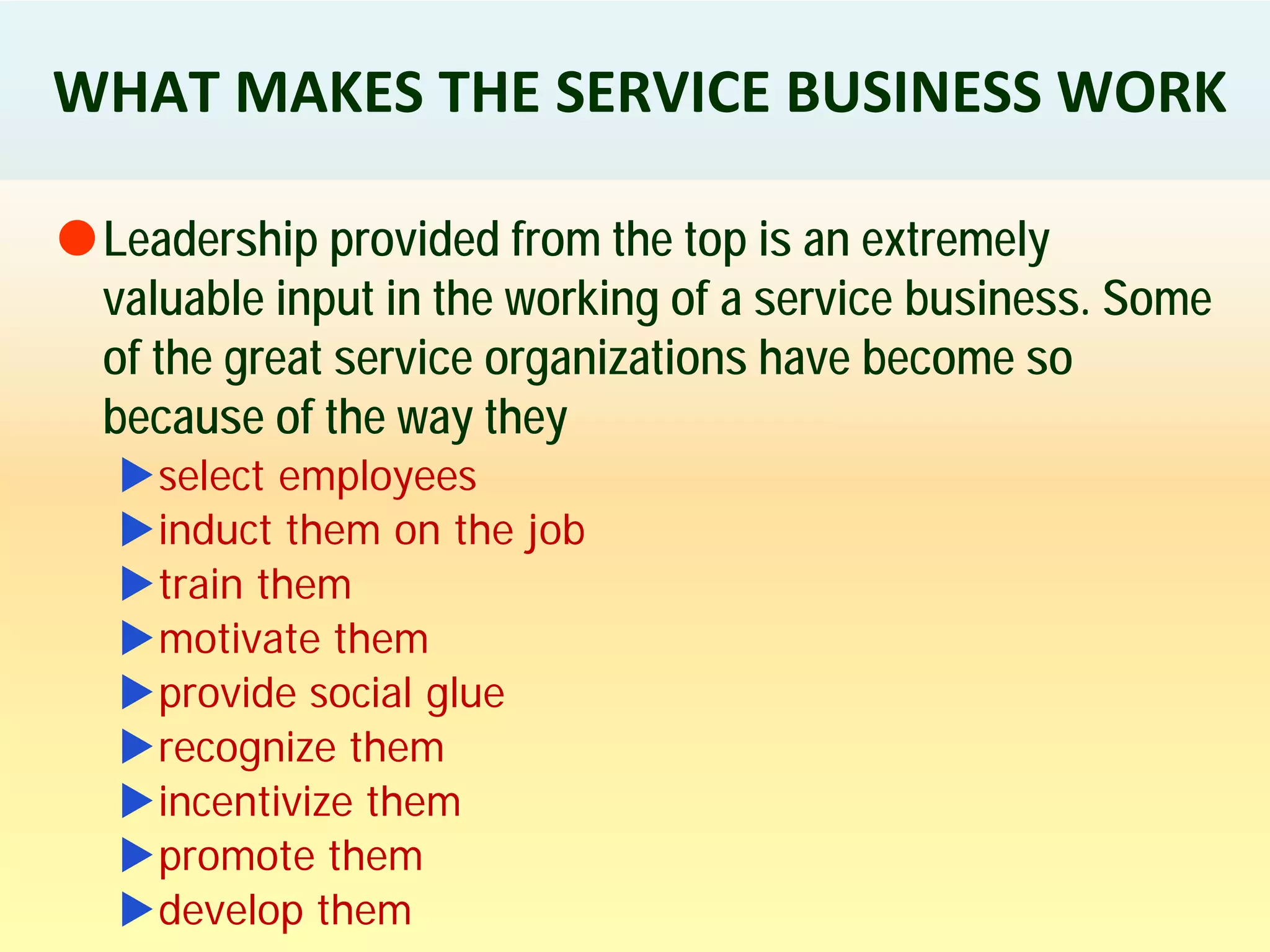
WHAT MAKES THE SERVICE BUSINESS WORK
Leadership provided from the top is an extremely
valuable input in the working of a service business. Some
of the great service organizations have become so
because of the way they
select employees
induct them on the job
train them
motivate them
provide social glue
recognize them
incentivize them
promote them
develop them
Service Profit Chain Model
skpalekar@hotmail.com
skpalekar@hotmail.com +9821046013
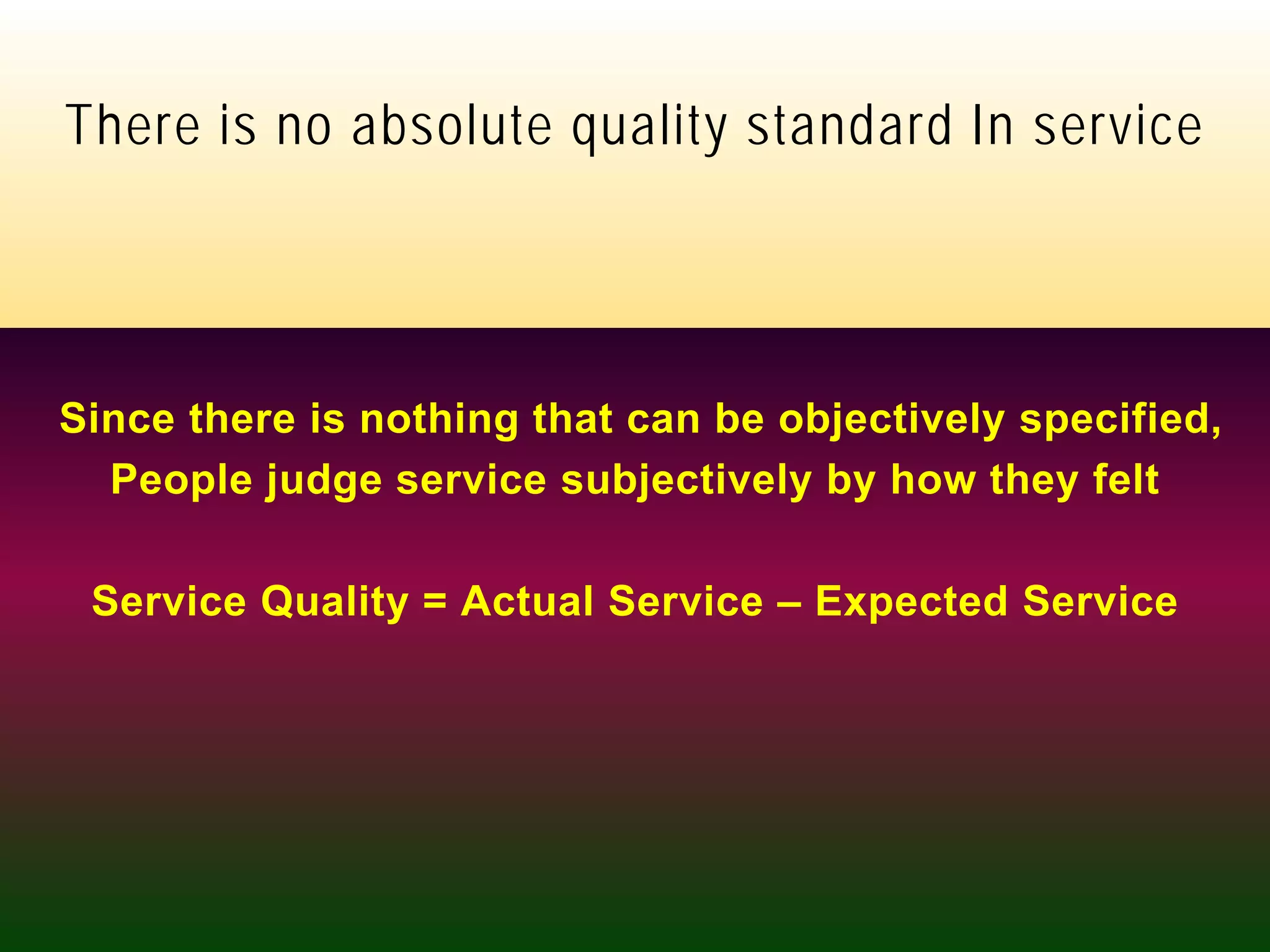
There is no absolute quality standard In service
Since there is nothing that can be objectively specified,
People judge service subjectively by how they felt
Service Quality = Actual Service – Expected Service
skpalekar@hotmail.com +9821046013
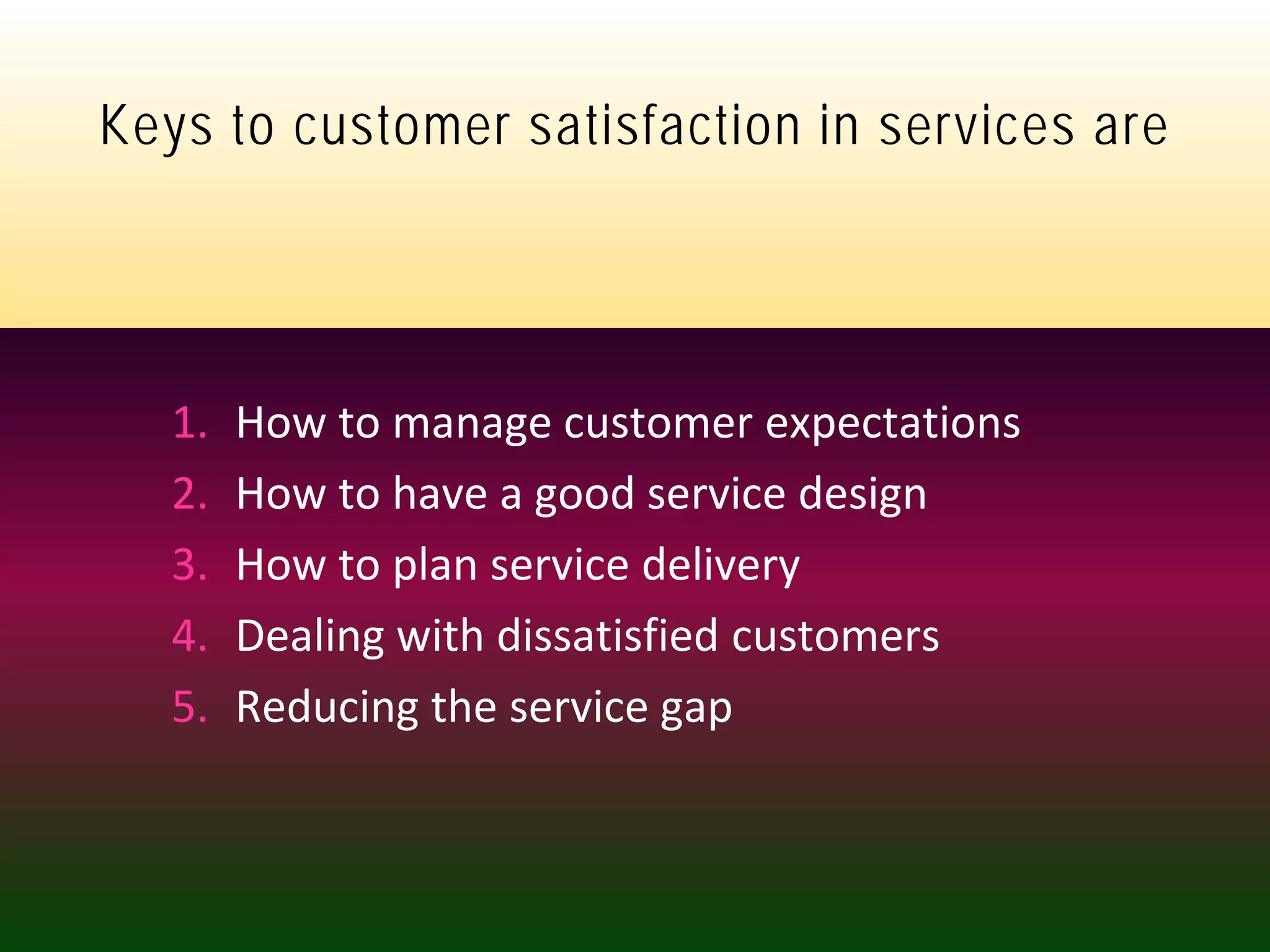
Keys to customer satisfaction in services are
1. How to manage customer expectations
2. How to have a good service design
3. How to plan service delivery
4. Dealing with dissatisfied customers
5. Reducing the service gap
How to Manage customer expectations ?
Admission / filtration process that accepts customers
whose expectations can be met / exceeded
Communicating with the customers so that the
expectations are brought in line with what can be
delivered
Rejecting customers whose expectations cannot be met
Get existing customers to bring new customers
Get existing customers to meet new customers
How to have a good service design?
 What to plan ?
Location, Layout, Fittings, Furnishings, Equipment,
Signage, Comfort, Lighting, Temperature, Colors
How to plan ? Keep in mind
Positioning : who do you want to serve? Who
competes for these customers ? How do you compete?
Logic : Customers, Employees, technical and legal
demands.
How to Plan / Execute Service delivery ?
( Service Marketing Mix )
Standard 4 Ps of products
Physical / Material product
Price
Place (location)
Promotion ( communication to attract customers, manage
expectations and inform at site)
3 Ps of services
People ( front line service providers, front line supervisors,
leaders up the line)
Processes (of discovering needs, diagnosing what needs to be
done, designing a solution and deploying the solution)
Proofs (because service is intangible, customers need evidence
and proof)
Dealing with dissatisfied customers
Service being intangible, there is an ample scope for
interpretation and subjectivity on both sides - provider
and receiver - and hence complaints is a normal
phenomenon in the marketing of services.
How complaints are handled is a very important part of
service marketing. Complaints - if not handled well - can
lead to loss of customers but if they are handled well,
they can lead to customers who spread good word about
the company. This is called service recovery.
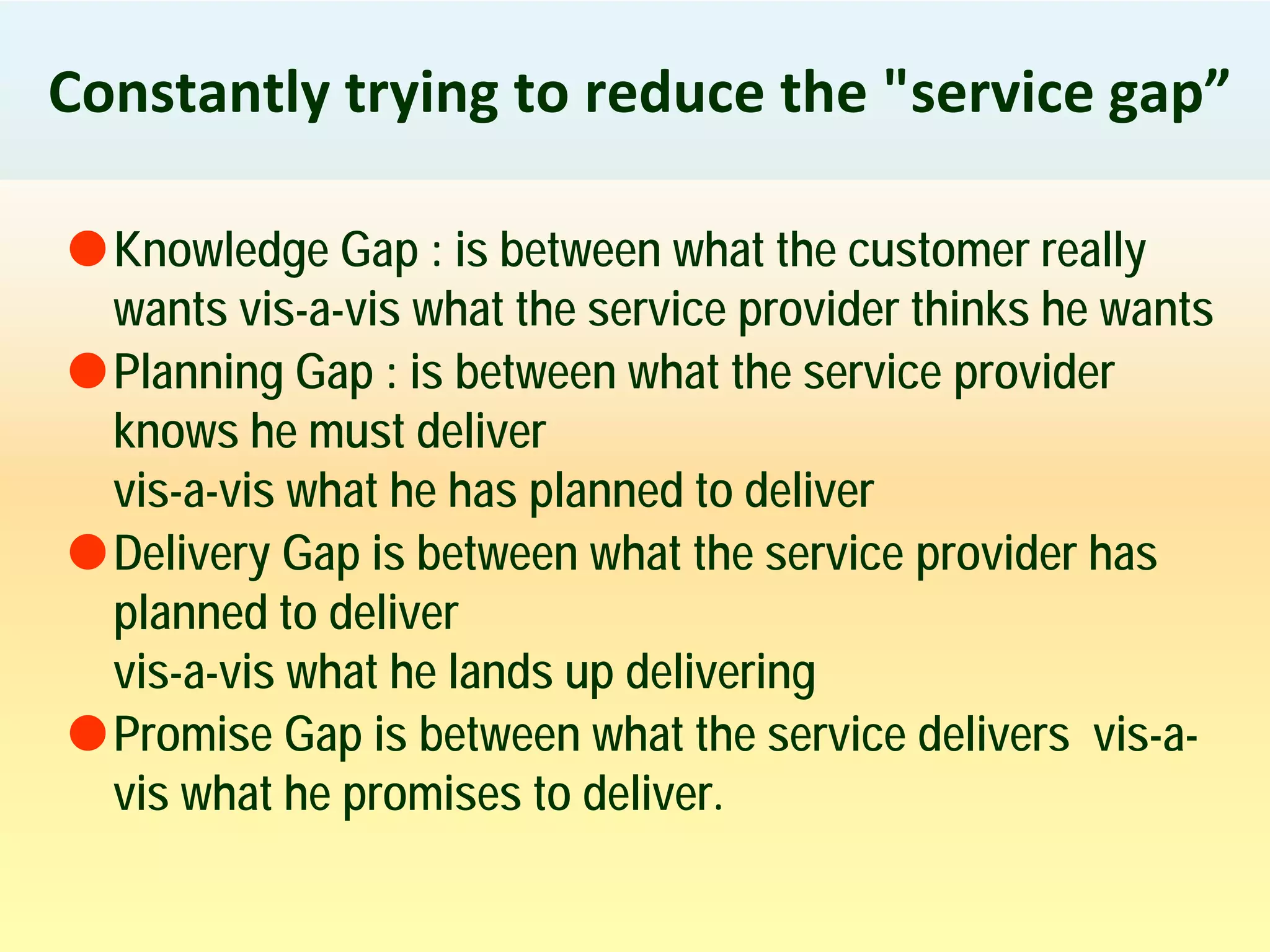
Constantly trying to reduce the "service gap”
Knowledge Gap : is between what the customer really
wants vis-a-vis what the service provider thinks he wants
Planning Gap : is between what the service provider
knows he must deliver
vis-a-vis what he has planned to deliver
Delivery Gap is between what the service provider has
planned to deliver
vis-a-vis what he lands up delivering
Promise Gap is between what the service delivers vis-a-
vis what he promises to deliver.
Service Gap Model
Customer Gap Provider Gap
Expected Service
Perceived Expectation Knowing
Satisfaction Design / SOP / Standards Planning
Deliver : Design / SOP / Standard Doing
Communicated to customers Promise
Perceived Delivery
skpalekar@hotmail.com
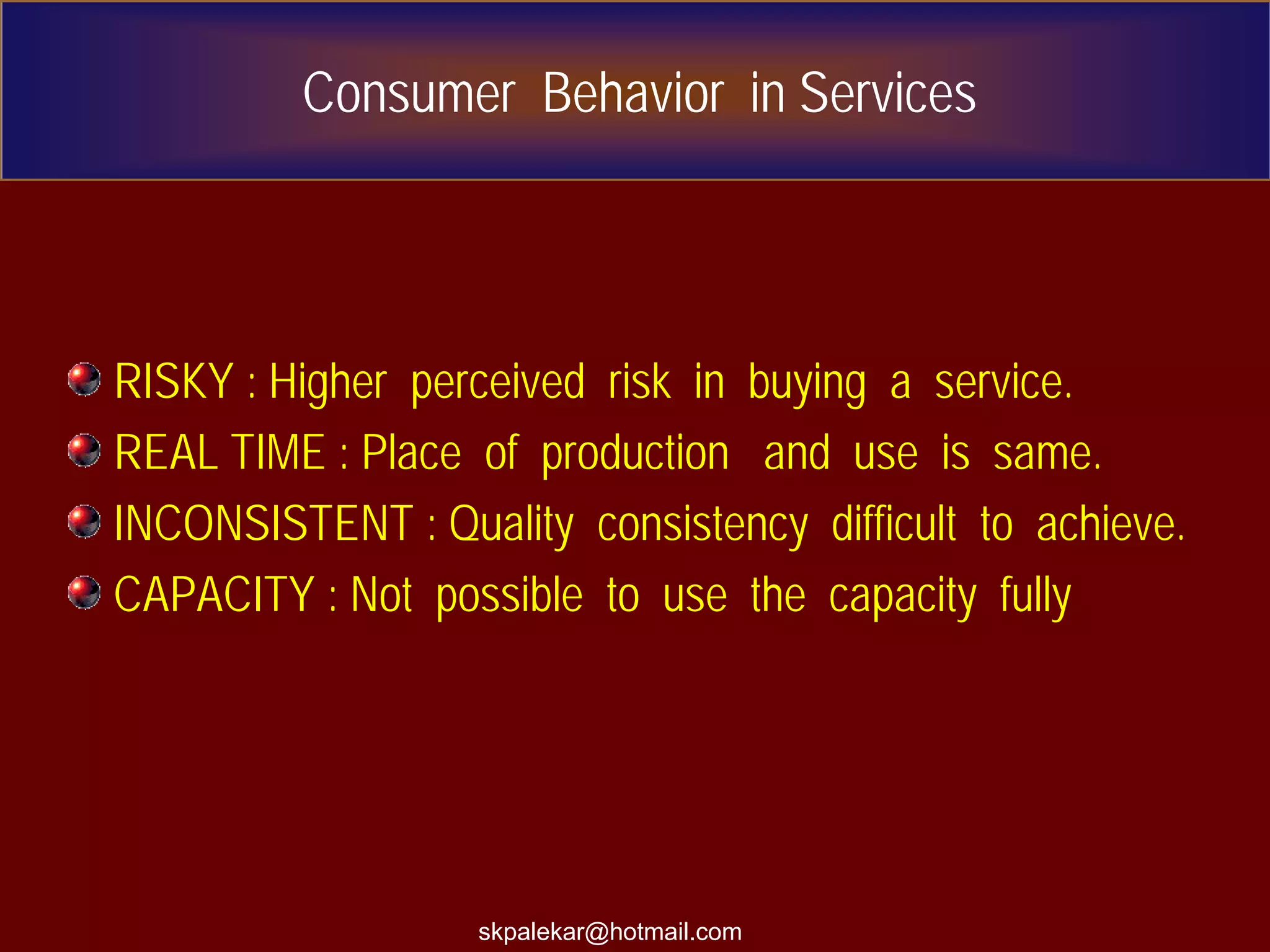
Consumer Behavior in Services
RISKY : Higher perceived risk in buying a service.
REAL TIME : Place of production and use is same.
INCONSISTENT : Quality consistency difficult to achieve.
CAPACITY : Not possible to use the capacity fully
skpalekar@hotmail.com

A short course on services marketing july 2 k13

  • 1.
    Short Course :July 2013 By Prof S K Palekar 3 Sessions on Services Marketing Audience : PGDM – IM The objective is to prepare you for consulting, business development and operations roles in IT and ITES industries These slides will be put up on http://
  • 2.
    Learning Objectives aboutServices Introduction to services How is it different than products How do services create value for the customer How can you compete in services You can use services but cannot carry them and own
  • 3.
    Service sector isfastest growing (Rs ‘000 Crores) Indian GDP 159 244 463 888 1736 104 154 280 480 831 209 243 339 445 554 0 200 400 600 800 1000 1200 1400 1600 1800 2000 1970 1980 1990 2000 2007 SER IND AGRI
  • 4.
    Who is inService !  Trading  Government / Public Admn / Defense  Banking & Insurance  Transport of people and goods  Communications  Customer contact : reception, selling, telemarketing  Personal service : teacher, waiter, hair stylist  Installation and repair  Housekeeping : Laundry, sweeping, floor care, polishing  Health and patient care : nurses  Entertainment and Tourism  Housing : construction and fabrication, masons, guards  Professionals : Lawyers, architects
  • 5.
  • 6.
    Generally there isneither a pure product, nor a pure service
  • 7.
    HUL sells products butcustomers buy products + services Customers of Dove soap need BOTH products and services Service costs  Trade margins  Advertising  Transportation  People  Administration You may be making a product But customers want to buy services along with it
  • 8.
    Fishermen : “Morefish : less cost” solution Cummins : Diesel Engines Promoters go and meet the fishermen and get acquainted Promoters explain type of engines and applications Promoters answer their queries and convince them Distributors stocks engines and spares and ensure availability Distributors take orders, invoice, collect payment Technical installs and trains After sales service for maintenance and repairs Customers Buy Solutions involving Service. You may think you are selling products. skpalekar@hotmail.com
  • 9.
    Role of Serviceas a competitive weapon My product best My price lowest I am close to you skpalekar@hotmail.com
  • 10.
    Role of Servicein a corporate turnaround Scandinavian Airlines skpalekar@hotmail.com
  • 11.
    Upper Part ofMaslow’s Pyramid expands faster with affluence Service skpalekar@hotmail.com
  • 12.
    Tailored Suit (S) Qualitycannot be pre-inspected : largely intangible Tailor’s role is to measure, advise, stitch and make it look good on you. (S) Quality depends on the quality of the tailor a bad tailor can ruin your suit. A good tailor can make you look good. (P) Only a brief contact for measurement and trial is needed Except measurement and trial the customer is not needed (S) Suit is made to order and customized A tailor makes to order and does not keep readymade products Fabric is product but tailoring is largely a service. Tailoring cannot be scaled up quickly skpalekar@hotmail.com
  • 13.
    Car Loan (P) Interestrate and terms can be pre-inspected Interest rate and commercial terms are tangible (P) Main value (Commercial Terms) not People dependent Response time, paper work, complaint resolution does depend on people. (P) Customer presence is necessary only for a little time Filling out forms and giving documents (P) Capacity to give loans is not perishable Front ( sales and reception ) capacity can get unutilized if no customer Car Loan is a product. Can be scaled up quickly. skpalekar@hotmail.com
  • 14.
  • 15.
    How Profit isMade Value Price Cost • Studying the market conditions • Selecting the right customers • Developing the right value proposition • Selecting the right delivery channels • To be different than the competition • Purchasing efficiency • Downgrading specifications • Value engineering • Reduction of waste Profit
  • 16.
    The Process ofMarketing Whom to serve ? Whom to fight? Create Attractive value? Capture some of it ? Go to market & “sell” the valueUndertake value creation activities Measure satisfactionMeasure Profit
  • 17.
    Important Difference In aproduct business the company creates a structure of high level and experienced specialist departments manned by experts to perform the tasks of discovering, diagnosing, designing and delivering at different locations and times and most of these are invisible to the customer. In a service business many of these functions are done by the front line service providers : they assess, diagnose, design and deliver in real time at the location when the customer is present and watching
  • 18.
    Discover Diagnose DesignDeliver Customer Service Employees Management The job of management in services is to create context, culture & employees “Service Value” is co-created between Customer & Service Employees skpalekar@hotmail.com
  • 19.
    Service Operations Model Management BuyerEmployee Alot of value gets created in this interaction Managing employees To make them Manage customers Managing customer Expectations and satisfaction Employees is the “first market”. Poor marketing to them results into poor marketing ultimately Selecting & Influencing employees. Based on knowledge or attitude? Actual interaction, observation and demonstrated leadership
  • 20.
    Nature of Service Intangible Lowsearch attributes ( which can be inspected prior to purchase ) Person dependent High in experience attributes ( can be felt but not inspected ) Reputation / Reference dependent High in credence attributes ( cannot be felt also ) Needs each customer’s presence / input Customer and provider needed in the same place at the same time Perishable Demand -Supply synchronization difficult , Capacity planning key. Peak and Lean times a regular phenomenon. Standardization and efficiency of machines   Customization and warmth of people skpalekar@hotmail.com
  • 21.
    TYPES OF SERVICES BASEDON “CONTACT” HIGH-END CONTACT SERVICES  Professional services needing high level of education and experience (architects, doctors, professors, lawyers, pilots) MID END CONTACT SERVICES  Technical services based on knowledge of technology. (nursing, tailoring, repairing). Or Customer care services involving personality and social skills (air hostess, handling complaints, salespersons, reception) LOW END CONTACT SERVICES  Routine services that can be performed by almost anyone with little training. (cleaning, guard duty, door keeping) AUTOMATABLE SERVICES  Simple services which can be automated (shoe shine, vending packaged products, ticketing on the net, giving cash against cards)
  • 22.
    Different types ofpersons needed for service RARE EXPERTISE / JUDGEMENT / SKILL Expertise / Experience Lawyer Perform Singer, Dancer, Teacher, Priest Judgment / Decision Doctor MEDIUM EXPERTISE / JUDGEMENT / SKILL Empathy Sales Executives Conversation / Sociability Customer Relation Executives Awareness and Feedback Barber, Tailor LOW EXPERTISE / JUDGEMENT / SKILL Physique Laborer, Guard skpalekar@hotmail.com
  • 23.
    High Contact ServiceEncounters S E R V I C E S C A P E MOOD INTERACTION PERSON TRAINING / EXPECTATIONS RESOURCES MOOD SCRIPT / INTERACTION M O M E N T O F T R U T H PERSON NEED EXPECTATION encounter
  • 24.
    People-intensive Services Costs Main investmentand cost is in selection, training, motivation & retention of people People Selection Criteria Good social skills of dealing with customers individually and to have a good EQ . In professional service you need judgment and experience. In performing arts you need flair, temperament Trained to follow Consultative, diagnostic, solution providing, counseling Customer orientation at the front end routine / standard operating process at the back end
  • 25.
    Equipment –Intensive Services Costs Maininvestment and cost is in the machines People Selection Criteria Good technical qualification / knowledge Trained to follow routine / standard operating process Dealing with the Customer : Transactional Classification automated services vending machines, automated car washes monitored by unskilled labor dry cleaning, door keepers, cleaning operated by skilled labor excavators, airline pilots,
  • 26.
    Value embedded inencounters between doctor and patient DIAGNOSIS
  • 27.
    Value embedded inencounters between airline staff and passengers CUSTOMER CARE
  • 28.
    Value embedded inencounters between a singer and audience ENTERTAINMENT
  • 29.
    Value embedded inencounters between a priest and parish FAITH
  • 30.
    High and LowContact Service - 1 Location ( Where to locate ) High contact : Convenient to customer Low contact : Near labor or Transportation source Service Scape ( How to layout and do interiors) High contact : set up like a customer reception / contact / service area. Presentable, inviting, facilitate interaction with staff, and waiting and serviceb. Low contact : set up like a job work shop : for efficiency  Quality Control High Contact : customized benchmarks – customer present and actively influences – can see all Ps - defects and all Low Contact : since there is no customer during production, it is possible to run using standard benchmarks and rework is possible to correct the defects
  • 31.
    High and LowContact Service - 2 How the operations are organized ? High Contact : Pace is set by the location and time of customer requests for service. Customer is present, sees process, intervenes, directs but also likes to see the process. A key issue is how to handle demand peaks and how to shape the demand Low Contact : Customer is absent and is concerned with completion date and final result. He does not see the people and the process. Hence grouping (batching) and scheduling is possible. Pace can be set internally and can be the “average demand”. Front Line Worker Skills High Contact : Capable of interacting with customers, capable of using judgment , capable of using his talent Low Contact : Only Technical skills are needed
  • 32.
    High and LowContact Service - 3 Service Process High contact : Mostly front-room activities. The service may change during delivery in response to customer. Low contact : Mostly backroom activities planned and executed with minimal interference from customer Service Package High contact : Varies with customer : many choices and outcomes Low contact : Fixed, less extensive
  • 33.
    Product –Service continuum “Pure Product”   “Pure Service” Teaching is almost pure service ( Mostly intangible ) Meal in a sit down diner is both product ( food) and service ( 3Ps) Match box is almost a pure product 7 Ps of Marketing Mix” ( Way to influence the market ) 4 Ps : Product like : Product, Place ( Location ), Price, Promotion 3 Ps : High contact like : People, Process, Physical Evidence / Proof serviceProduct INSPECTABLE EXPERIENCED BELIEVED
  • 35.
    High Contact Service valuecreation Customers are homogenized through filtration, access, fencing, selection Service providers are selected Through filtration, access, fencing, selection To match with the expectations of the customers Service providers are prepared to handle the job Customer expectations / scripts are communicated Service delivery process is taught Servicescape is appropriate : Facilities and processes Keep in mind technical logic, customer logic and employee logic Mechanism to handle complaints and counsel The ultimate objective is The “service encounter" should be satisfying for the customers as well as employees
  • 36.
    In high contactservice Variations are common On both the sides ! Mismatch of expectations is common Complaints should not be treated as exceptions Complaint handling mechanisms Counseling is a regular business process Customer recovery is an important process`
  • 37.
    Positioning  MarketingMix Product Product Place Price Promotion Service People Process Physical Evidence ( Proof )
  • 38.
    WHAT MAKES THESERVICE BUSINESS WORK Leadership provided from the top is an extremely valuable input in the working of a service business. Some of the great service organizations have become so because of the way they select employees induct them on the job train them motivate them provide social glue recognize them incentivize them promote them develop them
  • 39.
    Service Profit ChainModel skpalekar@hotmail.com
  • 40.
    skpalekar@hotmail.com +9821046013 There isno absolute quality standard In service Since there is nothing that can be objectively specified, People judge service subjectively by how they felt Service Quality = Actual Service – Expected Service
  • 41.
    skpalekar@hotmail.com +9821046013 Keys tocustomer satisfaction in services are 1. How to manage customer expectations 2. How to have a good service design 3. How to plan service delivery 4. Dealing with dissatisfied customers 5. Reducing the service gap
  • 42.
    How to Managecustomer expectations ? Admission / filtration process that accepts customers whose expectations can be met / exceeded Communicating with the customers so that the expectations are brought in line with what can be delivered Rejecting customers whose expectations cannot be met Get existing customers to bring new customers Get existing customers to meet new customers
  • 43.
    How to havea good service design?  What to plan ? Location, Layout, Fittings, Furnishings, Equipment, Signage, Comfort, Lighting, Temperature, Colors How to plan ? Keep in mind Positioning : who do you want to serve? Who competes for these customers ? How do you compete? Logic : Customers, Employees, technical and legal demands.
  • 44.
    How to Plan/ Execute Service delivery ? ( Service Marketing Mix ) Standard 4 Ps of products Physical / Material product Price Place (location) Promotion ( communication to attract customers, manage expectations and inform at site) 3 Ps of services People ( front line service providers, front line supervisors, leaders up the line) Processes (of discovering needs, diagnosing what needs to be done, designing a solution and deploying the solution) Proofs (because service is intangible, customers need evidence and proof)
  • 45.
    Dealing with dissatisfiedcustomers Service being intangible, there is an ample scope for interpretation and subjectivity on both sides - provider and receiver - and hence complaints is a normal phenomenon in the marketing of services. How complaints are handled is a very important part of service marketing. Complaints - if not handled well - can lead to loss of customers but if they are handled well, they can lead to customers who spread good word about the company. This is called service recovery.
  • 46.
    Constantly trying toreduce the "service gap” Knowledge Gap : is between what the customer really wants vis-a-vis what the service provider thinks he wants Planning Gap : is between what the service provider knows he must deliver vis-a-vis what he has planned to deliver Delivery Gap is between what the service provider has planned to deliver vis-a-vis what he lands up delivering Promise Gap is between what the service delivers vis-a- vis what he promises to deliver.
  • 47.
    Service Gap Model CustomerGap Provider Gap Expected Service Perceived Expectation Knowing Satisfaction Design / SOP / Standards Planning Deliver : Design / SOP / Standard Doing Communicated to customers Promise Perceived Delivery skpalekar@hotmail.com
  • 48.
    Consumer Behavior inServices RISKY : Higher perceived risk in buying a service. REAL TIME : Place of production and use is same. INCONSISTENT : Quality consistency difficult to achieve. CAPACITY : Not possible to use the capacity fully skpalekar@hotmail.com