Commas
English Language Arts
        Notes
Commas in a Series
Commas in a Series


Use a comma to separate three or more
items in a series.
Commas in a Series


Use a comma to separate three or more
items in a series.

  Please grab the leash, collar, and
  treats. (series of words)
Commas in a Series


Use a comma to separate three or more
items in a series.

  Please grab the leash, collar, and
  treats. (series of words)

  Was it a toy poodle, miniature
  poodle, or standard poodle? (series
  of phrases)
Commas in a Series
Commas in a Series


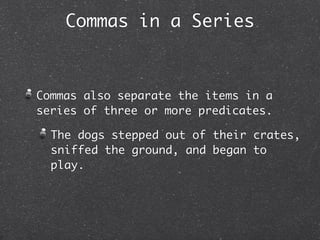
Commas also separate the items in a
series of three or more predicates.
Commas in a Series


Commas also separate the items in a
series of three or more predicates.

  The dogs stepped out of their crates,
  sniffed the ground, and began to
  play.
Commas After Introductory
    Phrases or Clauses
Commas After Introductory
      Phrases or Clauses
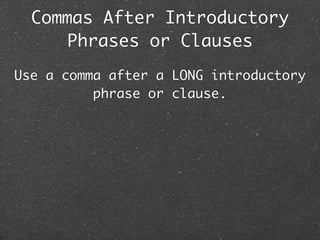
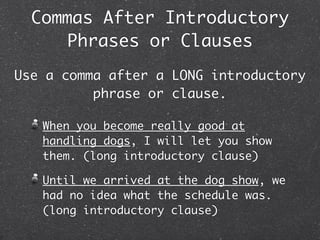
Use a comma after a LONG introductory
          phrase or clause.
Commas After Introductory
      Phrases or Clauses
Use a comma after a LONG introductory
          phrase or clause.

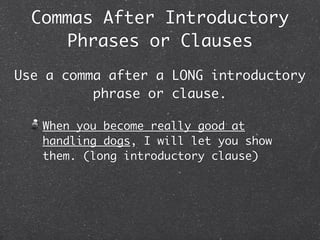
   When you become really good at
   handling dogs, I will let you show
   them. (long introductory clause)
Commas After Introductory
      Phrases or Clauses
Use a comma after a LONG introductory
          phrase or clause.

   When you become really good at
   handling dogs, I will let you show
   them. (long introductory clause)

   Until we arrived at the dog show, we
   had no idea what the schedule was.
   (long introductory clause)
Commas After Introductory
    Phrases or Clauses
Commas After Introductory
    Phrases or Clauses
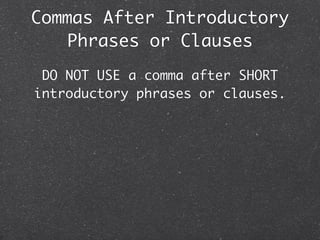
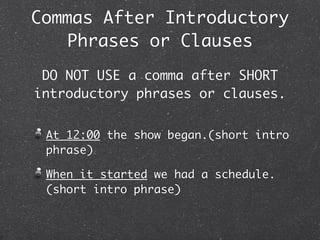
 DO NOT USE a comma after SHORT
introductory phrases or clauses.
Commas After Introductory
    Phrases or Clauses
 DO NOT USE a comma after SHORT
introductory phrases or clauses.


 At 12:00 the show began.(short intro
 phrase)

 When it started we had a schedule.
 (short intro phrase)
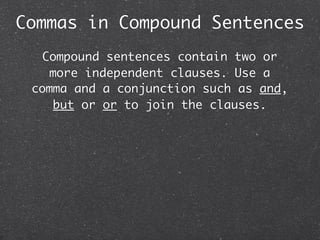
Commas in Compound Sentences
   Compound sentences contain two or
    more independent clauses. Use a
 comma and a conjunction such as and,
     but or or to join the clauses.
Commas in Compound Sentences
   Compound sentences contain two or
    more independent clauses. Use a
 comma and a conjunction such as and,
     but or or to join the clauses.


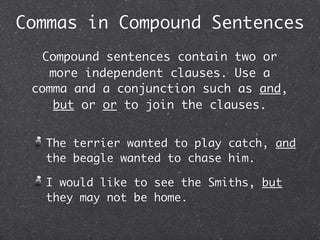
   The terrier wanted to play catch, and
   the beagle wanted to chase him.
Commas in Compound Sentences
   Compound sentences contain two or
    more independent clauses. Use a
 comma and a conjunction such as and,
     but or or to join the clauses.


   The terrier wanted to play catch, and
   the beagle wanted to chase him.

   I would like to see the Smiths, but
   they may not be home.
Commas in Compound Sentences

  DO NOT USE commas to separate the
    COMPOUND SUBJECTS or COMPOUND
   PREDICATES of simple sentences.
Commas in Compound Sentences

  DO NOT USE commas to separate the
    COMPOUND SUBJECTS or COMPOUND
   PREDICATES of simple sentences.


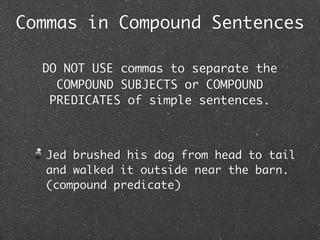
  Jed brushed his dog from head to tail
  and walked it outside near the barn.
  (compound predicate)
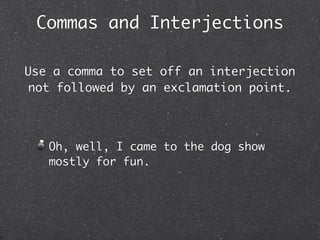
Commas and Interjections

Use a comma to set off an interjection
 not followed by an exclamation point.
Commas and Interjections

Use a comma to set off an interjection
 not followed by an exclamation point.


   Oh, well, I came to the dog show
   mostly for fun.

Commas (Part One)

  • 1.
  • 2.
  • 3.
    Commas in aSeries Use a comma to separate three or more items in a series.
  • 4.
    Commas in aSeries Use a comma to separate three or more items in a series. Please grab the leash, collar, and treats. (series of words)
  • 5.
    Commas in aSeries Use a comma to separate three or more items in a series. Please grab the leash, collar, and treats. (series of words) Was it a toy poodle, miniature poodle, or standard poodle? (series of phrases)
  • 6.
  • 7.
    Commas in aSeries Commas also separate the items in a series of three or more predicates.
  • 8.
    Commas in aSeries Commas also separate the items in a series of three or more predicates. The dogs stepped out of their crates, sniffed the ground, and began to play.
  • 9.
    Commas After Introductory Phrases or Clauses
  • 10.
    Commas After Introductory Phrases or Clauses Use a comma after a LONG introductory phrase or clause.
  • 11.
    Commas After Introductory Phrases or Clauses Use a comma after a LONG introductory phrase or clause. When you become really good at handling dogs, I will let you show them. (long introductory clause)
  • 12.
    Commas After Introductory Phrases or Clauses Use a comma after a LONG introductory phrase or clause. When you become really good at handling dogs, I will let you show them. (long introductory clause) Until we arrived at the dog show, we had no idea what the schedule was. (long introductory clause)
  • 13.
    Commas After Introductory Phrases or Clauses
  • 14.
    Commas After Introductory Phrases or Clauses DO NOT USE a comma after SHORT introductory phrases or clauses.
  • 15.
    Commas After Introductory Phrases or Clauses DO NOT USE a comma after SHORT introductory phrases or clauses. At 12:00 the show began.(short intro phrase) When it started we had a schedule. (short intro phrase)
  • 16.
  • 17.
    Commas in CompoundSentences Compound sentences contain two or more independent clauses. Use a comma and a conjunction such as and, but or or to join the clauses.
  • 18.
    Commas in CompoundSentences Compound sentences contain two or more independent clauses. Use a comma and a conjunction such as and, but or or to join the clauses. The terrier wanted to play catch, and the beagle wanted to chase him.
  • 19.
    Commas in CompoundSentences Compound sentences contain two or more independent clauses. Use a comma and a conjunction such as and, but or or to join the clauses. The terrier wanted to play catch, and the beagle wanted to chase him. I would like to see the Smiths, but they may not be home.
  • 20.
  • 21.
    Commas in CompoundSentences DO NOT USE commas to separate the COMPOUND SUBJECTS or COMPOUND PREDICATES of simple sentences.
  • 22.
    Commas in CompoundSentences DO NOT USE commas to separate the COMPOUND SUBJECTS or COMPOUND PREDICATES of simple sentences. Jed brushed his dog from head to tail and walked it outside near the barn. (compound predicate)
  • 23.
  • 24.
    Commas and Interjections Usea comma to set off an interjection not followed by an exclamation point.
  • 25.
    Commas and Interjections Usea comma to set off an interjection not followed by an exclamation point. Oh, well, I came to the dog show mostly for fun.