Conquering the Comma
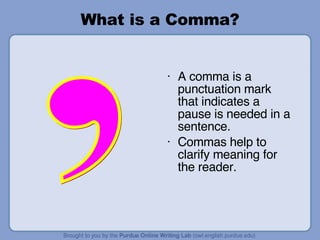
What is a Comma? , A comma is a punctuation mark that indicates a pause is needed in a sentence. Commas help to clarify meaning for the reader.
Clauses and Phrases A clause is a group of words that contains both a subject and a verb that complement each other. A phrase is a group of words that does not contain a subject or a verb that complement each other.
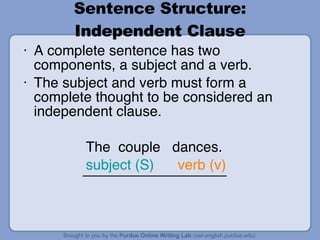
Sentence Structure: Independent Clause A complete sentence has two components, a subject and a verb. The subject and verb must form a complete thought to be considered an independent clause. The  couple  dances. subject (S)   verb (v)
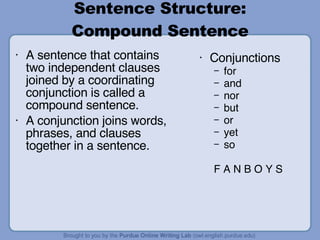
Sentence Structure: Compound Sentence A sentence that contains two independent clauses joined by a coordinating conjunction is called a compound sentence. A conjunction joins words, phrases, and clauses together in a sentence. Conjunctions for and nor but or yet so F A N B O Y S
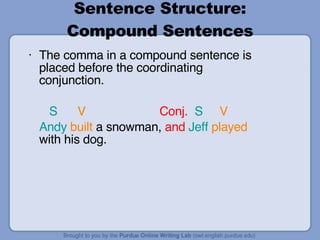
Sentence Structure: Compound Sentences The comma in a compound sentence is placed before the coordinating conjunction.   S   V   Conj.   S   V Andy   built  a snowman,  and   Jeff   played  with his dog.
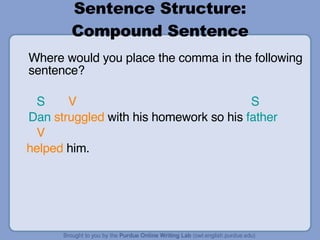
Sentence Structure: Compound Sentence Where would you place the comma in the following sentence? S   V  S   Dan   struggled  with his homework so his  father   V helped  him.
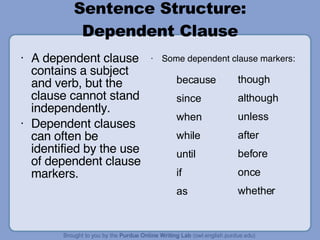
Sentence Structure: Dependent Clause A dependent clause contains a subject and verb, but the clause cannot stand independently. Dependent clauses can often be identified by the use of dependent clause markers. Some dependent clause markers: because since when while until if as though although unless after before once whether
Sentence Structure: Dependent Phrases & Clauses Dependent phrases and clauses help to clarify and add detail to an independent clause. Dependent clauses may appear at the beginning, middle, or end of a sentence.
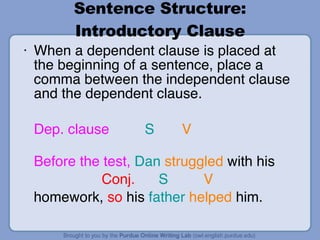
Sentence Structure: Introductory Clause When a dependent clause is placed at the beginning of a sentence, place a comma between the independent clause and the dependent clause. Dep. clause   S   V  Before   the test,   Dan   struggled  with his    Conj.  S  V  homework,  so  his  father   helped  him.
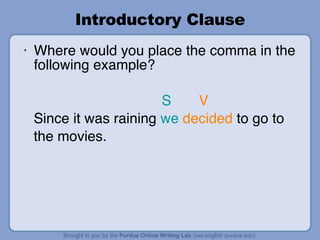
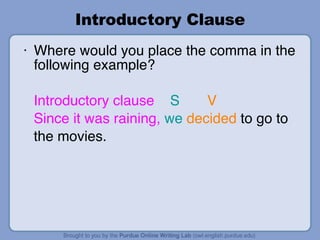
Introductory Clause Where would you place the comma in the following example?   S   V Since it was raining  we   decided  to go to  the movies.
Introductory Clause Where would you place the comma in the following example?  Introductory clause   S   V Since it was raining,   we   decided  to go to  the movies.
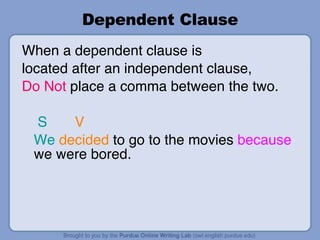
Dependent Clause When a dependent clause is  located after an independent clause,  Do Not  place a comma between the two. S   V We   decided  to go to the movies  because  we were bored.
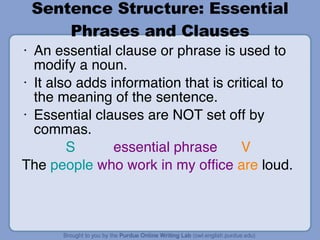
Sentence Structure: Essential Phrases and Clauses An essential clause or phrase is used to modify a noun. It also adds information that is critical to the meaning of the sentence. Essential clauses are NOT set off by commas.   S   essential phrase  V The  people   who work in my office   are  loud.
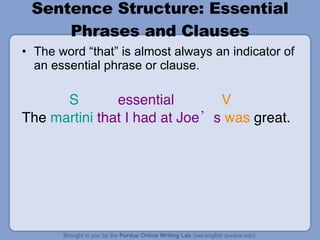
Sentence Structure: Essential Phrases and Clauses The word “that” is almost always an indicator of an essential phrase or clause. S essential  V The  martini   that I had at Joe’s   was  great.
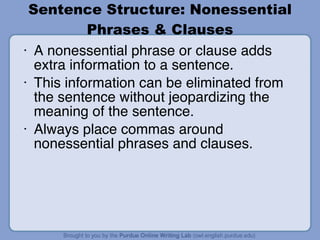
Sentence Structure: Nonessential Phrases & Clauses A nonessential phrase or clause adds extra information to a sentence. This information can be eliminated from the sentence without jeopardizing the meaning of the sentence. Always place commas around nonessential phrases and clauses.
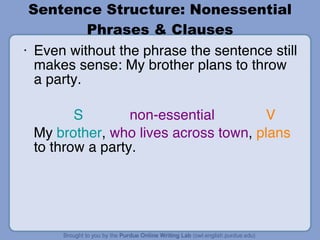
Sentence Structure: Nonessential Phrases & Clauses Even without the phrase the sentence still makes sense: My brother plans to throw a party.   S   non-essential   V My  brother ,  who lives across town ,  plans  to throw a party.
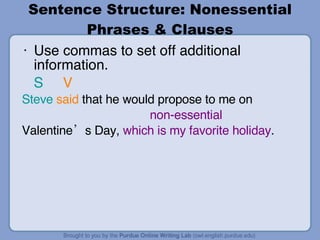
Sentence Structure: Nonessential Phrases & Clauses Use commas to set off additional information. S  V Steve   said  that he would propose to me on  non-essential Valentine’s Day,  which is my favorite holiday .
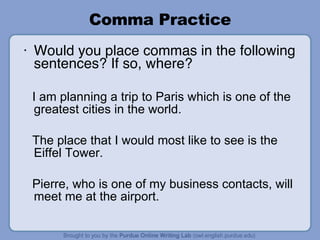
Comma Practice Would you place commas in the following sentences? If so, where? I am planning a trip to Paris which is one of the greatest cities in the world. The place that I would most like to see is the Eiffel Tower. Pierre, who is one of my business contacts, will meet me at the airport.
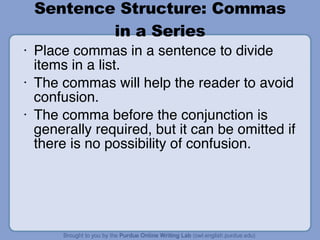
Sentence Structure: Commas in a Series Place commas in a sentence to divide items in a list. The commas will help the reader to avoid confusion. The comma before the conjunction is generally required, but it can be omitted if there is no possibility of confusion.
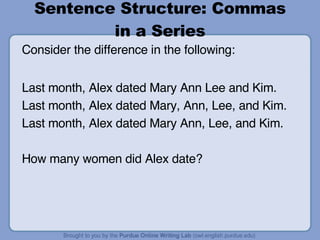
Sentence Structure: Commas in a Series Consider the difference in the following: Last month, Alex dated Mary Ann Lee and Kim. Last month, Alex dated Mary, Ann, Lee, and Kim. Last month, Alex dated Mary Ann, Lee, and Kim. How many women did Alex date?
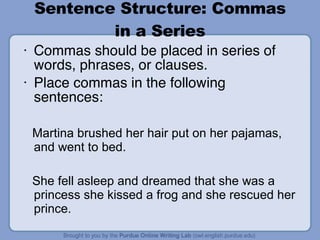
Sentence Structure: Commas in a Series Commas should be placed in series of words, phrases, or clauses. Place commas in the following sentences: Martina brushed her hair put on her pajamas, and went to bed. She fell asleep and dreamed that she was a princess she kissed a frog and she rescued her prince.
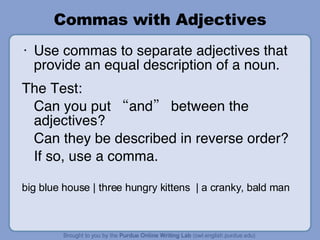
Commas with Adjectives Use commas to separate adjectives that provide an equal description of a noun. The Test: Can you put “and” between the adjectives? Can they be described in reverse order? If so, use a comma. big blue house | three hungry kittens  | a cranky, bald man
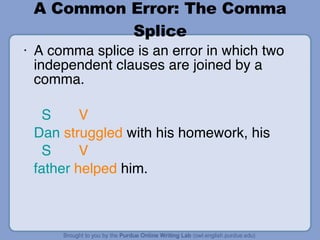
A Common Error: The Comma Splice A comma splice is an error in which two independent clauses are joined by a comma. S   V  Dan   struggled  with his homework, his  S   V father   helped  him.
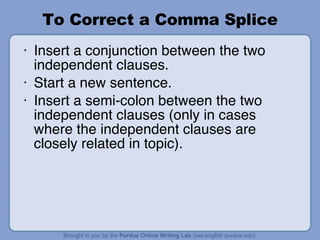
To Correct a Comma Splice Insert a conjunction between the two independent clauses. Start a new sentence. Insert a semi-colon between the two independent clauses (only in cases where the independent clauses are closely related in topic).
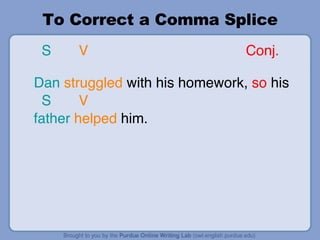
To Correct a Comma Splice S   V  Conj.   Dan   struggled  with his homework,  so  his  S   V father   helped  him.
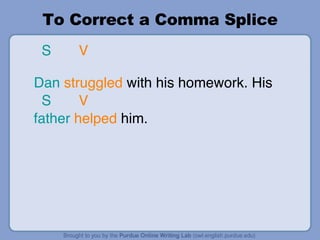
To Correct a Comma Splice S   V    Dan   struggled  with his homework. His  S   V father   helped  him.
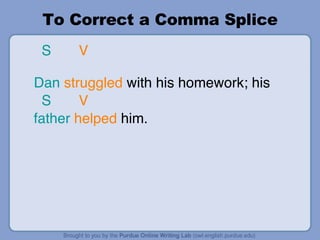
To Correct a Comma Splice S   V    Dan   struggled  with his homework; his  S   V father   helped  him.
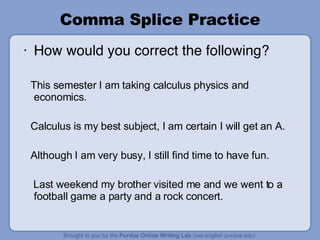
Comma Splice Practice How would you correct the following? This semester I am taking calculus physics and economics. Calculus is my best subject, I am certain I will get an A. Although I am very busy, I still find time to have fun. Last weekend my brother visited me and we went to a football game a party and a rock concert.
Additional Help Purdue University Writing Lab Heavilon 226 Grammar Hotline: (765) 494-3723 Check our web site:  http://owl.english.purdue.edu Email brief questions:  http://owl.english.purdue.edu/writinglab/email/owlmail
The End

Conquering The Comma

  • 1.
  • 2.
    What is aComma? , A comma is a punctuation mark that indicates a pause is needed in a sentence. Commas help to clarify meaning for the reader.
  • 3.
    Clauses and PhrasesA clause is a group of words that contains both a subject and a verb that complement each other. A phrase is a group of words that does not contain a subject or a verb that complement each other.
  • 4.
    Sentence Structure: IndependentClause A complete sentence has two components, a subject and a verb. The subject and verb must form a complete thought to be considered an independent clause. The couple dances. subject (S) verb (v)
  • 5.
    Sentence Structure: CompoundSentence A sentence that contains two independent clauses joined by a coordinating conjunction is called a compound sentence. A conjunction joins words, phrases, and clauses together in a sentence. Conjunctions for and nor but or yet so F A N B O Y S
  • 6.
    Sentence Structure: CompoundSentences The comma in a compound sentence is placed before the coordinating conjunction. S V Conj. S V Andy built a snowman, and Jeff played with his dog.
  • 7.
    Sentence Structure: CompoundSentence Where would you place the comma in the following sentence? S V S Dan struggled with his homework so his father V helped him.
  • 8.
    Sentence Structure: DependentClause A dependent clause contains a subject and verb, but the clause cannot stand independently. Dependent clauses can often be identified by the use of dependent clause markers. Some dependent clause markers: because since when while until if as though although unless after before once whether
  • 9.
    Sentence Structure: DependentPhrases & Clauses Dependent phrases and clauses help to clarify and add detail to an independent clause. Dependent clauses may appear at the beginning, middle, or end of a sentence.
  • 10.
    Sentence Structure: IntroductoryClause When a dependent clause is placed at the beginning of a sentence, place a comma between the independent clause and the dependent clause. Dep. clause S V Before the test, Dan struggled with his Conj. S V homework, so his father helped him.
  • 11.
    Introductory Clause Wherewould you place the comma in the following example? S V Since it was raining we decided to go to the movies.
  • 12.
    Introductory Clause Wherewould you place the comma in the following example? Introductory clause S V Since it was raining, we decided to go to the movies.
  • 13.
    Dependent Clause Whena dependent clause is located after an independent clause, Do Not place a comma between the two. S V We decided to go to the movies because we were bored.
  • 14.
    Sentence Structure: EssentialPhrases and Clauses An essential clause or phrase is used to modify a noun. It also adds information that is critical to the meaning of the sentence. Essential clauses are NOT set off by commas. S essential phrase V The people who work in my office are loud.
  • 15.
    Sentence Structure: EssentialPhrases and Clauses The word “that” is almost always an indicator of an essential phrase or clause. S essential V The martini that I had at Joe’s was great.
  • 16.
    Sentence Structure: NonessentialPhrases & Clauses A nonessential phrase or clause adds extra information to a sentence. This information can be eliminated from the sentence without jeopardizing the meaning of the sentence. Always place commas around nonessential phrases and clauses.
  • 17.
    Sentence Structure: NonessentialPhrases & Clauses Even without the phrase the sentence still makes sense: My brother plans to throw a party. S non-essential V My brother , who lives across town , plans to throw a party.
  • 18.
    Sentence Structure: NonessentialPhrases & Clauses Use commas to set off additional information. S V Steve said that he would propose to me on non-essential Valentine’s Day, which is my favorite holiday .
  • 19.
    Comma Practice Wouldyou place commas in the following sentences? If so, where? I am planning a trip to Paris which is one of the greatest cities in the world. The place that I would most like to see is the Eiffel Tower. Pierre, who is one of my business contacts, will meet me at the airport.
  • 20.
    Sentence Structure: Commasin a Series Place commas in a sentence to divide items in a list. The commas will help the reader to avoid confusion. The comma before the conjunction is generally required, but it can be omitted if there is no possibility of confusion.
  • 21.
    Sentence Structure: Commasin a Series Consider the difference in the following: Last month, Alex dated Mary Ann Lee and Kim. Last month, Alex dated Mary, Ann, Lee, and Kim. Last month, Alex dated Mary Ann, Lee, and Kim. How many women did Alex date?
  • 22.
    Sentence Structure: Commasin a Series Commas should be placed in series of words, phrases, or clauses. Place commas in the following sentences: Martina brushed her hair put on her pajamas, and went to bed. She fell asleep and dreamed that she was a princess she kissed a frog and she rescued her prince.
  • 23.
    Commas with AdjectivesUse commas to separate adjectives that provide an equal description of a noun. The Test: Can you put “and” between the adjectives? Can they be described in reverse order? If so, use a comma. big blue house | three hungry kittens | a cranky, bald man
  • 24.
    A Common Error:The Comma Splice A comma splice is an error in which two independent clauses are joined by a comma. S V Dan struggled with his homework, his S V father helped him.
  • 25.
    To Correct aComma Splice Insert a conjunction between the two independent clauses. Start a new sentence. Insert a semi-colon between the two independent clauses (only in cases where the independent clauses are closely related in topic).
  • 26.
    To Correct aComma Splice S V Conj. Dan struggled with his homework, so his S V father helped him.
  • 27.
    To Correct aComma Splice S V Dan struggled with his homework. His S V father helped him.
  • 28.
    To Correct aComma Splice S V Dan struggled with his homework; his S V father helped him.
  • 29.
    Comma Splice PracticeHow would you correct the following? This semester I am taking calculus physics and economics. Calculus is my best subject, I am certain I will get an A. Although I am very busy, I still find time to have fun. Last weekend my brother visited me and we went to a football game a party and a rock concert.
  • 30.
    Additional Help PurdueUniversity Writing Lab Heavilon 226 Grammar Hotline: (765) 494-3723 Check our web site: http://owl.english.purdue.edu Email brief questions: http://owl.english.purdue.edu/writinglab/email/owlmail
  • 31.

Editor's Notes

  • #2 Rationale: Welcome to “Conquering the Comma.” This presentation is designed to acquaint your students with the rules of comma usage, including placement in compound sentences, after introductory elements, with dependent phrases and clauses, around nonessential elements, in a series, and with adjectives. This presentation will also cover methods for avoiding a common comma error—the comma splice. The thirty-one slide presented here are designed to aid the facilitator in an interactive presentation of the elements of comma usage. This presentation is ideal for the beginning of a composition course, the assignment of a writing project, or as a refresher presentation for grammar usage. This presentation may be supplemented with OWL resources here: http://owl.english.purdue.edu/owl/. Directions: Each slide is activated by a single mouse click, unless otherwise noted in bold at the bottom of each notes page. Writer and Designer: Jennifer Liethen Kunka Contributors: Muriel Harris, Karen Bishop, Bryan Kopp, Matthew Mooney, David Neyhart, and Andrew Kunka Updated by H. Allen Brizee, 2007. Developed with resources courtesy of the Purdue University Writing Lab Grant funding courtesy of the Multimedia Instructional Development Center at Purdue University © Copyright Purdue University, 2000, 2007.