SGT A ALANKARSGT A ALANKAR
• THE AIR/ FUEL MIXTURE BURNS INSIDETHE AIR/ FUEL MIXTURE BURNS INSIDE
THE COMBUSTION CHAMBER.THE COMBUSTION CHAMBER.
PROPER BURNING MUST TAKE PLACEPROPER BURNING MUST TAKE PLACE
DURING ENGINE OPERATION.DURING ENGINE OPERATION.
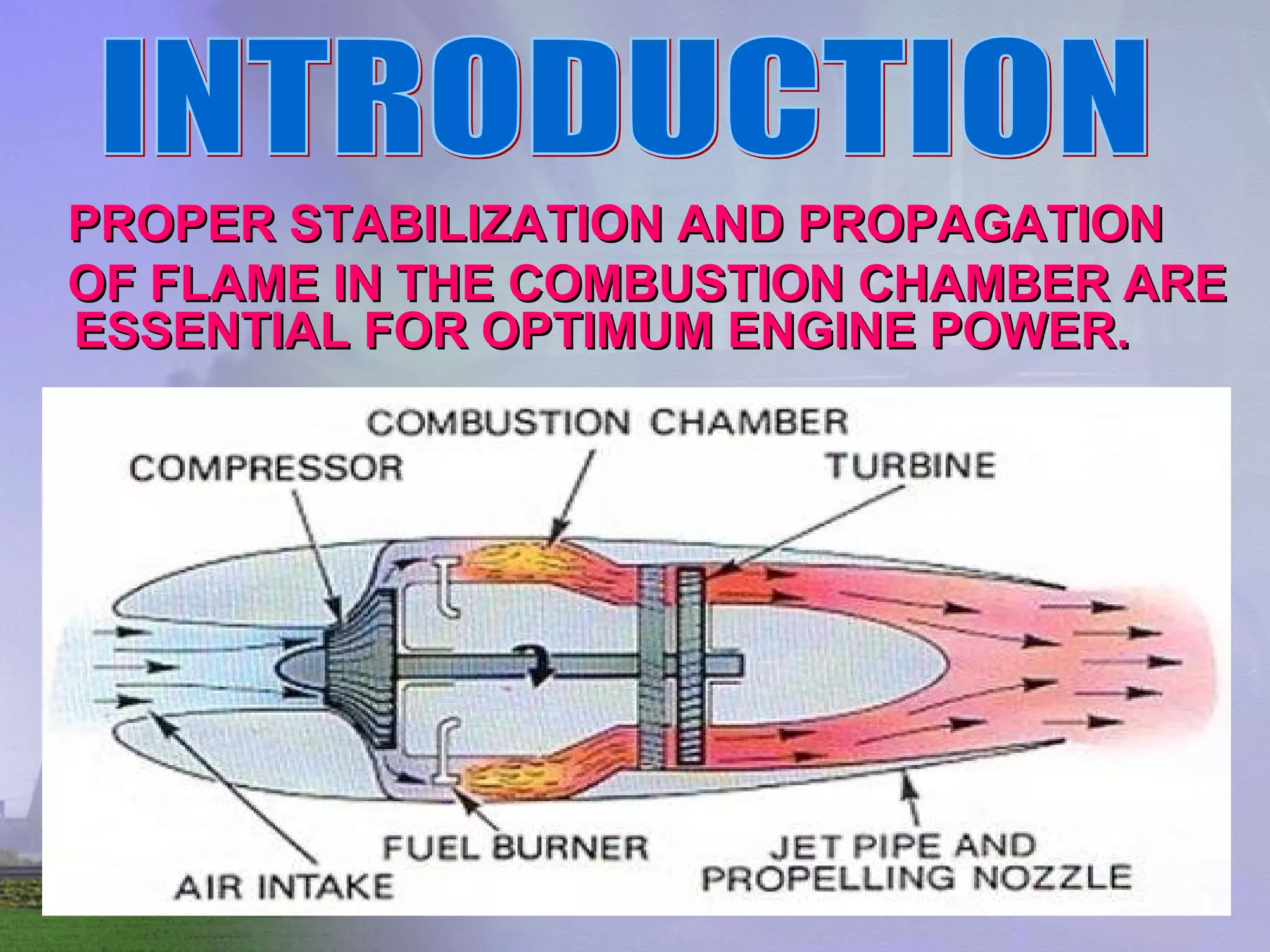
PROPER STABILIZATION AND PROPAGATIONPROPER STABILIZATION AND PROPAGATION
OF FLAME IN THE COMBUSTION CHAMBER AREOF FLAME IN THE COMBUSTION CHAMBER ARE
ESSENTIAL FOR OPTIMUM ENGINE POWER.ESSENTIAL FOR OPTIMUM ENGINE POWER.
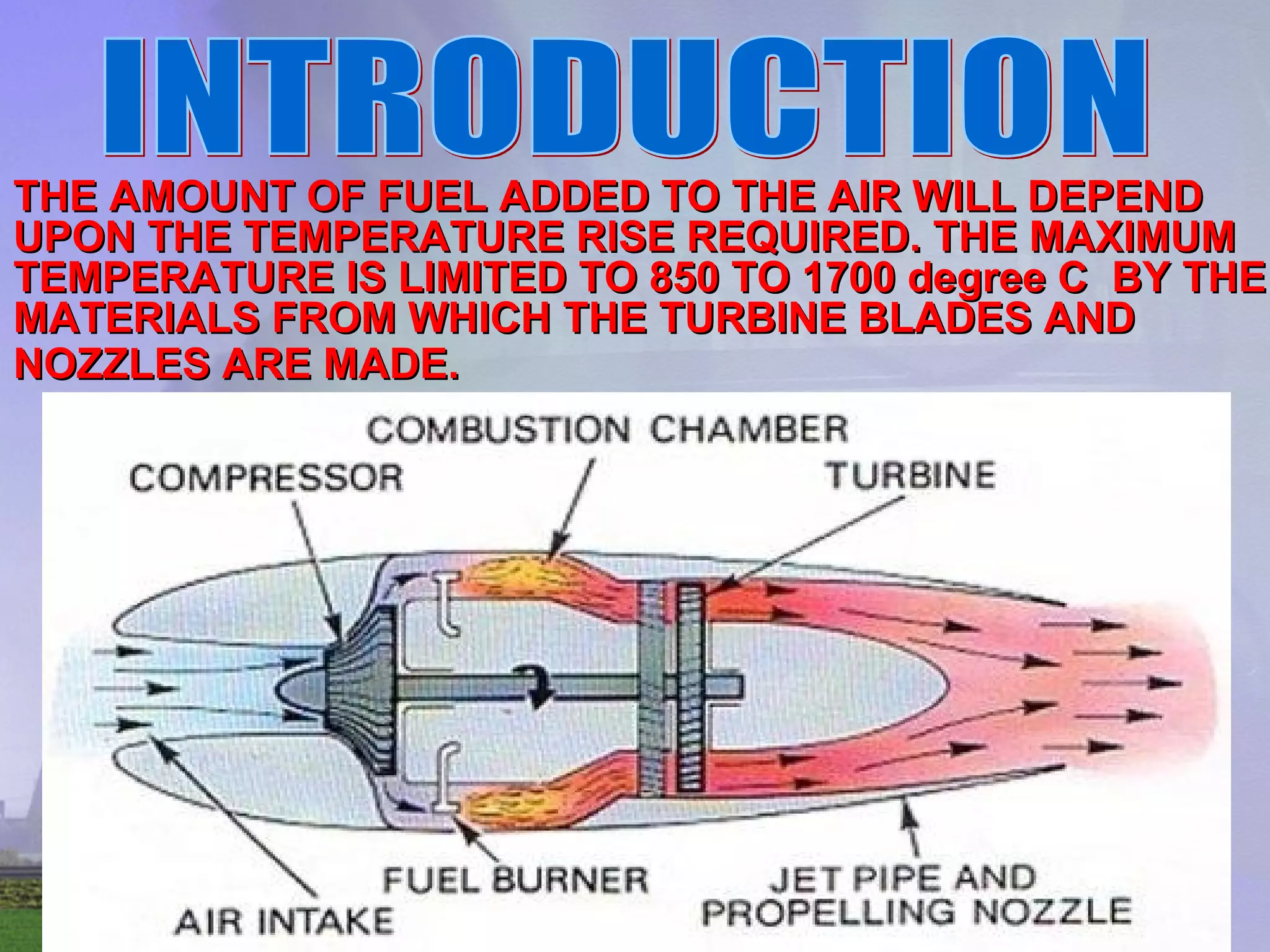
THE AMOUNT OF FUEL ADDED TO THE AIR WILL DEPENDTHE AMOUNT OF FUEL ADDED TO THE AIR WILL DEPEND
UPON THE TEMPERATURE RISE REQUIRED. THE MAXIMUMUPON THE TEMPERATURE RISE REQUIRED. THE MAXIMUM
TEMPERATURE IS LIMITED TO 850 TO 1700 degree C BY THETEMPERATURE IS LIMITED TO 850 TO 1700 degree C BY THE
MATERIALS FROM WHICH THE TURBINE BLADES ANDMATERIALS FROM WHICH THE TURBINE BLADES AND
NOZZLES ARE MADE.NOZZLES ARE MADE.
THE AMOUNT OF FUEL ADDED TO THE AIR WILL DEPENDTHE AMOUNT OF FUEL ADDED TO THE AIR WILL DEPEND
UPON THE TEMPERATURE RISE REQUIRED. THE MAXIMUMUPON THE TEMPERATURE RISE REQUIRED. THE MAXIMUM
TEMPERATURE IS LIMITED TO 850 TO 1700 degree C BY THETEMPERATURE IS LIMITED TO 850 TO 1700 degree C BY THE
MATERIALS FROM WHICH THE TURBINE BLADES ANDMATERIALS FROM WHICH THE TURBINE BLADES AND
NOZZLES ARE MADE.NOZZLES ARE MADE.
COMBUSTIONCOMBUSTION
CHAMBERSCHAMBERS
JET ENGINES EMPLOY VARIOUSJET ENGINES EMPLOY VARIOUS
TYPES OF COMBUSTIONTYPES OF COMBUSTION
CHAMBERS FOR BURNING OFCHAMBERS FOR BURNING OF
AIR/FUEL MIXTURE ANDAIR/FUEL MIXTURE AND
GENERATING LARGE AMOUNT OFGENERATING LARGE AMOUNT OF
HEAT DEPENDING UPON DESIGNHEAT DEPENDING UPON DESIGN
REQUIREMENTS.REQUIREMENTS.
COMBUSTIONCOMBUSTION
CHAMBERSCHAMBERS
•TO ENSURE EFFECTIVE ANDTO ENSURE EFFECTIVE AND
EFFICIENT COMBUSTION OFEFFICIENT COMBUSTION OF
AIR/FUEL MIXTURE AND MAINTAINAIR/FUEL MIXTURE AND MAINTAIN
OPTIMUM TEMPERATURES OF THEOPTIMUM TEMPERATURES OF THE
COMBUSTION PRODUCTS DURINGCOMBUSTION PRODUCTS DURING
THE ENTIRE RANGE OF ENGINETHE ENTIRE RANGE OF ENGINE
OPERATION.OPERATION.
COMBUSTIONCOMBUSTION
CHAMBERSCHAMBERS
VARIOUS DESIGN FEATURES AREVARIOUS DESIGN FEATURES ARE
INCORPORATED IN THEINCORPORATED IN THE
COMBUSTION CHAMBERS FROMCOMBUSTION CHAMBERS FROM
SHAPE, SIZE TO THE MATERIALSHAPE, SIZE TO THE MATERIAL
AND HEAT TREATMENT SO THATAND HEAT TREATMENT SO THAT
THEY MEET THEIRTHEY MEET THEIR
REQUIREMENTS.REQUIREMENTS.
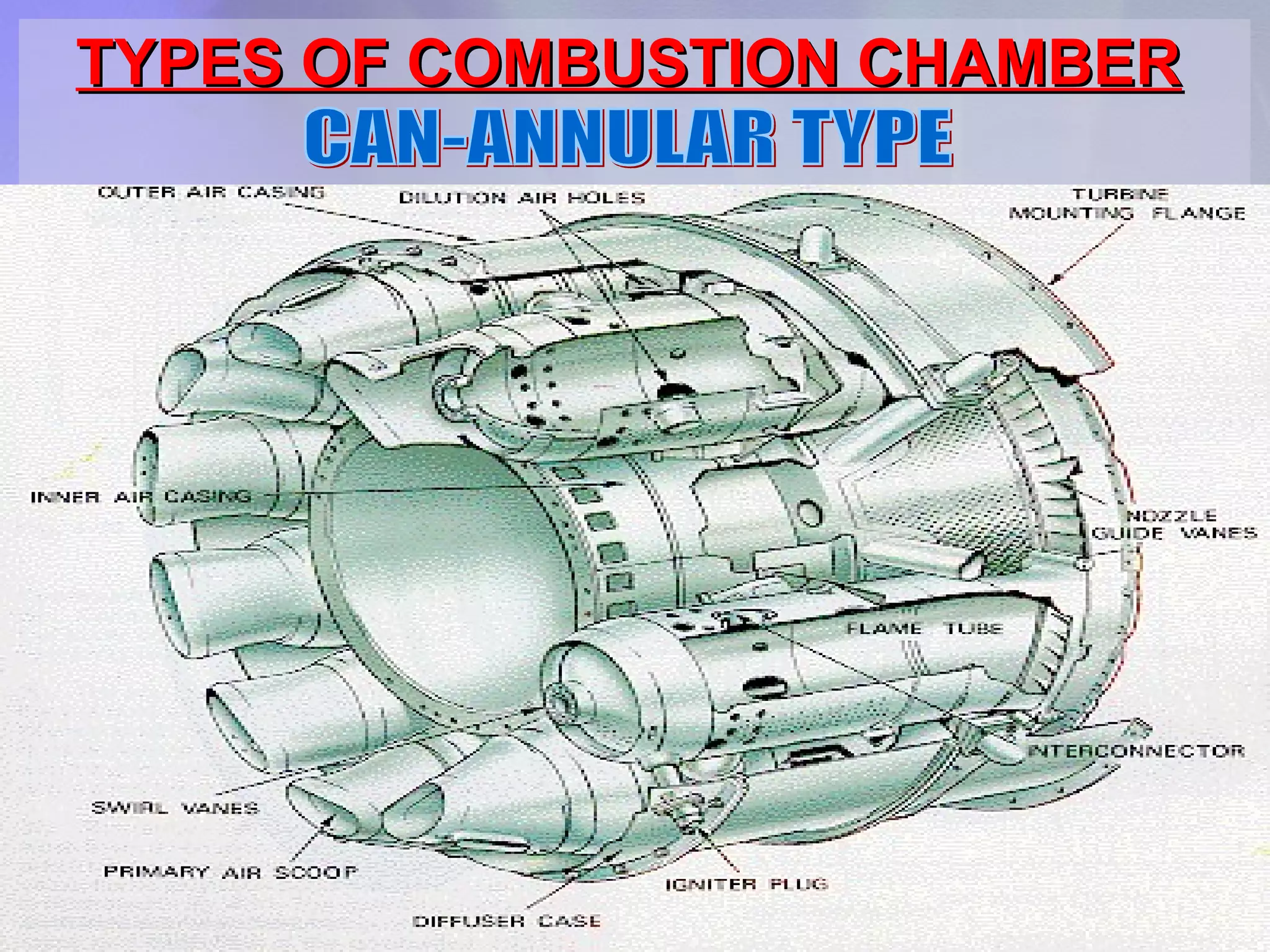
TYPES OF COMBUSTION CHAMBERTYPES OF COMBUSTION CHAMBER
TYPES OF COMBUSTION CHAMBERSTYPES OF COMBUSTION CHAMBERS
TYPES OF COMBUSTION CHAMBERTYPES OF COMBUSTION CHAMBER
The combustion chamber has the difficult taskThe combustion chamber has the difficult task
of burning large quantities of fuel, suppliedof burning large quantities of fuel, supplied
through the fuel spray nozzles, with extensivethrough the fuel spray nozzles, with extensive
volumes of air, supplied by the compressor, andvolumes of air, supplied by the compressor, and
releasing the heat in such a manner that the air isreleasing the heat in such a manner that the air is
expanded and accelerated to give a smoothexpanded and accelerated to give a smooth
stream of uniformly heated gas at all conditionsstream of uniformly heated gas at all conditions
required by the turbine. This task must berequired by the turbine. This task must be
accomplished with theaccomplished with the minimum loss in pressureminimum loss in pressure
and with the maximum heat release for the limitedand with the maximum heat release for the limited
space available. Hence, the combustion chamberspace available. Hence, the combustion chamber
have certainhave certain design and operational requirementsdesign and operational requirements..
1.1. Since the gas temperature required at the turbineSince the gas temperature required at the turbine
varies with engine thrust, and in the case of thevaries with engine thrust, and in the case of the
turbo-propeller engine upon the power required,turbo-propeller engine upon the power required,
the combustion chamber must bethe combustion chamber must be
capable of maintaining stable andcapable of maintaining stable and
efficient combustion over a wideefficient combustion over a wide
range of engine operatingrange of engine operating
conditions.conditions.
2.2. High combustion efficiencyHigh combustion efficiency
has become increasingly importanthas become increasingly important
because of the rapid rise in commercialbecause of the rapid rise in commercial
aircraft traffic and the consequentaircraft traffic and the consequent
increase in atmospheric pollution, whichincrease in atmospheric pollution, which
is seen by the general public as exhaustis seen by the general public as exhaust
smoke.smoke.
3.3. A combustion chamber must beA combustion chamber must be able toable to
operate efficiently over a wide rangeoperate efficiently over a wide range
of conditionsof conditions (( e.g. inlet pressure &e.g. inlet pressure &
temperature of air and air/fuel ratiostemperature of air and air/fuel ratios))..
4.4. In performing these functions, the flameIn performing these functions, the flame
tube and spray nozzle atomizertube and spray nozzle atomizer
components mustcomponents must bebe mechanicallymechanically
reliablereliable..
5.5. The gas turbine engine operates on a constantThe gas turbine engine operates on a constant
pressure cycle, therefore, during the processpressure cycle, therefore, during the process
of combustionof combustion pressure loss should bepressure loss should be
minimumminimum..
In providing adequate turbulence and mixing, aIn providing adequate turbulence and mixing, a
total pressure loss varying from about 3 - 8 %total pressure loss varying from about 3 - 8 %
of the air pressure at entry to the chamber isof the air pressure at entry to the chamber is
incurred.incurred.
6.6. Combustion stability (i.e.Combustion stability (i.e. satisfactorysatisfactory
rich and weak mixture extinction limits)rich and weak mixture extinction limits)
Combustion stabilityCombustion stability means smooth burningmeans smooth burning
and the ability of the flame to remain alightand the ability of the flame to remain alight
over a wide operating range. For any particularover a wide operating range. For any particular
type of combustion chamber there is both atype of combustion chamber there is both a
rich and weak limit to the air/fuel ratio, beyondrich and weak limit to the air/fuel ratio, beyond
which the flame is extinguished.which the flame is extinguished.
7.7. Uniform temperature and velocityUniform temperature and velocity
distribution at the entrance to the turbinedistribution at the entrance to the turbine
and simplicity of control.and simplicity of control.
8.8. Ease and cheapness of manufacture.Ease and cheapness of manufacture.
9.9. The containing walls and internal parts of theThe containing walls and internal parts of the
combustion chamber must becombustion chamber must be heat &heat &
corrosion resistantcorrosion resistant because it isbecause it is
subjectedsubjected to the productsto the products of the combustion,of the combustion,
creep failure and fatigue due to thermal andcreep failure and fatigue due to thermal and
vibrational stresses.vibrational stresses.
1.1. Air from the engine compressor enters theAir from the engine compressor enters the
combustion chamber at a velocity up to 500combustion chamber at a velocity up to 500 feetfeet
per second, but because at this velocityper second, but because at this velocity the airthe air
speed is far too high for combustion,speed is far too high for combustion, the firstthe first
thing that the chamber must do is tothing that the chamber must do is to diffuse it,diffuse it,
i.e. decelerate it and ATF at normali.e. decelerate it and ATF at normal mixture ratiosmixture ratios
is only a few feet per second,is only a few feet per second, any fuel lit even inany fuel lit even in
the diffused air stream,the diffused air stream, which now has a velocitywhich now has a velocity
of about 80 feet perof about 80 feet per second, would be blownsecond, would be blown
away. A region of lowaway. A region of low axial velocity hasaxial velocity has
therefore to be created in thetherefore to be created in the chamber, so that thechamber, so that the
flame will remain alightflame will remain alight throughout the range ofthroughout the range of
engine operatingengine operating conditions.conditions.
2.2. In normal operation, the overall air/fuelIn normal operation, the overall air/fuel
ratio of a combustion chamber can varyratio of a combustion chamber can vary
between 45:1 and 130:1, However, ATF willbetween 45:1 and 130:1, However, ATF will
only burn efficiently at, or close to, a ratio ofonly burn efficiently at, or close to, a ratio of
15:1, so the15:1, so the fuel must be burned with onlyfuel must be burned with only
part of the air entering the chamber, in whatpart of the air entering the chamber, in what
is called a primary combustion zone. This isis called a primary combustion zone. This is
achieved by means of a flame tubeachieved by means of a flame tube
(combustion liner) that has various devices(combustion liner) that has various devices
for metering the airflow distribution alongfor metering the airflow distribution along
the chamber.the chamber.
a
3.3. Approximately 20 per cent of the air mass flow is takenApproximately 20 per cent of the air mass flow is taken
in by the snout or entry section. Immediately downstreamin by the snout or entry section. Immediately downstream
of the snout are swirl vanes and a perforated flare, throughof the snout are swirl vanes and a perforated flare, through
which air passes into the primary combustion zone. Thewhich air passes into the primary combustion zone. The
swirling air induces a flow upstream of the centre of theswirling air induces a flow upstream of the centre of the
flame tube and promotes the desired recirculation. The airflame tube and promotes the desired recirculation. The air
not picked up by the snout flows into the annular spacenot picked up by the snout flows into the annular space
between the flame tube and the air casing.between the flame tube and the air casing.
7.7. Through the wall of the flame tube body, adjacent toThrough the wall of the flame tube body, adjacent to
the combustion zone, are a selected number ofthe combustion zone, are a selected number of
secondary holes through which a further 20 per cent ofsecondary holes through which a further 20 per cent of
the main flow of air passes into the primary zone. Thethe main flow of air passes into the primary zone. The
air from the swirl vanes and that from the secondaryair from the swirl vanes and that from the secondary
airair holes interacts and creates a region of low velocityholes interacts and creates a region of low velocity
recirculation. This takes the form of a toroidal vortex,recirculation. This takes the form of a toroidal vortex,
similar to a smoke ring, which has the effect ofsimilar to a smoke ring, which has the effect of
stabilizing and anchoring the flame. The recirculatingstabilizing and anchoring the flame. The recirculating
gases hasten the burning of freshly injected fuelgases hasten the burning of freshly injected fuel
droplets by rapidly bringing them to ignitiondroplets by rapidly bringing them to ignition
temperature.temperature.
8.8. It is arranged that the conical fuel spray from theIt is arranged that the conical fuel spray from the
nozzle intersects the recirculation vortex at its centre.nozzle intersects the recirculation vortex at its centre. ThisThis
action, together with the general turbulence in theaction, together with the general turbulence in the
primary zone, greatly assists in breaking up the fuelprimary zone, greatly assists in breaking up the fuel andand
mixing it with the incoming air.mixing it with the incoming air.
9.9. The temperature of the gases released by combustionThe temperature of the gases released by combustion
is about 1,800 to 2,000 deg. C., which is far too hot foris about 1,800 to 2,000 deg. C., which is far too hot for
entry to the nozzle guide vanes of the turbine. The airentry to the nozzle guide vanes of the turbine. The air
not used for combustion, which amounts to about 60not used for combustion, which amounts to about 60
per cent of the total airflow, is therefore introducedper cent of the total airflow, is therefore introduced
progressively into the flame tube. Approximately aprogressively into the flame tube. Approximately a
third of this is used to lower the gas temperature in thethird of this is used to lower the gas temperature in the
dilution zone before it enters the turbine and thedilution zone before it enters the turbine and the
remainder is used for cooling the walls of the flameremainder is used for cooling the walls of the flame tube.tube.
This is achieved by a film of cooling air flowingThis is achieved by a film of cooling air flowing along thealong the
inside surface of the flame tube wall,inside surface of the flame tube wall, insulating it frominsulating it from
the hot combustion gases. A recentthe hot combustion gases. A recent developmentdevelopment
allows cooling air to enter a network ofallows cooling air to enter a network of passages withinpassages within
the flame tube wall before exiting tothe flame tube wall before exiting to form anform an
insulating film of air, this can reduce theinsulating film of air, this can reduce the required wallrequired wall
cooling airflow by up to 50 per cent.cooling airflow by up to 50 per cent. CombustionCombustion
should be completed before the dilutionshould be completed before the dilution air enters theair enters the
flame tube, otherwise the incoming airflame tube, otherwise the incoming air will cool thewill cool the
flame and incomplete combustion willflame and incomplete combustion will result.result.
10.10. An electric spark from an igniter plug initiatesAn electric spark from an igniter plug initiates
combustion and the flame is then self-sustained.combustion and the flame is then self-sustained.
??

1 combustion chamber-jet engine

  • 1.
  • 3.
    • THE AIR/FUEL MIXTURE BURNS INSIDETHE AIR/ FUEL MIXTURE BURNS INSIDE THE COMBUSTION CHAMBER.THE COMBUSTION CHAMBER.
  • 4.
    PROPER BURNING MUSTTAKE PLACEPROPER BURNING MUST TAKE PLACE DURING ENGINE OPERATION.DURING ENGINE OPERATION.
  • 5.
    PROPER STABILIZATION ANDPROPAGATIONPROPER STABILIZATION AND PROPAGATION OF FLAME IN THE COMBUSTION CHAMBER AREOF FLAME IN THE COMBUSTION CHAMBER ARE ESSENTIAL FOR OPTIMUM ENGINE POWER.ESSENTIAL FOR OPTIMUM ENGINE POWER.
  • 6.
    THE AMOUNT OFFUEL ADDED TO THE AIR WILL DEPENDTHE AMOUNT OF FUEL ADDED TO THE AIR WILL DEPEND UPON THE TEMPERATURE RISE REQUIRED. THE MAXIMUMUPON THE TEMPERATURE RISE REQUIRED. THE MAXIMUM TEMPERATURE IS LIMITED TO 850 TO 1700 degree C BY THETEMPERATURE IS LIMITED TO 850 TO 1700 degree C BY THE MATERIALS FROM WHICH THE TURBINE BLADES ANDMATERIALS FROM WHICH THE TURBINE BLADES AND NOZZLES ARE MADE.NOZZLES ARE MADE.
  • 7.
    THE AMOUNT OFFUEL ADDED TO THE AIR WILL DEPENDTHE AMOUNT OF FUEL ADDED TO THE AIR WILL DEPEND UPON THE TEMPERATURE RISE REQUIRED. THE MAXIMUMUPON THE TEMPERATURE RISE REQUIRED. THE MAXIMUM TEMPERATURE IS LIMITED TO 850 TO 1700 degree C BY THETEMPERATURE IS LIMITED TO 850 TO 1700 degree C BY THE MATERIALS FROM WHICH THE TURBINE BLADES ANDMATERIALS FROM WHICH THE TURBINE BLADES AND NOZZLES ARE MADE.NOZZLES ARE MADE.
  • 8.
    COMBUSTIONCOMBUSTION CHAMBERSCHAMBERS JET ENGINES EMPLOYVARIOUSJET ENGINES EMPLOY VARIOUS TYPES OF COMBUSTIONTYPES OF COMBUSTION CHAMBERS FOR BURNING OFCHAMBERS FOR BURNING OF AIR/FUEL MIXTURE ANDAIR/FUEL MIXTURE AND GENERATING LARGE AMOUNT OFGENERATING LARGE AMOUNT OF HEAT DEPENDING UPON DESIGNHEAT DEPENDING UPON DESIGN REQUIREMENTS.REQUIREMENTS.
  • 9.
    COMBUSTIONCOMBUSTION CHAMBERSCHAMBERS •TO ENSURE EFFECTIVEANDTO ENSURE EFFECTIVE AND EFFICIENT COMBUSTION OFEFFICIENT COMBUSTION OF AIR/FUEL MIXTURE AND MAINTAINAIR/FUEL MIXTURE AND MAINTAIN OPTIMUM TEMPERATURES OF THEOPTIMUM TEMPERATURES OF THE COMBUSTION PRODUCTS DURINGCOMBUSTION PRODUCTS DURING THE ENTIRE RANGE OF ENGINETHE ENTIRE RANGE OF ENGINE OPERATION.OPERATION.
  • 10.
    COMBUSTIONCOMBUSTION CHAMBERSCHAMBERS VARIOUS DESIGN FEATURESAREVARIOUS DESIGN FEATURES ARE INCORPORATED IN THEINCORPORATED IN THE COMBUSTION CHAMBERS FROMCOMBUSTION CHAMBERS FROM SHAPE, SIZE TO THE MATERIALSHAPE, SIZE TO THE MATERIAL AND HEAT TREATMENT SO THATAND HEAT TREATMENT SO THAT THEY MEET THEIRTHEY MEET THEIR REQUIREMENTS.REQUIREMENTS.
  • 11.
    TYPES OF COMBUSTIONCHAMBERTYPES OF COMBUSTION CHAMBER
  • 12.
    TYPES OF COMBUSTIONCHAMBERSTYPES OF COMBUSTION CHAMBERS
  • 13.
    TYPES OF COMBUSTIONCHAMBERTYPES OF COMBUSTION CHAMBER
  • 14.
    The combustion chamberhas the difficult taskThe combustion chamber has the difficult task of burning large quantities of fuel, suppliedof burning large quantities of fuel, supplied through the fuel spray nozzles, with extensivethrough the fuel spray nozzles, with extensive volumes of air, supplied by the compressor, andvolumes of air, supplied by the compressor, and releasing the heat in such a manner that the air isreleasing the heat in such a manner that the air is expanded and accelerated to give a smoothexpanded and accelerated to give a smooth stream of uniformly heated gas at all conditionsstream of uniformly heated gas at all conditions required by the turbine. This task must berequired by the turbine. This task must be accomplished with theaccomplished with the minimum loss in pressureminimum loss in pressure and with the maximum heat release for the limitedand with the maximum heat release for the limited space available. Hence, the combustion chamberspace available. Hence, the combustion chamber have certainhave certain design and operational requirementsdesign and operational requirements..
  • 15.
    1.1. Since thegas temperature required at the turbineSince the gas temperature required at the turbine varies with engine thrust, and in the case of thevaries with engine thrust, and in the case of the turbo-propeller engine upon the power required,turbo-propeller engine upon the power required, the combustion chamber must bethe combustion chamber must be capable of maintaining stable andcapable of maintaining stable and efficient combustion over a wideefficient combustion over a wide range of engine operatingrange of engine operating conditions.conditions.
  • 16.
    2.2. High combustionefficiencyHigh combustion efficiency has become increasingly importanthas become increasingly important because of the rapid rise in commercialbecause of the rapid rise in commercial aircraft traffic and the consequentaircraft traffic and the consequent increase in atmospheric pollution, whichincrease in atmospheric pollution, which is seen by the general public as exhaustis seen by the general public as exhaust smoke.smoke.
  • 17.
    3.3. A combustionchamber must beA combustion chamber must be able toable to operate efficiently over a wide rangeoperate efficiently over a wide range of conditionsof conditions (( e.g. inlet pressure &e.g. inlet pressure & temperature of air and air/fuel ratiostemperature of air and air/fuel ratios)).. 4.4. In performing these functions, the flameIn performing these functions, the flame tube and spray nozzle atomizertube and spray nozzle atomizer components mustcomponents must bebe mechanicallymechanically reliablereliable..
  • 18.
    5.5. The gasturbine engine operates on a constantThe gas turbine engine operates on a constant pressure cycle, therefore, during the processpressure cycle, therefore, during the process of combustionof combustion pressure loss should bepressure loss should be minimumminimum.. In providing adequate turbulence and mixing, aIn providing adequate turbulence and mixing, a total pressure loss varying from about 3 - 8 %total pressure loss varying from about 3 - 8 % of the air pressure at entry to the chamber isof the air pressure at entry to the chamber is incurred.incurred.
  • 19.
    6.6. Combustion stability(i.e.Combustion stability (i.e. satisfactorysatisfactory rich and weak mixture extinction limits)rich and weak mixture extinction limits) Combustion stabilityCombustion stability means smooth burningmeans smooth burning and the ability of the flame to remain alightand the ability of the flame to remain alight over a wide operating range. For any particularover a wide operating range. For any particular type of combustion chamber there is both atype of combustion chamber there is both a rich and weak limit to the air/fuel ratio, beyondrich and weak limit to the air/fuel ratio, beyond which the flame is extinguished.which the flame is extinguished.
  • 20.
    7.7. Uniform temperatureand velocityUniform temperature and velocity distribution at the entrance to the turbinedistribution at the entrance to the turbine and simplicity of control.and simplicity of control. 8.8. Ease and cheapness of manufacture.Ease and cheapness of manufacture. 9.9. The containing walls and internal parts of theThe containing walls and internal parts of the combustion chamber must becombustion chamber must be heat &heat & corrosion resistantcorrosion resistant because it isbecause it is subjectedsubjected to the productsto the products of the combustion,of the combustion, creep failure and fatigue due to thermal andcreep failure and fatigue due to thermal and vibrational stresses.vibrational stresses.
  • 21.
    1.1. Air fromthe engine compressor enters theAir from the engine compressor enters the combustion chamber at a velocity up to 500combustion chamber at a velocity up to 500 feetfeet per second, but because at this velocityper second, but because at this velocity the airthe air speed is far too high for combustion,speed is far too high for combustion, the firstthe first thing that the chamber must do is tothing that the chamber must do is to diffuse it,diffuse it, i.e. decelerate it and ATF at normali.e. decelerate it and ATF at normal mixture ratiosmixture ratios is only a few feet per second,is only a few feet per second, any fuel lit even inany fuel lit even in the diffused air stream,the diffused air stream, which now has a velocitywhich now has a velocity of about 80 feet perof about 80 feet per second, would be blownsecond, would be blown away. A region of lowaway. A region of low axial velocity hasaxial velocity has therefore to be created in thetherefore to be created in the chamber, so that thechamber, so that the flame will remain alightflame will remain alight throughout the range ofthroughout the range of engine operatingengine operating conditions.conditions.
  • 22.
    2.2. In normaloperation, the overall air/fuelIn normal operation, the overall air/fuel ratio of a combustion chamber can varyratio of a combustion chamber can vary between 45:1 and 130:1, However, ATF willbetween 45:1 and 130:1, However, ATF will only burn efficiently at, or close to, a ratio ofonly burn efficiently at, or close to, a ratio of 15:1, so the15:1, so the fuel must be burned with onlyfuel must be burned with only part of the air entering the chamber, in whatpart of the air entering the chamber, in what is called a primary combustion zone. This isis called a primary combustion zone. This is achieved by means of a flame tubeachieved by means of a flame tube (combustion liner) that has various devices(combustion liner) that has various devices for metering the airflow distribution alongfor metering the airflow distribution along the chamber.the chamber. a
  • 23.
    3.3. Approximately 20per cent of the air mass flow is takenApproximately 20 per cent of the air mass flow is taken in by the snout or entry section. Immediately downstreamin by the snout or entry section. Immediately downstream of the snout are swirl vanes and a perforated flare, throughof the snout are swirl vanes and a perforated flare, through which air passes into the primary combustion zone. Thewhich air passes into the primary combustion zone. The swirling air induces a flow upstream of the centre of theswirling air induces a flow upstream of the centre of the flame tube and promotes the desired recirculation. The airflame tube and promotes the desired recirculation. The air not picked up by the snout flows into the annular spacenot picked up by the snout flows into the annular space between the flame tube and the air casing.between the flame tube and the air casing.
  • 24.
    7.7. Through thewall of the flame tube body, adjacent toThrough the wall of the flame tube body, adjacent to the combustion zone, are a selected number ofthe combustion zone, are a selected number of secondary holes through which a further 20 per cent ofsecondary holes through which a further 20 per cent of the main flow of air passes into the primary zone. Thethe main flow of air passes into the primary zone. The air from the swirl vanes and that from the secondaryair from the swirl vanes and that from the secondary airair holes interacts and creates a region of low velocityholes interacts and creates a region of low velocity recirculation. This takes the form of a toroidal vortex,recirculation. This takes the form of a toroidal vortex, similar to a smoke ring, which has the effect ofsimilar to a smoke ring, which has the effect of stabilizing and anchoring the flame. The recirculatingstabilizing and anchoring the flame. The recirculating gases hasten the burning of freshly injected fuelgases hasten the burning of freshly injected fuel droplets by rapidly bringing them to ignitiondroplets by rapidly bringing them to ignition temperature.temperature.
  • 25.
    8.8. It isarranged that the conical fuel spray from theIt is arranged that the conical fuel spray from the nozzle intersects the recirculation vortex at its centre.nozzle intersects the recirculation vortex at its centre. ThisThis action, together with the general turbulence in theaction, together with the general turbulence in the primary zone, greatly assists in breaking up the fuelprimary zone, greatly assists in breaking up the fuel andand mixing it with the incoming air.mixing it with the incoming air.
  • 26.
    9.9. The temperatureof the gases released by combustionThe temperature of the gases released by combustion is about 1,800 to 2,000 deg. C., which is far too hot foris about 1,800 to 2,000 deg. C., which is far too hot for entry to the nozzle guide vanes of the turbine. The airentry to the nozzle guide vanes of the turbine. The air not used for combustion, which amounts to about 60not used for combustion, which amounts to about 60 per cent of the total airflow, is therefore introducedper cent of the total airflow, is therefore introduced progressively into the flame tube. Approximately aprogressively into the flame tube. Approximately a third of this is used to lower the gas temperature in thethird of this is used to lower the gas temperature in the dilution zone before it enters the turbine and thedilution zone before it enters the turbine and the remainder is used for cooling the walls of the flameremainder is used for cooling the walls of the flame tube.tube. This is achieved by a film of cooling air flowingThis is achieved by a film of cooling air flowing along thealong the inside surface of the flame tube wall,inside surface of the flame tube wall, insulating it frominsulating it from the hot combustion gases. A recentthe hot combustion gases. A recent developmentdevelopment allows cooling air to enter a network ofallows cooling air to enter a network of passages withinpassages within the flame tube wall before exiting tothe flame tube wall before exiting to form anform an insulating film of air, this can reduce theinsulating film of air, this can reduce the required wallrequired wall cooling airflow by up to 50 per cent.cooling airflow by up to 50 per cent. CombustionCombustion should be completed before the dilutionshould be completed before the dilution air enters theair enters the flame tube, otherwise the incoming airflame tube, otherwise the incoming air will cool thewill cool the flame and incomplete combustion willflame and incomplete combustion will result.result.
  • 27.
    10.10. An electricspark from an igniter plug initiatesAn electric spark from an igniter plug initiates combustion and the flame is then self-sustained.combustion and the flame is then self-sustained.
  • 28.